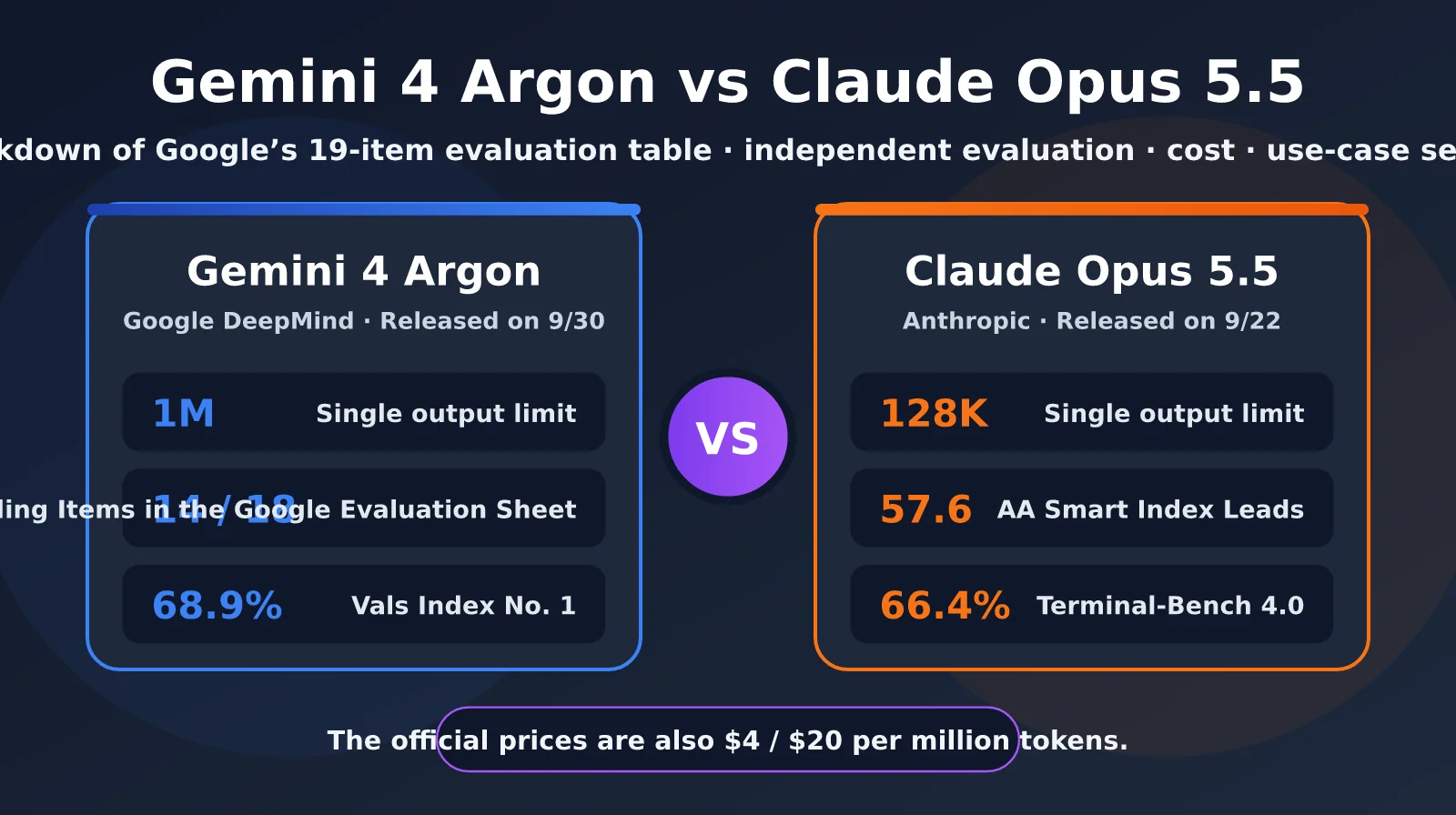
From late September to early October, leading large language models rolled out updates in quick succession: Anthropic released Claude Opus 5.5 on September 22, and just eight days later, Google launched Gemini 4 Argon. The two models have a lot in common: both target long-chain reasoning, agentic coding, and enterprise knowledge work, and both have the same official pricing: $4 per million input tokens and $20 per million output tokens. It’s no surprise that “Gemini 4 Argon vs Claude Opus 5.5” has become one of developers’ most common model-selection questions.
There isn’t much public information yet. The most comprehensive first-party data available is a comparison table of 19 benchmarks in Google’s Argon evaluation documentation, which includes Claude Opus 5.5. This article uses that table as its guide, examining each benchmark and supplementing the analysis with independent evaluations from third parties such as Artificial Analysis and Vals, along with engineering considerations like pricing, output limits, and availability. The goal is to help you decide which scenarios each model is best suited for.
What you’ll learn: By the end of this article, you’ll know which numbers in Google’s evaluation table you can trust and which ones to take with a grain of salt. You’ll also be able to choose between Gemini 4 Argon and Claude Opus 5.5 based on your own use case.
Gemini 4 Argon vs. Claude Opus 5.5: Key Specifications
Before looking at benchmark scores, let’s compare the two models’ key specifications. Their official prices are identical. The real differences come down to output limits, availability, and introductory pricing.
| Comparison | Gemini 4 Argon | Claude Opus 5.5 |
|---|---|---|
| Release date | September 30, 2026 | September 22, 2026 |
| Availability | Rolling out through the Fairwind program and Vertex AI; paid API access isn’t widely available yet | Generally available through Claude API, Bedrock, Vertex AI, and Foundry |
| Model ID | Not yet announced | claude-opus-5-5 |
| Pricing (input/output) | Introductory: $2/$10; standard: $4/$20 | $4/$20 |
| Cache reads | 95% off input pricing (from $0.10) | $0.20 |
| Batch pricing | Not announced | $2/$10 |
| Context window | Not officially announced (third parties report 1M) | 1M, with no long-context surcharge |
| Maximum output per request | 1M tokens | 128K tokens |
| Reasoning controls | Reasoning levels such as High | Five effort levels, from low to max, with adaptive thinking |
The table shows that Argon’s biggest hard advantage is its 1M-token output limit—about eight times Opus 5.5’s—making it a good fit for very long code generation and large-scale migration tasks. Opus 5.5’s biggest advantage is that you can use it reliably today: it has a clearly defined model ID, is available on all major cloud platforms, and offers half-price Batch processing and five effort levels. Its tooling and production readiness are noticeably more mature.
🎯 Recommendation: The two models have the same standard pricing, so your choice should depend mainly on the task. We recommend using the same API through the APIYI apiyi.com platform to call Claude Opus 5.5 and Gemini models, then testing them side by side on your real workloads. That’s more reliable than comparing leaderboard scores alone.
Gemini 4 Argon vs. Claude Opus 5.5: A Line-by-Line Breakdown of Google’s Benchmark Table
Below are the comparison results Google published in its Argon benchmark document. I’ve kept only the Argon and Opus 5.5 columns and grouped the results by category. Keep in mind that this is a vendor-published table: Google ran the Argon tests itself, while most Opus 5.5 results come from public leaderboards or Anthropic system cards. Google reran some benchmarks under a unified setup.
| Category | Benchmark | Gemini 4 Argon | Claude Opus 5.5 | Leader |
|---|---|---|---|---|
| Knowledge work | Vals Index | 68.9% | 67.0% | Argon +1.9 |
| Knowledge work | AutomationBench | 51.3% | 42.5% | Argon +8.8 |
| Knowledge work | Vals Finance Agent v2 | 65.4% | 58.6% | Argon +6.8 |
| Knowledge work | Harvey Legal Agent | 19.6% | 3.8% | Argon +15.8 |
| Agentic coding | DeepSWE v1.1 | 77.9% | 74.2% | Argon +3.7 |
| Agentic coding | FrontierSWE v2 | 55.0% | 62.3% | Opus +7.3 |
| Agentic coding | Vibe Code Bench | 91.9% | 90.3% | Argon +1.6 |
| Agentic coding | Terminal-Bench 4.0 | 57.4% | 66.4% | Opus +9.0 |
| ML engineering | PostTrainBench | 45.3% | 49.3% | Opus +4.0 |
| Science and math | Terminal-Bench Science 0.1 | 57.6% | 63.3% | Opus +5.7 |
| Science and math | LABBench 2 | 88.8% | 73.1% | Argon +15.7 |
| Science and math | RiemannBench | 76.0% | 69.6% | Argon +6.4 |
| Long context | GraphWalks ≤128K | 99.7% | 90.6% | Argon +9.1 |
| Long context | GraphWalks 256K–1M | 84.2% | 66.8% | Argon +17.4 |
| Computer use | Agent’s Last Exam | 39.5% | 38.2% | Argon +1.3 |
| Multimodal | Chartography | 71.6% | 66.3% | Argon +5.3 |
| Multimodal | LVBench long video | 91.7% | 83.7% | Argon +8.0 |
| Cybersecurity | CWE-bench v1 | 68.0% | 67.0% | Argon +1.0 |
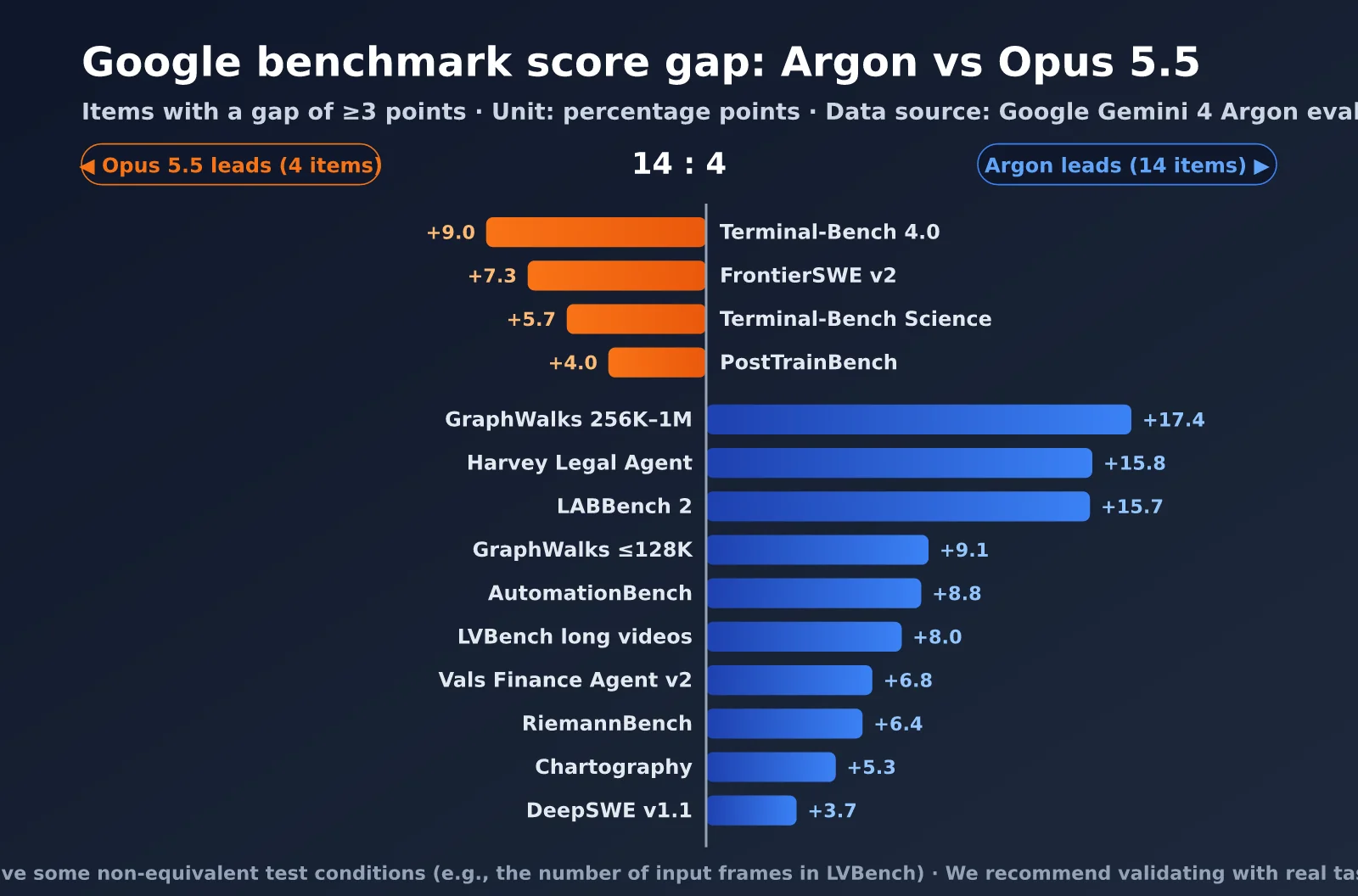
Across the 18 benchmarks where both models have results, Argon leads on 14 and Opus 5.5 leads on 4. Opus 5.5’s four wins follow a clear pattern: FrontierSWE v2, Terminal-Bench 4.0, PostTrainBench, and Terminal-Bench Science all involve extended work in a real terminal environment, with repeated command execution. Argon’s biggest leads are in long-context tasks (a 17.4-point lead on GraphWalks 256K–1M), legal agents, and life sciences (LABBench 2).
Where Google’s Benchmark Table Needs a Grain of Salt
Vendor-published benchmark tables naturally favor the vendor’s own model, and the footnotes in this one include a few details worth keeping in mind. Understanding them is key to interpreting the score differences between Gemini 4 Argon and Claude Opus 5.5:
- Different frame counts for LVBench: Argon processes the full video at one frame per second, while Opus 5.5 is limited by the API to 600 input frames. Some of the gap on long-video tasks comes from these unequal input conditions.
- Longer timeout for Terminal-Bench Science: Argon’s verification timeout was set to six times the default. Even so, Argon still trails Opus 5.5 by 5.7 points.
- Different DeepSWE test frameworks: Argon was evaluated using the mini-swe agent framework, while Claude’s score comes from the Anthropic system card. The two models weren’t tested with the same framework.
- Differences from Anthropic’s own reported results: Anthropic’s published Opus 5.5 results show 40.0% on AutomationBench, 89.0% on Chartography with tools, and 81.8% on OSWorld 2.0. Google’s table lists just 66.3% for Chartography and leaves OSWorld blank.
In other words, the gap between the two models is smaller when test conditions are aligned. Argon’s leads in long-context tasks, legal work, and life sciences are large enough to be fairly convincing. On benchmarks where the gap is just 1–2 points—such as Vals Index, Vibe Code, and CWE-bench—the results are best treated as a tie.
Gemini 4 Argon vs. Claude Opus 5.5: Independent Evaluation Results
The conclusions from third-party independent evaluations don’t align with Google’s benchmark results—in fact, they point in opposite directions on the overall intelligence index. The table below summarizes public data from Artificial Analysis (AA) and Vals.
| Independent Evaluation | Gemini 4 Argon | Claude Opus 5.5 | Leader |
|---|---|---|---|
| AA Intelligence Index v4.3 | 52.6 | 57.6 | Opus +5.0 |
| Vals Index ranking | 68.90% (No. 1) | 66.97% (No. 3) | Argon +1.9 |
| AA Terminal-Bench 4.0 | 57.1% | 59.6% | Opus +2.5 |
| AA Humanity’s Last Exam | 57.1% | 61.4% | Opus +4.3 |
| AA SciCode | 61.8% | 66.9% | Opus +5.1 |
| AA Long-Context Reasoning | 79.7% | 84.7% | Opus +5.0 |
| AA GDPval (Elo) | 1611 | 1846 | Opus +235 |
| AA AutomationBench | 77.5% | 69.5% | Argon +8.0 |
| AA Output Speed | 48.9 tokens/s | 92.2 tokens/s | Opus is about 1.9x faster |
In AA’s tests, Opus 5.5 leads across reasoning, scientific programming, long-context reasoning, and GDPval professional tasks. Argon’s clear win is on AutomationBench for business automation. However, the comparison isn’t entirely fair: Argon was tested only at the High tier, while Opus 5.5 used the Max tier with adaptive reasoning. Some of the gap may come from differences in reasoning settings rather than capability alone.
Vals Index ranks Argon first among 41 models and Opus 5.5 third. But the gap between them is about 1.5 standard errors, suggesting Argon has a slight edge, though the advantage isn’t conclusive. Overall, Gemini 4 Argon and Claude Opus 5.5 are in the same tier of overall capability—neither one dominates the other.
💡 Evaluation tip: Different evaluation providers can reach opposite conclusions, so it’s best to test with your own data. The APIYI apiyi.com platform lets you switch between Claude, Gemini, GPT, and other model families through a unified interface, making it easy to build a small evaluation set of your own.
Gemini 4 Argon vs. Claude Opus 5.5: Key Differences
Set the scores aside, and the difference in design philosophy between these two models may offer more useful guidance for choosing between them than any individual benchmark gap.
Two Approaches to Long-Running Tasks
Gemini 4 Argon’s approach is to make each response much larger. Its 1M output limit lets it generate hundreds of thousands of lines of code or an exceptionally long report in a single request. Google has used it internally for tasks including migrating more than 800,000 lines of C/C++ code in the Fuchsia Zircon kernel to Rust, and replacing 32,000 lines of SIMD code in libgav1. This design reduces the need to split up tasks and stitch together context, making it especially suitable for scenarios that require “producing a large amount of content all at once.”
Claude Opus 5.5’s approach is to make the reasoning process more controllable. Rather than aiming for enormous outputs, it offers five effort levels, from low to max, along with adaptive thinking that’s always on. This lets developers adjust reasoning depth and cost to match task difficulty. Paired with agent frameworks like Claude Code, Opus 5.5 is better at repeatedly executing, observing, and correcting its work across multiple rounds of tool calls. This also helps explain its clear lead on interactive terminal tasks like Terminal-Bench.
Speed, Latency, and Reliability
Artificial Analysis’s tests show that Opus 5.5 generates around 92 tokens/s, nearly twice Argon’s 48.9 tokens/s. For coding assistants and customer service agents that need to respond in real time, this difference directly affects the user experience. Argon’s strength is that it can accomplish more in a single request, making it a good fit for background jobs where responsiveness isn’t critical but individual tasks are very large.
Opus 5.5 has also been running reliably on multiple cloud platforms for several weeks, with well-documented quotas, rate limits, and error handling. Argon is still in the early stages of its rollout, and its quota and rate-limit policies remain unclear. For production systems with demanding SLA requirements, this should carry at least as much weight as benchmark scores.
Safety and Prompt Injection Protection
Both companies prioritize agent safety. Google says Argon is its most resilient model to date against indirect prompt injection and leads on the Gray Swan IPI benchmark, but it hasn’t published specific scores. Analysis from third-party security vendors, meanwhile, shows Opus 5.5 tied with Claude Fable 5.1 for the lowest injection success rate on the same benchmark. In other words, both models are in the top tier for prompt injection protection, and each can claim a lead. For agents that need to read external webpages, emails, or documents, whichever model you choose, you’ll still need to enforce tool permissions and require human confirmation outside the model itself.
Gemini 4 Argon vs. Claude Opus 5.5 Cost Comparison
The two models have the same list price, but they use different numbers of tokens for the same task, resulting in a significant difference in actual costs. The table below shows the per-task costs measured by a third-party organization.
| Cost metric | Gemini 4 Argon | Claude Opus 5.5 | Difference |
|---|---|---|---|
| Average cost per AA task | $1.99 (introductory price) | $5.98 | Argon costs about one-third as much |
| Total cost to run the full AA benchmark | $2,407 | $8,708 | Argon costs about 28% as much |
| Cost per Vals test | $15.68 | $32.14 | Argon costs about 49% as much |
| AA cost per task at list price | About $3.98 | $5.98 | Argon is still about one-third cheaper |
| Batch processing | Not announced | Half price: $2/$10 | Opus has a confirmed batch discount |
Even at the list price of $4/$20, Argon’s per-task cost on the AA benchmark is still about one-third lower than Opus 5.5’s. One reason is that Opus 5.5 uses a longer reasoning process at the Max effort level. Lowering Opus 5.5’s effort to medium or high can significantly reduce costs—that’s one practical benefit of its five-level effort control. For offline batch processing, Opus 5.5’s confirmed 50% Batch discount is also more predictable than Argon’s batch pricing, which hasn’t been announced yet.
Gemini 4 Argon vs. Claude Opus 5.5: Use Cases and Recommendations
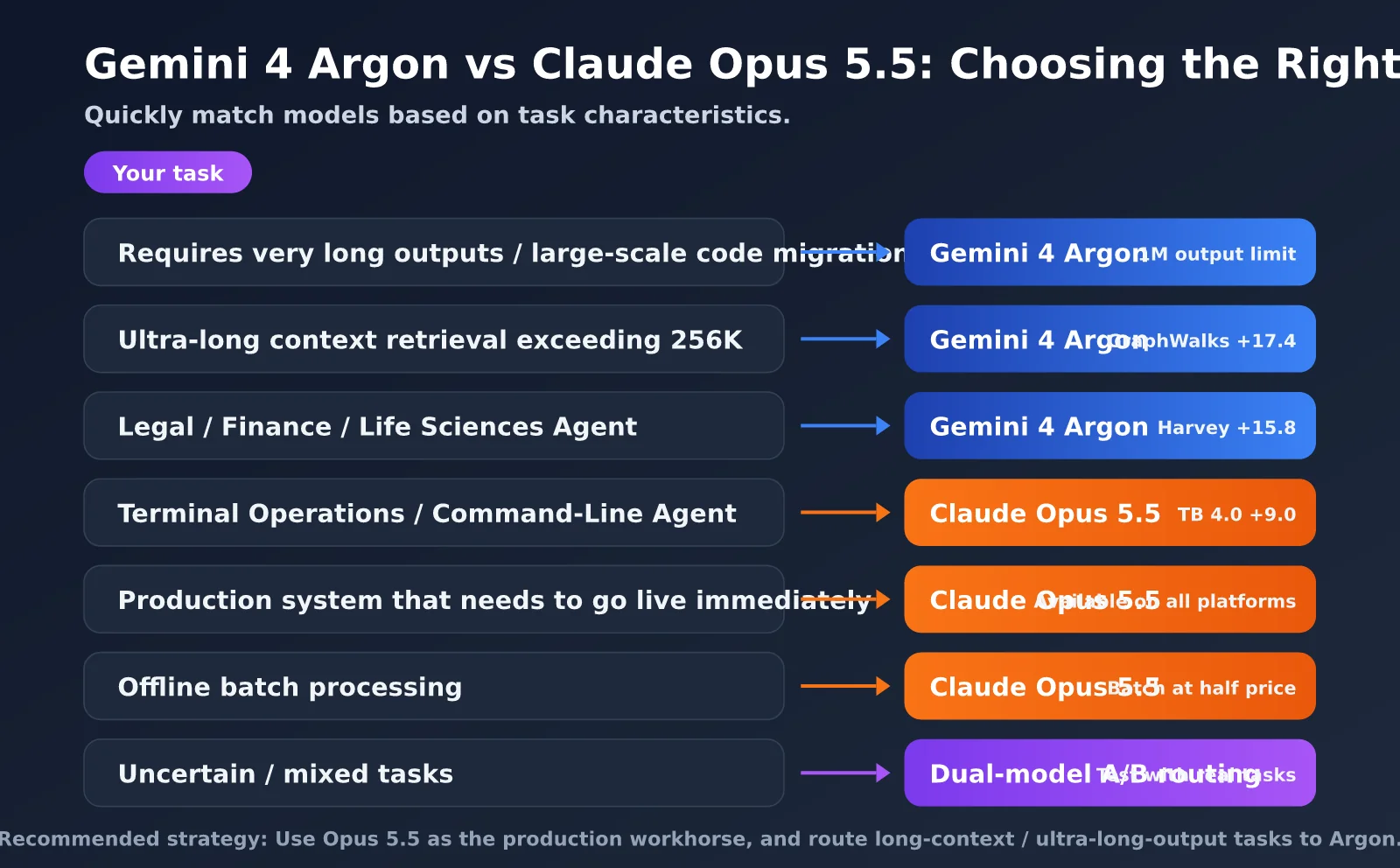
Based on Google’s benchmark results, independent evaluations, cost, and availability, here are some clear recommendations for different types of tasks:
| Use case | Recommended model | Key reason |
|---|---|---|
| Large-scale code migrations / extremely long code generation | Gemini 4 Argon | 1M output limit; leads DeepSWE by 3.7 points |
| Retrieval from contexts longer than 256K | Gemini 4 Argon | Leads GraphWalks by 17.4 points at 256K–1M |
| Legal and financial agents | Gemini 4 Argon | Leads Harvey by 15.8 points and Finance Agent by 6.8 points |
| Long-form video and chart understanding | Gemini 4 Argon | Leads on both LVBench and Chartography |
| Terminal operations and command-line agents | Claude Opus 5.5 | Leads Terminal-Bench 4.0 by 9 points |
| Scientific programming and complex reasoning | Claude Opus 5.5 | Leads on SciCode, HLE, and CritPt in AA |
| Production systems that need to launch immediately | Claude Opus 5.5 | Available across platforms, with a clearly defined model ID and quotas |
| Offline batch processing | Claude Opus 5.5 | Confirmed 50% Batch discount at $2/$10 |
Gemini 4 Argon vs. Claude Opus 5.5: Dual-Model Routing in Practice
For most teams, the most practical strategy isn’t to pick just one model. Instead, use both: start with Opus 5.5 as your primary production model, then gradually route tasks that play to Argon’s strengths—such as long-context processing and very long outputs—to Argon. Here’s a minimal example using an OpenAI-compatible API.
import os
from openai import OpenAI

client = OpenAI(
    api_key=os.getenv("APIYI_API_KEY"),
    base_url="https://api.apiyi.com/v1"  # Unified API from APIYI
)

OPUS = "claude-opus-5-5"
ARGON = os.getenv("ARGON_MODEL", "gemini-4-argon")  # Use the model ID currently available on the platform

def pick_model(prompt_tokens: int, need_long_output: bool) -> str:
    # Route long-context or long-output tasks to Argon; use Opus 5.5 for everything else by default
    return ARGON if prompt_tokens > 256_000 or need_long_output else OPUS

model = pick_model(prompt_tokens=12_000, need_long_output=False)
resp = client.chat.completions.create(
    model=model,
    messages=[{"role": "user", "content": "Diagnose the cause of this CI pipeline failure"}],
)
print(model, resp.choices[0].message.content)
View the full code: A/B test both models on the same task
import os
import time
from openai import OpenAI

client = OpenAI(
    api_key=os.getenv("APIYI_API_KEY"),
    base_url="https://api.apiyi.com/v1"
)

MODELS = {
    "claude-opus-5-5": (4.0, 20.0),
    os.getenv("ARGON_MODEL", "gemini-4-argon"): (
        float(os.getenv("ARGON_PRICE_IN", "2")),
        float(os.getenv("ARGON_PRICE_OUT", "10")),
    ),
}

TASKS = [
    "Review the following contract terms, list five risks that are unfavorable to Party B, and suggest revisions:...",
    "Migrate this Python 2 code to Python 3.12 and add type annotations:...",
    "Find the root cause of the service timeout based on the following logs:...",
]


def run(model: str, task: str) -> dict:
    start = time.time()
    resp = client.chat.completions.create(
        model=model,
        max_tokens=16000,
        messages=[{"role": "user", "content": task}],
    )
    u = resp.usage
    price_in, price_out = MODELS[model]
    cost = (u.prompt_tokens * price_in + u.completion_tokens * price_out) / 1_000_000
    return {
        "model": model,
        "latency": round(time.time() - start, 1),
        "out_tokens": u.completion_tokens,
        "cost": round(cost, 4),
        "answer": resp.choices[0].message.content,
    }


if __name__ == "__main__":
    for task in TASKS:
        print("=" * 60, "\nTask:", task[:30])
        for model in MODELS:
            r = run(model, task)
            print(f"[{r['model']}] {r['latency']}s, {r['out_tokens']} output tokens, ${r['cost']}")
This A/B script records each model’s latency, output token count, and cost for the same task. We recommend preparing 30–50 real tasks that represent your business needs, then scoring the results manually or with a scoring model before deciding how to split traffic between the two models.
🚀 Get started quickly: You can register at APIYI apiyi.com to get testing credits, then use Claude Opus 5.5 to run the A/B script above. Once Argon is officially available on the platform, just update the model name in your environment variables to run the comparison.
Frequently Asked Questions
Q1: Which model is more capable, Gemini 4 Argon or Claude Opus 5.5?
There’s no definitive answer. In Google’s benchmark table, Argon leads in 14 tests, while Opus 5.5 leads in 4. However, Opus 5.5 scores 57.6 to Argon’s 52.6 on Artificial Analysis’s Intelligence Index. The two models are in the same tier: Argon excels at long context, very long outputs, and agents for specialized domains, while Opus 5.5 stands out for terminal operations, complex reasoning, and engineering maturity.
Q2: How reliable is Google’s benchmark table?
It’s useful as a reference, but take the results with a grain of salt. The table was published by Google, and some benchmarks use uneven test conditions—for example, the number of input frames in LVBench and the timeout settings in Terminal-Bench Science. Some Opus 5.5 scores are also lower than Anthropic’s self-reported results. We recommend focusing on tests where the lead is more than 5 points; differences of 1–2 points can be considered a tie.
Q3: Can I use both models right now?
Claude Opus 5.5 is now fully available through the Claude API, Bedrock, Vertex AI, and Foundry. Gemini 4 Argon is still being rolled out in stages. It’s available to access through Vertex AI, but its paid API isn’t yet widely available. We recommend connecting to Opus 5.5 and the Gemini model family through APIYI at apiyi.com first. Once Argon officially launches, you can switch models by changing the model parameter and compare results.
Q4: The two models cost the same. Which one is cheaper in practice?
According to third-party tests, Argon’s cost per task is about one-third to one-half that of Opus 5.5, giving it a more noticeable advantage during its introductory period. But Opus 5.5 costs can be reduced substantially by lowering the effort level and using Batch at half price. The most accurate approach is to track usage on real tasks and calculate the cost. APIYI at apiyi.com provides unified billing, making it easy to compare the actual costs of both models.
Summary
Gemini 4 Argon vs. Claude Opus 5.5 is a closely matched contest. Google’s benchmark table shows Argon with clear advantages in long context, legal and financial agents, life sciences, and multimodal tasks. Its 1M output limit is also in a class of its own. Independent evaluations, on the other hand, give Opus 5.5 the edge in reasoning, scientific coding, and terminal operations. It’s also available across platforms and more mature from an engineering perspective.
For now, we recommend using Claude Opus 5.5 as your primary model in production, while gradually introducing Gemini 4 Argon for long-context and very long-output tasks. Keep running A/B tests on your own real-world task sets. Once Argon’s paid API is widely available and more independent evaluations are published, you can adjust the routing mix based on the results.
We recommend connecting to Claude and Gemini models through APIYI at apiyi.com, so you can compare and route requests across multiple models using a single interface and bill. This lets you make model selection decisions based on real-world data.
References:
- Google’s official Gemini 4 Argon announcement: blog.google/innovation-and-ai/models-and-research/gemini-models/gemini-4-argon
- Anthropic’s Claude Opus 5.5 announcement: anthropic.com/news
- Artificial Analysis Intelligence Index and model comparisons: artificialanalysis.ai
- Vals AI model benchmark leaderboard: vals.ai
- Compilation of the full Gemini 4 Argon benchmark table (ToolScout): toolscout.ai/news/gemini-4-argon-benchmarks
Author: APIYI Team | We track the latest Large Language Model evaluations and selection strategies. For more updates on model integrations, visit APIYI at apiyi.com.