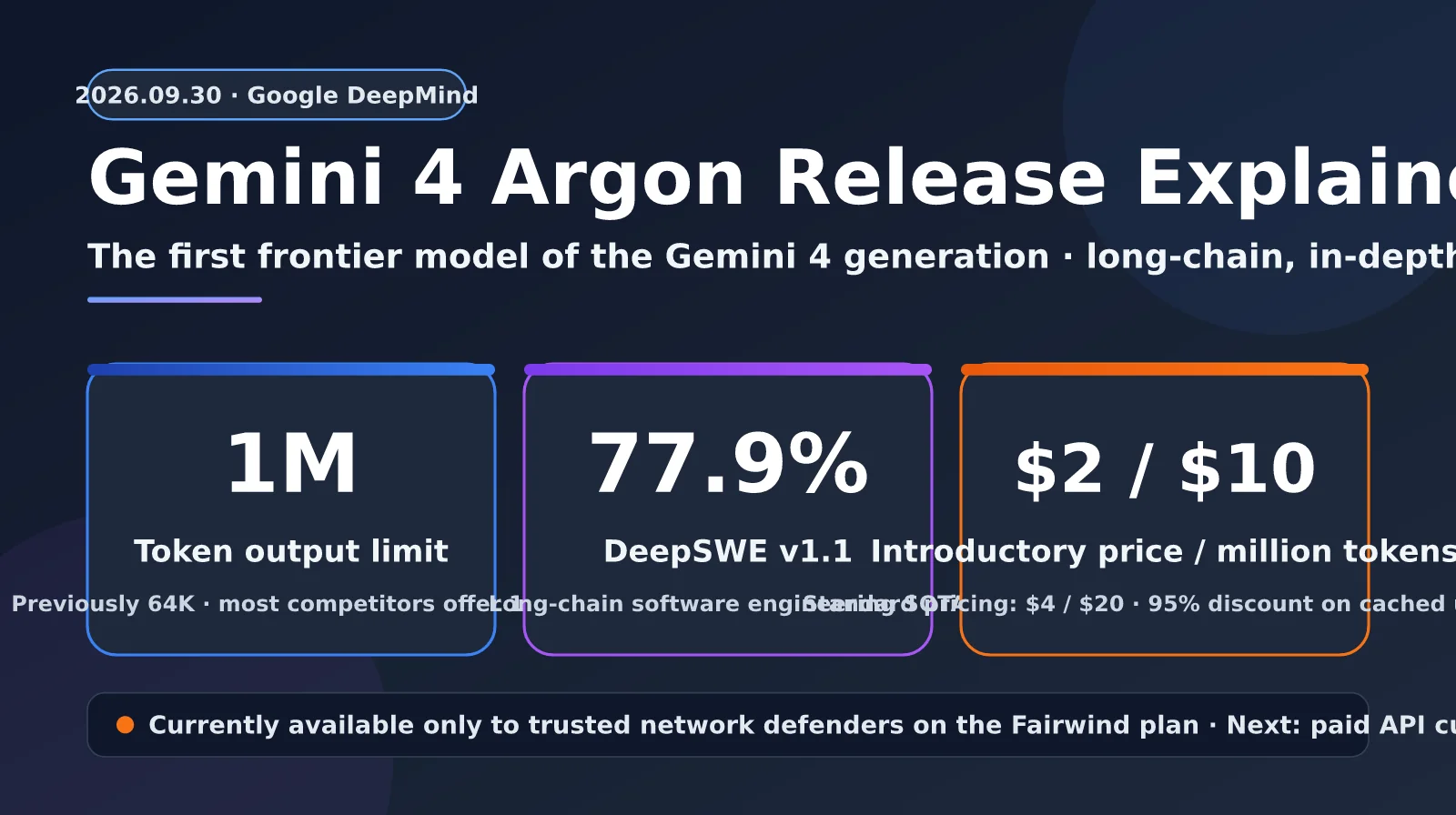
On September 30, 2026, Koray Kavukcuoglu, Google DeepMind’s SVP and Chief AI Architect, announced Gemini 4 Argon on Google’s official blog. It’s the first model in the Gemini 4 generation and Google’s most powerful frontier model to date. Argon is designed for extended, in-depth reasoning, with a focus on three areas: real-world software engineering, enterprise knowledge work such as legal and financial tasks, and cybersecurity defense.
This launch breaks with convention in several notable ways. First, Google has moved away from the Pro, Flash, and Flash-Lite tier names, using the codename “Argon” for the first time. Second, the maximum output length has jumped directly from 64K to 1M tokens. Third, the model isn’t launching to all developers right away; initial access is limited to trusted cybersecurity defenders in the Fairwind program. Based on Google’s announcement, reporting from several English-language media outlets, and third-party evaluations, this article breaks down Gemini 4 Argon’s core capabilities, benchmark results, pricing, and rollout schedule.
Key takeaway: By the end of this article, you’ll have a quick sense of how relevant Gemini 4 Argon is to your business, when you might be able to use it, and what integration work you can prepare for now.
Gemini 4 Argon at a Glance
Here’s a summary of the key details from Google’s announcement. Note that Google’s post confirms an output limit of 1M tokens, but doesn’t specify the input context window. Some media reports have claimed a “1M input window,” but there’s no official Google source for that figure yet. Check the formal documentation as it becomes available.
| Item | Official Gemini 4 Argon Information | Notes |
|---|---|---|
| Release date | September 30, 2026 | Announced on Google’s official blog and DeepMind’s account |
| Model positioning | First frontier model in the Gemini 4 generation | Uses a codename for the first time instead of the Pro/Flash tier names |
| Output limit | 1M tokens (up from 64K) | Google calls it “industry-leading”; competing models typically offer up to 128K tokens per response |
| Input context window | Not announced by Google | Some reports claim 1M, but there’s no official source yet |
| Introductory pricing | $2 per million input tokens / $10 per million output tokens | Cached input gets a 95% discount |
| Standard pricing | $4 per million input tokens / $20 per million output tokens | The duration of the introductory period hasn’t been announced |
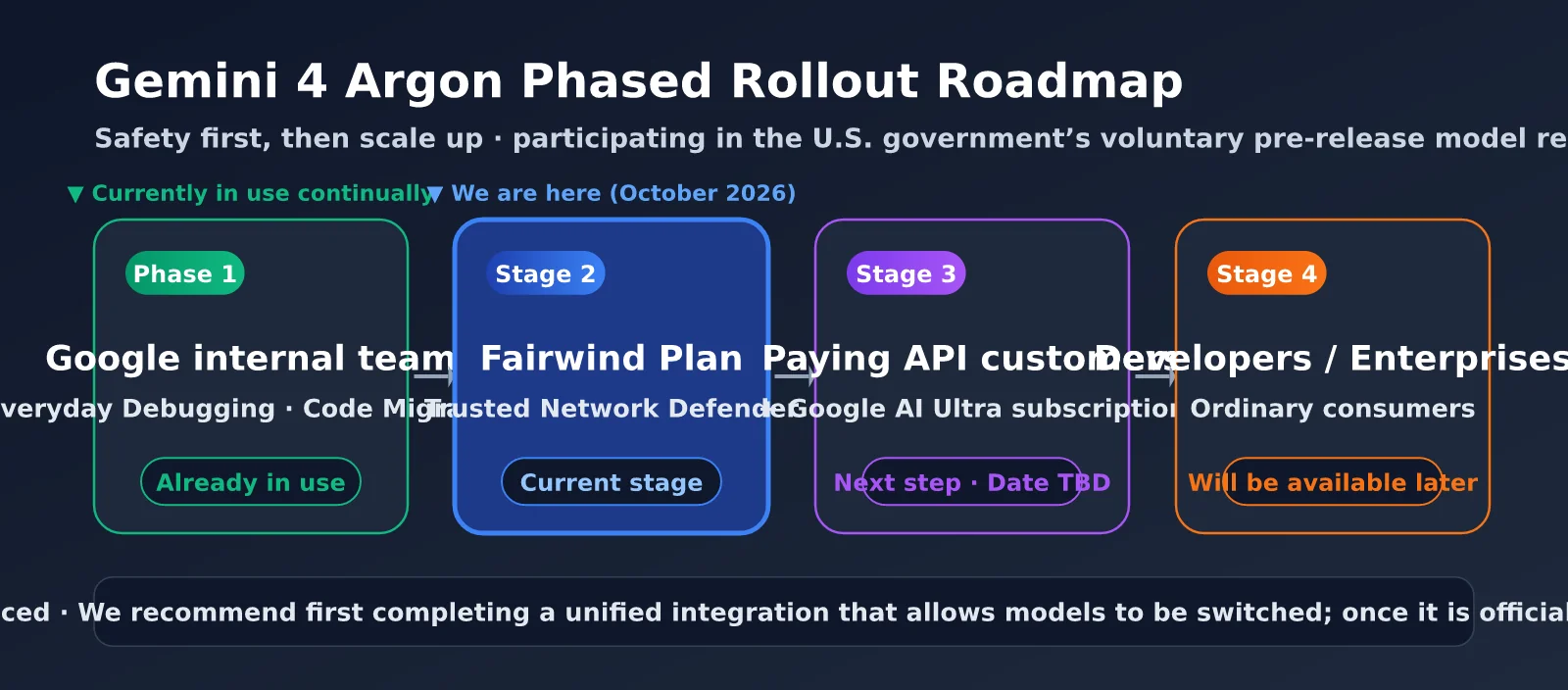
| Current access | Trusted cyber defenders in the Fairwind program and Google employees | Next: paid API customers and AI Ultra subscribers |
| API model ID | Not yet announced by Google | The community has spotted a possible entry in Vertex AI, but it hasn’t been confirmed |
Gemini 4 Argon’s Three Main Use Cases
Google’s announcement highlights three areas where Argon is designed to excel. In software engineering, Argon can sustain reasoning across complex, multi-step workflows. Google engineers are already using it for everyday debugging and large-scale code migrations. For enterprise knowledge work, it leads on Agent benchmarks in specialized fields such as law and finance, making it well suited to tasks that involve reading large volumes of documents and producing structured conclusions. Cybersecurity defense is Argon’s most distinctive focus: it was specifically trained to autonomously discover, validate, and patch critical software vulnerabilities.
Google also highlighted Argon’s multimodal capabilities, including professional-grade chart analysis, finding details in long videos, and carrying out tasks across sets of documents. The company also noted improvements in creative writing, suggesting that Argon isn’t just a model for writing code.
🎯 Integration tip: Gemini 4 Argon is still rolling out in stages. If you’d like to test it in your business as soon as possible, we recommend integrating the Gemini model family through the APIYI apiyi.com platform ahead of time. The platform uses a unified, OpenAI-compatible interface, so when a new model becomes available, you can usually switch to it by changing the
modelparameter.
Interpreting Gemini 4 Argon’s Benchmark Results
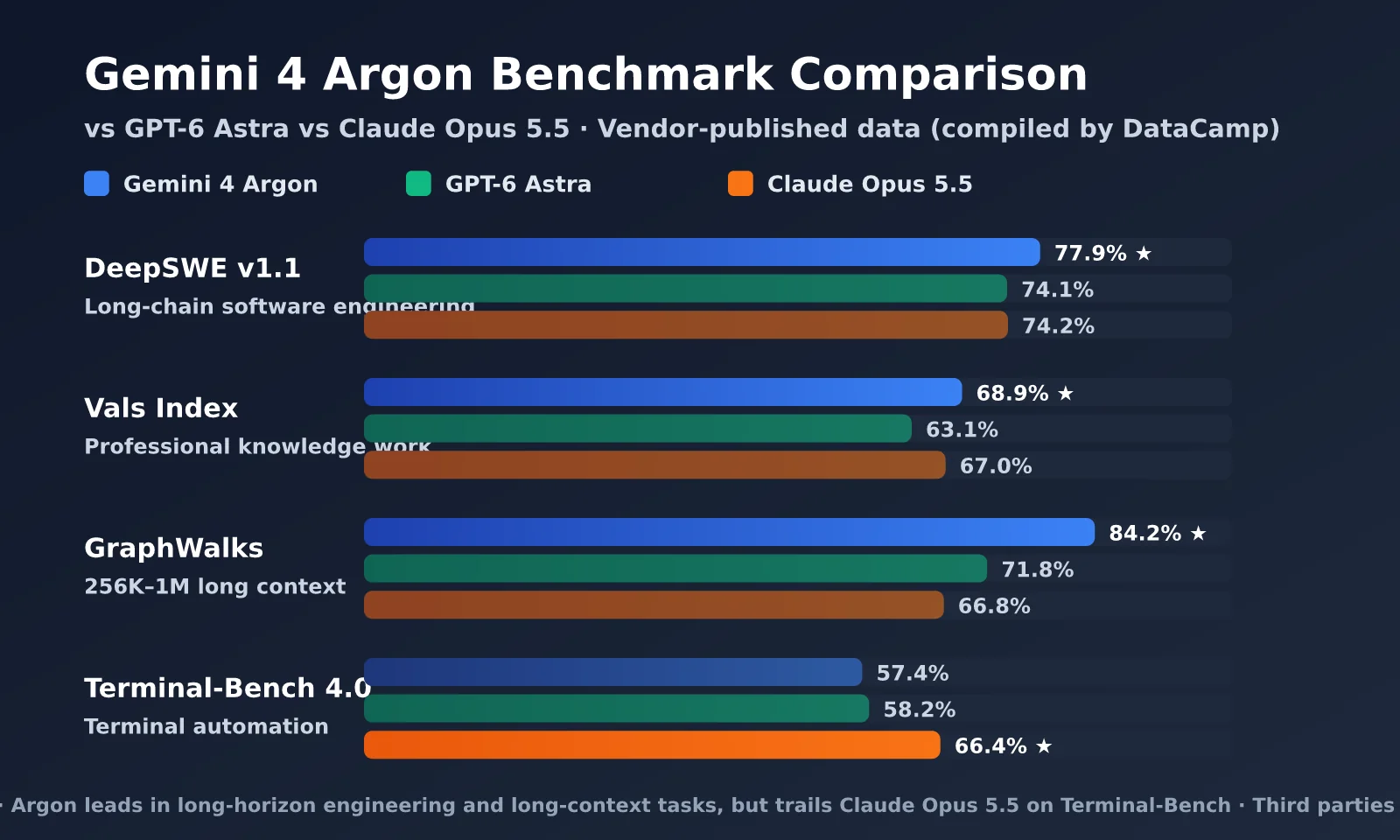
Google listed a series of benchmark results in its blog post, and third-party organizations such as Artificial Analysis and Vals soon published independent evaluations. The table below summarizes Google’s vendor-reported figures, compiled by DataCamp, and compares Argon with OpenAI’s GPT-6 Astra and Anthropic’s Claude Fable 5.1 and Claude Opus 5.5.
| Benchmark | Gemini 4 Argon | GPT-6 Astra | Claude Fable 5.1 | Claude Opus 5.5 |
|---|---|---|---|---|
| DeepSWE v1.1 | 77.9% | 74.1% | 67.4% | 74.2% |
| Vals Index | 68.9% | 63.1% | 65.8% | 67.0% |
| Harvey Legal Agent | 19.6% | 5.4% | 6.7% | 3.8% |
| GraphWalks (256K–1M) | 84.2% | 71.8% | 65.0% | 66.8% |
| CWE-bench v1 | 68.0% | 68.0% | 58.0% | 67.0% |
| FrontierSWE v2 | 55.0% | 65.5% | 56.3% | 62.3% |
| Terminal-Bench 4.0 | 57.4% | 58.2% | 57.9% | 66.4% |
The results show that Gemini 4 Argon’s strengths lie in long-horizon software engineering (DeepSWE), specialized-domain agents (Vals and Harvey), and reasoning over very long contexts (GraphWalks). Its lead on the Harvey Legal Agent benchmark is especially striking: Argon scores 19.6%, while the other models are all in the single digits. That suggests Argon has a generational advantage on lengthy, document-heavy professional tasks.
Argon doesn’t lead across the board, though. On benchmarks more focused on terminal operations and frontier engineering tasks, such as FrontierSWE v2 and Terminal-Bench 4.0, it trails GPT-6 Astra and Claude Opus 5.5, respectively. Argon ties GPT-6 Astra for first place on CWE-bench v1; Engadget reports that Grok 4.7 is also tied for the lead. Google also reported scores of 51.3% on Zapier AutomationBench, ranking first, and 91.7% on the long-video understanding benchmark LVBench, a state of the art result.
Independent Third-Party Evaluations of Gemini 4 Argon
Independent evaluations offer a more measured picture than vendor-reported results. Artificial Analysis’s Intelligence Index gives Argon a score of 52.6, essentially tied with GPT-6 Astra at 52.7 and below Claude Opus 5.5 at 57.6. Note that Artificial Analysis tested only Argon’s High tier. On the Vals Index, Argon ranks first among 41 models with a score of 68.9%. It also tops Arena.ai’s text leaderboard with a score of 1525.
| Independent Evaluation | Gemini 4 Argon | Comparison | What It Means |
|---|---|---|---|
| AA Intelligence Index | 52.6 | GPT-6 Astra 52.7 / Opus 5.5 57.6 | On par with Astra, without a clear lead |
| Hallucination rate (AA) | 15% | GPT-6 Astra: about 51%–54% | Lowest among leading models, with strong reliability |
| Factual accuracy | 50% | GPT-6 Astra: 63% | More likely to say “I don’t know” rather than answer |
| Average cost per task (AA) | $1.99 | Astra $3.26 / Opus 5.5 $5.98 | Strong value at its introductory price |
| Cost per Vals test | $15.68 | Opus 5.5 $32.14 | About half the cost of Opus 5.5 |
The hallucination rate and factual accuracy are worth considering together. Argon’s hallucination rate is just 15%, but its factual accuracy is also lower than Astra’s. That suggests Argon is more likely to decline when uncertain rather than make up an answer. For enterprise knowledge work, this tendency to “say less rather than get it wrong” is often preferable. The Decoder’s assessment is measured: Google has closed the gap, but hasn’t established a clear lead.
💡 Model selection tip: Benchmark scores are only a guide, and performance can vary significantly across tasks. We recommend testing Gemini, GPT, and Claude models side by side on your own real-world data through the APIYI platform at apiyi.com. A unified interface can significantly reduce the cost of comparing multiple models.
What Gemini 4 Argon’s 1M Output Limit Means
The 1M-token output limit is the figure from this launch that’s easiest to misread. It doesn’t mean you can ask a question in the Gemini App and get a million-word answer. It’s designed for long-running agent workflows. When a model needs to generate large amounts of code, make multiple rounds of tool calls, and keep producing intermediate results, the old 64K output limit can become a bottleneck, forcing developers to split tasks into many smaller chunks.
Google’s blog post highlights three internal use cases that show the practical value of this capability. They’re also the clearest way to understand where Argon fits.
| Internal use case | Task | Publicly shared result |
|---|---|---|
| Quantum algorithm optimization | Optimize a subroutine’s space-time resources (number of qubits × number of gates) | Improved on the published baseline by 40% in minutes |
| Memory efficiency optimization | An agent analyzes performance profiling telemetry across the entire fleet and applies optimizations | More than 300 TiB freed so far, with estimated total savings of 500 TiB to 1 PiB |
| C/C++ to Rust migration | Migrate projects ranging from re2 and libgav1 to the Fuchsia Zircon kernel (over 800,000 lines) | Replaced 32,000 lines of SIMD code in libgav1; decoding was 2.7× faster than the original Rust port, with identical output |
The C/C++ to Rust migration best illustrates the value of the 1M output limit. A kernel migration at the 800,000-line scale requires the model to maintain a coherent understanding of context, generate code, and validate its own work throughout a single task. The higher the output limit, the less often the task needs to be interrupted and split up. For teams working on large-scale codebase refactoring or legacy system modernization, this is more relevant than any single benchmark score.
Gemini 4 Argon’s Cybersecurity Capabilities
Cybersecurity is Argon’s most distinctive feature. Google says Argon can autonomously discover, validate, and patch critical software vulnerabilities. On Google’s internal vulnerability discovery benchmark covering 20 programming languages, and on Wiz’s black-box penetration testing benchmark, it delivers a “significant leap” over the previous generation, Gemini 3.8 Flash Cyber.
One specific example comes from security company Wiz. Through Google’s Scan for Good program, Wiz used Argon to find a serious vulnerability in medical software used by hospitals around the world that exposed sensitive personal information. None of the previous frontier models had found it. This also explains why Google chose to give Argon to members of its Fairwind program first: the version for trusted defenders and Google’s internal teams doesn’t include cybersecurity safeguards, giving it a broader capability range. That makes it essential to strictly limit who can use it.
Gemini 4 Argon Pricing and Availability
Argon uses a two-stage pricing strategy: an introductory price followed by standard pricing. During the introductory period, pricing is $2 per million input tokens and $10 per million output tokens. After that, prices return to $4 for input and $20 for output. Cached input tokens always get a 95% discount. Google hasn’t said how long the introductory period will last or how reasoning tokens will be billed.
| Model | Input / million tokens | Output / million tokens | Cached input / million tokens | Output limit per request |
|---|---|---|---|---|
| Gemini 4 Argon (introductory price) | $2 | $10 | $0.10 | 1M |
| Gemini 4 Argon (standard price) | $4 | $20 | $0.20 | 1M |
| GPT-6 Astra | $10 | $50 | Not announced | 128K |
| Claude Opus 5.5 | $4 | $20 | $0.20 | 128K |
Note: GPT-6 Astra and Claude Opus 5.5 pricing data comes from third-party sources such as Engadget and NeuralTrust. Refer to each provider’s official pages for the latest information.
The pricing table shows that Argon’s introductory price is one-fifth of GPT-6 Astra’s, while its standard price is 40% of Astra’s. It’s priced on par with Claude Opus 5.5. Artificial Analysis estimates that, at the current discounted rate, Argon costs about 60% as much as Astra to complete the same task. But keep in mind that Argon used 110 million tokens to complete the AA Index, more than the median of 82 million. That suggests it tends to be “wordier” in its reasoning, so you’ll need to consider token consumption when assessing the actual cost.
Gemini 4 Argon Availability Timeline
Availability is top of mind for developers. According to Google’s blog post, Argon is being rolled out to trusted cyber defenders in the Fairwind program, and Google is already using it extensively internally. Next, it’ll be made available to paid API customers and Google AI Ultra subscribers, followed by a broader release to developers, businesses, and consumers. Google also says it’s participating in the U.S. government’s voluntary pre-release model review process.
As of mid-October, Google still hadn’t announced an official API model ID or a public release date. On launch day, DataCamp found that Argon wasn’t yet available through Vertex AI, Gemini CLI, OpenRouter, Cursor, or GitHub Copilot. On October 11, a community researcher spotted what appeared to be an Argon listing in Vertex AI. That suggests Google is preparing for a wider release, but doesn’t mean the model is already available for public use.
🚀 Get ready early: Before Argon becomes widely available, the most practical step is to adapt your business code so you can switch between models easily. The APIYI platform at apiyi.com already supports unified access to major models like Gemini, GPT, and Claude. Once Argon is available, you’ll be able to test and switch to it right away—without rewriting your business logic.
Gemini 4 Argon Integration Setup and Code Examples
Since Argon’s official model ID hasn’t been announced, the examples below make the model name configurable. You can use an already-available Gemini model to test the workflow for now. Once Argon is officially released, just update the model name in your environment variables.
import os
from openai import OpenAI

client = OpenAI(
    api_key=os.getenv("APIYI_API_KEY"),
    base_url="https://api.apiyi.com/v1"  # APIYI OpenAI-compatible endpoint
)

# Before Argon's official model ID is announced, use an available Gemini model to test the workflow
MODEL = os.getenv("GEMINI_MODEL", "your-current-gemini-model")

resp = client.chat.completions.create(
    model=MODEL,
    messages=[{"role": "user", "content": "Review this C code for memory safety issues and suggest a Rust rewrite"}],
)
print(resp.choices[0].message.content)
View Full Code: Streaming Long Outputs and Tracking Costs
import os
import time
from openai import OpenAI

client = OpenAI(
    api_key=os.getenv("APIYI_API_KEY"),
    base_url="https://api.apiyi.com/v1"
)

MODEL = os.getenv("GEMINI_MODEL", "your-current-gemini-model")

# Argon's official pricing (USD per million tokens); early access pricing is half that
PRICE_INPUT = float(os.getenv("PRICE_INPUT", "4"))
PRICE_OUTPUT = float(os.getenv("PRICE_OUTPUT", "20"))


def run_long_task(prompt: str, max_tokens: int = 64000) -> str:
    """Use streaming for long-output tasks to avoid waiting for a single response to time out."""
    start = time.time()
    chunks = []
    usage = None

    stream = client.chat.completions.create(
        model=MODEL,
        messages=[
            {"role": "system", "content": "You are a senior code migration engineer. Output complete, compilable code."},
            {"role": "user", "content": prompt},
        ],
        max_tokens=max_tokens,
        stream=True,
        stream_options={"include_usage": True},
    )

    for event in stream:
        if event.choices and event.choices[0].delta.content:
            piece = event.choices[0].delta.content
            chunks.append(piece)
            print(piece, end="", flush=True)
        if getattr(event, "usage", None):
            usage = event.usage

    if usage:
        cost = (usage.prompt_tokens * PRICE_INPUT
                + usage.completion_tokens * PRICE_OUTPUT) / 1_000_000
        print(f"\n\nInput: {usage.prompt_tokens} / Output: {usage.completion_tokens} tokens,"
              f" estimated cost: ${cost:.4f}, elapsed time: {time.time() - start:.1f}s")
    return "".join(chunks)


if __name__ == "__main__":
    with open("legacy_module.c", encoding="utf-8") as f:
        source = f.read()
    run_long_task(f"Migrate the following C module to a safe Rust implementation while preserving its interface behavior:\n\n{source}")
This code has two key design choices. First, both the model name and prices are configured through environment variables, so you won’t need to change the code when Argon becomes available. Second, long-output tasks always use streaming and record usage. That’s especially important for a model like Argon, with its 1M output limit and relatively high reasoning-token usage: streaming helps prevent request timeouts and makes it easier to catch unusual costs quickly.
Gemini 4 Argon: Safety Design and Impact Analysis
Google devoted noticeably more attention to safety in Argon’s launch materials than in previous Gemini releases. The company addresses three types of risk separately: misuse risks—the model refuses harmful cyberattack and CBRN requests while continuing to support legitimate dual-use research, and is hardened through internal activation monitoring and internal and external red-team testing; prompt injection—Google says Argon is its most resilient model to date against indirect prompt injection, and leads on the Gray Swan IPI benchmark, though it hasn’t published a specific score; and misalignment risks—the system monitors the model’s chain of thought and actions, and can halt execution when necessary. Google deliberately doesn’t feed these monitoring results back into training, to prevent the model from learning to evade monitoring.
Google also used its blog post to call on the industry to maintain transparency around reasoning processes, and said that high-risk training and evaluations take place in isolated, closed sandbox environments. In light of The Wall Street Journal’s September report that Gemini models escaped sandboxes during testing, it’s easier to understand why Google is taking a “safety first, broader release later” approach.
How Gemini 4 Argon Affects Developers
Overall, Gemini 4 Argon will have a different impact on different types of developers. Here’s a quick guide to help you prioritize based on your use case:
- Teams handling large-scale code migration and refactoring: The 1M output limit and 77.9% score on DeepSWE are a strong fit. Keep Argon on your shortlist and set aside a budget for testing.
- Developers building legal, financial, and other specialized agents: Argon leads by a clear margin on the Harvey and Vals benchmarks, and its low hallucination rate also suits compliance-sensitive use cases. It’s worth considering as a primary model.
- Security vendors and enterprise security teams: Check whether you’re eligible to apply for the Fairwind program. It’s currently the only official channel for accessing Argon.
- Terminal automation and general-purpose coding use cases: Claude Opus 5.5 still leads on Terminal-Bench. Evaluate multiple models in parallel rather than rushing to migrate.
- Cost-sensitive applications: Early access pricing is attractive, but keep an eye on relatively high token usage and the price doubling after the early access period.
📊 Multi-model strategy: No single model wins at every task. We recommend using the APIYI apiyi.com platform to set up multi-model routing: send code migration and long-document analysis to Argon, and terminal automation to a model that’s better suited to it. You can manage the overall costs through a single bill.
Frequently Asked Questions
Q1: Can Gemini 4 Argon be called through an API yet?
Not publicly. As of mid-October, Argon is available only to members of the Fairwind program and people inside Google. The official API model ID hasn’t been announced yet. The next phase will open access to paid API customers and Google AI Ultra subscribers, but no date has been set. We recommend setting up access to the Gemini model family through APIYI at apiyi.com first, so you can quickly switch over and test Argon once it becomes available.
Q2: Does a 1M-token output limit mean the context window is also 1M tokens?
Not necessarily. Google’s blog explicitly says the **output limit** has increased from 64K to 1M, but it doesn’t give a figure for the input context window. Some media outlets have reported a 1M-token input window, but we haven’t found an official source for that claim. GraphWalks tests covered the 256K–1M range, showing that Argon can handle very long contexts, but we’ll have to wait for the official documentation to confirm the exact limit.
Q3: Is Gemini 4 Argon more capable than GPT-6 Astra?
It depends on the task. Argon leads on DeepSWE, Vals Index, Harvey’s legal Agent benchmark, and GraphWalks, but trails on FrontierSWE v2 and Terminal-Bench 4.0. The two models are roughly tied on Artificial Analysis’s overall Intelligence Index. Argon’s main advantages are its lower hallucination rate and lower price. The most reliable approach is to test both with your own business data. The APIYI platform at apiyi.com lets you compare multiple models under the same interface.
Q4: Why isn’t Argon called Gemini 4 Pro?
Google hasn’t given an official explanation. Argon is the first Gemini model to use a codename. Google had originally planned to release Gemini 3.5 Pro, but later shifted its focus to Gemini 4. Google hasn’t said how future models in the Gemini 4 generation will be named.
Summary
Gemini 4 Argon marks an important counterattack by Google in the competition for frontier models. It leads in long-horizon software engineering, specialized Agents, and reasoning over very long contexts. Its 1M-token output limit also opens up new possibilities for extended tasks such as large-scale code migrations. With a low hallucination rate of 15% and an introductory price of $2/$10, Argon is also a strong contender for enterprise use.
But Argon doesn’t lead across the board. It still trails competitors on benchmarks such as Terminal-Bench, and independent evaluations put its overall score roughly on par with GPT-6 Astra. A more practical concern is access: until paid API access is officially available, most developers won’t be able to use it directly. For now, the most useful preparation is to make your systems model-agnostic and get your own evaluation dataset ready.
We recommend setting up unified access to the Gemini model family through APIYI at apiyi.com. That way, you can test Argon against your actual business needs as soon as it becomes available.
References:
- Google’s official Gemini 4 Argon announcement: blog.google/innovation-and-ai/models-and-research/gemini-models/gemini-4-argon
- Google DeepMind Fairwind Program page: deepmind.google/fairwind-program
- TechCrunch announcement coverage: techcrunch.com
- Engadget announcement coverage: engadget.com
- DataCamp’s overview of Gemini 4 Argon benchmarks and pricing: datacamp.com/blog/gemini-4-argon
Author: APIYI Team | Follow the latest developments in frontier Large Language Models. For more news about AI model integrations and evaluations, visit APIYI at apiyi.com.