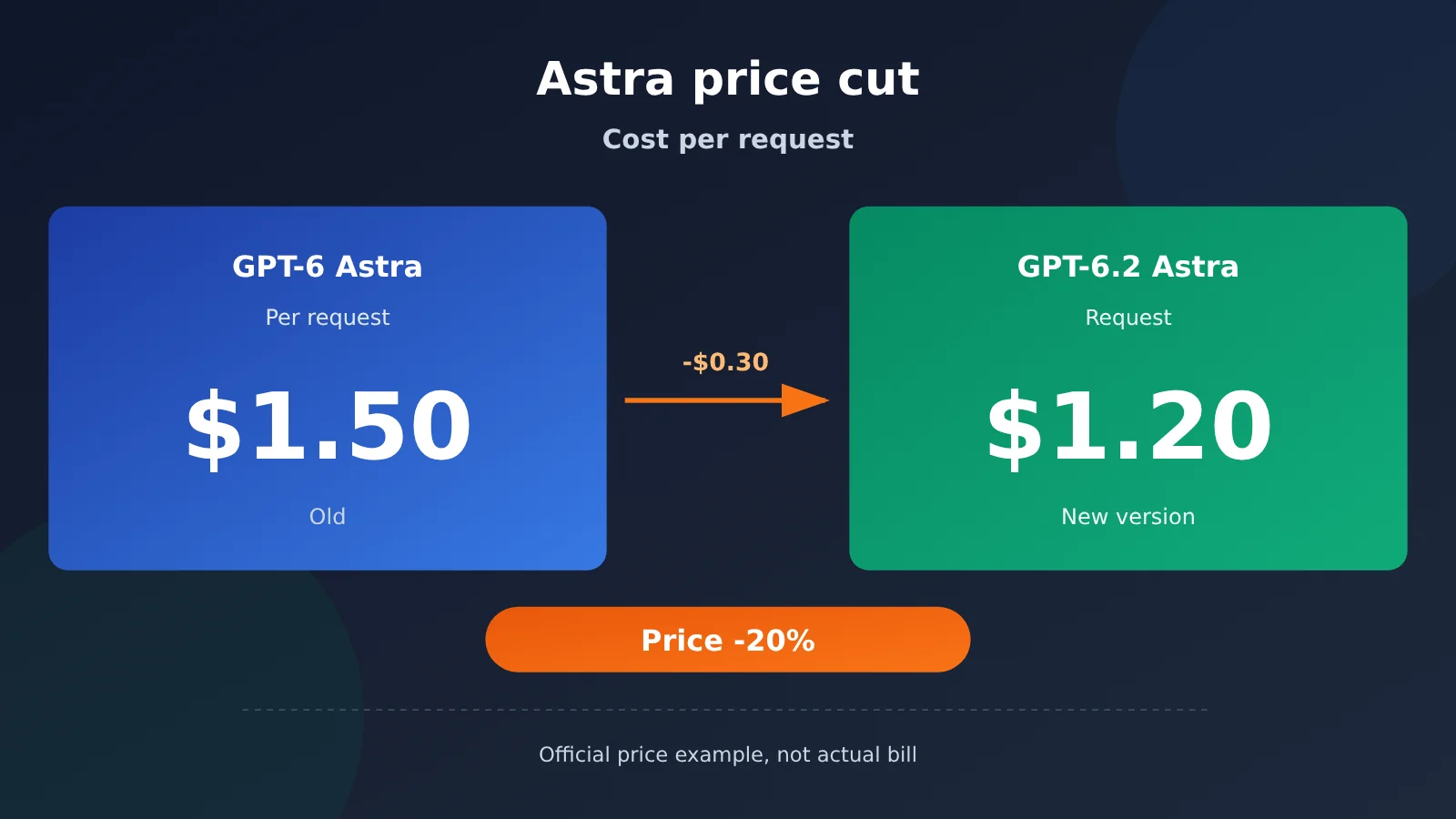
Take a standard request with 100K non-cached input tokens and 10K output tokens, where input stays under 272K: at official standard unit prices, GPT-6 Astra costs about $1.50, and GPT-6.2 Astra costs about $1.20—$0.30 less per request, exactly 20%. For the same token volume, GPT-6.2 Sol costs only about $0.30. Keep in mind that this is a “20% drop in unit price.” Caching, long-context tiers, reasoning output volume, tool calls, and other factors all affect the final cost, so your actual bill won’t necessarily fall by the same 20%.
What will you learn from this article?
- What OpenAI’s official standard prices are for GPT-6.2 Astra and Sol, released on November 17, 2026.
- How to calculate the cost of a single API request: every multiplication step, unit conversion, and underlying assumption.
- How cache reads, long contexts above 272K, and changes in output tokens can push actual costs away from the “20% price cut.”
- How developers and budget owners should re-estimate their invocation costs.
Index: This article starts with a concept table and a quick impact overview to set the context. Part 1, “Objective Facts,” collects the official release information, price table, and official benchmarks, then gives three examples calculated from official unit prices. Part 2, “Analysis and Judgment,” explains the gap between a unit-price drop and a bill drop, offers recommendations for different roles, and includes a ready-to-run cost estimation code snippet.
GPT-6.2 Astra Price Cut: Key Concepts to Know
| Concept | Quick explanation |
|---|---|
| Token | The basic unit the model uses to bill and process text; the API is priced “per million tokens” |
| Non-cached input | In this article, the ordinary input portion that is neither billed as a cache read nor a cache write |
| Cache read | The part of a request that hits the prompt cache; its unit price is far lower than non-cached input |
| Cache write | Writing tokens uses a separate total rate; the same token isn’t charged the ordinary input fee on top |
| Long-context tier | Once input exceeds 272K tokens, input and cache rates double for the whole request, and the output rate becomes 1.5× |
| Reasoning level | How much reasoning effort the model puts in before answering; higher levels usually burn more tokens |
| GDPval v2 / ALE / FrontierCode 2.0 | The three benchmarks OpenAI cites in its announcement. They measure different subjects and use different scopes, so results can’t be converted between them |
GPT-6.2 Astra 20% Price Cut: Impact at a Glance
| Audience | Main impact |
|---|---|
| API developers | For requests of normal length, Astra’s input and output unit prices both drop 20%, so the same call volume costs proportionally less; very long-context requests have to be calculated separately |
| Budget owners | You can rework Astra’s unit-price budget around the 20%, but the real reduction depends on cache hit rate, context length, and output volume — check it against your billing data |
| Teams choosing a model | Sol’s standard unit price is roughly 1/4 of Astra’s, so cost-sensitive tasks now have another option worth evaluating |
| Regular ChatGPT users | This round is rolling out mainly to ChatGPT Work, Codex, and the API step by step; regular Chat isn’t part of this launch |
1. The objective facts behind GPT-6.2 Astra’s 20% price cut
The following information comes from OpenAI’s official launch page, model documentation, and pricing page, verified as of November 18, 2026. All benchmark data comes from official reports—not hands-on results from our team.
1.1 Basic release information for GPT-6.2 Astra and Sol
OpenAI released GPT-6.2 Astra and GPT-6.2 Sol on November 17, 2026. Both models accept text and images as input and return text as output; they can’t natively generate video.
On availability: the official announcement says the new models will roll out gradually to ChatGPT Work, Codex, and API users. Regular Chat isn’t part of this initial rollout. For the exact rollout schedule, check OpenAI’s help documentation.
1.2 GPT-6.2 Astra Official API Standard Pricing
The table below shows OpenAI’s official Standard tier pricing when input does not exceed 272K tokens. Prices are in USD per million tokens, not APIYI pricing. Output volume is calculated based on the total billable output in usage, including reasoning tokens, and is not equal to the visible response length.
| Model | Non-cached input | Cache read | Output | Data source |
|---|---|---|---|---|
| GPT-6 Astra (previous generation) | $10 | $1.00 | $50 | OpenAI model page |
| GPT-6.2 Astra | $8 | $0.4 | $40 | OpenAI model page / pricing page |
| GPT-6.2 Sol | $2 | $0.1 | $10 | OpenAI model page / pricing page |
There are two more official billing rules to note:
- Cache writes are billed at a separate total rate: For Standard short-context Astra, the write fee is $10 per million tokens for 30 minutes and $20 per million tokens for 12 hours. This is not an additional charge on top of the regular input rate of $8. The same input token should fall into one of regular input, cache read, or cache write for the corresponding lifetime, and cannot be billed twice.
- When input exceeds 272K tokens, the input rate and cache rate for the entire request are calculated at 2x, and the output rate at 1.5x.
Compared with the previous generation, Astra’s non-cached input dropped from $10 to $8, and output dropped from $50 to $40, a 20% decrease for both. That’s the exact meaning of “20% price cut”: a 20% drop in standard unit price.
1.3 GPT-6.2 Astra Official Benchmark Data (Not Our Own Testing)
OpenAI shared several benchmark results in its launch post. These benchmarks use different scoring methods, so they shouldn’t be interpreted together:
- GDPval v2: GPT-6.2 Astra scores 6.2 percentage points higher than GPT-6 Astra and produces 22% fewer output tokens. GPT-6.2 Sol scores 5.3 percentage points higher than GPT-6.1 Sol.
- ALE: GPT-6.2 Astra improves by 5.2 points. This is a separate benchmark, so its points can’t be added to or compared with GDPval’s percentage points.
- FrontierCode 2.0: At the max reasoning tier, Sol scores 0.5 points lower than Astra and costs about 1/5 as much per task. This applies only to this test and this tier, so it isn’t a general cost conclusion.
1.4 GPT-6.2 Astra Single-Request Cost Worked Examples
The three worked examples below are our own arithmetic based on the official list prices — not measured API results, and not a reflection of any account’s actual bill. The formula is:
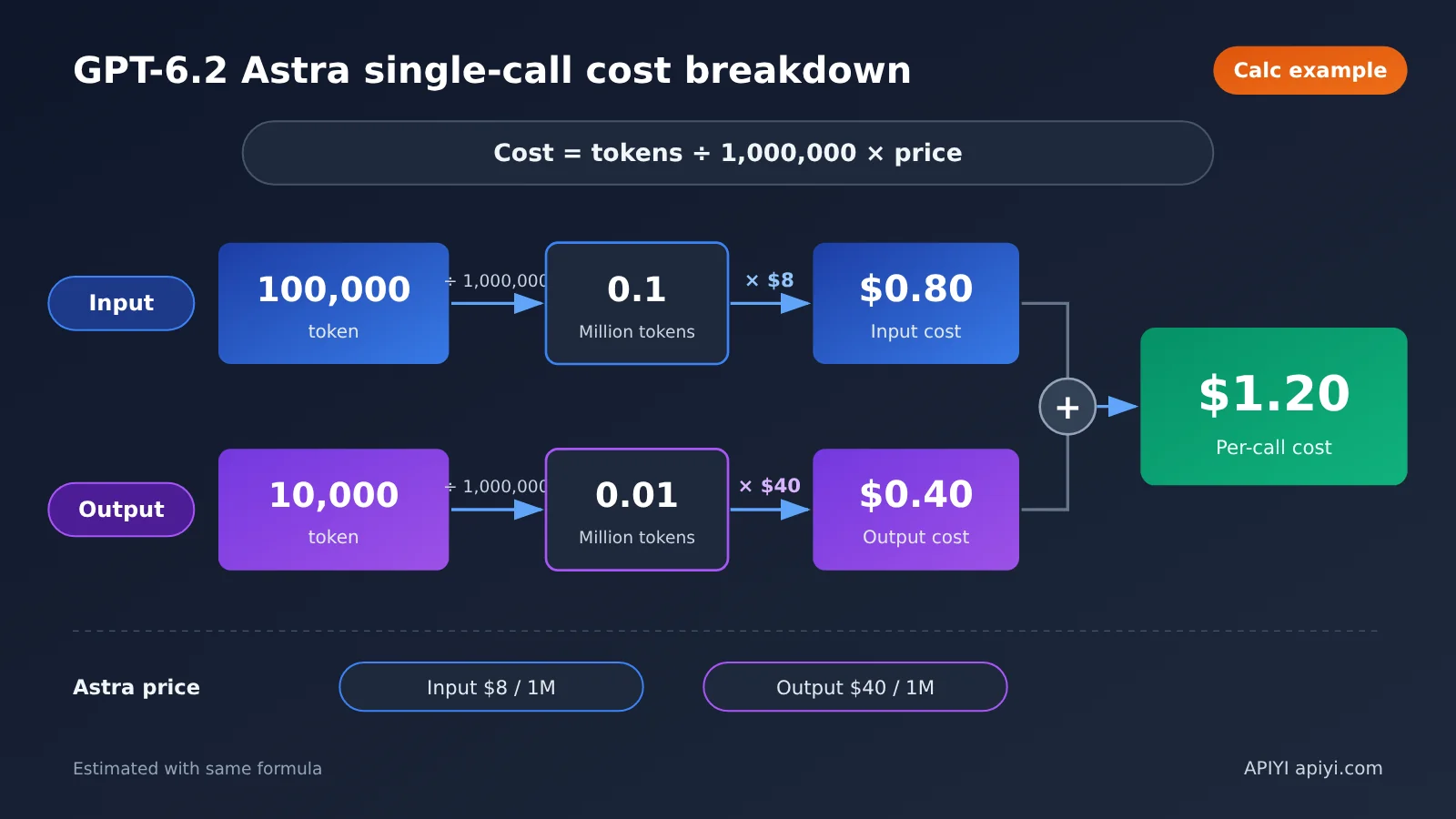
Cost = tokens ÷ 1,000,000 × price per million tokens
Example 1: A standard request, comparing old and new Astra with Sol
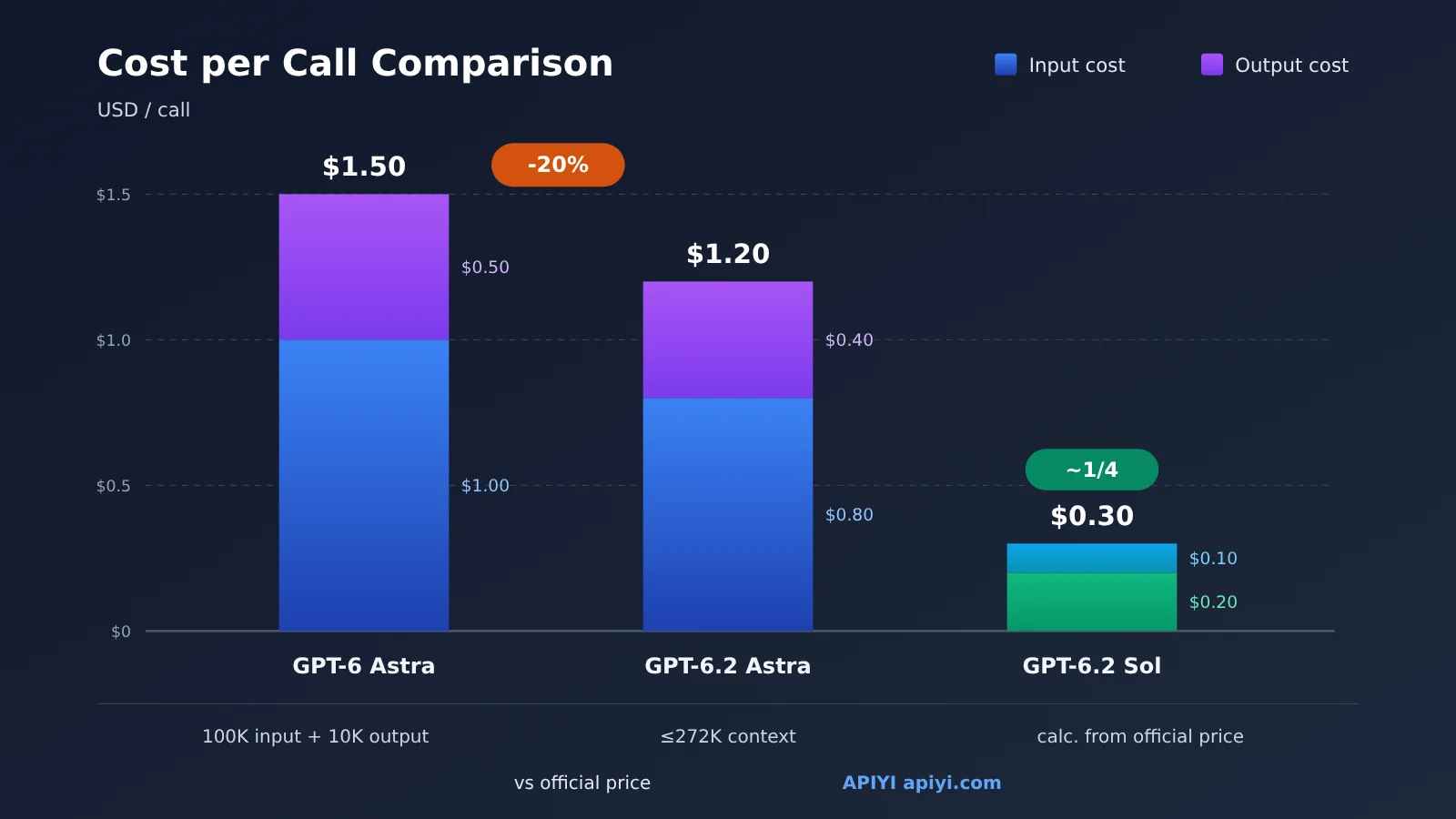
Assumptions: 100,000 non-cached input tokens, 10,000 output tokens, input under 272K, no cache reads or writes, no tool calls, billed at standard rates.
| Item | GPT-6 Astra | GPT-6.2 Astra | GPT-6.2 Sol |
|---|---|---|---|
| Input cost | 0.1 × $10 = $1.00 | 0.1 × $8 = $0.80 | 0.1 × $2 = $0.20 |
| Output cost | 0.01 × $50 = $0.50 | 0.01 × $40 = $0.40 | 0.01 × $10 = $0.10 |
| Total per request | $1.50 | $1.20 | $0.30 |
| vs. GPT-6 Astra | Baseline | $0.30 less (-20%) | $1.20 less (-80%) |
In the table, “0.1” means 100,000 ÷ 1,000,000, and “0.01” means 10,000 ÷ 1,000,000. If you send 10,000 identical requests per month, under these assumptions GPT-6 Astra comes to about $15,000 and GPT-6.2 Astra to about $12,000. That’s just linear extrapolation — it isn’t a cost commitment of any kind.
Example 2: A GPT-6.2 Astra request that hits the cache
Assumptions: 100,000 total input tokens, of which 80,000 are cache reads and 20,000 are ordinary input with no cache write, plus 10,000 output tokens. Cache writes for this request are set to zero, and the historical cost of building the cache isn’t counted here.
- Non-cached input: 0.02 × $8 = $0.16
- Cache reads: 0.08 × $0.4 = $0.032
- Output: 0.01 × $40 = $0.40
- Total: about $0.592
The previous-generation GPT-6 Astra charged $1.00 per million tokens for cache reads; the new version charges $0.40, a 60% drop. With the same token counts, the previous generation comes to $0.20 + $0.08 + $0.50 = $0.78; the new version is $0.592, which is $0.188 less — roughly a 24.1% decrease. Neither figure includes cache writes, tools, or other charges, so neither should be treated as a complete bill.
Example 3: A GPT-6.2 Astra long-context request above 272K
Assumptions: 300,000 ordinary input tokens (above 272K), 10,000 output tokens, and zero cache reads or writes.
- Input: 0.3 × ($8 × 2) = $4.80
- Output: 0.01 × ($40 × 1.5) = $0.60
- Total: $5.40
Note that the tier applies to the whole request. Once input exceeds 272K, every input token in that request is billed at the 2x rate — it’s not a surcharge on just the portion above the threshold.
Cache lifetime is configured through the Responses API’s prompt_cache_options.ttl: the default is "30m", "12h" is also available, and individual explicit breakpoints can override it via prompt_cache_breakpoint.ttl. It represents a minimum cache lifetime, not a deadline for data deletion, and it shouldn’t be confused with the legacy prompt_cache_retention parameter used by older models.
Once input exceeds 272K, Standard tier Astra charges $16 for regular input, $0.80 for cache reads, $20 for 30-minute writes, $40 for 12-hour writes, and $60 for output, per million tokens; the multiplier applies to the entire request, not just the portion above the threshold.
1.5 GPT-6.2 Astra Official Sources
- OpenAI prompt caching configuration and billing guide
- OpenAI announcement: openai.com/index/introducing-gpt-6-2-astra-sol/
- GPT-6 Astra model docs: official legacy model pricing
- GPT-6.2 Astra model docs: official new model pricing and rate conditions
- GPT-6.2 Sol model docs: developers.openai.com/api/docs/models/gpt-6.2-sol
- OpenAI API pricing page: developers.openai.com/api/docs/pricing
- ChatGPT Work and Codex help docs: help.openai.com/en/articles/20001275-chatgpt-work-and-codex
II. Analysis and Assessment of GPT-6.2 Astra’s 20% Price Cut
The following is the editor’s interpretation based on the facts above. It’s analysis and judgment, not an official conclusion.
2.1 The unit price drops 20%, so why won’t your bill necessarily drop 20%?
Example 1 can arrive at an exact 20% because it includes only two line items: non-cached input and standard output—and both happen to drop by exactly 20%. Real-world bills usually consist of multiple cost components, and a change in the proportion of any one of them will push the overall reduction away from 20%.
| Cost factor | Potential impact on actual bill | Basis for assessment |
|---|---|---|
| Cache reads and writes | The cache read unit price drops 60%, which is different from the 20% for non-cached input; you need to calculate based on their respective token counts, and you can’t assume an overall reduction; cache writes use a separate total rate and don’t stack with the regular input fee | Official price table |
| Long-context tiers | When it exceeds 272K, the rate for the entire request goes up, so a single call in long-document scenarios may cost noticeably more than in Example 1 | Official billing rules |
| Output / reasoning token count | The official report on GDPval v2 shows 22% fewer output tokens. If your tasks show a similar change, savings could exceed 20%; if you use a higher reasoning tier, it could also be more expensive | Official evaluation (specific task) |
| Tool calls and speed tiers | For GPT-6.2 Astra, Fast is 2x the Standard rate for the same context, and Batch is 50%; tool fees are calculated separately based on the tools used | Official model page and pricing page |
| Invocation channel | When invoking through third-party platforms such as APIYI apiyi.com, the platform’s published actual billing applies; you can’t directly apply official pricing | Channel differences |
One easily overlooked point is “22% fewer output tokens.” This number comes from a single evaluation, GDPval v2. If you directly apply it to every business scenario and conclude that you’ll “actually save more than 30%,” you’re treating the official result from a specific evaluation as a universal rule. A safer approach is to run a small-sample test with your own real requests, record the token counts in the usage field, and then make your judgment.
2.2 Choosing Between GPT-6.2 Astra and Sol
At standard unit prices, every Sol line item costs about 1/4 of the corresponding Astra line item. In Example 1, Sol’s per-call cost was only a quarter of Astra’s. FrontierCode 2.0 results show that at the max reasoning tier, the gap between Sol and Astra is small, but the official documentation doesn’t say this conclusion extends to other tasks.
So our view is: for cost-sensitive scenarios with medium task difficulty, Sol is worth evaluating first; for scenarios that demand high quality or involve complex tasks, Astra’s price cut also lowers the entry barrier. Ultimately, which one to choose should be decided by an A/B comparison on your own task set.
💡 Selection tip: If you need to compare token consumption and output quality across multiple models in the same codebase, consider switching models through an OpenAI-compatible aggregation interface such as APIYI apiyi.com. Whether the GPT-6.2 series is already available on the platform and what it costs should be based on the platform’s model list and billing page.
2.3 GPT-6.2 Astra Cost Estimation Code
The script below only does local arithmetic and doesn’t call any API. It splits input into four non-overlapping categories: ordinary input, cached reads, 30-minute writes, and 12-hour writes; total input is used to determine the 272K tier. Write rates are total rates, and no ordinary input fee is added on top of write tokens.
# OpenAI Standard rates, USD per million tokens; excludes tools, taxes, and other tier fees
PRICES = {
    "gpt-6-astra":   {"input": 10.0, "cached": 1.0, "output": 50.0},
    "gpt-6.2-astra": {"input": 8.0, "cached": 0.4, "output": 40.0},
    "gpt-6.2-sol":   {"input": 2.0, "cached": 0.1, "output": 10.0},
}

def estimate_cost(model, ordinary_input, output_tokens, cached_read=0,
                  write_30m=0, write_12h=0):
    counts = (ordinary_input, output_tokens, cached_read, write_30m, write_12h)
    if any(n < 0 for n in counts):
        raise ValueError("token 数不得为负")
    p = PRICES[model]
    total_input = ordinary_input + cached_read + write_30m + write_12h
    im, om = (2.0, 1.5) if total_input > 272_000 else (1.0, 1.0)
    input_cost = (ordinary_input * p["input"] + cached_read * p["cached"]
                  + write_30m * p["input"] * 1.25
                  + write_12h * p["input"] * 2.5) * im
    return round((input_cost + output_tokens * p["output"] * om) / 1e6, 6)

print(estimate_cost("gpt-6-astra", 100_000, 10_000))  # 1.5
print(estimate_cost("gpt-6.2-astra", 100_000, 10_000))  # 1.2
print(estimate_cost("gpt-6.2-sol", 100_000, 10_000))  # 0.3
print(estimate_cost("gpt-6.2-astra", 20_000, 10_000, cached_read=80_000))  # 0.592
# Same 100K input all billed as 30-minute writes: not 1.2 plus another 1.0
print(estimate_cost("gpt-6.2-astra", 0, 10_000, write_30m=100_000))  # 1.4
For usage from the Responses API, you should first identify the cached read volume and write volume, then subtract both from total input to get ordinary input. When 30-minute and 12-hour lifetimes are mixed, you also need to allocate write volume according to the actual billing breakdown; you can’t apply one rate to all writes. If a provider lacks write details or uses a different billing convention, reconcile against that provider’s bill rather than assuming write volume is zero. When billed output includes reasoning tokens, don’t add the reasoning volume again. This article doesn’t actually call the API; whether third-party platforms support these configurations and how they bill should be governed by their documentation.
2.4 How to Respond to the GPT-6.2 Astra Price Cut
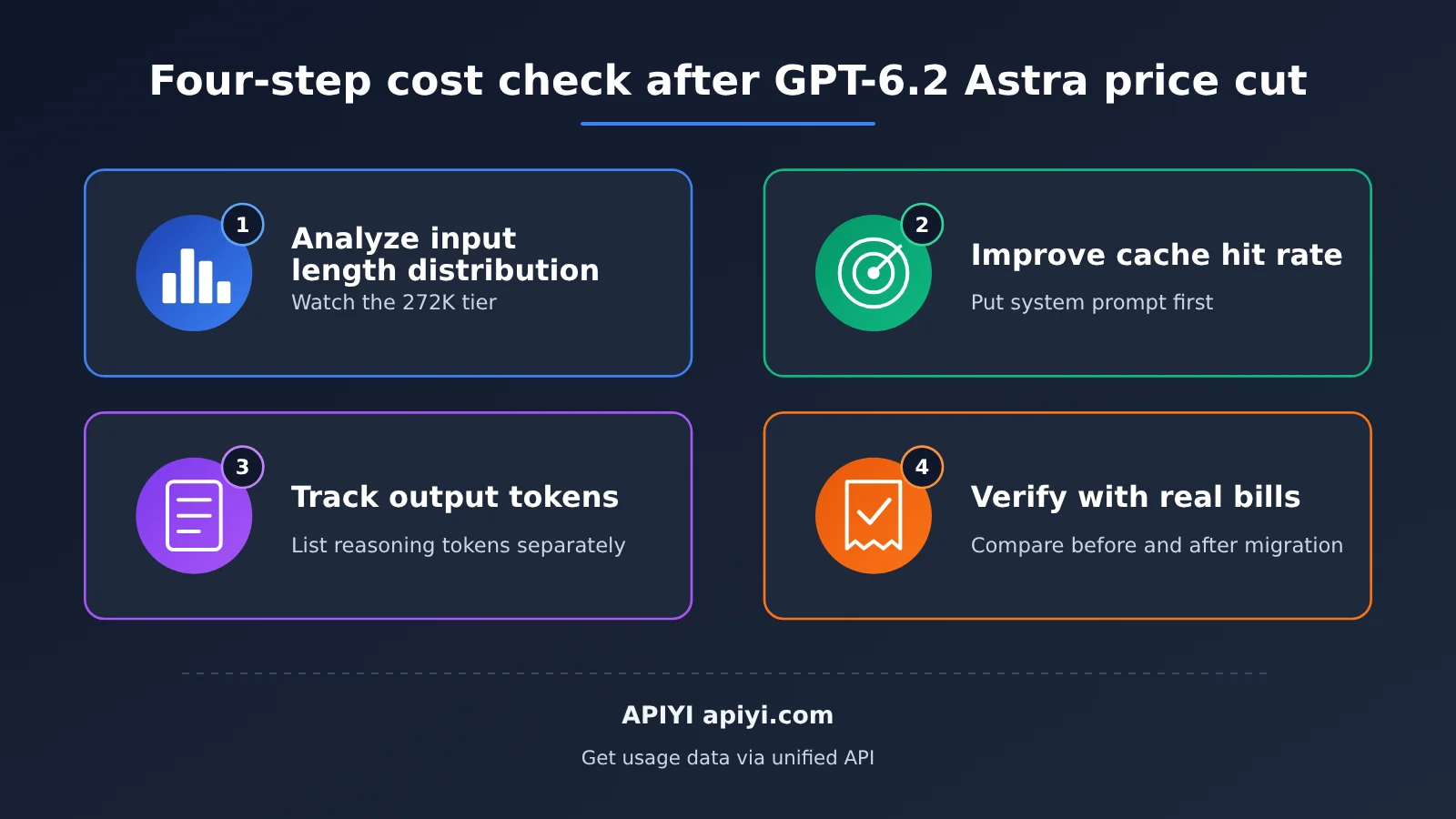
For developers: Start by measuring the input-length distribution of your current requests to see how many come close to or exceed 272K. If long-context requests make up a big share, you can use retrieval chunking, summarization and compression, and similar techniques to keep inputs inside the lower tier — the money you save that way may well beat the 20% cut itself. At the same time, put your fixed system prompt at the front of the request to improve the cache hit rate.
For budget owners: Treat “Astra standard unit price down 20%” as a baseline reference for budgeting at equal non-cached input and output volume — not as a cap on the actual reduction, and not as a guaranteed saving. Compare real bills from a stretch of time before and after migration, and break out the changes in caching, long context, and output tokens separately. Teams calling through platforms like APIYI apiyi.com should also go by that platform’s billing definitions.
Changes still worth watching: official price updates, channel rollout progress, and whether independent third-party benchmarks can reproduce the official numbers. The official docs already spell out cache-write and speed-tier rates, so check which tier you’re on when estimating — don’t assume they haven’t been announced yet. For the new Astra under Standard short context, cache writes cost $10 per million tokens with 30-minute retention and $20 per million tokens for 12 hours; all three main worked examples in this article assume zero cache writes, which doesn’t mean a default API request necessarily has none.
If you’d like to run through the billing verification process first, you can compare usage data across models with the same code on APIYI apiyi.com. Once the GPT-6.2 series goes live on the channel you use, you’ll be able to plug real token counts straight into the estimation function above.
A 20% price cut is a clear signal, but the number on your bill depends on how long each request’s input is, how much of it hits cache, and how much it outputs. Getting every one of those multiplications right is more useful than memorizing a percentage.
“Beware of little expenses; a small leak will sink a great ship.”
— Benjamin Franklin, Poor Richard’s Almanack