
Author’s note: All 10 retirement dates for OpenAI, Anthropic, and Google between November 17, 2026 and April 1, 2027 in one view — plus what to switch to at each date and which lines of code to change.
Bottom line first: this year only has two small dates left, November 17 and December 1. What will actually break your API calls are November 30 and December 11 — everything else lands next year. On November 30, Claude Sonnet 4.5 and three OpenAI products shut down at the same time; on December 11, the whole GPT-5 family and the o3 series go dark. After those two days, the old model names will fail outright. This article lists all 10 retirement dates in order, and by the end you’ll be able to answer three things: whether the model you use is on the list, the latest date you can act, and exactly which lines to change.
This isn’t rumor or hearsay — every date comes from the official deprecation pages of OpenAI, Anthropic, and Google (retrieved October 26, 2026), and every “now” in this article is measured from that day.
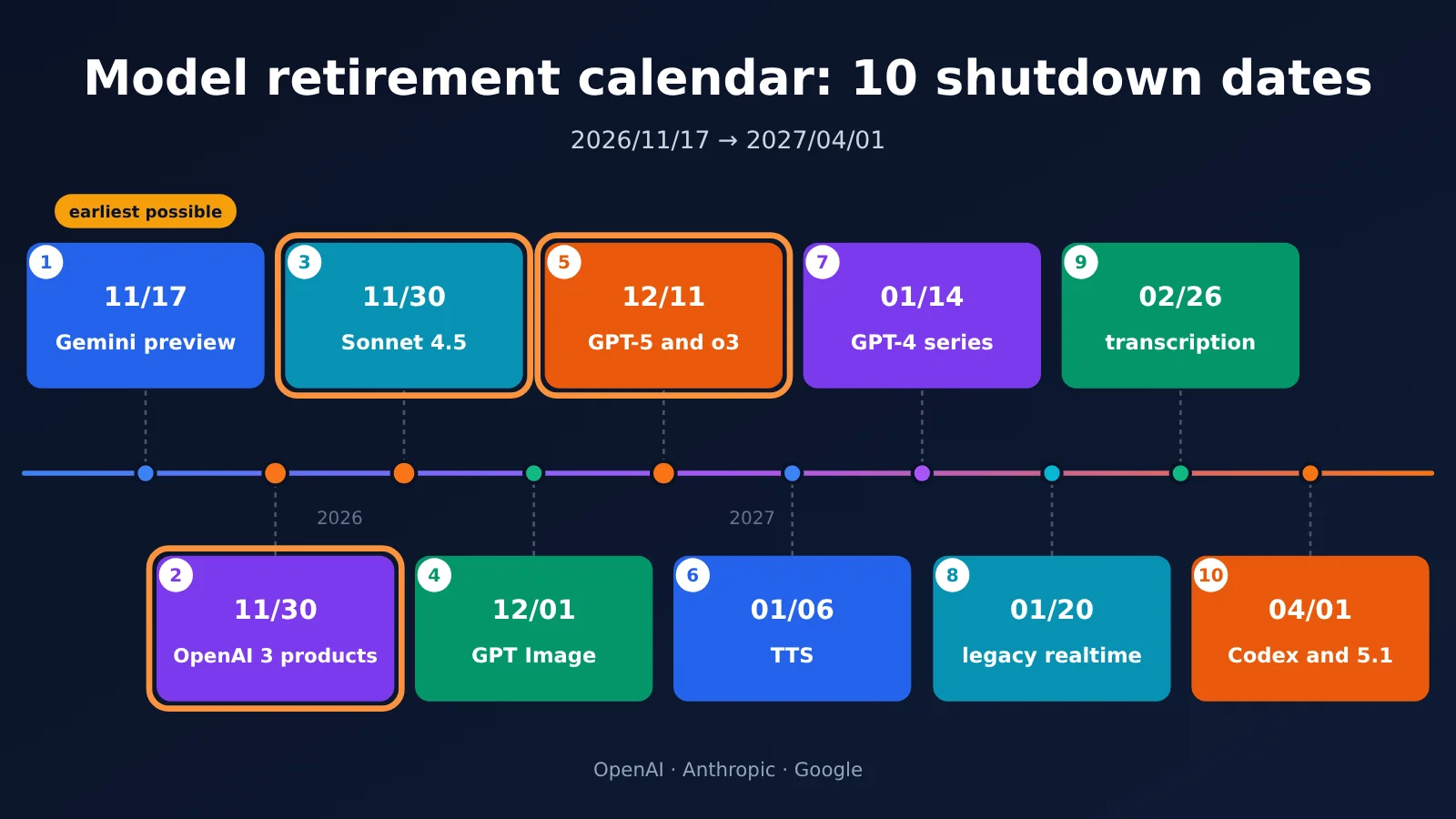
Model Retirement Calendar: 10 Key Dates at a Glance
The table below is sorted chronologically. The “Date Type” column distinguishes between a confirmed date and an earliest possible date. A confirmed date is the official shutdown day — when it arrives, the model stops. An earliest possible date is a lower bound; the actual retirement may come later.
| # | Date | Date Type | Who | Affected Models | Replace With | Will It Throw an Error? |
|---|---|---|---|---|---|---|
| 1 | 2026-11-17 | ⚠️ Earliest possible | Gemini | gemini-3.1-flash-tts-preview, gemini-2.5-flash-preview-tts, gemini-2.5-pro-preview-tts, gemini-3.1-flash-live-preview, gemini-2.5-flash-native-audio-preview-12-2025 | TTS models → gemini-3.8-flash-tts or gemini-3.8-flash-lite-tts; live models → gemini-3.8-live | Fails after shutdown |
| 2 | 2026-11-30 | ✅ Confirmed | OpenAI | Reusable prompts (v1/prompts), Evals platform, Agent Builder | Prompts in code / Promptfoo / Agents SDK or ChatGPT Workspace Agents | Yes |
| 3 | 2026-11-30 | ✅ Confirmed | Anthropic | claude-sonnet-4-5-20250929 | claude-sonnet-5-5 | Yes; old parameters also return 400 after the switch |
| 4 | 2026-12-01 | ✅ Confirmed | OpenAI | gpt-image-1-mini, gpt-image-1.5, gpt-image-1.5-2025-12-16, chatgpt-image-latest | gpt-image-2.5-sunburst or gpt-image-2.5-flare | Yes |
| 5 | 2026-12-11 | ✅ Confirmed | OpenAI | gpt-5, gpt-5-mini, gpt-5-nano, gpt-5-pro, o3, o3-pro (including dated snapshots) | gpt-5.6-sol / terra / luna; the two pro tiers also need extra parameters | Yes |
| 6 | 2027-01-06 | ✅ Confirmed | OpenAI | tts-1, tts-1-hd, gpt-4o-mini-tts and their snapshots | gpt-realtime-2.1-mini | Yes |
| 7 | 2027-01-14 | ✅ Confirmed | OpenAI | gpt-4o (2024-08-06, 2024-11-20), gpt-4o-mini-2024-07-18, gpt-4.1-2025-04-14, gpt-4.1-mini-2025-04-14 | gpt-6-luna | Yes |
| 8 | 2027-01-20 | ✅ Confirmed | OpenAI | 8 older realtime / audio models, including gpt-realtime and gpt-audio | gpt-realtime-2.1, gpt-audio-1.5, gpt-realtime-2.1-mini | Yes |
| 9 | 2027-02-26 | ✅ Confirmed | OpenAI | whisper-1, gpt-4o-transcribe, gpt-4o-mini-transcribe, gpt-4o-transcribe-diarize | gpt-live-transcribe or gpt-transcribe | Yes |
| 10 | 2027-04-01 | ✅ Confirmed | OpenAI | gpt-5.3-codex, gpt-5.1, gpt-5.4-nano (including snapshots) | gpt-6-sol / gpt-6-luna | Yes |
Background: on 2026-10-23, another batch of older models was already retired, including gpt-3.5-turbo, gpt-4, gpt-4-turbo-2024-04-09, gpt-4.1-nano, gpt-image-1, o1, o1-pro, o3-mini, o4-mini, and more. In APIYI’s master table, these models still show prices for now. Model availability and pricing are subject to the platform’s model list, and whether a call actually goes through depends on what the request returns.
🚀 Quick reference: If you’re calling through APIYI (apiyi.com), migration usually just means swapping the model name under the same API key. Whether a replacement model is already listed depends on the platform’s model list.
November Model Retirements: Gemini Previews, Three OpenAI Products, Sonnet 4.5
November 17: Five Gemini Previews (Earliest Possible)
- What’s shutting down: The five TTS / live preview models listed in row 1 of the table. Note that November 17 is the shutdown date — the earliest possible date.
- What happens: Once they’re shut down, requests to these model IDs will fail.
- What to change: For TTS models, switch to gemini-3.8-flash-tts or gemini-3.8-flash-lite-tts; for live models, switch to gemini-3.8-live.
November 30: Three Product-Level OpenAI Shutdowns
- What’s shutting down: Reusable prompts (the
v1/promptsAPI and prompt objects), the Evals platform, and Agent Builder. For Evals, existing evaluations will become read-only starting October 31. - What happens: Requests that call
v1/promptsor reference prompt objects will fail, and neither the Evals console nor API will be usable. - What to change: Move prompt content back into your application code (see the official “Migrate from prompt objects” guide); migrate evaluations to Promptfoo; migrate Agent Builder to the Agents SDK or ChatGPT Workspace Agents. ChatKit remains available.
November 30: Claude Sonnet 4.5 Migration Checklist
This is the one most likely to trip you up. Changing the model name alone isn’t enough — Sonnet 5.5 returns a 400 for several legacy parameters.
| Change item | Sonnet 4.5 syntax | Sonnet 5.5 syntax | If you don’t change it |
|---|---|---|---|
| Thinking parameters | enabled + budget_tokens | adaptive + output_config.effort | 400 |
| assistant prefill | Supported | Not supported | 400 |
| Forced tools | tool_choice set to any / tool | Only auto + strict tool use | 400 |
| computer use | computer_20250124 | computer_toolset_20260801 (computer_20251124 on Bedrock) | No longer accepted |
| Output format | output_format | output_config.format | Deprecated; 400 without the beta header |
Here are the specific parameters to change, along with the exact error messages:
- The legacy form
thinking: {"type": "enabled", "budget_tokens": N}returns"thinking.type.enabled" is not supported for this model. Use "thinking.type.adaptive" and "output_config.effort" - If you want to turn off thinking at the start, use
thinking: {"type": "between_tools"}, which works for high effort and below - 4.5 doesn’t have an effort parameter, so after migrating you’ll need to explicitly set
output_config.effort - Using prefill returns
This model does not support assistant message prefill. The conversation must end with a user message. To control output format, switch to structured outputs, put the opening line in the system prompt, and move continuations and context reminders into user turns interleaved-thinking-2025-05-14can be removed; usingfine-grained-tool-streaming-2025-05-14together with tool sets returns a 400 — instead, addeager_input_streaming: trueto each tool- Thinking blocks produced by Sonnet 5.5 are only valid within the account that produced them (or linked accounts); cross-account passthrough will be dropped, but the request itself won’t fail
The migration comes with two upsides: the minimum cacheable length drops from 1024 tokens to 512 tokens, and the context window is larger, so context-related beta headers can be removed.
December Model Retirements: GPT Image and GPT-5, o3 Series
December 1: Older GPT Image Models
- What’s being retired: gpt-image-1-mini, gpt-image-1.5, gpt-image-1.5-2025-12-16, chatgpt-image-latest.
- What happens: Image generation requests will fail.
- What to change: Replace the model name with gpt-image-2.5-sunburst or gpt-image-2.5-flare. Both support the chat and images endpoints.
December 11: The Entire GPT-5 Family and o3 Series
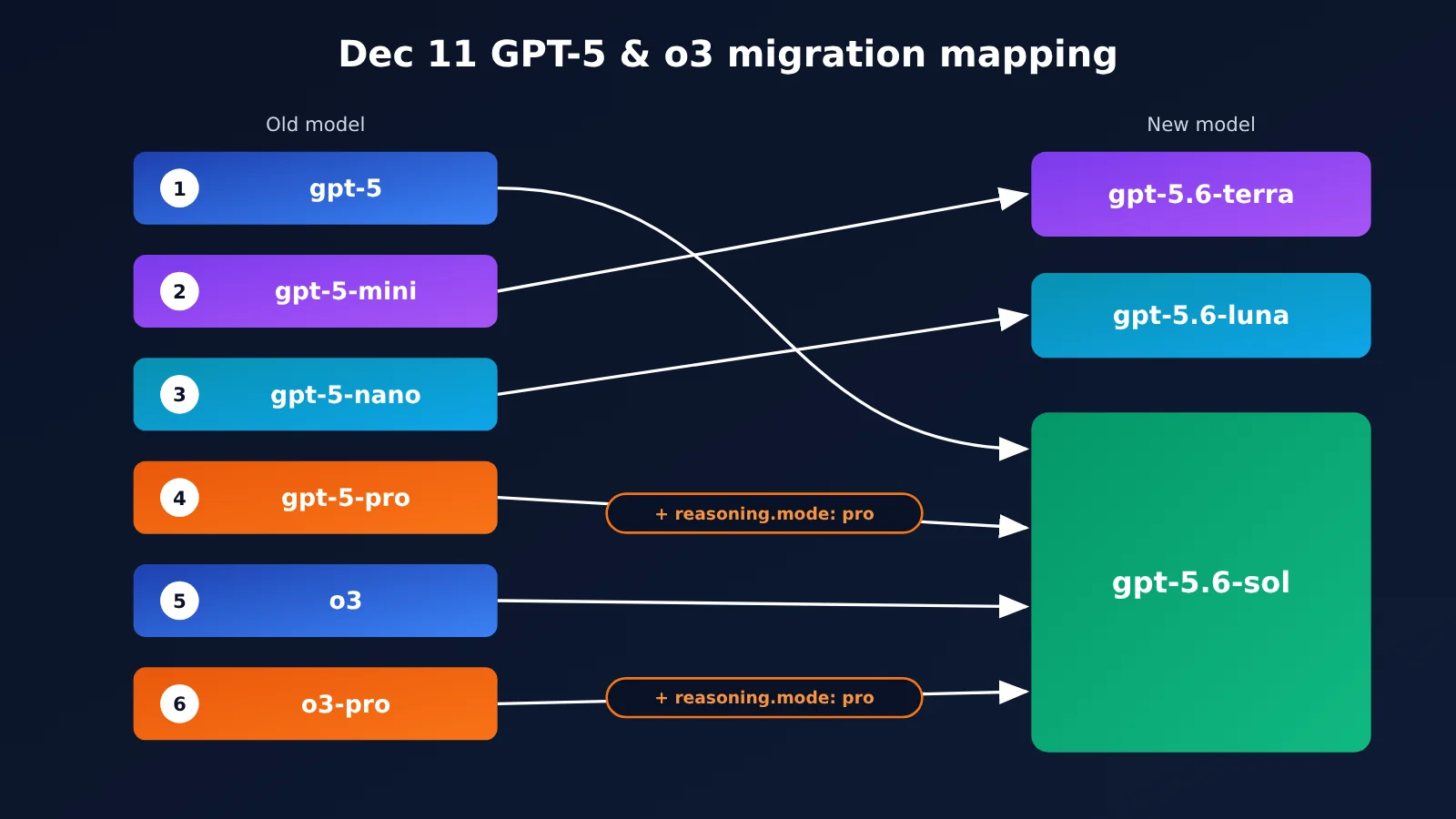
- What’s being retired: gpt-5, gpt-5-mini, gpt-5-nano, gpt-5-pro, o3, o3-pro, and their dated snapshots.
- What happens: Old model names will fail outright. If you only change the model name for the two pro variants, the request won’t error out—but it will drop the officially required reasoning.mode: pro setting.
- What to change: For gpt-5 and o3, switch to gpt-5.6-sol; for mini, switch to gpt-5.6-terra; for nano, switch to gpt-5.6-luna. For gpt-5-pro and o3-pro, switch to gpt-5.6-sol and also add
reasoning.mode: pro.
Model Retirements Next January: TTS, GPT-4 Family, and Older realtime Models
- January 6: tts-1, tts-1-hd, and gpt-4o-mini-tts (including the 2025-03-20 and 2025-12-15 snapshots) will be retired and replaced by gpt-realtime-2.1-mini. Starting the same day, self-service fine-tuning will no longer accept new jobs, including from existing customers. Models that have already been fine-tuned can continue to serve inference until their base models are retired.
- January 14: the 2024-08-06 and 2024-11-20 snapshots of gpt-4o, along with gpt-4o-mini-2024-07-18, gpt-4.1-2025-04-14, and gpt-4.1-mini-2025-04-14, will be retired and all replaced by gpt-6-luna. If your code hardcodes dated snapshots, you’ll need to do a global search-and-replace.
- January 20: gpt-realtime, gpt-audio, gpt-4o-audio, gpt-4o-realtime, gpt-realtime-mini, gpt-audio-mini, gpt-4o-mini-realtime, and gpt-4o-mini-audio will all be discontinued. The official replacements are gpt-realtime-2.1, gpt-audio-1.5, and gpt-realtime-2.1-mini; check the official retirement page for the exact mapping. The official table also lists one snapshot change that day, not a retirement: the 2025-03-20 snapshot of gpt-4o-mini-transcribe will move to the 2025-12-15 snapshot.
Once these three deadlines pass, requests to the old model versions will fail.
Model Retirements from February to April: Transcription, Codex, and 5.1
- February 26: whisper-1, gpt-4o-transcribe, gpt-4o-mini-transcribe, and gpt-4o-transcribe-diarize are retired. The official migration path is gpt-live-transcribe or gpt-transcribe. The endpoint changes along with the model —
v1/audio/translationsbecomesv1/realtime/translations. - April 1: gpt-5.3-codex and gpt-5.1 (including the 2025-11-13 snapshot) move to gpt-6-sol, and gpt-5.4-nano (including the 2026-03-17 snapshot) moves to gpt-6-luna.
Where the platform stands right now: whisper-1, gpt-transcribe, and gpt-live-transcribe aren’t in the APIYI master table, and neither is gpt-5.3-codex — so for these, migration planning has to follow the official direction. gpt-transcribe and gpt-live-transcribe are models that have been officially released but aren’t listed on the platform yet; APIYI will roll them out as soon as possible.
Gemini’s Silent Rerouting: No Errors, but the Bill Changes
This next part needs to be read separately from the section above. The deadlines above will throw errors when they hit. Gemini’s two Flash models, on the other hand, reroute silently: the endpoint stays open and requests still succeed — it’s just that a newer model is doing the actual work behind the scenes.
| Model you request | Model that actually answers | Price change (input / output / cached read) |
|---|---|---|
| gemini-3.7-flash | gemini-3.8-flash | 0.75 / 3.75 / 0.075 → unchanged |
| gemini-3.5-flash | gemini-3.6-flash | 1.5 / 9 / 0.15 → 1.5 / 7.5 / 0.15 |
What the rerouting means for you: you won’t get a “model not found” error, but billing is calculated based on the newer model doing the actual work — and its reasoning behavior and output style may differ from the old model’s. If you notice “the bill doesn’t match what it used to be,” or the output style suddenly shifts, check this first. Also worth noting: the 2.5 series hasn’t been deprecated, but it’s only available to accounts that used 2.5 before; for new projects, the official recommendation is 3.5 Flash-Lite or 3.8 Flash.
The Earliest Retirement Date Isn’t the Shutdown Date
The “no earlier than” dates on Anthropic’s status page, along with Gemini’s shutdown date, are all earliest possible dates. They’re just lower bounds, not confirmed shutdown dates. Two entries deserve extra attention:
- claude-haiku-4-5-20251001: Its earliest date, 2026-10-15, has already passed, but the official shutdown date hasn’t been announced. Models like this can get notice at any time, so it’s worth preparing a replacement in advance.
- claude-opus-4-5-20251101: No earlier than 2026-11-24; a notice with a specific date could arrive anytime before the end of the year.
The other models have lower bounds further out: claude-opus-4-6 is no earlier than 2027-02-05, and claude-sonnet-4-6 is no earlier than 2027-02-17.
Model Retirement Checklist: Three Steps
- Check usage: Count calls by model name in request logs and billing details, then search your codebase globally for the model name string. Search for date-snapshot names (like
-2025-08-07) as well. - Update the model name: Replace it using the master table. If you’re calling through APIYI, keep
base_urlset tohttps://api.apiyi.com/v1and just change themodelfield. For both pro tiers, addreasoning.mode: proas well. - Run regression tests: Focus on five areas.
- Thinking parameters: how
thinkingis written, and whetheroutput_config.effortis set - Assistant prefill: the last message in the conversation must be a user message
tool_choice: onlyautois allowed- Streaming: check whether
eager_input_streaming: truehas replaced the old beta - Computer use: whether the tool version number has been updated
💡 Migration tip: You can first run the regression test cases with the new model name on APIYI apiyi.com, confirm there are no 400 errors, and then switch production traffic.
Model Retirement Platform-Side Comparison: How the Unit Prices Change
The unit prices below come from the APIYI platform model list (data updated 2026-10-25). They’re in USD per million tokens, listed in input / output / cache-read order. The platform model list is the authoritative source for models and pricing.
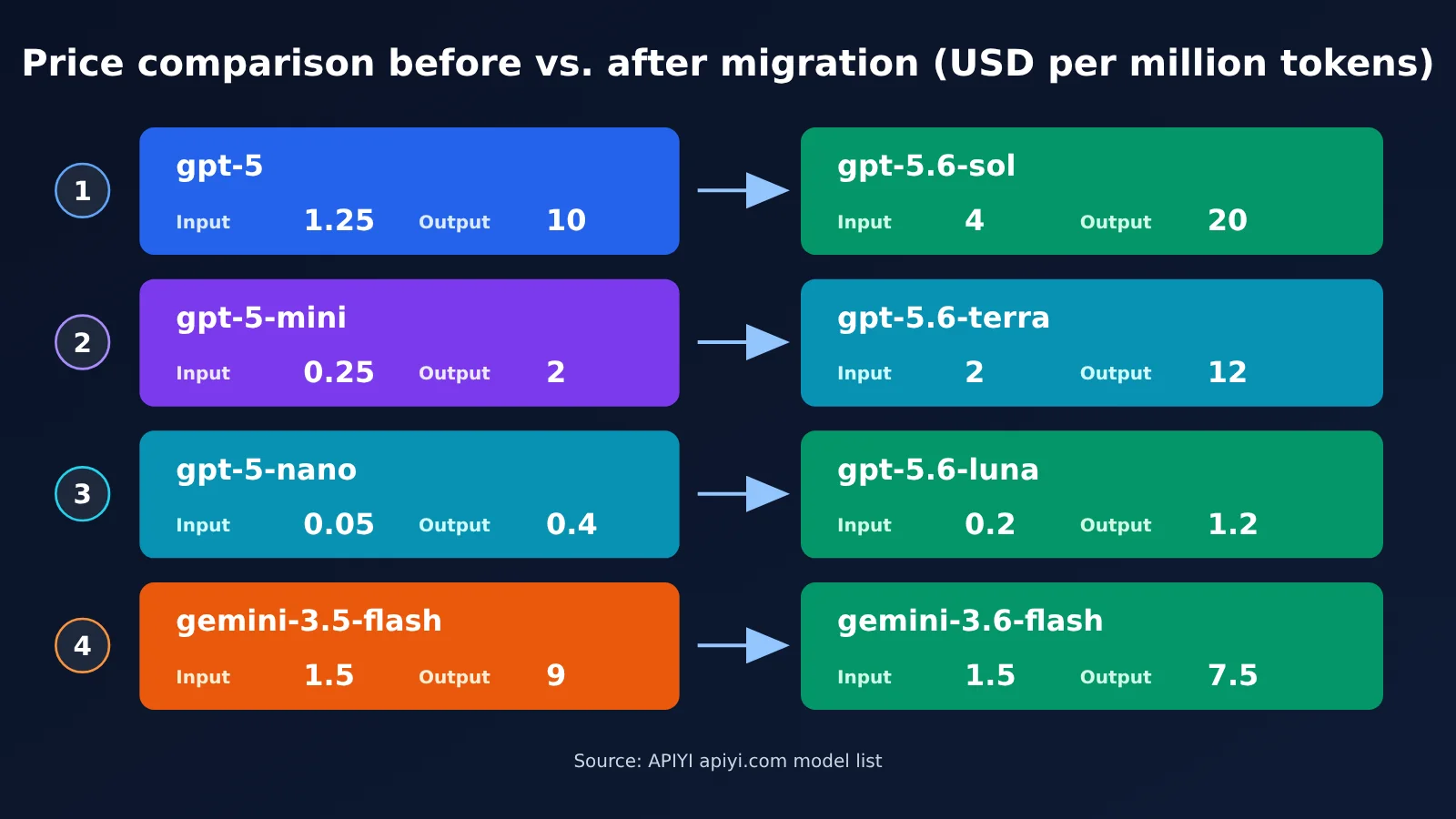
The December 11 batch
| Current model | Current price | Replacement model | Replacement price |
|---|---|---|---|
| gpt-5 | 1.25 / 10 / 0.125 | gpt-5.6-sol † | 4 / 20 / 0.4 |
| gpt-5-mini | 0.25 / 2 / 0.025 | gpt-5.6-terra † | 2 / 12 / 0.2 |
| gpt-5-nano | 0.05 / 0.4 / 0.005 | gpt-5.6-luna † | 0.2 / 1.2 / 0.02 |
| gpt-5-pro | 15 / 120 / 1.5 | gpt-5.6-sol † (with reasoning.mode: pro) |
4 / 20 / 0.4 |
| o3 | 3 / 12 / 0.75 | gpt-5.6-sol † | 4 / 20 / 0.4 |
| o3-pro | 20 / 80 / 5 | gpt-5.6-sol † (with reasoning.mode: pro) |
4 / 20 / 0.4 |
† means tiered pricing: once a single input exceeds 272,000 tokens, the input price doubles (sol becomes 8, terra becomes 4, luna becomes 0.4), and the output price is calculated as the corresponding tier’s input price times the multiplier. As you can see from the table, the main models in this batch—gpt-5, mini, nano, and o3—all go up in unit price after switching. Moving from gpt-5 to gpt-5.6-sol takes you from $1.25 input / $10 output to $4 / $20, so you’ll want to adjust your budget ahead of time. The two pro tiers show lower numbers in the price table, but how much you actually consume once pro mode is enabled is something you’ll need to verify against your own bill.
Other milestones
| Node | Current model and pricing | Replacement model and pricing |
|---|---|---|
| 11-30 | claude-sonnet-4-5-20250929: 3 / 15 / 0.3 | claude-sonnet-5-5: 2 / 10 / 0.1 |
| 12-01 | gpt-image-1.5: 5 / 32 / 1.25; gpt-image-1-mini: 2 / 8 / 0.2 | gpt-image-2.5-sunburst, gpt-image-2.5-flare: both 5 / 30 / 1.25 |
| 01-06 | tts-1: 30 / 30 (no cached-read pricing); tts-1-hd: 60 / 60 (no cached-read pricing) | gpt-realtime-2.1-mini: 0.6 / 2.4 / 0.06 |
| 01-14 | gpt-4o: 2.5 / 10 / 1.25; gpt-4o-mini: 0.15 / 0.6 / 0.075; gpt-4.1: 2 / 8 / 0.5; gpt-4.1-mini: 0.4 / 1.6 / 0.1 | gpt-6-luna †: 0.1 / 0.5 / 0.01, input at 0.2 after 272,000 tokens |
| 04-01 | gpt-5.3-codex (not available on the platform) | gpt-6-sol †: 2 / 10 / 0.2, input at 4 after 272,000 tokens |
Across all the reroutes, there’s only one case where the unit price drops automatically without any code changes: after switching Gemini 3.5 Flash to 3.6 Flash, the output price falls from $9 to $7.5.
Model Retirement FAQ
Q1: Is changing the model name enough?
For most OpenAI models, a name swap is all it takes — but there are two exceptions. First, when moving gpt-5-pro and o3-pro to gpt-5.6-sol, you must also add `reasoning.mode: pro`, otherwise you lose pro mode. Second, when migrating Claude Sonnet 4.5 to 5.5, the thinking parameters, prefill, `tool_choice`, and computer use all need to be updated according to the checklist above.
Q2: How will my bill change after switching?
After moving off the mainstream models in the December 11 batch, per-unit prices go up, and for † models, input pricing doubles once a single request exceeds 272,000 tokens. You can verify per-unit prices by new model name in the model list on APIYI apiyi.com; the model list on the platform is the authoritative source for models and pricing.
Q3: Could the official dates move earlier?
The dates in OpenAI’s table are firm shutdown dates, and each one states the advance notice period. Anthropic’s “no earlier than” and Gemini’s shutdown date are the earliest possible dates — the actual retirement won’t happen before that day, but a specific notice could arrive at any time. Haiku 4.5 and Opus 4.5 both fall into this category.
Q4: When will the platform catch up?
The three gpt-5.6 generations, claude-sonnet-5-5, both gpt-image-2.5 variants, gpt-6-luna, gpt-6-sol, and gpt-realtime-2.1-mini are already in the model list on APIYI apiyi.com. gpt-transcribe and gpt-live-transcribe aren’t listed yet — APIYI will roll them out as soon as possible.
Model Retirement Calendar: Key Takeaways
- Two critical dates: November 30 and December 11 are the cutoff points—using the old model names will fail outright
- Sonnet 4.5 migration: Thinking parameters, prefill, and tool_choice all trigger a 400 error, so you’ll need to rework the integration
- Two pro tiers: When migrating, you must add
reasoning.mode: pro - Gemini rerouting: Requests won’t error out, but billing gets calculated at the new model’s rate—check this first when your invoice doesn’t add up
- “No earlier than” is a floor, not a deadline: Haiku 4.5 and Opus 4.5 could get their notices any day
- Higher unit prices: The batch switching over on December 11 costs more per unit, so adjust your budget ahead of time
Summary
This model retirement calendar has 10 milestones in total. What you’ll need to handle this year are the four on November 17, November 30, December 1, and December 11—with November 30 and December 11 being the most urgent. The rest fall between January and April of next year.
The one line to remember: Switching models on the platform side is just the same Key with a different model name. When calling through APIYI apiyi.com, the exact available models and prices are subject to the platform’s model list.
📚 References
- OpenAI Deprecations: The official retirement schedule
- Link:
platform.openai.com/docs/deprecations - Claude Model Deprecations and Sonnet 5.5 Migration Guide: Anthropic’s deprecation status and migration guide
- Link:
platform.claude.com - Gemini API Deprecations: Google’s redirects and shutdown list
- Link:
ai.google.dev/gemini-api/docs/deprecations - APIYI Model List: Available models and pricing on the platform
- Link:
docs.apiyi.com/models
Author: APIYI Technical Team
Technical Discussion: Feel free to reach out to us through the APIYI homepage at apiyi.com. For more resources, check out the documentation center at docs.apiyi.com