On March 19, 2026, OpenAI announced its acquisition of Astral, the Python toolchain company—the creators of uv and ruff. This deal has sent shockwaves through the Python community: uv, which sees over 126 million downloads per month, and ruff, which is 1,000 times faster than traditional tools, are now under the OpenAI umbrella.
Core Value: Spend 3 minutes learning what Astral is, why OpenAI acquired it, and what this means for every Python developer.
What is Astral: 3 Tools Changing the Python Ecosystem
If you're a Python developer, you're likely already using Astral's tools—you just might not have realized they all come from the same company.
Founded in 2023 by Charlie Marsh, Astral focuses on rewriting the Python toolchain in Rust to provide a massive leap in the Python development experience. Marsh is a Princeton University Computer Science graduate and a former engineer at Khan Academy.
Quick Look at Astral's Core Products
| Tool | Positioning | Replaces | Performance Gain | User Base |
|---|---|---|---|---|
| uv | Package Manager + Project Manager | pip, pip-tools, virtualenv | 10-100x faster | 126M monthly downloads |
| ruff | Linter + Formatter | Flake8, Black, isort, pyupgrade | ~1000x faster | Millions of developers |
| ty | Type Checker + Language Server | mypy, Pyright, Pylance | Extremely fast (Rust-based) | Newly released |
uv: Redefining Python Package Management
uv is Astral's most influential product. Released in February 2024, it has become one of the most popular package management tools in the Python ecosystem in just two years.
Core pain points solved by uv:
- Speed: Installs dependencies 10-100x faster than pip.
- Unified: A single tool that replaces pip, pip-tools, virtualenv, and pyenv.
- Caching: Intelligent caching mechanism to avoid redundant downloads.
- Python Version Management: Can directly install and manage different versions of Python.
Real-world experience with uv:
# Create a project with uv (takes seconds)
uv init my-project
cd my-project

# Add dependencies (10-100x faster than pip)
uv add requests flask openai

# Run a Python script
uv run python app.py

# Manage Python versions
uv python install 3.12
ruff: The 1,000x Faster Linter
ruff was Astral's first product and began as Charlie Marsh's personal project. It rewrites the entire Python linting and formatting pipeline in Rust.
Tools replaced by ruff:
- Flake8 (and its dozens of plugins)
- Black (code formatter)
- isort (import sorter)
- pyupgrade (syntax upgrader)
- autoflake (unused import cleaner)
- pydocstyle (docstring style checker)
One ruff command = 6+ previous tools.
Who is using Astral's tools:
Major projects and companies like Pandas, Hugging Face, FastAPI, Apache Airflow, SciPy, Mozilla, and Snowflake have all adopted them.
🎯 Developer Perspective: Astral's tools are particularly important for AI application development. When you use the APIYI (apiyi.com) platform to build AI apps, uv can speed up your dependency installation by 10-100x, and ruff ensures your code quality—both of which are invaluable for the rapid iteration cycles of AI projects.
title: "Why OpenAI Acquired Astral: 4 Strategic Considerations"
description: "An in-depth look at why OpenAI's acquisition of Astral is a calculated move to optimize costs, dominate developer workflows, and secure top-tier engineering talent."
tags: [OpenAI, Astral, AI Infrastructure, Developer Tools, Tech Strategy]
Why OpenAI Acquired Astral: 4 Strategic Considerations
This wasn't an impulsive move. OpenAI’s acquisition of Astral is backed by clear strategic logic.
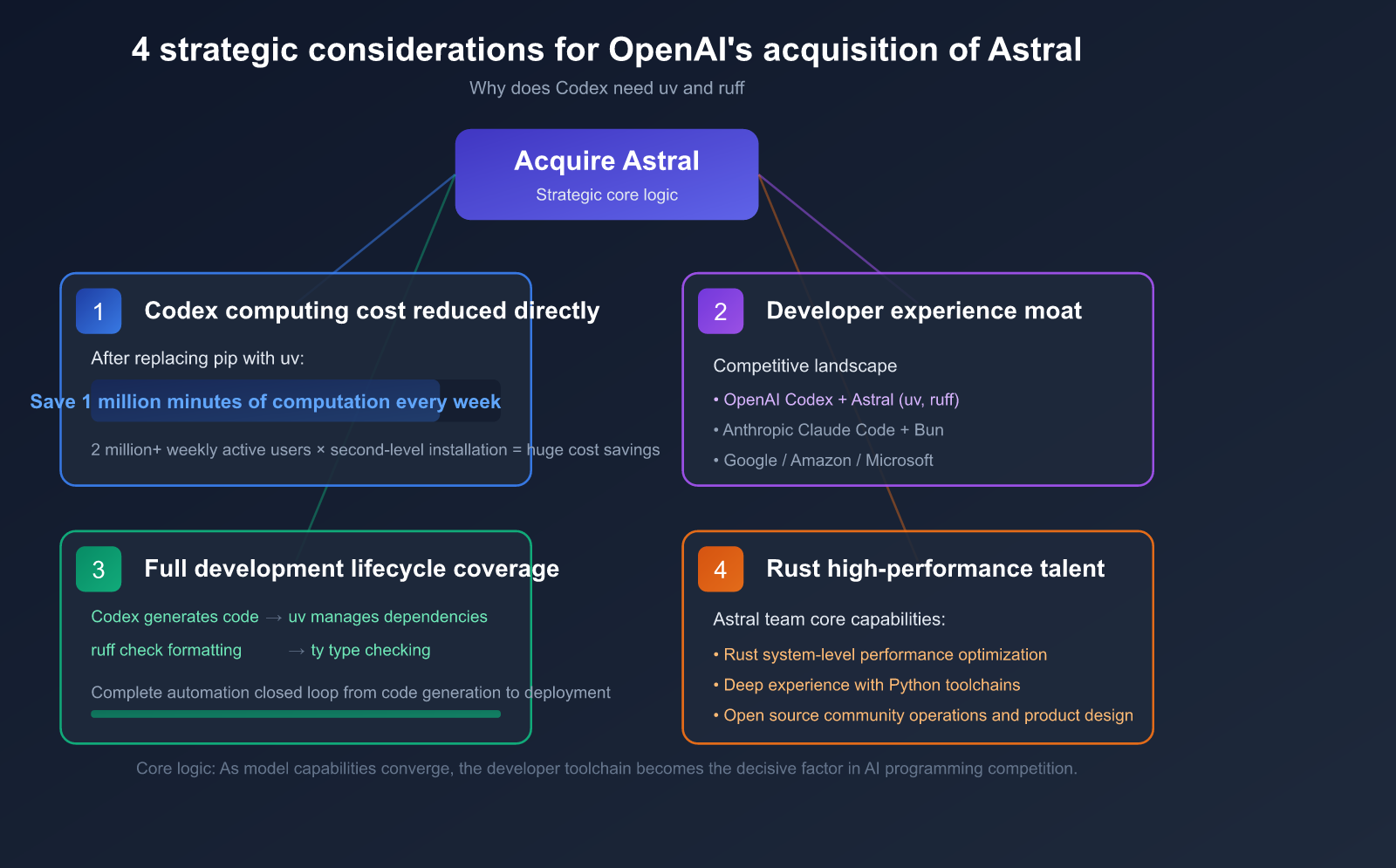
Consideration 1: Drastic Reduction in Codex Compute Costs—Saving 1 Million Minutes Weekly
This is the most direct business driver.
OpenAI’s Codex programming agent has over 2 million weekly active users (a 3x increase since early 2026). Every Codex session requires installing Python dependencies and running code.
Key Data: By replacing pip with uv, Codex saves approximately 1 million minutes of compute time every week.
| Comparison Metric | Using pip |
Using uv |
Improvement |
|---|---|---|---|
| Dependency Installation Speed | Slow (minutes) | Extremely fast (seconds) | 10-100x |
| Weekly Compute Consumption | High | Saves 1 million minutes | Significant reduction |
| Cache Efficiency | Basic | Intelligent caching | Reduced redundant downloads |
| Session Startup Time | Longer | Extremely short | Enhanced user experience |
For a company that reportedly "spends $2.50 for every $1 earned," this kind of infrastructure-level cost optimization is critical.
Consideration 2: A Moat for Developer Experience
Competition among AI companies is shifting from "model capabilities" to "developer toolchains."
- Anthropic acquired Bun (a JavaScript runtime) in December 2025 to enhance Claude Code.
- Amazon, Google, and Microsoft are also aggressively acquiring developer infrastructure.
Mastering the best toolchain for Python is how you build a competitive barrier in the AI programming space.
Consideration 3: Covering the Full Development Lifecycle
OpenAI’s ambition goes beyond just "generating code"; they want to be part of the entire development workflow:
Code Generation (Codex) → Dependency Management (uv) → Linting (ruff)
     → Type Checking (ty) → Formatting (ruff) → Deployment
By acquiring Astral, OpenAI allows Codex to automatically check, format, and manage dependencies while generating code, creating a seamless closed loop.
Consideration 4: High-Performance Rust Engineering Talent
The Astral team has deep expertise in high-performance system development using Rust. This capability is incredibly valuable for building out OpenAI’s core infrastructure.
💡 Industry Trend: The wave of AI companies acquiring developer tools is accelerating. This means developer tools will increasingly be deeply integrated with AI capabilities. If your project uses multiple models like OpenAI and Claude, using APIYI (apiyi.com) to manage your API keys centrally can help you avoid being locked into a single ecosystem.
Acquisition Details and Open Source Commitment Analysis
Key Transaction Information
| Information Item | Details |
|---|---|
| Announcement Date | March 19, 2026 |
| Acquisition Amount | Undisclosed |
| Transaction Status | Agreement signed, pending regulatory approval |
| Team Destination | Entire Astral team joins the OpenAI Codex team |
| Open Source Commitment | uv, ruff, and ty remain open source (MIT License) |
| pyx Registry | Not mentioned in the announcement, future uncertain |
Statement from Charlie Marsh
Astral founder Charlie Marsh stated on the official blog:
"Today, AI is rapidly changing how we build software, and the pace of this change is only accelerating. Joining OpenAI's Codex team is the highest-leverage thing we can do."
He also promised:
"We will continue to build in the open, with the community—serving the broader Python ecosystem—just as we have from the beginning."
A Sober Analysis of the Open Source Outlook
While both parties have committed to keeping the projects open source, the community's concerns aren't unfounded.
Optimistic Factors:
- The MIT license means that even in a worst-case scenario, the projects can be forked.
- Armin Ronacher (founder of Flask) assessed that "even in the worst-case future, this is a very easy project to fork and maintain."
- The tools themselves are already highly mature and stable.
Risk Factors:
- Development priorities may shift toward Codex requirements.
- Community contributor engagement might decline.
- The future of the commercial registry, pyx, remains unclear.
- Simon Willison warns: OpenAI lacks a track record of open-source acquisitions.
🎯 Practical Advice: Regardless of how the future of Astral's tools evolves, it’s always wise for AI application developers to choose technology stacks that aren't locked into a single vendor. APIYI (apiyi.com) provides a unified API interface for 200+ models, ensuring your application doesn't depend on any single AI platform.
Analysis of the 5 Major Impacts on Python Developers
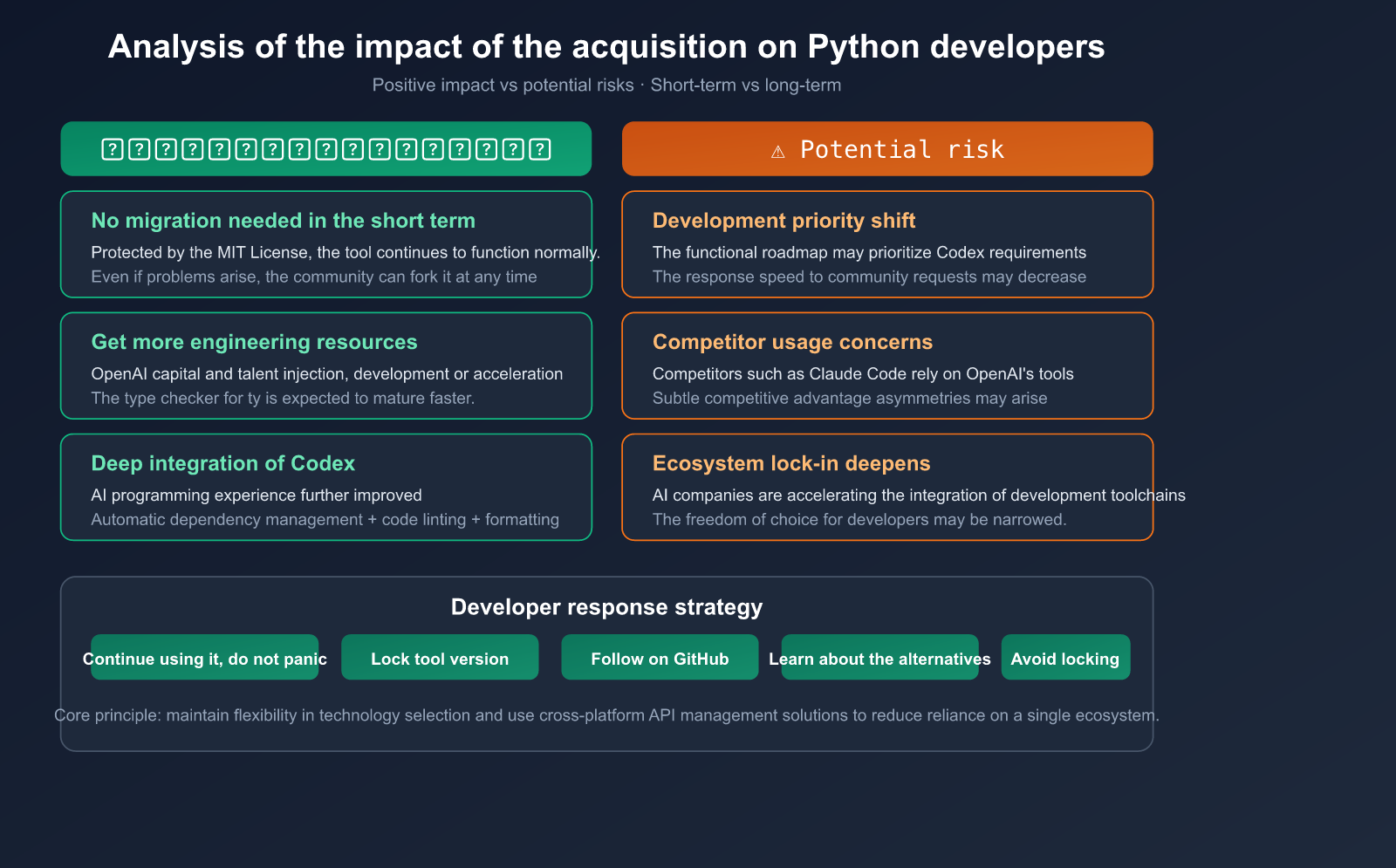
Impact 1: No Need for Panic Migration in the Short Term
uv and ruff are MIT-licensed open source projects. Even if OpenAI changes direction, the community can fork them. There is no need to perform any migration operations right now.
Impact 2: Tools May Receive More Resources
After joining OpenAI, Astral's tools may gain access to more engineering resources and financial backing, potentially accelerating development speed.
Impact 3: Deeper Integration with Codex
We can expect uv and ruff to see deeper integration with OpenAI Codex. Codex users may enjoy a more seamless Python development experience.
Impact 4: Risks of Competitor Usage
Simon Willison pointed out a scenario worth noting: OpenAI could theoretically leverage ownership of uv to exert influence over competitors (like Anthropic's Claude Code). While the MIT license provides legal protection, "maintenance priorities" and "feature direction" could still be steered.
Impact 5: Accelerated Consolidation of the AI Programming Ecosystem
This acquisition is the latest example of AI companies consolidating developer toolchains. Previously, Anthropic acquired Bun (a JavaScript runtime). Competition in the AI programming space has shifted from "whose model is smarter" to "whose developer experience is better."
Developer Response Strategy
| Strategy | Specific Action | Priority |
|---|---|---|
| Don't Panic | Continue using uv and ruff; no immediate migration needed | High |
| Lock Versions | Pin the versions of the tools you are currently using | Medium |
| Monitor Trends | Keep an eye on changes in GitHub repository contribution patterns | Medium |
| Know Alternatives | Be aware of alternatives like Poetry, PDM, Flake8, etc. | Low |
| Avoid Lock-in | Use cross-platform API management solutions | High |
💰 Reduce Risk: In the trend of rapid consolidation within the AI programming ecosystem, using a neutral API management platform is particularly important. Through APIYI (apiyi.com), you can simultaneously access AI programming capabilities from OpenAI Codex, Claude, Gemini, and others, avoiding lock-in to any single ecosystem.
The Industry Trend of AI Companies Acquiring Development Tools
This acquisition isn't an isolated event; it's part of an "AI toolchain arms race" sweeping through the industry.
AI Company Toolchain Acquisition Landscape (2025-2026)
| Acquirer | Target | Domain | Date | Strategic Intent |
|---|---|---|---|---|
| OpenAI | Astral (uv, ruff) | Python Toolchain | 2026.03 | Strengthen Codex ecosystem |
| Anthropic | Bun | JavaScript Runtime | 2025.12 | Enhance Claude Code |
| Amazon | Multiple Investments | Developer Infrastructure | Ongoing | Cloud service ecosystem |
| Multiple Investments | Developer Tools | Ongoing | Google Cloud ecosystem |
What This Means
For Developers: AI programming tools are becoming increasingly powerful, but they may also become more platform-locked. It's crucial to maintain flexibility in your technology stack.
For the Industry: Developer tools are becoming a core competitive advantage for AI companies. As model capabilities converge, the real battle is over "who can make developers more efficient."
🚀 Pro Tip: As AI companies accelerate their acquisition of development tools, choosing a "neutral platform" to handle your model invocations is becoming more important. APIYI (apiyi.com) supports unified access to all mainstream models, including OpenAI, Anthropic, and Google, helping you stay flexible amidst shifting ecosystems.
Quick Start: Core Usage of uv and ruff
Regardless of acquisition outcomes, uv and ruff remain the best tools for Python development today. Here’s a quick guide to getting started.
Getting Started with uv
# Install uv
curl -LsSf https://astral.sh/uv/install.sh | sh

# Create a new AI project
uv init ai-chatbot
cd ai-chatbot

# Add common AI development dependencies
uv add openai flask python-dotenv

# Run the project
uv run python main.py
Getting Started with ruff
# Install ruff
uv tool install ruff

# Check code quality
ruff check .

# Automatically fix issues
ruff check --fix .

# Format code (replaces Black)
ruff format .
Building an AI App with uv
import openai

client = openai.OpenAI(
    api_key="YOUR_API_KEY",
    base_url="https://api.apiyi.com/v1"  # APIYI unified interface
)

response = client.chat.completions.create(
    model="gpt-4o",
    messages=[{"role": "user", "content": "Hello!"}]
)
print(response.choices[0].message.content)
View Full AI Chat App Code
import openai
from flask import Flask, request, jsonify
from dotenv import load_dotenv
import os

load_dotenv()
app = Flask(__name__)

client = openai.OpenAI(
    api_key=os.getenv("API_KEY"),
    base_url="https://api.apiyi.com/v1"  # APIYI unified interface
)

@app.route("/chat", methods=["POST"])
def chat():
    user_msg = request.json.get("message", "")
    response = client.chat.completions.create(
        model="gpt-4o",
        messages=[
            {"role": "system", "content": "You are a helpful assistant."},
            {"role": "user", "content": user_msg}
        ]
    )
    return jsonify({"reply": response.choices[0].message.content})

if __name__ == "__main__":
    app.run(port=5000)
🚀 Get Started Fast: We recommend using uv to manage your Python dependencies. Combined with the unified API interface from APIYI (apiyi.com), you can build an AI application prototype that supports multi-model switching in just 5 minutes.
FAQ
Q1: Can I still use uv and ruff for free after OpenAI’s acquisition of Astral?
Yes. Both uv and ruff are licensed under the MIT open-source license, which means they will remain free and open-source forever. Even if OpenAI changes its strategy in the future, the community has the right to fork the repositories and continue maintenance. Both parties have explicitly committed to keeping them open-source.
Q2: Do I need to migrate from uv to other tools right now?
No. The community generally advises against panic-migrating. uv and ruff are currently the highest-performing tools in the Python ecosystem, and nothing will change in the short term. What you should do is pin your tool versions and keep an eye on the GitHub repository updates. If you're developing AI applications, you can use APIYI (apiyi.com) to manage model invocations across multiple providers, ensuring flexibility in your tech stack.
Q3: Does this acquisition have any direct impact on AI application developers?
In the short term, the impact is minimal. You can continue using uv and ruff as usual. In the medium to long term, these tools might be deeply integrated with OpenAI Codex, providing a better Python development experience for Codex users. However, for developers using other AI coding tools (like Claude Code), it's worth monitoring whether the feature prioritization of Astral's tools shifts toward Codex. Using APIYI (apiyi.com) to access multiple models simultaneously can help reduce the risk of ecosystem lock-in.
Q4: What will happen to Astral’s pyx package registry?
This is a point of concern. pyx is a Python package registry (Beta) released by Astral in August 2025, but it wasn't mentioned by either party in the acquisition announcement. This suggests that pyx might not align with OpenAI's strategic direction, leaving its future uncertain.
Q5: Are there any alternatives to uv and ruff?
For package management: Poetry, PDM, and pip-tools. For linting: Flake8 + Black + isort (the traditional combination). However, these tools currently lag significantly behind Astral's products in terms of performance. It's recommended to stick with uv and ruff for now while staying informed about the alternatives.
Summary: The Shift in the Python Ecosystem Behind the Acquisition
OpenAI's acquisition of Astral is a landmark event in the AI industry's consolidation of developer toolchains. As the most popular modern tools in the Python ecosystem, uv and ruff will profoundly change the competitive landscape of AI programming now that they are part of the OpenAI Codex roadmap.
3 Key Takeaways:
- Short-term: uv and ruff remain unaffected; continue using them as usual.
- Medium-term: Expect deep integration with Codex, leading to an enhanced experience within the OpenAI ecosystem.
- Long-term: Developer tools are becoming a core competitive advantage for AI companies, increasing the risk of ecosystem lock-in.
For AI application developers, maintaining flexibility in your technology choices is the best strategy to navigate these changes. We recommend using APIYI (apiyi.com) to unify the management of model invocations from multiple providers, helping you stay in control within the rapidly evolving AI landscape.
References
-
Astral Official Blog: OpenAI Acquisition Announcement
- Link:
astral.sh/blog/openai
- Link:
-
OpenAI Official Announcement: Statement on the Acquisition of Astral
- Link:
openai.com/index/openai-to-acquire-astral/
- Link:
-
Simon Willison's Analysis: An in-depth perspective from an independent developer
- Link:
simonwillison.net
- Link:
-
Astral Official Website: Product and tool introductions
- Link:
astral.sh
- Link:
Author: APIYI Team | Stay tuned for the latest updates in the AI programming ecosystem. Visit APIYI at apiyi.com for technical support and a unified API interface for various models.