
Author’s note: Along the two lines of image editing and image generation, this compares the final leaderboard ranges, normalized prices, and invocation channels for the MAI-Image-2.7 and GPT Image 2.6 tiers, then lays out selection steps you can follow directly.
If your image work is mostly editing, with the occasional generation from scratch, you’ve probably been torn lately between MAI-Image-2.7 and GPT Image 2.6. The former was released by Microsoft on 2026-11-17, while the latter shows up on the leaderboard in two tiers, Sunburst and Flare, each with its own score.
This isn’t an article about ranking. Image editing and image generation are two different things. The same model doesn’t sit in the same place on both leaderboards, and when the scores are close, you can’t just jump to a conclusion.
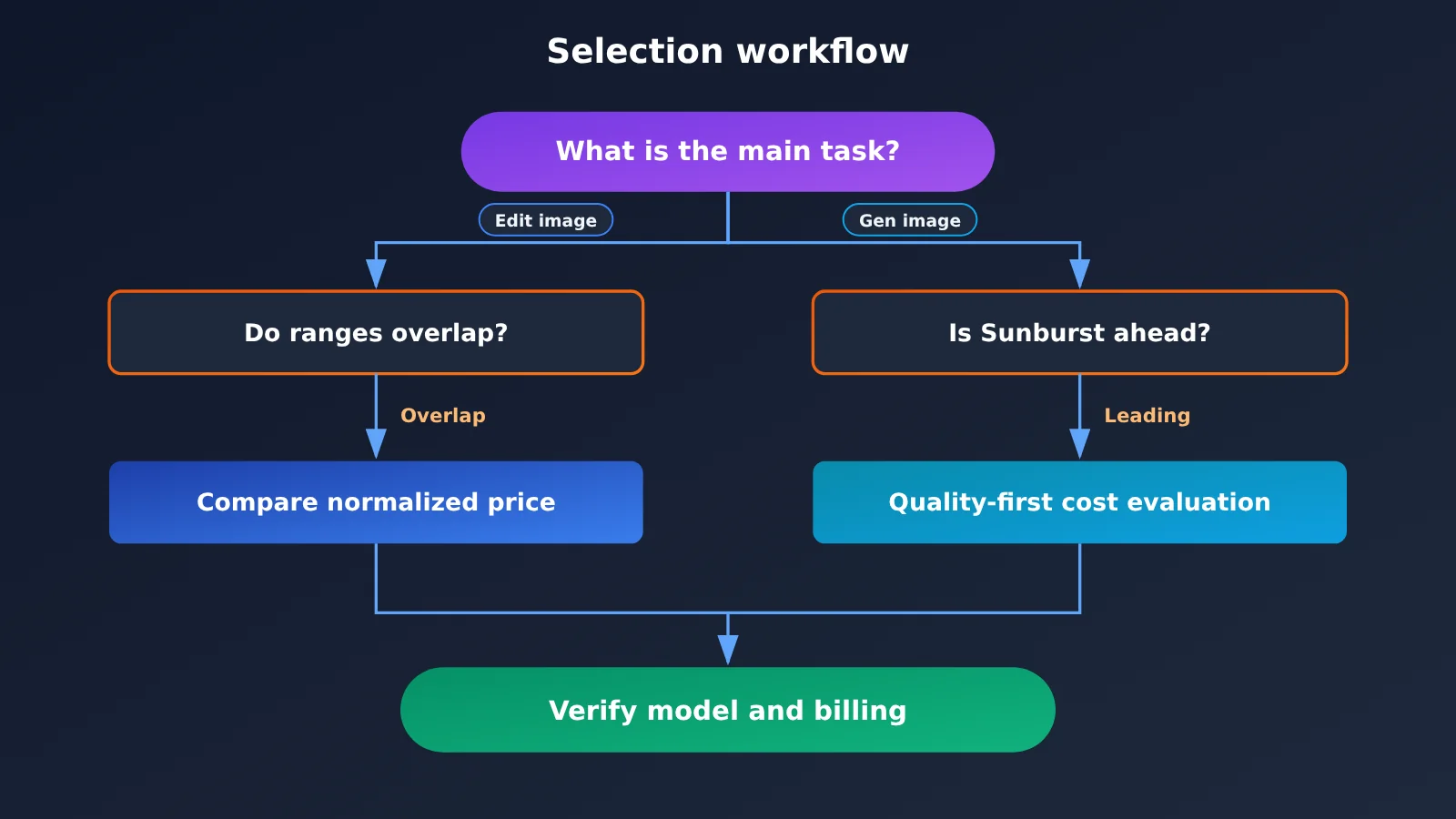
Here are three steps you can put to use right away, then we’ll dig into the data:
- For image editing, first check whether the score ranges on both sides overlap. If they do, don’t treat a few points of difference as a win—then compare the price per thousand images.
- For image generation, first check whether GPT Image 2.6’s Sunburst tier is clearly ahead, and don’t substitute the editing ranking for it.
- Before you actually place an order, figure out which tier each model on the invocation platform corresponds to and how it’s billed, and don’t mix prices from different tiers.
Key point: Look at image editing and image generation separately. For each line, check the range first, then the price.
Before Comparing MAI-Image-2.7 and GPT Image 2.6: First, Split the Model into Three
A lot of discussions treat GPT Image 2.6 as a single model with a single score. In reality, in the Artificial Analysis final leaderboard read on 2026-11-18, it shows up as two separate entries — Sunburst (max) and Flare (max) — each with its own score and range. So this comparison is really a three-way affair: MAI-Image-2.7, GPT Image 2.6 Sunburst, and GPT Image 2.6 Flare.
The data sources need to be kept separate too. Artificial Analysis’s final leaderboard computes Elo from human pairwise preference votes and provides a 95% confidence interval plus a possible ranking range; the Microsoft announcement is an official self-description; Arena is a separate independent arena with a different methodology from the other two.
| Source | Nature | How it’s used in this article |
|---|---|---|
| Artificial Analysis final leaderboard (read 2026-11-18) | Independent third party, human preference voting Elo + 95% interval | Primary basis for image editing and image generation comparisons |
| Microsoft announcement (2026-11-17) | Official self-description | Capability descriptions, official pricing reference — labeled separately |
| Arena post (2026-11-17) | Another arena, different methodology | Supporting evidence only; never mixed into the final leaderboard scores |
| 2026-10-27 preview draft | Old snapshot | Not used for these results |
Pricing Reference for MAI-Image-2.7 vs. GPT Image 2.6
The price column in the Artificial Analysis final leaderboard is a normalized price for generating 1,000 images at 1024×1024 with default settings on the vendor’s own API. It’s fine for side-by-side comparisons, but it doesn’t equal the per-image price you actually pay on some platform — I’ll cover that separately when we get to invocation channels later.
Core Differences Between MAI-Image-2.7 and GPT Image 2.6 for Image Editing
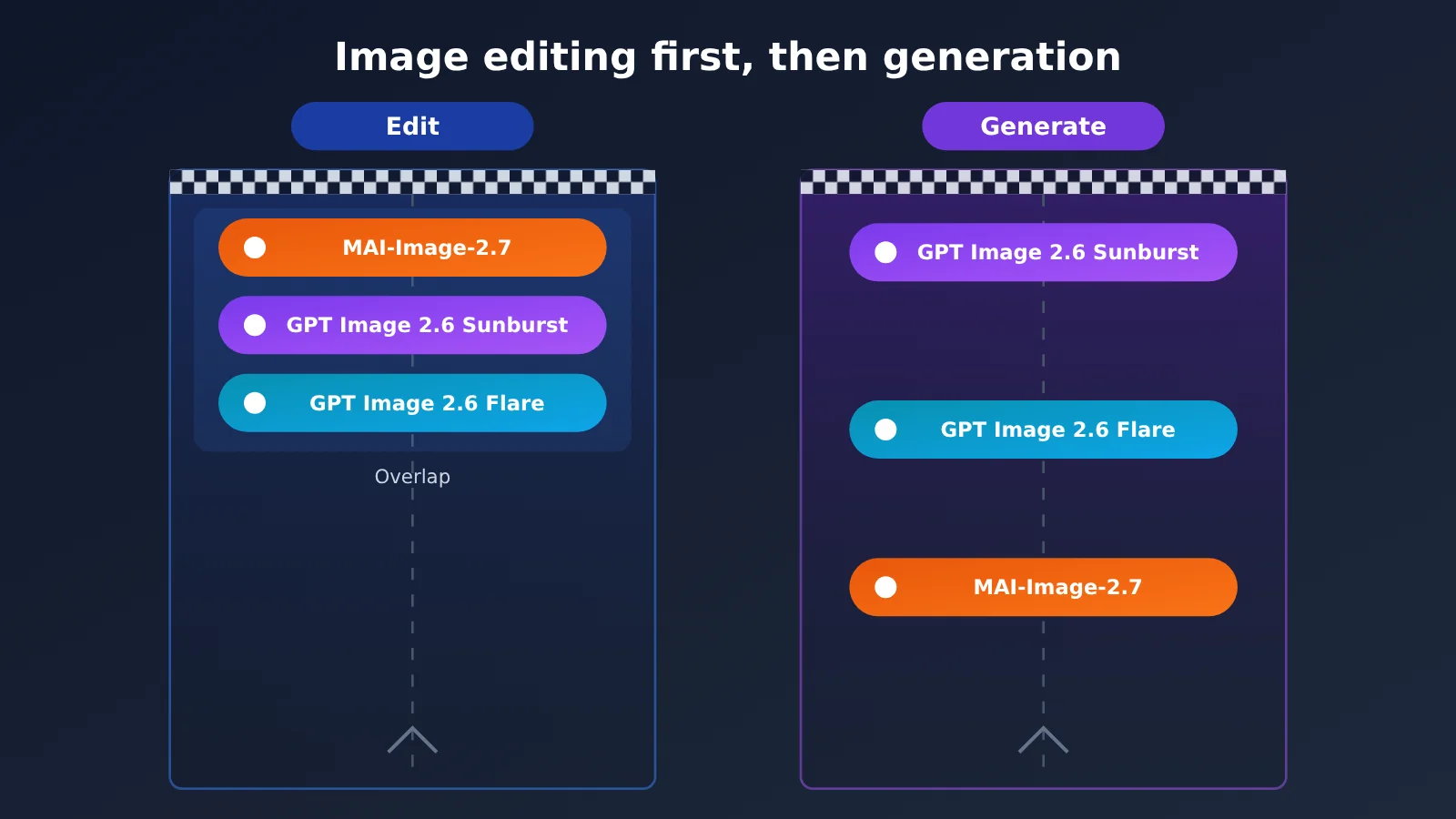
Image editing is the part of this release Microsoft pushed hardest. On the image editing leaderboard of the final Artificial Analysis rankings, the three players line up like this:
| Model | Rank (possible range) | Elo | 95% interval | Samples | Normalized price (per thousand images) |
|---|---|---|---|---|---|
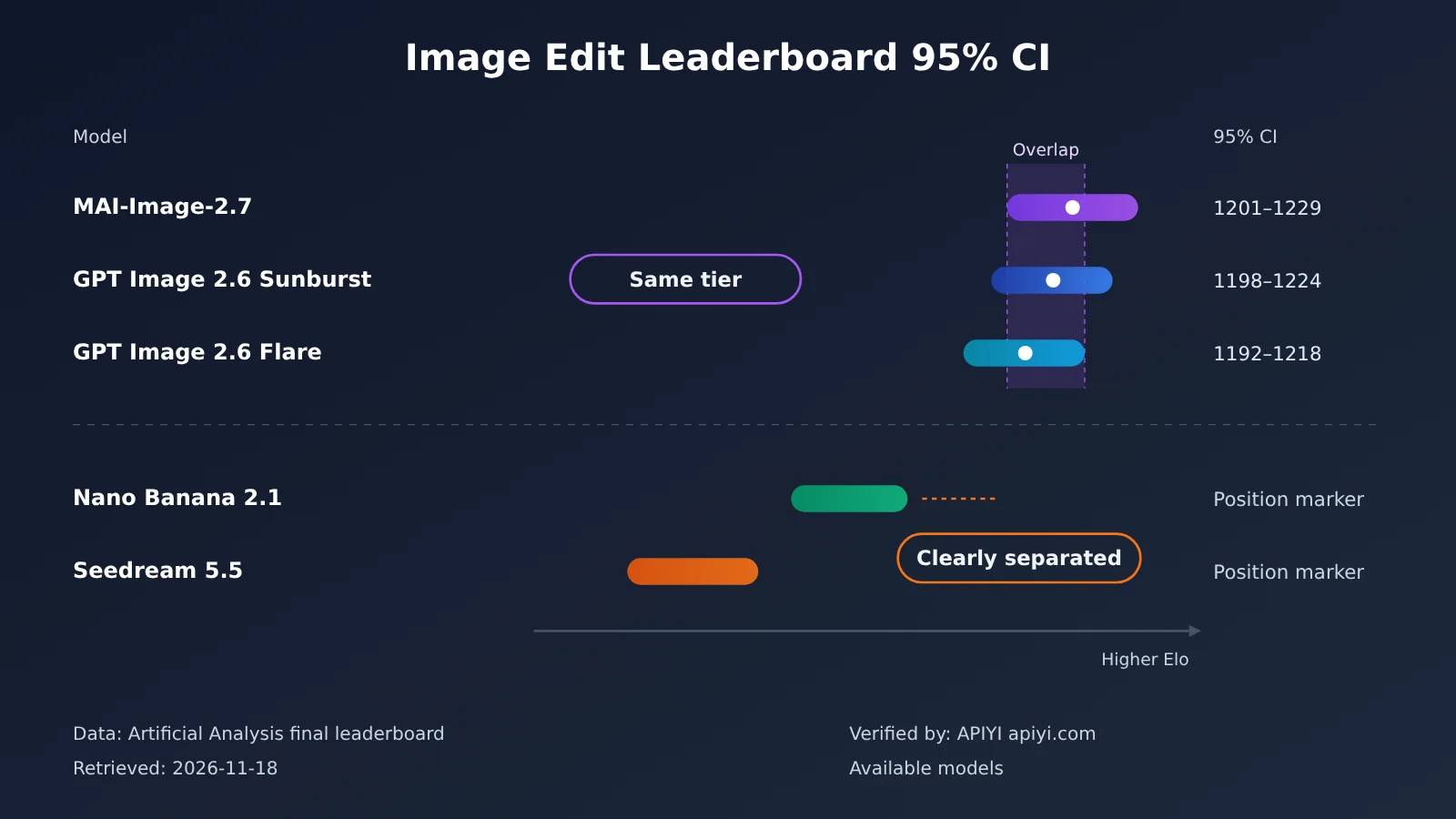
| MAI-Image-2.7 | 1st (1–3) | 1215 | 1201–1229 | 5478 | $34.82 |
| GPT Image 2.6 Sunburst (max) | 2nd (1–4) | 1211 | 1198–1224 | 6554 | $210.72 |
| GPT Image 2.6 Flare (max) | 3rd (1–4) | 1205 | 1192–1218 | 6798 | $210.72 |
| MAI-Image-2.7-Flash | 7th (5–7) | 1179 | 1166–1192 | 5891 | $10.24 |
| Seedream 5.5 | 8th (8–11) | 1160 | 1146–1174 | 5101 | $28.00 |
| Nano Banana 2.1 | 10th (8–13) | 1152 | 1140–1164 | 7606 | $33.60 |
MAI-Image-2.7 leads Sunburst’s 1211 by 4 points and Flare’s 1205 by 10. But their intervals — 1201–1229, 1198–1224, and 1192–1218 — all overlap, and every rank range includes first place. In other words, a 4-point lead doesn’t mean the gap is open, and 10 points can’t be written up as a stable advantage either; statistically, the three belong in the same tier.
What does separate them is the gap between tiers. MAI-Image-2.7’s image editing interval doesn’t overlap with Nano Banana 2.1 or Seedream 5.5, so at that level you can confirm it sits ahead. Microsoft’s own statement claims it’s No. 1 in image editing and beats GPT Image 2.6 Sunburst (max), with a footnote noting the data is as of 2026-11-16 and the lead is 4 Elo — which matches the final leaderboard numbers. But the word “beats” needs to be read alongside the intervals.
How MAI-Image-2.7 Performs on Individual Image Editing Tasks
Artificial Analysis’s launch thread notes that MAI-Image-2.7 ranks No. 1 in 4 of 7 image editing actions. The ones it names are text or symbols, scenes and styles, and enhancement and restoration; the name of the fourth doesn’t appear in the post body. Across 10 image editing use cases, it takes No. 1 in 4: architecture and real estate, consumer, Frontier, and marketing and advertising. If your image editing needs happen to cluster in those areas, these per-category results are worth a look.
MAI-Image-2.7 vs GPT Image 2.6: The Core Differences in Image Generation
Switch to the text-to-image leaderboard and the picture changes. That’s exactly why you can’t swap editing rankings in for generation rankings.
| Model | Rank (possible range) | Elo | 95% interval | Samples | Normalized price (per 1,000 images) |
|---|---|---|---|---|---|
| GPT Image 2.6 Sunburst (max) | 1st (only 1) | 1261 | 1247–1275 | 5337 | $210.72 |
| GPT Image 2.5 Sunburst (max) | 2nd | 1229 | 1219–1239 | — | — |
| GPT Image 2.6 Flare (max) | 3rd (2–4) | 1227 | 1215–1239 | 7214 | $210.72 |
| MAI-Image-2.7 | 4th (3–5) | 1214 | 1200–1228 | 5008 | $34.82 |
| Nano Banana 2.1 | 8th (7–10) | 1176 | 1164–1188 | 6793 | $33.60 |
| MAI-Image-2.7-Flash | 11th (9–12) | 1158 | 1146–1170 | 5951 | $10.24 |
| Seedream 5.5 | 14th (13–17) | 1134 | 1122–1146 | 5260 | $20.00 |
Sunburst’s 1261 against MAI-Image-2.7’s 1214: the intervals 1247–1275 and 1200–1228 don’t overlap, and its rank range is just 1st. On this segment you can say outright that Sunburst has pulled ahead in generation. Flare’s 1227 against MAI-Image-2.7’s 1214: the intervals 1215–1239 and 1200–1228 still overlap, so a 13-point gap doesn’t settle anything.
Microsoft’s Ignite post describes itself as 4th in text-to-image, and on that basis calls itself the second-place lab — which lines up with the final leaderboard. MAI-Image-2.7 ranks 1st in the Knowledge category for text-to-image, but its overall rank still sits behind Sunburst.
How should you read MAI-Image-2.7 and GPT Image 2.6 pricing?
There are two price claims, and they come from different sources, so we need to keep them separate.
| Basis | MAI-Image-2.7 | GPT Image 2.6 (max) | Multiple | Source |
|---|---|---|---|---|
| Normalized price (per 1,000 images) | $34.82 | $210.72 | 210.72 ÷ 34.82 ≈ 6.05 | Artificial Analysis final leaderboard |
| Per-image equivalent | $0.03482 | $0.21072 | about 6x | Same conversion |
| Official claim | about $35 per 1,000 images | — | about one-fifth the cost | Microsoft announcement; company’s own statement |
| Arena claim | about $0.035/image | — | — | Arena post |
Microsoft said in its announcement that MAI-Image-2.7 costs roughly one-fifth as much as GPT Image 2.6 Sunburst (max). That’s the company’s own claim. Using the two tiers’ normalized prices from the final Artificial Analysis leaderboard, 210.72 divided by 34.82 comes out to about 6.05x, or roughly one-sixth. Keep the source attached to each claim, and don’t merge them into a single number.
The Flash tier is cheaper: its normalized price on the final leaderboard is $10.24 per 1,000 images, and Microsoft says about $10 per 1,000 images. Arena’s roughly $0.035/image, Microsoft’s roughly $35 per 1,000 images, and the final leaderboard’s $34.82 are all in the same ballpark, but they’re not from the same price sheet.
Back to image editing: since the ranges from the three sources overlap and quality is too close to call, the roughly 6x normalized price gap becomes the more decisive factor in real-world decisions. Image generation is the opposite: Sunburst’s lead is clear, so you need to decide whether that extra quality is worth paying more for.
Checking APIYI apiyi.com’s model catalog (data timestamp 2026-11-17 15:54, UTC+8) and the pricing API read on 2026-11-18, the only Microsoft image models in either place right now are MAI-Image-2.6 (per call $0.12) and MAI-Image-2.6-Flash (per call $0.06). Those are 2.6-generation prices and shouldn’t be treated as 2.7 pricing. MAI-Image-2.7 and MAI-Image-2.7-Flash aren’t listed yet; we’ll get these models listed as soon as we can. Model names and prices are subject to the platform’s model list.
Three Channels for Calling GPT Image 2.6 on APIYI
GPT Image 2.6 has three model IDs on APIYI, each mapping to a different channel — and their prices don’t mix:
| Model ID | Summary table billing | Pricing API | Endpoint | Groups |
|---|---|---|---|---|
gpt-image-2.6-sunburst |
$0.2 per call | model_price 0.2, plus a per-million-token billing formula | images | Default, image2Enterprise, image2_OSS, SVIP |
gpt-image-2.6-flare |
$0.2 per call | same as above | images | same as above |
gpt-image-2.6-all |
$0.025 per call | — | chat, images | Default, image2_OSS, SVIP |
The Sunburst and Flare models are listed in the summary table at $0.2 per call; the pricing API at that same moment carries not only model_price 0.2 but also the billing expression p * 5 + cr * 1.25 + img * 8 + img_cr * 2 + c * 30. That works out to $5 for text input, $1.25 for text cache reads, $8 for image input, $2 for image cache reads, and $30 for output — all per million tokens. The summary table and the API don’t say the same thing, so both versions are listed here. Check the console bill before you call.
gpt-image-2.6-all is a separate channel at $0.025 per call. That price belongs to all alone and can’t be applied to Sunburst or Flare. Likewise, the $210.72 per thousand images on the Artificial Analysis leaderboard reflects the max tier at the default 1024 setting — roughly $0.211 per image — and that isn’t the all price either.
As for how to call it, APIYI uses an OpenAI-compatible interface: set the SDK’s base_url to https://api.apiyi.com/v1, swap the model parameter for one of the three model IDs above, and hit the images endpoint. For image-editing work, it’s worth running a small batch of your own real assets through Sunburst and Flare first, then comparing the bills to see which tier comes out cheaper.
🚀 Quick start: With a single API key on APIYI (apiyi.com) you can switch between
gpt-image-2.6-sunburst,gpt-image-2.6-flare, andgpt-image-2.6-all. New users get free trial credit, which makes it easy to compare results and bills across all three channels using a small batch of assets first.
Scenario Recommendations for MAI-Image-2.7 vs. GPT Image 2.6
When MAI-Image-2.7 Is the Better Fit
- Editing-heavy, high-volume work: Its range overlaps the two GPT Image 2.6 tiers, but the normalized price is roughly one-sixth, and that cost gap widens as usage grows.
- Category fit: Text and symbols, scenes and styles, enhancement and restoration, plus use cases like architecture and real estate or marketing and advertising — it ranks No. 1 in the final leaderboard on these.
- You need transparent backgrounds: Microsoft’s own documentation says both 2.7 and Flash support transparent backgrounds, which works for product shots, logos, and icons. Note that this comes from the vendor, not from leaderboard testing.
When GPT Image 2.6 Sunburst Is the Better Fit
- Mostly generating from scratch, with image quality as the priority: It scores 1261 on text-to-image, a range that doesn’t overlap MAI-Image-2.7 at all, and its rank range is simply No. 1.
- You want one model for both editing and generation: Its editing capabilities overlap with the top tier while its generation leads, which cuts down the management overhead of switching between models.
When to Look at Flare or all
Flare’s range overlaps MAI-Image-2.7 on both leaderboards, and it sits in the same price tier as Sunburst — so it’s worth comparing against Sunburst on your own actual assets before deciding. gpt-image-2.6-all is a separate channel at $0.025 per call; it doesn’t use the same billing basis as the max tier on the leaderboard, so it’s a good way to get a pipeline working end to end while keeping experimentation costs down.
Alternative Models If You Need to Launch Now
If your project can’t wait for 2.7 to go live, take a look at two models already available on APIYI. gemini-nano-banana-2.1 costs $0.045 per call, with 1K, 2K, and 4K all at the same price. It supports up to 10 object reference images + 4 character reference images + 3 style reference images, and uses Gemini’s native /v1beta/models/gemini-nano-banana-2.1:generateContent path. Per the docs, per-call billing is cheaper at 4K, while usage-based billing is lower at 1K and 2K. Seedream 5.5 (seedream-5-5-261028 or doubao-seedream-5-5-261028) only exposes /v1/images/generations, with reference images passed in the image field; it natively supports transparent images and layer separation of up to 100 layers. These two capabilities weren’t part of the preference scoring, so the docs are your source of truth here.
Decision Recommendations for MAI-Image-2.7 and GPT Image 2.6
Here’s how to turn the above into an actionable path:
- Pin down the primary task: Look at your invocation volume over the past month and estimate roughly how much is image editing versus image generation.
- For image editing, look at the range: The three providers’ ranges overlap, so quality isn’t the deciding factor. Instead, compare normalized pricing — about 6x under the final leaderboard calculation, or about one-fifth according to Microsoft’s own account.
- For image generation, look at Sunburst: It has a clear lead. Then assess whether that quality gain is worth the extra cost; Flare and MAI-Image-2.7 still need a real-world comparison.
- Check the channels: The three model IDs — Sunburst, Flare, and all — are billed separately, so check the dashboard billing before invoking.
- Wait for 2.7 to launch: Before launch, use GPT Image 2.6 or an available alternative model to get the workflow running; after launch, run an A/B comparison.
💡 Recommendation: Which model you pick depends on your image-editing-to-generation ratio and your budget. We suggest using APIYI (apiyi.com) to invoke Sunburst, Flare, and all separately with the same set of real assets, then decide based on the bill and final output quality; once MAI-Image-2.7 launches, you can add it directly to the same comparison workflow.
Frequently Asked Questions (FAQ)
Q1: What is MAI-Image-2.7?
An image model released by Microsoft AI on 2026-11-17, alongside MAI-Image-2.7-Flash. Both support text-to-image and image editing, and are currently in public preview on Microsoft Foundry. The Foundry catalog page lists text and images as input, and images as output.
Q2: MAI-Image-2.7 leads GPT Image 2.6 by a few points on image editing — does that count as a win?
Not a clear gap. According to the Artificial Analysis final leaderboard read on 2026-11-18, MAI-Image-2.7 sits at 1215, Sunburst at 1211, and Flare at 1205. Their 95% intervals overlap, and every rank range includes 1st place — so the fair take is that they’re all in the same tier.
Q3: Can I infer text-to-image performance from the image-editing rankings?
No. On the text-to-image leaderboard, Sunburst is at 1261 versus MAI-Image-2.7 at 1214, and those intervals don’t overlap; Flare’s 1227 still overlaps with MAI-Image-2.7. The two leaderboards tell different stories, so you need to look at each one separately.
Q4: Is the price difference one-fifth or one-sixth?
The two numbers come from different sources. Microsoft itself describes the cost as roughly one-fifth of Sunburst (max); using the normalized prices on the Artificial Analysis final leaderboard, 210.72 ÷ 34.82 ≈ 6.05, which works out to about one-sixth. Both figures assume the 1024 default settings, and neither equals the actual per-unit price on any given platform.
Q5: Can I call MAI-Image-2.7 through an API right now?
Microsoft’s announcement says it’s available through Microsoft Foundry as well as fal, Genspark, OpenRouter, and Vercel. APIYI currently offers `MAI-Image-2.6` and `MAI-Image-2.6-Flash`; the two 2.7 models aren’t listed yet. In the meantime, you can get your workflow up and running with the three GPT Image 2.6 models on APIYI at apiyi.com.
Q6: Is the $0.025 for gpt-image-2.6-all the price of Sunburst?
No. $0.025 applies only to the `gpt-image-2.6-all` channel. `gpt-image-2.6-sunburst` and `gpt-image-2.6-flare` are listed at $0.2 per call in the summary table, and the pricing API also includes a per-million-token formula — your bill is the source of truth.
Q7: What limitations do the leaderboards fail to capture?
Preference voting scores don’t test capabilities like transparent backgrounds or layer separation. MAI-Image-2.7’s transparent background support and editing consistency come from Microsoft’s own claims, and 2.7 is still in public preview. On APIYI, GPT Image 2.6’s two billing formats haven’t been unified yet, so keep an eye on your bill.
MAI-Image-2.7 vs. GPT Image 2.6: Key Takeaways
- Three-way comparison: GPT Image 2.6 appears on the leaderboard as both Sunburst and Flare, so you can’t just pick one score.
- Image editing sits in the same tier: the 1215, 1211, and 1205 ranges overlap — a 4-point lead doesn’t mean anyone has pulled ahead.
- Image generation is layered: Sunburst’s 1261 and MAI-Image-2.7’s 1214 ranges don’t overlap, but Flare’s still does.
- Two ways of stating the price: Microsoft’s own wording puts it at roughly one-fifth, while the final leaderboard calculation comes out to about 6.05x — each figure needs its source labeled.
- Channels are billed separately: in the overview table, Sunburst and Flare are $0.2 per call with a token formula attached, while all is $0.025 per call.
- How to try it: before 2.7 launches, you can compare all three GPT Image 2.6 channels on APIYI apiyi.com using the same API key.
Summary
The key to comparing MAI-Image-2.7 and GPT Image 2.6 is to keep image editing and image generation separate:
- Image editing: the three-way ranges overlap, so quality alone isn’t enough to tell them apart. What matters most is the price gap — about 6x (final leaderboard) or about one-fifth (Microsoft’s own statement).
- Image generation: Sunburst’s lead is clear, while Flare and MAI-Image-2.7 are still in overlapping ranges.
- Invocation: each of the three model IDs is billed separately, so go by your control panel invoice; 2.7 isn’t listed yet.
We’d suggest running a small-batch comparison with your real assets, based on your own mix of image editing and image generation. You can do the testing through APIYI apiyi.com using the OpenAI-compatible interface, then add MAI-Image-2.7 to the comparison once it goes live.
📚 References
-
Artificial Analysis image editing final leaderboard: retrieved 2026-11-18
- Link:
artificialanalysis.ai/image/leaderboard/editing - Notes: image editing Elo, 95% intervals, rank ranges, and normalized price
- Link:
-
Artificial Analysis text-to-image final leaderboard: retrieved 2026-11-18
- Link:
artificialanalysis.ai/image/leaderboard/text-to-image - Notes: text-to-image Elo, intervals, and normalized price
- Link:
-
Artificial Analysis release thread: 2026-11-17
- Link:
x.com/ArtificialAnlys/status/2122754535206846610 - Notes: image editing sub-scores and rankings by use case
- Link:
-
Microsoft MAI-Image-2.7 announcement: official statement
- Link:
microsoft.ai/news/introducing-mai-image-2-7 - Notes: capability description, official pricing basis, and footnote statistics date
- Link:
-
Arena release post: 2026-11-17
- Link:
x.com/arena/status/2122764936388784405 - Notes: an alternative arena methodology, used only as corroborating evidence
- Link:
Author: APIYI technical team
Technical discussion: feel free to contact us via the APIYI website homepage. The full model list and integration guides are available in the docs center at docs.apiyi.com