Author’s note: As of November 8, 2026, Gemini 4 Flash still has no official model ID. This article examines the sources behind the Hydrogen and Hyperion codenames, clarifies how they relate to Gemini 4 Argon and Gemini 3.8 Flash, and provides a checklist for choosing a model and preparing for launch.
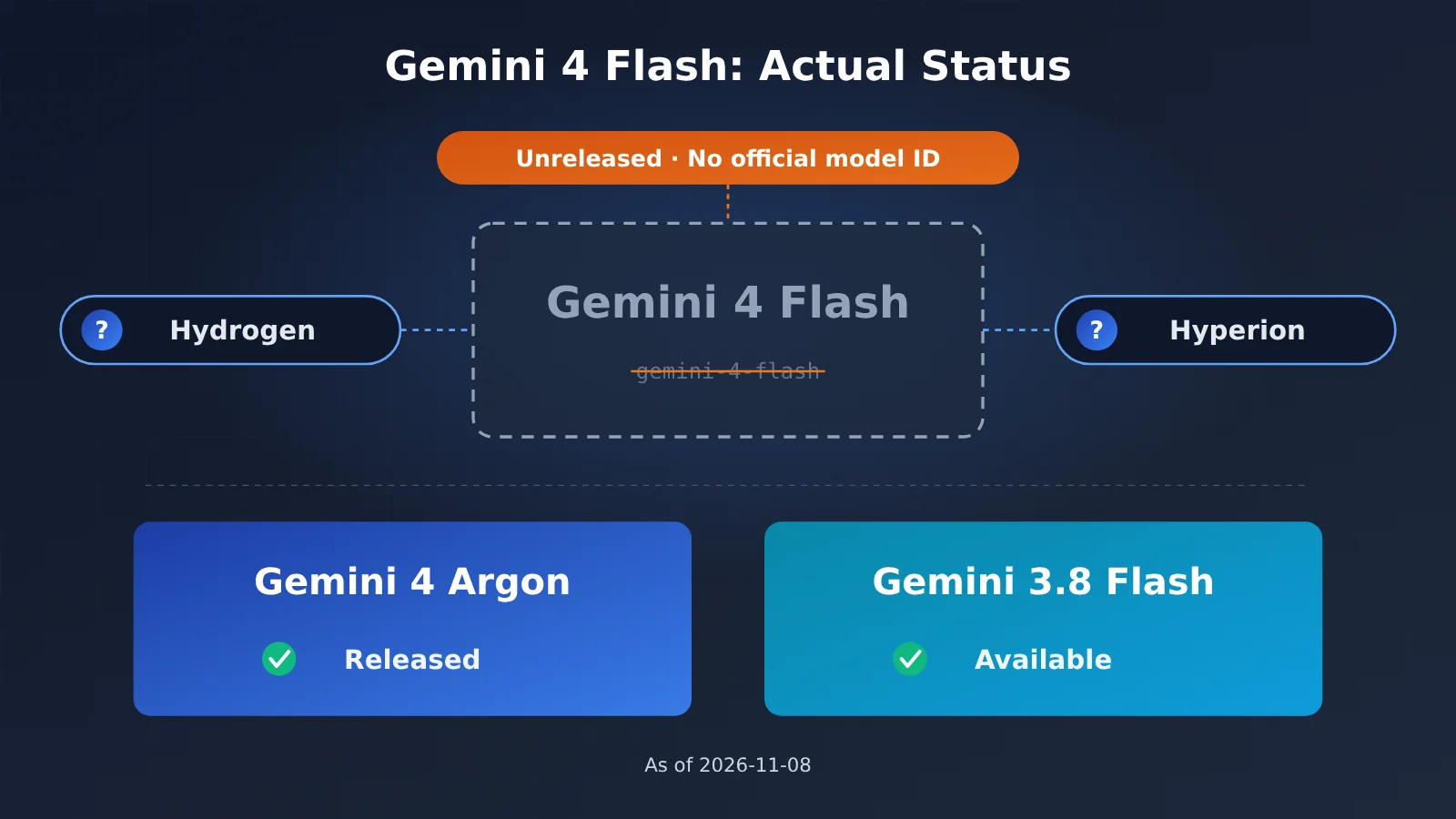
Here’s the bottom line: Gemini 4 Flash hasn’t been released. As of November 8, 2026, Google hasn’t announced an official model ID for Gemini 4 Flash, gemini-4-flash doesn’t appear in the Gemini API model reference, and there’s no official release date. If your team is considering pausing its plans because someone says “Flash is coming next week,” don’t stop just yet.
For now, there are two models you can actually call. Use gemini-4-argon when you need flagship capabilities and a long context window. Use Gemini 3.8 Flash when you need high concurrency, low latency, and predictable costs. The Hydrogen and Hyperion codenames are worth watching, but they’re leaked clues, not signs of a release.
This isn’t about talking down a new model. We’re separating confirmed facts, leaked clues, and pure rumors so you can make scheduling decisions based on verifiable information.
What you’ll get: A three-minute overview of Gemini 4 Flash’s actual status, plus a decision table showing what you can use now and how to prepare before launch.
Has Gemini 4 Flash Launched? Start With a Clear Standard
Before discussing model launch rumors, teams should agree on how to verify a release. Otherwise, a product manager might see a leak and an engineer might see a screenshot, only for each to have a different understanding of what “released” means. We recommend using Google’s own release channels as the sole source of truth and requiring multiple criteria to be met at the same time.
| Criterion | Specific standard | Current status of Gemini 4 Flash |
|---|---|---|
| Official model ID | Appears on the Gemini API model reference page | ❌ Not listed; only gemini-4-argon appears |
| Pricing page | The Gemini API pricing page lists a price for the model | ❌ Not listed |
| Available in AI Studio | Can be selected directly from the model dropdown in AI Studio | ❌ No official option |
| Official announcement | Published on Google’s official blog or an official account | ❌ None |
The rule is simple: the first three criteria must all be met for a model to count as “released.” An official announcement is a bonus, but an announcement alone doesn’t let developers integrate a model into production without a model ID and pricing. By this standard, Gemini 4 Flash meets none of the four criteria, so there’s no ambiguity in the conclusion.
This standard has another advantage: you can build it directly into your team’s model approval process. Whether the next model comes from Gemini, Claude, or another provider, you can check it against these criteria before deciding whether to invest resources in evaluating it.
💡 Recommended approach: Besides official documentation, the model list in your API access layer is another useful checkpoint. With APIYI apiyi.com, for example, a model’s availability is determined by the console’s model list. A rumored model won’t appear there just because a leak is generating buzz.
Gemini 4 Flash: Facts, Leaks, and Rumors Compared
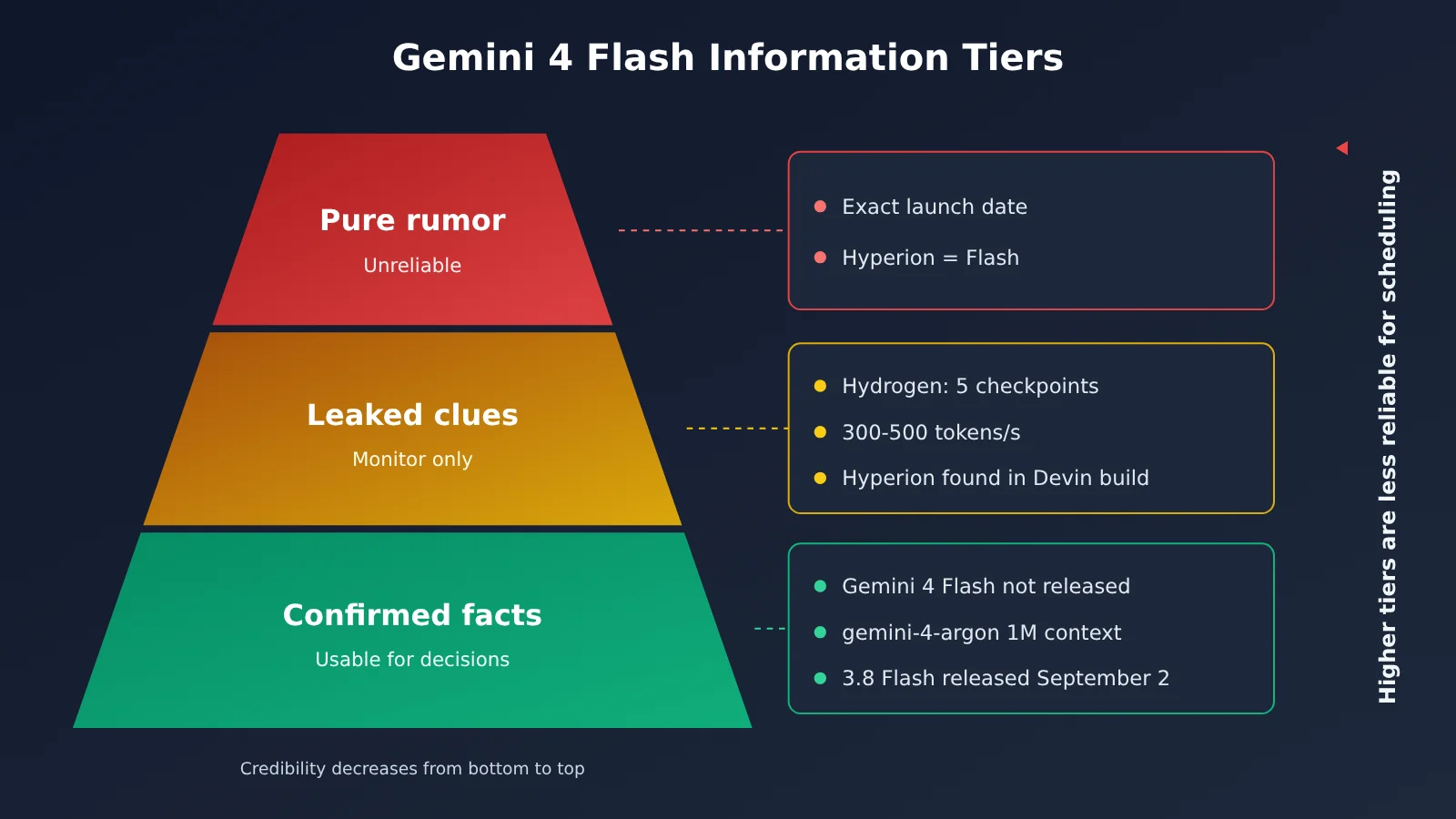
Sorting the information in circulation by credibility is more efficient than debating each claim individually. The table below provides the basis for this article’s conclusions:
| Information | Category | Source | Can you make decisions based on it? |
|---|---|---|---|
| Gemini 4 Flash has not launched and has no official model ID | Confirmed fact | Gemini API model reference | ✅ Yes |
gemini-4-argon has launched, with a 1M context window and API availability |
Confirmed fact | Gemini API documentation | ✅ Yes |
| Gemini 3.8 Flash is the latest Flash model, released on September 2, 2026 | Confirmed fact | Official Google release | ✅ Yes |
| Gemini 4 Flash is internally codenamed Hydrogen and has five checkpoints | Leaked lead | Claims from an X account | ⚠️ Worth watching only |
| Hydrogen output speed is 300–500 tokens/s | Leaked lead | Claims from an X account | ⚠️ Not suitable for capacity planning |
| A/B testing in LMArena and AI Studio began in late October | Leaked lead | Claims from an X account | ⚠️ Worth watching only |
| The Hyperion model family appeared in a Devin build | Leaked lead | Cognition’s Devin build | ⚠️ Not confirmed by the provider |
| “Hyperion is Gemini 4 Flash” | Pure speculation | Community inference | ❌ No |
| “Gemini 4 Flash will launch on a specific date” | Pure rumor | No official source | ❌ No |
Gemini 4 Flash Codename Hydrogen: Where the Leaks Stand
Hydrogen is the codename most closely associated with Gemini 4 Flash so far. According to leaks on X, Gemini 4 Flash is internally codenamed Hydrogen and has gone through five checkpoint iterations to date. The leaks also claim an output speed of 300–500 tokens/s and say the model has been undergoing A/B testing in LMArena and AI Studio since late October.
These claims sound specific, but their source matters. Everything about Hydrogen comes from accounts on X, not from Google’s official documentation, blog, or model cards. Five checkpoints suggest the model is still being iterated internally—not that it’s close to being finalized.
What the Hydrogen Clues Mean for Developers
Even if you take all the leaks at face value, there’s only so much you can conclude. A/B testing means the model may appear anonymously on an evaluation platform, but users can’t select it directly or get a stable model ID. The 300–500 tokens/s range is broad, and without details about the test conditions, you can’t use it to estimate your service latency or concurrent capacity.
A more useful takeaway for developers is that Hydrogen suggests Google is likely working on a Flash-tier model in the Gemini 4 family, but its timing, pricing, and capabilities remain unconfirmed. Add it to your watchlist, but don’t make it a dependency in your project schedule.
- What you can do: Follow the model reference and pricing pages in the Gemini API documentation, and watch for changes in the AI Studio model dropdown.
- What you shouldn’t do: Adjust production timeout settings based on 300–500 tokens/s, or delay a feature launch while waiting for Hydrogen.
Hyperion Codename: How It Relates to Gemini 4 Argon
Hyperion comes from a different source than Hydrogen. It appeared as a model family name in a build of Devin, a product from Cognition, listed before Gemini 4 Argon. That placement led the community to speculate that Hyperion is related to the Gemini 4 series.
But two key facts are worth clarifying. First, no vendor has confirmed what Hyperion is. It could be a Google model, or it could simply be Cognition’s internal codename for a preview model. Second, even if Hyperion is a Google model, there’s no evidence that it belongs to the Flash tier.
Why Hyperion Shouldn’t Be Equated with Gemini 4 Flash
Model names in third-party products often differ from vendors’ official names. It’s common for tool developers to assign codenames to preview models for internal testing, phased rollouts, or confidentiality. The list could also be sorted alphabetically, by launch date, or by internal priority. Its order doesn’t tell us anything definitive about model specifications.
So the takeaway is clear: Hyperion indicates that a model family that hasn’t been publicly disclosed appeared in a third-party build—and nothing more. Combining it with Hydrogen to conclude that “Gemini 4 Flash is already being used in Devin” is a classic case of reading too much into separate clues.
Gemini 4 Argon vs. Gemini 3.8 Flash: Two Models You Can Use Today
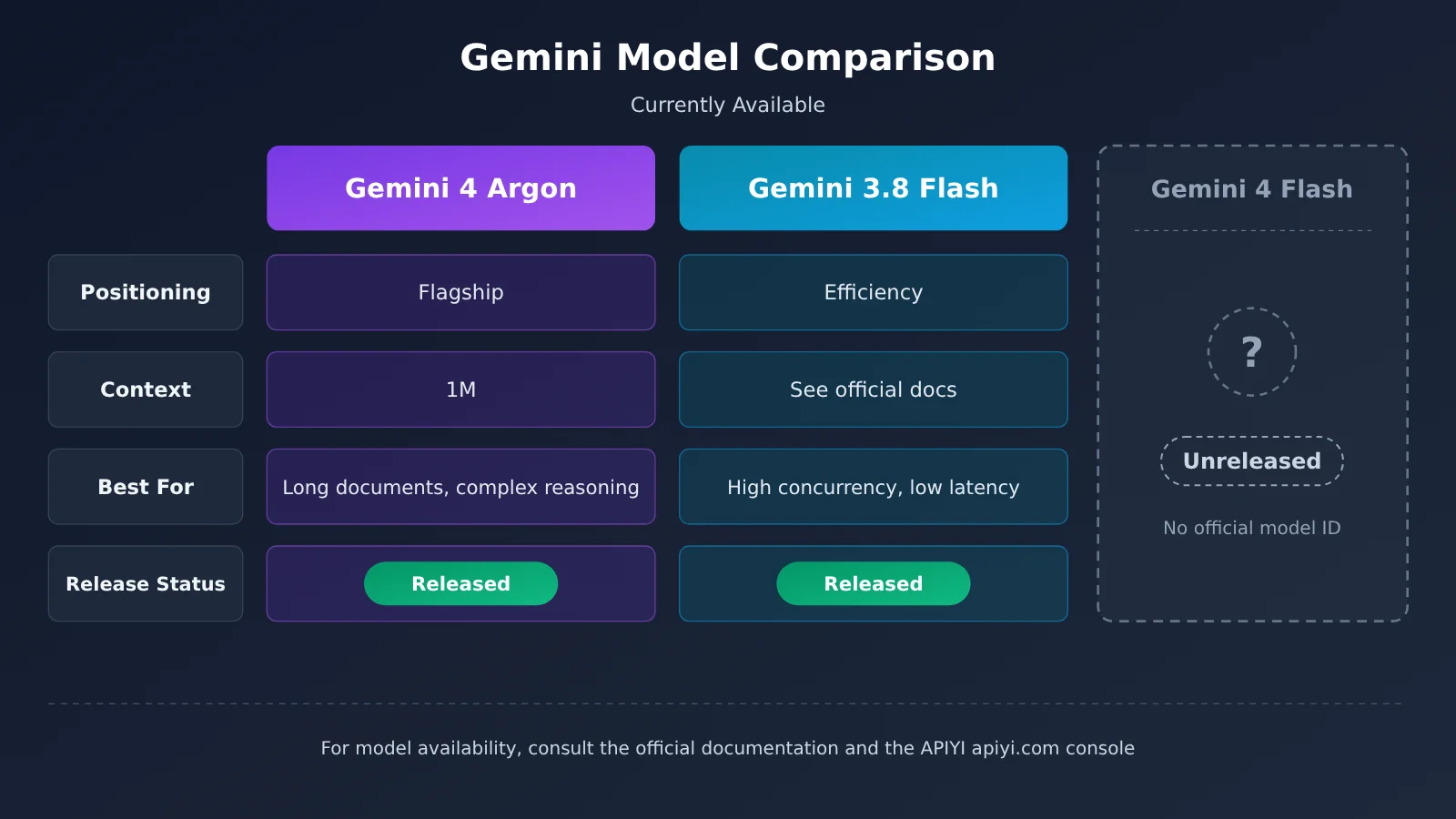
Until Gemini 4 Flash arrives, these are the two main Gemini models available to developers. They serve distinct purposes, covering both capability-first and efficiency-first needs.
Gemini 4 Argon: The Released Flagship of the Gemini 4 Family
gemini-4-argon is the first flagship in the Gemini 4 family and currently the only Gemini 4 model listed in the Gemini API model reference. It supports a 1M context window and is available through the official API. It’s suited to long-document analysis, understanding large codebases, reasoning across multiple files, and tasks where answer quality matters more than response speed.
Argon and Gemini 4 Flash belong to the same generation but occupy different tiers. Argon’s release doesn’t mean Flash will follow soon—there’s no official information about their respective release schedules.
Gemini 3.8 Flash: The Latest Flash Option
Gemini 3.8 Flash was released on September 2, 2026, and is Google’s latest Flash model. It’s designed for high-concurrency, low-latency, and cost-sensitive tasks such as batch classification, information extraction, initial customer support responses, real-time completion, and lightweight tool calls in agents.
Until Gemini 4 Flash is released, 3.8 Flash is the most practical Flash-tier option. Rather than waiting for the next generation, it’s worth measuring 3.8 Flash’s performance and cost now. Those results will give you a baseline for evaluating Gemini 4 Flash later.
| Model | Official Model ID / Status | Key Features | Use Cases | Available Platforms |
|---|---|---|---|---|
| Gemini 4 Argon | gemini-4-argon, released |
First Gemini 4 flagship, 1M context window | Long-context tasks, complex reasoning, high-quality output | Official Google API, APIYI apiyi.com |
| Gemini 3.8 Flash | Released (2026-09-02) | Latest Flash model, low latency | High concurrency, real-time responses, cost-sensitive tasks | Official Google API, APIYI |
| Gemini 4 Flash | No official model ID | Not released | Can’t be planned for yet | Check official documentation and console listings |
Choosing Before Gemini 4 Flash Launches: An Argon and 3.8 Flash Strategy
Most production systems don’t need to bet on a single model. A safer approach is to divide tasks by type, let Argon and 3.8 Flash each handle what they do best, and use models from other providers as fallbacks or benchmarks when needed.
- Use Argon for complex tasks: Assign quality-sensitive work like long-context retrieval, cross-document summarization, and code review to
gemini-4-argon. - Use 3.8 Flash for high-frequency tasks: Assign high-volume, lower-value work like classification, extraction, rewriting, and intent recognition to Gemini 3.8 Flash.
- Use cascading routing: Start with 3.8 Flash, then escalate to Argon when confidence is low or the input is too long. This balances cost and quality.
- Compare across providers: Keep a Claude or OpenAI model available as a fallback for critical workflows, so fluctuations at one provider don’t disrupt your business.
This layered architecture has another benefit: when Gemini 4 Flash actually launches, you can replace the model in the “high-frequency task layer” for a gradual rollout, limiting the impact. If you hard-code every invocation to a single model now, switching later will be more expensive.
🎯 Recommendation: The trickiest part of using multiple models is managing separate API keys and billing systems. With APIYI at apiyi.com, you can use one API key to call Gemini 4 Argon, Gemini 3.8 Flash, and models from Claude and OpenAI. The interface is compatible with the OpenAI format, so switching models only requires changing the
modelparameter, making layered routing easier to implement.
What to Prepare Before Gemini 4 Flash Launches: Four Engineering Tasks
Not changing your schedule based on rumors doesn’t mean doing nothing. The better approach is to prepare your integration process for new models in advance. That way, whenever Gemini 4 Flash launches, you can evaluate it in hours rather than weeks.
| Preparation | Action | Benefit when the new model launches |
|---|---|---|
| Evaluation set | Pull representative samples from real workloads and fix the inputs and scoring criteria | Run benchmarks as soon as the new model is available instead of relying on gut feeling |
| Model mapping | Have application code reference logical names only, such as fast-tier, and map those names to specific model IDs in configuration |
Switch models by changing configuration, not application code |
| Cost baseline | Record current token usage, per-request costs, and latency distributions for Argon and 3.8 Flash | Determine whether the new model is actually cheaper and faster |
| Rollback and gradual rollout | Switch traffic by percentage and keep a one-click option to revert to the old model | Limit the impact quickly if the new model falls short |
Model Mapping and Evaluation Sets: Make Switching a Configuration Change
Model mapping is the easiest of the four tasks to overlook—and one of the most worthwhile to do ahead of time. Keep a “logical tier → model ID” mapping table in your configuration system. For example, quality-tier might map to gemini-4-argon, while fast-tier maps to Gemini 3.8 Flash. If you use APIYI for your integration layer, all models share the same base_url: https://api.apiyi.com/v1. You only need to maintain model names in the mapping table, rather than separate addresses and keys for each model.
For your evaluation set, cover three types of samples: typical requests, challenging long-tail cases, and bad cases that have caused problems in the past. The set doesn’t need to be large. What matters is that it’s fixed and repeatable. Once Gemini 4 Flash has an official model ID, run the same evaluation set against it for a direct comparison with 3.8 Flash.
Cost Baselines and Usage Logs: Replace Guesswork With Data
A cost baseline needs real usage data, not published unit prices multiplied by estimated volume. Track at least a week to a month of token usage and request counts by model and business line, along with P50 and P95 latency. Then, when a new model claims to be “faster and cheaper,” you can verify it against your own workloads.
📊 Data tip: APIYI apiyi.com provides unified billing and usage logs, bringing invocation records for different models together in one place. You can use them to build cost baselines for Argon and 3.8 Flash. Check the console and documentation for current pricing and availability.
Gemini 4 Flash FAQ
Q1: Can I use Gemini 4 Flash yet?
No. As of November 8, 2026, Google hasn’t released Gemini 4 Flash, the Gemini API documentation doesn’t list a `gemini-4-flash` model ID, and there’s no official release date. The only Gemini 4 model currently available is `gemini-4-argon`.
Q2: Are Hydrogen and Hyperion the same model?
There’s no evidence to support that. Hydrogen comes from a claim by an X account about an internal codename for Gemini 4 Flash. Hyperion comes from a Cognition Devin build and hasn’t been confirmed by the vendor; it could be a Google model or a codename Cognition gave to a preview version. They come from different sources, so they shouldn’t be treated as the same thing, and neither should be considered official information.
Q3: Should I wait for Gemini 4 Flash or use Gemini 3.8 Flash now?
Use Gemini 3.8 Flash now. It’s the latest Flash model currently available and is well suited to high-concurrency, low-latency, and cost-sensitive tasks. The evaluation results and cost data you gather now will provide a baseline for assessing Gemini 4 Flash later. Through APIYI apiyi.com, you can use the same key to call both 3.8 Flash and Argon, making it easy to try a tiered approach.
Q4: How can I confirm Gemini 4 Flash is available as soon as it launches?
Check it against the criteria in this article: the Gemini API documentation must list an official model ID, the pricing page must show a price, and the model must be selectable in AI Studio. All three conditions must be met before it’s considered released. To check whether it’s available through APIYI apiyi.com, consult the model list in the console. Once the model appears there, validate it using your prepared evaluation dataset.
Gemini 4 Flash: Key Takeaways and Rumor Checklist
Key Takeaways:
- Release status: As of November 8, Gemini 4 Flash hasn’t been released. There’s no official model ID or release date.
- Hydrogen: An internal codename reported by an X account. Neither the five checkpoints nor the claimed 300–500 tokens/s speed has been officially confirmed.
- Hyperion: Appeared in a Devin build, listed ahead of Argon. The vendor hasn’t confirmed it, and there’s no basis to conclude it’s a Flash model.
- Gemini 4 Argon: The first flagship Gemini 4 model has been released, with a 1M context window and API availability.
- Gemini 3.8 Flash: Released on September 2, 2026, it’s currently the most practical Flash-class option.
- What to do: Keep your projects on schedule. Start building an evaluation set, model mapping, cost baseline, and rollback mechanism.
Gemini 4 Flash Rumor Checklist
The next time you see a claim that “Gemini 4 Flash is live,” check it against this list:
| What to check | How to check | Passing criterion |
|---|---|---|
| Official model ID | Check the Gemini API model reference page | An explicit Gemini 4 Flash model ID appears |
| Pricing | Check the Gemini API pricing page | Input and output prices are listed |
| AI Studio | Open the AI Studio model selector | You can select it directly, rather than encounter it in an anonymous A/B test |
| Official announcement | Check Google’s official blog or accounts | A formal release announcement has been published |
| Source | Trace the claim back to its original source | It comes from an official source, not an X account or third-party build |
| Codename mapping | Check for an official explanation linking the codename to the formal name | The mapping is officially confirmed, not community speculation |
| Access | Check the model list in your platform’s console | The model is listed and available to invoke |
Only when the first three checks pass should you consider the model released. The last four help assess the claim’s credibility. If the first check fails, no matter how detailed the leak is, treat it as something to watch—not a basis for decisions.
Summary
Gemini 4 Flash’s status comes down to three points:
- It hasn’t been released: There’s no official model ID, pricing, or date. Hydrogen and Hyperion are just leads.
- Alternatives are available now: Use
gemini-4-argonfor flagship capabilities and long-context tasks, and Gemini 3.8 Flash for high concurrency and low latency. - Preparation matters more than waiting: Get your evaluation set, model mapping, cost baseline, rollback mechanism, and staged rollout ready so you can switch quickly when the new model launches.
For developers and product teams, the best approach is to keep moving with existing schedules while making new model integration a repeatable engineering process. We recommend using a single key through APIYI at apiyi.com to get an Argon and 3.8 Flash setup running, then using usage logs to establish a cost baseline. Once Gemini 4 Flash is officially available, you can compare it through a staged rollout.
References
- Gemini API model reference: Official model IDs and context specifications
- Link:
ai.google.dev/gemini-api/docs/models -
Note: The primary source for checking whether Gemini 4 Flash has been released
-
Gemini API pricing page: Official model pricing
- Link:
ai.google.dev/gemini-api/docs/pricing -
Note: Prices for new models are listed here after their official release
-
Google AI Studio: Official entry point for trying models
- Link:
aistudio.google.com - Note: Use it to check whether a model can be selected directly
Author: APIYI Technical Team
Technical discussion: Contact us through the APIYI homepage. For more model integration guides, visit the documentation center at docs.apiyi.com.