Author’s note: Fable 5.5 and GPT-6.2 Astra both have public demos, but none use the same task. This article assesses the evidence behind six demos, compares the official specifications and pricing of the current flagships Fable 5.1 and GPT-6 Astra, and offers a repeatable evaluation method for choosing between them.
The short answer: We don’t yet know whether Fable 5.5 or GPT-6.2 Astra is stronger. Neither model has been officially released. As of 2026-11-03, Anthropic’s model catalog still lists Fable 5.1, while OpenAI’s still lists GPT-6 Astra (source: both companies’ official model pages; evidence level: official documentation). Public demos for both appear on the same third-party testing site, Model Tests, and were created by @notjazii—but they don’t tackle the same task. Fable 5.5 has five projects, including a game, a short film, SVG, and WebGL work; GPT-6.2 Astra has just one pixel-animation GIF. With different tasks, there’s no basis for declaring a winner.
So this article doesn’t rank them. Instead, it answers three questions: what these demos can and can’t prove; how the official specifications of Fable 5.1 and GPT-6 Astra compare today; and how to prepare your own evaluation set of 20 to 50 tasks that you can rerun with the new models simply by changing the model names. We won’t cover other rumors, such as Mythos 5.5 and Gemini 4 Carbon.
This isn’t a compromise piece that says “both have their strengths.” Where the evidence isn’t sufficient, we’ll say so. Where it supports a judgment, we’ll give you a direct recommendation.
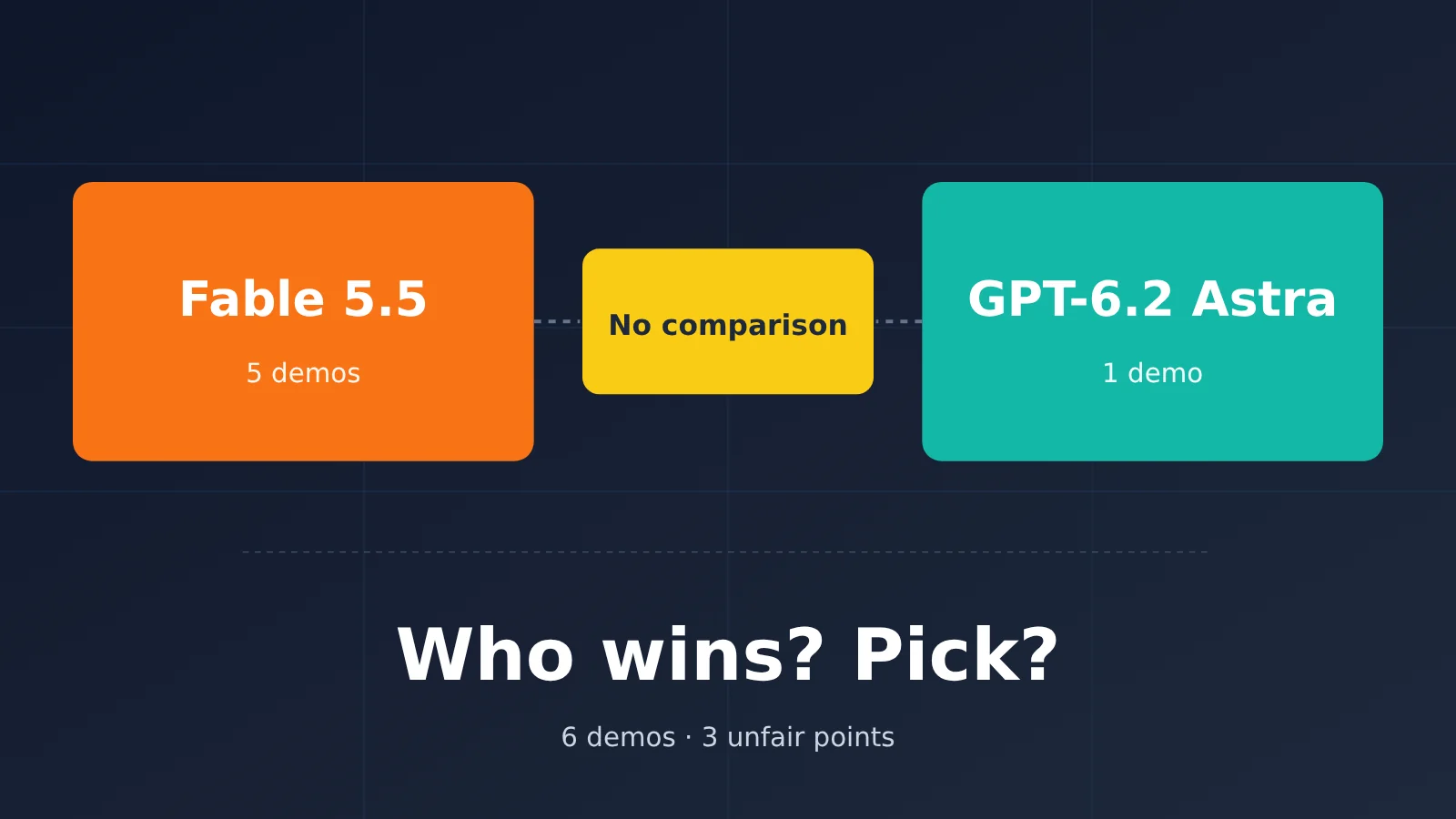
Public Demos: Fable 5.5 vs GPT-6.2 Astra
Bottom line: The demos show that the models can produce functional finished projects, but the tasks, number of entries, and model tiers differ, so they can’t be compared directly.
The Model Tests site lists 11 projects across 8 models, each labeled with a date, model, and type (source: site pages; evidence level: community claims). The table below brings together all six works attributed to Fable 5.5 and GPT-6.2 Astra, along with several entries on the site that can serve as baselines. All model attributions are self-reported by the creator.
| Project | Creator’s model label | Type | Date | Highlights |
|---|---|---|---|---|
| VoxelCraft | Fable 5.5 xhigh | Playable HTML game | 2026-11-01 | Single-file Minecraft clone with survival and creative modes, crafting, furnaces, enchanting, redstone, villagers, multiple biomes, the Nether, and the End |
| The Last Page | Fable 5.5 xhigh | 66-second short film with audio | 2026-11-02 | A fox, a moonlit library, a storm of pages, and a flight into the clouds |
| Open Me | Fable 5.5 xhigh | Interactive WebGL experience | 2026-11-02 | Raymarched WebGL2 with generative music; requires a dedicated GPU |
| Acorn Bread on a Stick | Fable 5.5 xhigh | Hand-coded SVG | 2026-11-02 | Illustration of acorn bread |
| Fruit Basket | Fable 5.5 max | Pure vector still life | 2026-11-02 | 3000×2400, no bitmaps, realistic fruit basket |
| Tsukimi Moon Ferry | GPT 6.2 Astra Max | Pixel animation GIF | 2026-11-02 | A Japanese riverside town under a full moon, with a castle, Mount Fuji, a red bridge, flying carp, floating lanterns, and a ferry |
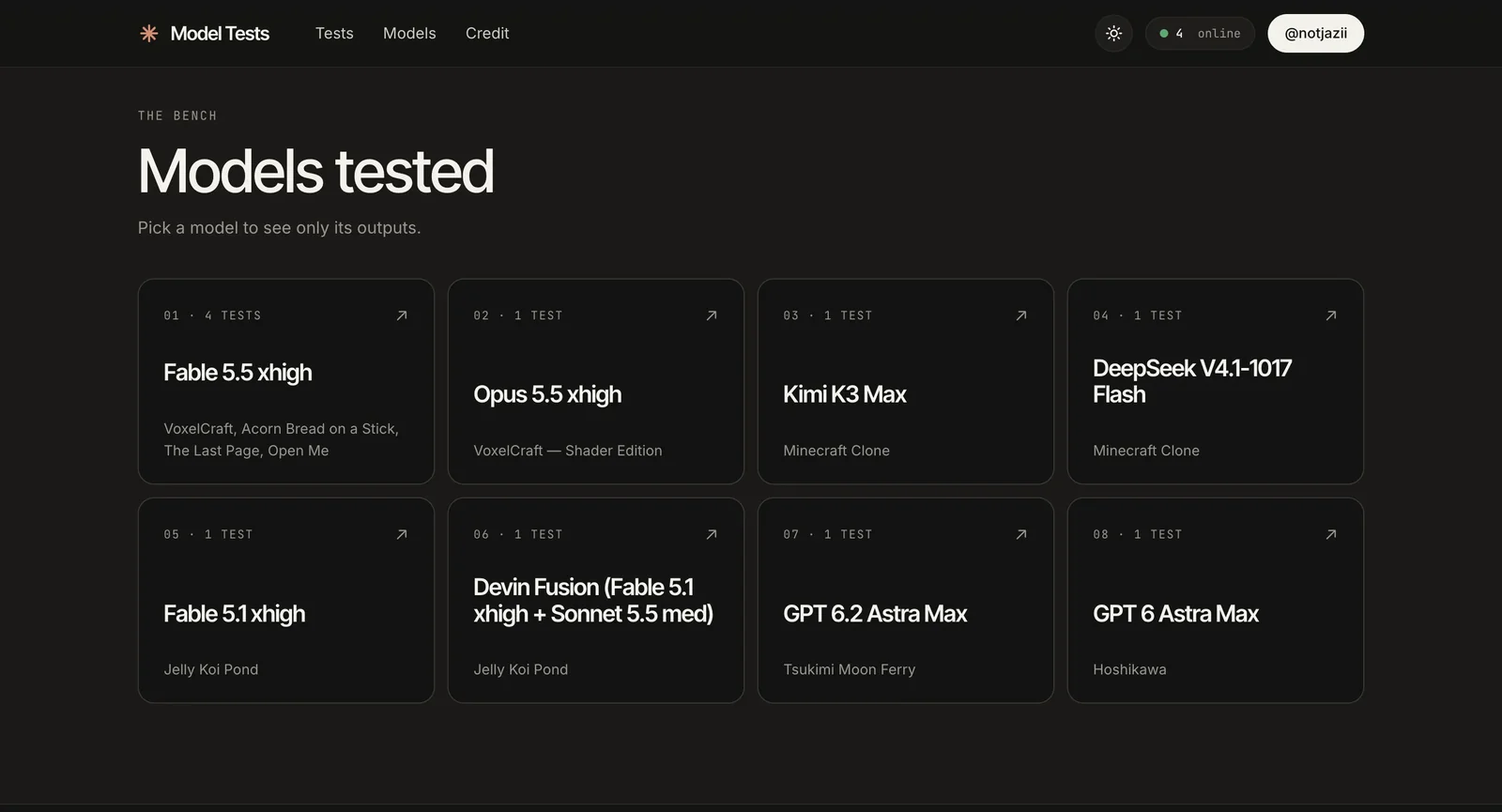
Caption: The Model Tests model list. Fable 5.5 xhigh has 4 tests, while GPT-6.2 Astra Max and GPT-6 Astra Max each have 1 (screenshot taken 2026-11-03).
There are several other projects on the site worth using as references. Hoshikawa is labeled GPT 6 Astra Max and is also a pixel animation of a Japanese town under a full moon (2026-11-02). Its style is close to Tsukimi Moon Ferry, making it the site’s only near-matched comparison between the older and newer OpenAI versions. VoxelCraft — Shader Edition is labeled Opus 5.5 xhigh (2026-11-01) and uses the same task as Fable 5.5’s VoxelCraft. Kimi K3 Max and DeepSeek V4.1-1017 Flash have also each made a Minecraft clone (2026-10-17).
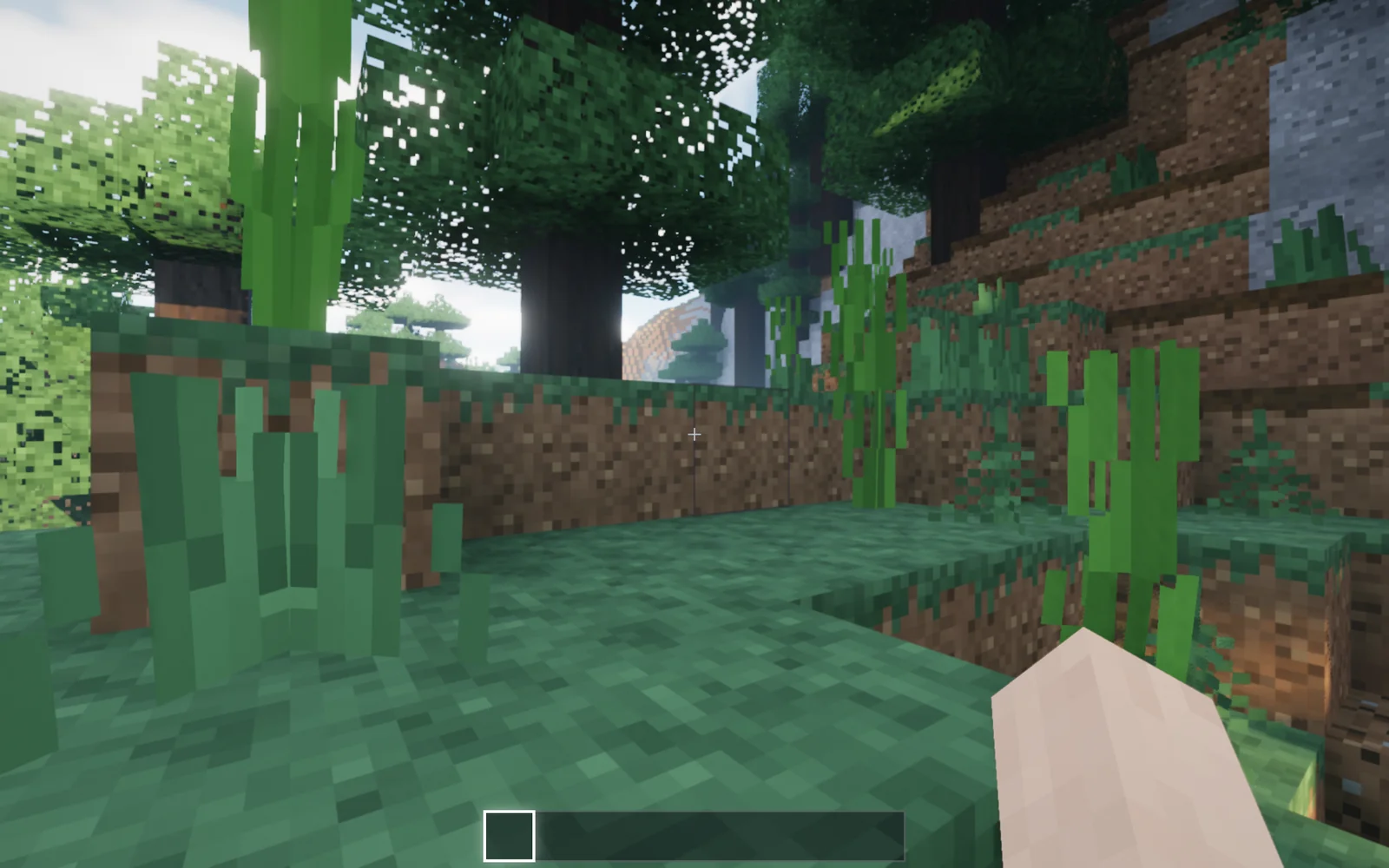
Caption: Fable 5.5 xhigh’s VoxelCraft, a single-file Minecraft clone you can open and start exploring (screenshot taken 2026-11-03).

Caption: GPT-6.2 Astra Max’s Tsukimi Moon Ferry, a pixel animation GIF of a Japanese riverside town under a full moon (screen recording taken 2026-11-03).

Caption: The control example, Hoshikawa by GPT-6 Astra Max, from the same site and in the same style, for comparison with 6.2’s pixel animation (screen recording from 2026-11-03).

Caption: A scene with the fox in a moonlit library from The Last Page, a 66-second short film with sound by Fable 5.5 xhigh (GIF excerpt from 2026-11-03, no audio).
Jelly Koi Pond is the only project on the site with published cost and time figures. The Fable 5.1 xhigh version took about 1 hour and 40 minutes and cost $25; the Devin Fusion combination (Fable 5.1 xhigh plus Sonnet 5.5 med) took about 1 hour and cost $11 (dated 2026-10-21, evidence level: community self-report). No other project on the site discloses its time or cost, and this article doesn’t estimate them.
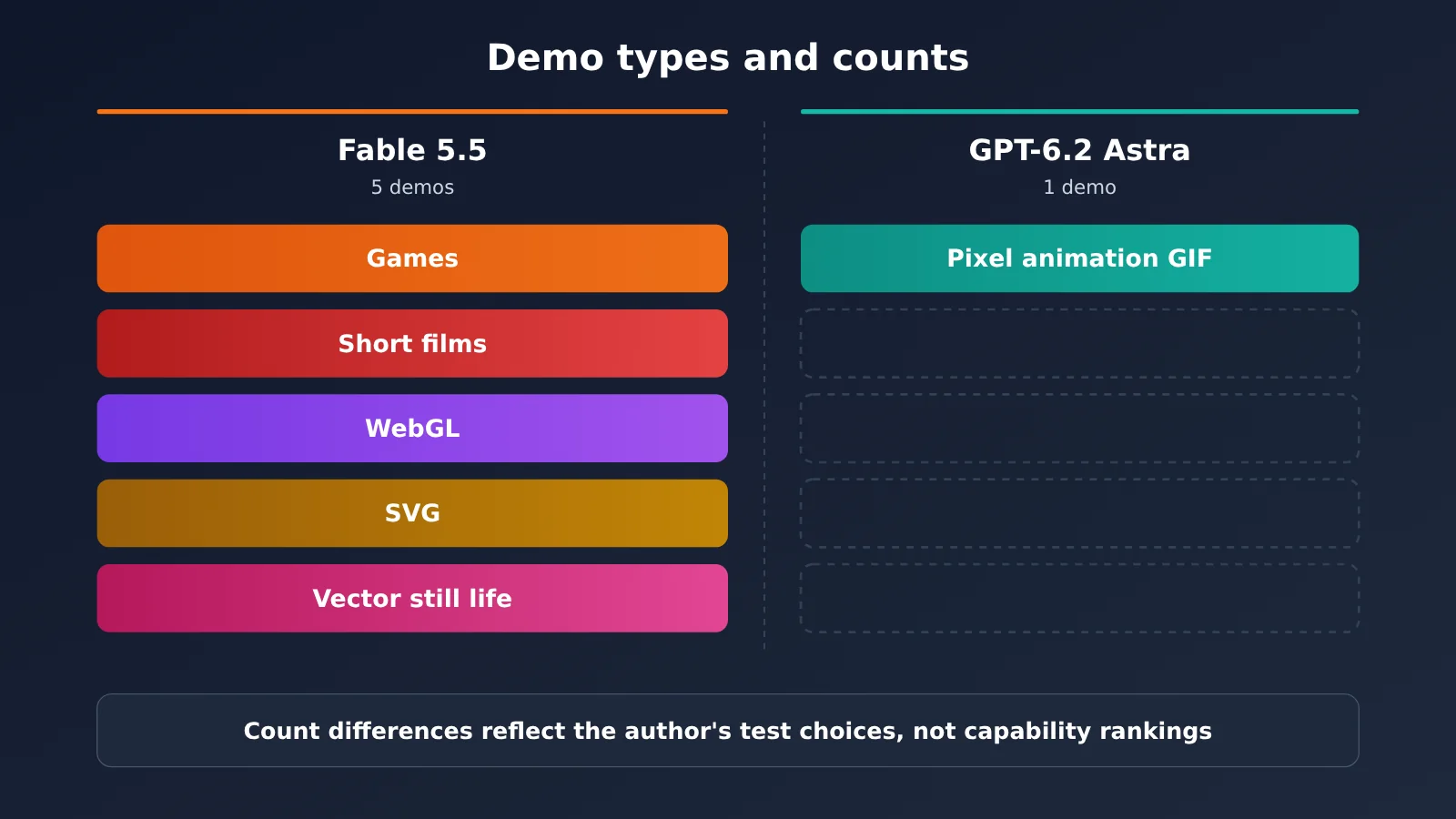
The chart above shows the distribution of demo types and counts, not a capability ranking. If you’d like to see how the two companies’ current flagship models compare on your own tasks, you can call claude-fable-5-1 and gpt-6-astra using the same key on APIYI at apiyi.com.
Fable 5.5 vs. GPT-6.2 Astra: Three Things That Look Fair but Aren’t
The takeaway: The same site and author might make this look like a head-to-head comparison, but there are at least three ways the two tests aren’t equivalent.
Unfair Point One: Completely Different Tasks
Fable 5.5’s five entries span four categories: games, short films, WebGL, and SVG. GPT-6.2 Astra’s entries cover only pixel animation. The two models didn’t complete a single task in common. Pixel animation tests composition and frame-to-frame consistency, while single-file games test long-form code organization and state management. You can’t directly compare the two. For a longitudinal comparison, GPT-6.2 Astra can only be compared with GPT-6 Astra (Hoshikawa) on the same site, while Fable 5.5 can only be compared with Opus 5.5 (VoxelCraft — Shader Edition).
Unfair Comparison #2: Reasoning Levels, Dates, and Sample Sizes Don’t Match
Most of the Fable 5.5 demos are labeled xhigh, with only Fruit Basket labeled max; GPT-6.2 Astra is labeled Max. Different levels mean different reasoning budgets, so their output quality can’t be compared directly. The sample sizes are also five to one, reflecting what the author chose to test—not official benchmark results. Treating the number of demos as a measure of capability is the most common misreading in this discussion.
Unfair Point #3: Model Attribution Can’t Be Verified
None of the demos disclosed their prompts, invocation logs, or model cards, so model attribution depends entirely on the authors’ labels. In a November 2 investigation, ByteForward noted that some demos labeled “Fable 5.5” may have involved Opus 5.5 requests being routed to the new model while the model selector still displayed Opus 5.5 (evidence level: single media report). Given that uncertainty, we can only write “the author claims it was Fable 5.5,” not “Fable 5.5 built it.”
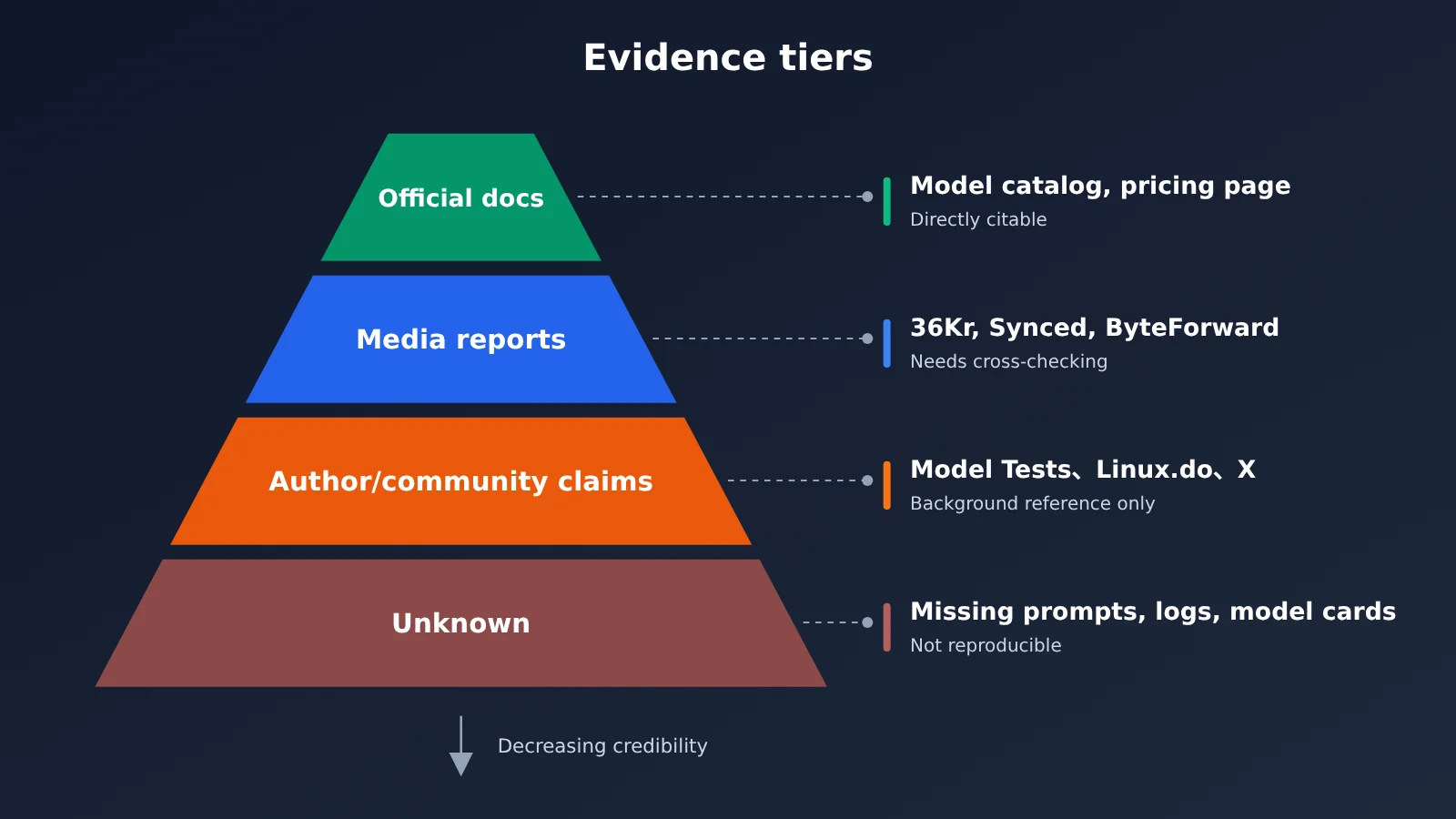
The table below groups current claims about the two models by evidence level. If you share these claims with your team, it’s worth keeping the evidence-level column.
| Claim | Source | Date | Evidence level |
|---|---|---|---|
| Anthropic’s catalog still lists Fable 5.1, not Fable 5.5 | Anthropic pricing and news pages | Accessed 11-03 | Official documentation |
| OpenAI’s catalog still lists GPT-6 Astra, not GPT-6.2 Astra | OpenAI model catalog | Accessed 11-03 | Official documentation |
LiteLLM added a pricing entry for azure_ai/claude-fable-5-5 |
TestingCatalog record | 10-13 | Third-party record |
| Fable 5.5 supports 1M input and 128,000 output tokens | 36Kr / AI Era | 11-02 | Single media report |
| GPT-6.2 Astra received an overall assessment of a “significant leap” | Synced / Sina | 11-02 | Media roundup, no benchmark |
| gpt-6.2-astra accounted for 1.6% of usage | Linux.do @fourfour | 11-01 | Community self-report |
| gpt-6.2-astra accounted for 19.8% of usage | X @TokenGremlin | 11-01 | Community self-report |
| Model attribution for demos on Model Tests | Author @notjazii | 11-01 to 11-02 | Author’s claim |
| Some Fable 5.5 demos actually involved routed Opus 5.5 requests | ByteForward | 11-02 | Single media report |
The GPT-6.2 Astra traffic figures need some context. The Linux.do post showed Codex usage from October 25 to October 31: 97.7% was still gpt-6-astra, while gpt-6.2-astra accounted for just 1.6%. In the same post, 12 of 13 billing entries were still for gpt-6-astra, with speeds ranging from 44 to 73 tok/s. TokenGremlin’s screenshot on X showed 19.8% and circulated more widely, with around 155,000 views. Both figures come from screenshots shared by individual accounts, not official data. Synced itself noted that the screenshots only prove that “some users reported gaining access.” Also, GPT-6.2 Betelgeuse / Bel is another base model codename that circulated earlier; it’s not the same as 6.2 Astra.
Community impressions contradict one another, too. Some people think Fable 5.5 is stronger, while others consider it on par with Opus 5.5. As for GPT-6.2 Astra, some say it’s weaker than Opus 5.5, some call it an incremental improvement, and others say it outperforms Opus 5.5 on multiple dimensions. None of these claims comes with benchmarks or sample sizes, so they should only be treated as background context.
Fable 5.1 vs GPT-6 Astra: Official Specs and Pricing
Bottom line: The new models don’t have official specs yet, so only the current flagships can be compared directly. Their base prices are the same, but they differ in long-input pricing, knowledge cutoffs, and reasoning levels.
Fable 5.1 and GPT-6 Astra both have official prices of $10 for input and $50 for output per million tokens. Both support a maximum output of 128K, while their context windows are 1M and 1.05M, respectively. The table below is based on the two companies’ official model pages, accessed on 2026-11-03.
| Specification | Fable 5.1 | GPT-6 Astra |
|---|---|---|
| Model ID | Anthropic official Fable 5.1 | gpt-6-astra |
| Context window | 1M | 1.05M |
| Maximum output | 128K | 128K |
| Knowledge cutoff | 2026-06 | 2026-04-30 |
| Reasoning control | Adaptive thinking is always on; default effort is high | low / medium / high / xhigh / max |
| Tool support | Refer to the official documentation | Function calling, web search, file search, computer use |
The difference in reasoning controls directly affects evaluation design. Fable 5.1’s Adaptive thinking is always on, with effort set to high by default; GPT-6 Astra offers five selectable levels. The level names don’t map directly between the two, so you can try to align them, but they won’t be fully equivalent. When testing, record the level as a field rather than assuming that high equals high.
The official base prices are the same, but the billing details differ considerably. The table below shows both official prices and the prices listed on the APIYI platform, in US dollars per million tokens.
| Billing item | Fable 5.1 official | GPT-6 Astra official | APIYI apiyi.com listing |
|---|---|---|---|
| Input | $10 | $10 | claude-fable-5-1 $10; gpt-6-astra $10 for 0 to 272,000 tokens |
| Long input | $10 within 1M | Refer to the official page | gpt-6-astra $20 for 272,001 to 1,050,000 tokens |
| Output | $50 | $50 | $50 for both |
| Cache hit/read | $0.25 | Refer to the official page | claude-fable-5-1 $0.25; gpt-6-astra $1 |
| Cache write | $12.50 for 5 minutes, $20 for 1 hour | Refer to the official page | Refer to the platform’s model list |
| Endpoints | messages | responses, chat | claude-fable-5-1: chat / messages; gpt-6-astra: responses / chat |
For teams analyzing long documents or working with large codebases, this table is more useful than asking “which is stronger?” When a single input exceeds 272,000 tokens, the input price for gpt-6-astra doubles to $20; claude-fable-5-1 stays at $10 within 1M. Cache read prices also differ by a factor of four ($0.25 versus $1). If you repeatedly use the same long context, these differences will be noticeable on your bill. Refer to the platform’s model list for current models and prices.
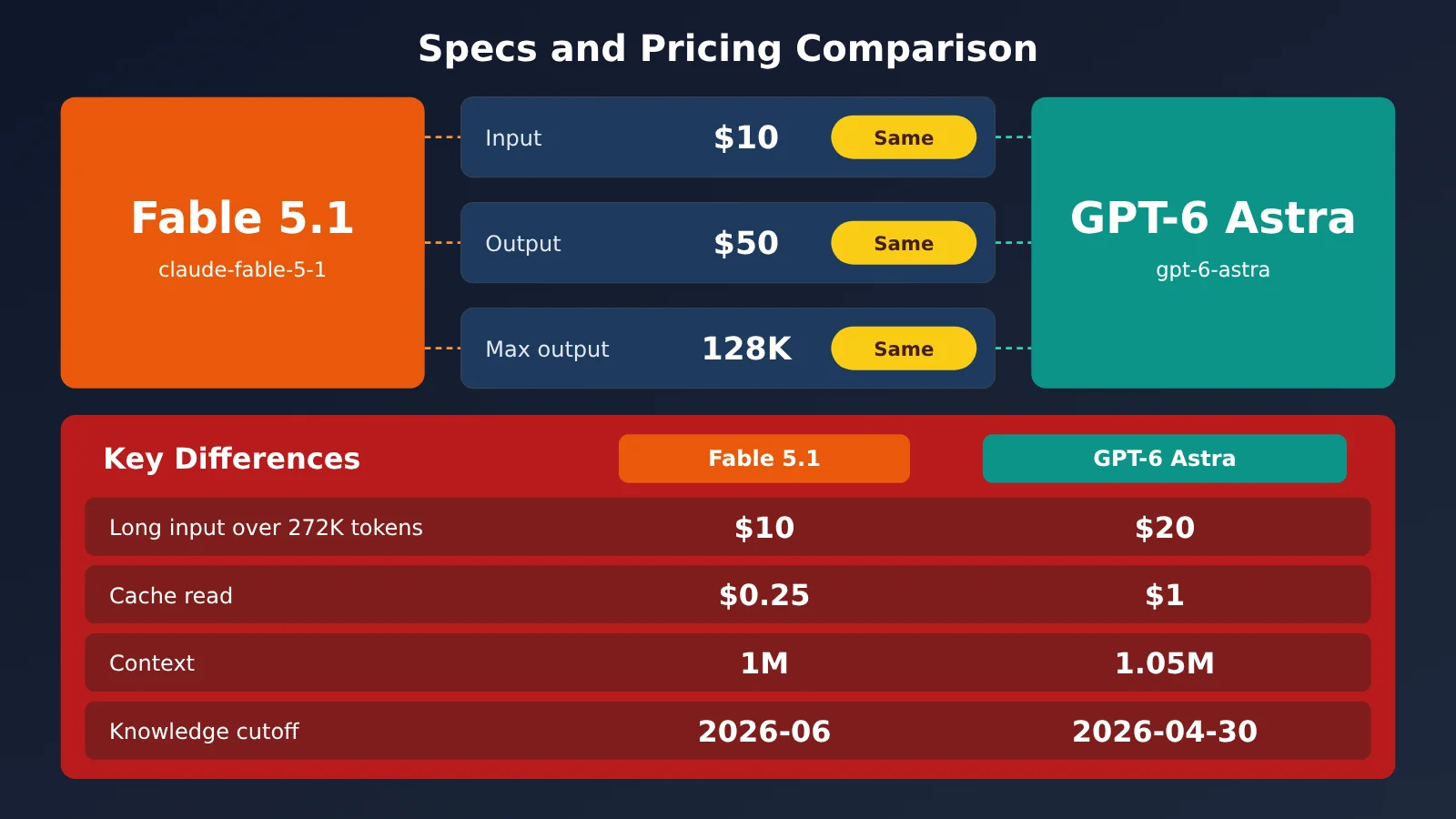
The prices shown in the figure come from official model pages and the APIYI apiyi.com platform’s pricing API, retrieved on 2026-11-03.
What You Can Use Before Fable 5.5 and GPT-6.2 Astra Launch
The takeaway: Neither new model has an official API yet. For now, you can run baselines with both providers’ current flagships and get your evaluation framework ready.
As of 2026-11-03, APIYI’s model endpoint returned 259 models, while its pricing endpoint listed 277. These included gpt-6-astra, gpt-6.1-sol, gpt-6.1-terra, gpt-6-luna, and claude-fable-5-1, but not gpt-6.2-astra or claude-fable-5-5. In other words, you can already run baseline tests on both providers’ current flagships using the same API key. A messages request sent to claude-fable-5-1 that day with max_tokens set to 32 returned HTTP 200, confirming that the endpoint was available.
The integration is compatible with the OpenAI SDK. Set base_url to https://api.apiyi.com/v1 and use claude-fable-5-1 or gpt-6-astra as the model name. If you need Anthropic’s native messages format, claude-fable-5-1 supports that too; gpt-6-astra can use the responses or chat endpoint.
🚀 Quick start: Register at APIYI apiyi.com and use the free testing credits for new users to try 3 to 5 tasks with
claude-fable-5-1andgpt-6-astra. Confirm that the output format and token tracking work as expected before expanding to the full test set.
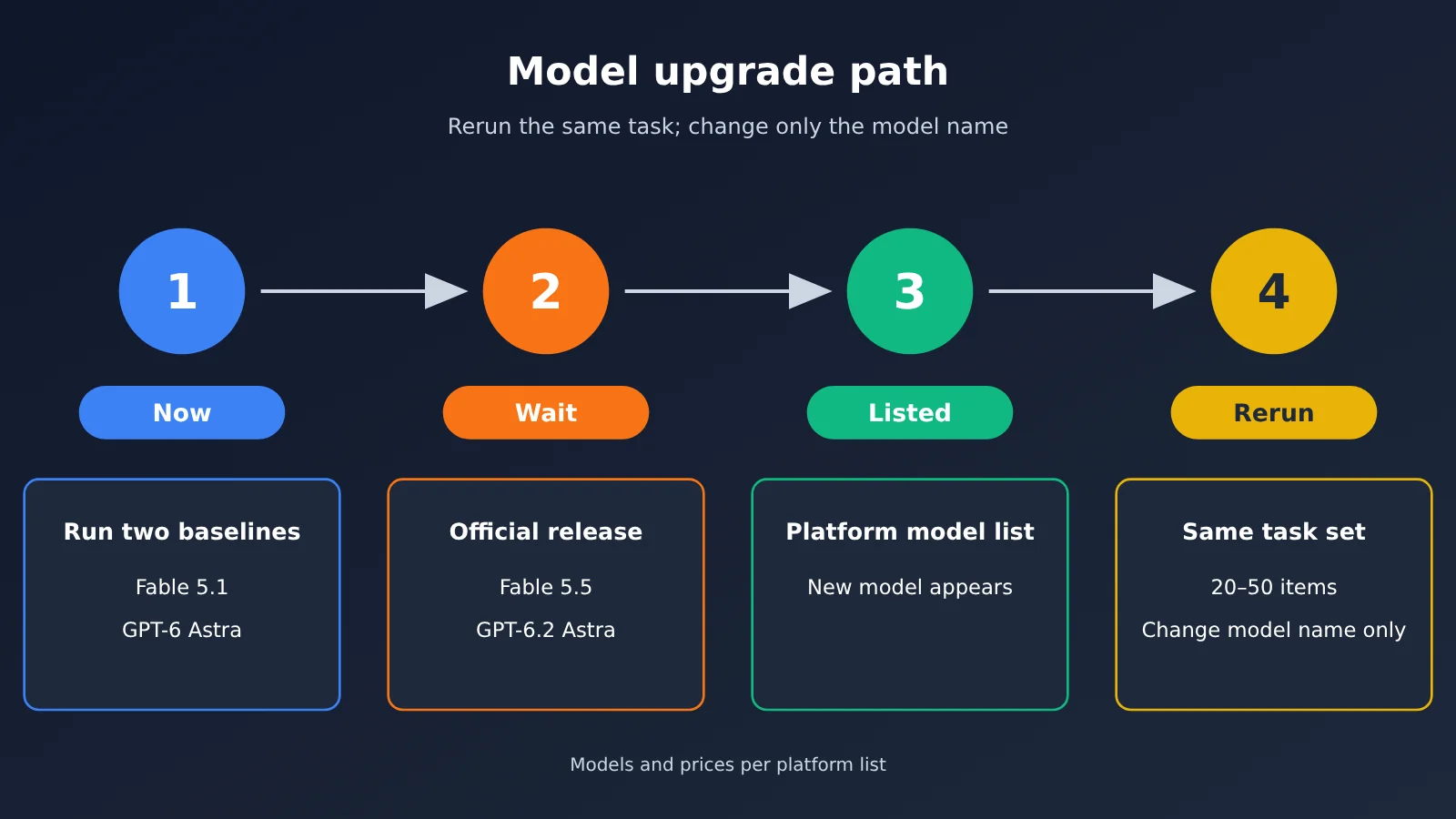
The point isn’t to predict how the new models will perform. It’s to prepare your test set, scoring criteria, and tracking sheet in advance. When Fable 5.5 or GPT-6.2 Astra officially launches, your team can change the model name and get results for your own use cases within a day or two, rather than relying on someone else’s demos and screenshots.
How to Choose and Test Fable 5.5 vs GPT-6.2 Astra
The takeaway: You don’t need to wait for new models. Establish a baseline with current flagship models, and make your choice based on 20 to 50 of your own tasks—not public demos.
As of 2026-11-03, neither Fable 5.5 nor GPT-6.2 Astra is available on APIYI. Once they’re released, we’ll add both models as soon as possible. Check the platform’s model list for available models and pricing. In the meantime, use these scenarios to guide your initial evaluation:
- Long documents, large codebases, and repeated long-context tasks: Start by evaluating
claude-fable-5-1. Input pricing stays the same up to 1M tokens, and cache reads cost just $0.25, making costs more predictable. - Fine-grained reasoning budgets, web search, or computer use: Start by evaluating
gpt-6-astra. It offers five reasoning levels, and its officially listed tool capabilities are more comprehensive. - Single-file frontends and creative visualizations: Both have example projects, but they’re all self-reported by their creators. Treat them as inspiration and test with your own tasks.
- Time-sensitive knowledge: Fable 5.1 has a knowledge cutoff of 2026-06, while GPT-6 Astra’s is 2026-04-30—a difference of about two months. Retrieval tools can help bridge the gap.
How to Set Up Your Own Evaluation
The key is to keep everything fixed and change only the model name. Here’s how:
- Select 20 to 50 tasks from real business workflows, covering major categories such as code, long documents, and structured output. Define a pass criterion for each task.
- Keep the system prompt, user prompt, maximum output tokens, and reasoning level fixed. Record the effort setting for Fable 5.1 and the reasoning level name for GPT-6 Astra.
- For each task, record input tokens, output tokens, end-to-end latency, and whether a human reviewer marked it as passed.
- Flag tasks with more than 272,000 input tokens and calculate costs using the applicable tiered pricing.
- First, establish baselines with
claude-fable-5-1andgpt-6-astra. Once the new models are available, change only the model name and rerun the same tasks.
Your tracking table should include at least these fields to make comparisons across models and over time easier:
| Field | What to Record | Purpose |
|---|---|---|
| Task ID and type | Code / long document / structured output, etc. | Break down pass rates by scenario |
| Model name and reasoning level | For example, gpt-6-astra high |
Keep conditions consistent on reruns |
| input / output tokens | usage returned by the platform | Calculate the actual cost per task |
| Latency | From request to complete response | Evaluate the interactive experience |
| Human pass | Yes / no + reason | Final quality metric |
💡 Selection tip: Running models from both providers under the same Key helps prevent network and rate-limit differences across accounts from skewing the results. With unified access through APIYI apiyi.com, the recorded usage fields use a consistent format, making your results easier to compare.
FAQs and Recommended Next Steps
Q1: Do the demos on Model Tests show that Fable 5.5 is better than GPT-6.2 Astra?
No. The two models weren’t tested on the same task, and their reasoning levels, dates, and number of demos also differed. The model attribution is based on the authors’ own claims. At most, the demos suggest that, according to their authors, both models can produce runnable or viewable results.
Q2: Have Fable 5.5 and GPT-6.2 Astra been released? When will they be available?
As of 2026-11-03, neither model appears in its provider’s official model catalog, and there’s no reliable release date for either. As of 2026-11-03, Fable 5.5 and GPT-6.2 Astra aren’t available on APIYI yet. We’ll add both models as soon as possible; check the platform’s model list for available models and pricing. Once they’re available, you’ll be able to find them in the model list on APIYI at apiyi.com.
Q3: Is the screenshot showing 19.8% of traffic credible?
It comes from a personal screenshot posted by X user TokenGremlin. An earlier Linux.do post showed just 1.6%, while the model selector still displayed GPT-6 Astra. Reports from other users also vary. Both figures are community-reported, not official data. They only show that the model name has appeared in the usage details of some accounts.
Q4: Should I wait for the new models or use the current flagships?
We recommend using the current flagships for now. Fable 5.1 and GPT-6 Astra have the same unit prices, both offer top-tier capabilities, and they’re ready for production today. More importantly, build your evaluation test set first so you can quickly assess the new models when they launch. At APIYI, apiyi.com, you can use free testing credits to run a small sample and validate your evaluation workflow.
Q5: If the two current flagships have the same prices, can costs still differ?
Yes. For `gpt-6-astra`, the input price rises from $10 to $20 when a single input exceeds 272,000 tokens. Cache reads cost $1, compared with $0.25 for `claude-fable-5-1`. The difference is most noticeable in long-context workloads with high cache hit rates, so calculate costs using your actual token distribution.
Recommended Next Steps
If your team is choosing a model this month, take three steps: First, compile 20 to 50 business tasks and their pass criteria this week. Next, use the same API key on APIYI apiyi.com to run claude-fable-5-1 and gpt-6-astra as baselines, recording token usage, elapsed time, and human-evaluated pass rates. Once Fable 5.5 or GPT-6.2 Astra is officially released and available on the platform, change only the model name and rerun the same test set. You’ll then have comparison data based on your own tasks under consistent conditions—more reliable than any demo or screenshot. Check the platform’s model list for available models and pricing.
References
- OpenAI Model Catalog: Official GPT-6 Astra specifications and pricing
- Link:
developers.openai.com/api/docs/models - Note: Accessed 2026-11-03; GPT-6.2 Astra was not listed in the catalog
- Anthropic Platform Pricing and Model Pages: Official Fable 5.1 specifications, pricing, and cache billing
- Link:
platform.claude.com - Note: Accessed 2026-11-03; Fable 5.5 was not listed on the pricing or news pages
- Model Tests Third-Party Testing Site: A collection of public demos by @notjazii
- Link:
model-tests.vercel.app - Note: Model attribution is based on the author’s own claims; no prompts or invocation logs are provided
Author: APIYI Technical Team
Technical Discussions: Visit the APIYI apiyi.com homepage to contact us. Model and integration documentation is available at docs.apiyi.com.