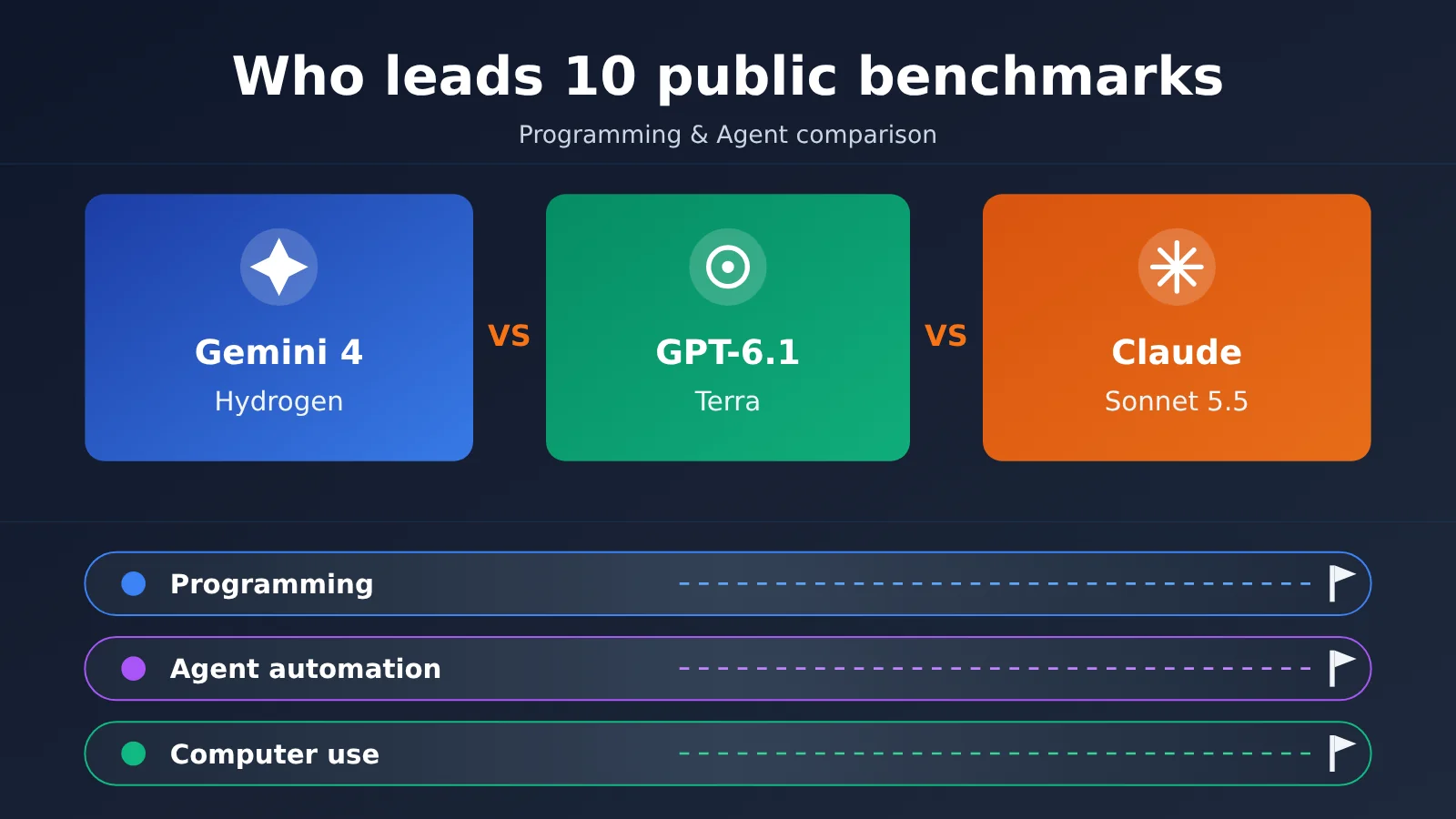
Author’s note: Based on the 10 cross-model benchmarks published by Google DeepMind, this article breaks down the relative strengths and weaknesses of Gemini 4 Hydrogen, GPT-6.1 Terra, and Claude Sonnet 5.5 in coding, Agent automation, and computer use—and offers task-based model selection advice.
One-sentence summary: Google’s cross-model benchmarks show that Gemini 4 Hydrogen and Claude Sonnet 5.5 each lead on different coding and Agent tasks, while GPT-6.1 Terra stands out for cost and visual computer use. Real-world model selection should account for test conditions, task type, and cost.
To know: 5 terms you should understand before reading this
- Harness: A test framework that organizes model inputs, tool execution, and task scoring. The same model can score noticeably differently under a different Harness.
- Benchmark version: The data, tasks, and rules version for a given benchmark. For example, Terminal-Bench 4.0 and 4.1 are different versions, and their scores need to be interpreted separately.
- Agent: A system that completes multi-step tasks through a model and a tool execution environment together. Scores reflect the overall performance of the “model + toolchain.”
- Token: The unit models use to process text and other information. API pricing is usually billed per million Tokens.
- API: An interface that lets programs call a service. Developers use it to plug models into their own apps or Agents.
On November 12, 2026, Google officially released Gemini 4 Hydrogen and put it alongside GPT-6.1 Terra and Claude Sonnet 5.5 in the same benchmark table in its official model card. The table spans coding, Agent automation, computer use, and multimodal knowledge work, and is the most consolidated set of public head-to-head data for these three models available today.
This isn’t a fence-sitting “everyone has their strengths” analysis. We’ll unpack exactly what each test measures and under what conditions it was run, then draw conclusions separately for coding, Agents, and computer use, and finish with a ready-to-use model selection matrix.
Core value: By the end, you’ll know exactly where Gemini 4 Hydrogen leads, where it falls behind Sonnet 5.5, and where Terra fits into your team’s workflow.
Why Compare Gemini 4 Hydrogen with Terra and Sonnet 5.5
All three models launched within two months of each other, and their positioning overlaps heavily: none of them is the heaviest flagship reasoning model from its vendor. Instead, they’re the “workhorse” models built for developers, agent execution, and high-frequency professional tasks. For teams making a huge number of calls every day, this is the tier that actually decides cost and efficiency.
Gemini 4 Hydrogen is Google DeepMind’s new-generation high-efficiency model, officially positioned for everyday coding and AI agent execution. It can run standalone, and it can also serve as an executor or verifier inside multi-model systems. GPT-6.1 Terra was released by OpenAI on October 26, 2026, with a focus on visual reasoning, computer operation, and efficient everyday work. Claude Sonnet 5.5 was released by Anthropic on September 28, 2026, and officially emphasizes everyday coding, bug fixing, producing professional documents, and complex interface design.
| Model | Vendor | Release date | Official positioning | Standard API price (per million tokens, input/output) | Price source |
|---|---|---|---|---|---|
| Gemini 4 Hydrogen | Google DeepMind | 2026-11-12 | Everyday coding, multi-tool invocation, agent execution | $1.50 / $7.50 | Google AI Studio pricing page, verified 2026-11-13 |
| GPT-6.1 Terra | OpenAI | 2026-10-26 | Visual reasoning, computer operation, everyday work | $1 / $5 | OpenAI release materials, 2026-10-26 |
| Claude Sonnet 5.5 | Anthropic | 2026-09-28 | Everyday coding, bug fixing, professional documents, interface design | Not covered by reference materials; see the official pricing page | Anthropic official |
One thing worth noting: Hydrogen’s thinking tokens are billed at the output rate, so real cost can’t be estimated from the final visible text alone. On top of that, Hydrogen’s Batch and Flex modes are priced at $0.75 / $3.75, which makes them a good fit for offline batch jobs.
The quantitative comparison in this article is based primarily on the Google DeepMind November 2026 model card and its accompanying evaluation methodology document. That means the data was aggregated by Google, and some competitor results come from vendor public reports or leaderboards — we’ll look specifically at how that affects the conclusions in Section 5.
Gemini 4 Hydrogen Coding Capability Comparison: Who’s Better at Fixing Real Problems
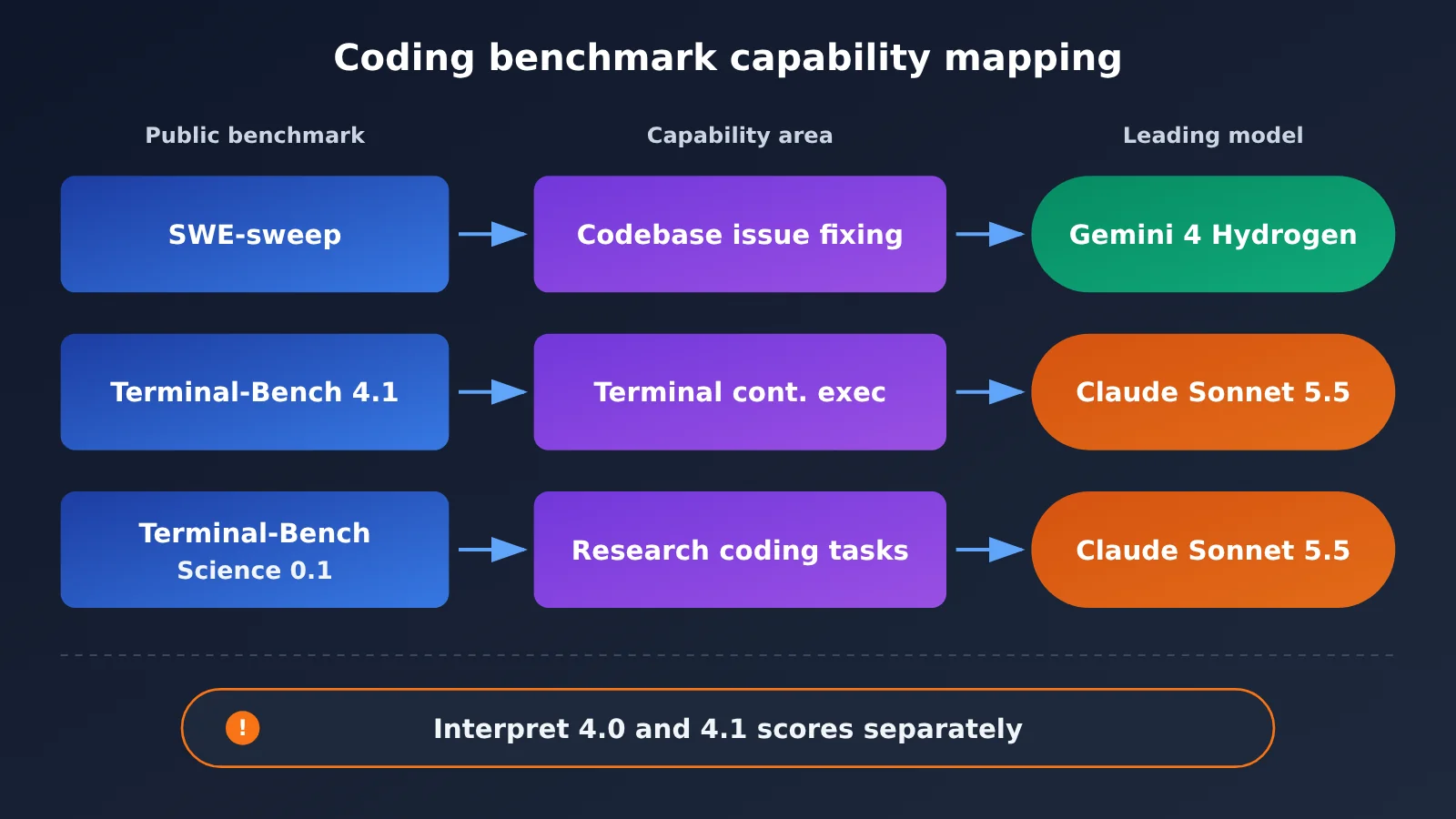
Coding benchmarks can test two different capabilities: finding and fixing issues in a real codebase, and continuously running commands and completing engineering tasks in a terminal environment. SWE-sweep leans toward the former, the Terminal-Bench series leans toward the latter, and Terminal-Bench-Science evaluates the ability to use code to complete scientific research tasks.
| Benchmark (version) | Metric | Gemini 4 Hydrogen | Claude Sonnet 5.5 | GPT-6.1 Terra | Leader |
|---|---|---|---|---|---|
| SWE-sweep | Subtask-weighted reward | 13.5% | 3.1% | 5.8% | Hydrogen |
| Terminal-Bench 4.1 | Average reward | 57.0% | 63.9% | — | Sonnet |
| Terminal-Bench-Science 0.1 | Task score | 51.4% | 59.9% | 58.3% | Sonnet |
Source: Google DeepMind, Gemini 4 Hydrogen Model Evaluation and model card, November 2026.
How to Interpret the Coding Benchmark Results
SWE-sweep’s absolute scores are low across the board, which shows it’s a very hard benchmark. Hydrogen’s 13.5% is more than twice Terra’s and more than four times Sonnet’s—the gap is most pronounced here. However, Hydrogen ran this benchmark using Google’s own Antigravity-CLI 1.4.8, and the competitors weren’t necessarily run under identical conditions, so some of the gap may come from harness adaptation.
On Terminal-Bench 4.1, Sonnet 5.5’s 63.9% leads Hydrogen’s 57.0%, and Terra has no score for this item in Google’s table. Hydrogen used the mini-swe-agent vision harness and the High thinking setting for this item, running each task 5 times and averaging the reward. On Terminal-Bench-Science 0.1, Sonnet still leads, Terra follows closely at 58.3%, and Hydrogen actually comes in third.
Coding takeaway: Hydrogen has a clear advantage on codebase issue-fixing benchmarks like SWE-sweep; Sonnet 5.5 is steadier on terminal execution tasks; Terra performs close to Sonnet on research code tasks. No single model leads across all coding benchmarks.
Vendor-Reported Terminal-Bench 4.0 Background Data
OpenAI and Anthropic have each published Terminal-Bench 4.0 results. Because 4.0 and 4.1 are different benchmark versions, the table below lists them separately and should not be compared side by side with the 4.1 scores above.
| Benchmark (version) | Model | Score | Test conditions | Source |
|---|---|---|---|---|
| Terminal-Bench 4.0 | Claude Sonnet 5.5 | 70.6% | Vendor self-test | Anthropic release materials, 2026-09-28 |
| Terminal-Bench 4.0 | GPT-6.1 Terra | 50.3% | Highest reasoning setting | OpenAI release materials, 2026-10-26 |
The value of this data is that it provides a reference point: under each vendor’s own test conditions, Sonnet 5.5’s terminal task capability is clearly higher than Terra’s, consistent with the direction in Google’s table, where Sonnet leads on terminal-style benchmarks.
Can Gemini 4 Hydrogen Complete End-to-End Work in Agent and Automated Testing?
The biggest difference between Agent testing and single-turn Q&A is that the model has to plan its own steps, call tools in sequence, adjust its strategy after failures, and finally verify the results. These tests are closer to real automation workflows and place greater demands on the model’s “execution discipline.”
The table below summarizes all cross-model scores from Google’s evaluations across Agent automation, computer operation, and multimodal knowledge work. The third and fourth sections share this table.
| Benchmark (version) | Capability area | Metric | Gemini 4 Hydrogen | Claude Sonnet 5.5 | GPT-6.1 Terra |
|---|---|---|---|---|---|
| Agents’ Last Exam v1.1 | Expert multi-step Agent | Task score | 71.6% | 60.4% | 69.8% |
| AutomationBench-AA | Workflow automation | Task score | 76.1% | 71.8% | 60.2% |
| Vending-Bench 2 | Long-term simulated business operation | Final cash balance | $14,549 | $11,165 | $9,107 |
| OSWorld-2.1 | Computer/GUI operation | Task success rate | 77.6% | 83.9% | 74.2% |
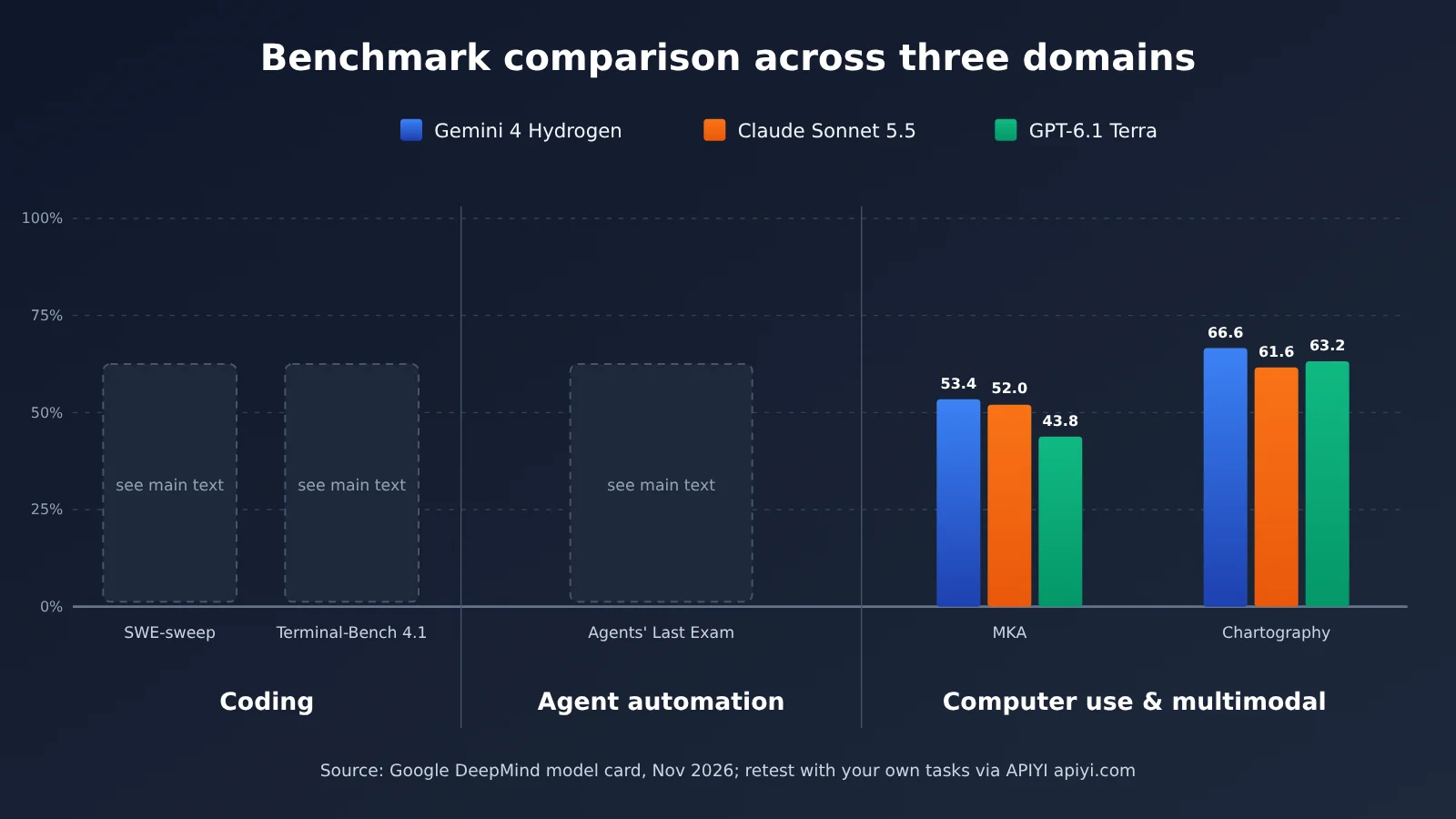
| MKA | Multimodal knowledge work | Task score | 53.4% | 52.0% | 43.8% |
| Chartography | Chart understanding (no tools) | Accuracy | 66.6% | 61.6% | 63.2% |
| HLE-Diamond | High-difficulty knowledge reasoning | Accuracy | 58.8% | 53.3% | 47.3% |
Source: Google DeepMind model card and “Gemini 4 Hydrogen Model Evaluation,” November 2026.
Interpreting the Agent and Automation Results
Agents’ Last Exam v1.1 includes 122 tasks within a 5-hour time window, and Hydrogen also runs on Antigravity-CLI 1.4.8. Hydrogen leads at 71.6%, but it’s worth noting that Terra follows closely at 69.8%—nearly 10 percentage points ahead of Sonnet. That shows Terra isn’t weak on expert multi-step tasks.
AutomationBench-AA shows a different pattern: Hydrogen scores 76.1%, Sonnet 71.8%, and Terra falls clearly behind at 60.2%. If your business involves a lot of cross-system workflow automation, this gap is worth taking seriously.
Vending-Bench 2 is a long-term simulated business task, and the metric is final cash balance rather than accuracy. Hydrogen’s $14,549 leads by a wide margin and can serve as a supplementary signal for “long-horizon decision stability,” but it’s a single simulated environment, so it shouldn’t be generalized directly to all long-running tasks.
Agent conclusion: In every Agent and automation test Google lists, Hydrogen leads; Terra is close to Hydrogen on expert multi-step tasks but lags on workflow automation; Sonnet sits in the middle.
🚀 Quick start: Agent scores depend heavily on the harness and tool definitions, so public numbers are only a starting point. We recommend running all three models through APIYI apiyi.com with the same toolchain and the same set of real tasks—one API key lets you switch between them—so you can get comparison data for your own use case.
Gemini 4 Hydrogen vs. Sonnet 5.5: Which Is Stronger at Computer Use and Multimodal Knowledge Work?
Computer-use tests ask a model to “look at the screen, click the mouse, and type on the keyboard”—tasks that map directly to browser use, office software automation, and similar scenarios. Multimodal knowledge work, by contrast, tests complex document reading and chart comprehension, which maps to jobs like financial report analysis and research report compilation.
OSWorld-2.1: Sonnet 5.5 Leads on GUI Operations
In Google’s evaluation, OSWorld 2.1 uses 82 offline tasks at 1080p resolution, with up to 500 steps; the model observes through screenshots and executes actions through PyAutoGUI. Sonnet 5.5 leads at 83.9%, followed by Hydrogen at 77.6% and Terra at 74.2%.
There’s a methodological caveat worth flagging: Anthropic’s own published score for Sonnet 5.5 on part of OSWorld 2.1 is 80.1%, while Google’s comparison table uses 83.9%, which Google measured under its specified conditions and reported as the best result across multiple runs. In other words, the same benchmark can produce different scores depending on the vendor, so any comparison has to stick to a single source.
MKA and Chartography: Hydrogen Takes a Narrow Lead
In MKA multimodal knowledge work, Hydrogen at 53.4% and Sonnet at 52.0% are very close, while Terra at 43.8% trails by about 10 percentage points. Chartography tests chart comprehension without tools: Hydrogen leads at 66.6%, and interestingly Terra comes second at 63.2%, ahead of Sonnet at 61.6%—a result that fits OpenAI’s positioning of Terra as a “visual reasoning” model.
Computer Use and Multimodal Takeaways: For GUI operations, prioritize Sonnet 5.5; for complex document reading and multimodal knowledge integration, Hydrogen and Sonnet are close, with Hydrogen slightly ahead; for pure chart comprehension, Hydrogen leads, and Terra is also competitive.
How to Read Gemini 4 Hydrogen Public Benchmark Data Correctly
The most common misreading of public benchmark data is treating a single table as a scorecard from the same exam under the same rules. In reality, Google’s evaluation methodology document lays out several key caveats:
- Thinking level: Hydrogen is usually tested at the highest thinking setting, but some benchmarks specify otherwise—for example, Terminal-Bench 4.1 uses the High level.
- Execution harness: SWE-sweep and Agents’ Last Exam use Antigravity-CLI 1.4.8; Terminal-Bench 4.1 uses the mini-swe-agent vision Harness; OSWorld 2.1 uses screenshots plus PyAutoGUI.
- Number of runs: Terminal-Bench 4.1 runs each task 5 times and averages the reward, while OSWorld competitor scores use the best result across multiple runs—these two statistical methods are different to begin with.
- Score source: Competitor results mainly come from vendors’ public reports and leaderboards; not all models were run by the same team under the same setup.
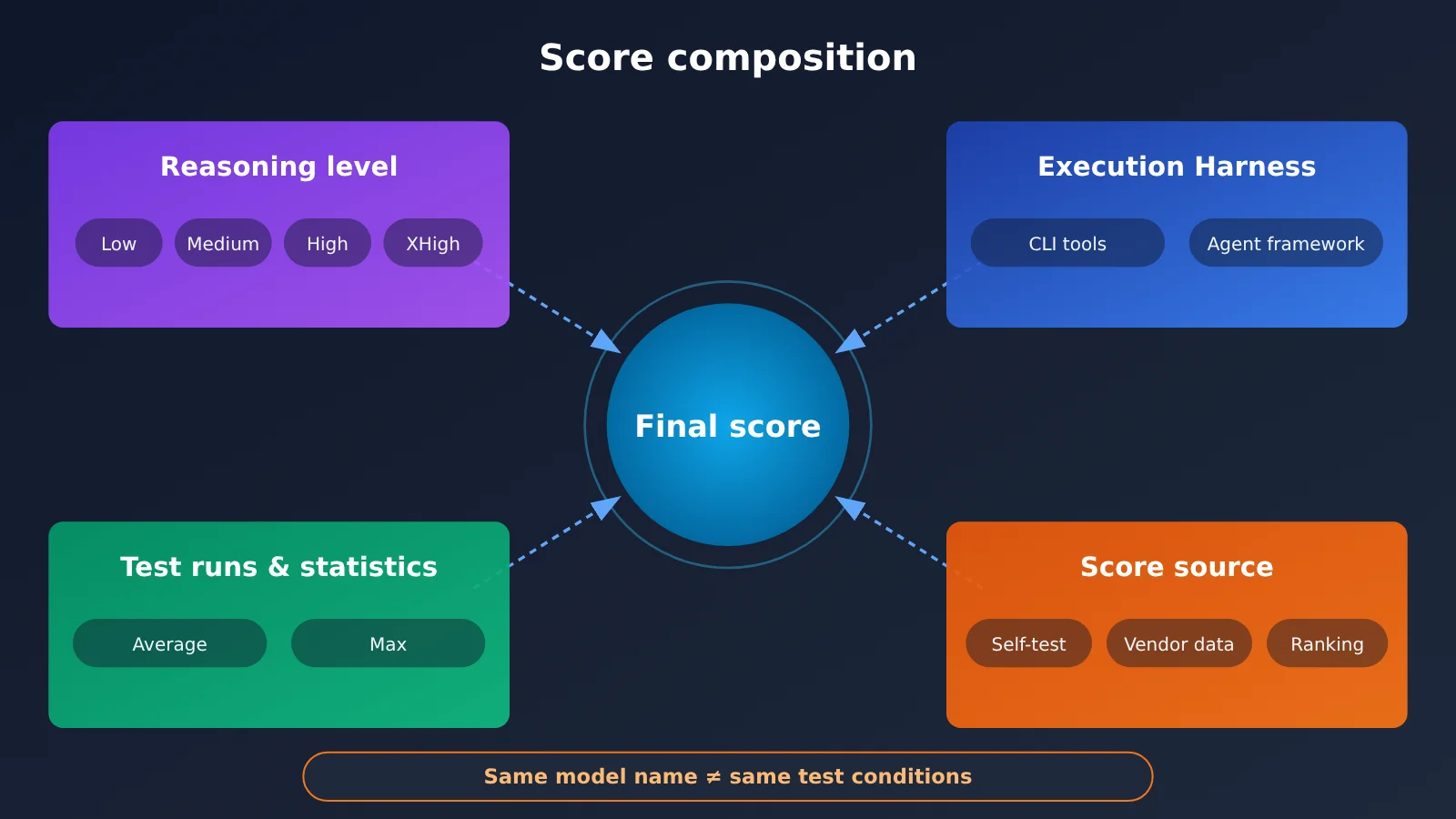
The thinking level has an especially large impact. On November 12, Artificial Analysis ran an independent evaluation of all four Hydrogen levels: the Intelligence Index came in at 27 for Low, 41 for Medium, 51 for High (the default), and 54 for XHigh; the corresponding average cost on its standardized evaluation tasks ranged from $0.29 to $3.16. These are benchmark task results, not the actual per-call cost for ordinary users, but they’re enough to show how much the same model can vary across levels: XHigh scores only 3 points more than High, yet costs noticeably more.
So when reading the scores in this article, keep two things in mind: first, the conclusions apply only to the public tests listed here; second, don’t stitch together the most favorable numbers from Google’s table, OpenAI’s self-reported results, and Anthropic’s self-reported results into a single “overall ranking.”
Gemini 4 Hydrogen Quick Start: Compare Three Models with the Same Code
The most reliable way to pick a model is to run all three against your own tasks. The examples below use the OpenAI-compatible interface — you only need to change the model parameter to switch.
Minimal Example
import openai

client = openai.OpenAI(
    api_key="YOUR_API_KEY",
    base_url="https://api.apiyi.com/v1"  # APIYI OpenAI-compatible interface
)

response = client.chat.completions.create(
    model="gemini-4-hydrogen",
    messages=[{"role": "user", "content": "Find the bug in this Python code and give the minimal fix"}]
)
print(response.choices[0].message.content)
View the full implementation: a three-model comparison script on the same prompt
import time
import openai

client = openai.OpenAI(
    api_key="YOUR_API_KEY",
    base_url="https://api.apiyi.com/v1"
)

# Model IDs follow the platform's model list; gemini-4-hydrogen is the official Google ID
MODELS = [
    "gemini-4-hydrogen",
    "gpt-6.1-terra",       # Illustrative ID — confirm in the console
    "claude-sonnet-5.5",   # Illustrative ID — confirm in the console
]

def compare(prompt: str, system: str = "You are a senior engineer; only change the code that must be changed"):
    results = []
    for model in MODELS:
        start = time.time()
        try:
            resp = client.chat.completions.create(
                model=model,
                messages=[
                    {"role": "system", "content": system},
                    {"role": "user", "content": prompt},
                ],
            )
            usage = resp.usage
            results.append({
                "model": model,
                "seconds": round(time.time() - start, 1),
                "prompt_tokens": usage.prompt_tokens if usage else None,
                "completion_tokens": usage.completion_tokens if usage else None,
                "answer": resp.choices[0].message.content[:300],
            })
        except Exception as e:
            results.append({"model": model, "error": str(e)})
    return results

if __name__ == "__main__":
    for r in compare("Fix: the function throws IndexError on empty list input ..."):
        print(r)
There are a few things to watch for when migrating to Hydrogen: custom temperature, top_p, and top_k are ignored; thinking_budget and MINIMAL aren’t supported; the default thinking level is High; and multi-turn tool calls need thought signatures passed back correctly. If your agent relied on low temperature to constrain output, you’ll need to switch to structured output or clearer instructions instead.
Tip: Start with 10–20 real tickets or tasks as your eval set, call all three models through APIYI at apiyi.com, and record success rate, latency, and output token count for each. New users get free testing credits, so you can complete a small-scale validation before committing to a purchase.
Gemini 4 Hydrogen, Terra, and Sonnet 5.5: Scenario Recommendations and Selection Matrix
When to choose Gemini 4 Hydrogen
- Codebase bug fixing and dependency upgrades: Largest lead on SWE-sweep, and the official release focused heavily on improving precise edits.
- Multi-step agents and workflow automation: Leads on Agents’ Last Exam, AutomationBench-AA, and Vending-Bench 2.
- Complex document and chart analysis: Leads on MKA and Chartography, and accepts multi-format input such as PDF and Office documents.
When to choose Claude Sonnet 5.5
- Terminal-heavy engineering tasks: Leads on both Terminal-Bench 4.1 and Terminal-Bench-Science 0.1.
- Desktop and GUI operation: Highest score on OSWorld-2.1 in Google’s table.
- Professional documents and interface design: An area Anthropic explicitly highlights.
When to choose GPT-6.1 Terra
- Cost-sensitive, high-volume tasks: Standard pricing of $1 / $5, the lowest among the three at known prices.
- Visual reasoning and everyday automation: Second on Chartography, and close to Hydrogen on Agents’ Last Exam.
| Task type | First choice | Alternative | Cost sensitivity | Suggested execution approach | Access channel |
|---|---|---|---|---|---|
| Codebase maintenance, bug fixes | Hydrogen | Sonnet 5.5 | Medium | Hydrogen writes the code, Sonnet runs terminal verification | APIYI apiyi.com unified interface |
| Terminal ops, research code | Sonnet 5.5 | Terra | Medium | Single-model long session | Same as above |
| Multi-step agent workflows | Hydrogen | Terra | Medium | Start at the High effort level, escalate to XHigh on failure | Same as above |
| Desktop/browser GUI operation | Sonnet 5.5 | Hydrogen | Low | Screenshot observation + action tools | Same as above |
| Chart and document reading | Hydrogen | Terra | Medium | No tools, or retrieval-augmented | Same as above |
| High-volume everyday automation | Terra | Hydrogen (Batch) | High | Batch asynchronous processing | Same as above |
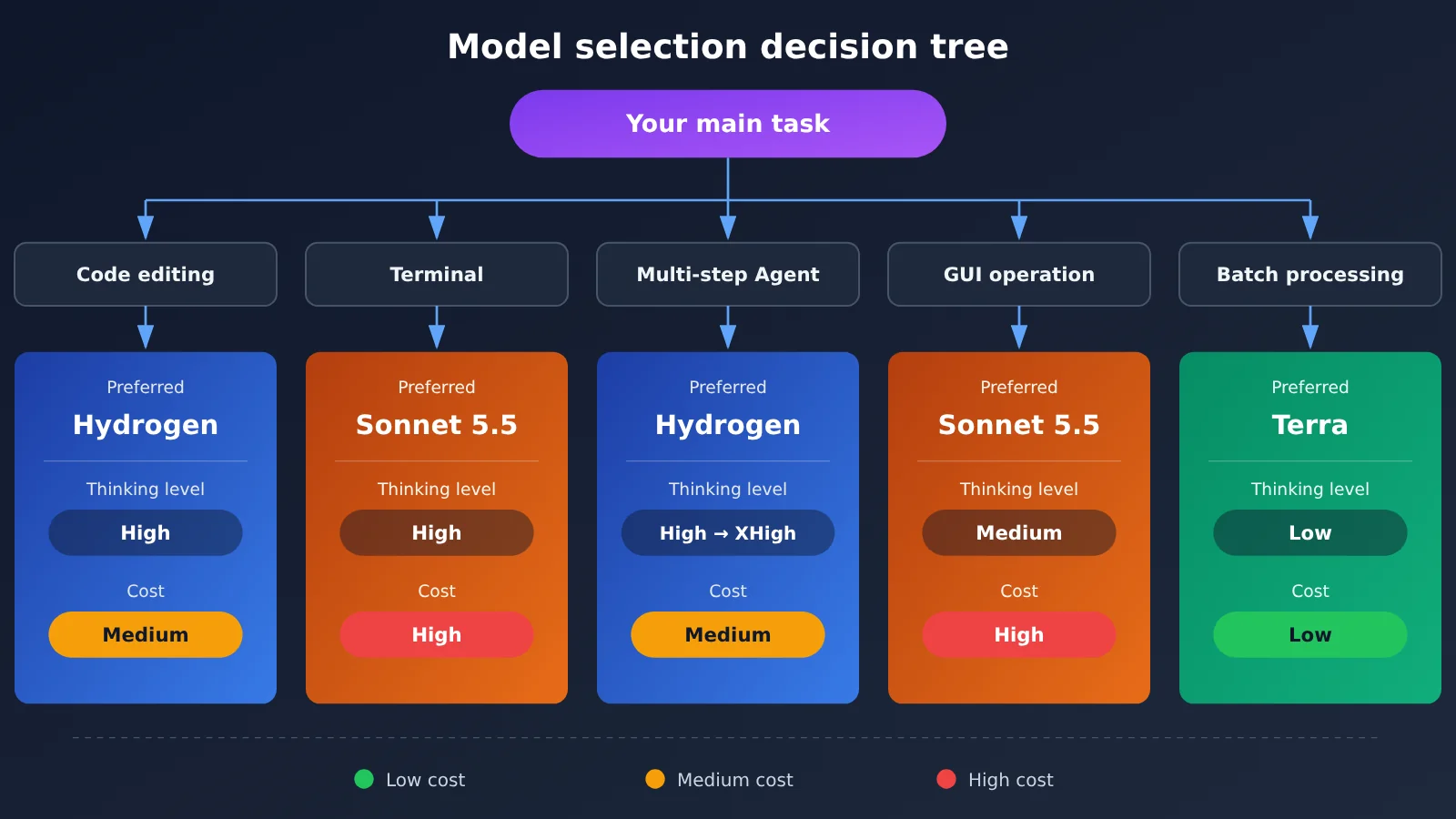
💡 Recommendation: If your team needs both coding and GUI automation, you don’t have to bet on a single model — you can split the work by stage, following the approach behind Google Antigravity Orchestrator. With APIYI apiyi.com, you can call multiple models using the same Key, and switching routes is just a one-parameter change.
FAQ
Q1: What is Gemini 4 Hydrogen?
Gemini 4 Hydrogen is a high-efficiency model released by Google DeepMind on November 12, 2026. Its API model ID is `gemini-4-hydrogen`, and it’s aimed at everyday programming and Agent execution. It supports a unified context window of 1,048,576 tokens and offers four thinking levels — Low, Medium, High, and XHigh — with High as the default.
Q2: Which is better at programming, Gemini 4 Hydrogen or Claude Sonnet 5.5?
It depends on the task type. Hydrogen leads by a wide margin in SWE-sweep codebase repair tests; Sonnet 5.5 leads in terminal-execution tests like Terminal-Bench 4.1 and Terminal-Bench-Science 0.1. For everyday code changes, lean toward Hydrogen; for terminal-intensive engineering, go with Sonnet.
Q3: GPT-6.1 Terra didn’t take first place in a single category — is it still worth using?
It’s worth considering. In Google’s three-way comparison table, Terra indeed has no top score in any single category, but it’s close to Hydrogen on Agents’ Last Exam, ranks second on Chartography, and has the lowest standard API price. For cost-sensitive scenarios centered on visual operations and routine automation, it’s an important candidate.
Q4: Why does Sonnet 5.5 have two versions of its OSWorld score, 80.1% and 83.9%?
80.1% is a partial test result Anthropic published itself, while 83.9% is Google’s result from testing under specified conditions and taking the highest of multiple runs. The test conditions differ, so when comparing you should stick to a single source — don’t mix the two.
Q5: How can I quickly compare these three models via API?
We recommend using a multi-model API aggregation platform:
1. Visit APIYI apiyi.com to register an account and get an API key;
2. Confirm the available IDs for the three models in the console’s model list;
3. Set the `base_url` in the code from this article to `https://api.apiyi.com/v1` and call each model with the same batch of tasks.
APIYI offers an OpenAI-compatible interface with pay-as-you-go billing, making it easy to run a side-by-side comparison in a single script.
Q6: What are the known limitations of Gemini 4 Hydrogen?
The official model card notes: it can still hallucinate; high thinking levels noticeably increase latency and cost; its knowledge cutoff is March 2026; its unreasonable-refusal metric is 5.57 percentage points worse than 3.8 Flash; and the full safety report hadn’t been published at the time of verification. Some developers also report over-execution in certain Agent tasks. In addition, its standard per-token price is twice the current price of 3.8 Flash, so batch tasks may want to consider Batch mode.
Gemini 4 Hydrogen Comparison: Key Takeaways
- No all-round coding champion: Hydrogen shines at codebase repair, Sonnet 5.5 at terminal execution tasks.
- Hydrogen leads in agent automation: In every agent and automation test Google listed, Hydrogen came out on top.
- GUI operations favor Sonnet 5.5: On OSWorld-2.1, Sonnet leads at 83.9% — though watch out for methodological differences.
- Terra wins on cost and vision: Lowest standard price, and it holds its own on chart comprehension and specialized agent tasks.
- Don’t mix versions or sources: Terminal-Bench 4.0 vs. 4.1, and vendor-reported vs. Google’s own results, need to be kept separate.
- Thinking tiers make a big difference: Hydrogen High and XHigh are only 3 points apart on the intelligence index, but the cost climbs noticeably.
- Trust your own task re-tests: With a single APIYI apiyi.com key, you can cross-test all three models side by side.
Summary
The core takeaways from comparing Gemini 4 Hydrogen, GPT-6.1 Terra, and Claude Sonnet 5.5:
- Coding: Hydrogen leads on SWE-sweep, Sonnet 5.5 leads two terminal-style tests, and Terra comes close to Sonnet on research code tasks.
- Agents: Hydrogen sweeps multi-step agents, workflow automation, and long-horizon simulation management, with Terra close behind on specialized tasks.
- Computer use and multimodality: Sonnet 5.5 dominates GUI operation, while Hydrogen edges slightly ahead on multimodal knowledge work and chart comprehension.
Public benchmarks tell you “who’s stronger under a given set of conditions” — not “who fits your business better.” A more practical approach is to use the selection matrix above to narrow things down to one or two candidates, then run a small-scale re-test with your own real tasks, a fixed thinking tier, and your existing toolchain.
We recommend validating quickly through APIYI apiyi.com — the platform offers free trial credits and a unified interface across multiple models, making it ideal for teams running horizontal evaluations before going live.
📚 References
- Google Official Blog – Introducing Gemini 4 Hydrogen: launch announcement and partner case studies
- Link:
blog.google/innovation-and-ai/models-and-research/gemini-models/introducing-gemini-4-hydrogen/ -
Notes: official positioning, capability scope, and early test data
-
Google DeepMind Model Card: cross-model evaluation comparison table
- Link:
deepmind.google/models/model-cards/gemini-4-hydrogen/ -
Notes: the main source of quantitative data for this article
-
Google DeepMind Model Evaluation PDF: detailed test execution conditions
- Link:
storage.googleapis.com/deepmind-media/gemini/gemini_4_hydrogen_model_evaluation.pdf -
Notes: harness, thinking levels, number of runs, and supplementary results such as Vending-Bench 2
-
Google Cloud Technical Docs: Hydrogen specs and migration notes
- Link:
docs.cloud.google.com/gemini-enterprise-agent-platform/models/gemini/4-hydrogen -
Notes: context limits, parameter behavior, and compatibility considerations
-
Google AI Studio Pricing Page: official API pricing
- Link:
aistudio.google.com/docs/pricing -
Notes: pricing for the Standard, Batch, Flex, and Priority modes
-
OpenAI – Introducing GPT-6.1 Terra: Terra launch materials
- Link:
openai.com/index/introducing-gpt-6-1-terra/ -
Notes: self-reported Terminal-Bench 4.0 scores and API pricing
-
Anthropic – Introducing Claude Sonnet 5.5: Sonnet 5.5 launch materials
- Link:
anthropic.com/claude-sonnet-5-5 -
Notes: self-reported Terminal-Bench 4.0 and OSWorld 2.1 scores
-
Artificial Analysis – Gemini 4 Hydrogen: independent evaluation across the four thinking levels
- Link:
artificialanalysis.ai/models/gemini-4-hydrogen - Notes: Intelligence Index v5.0.1 scores, latency, and cost for each level
Author: APIYI technical team
Technical discussion: Feel free to reach out to us through the APIYI website homepage — for more model integration resources, head over to the docs.apiyi.com documentation center