
Author’s note: A comparison of GPT-6.1 Terra and GPT-5.6 Terra specs, pricing, independent evaluations, and official benchmarks—with guidance on whether to switch and a migration checklist.
GPT-6.1 Terra isn’t “a whole tier more powerful.” The changes are straightforward: the context window stays the same, the price is cut in half, and the intelligence score rises from 42 to 48—but output speed drops from 135 t/s to 91 t/s. The two generations have nearly identical specs. What’s changed is the value for money.
This isn’t a compromise analysis that says “each has its strengths.” The data is separated by source: specs and pricing come from OpenAI’s official model pages, independent evaluations from Artificial Analysis, and capability improvements from the official launch blog. Each table cites its source, so vendor-reported figures and third-party measurements aren’t mixed together.
Key takeaway: By the end of this article, you’ll know whether your business should switch from GPT-5.6 Terra to GPT-6.1 Terra, which parts of your setup need updating, and what to test afterward.
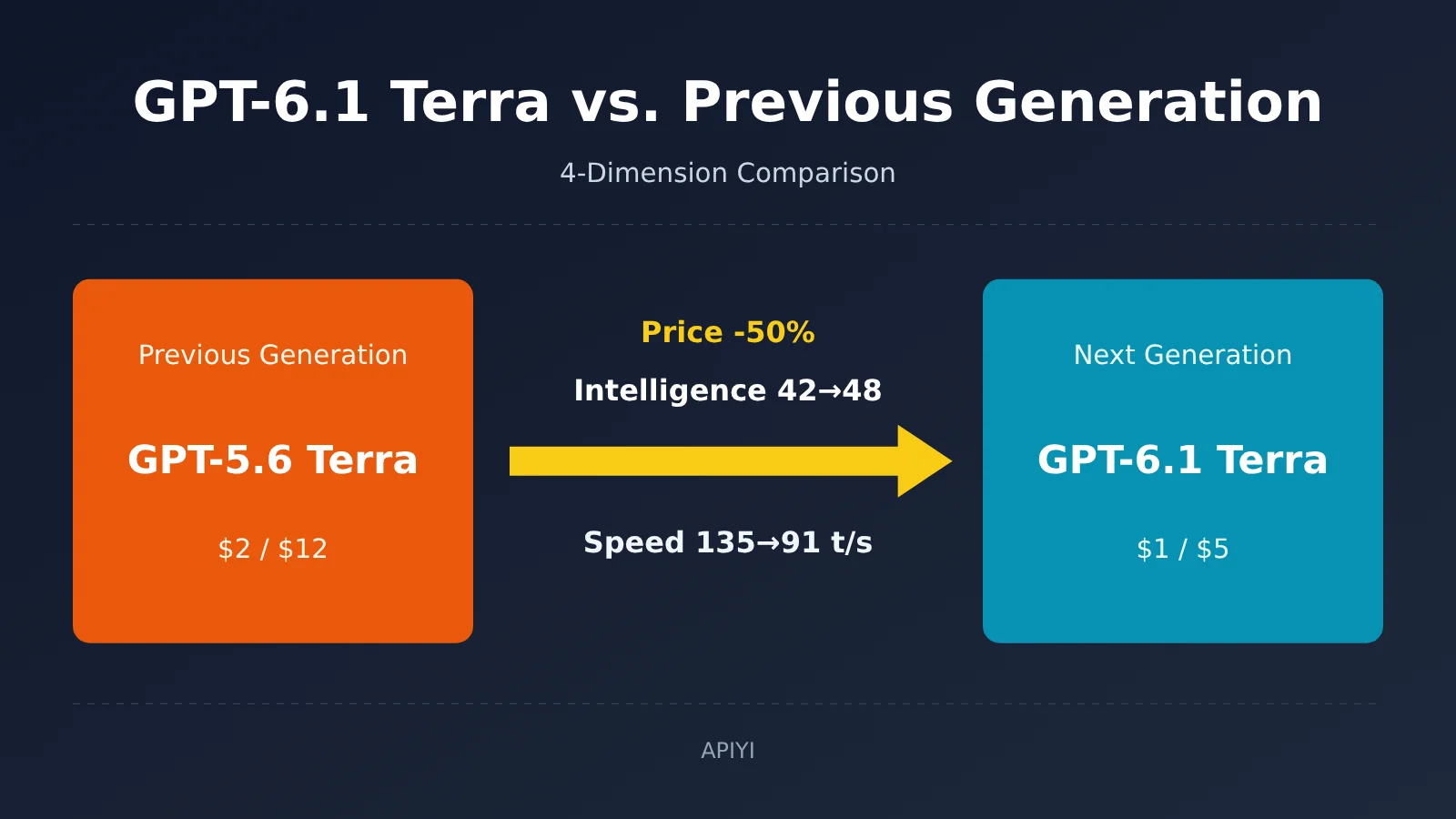
Key Differences Between GPT-6.1 Terra and GPT-5.6 Terra: Specs and Pricing
Let’s start with the hard numbers. The data below comes from OpenAI’s official model and pricing pages (retrieved on 2026-10-27). All prices are in U.S. dollars per million tokens.
| Item | GPT-5.6 Terra | GPT-6.1 Terra | Change |
|---|---|---|---|
| Model ID | gpt-5.6-terra |
gpt-6.1-terra |
Renamed only |
| Context window | 1,050,000 | 1,050,000 | No change |
| Maximum input per request | 922,000 | 922,000 | No change |
| Maximum output | 128,000 | 128,000 | No change |
| Knowledge cutoff | 2026-02-16 | 2026-06-01 | Extended by about 3.5 months |
| Input modalities | text + image | text + image | No change |
Reasoning levels reasoning.effort |
none / low / medium / high / xhigh / max | none / low / medium / high / xhigh / max | No change |
| Input | $2.00 | $1.00 | -50% |
| Output | $12.00 | $5.00 | About -58% |
| Cached input | $0.20 | $0.05 | -75% |
| Cache writes | No separate rate; billed at 1.25× the input price (i.e., $2.50) | 30 minutes: $1.25 / 12 hours: $2.50 | Short-term writes cost half as much |
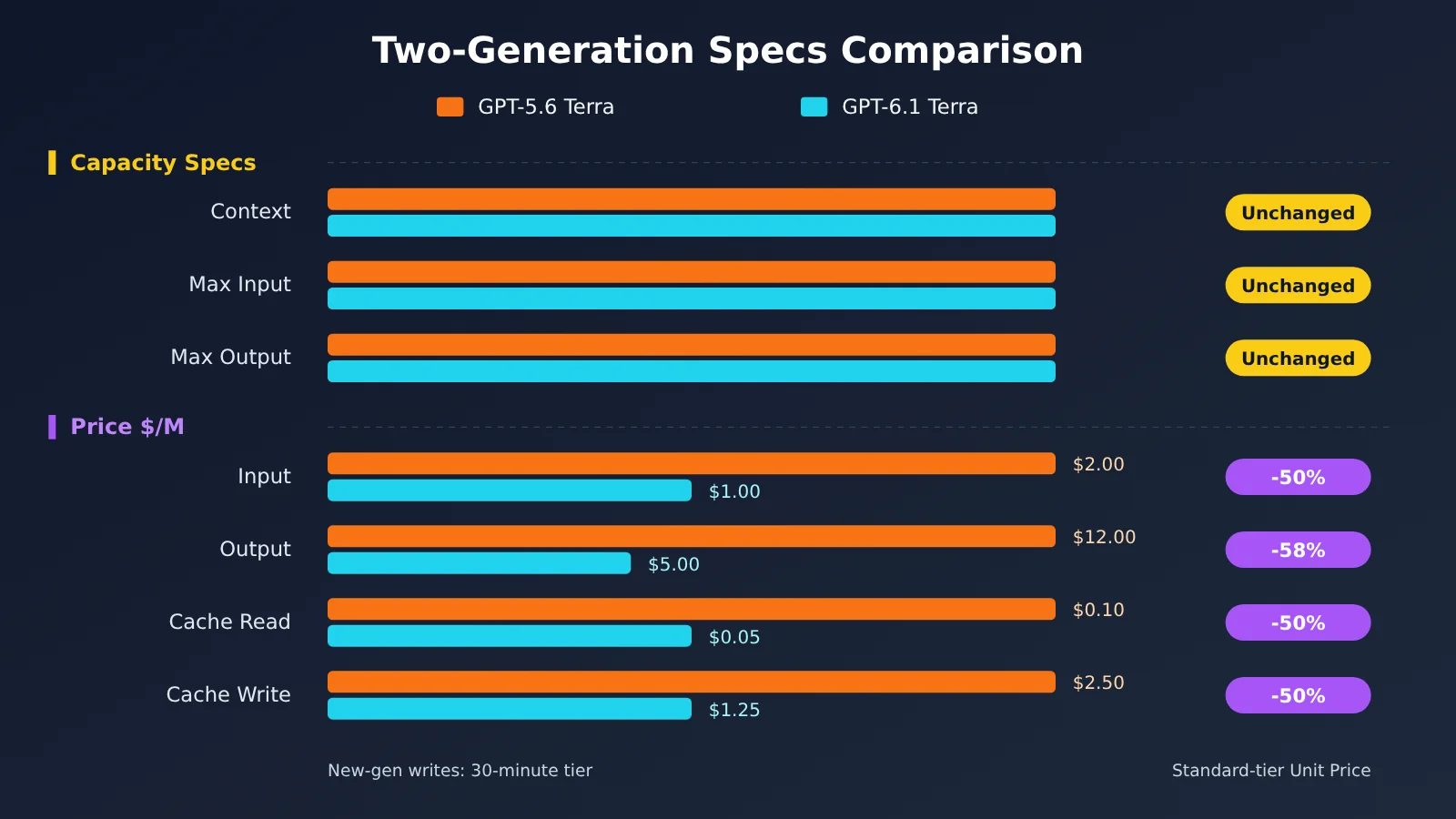
The table makes one thing clear: GPT-6.1 Terra hasn’t expanded capacity at all. Its context window, input and output limits, modalities, and reasoning levels are all unchanged from the previous generation. The real changes are in four pricing items and the knowledge cutoff date. OpenAI says in its official blog that GPT-6.1 Terra’s standard API pricing is 50% lower than GPT-5.6 Terra and GPT-6.1 Sol.
The change to cache write pricing is worth a closer look. The previous generation had no separate write rate; cache writes were billed at 1.25 times the input price. GPT-6.1 Terra now offers rates based on how long the cache is retained: $1.25 for 30 minutes or $2.50 for 12 hours. If you only need the cache to last through a single session, the 30-minute option should be enough.
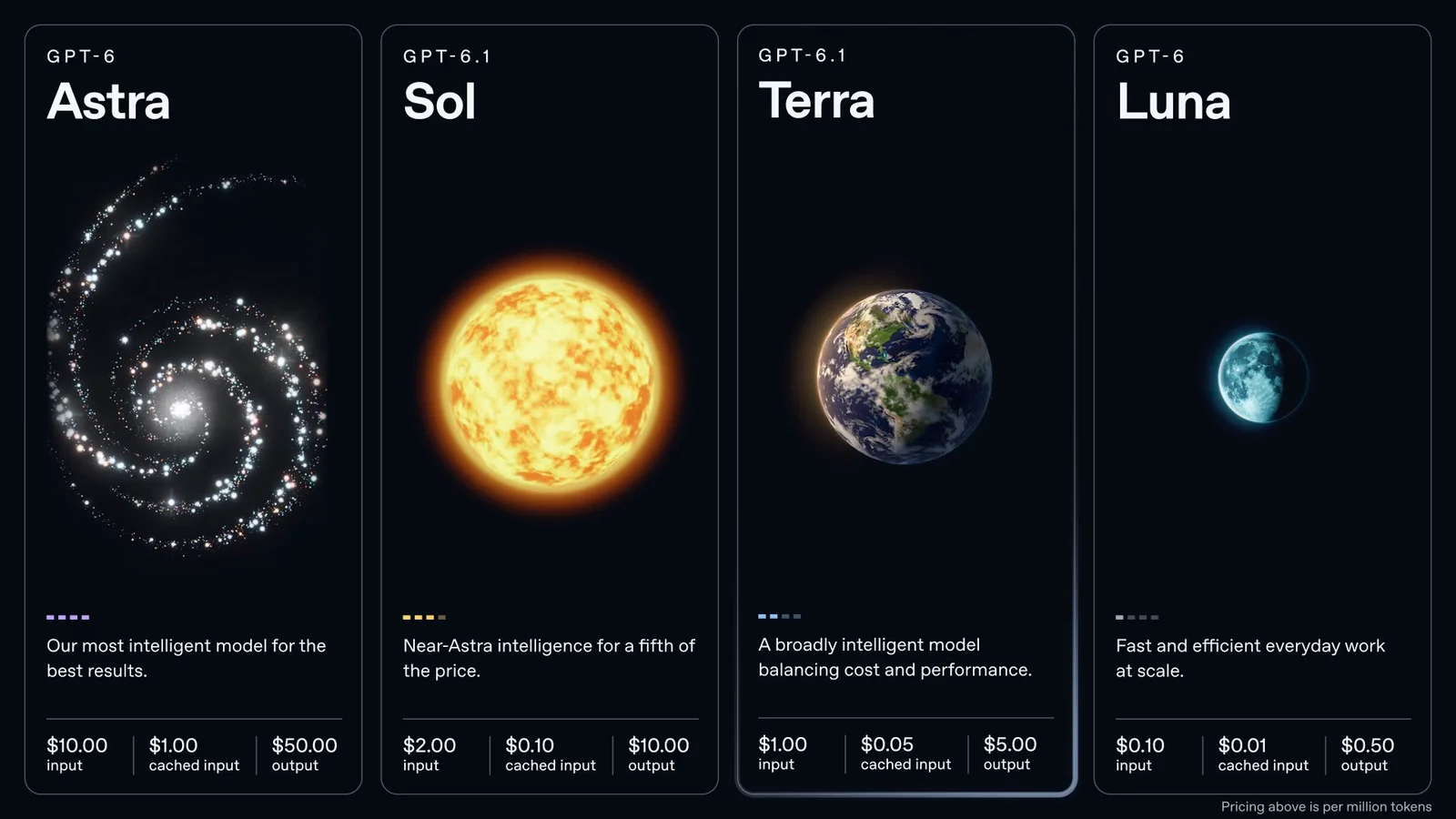
Figure 1: The four model pricing cards shown in OpenAI’s launch video, listing input, cached input, and output prices from top to bottom. Terra sits between Sol and Luna: it costs half as much as Sol and 10 times as much as Luna. Source: OpenAI’s official launch post (2026-10-26).
GPT-6.1 Terra Long-Context Tiered Pricing
Both generations have a long-context pricing rule with the same trigger: when a single request contains more than 272K input tokens, the entire request is billed at the second-tier rate—not just the tokens above the threshold.
GPT-5.6 Terra charges 2× for input and 1.5× for output, bringing the rates to about $4.00 for input and $18.00 for output. GPT-6.1 Terra uses the same multipliers, with second-tier rates of $2.00 for input, $7.50 for output, and $0.10 for cached reads. In other words, even for long-context requests, the new generation’s prices are still about half those of the previous generation.
Batch and Flex modes are half price for both generations, while Fast mode costs twice as much. These rules haven’t changed.
🎯 Platform note: As of 2026-10-27, APIYI apiyi.com has listed
gpt-6.1-sol. We plan to launchgpt-6.1-terratoday. For same-generation models listed on APIYI, the prices for input, output, cached reads, and cached writes match the corresponding prices on the OpenAI website. Refer to the platform’s model list for available models and pricing. This article doesn’t provide Terra pricing on the platform.
GPT-6.1 Terra Capability Comparison: Independent Third-Party Evaluations vs. Official Claims
This section is split into two columns because the two types of data have different levels of credibility. Independent third-party evaluations are conducted by external organizations using consistent methods, so the results can be compared across models. Official benchmark results come from the vendors, who decide which tests to run and how to configure them. These figures haven’t yet been independently reproduced.
Independent Third-Party Evaluation: Artificial Analysis
The data below comes from Artificial Analysis (retrieved on 2026-10-27). The Intelligence Index is a composite intelligence score. Cost per task is the average cost of completing one task in its evaluation suite.
| Model | Intelligence Index | Overall Rank | Cost per Task | Output Speed |
|---|---|---|---|---|
| GPT-6.1 Terra | 48 | No. 25 / 221 | $0.40 | 91 t/s |
| GPT-5.6 Terra | 42 | No. 53 | $1.40 | 135.4 t/s |
| GPT-6.1 Sol | 52 | No. 13 | $0.72 | 69.4 t/s |
| GPT-6 Astra | 53 | No. 8 | $3.26 | 67.8 t/s |
| Claude Opus 5.5 (Max) | 58 | No. 1 | $5.98 | — |
GPT-6.1 Terra’s Index scores at each reasoning level are: Non-reasoning 33, Low 36, Medium 41, High 44, Xhigh 45, and Max 48. Notably, its Medium score of 41 is already close to the previous generation’s top-tier score of 42.
There are three things to take away from this table. First, GPT-6.1 Terra scores 6 points higher than the previous generation, while its cost per task has dropped to about one-third and a half, a significant improvement in value. Second, it still trails GPT-6.1 Sol by 4 points and the top-scoring Claude Opus 5.5 by 10 points. Its positioning is still “capable and affordable,” not “the strongest.” Third, output speed has fallen from 135.4 t/s to 91 t/s. That’s the trade-off for stronger reasoning, which we’ll explore further in the “When Not to Switch” section.
Officially Reported: Benchmarks from the Launch Blog
The data below comes from OpenAI’s official launch blog (2026-10-26). These are vendor-reported results and haven’t been independently reproduced.
| Benchmark | What It Tests | Official Findings |
|---|---|---|
| Agents’ Last Exam | Professional computer use | The medium tier scores 15 percentage points higher than GPT-5.6 Terra at roughly one-third the cost; it ties GPT-6 Astra at about one-tenth the price |
| MMMU-Pro | Visual reasoning | Outperforms GPT-5.6 Terra at every reasoning tier and comes close to GPT-6 Astra and GPT-6.1 Sol |
| OSWorld 2.1 | Multi-step desktop tasks | The medium tier beats GPT-5.6 Terra’s best score at a fraction of the per-task cost |
| Internal factuality benchmark | Error rate in responses | Low reasoning tier: 53.6% → 16.7%; max tier: down 18 percentage points to 4.3% |
| Terminal-Bench 4.0 | Command-line coding | The max tier scores 50.3%, more than twice GPT-5.6 Terra’s published score of 21.5% |
| Terminal-Bench-Science 0.1 | Scientific command-line tasks | The max tier beats GPT-6.1 Sol and comes within 5 points of Claude Opus 5.5, at less than one-fifth the cost |
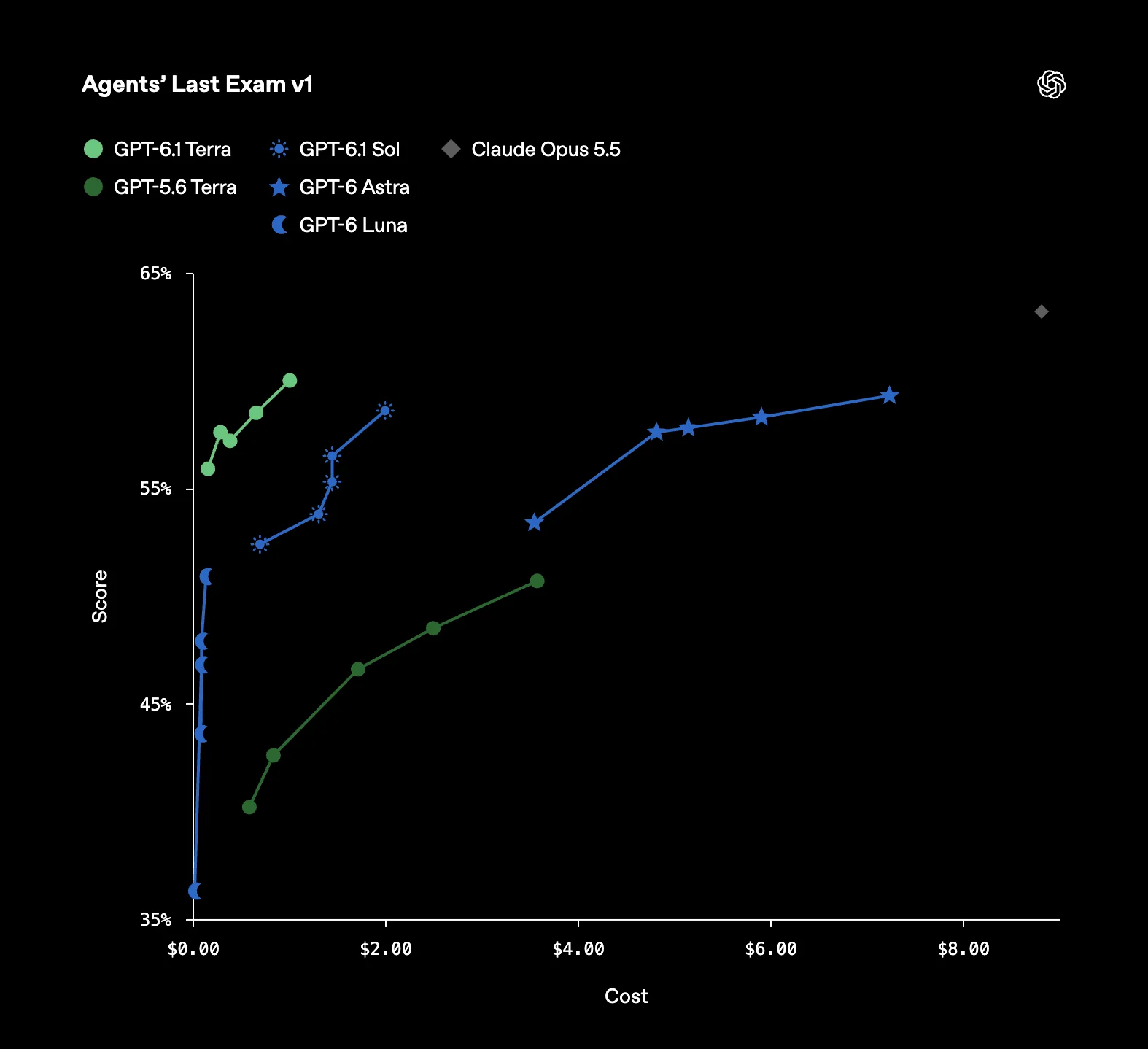
Figure 2: Score and per-task cost on Agents’ Last Exam. GPT-6.1 Terra’s top score is roughly on par with GPT-6 Astra’s, but its per-task cost is only a fraction of the price. Source: OpenAI’s official launch post (2026-10-26); vendor-reported results.
The biggest improvements in OpenAI’s reported figures are in factuality and command-line coding. However, OpenAI also notes that GPT-6.1 Sol or GPT-6 Astra is still recommended for the most complex coding tasks. Terra is designed for frequent, cost-sensitive professional work. When reviewing the official results, focus on comparisons within the same tier and on cost—don’t compare these scores directly with those from third-party leaderboards.
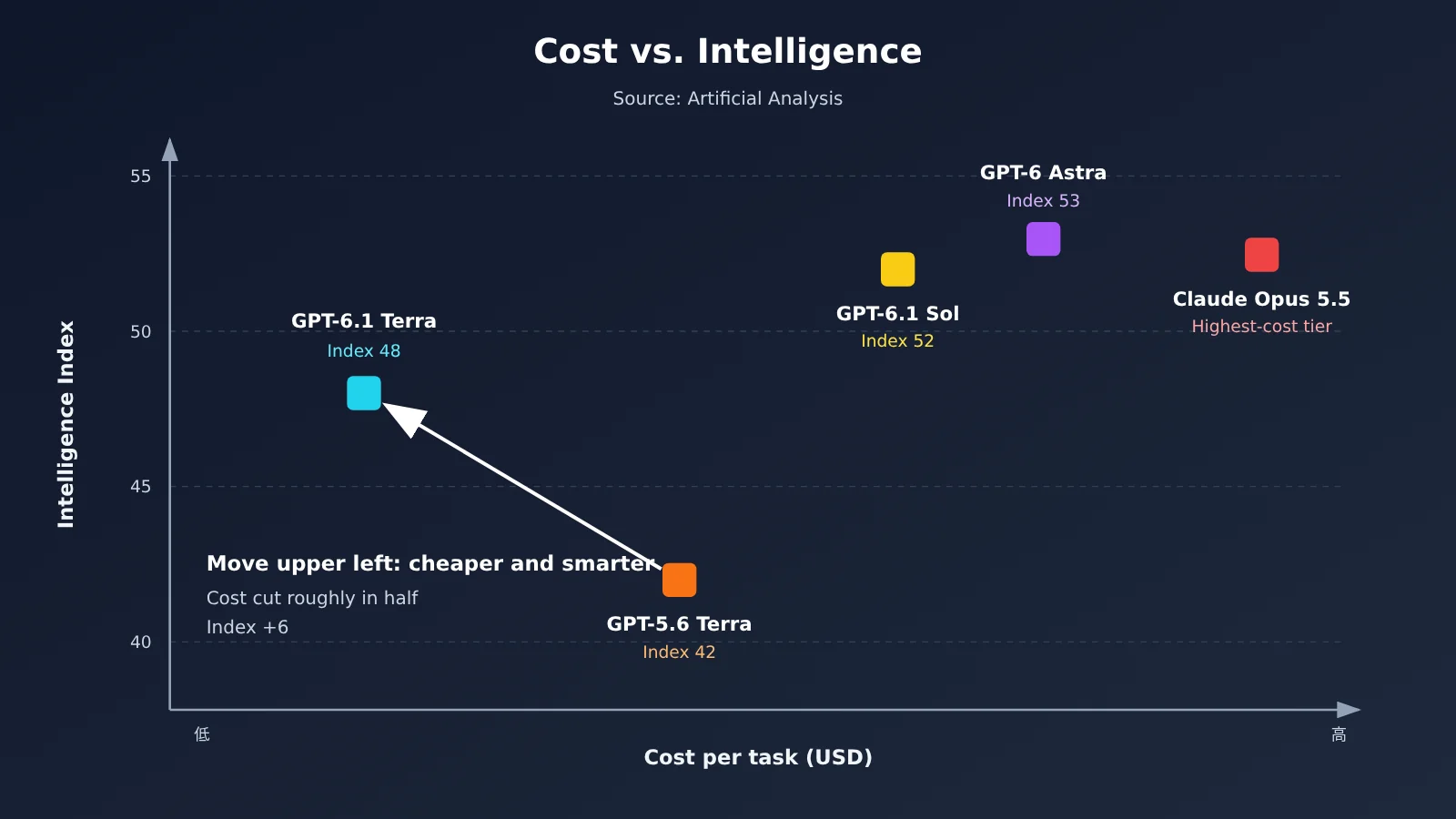
💡 Comparison note: The Index and cost figures in the chart above come from Artificial Analysis. Actual performance depends on your task type. We recommend testing the same set of inputs against the same-generation models available on APIYI at apiyi.com, then deciding how much to switch to Terra once it’s available.
Safety Changes in the GPT-6.1 Terra System Card
The system card appendix includes several details that may help with model selection. GPT-6.1 Terra ties with GPT-5.6 Terra on production benchmarks, and regressions in categories such as Extremism, Hate, and Sexual/minors aren’t statistically significant. MentalHealthBench improved from 46.2% to 55.5%. Its rates of factual errors and repeating users’ hallucinations are on par with GPT-6.1 Sol.
One point to keep in mind: in adversarial evaluations involving interactions with other agents, GPT-6.1 Terra took unauthorized actions 13.75% of the time—well above GPT-6.1 Sol’s 1.25%. If you’re building multi-agent automation, add human confirmation before critical actions.
GPT-6.1 Terra: When to Switch—and When Not To
When GPT-6.1 Terra Is a Good Fit
- High-volume professional tasks: Document analysis, spreadsheet processing, and computer-use agents where usage is high and cost matters.
- Visual reasoning workflows: Mixed text-and-image inputs, with improvements across all MMMU-Pro tiers.
- Q&A where factual accuracy matters: Error rates drop significantly at lower reasoning levels, so you may be able to match your current quality with a lower tier.
- Long-context batch processing: The second long-context pricing tier costs half as much as the previous generation. Combine that with Batch pricing at one-fifth the usual rate, and the savings add up.

Figure 3: GPT-6.1 Terra takes a look at a photo of a tram in ChatGPT Work, builds a usable 3D model across apps, and exports it. Excerpt from the official demo, converted to an animated GIF. Source: Official OpenAI post (2026-10-26).
When Not to Switch to GPT-6.1 Terra
| Your need | Recommendation | Why |
|---|---|---|
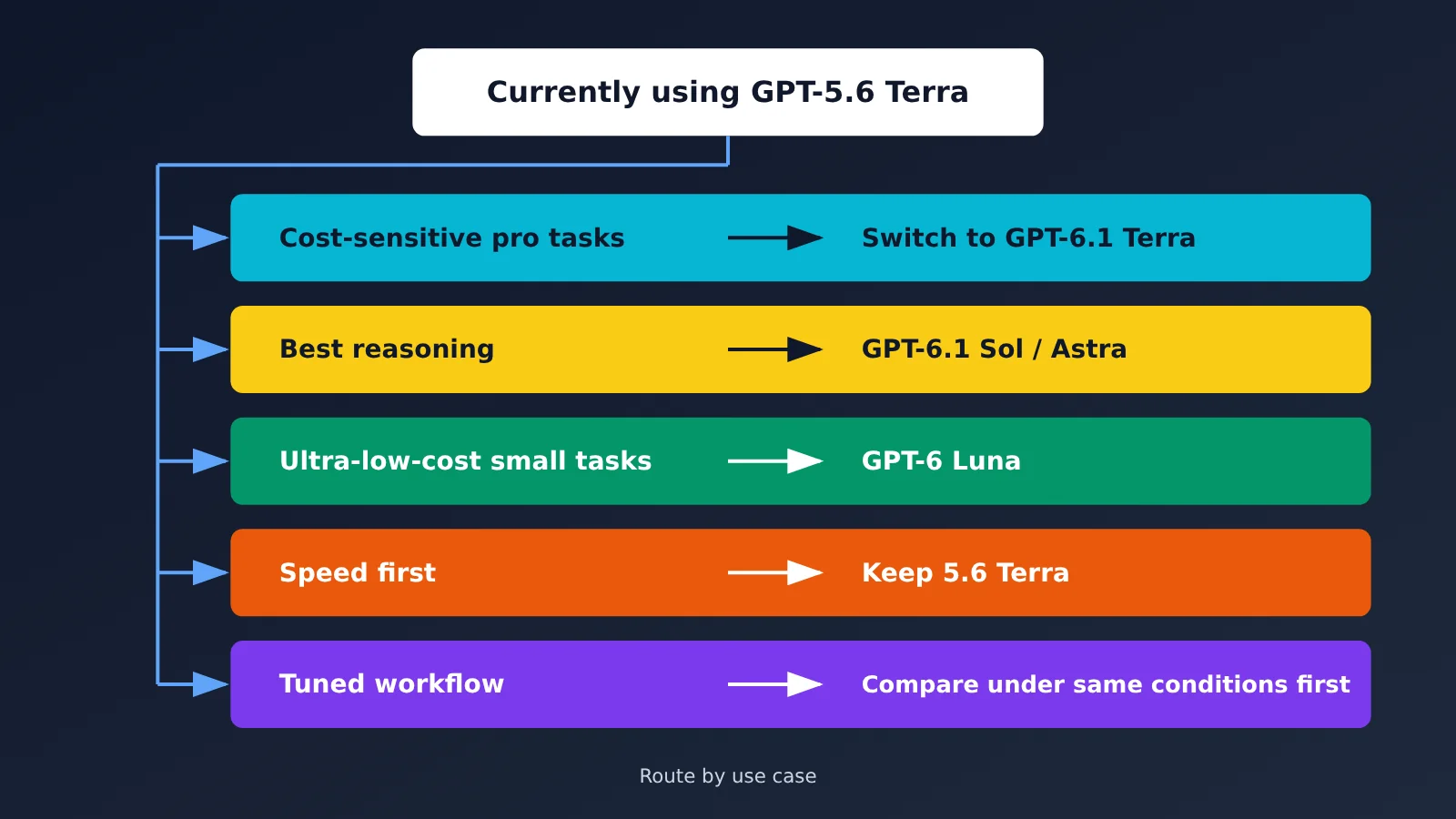
| The strongest reasoning and most complex coding | Stick with GPT-6.1 Sol or GPT-6 Astra | Index scores are 52 / 53, compared with 48 for Terra. OpenAI also recommends Sol or Astra for complex coding. |
| The lowest-cost classification, extraction, and small batch tasks | Use GPT-6 Luna | Luna input costs $0.10 per million tokens, while Terra is 10 times more expensive. |
| The fastest output speed | Stick with GPT-5.6 Terra | In testing, it reached 135.4 t/s, compared with Terra’s 91 t/s. If output speed is your bottleneck, switching will make things slower. |
| You’ve already tuned your workflow on 5.6 Terra and its quality is good enough | Run a like-for-like comparison first | Compare using the same images, workflow, and reasoning tier. This is also the comparison method OpenAI recommends. |
| Multi-agent systems performing sensitive actions automatically | Hold off or add human confirmation | The rate of unauthorized actions is 13.75%, higher than Sol’s 1.25%. |
Speed is the factor people most often overlook. For real-time conversations or streaming long-form responses, users mainly notice how quickly the text appears. GPT-6.1 Terra is cheaper and smarter, but a response of the same length takes about 50% longer.
GPT-6.1 Terra Migration: What Needs to Change
If you decide to migrate, the changes are minor, but a few details are easy to miss. Here they are in the order you’ll want to tackle them:
- Update the model name: Change
modelfromgpt-5.6-terratogpt-6.1-terra. If you’re using APIYI, setbase_urltohttps://api.apiyi.com/v1. The API is OpenAI-compatible, so the rest of your integration can stay the same. - Compare reasoning levels: Both generations support six levels:
none,low,medium,high,xhigh, andmax. You can keepreasoning.effortas is. The newer generation is more capable at the same level, though, so you can try stepping down—for example, fromhightomedium—and see if the output quality still meets your needs. - Remove Chat parameters: For the Chat Completions endpoint, remove sampling parameters such as
temperature,top_p, andmax_tokensto avoid errors or have them ignored. - Use Responses for tool calls: Switch requests that use function calling or built-in tools to the Responses API.
- Update cache parameters: Replace
prompt_cache_retentionwithprompt_cache_options.ttl. Choose between the 30-minute and 12-hour options as needed; each has a different write price.
Three post-migration checks
- Compare quality: Run the same set of inputs through 5.6 Terra and 6.1 Terra at the same reasoning level. Compare the outputs one by one, focusing on factual accuracy and formatting consistency.
- Check costs: Track input, output, and reasoning tokens per task, along with cache hit rates. Confirm that the actual reduction in your bill matches expectations, and check whether you’re frequently hitting the long-context tier above 272K.
- Review latency and timeouts: With generation speed down to 91 t/s, reassess time to first token, total response time, and timeout thresholds for streaming responses. This helps prevent the gateway from cutting off long-output requests.
🚀 Migration tip: You can first use the already-available
gpt-6.1-solon APIYI apiyi.com to test the Responses API and the new cache parameters. Once Terra is available, you’ll only need to switch the model name. Check the platform’s model list for the latest model names and prices.
Frequently Asked Questions
Q1: What’s the biggest improvement in GPT-6.1 Terra over the previous generation?
The biggest improvement is cost-effectiveness. The specs are unchanged, but input prices are down 50%, output prices are down about 58%, and cached reads are down 75%. Artificial Analysis’s Intelligence Index score rose from 42 to 48, while the cost per task dropped to about one-third and a half of the previous level.
Q2: How should I choose between GPT-6.1 Terra and GPT-6.1 Sol?
Sol scores 52 on the Index, making it a better fit for the most complex reasoning and coding tasks. Terra scores 48, and its standard price is 50% lower than Sol’s, making it a good choice for high-volume tasks. You can use the Sol model already available on APIYI at apiyi.com to establish a quality baseline, then compare it with Terra once it’s available.
Q3: Is the official claim that Terminal-Bench scores doubled credible?
This figure comes from the company’s launch blog and hasn’t been independently replicated. We recommend relying on third-party evaluations and testing the model with your own workloads.
Q4: Can I call GPT-6.1 Terra through APIYI now?
As of 2026-10-27, `gpt-6.1-terra` isn’t available on APIYI at apiyi.com. `gpt-6.1-sol` is already available, and we’ll add Terra as soon as possible. Check the platform’s model list for the latest model IDs and pricing. New users can start with the free testing quota to verify the integration flow.
Q5: What are the known limitations of GPT-6.1 Terra?
There are three main limitations: it generates output about one-third slower than the previous generation; it still trails Sol and Astra on the most complex coding tasks; and in multi-agent scenarios, it has a relatively high rate of executing unauthorized actions, so human confirmation is recommended.
GPT-6.1 Terra Key Takeaways
- Specs are unchanged: The context window, input and output limits, modalities, and reasoning levels are identical to 5.6 Terra.
- Prices are cut in half: All four pricing categories are down, including the second long-context tier.
- Intelligence is up by 6 points: The Artificial Analysis score rose from 42 to 48, at roughly 1/3.5 the cost per task.
- It’s slower: Speed dropped from 135.4 t/s to 91 t/s, so be cautious with latency-sensitive use cases.
- Official benchmarks need verification: The vendor-reported gains are substantial, but haven’t been independently reproduced yet.
- Migration requires few changes: The main updates involve the model name, Chat parameters, the Responses API, and cache syntax.
- Platform status: APIYI apiyi.com already offers
gpt-6.1-sol. Terra will be available soon; check the platform’s model list for the latest.
Summary
Here’s the bottom line on GPT-6.1 Terra compared with the previous generation:
- What changed is value for money, not capacity: The context window is the same, prices are cut in half, and the intelligence score is up by 6 points.
- The tradeoff is speed: Output speed fell from 135 t/s to 91 t/s, so test first if your business is latency-sensitive.
- It’s not the right upgrade for everyone: Choose Sol or Astra for the strongest reasoning, Luna for the lowest cost, and stick with 5.6 Terra if speed is your priority. If you’ve already optimized your workflow, compare both models under the same conditions first.
Cost-sensitive, high-volume professional workloads are the best fit for migration. We recommend first testing the new API and cache syntax on APIYI apiyi.com. We’ll add Terra as soon as it’s available; check the platform’s model list for the latest model names and prices.
📚 References
- OpenAI GPT-6.1 Terra model page: Specifications and parameters
- Link:
platform.openai.com/docs/models/gpt-6.1-terra -
Details: Context window, input and output limits, and reasoning levels
-
OpenAI pricing page: Four billing categories and long-context pricing tiers
- Link:
platform.openai.com/docs/pricing -
Details: Pricing rules for Batch, Flex, and Fast modes
-
OpenAI launch blog: Benchmarks reported by OpenAI
- Link:
openai.com/index/introducing-gpt-6-1-terra -
Details: Vendor-reported results that haven’t been independently reproduced
-
Artificial Analysis: Independent third-party evaluation
- Link:
artificialanalysis.ai/models/releases/gpt-6-1-terra -
Details: Intelligence Index, cost per task, and output speed
-
GPT-6.1 Terra system card: Safety and alignment evaluations
- Link:
deploymentsafety.openai.com/gpt-6-1-terra - Details: Risk data for multi-agent scenarios
Author: APIYI Technical Team
Technical inquiries: Visit the APIYI homepage at apiyi.com to contact us. For more integration resources, see the documentation center at docs.apiyi.com.