
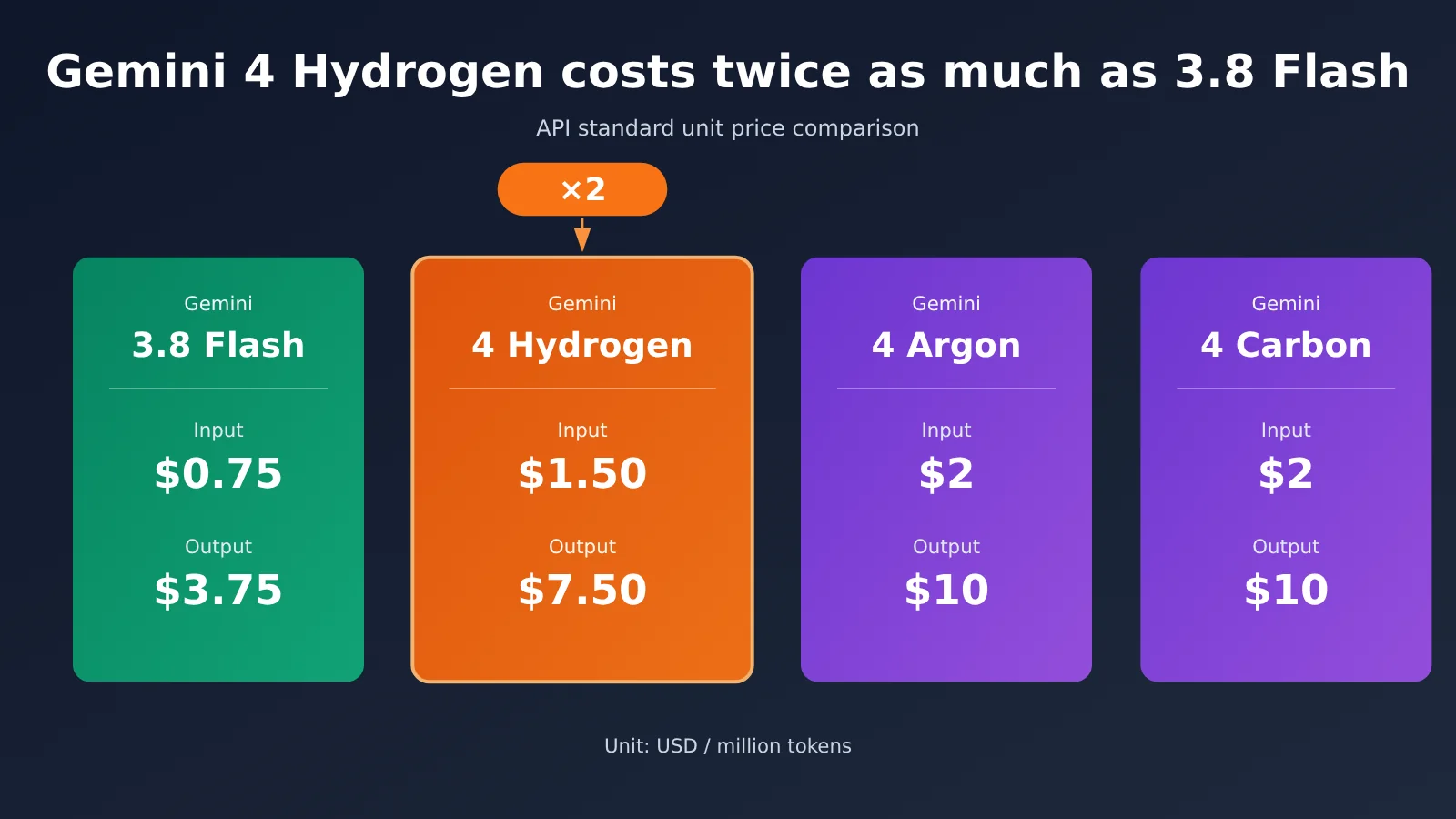
Author’s note: Under the same Token load, Gemini 4 Hydrogen’s current standard unit price is twice that of 3.8 Flash. To choose among the four Gemini models, you shouldn’t look only at the unit price — you also need to consider the cost per successfully completed task, plus the official price adjustment dates that have already been announced.
Google officially released Gemini 4 Hydrogen on November 12, 2026. Many developers’ first reaction was: “The next-generation Flash is here, so it should be cheaper.” The reality is exactly the opposite. Under Google Gemini API standard pricing, Hydrogen costs twice as much per million Tokens as 3.8 Flash, but it is cheaper than Argon and Carbon in the same family.
This isn’t a compromise analysis where every model has its strengths and weaknesses. This article consistently uses Google Gemini API standard pricing (verified on November 13, 2026; in USD per million Tokens). First, let’s work out how much each of the four models costs for the same workload. Then we’ll reason through when Hydrogen is actually cost-effective. Finally, taking into account the price changes on December 1 and January 1 next year, we’ll give you model selection recommendations you can put into practice directly.
In one sentence: Hydrogen’s current Token unit price is 2x that of 3.8 Flash. Whether it’s worth switching depends on whether it can cut the total billable Tokens in half or double the success rate of a single attempt.
5 Terms to Know Before Reading
A few of these concepts directly affect how you judge Gemini 4 Hydrogen pricing, so it’s worth going through them first:
- Token: The unit of measurement a model uses when processing text, images, and other information. APIs bill input tokens and output tokens separately.
- Thinking tokens: Tokens consumed during the model’s reasoning process. Google’s official pricing page explicitly states that thinking tokens are billed at the output rate, so if you estimate cost based only on the length of the final response, you’ll come up short.
- Implicit caching: The platform automatically reuses input prefixes that meet the criteria. The portion that hits the cache is billed at the cache price. Hydrogen supports implicit caching, with a minimum prefix of 4096 tokens; it does not support explicit caching.
- Grounding: Tying generated answers back to retrieved external evidence, such as Google Search Grounding. This is billed separately based on the number of search requests.
- API: The interface through which programs call a service. All prices in this article refer to billing when a program invokes the API, and don’t cover Gemini App subscriptions.
The Core Pricing Differences Between Gemini 4 Hydrogen, 3.8 Flash, Argon, and Carbon
How the Four Gemini Models Are Priced After Hydrogen’s Launch
The table below shows standard invocation pricing for the Google Gemini API. The figures come from the official pricing page and were verified on November 13, 2026.
| Model | Current input price | Current output price | Announced adjustment | Official positioning |
|---|---|---|---|---|
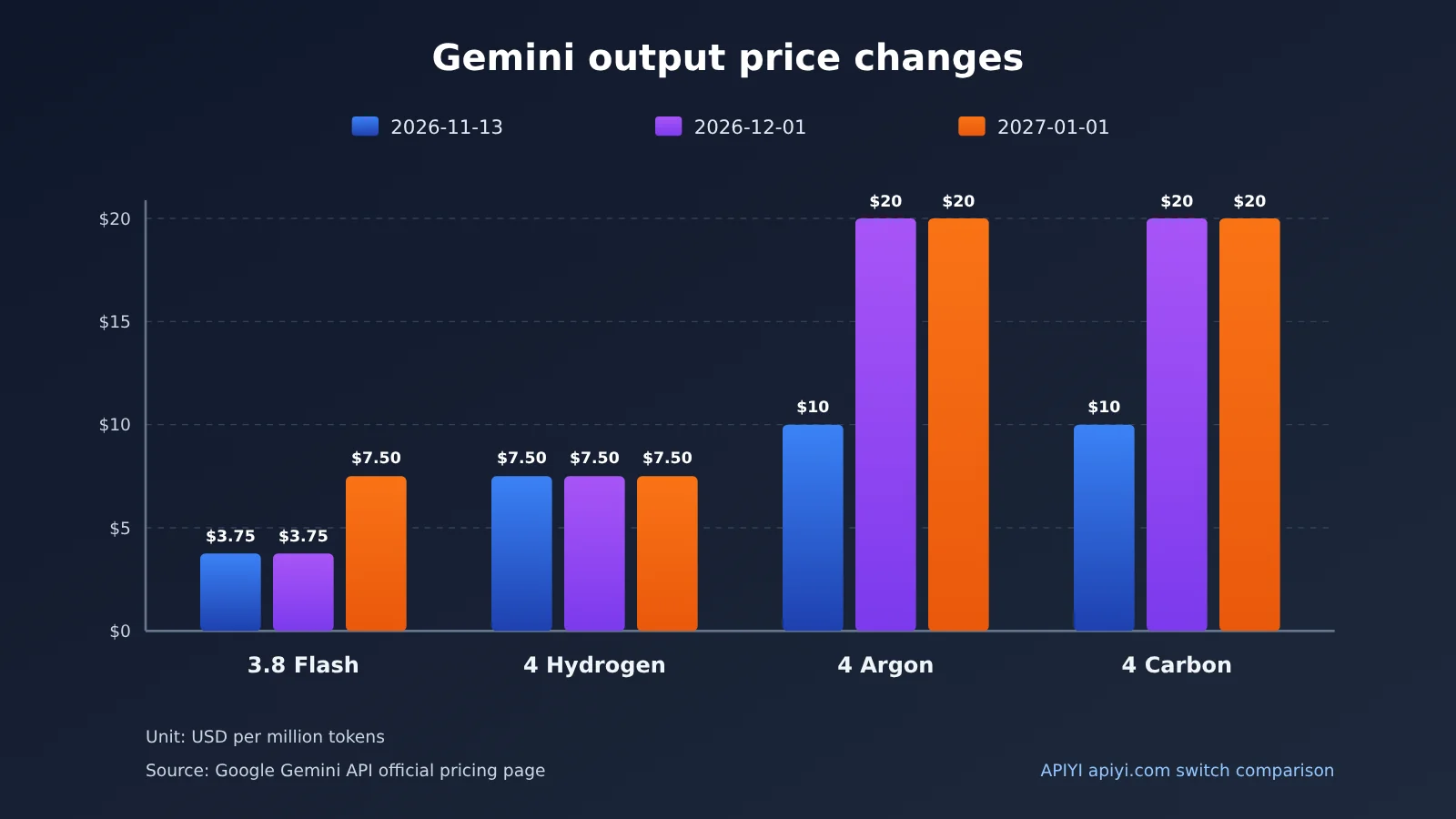
| Gemini 3.8 Flash | $0.75 | $3.75 | Adjusted to $1.50 / $7.50 starting 2027-01-01 | Previous-generation, high cost-performance model |
| Gemini 4 Hydrogen | $1.50 | $7.50 | No publicly announced tiered price changes | Everyday coding and agent execution |
| Gemini 4 Argon | $2.00 | $10.00 | Adjusted to $4 / $20 starting 2026-12-01 | Complex, long-running deep reasoning |
| Gemini 4 Carbon | $2.00 | $10.00 | Adjusted to $4 / $20 starting 2026-12-01 | Complex, long-running deep reasoning |
All unit prices are in USD per million tokens. As the table shows, Hydrogen’s input and output prices are exactly twice 3.8 Flash’s current prices. So for anyone migrating from Flash, Hydrogen is a price increase — the unit price hasn’t gone down.
Ars Technica described Hydrogen as the model taking over from the Flash series, which makes it easy to assume its pricing also sits in the Flash bracket. In reality, its price falls between Flash and Argon/Carbon — it’s a middle tier.
Hydrogen’s Other Billing Modes
Beyond standard invocation, Hydrogen offers several billing modes suited to different latency requirements:
- Batch / Flex: input $0.75, output $3.75 — exactly half the standard price.
- Priority: input $2.70, output $13.50.
- Implicit cache hit input: $0.075 for standard invocation, $0.0375 for Batch and Flex.
- Free API tier: free, but with quota limits. The official docs note that free-tier content may be used to improve Google products, and the free tier doesn’t include free request quota for Search Grounding.
One more thing to keep in mind: Google Cloud Agent Platform pricing also varies by region. In non-Global regions, Hydrogen’s standard price is $1.65 input and $8.25 output — 10% higher than the Global price. To keep the basis consistent, all comparisons in this article use standard Google Gemini API pricing and don’t mix in regional enterprise cloud quotes.
Monthly Cost Comparison: Gemini 4 Hydrogen vs 3.8 Flash at the Same Business Volume
Monthly Budget Under a Unified Example
The unit price gap eventually shows up on your monthly bill. Let’s set up a unified example workload: 1,000 calls per month, each with 8,000 input tokens and 2,000 output tokens (including thinking tokens), using standard API pricing, and leaving out cache hits, tool fees, and retries for now.
The formula is:
Monthly cost = (monthly input tokens × input unit price + monthly output tokens × output unit price) ÷ 1,000,000
Monthly input = 1,000 × 8,000 = 8,000,000 tokens
Monthly output = 1,000 × 2,000 = 2,000,000 tokens
| Model | Calculation | Monthly budget as of 2026-11-13 | Budget after announced price changes |
|---|---|---|---|
| 3.8 Flash | 8 × 0.75 + 2 × 3.75 | $13.50 | $27.00 (from 2027-01-01) |
| 4 Hydrogen | 8 × 1.50 + 2 × 7.50 | $27.00 | $27.00 |
| 4 Argon | 8 × 2.00 + 2 × 10.00 | $36.00 | $72.00 (from 2026-12-01) |
| 4 Carbon | 8 × 2.00 + 2 × 10.00 | $36.00 | $72.00 (from 2026-12-01) |
This is a scenario budget calculated from official pricing, not a measurement of how much the models actually consume. Two things stand out in the table: in November, Hydrogen really does cost twice as much as Flash; and based on the announced schedule, by January 1, 2027, Flash’s standard unit price will match what Hydrogen costs today.
How Thinking Tokens, Caching, Batch, and Search Affect Your Gemini Bill
The budget above is an ideal case. Your actual bill is also shaped by four factors.
The first is thinking tokens. Hydrogen’s default thinking level is High (3.8 Flash defaults to Medium), and thinking tokens are billed at the output price. If you migrate without adjusting the level, your output tokens will likely rise noticeably. Independent testing from Artificial Analysis shows Hydrogen’s average cost on benchmark tasks at the Low, Medium, High, and XHigh levels is roughly $0.29, $0.80, $1.87, and $3.16 respectively. Note that these are numbers from its standardized evaluation tasks and don’t equal the per-message cost of an ordinary conversation.
The second is implicit caching. Suppose that of the 8,000 input tokens per call, 6,000 are a fixed system prompt and document prefix (above the 4,096-token minimum threshold), and all of them hit the cache. Hydrogen’s monthly cost then becomes: 2 × 1.50 + 6 × 0.075 + 2 × 7.50 = $18.45, about a third less than $27. This is the editor’s derivation based on assumptions; your actual hit rate should be taken from the bill.
The third is batch invocation. For tasks that don’t need real-time responses, such as overnight batch analysis, switching to Batch brings Hydrogen’s example monthly cost down to $13.50, on par with Flash’s standard price.
The fourth is the search tool. Google Search Grounding on paid tiers gives you the first 5,000 search requests per month free (shared with the Gemini 3 and newer models), then charges $14 per 1,000 requests beyond that — and a single model request can trigger multiple searches. Agent-style applications should monitor this line item separately.
🎯 Technical advice: When evaluating costs, run the same set of real business samples through each of the four models and record the
usagefield for every call. With APIYI apiyi.com, you can switch between models using a single API key and an OpenAI-compatible interface, which cuts down on maintaining multiple SDKs (available models are subject to the platform’s model list).
How to Compare the Real Cost of Four Gemini Models with Code
A Minimal Example
The code below calls Hydrogen through the OpenAI-compatible interface and prints token usage:
import openai

client = openai.OpenAI(
    api_key="YOUR_API_KEY",
    base_url="https://api.apiyi.com/v1"  # APIYI unified endpoint
)

resp = client.chat.completions.create(
    model="gemini-4-hydrogen",
    messages=[{"role": "user", "content": "用三句话解释隐式缓存"}]
)
print(resp.choices[0].message.content)
print(resp.usage)  # Pay attention to prompt_tokens and completion_tokens
View the full implementation: compare the cost of four models on the same task in batch
import openai

# Unit prices: USD per million tokens, standard Google Gemini API prices, verified on 2026-11-13
PRICES = {
    "gemini-3.8-flash":  (0.75, 3.75),
    "gemini-4-hydrogen": (1.50, 7.50),
    "gemini-4-argon":    (2.00, 10.00),
    "gemini-4-carbon":   (2.00, 10.00),
}

client = openai.OpenAI(
    api_key="YOUR_API_KEY",
    base_url="https://api.apiyi.com/v1"
)

def run_once(model: str, prompt: str) -> dict:
    """Call the model once and return usage plus the cost estimated at standard prices"""
    resp = client.chat.completions.create(
        model=model,
        messages=[{"role": "user", "content": prompt}],
    )
    u = resp.usage
    p_in, p_out = PRICES[model]
    # completion_tokens usually already includes thinking tokens; refer to the returned fields for the exact value
    cost = (u.prompt_tokens * p_in + u.completion_tokens * p_out) / 1_000_000
    return {
        "model": model,
        "input": u.prompt_tokens,
        "output": u.completion_tokens,
        "cost_usd": round(cost, 6),
        "text": resp.choices[0].message.content,
    }

def compare(prompt: str, check) -> None:
    """check: a function that determines whether the output successfully completes the task"""
    for model in PRICES:
        try:
            r = run_once(model, prompt)
            ok = check(r["text"])
            print(f'{r["model"]:20} in={r["input"]:6} out={r["output"]:6} '
                  f'cost=${r["cost_usd"]:.5f} success={ok}')
        except Exception as e:
            print(f"{model:20} error: {e}")

if __name__ == "__main__":
    compare(
        "写一个 Python 函数,解析 ISO8601 日期并处理时区,附带单元测试",
        check=lambda t: "def " in t and "assert" in t,
    )
The value of this script is that it tracks “did it succeed?” and “how much did it cost?” together. Looking at unit price alone won’t get you a conclusion—you need to run each model dozens of times and calculate the average cost per success for it to be meaningful.
🚀 Quick Start: New users can sign up at APIYI apiyi.com and claim free trial credits, run the comparison script above with their own real prompts, and then decide which model to use in production.
When Is Gemini 4 Hydrogen Still Worth Using at Double the Price
From Unit Price to Cost per Successful Task
For tasks that require multiple steps, what you really need to compare is the expected cost per successful task completion:
Cost per attempt C = (T_in × P_in + T_out × P_out) ÷ 10^6
Cost per successful task = C ÷ per-attempt success rate
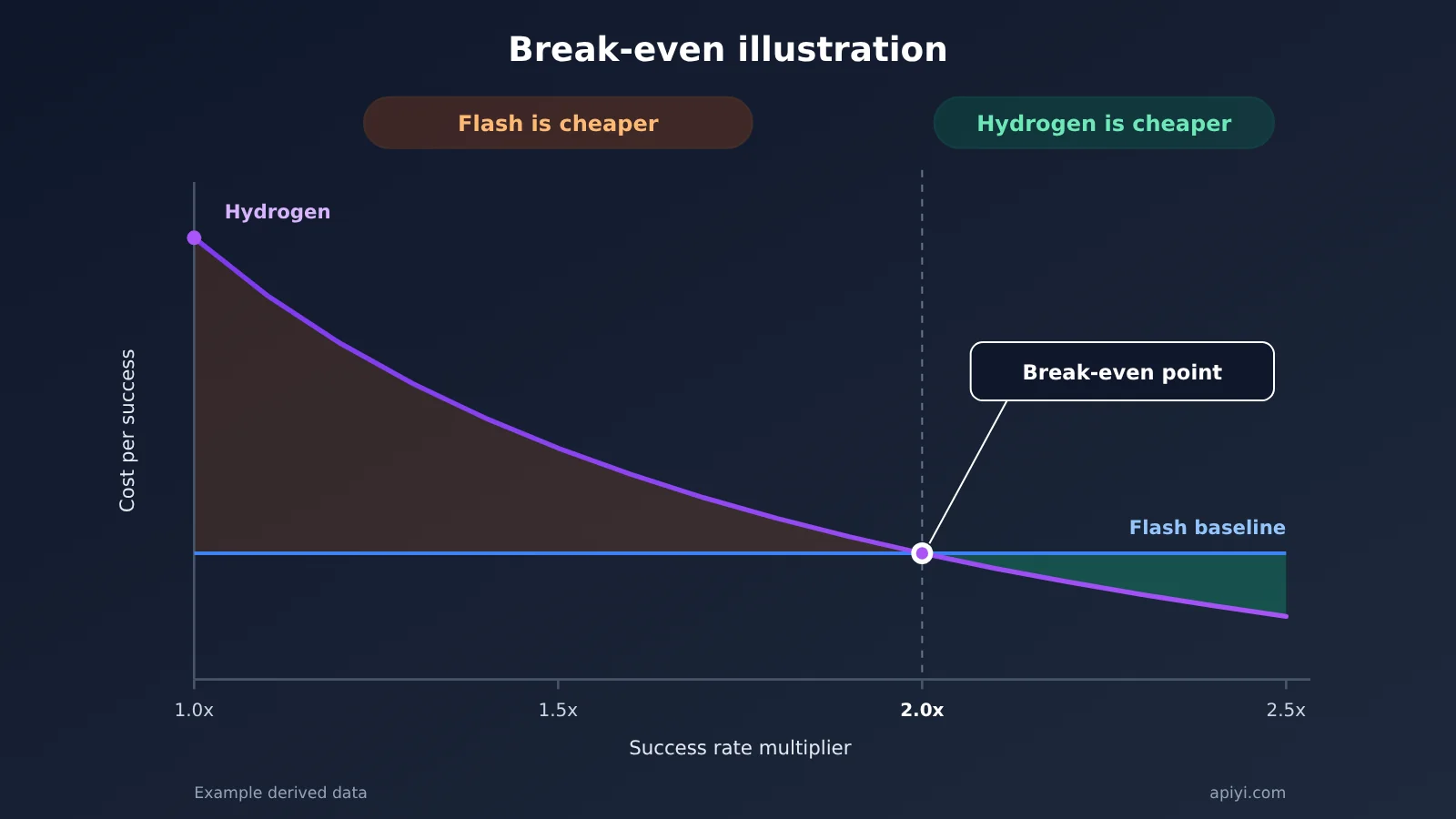
At November 2026 pricing, Hydrogen’s cost per token is exactly twice that of Flash, which gives us two break-even conditions:
- If both have the same success rate, Hydrogen needs to cut total billed tokens by about 50% to break even.
- If both consume the same number of tokens per attempt, Hydrogen’s per-attempt success rate needs to be 2x that of Flash to match the expected cost per success.
Here’s an editorial derivation example. All success rates are hypothetical, not measured results:
| Scenario | Cost per attempt | Assumed success rate | Expected cost per success |
|---|---|---|---|
| Flash handling a multi-step agent task | $0.0135 | 40% | $0.0338 |
| Hydrogen handling the same task | $0.0270 | 80% | $0.0338 (break-even) |
| Hydrogen handling the same task | $0.0270 | 90% | $0.0300 (cheaper) |
| Flash handling a simple classification task | $0.0135 | 95% | $0.0142 |
| Hydrogen handling a simple classification task | $0.0270 | 98% | $0.0276 (nearly 2x as expensive) |
The conclusion is straightforward: on simple tasks that Flash can already handle well, Hydrogen’s extra cost is basically unrecoverable; on complex tasks where Flash often fails and requires repeated retries, Hydrogen has a chance to match or even lower the cost.
What the Official Performance Data Tells Us
Google’s published data shows Hydrogen scoring 57.0% on Terminal-Bench 4.1, versus 18.2% for 3.8 Flash. The company also says that under the same test conditions, tasks are completed about 2.5x faster and the frequency of fabricated facts drops by more than 5x. In partner-disclosed data, Box reduced token usage by 12% on enterprise document tasks, and STAN cut total token usage by 23%.
These numbers need to be read carefully. They are official or partner test results, and can’t be directly converted into your cost savings percentage. A 12% to 23% token reduction is still far from the 50% break-even threshold, so whether Hydrogen saves money mainly depends on the success-rate improvement, not on token savings. Also, being faster can reduce waiting time and machine occupancy, but that doesn’t directly offset your API bill.
Gemini 4 Hydrogen, Flash, Argon, and Carbon: When to Use Each
When to choose 3.8 Flash
- High-volume, stable processing tasks: Things like text classification, field extraction, summarization, and format conversion. Flash already has a high success rate on these kinds of tasks, so bringing in Hydrogen would only double your bill.
- Cost-sensitive workloads that can tolerate an occasional retry: Until December 31, 2026, Flash has the lowest per-unit price of all four models.
When to choose Gemini 4 Hydrogen
- Code generation and debugging: Google emphasizes its precise editing—it avoids touching unrelated code—making it a good fit for fixing bugs, upgrading dependencies, and running tests.
- Multi-step Agent execution: Chaining tool calls, parallel retrieval, and adjusting strategy after a tool failure are all core strengths here.
- Complex document processing: It supports PDF, Word, Excel, PPT, and other formats, with a single request able to include up to 3,000 images or documents.
- The executor in multi-model systems: Carbon or Argon handles the planning, while Hydrogen handles implementation and verification.
When to choose Argon or Carbon
Google positions both Argon and Carbon for complex, long-running deep reasoning tasks, and the reference material doesn’t spell out finer differences between the two. Based on the division-of-labor recommendation in this article, Argon suits complex work that needs deeper reasoning while still caring about efficiency; Carbon suits architecture design, high-difficulty reasoning, and long-cycle engineering tasks. Google’s official Antigravity Orchestrator workflow is exactly this kind of split: Carbon analyzes the repository and draws up a plan, Hydrogen carries out edits and tests, and complex errors get handed back to Carbon. Google says this approach cuts average quota consumption by 24% and boosts completion speed by 19% compared with using Carbon alone.
| Task type | Preferred model | Cost consideration | Available platforms |
|---|---|---|---|
| Batch tasks like classification, extraction, summarization | 3.8 Flash | Lowest per-unit price, and the success rate is already sufficient | Google official, APIYI apiyi.com |
| Everyday programming, bug fixing | 4 Hydrogen | The success-rate gain offsets the 2x per-unit price | Google official, APIYI |
| Multi-step Agents, tool calls | 4 Hydrogen | Fewer retries and execution steps | Google official, APIYI |
| Complex reasoning where efficiency matters | 4 Argon | Per-unit price doubles after December 1 | Google official, APIYI |
| Architecture design, long-cycle engineering | 4 Carbon | Recommended to pair with Hydrogen for execution | Google official, APIYI |
Actual model availability on APIYI is subject to the platform’s model list.
Decision Recommendations After the Gemini 4 Hydrogen Price Adjustment
How the Two Pricing Milestones Change Model Selection
| Time Period | Flash | Hydrogen | Argon / Carbon | Selection Landscape |
|---|---|---|---|---|
| 2026-11-13 to 11-30 | $0.75 / $3.75 | $1.50 / $7.50 | $2 / $10 | Small gap between Hydrogen and Argon/Carbon |
| 2026-12-01 to 12-31 | $0.75 / $3.75 | $1.50 / $7.50 | $4 / $20 | Argon/Carbon becomes 2.67× Hydrogen |
| From 2027-01-01 | $1.50 / $7.50 | $1.50 / $7.50 | $4 / $20 | Flash loses its price edge, level with Hydrogen |
This table highlights two planning takeaways. In the short term, during November, Argon/Carbon is only about a third more expensive than Hydrogen, so tasks that need deep reasoning can be batched and run during this window. In the medium term, starting January next year, Flash and Hydrogen will have the same unit price, and the more capable Hydrogen will become the more reasonable default for most scenarios — provided Google doesn’t announce another price change in the meantime.
Compatibility Checks Before Migrating to Hydrogen
When migrating from 3.8 Flash to Hydrogen, the following configuration items can’t be carried over as-is — otherwise you may hit errors or lose control of costs:
thinking_budgetand theMINIMALlevel are no longer supported; using them returns HTTP 400.- The default thinking level changes from Medium to High, so you need to actively assess whether to drop it down a level.
- Custom temperature, top_p, and top_k values are ignored.
- Explicit caching isn’t supported — you’ll need to rely on implicit caching instead and put fixed content at the front of the prompt.
- Multi-turn tool calls require you to correctly save and return thought signatures.
💡 Recommendation: Don’t do a one-shot, full-scale switch based on model name alone. Instead, split traffic by task type and track the cost per successful call separately. With APIYI’s unified interface at apiyi.com, you only need to change the
modelparameter to run A/B comparisons across all four models, making it easy to build a routing strategy from the data.
Common Questions FAQ
Q1: What’s the positioning of the Gemini 4 Hydrogen model?
Hydrogen is a model released by Google DeepMind on November 12, 2026, with the API ID `gemini-4-hydrogen`, positioned for high-efficiency everyday coding and AI Agent execution. The official model card shows it was adapted from Gemini 4 Carbon. The total context window is 1,048,576 Tokens, shared across input, thinking, and output.
Q2: How much more expensive is Gemini 4 Hydrogen than 3.8 Flash?
At the standard Google Gemini API price on November 13, 2026, Hydrogen’s input and output unit prices are both 2x those of 3.8 Flash ($1.50 / $7.50 vs. $0.75 / $3.75). Under the example workload in this article, the monthly cost is $27 and $13.50 respectively.
Q3: When do Argon and Carbon go up in price?
The official pricing page notes that Argon and Carbon will be adjusted from $2 / $10 to $4 / $20 starting December 1, 2026. 3.8 Flash will be adjusted to $1.50 / $7.50 starting January 1, 2027. Hydrogen currently has no publicly announced tiered pricing changes.
Q4: Which thinking tier is the most cost-effective for Hydrogen?
Officially, Low is recommended for classification, Medium for regular coding, High for multi-step Agents, and XHigh for complex deep reasoning. Artificial Analysis data shows that XHigh’s intelligence index is only 3 points higher than High (54 vs. 51), while the average cost per benchmark task rises from $1.87 to $3.16. So for most scenarios, we don’t recommend enabling XHigh by default.
Q5: How can I quickly compare the actual cost of the four Gemini models?
The easiest approach is to use an aggregation interface that supports multiple models:
1. Register an account at APIYI apiyi.com to get an API key and free testing quota;
2. Set the base_url in the code in this article to `https://api.apiyi.com/v1`;
3. Run the comparison script with your own real task samples and tally the cost per successful run.
Q6: What are the known shortcomings of Hydrogen?
The issues listed on the official model card include: it may still produce hallucinations; its knowledge cutoff is March 2026; compared with 3.8 Flash, its unreasonable-refusal metric deteriorated by 5.57 percentage points; and the full safety report had not yet been published as of verification. In the early days after launch, some users also reported rollout issues such as model options disappearing and invocation failures, and some users on Hacker News mentioned it over-executing on certain Agent tasks.
Q7: How can teams in China reliably run Gemini model selection tests?
Google uses a gradual rollout strategy, so availability may differ by region and account. For teams that need to compare Gemini, Claude, GPT, and other models at the same time, you can access them uniformly through APIYI apiyi.com using the OpenAI-compatible interface, pay per usage, and avoid rewriting test scripts for each vendor separately.
Gemini 4 Hydrogen Pricing Comparison: Key Takeaways
- Unit price doubles: Hydrogen’s current standard unit price is 2x that of 3.8 Flash—this is a price increase, not a price cut.
- Middle tier: Hydrogen costs less than Argon and Carbon, but after December, the gap will widen to 2.67x.
- Break-even threshold: Hydrogen only reaches cost parity with Flash if token usage is cut in half or the success rate per call doubles.
- Billing variables: Reasoning tokens, implicit caching, Batch mode, and the number of searches can all significantly change actual costs.
- Pricing change dates: 2026-12-01: Argon/Carbon prices increase; 2027-01-01: Flash and Hydrogen reach price parity.
- How to validate: Use real samples to measure the cost per successful run, and compare all four models through APIYI’s unified interface.
Summary
Here are the key considerations for choosing between Gemini 4 Hydrogen, 3.8 Flash, Argon, and Carbon:
- Check the unit price: In November, Flash is the cheapest; Hydrogen costs twice as much, while Argon and Carbon are even more expensive—and their prices will double on December 1.
- Check the cost per success: For simple tasks, keep using Flash; for coding and Agent tasks where Flash tends to fail, evaluate switching to Hydrogen; leave deep reasoning to Argon or Carbon and execution to Hydrogen.
- Check the timeline: Budget planning should account for the two pricing change dates; starting in 2027, Hydrogen is likely to become the default best-value option.
This choice ultimately comes down to a trade-off between cost and task value. Unit prices are easy to check, but task success rates can only be measured from your own data. We recommend running a round of real-task comparisons with the free quota on APIYI (apiyi.com), then using the results to define your model routing strategy.
📚 References
- Google Official Blog – Introducing Gemini 4 Hydrogen: Release announcement and partner use cases
- Link:
blog.google/innovation-and-ai/models-and-research/gemini-models/introducing-gemini-4-hydrogen/ -
Notes: Official positioning and performance comparison against 3.8 Flash
-
Google Gemini API Official Pricing: Standard pricing for the four models and price adjustment milestones
- Link:
aistudio.google.com/docs/pricing -
Notes: The source for all prices in this article, verified on 2026-11-13
-
Google DeepMind Model Card: Hydrogen capabilities, limitations, and safety evaluation
- Link:
deepmind.google/models/model-cards/gemini-4-hydrogen/ -
Notes: Cross-model benchmark data and known limitations
-
Google Cloud Technical Documentation: API specs and migration notes
- Link:
docs.cloud.google.com/gemini-enterprise-agent-platform/models/gemini/4-hydrogen -
Notes: Context limits, caching rules, and parameter compatibility
-
Google Cloud Regional Pricing: The price gap between Global and Non-global
- Link:
cloud.google.com/model-garden/pricing -
Notes: Reference for regional quotes on the enterprise cloud platform
-
Artificial Analysis: Independent evaluation of Hydrogen’s four thinking modes
- Link:
artificialanalysis.ai/models/gemini-4-hydrogen -
Notes: Intelligence index, latency, and benchmark task costs for each mode
-
Google Antigravity Blog: Orchestrator multi-model orchestration
- Link:
antigravity.google/blog/gemini-4-hydrogen-in-google-antigravity - Notes: Official data on how Carbon and Hydrogen divide the work and collaborate
Author: APIYI Technical Team
Technical Inquiries: Feel free to contact us through the APIYI apiyi.com homepage. For more integration resources, visit the docs.apiyi.com documentation center.