Author’s note: Google released Gemini 4 Hydrogen on 2026-11-12. This article walks through the 10-item comparison table in the official model card, the improvements over Gemini 3.8 Flash, the specs, and standard-tier pricing—and spells out the basis for each number.
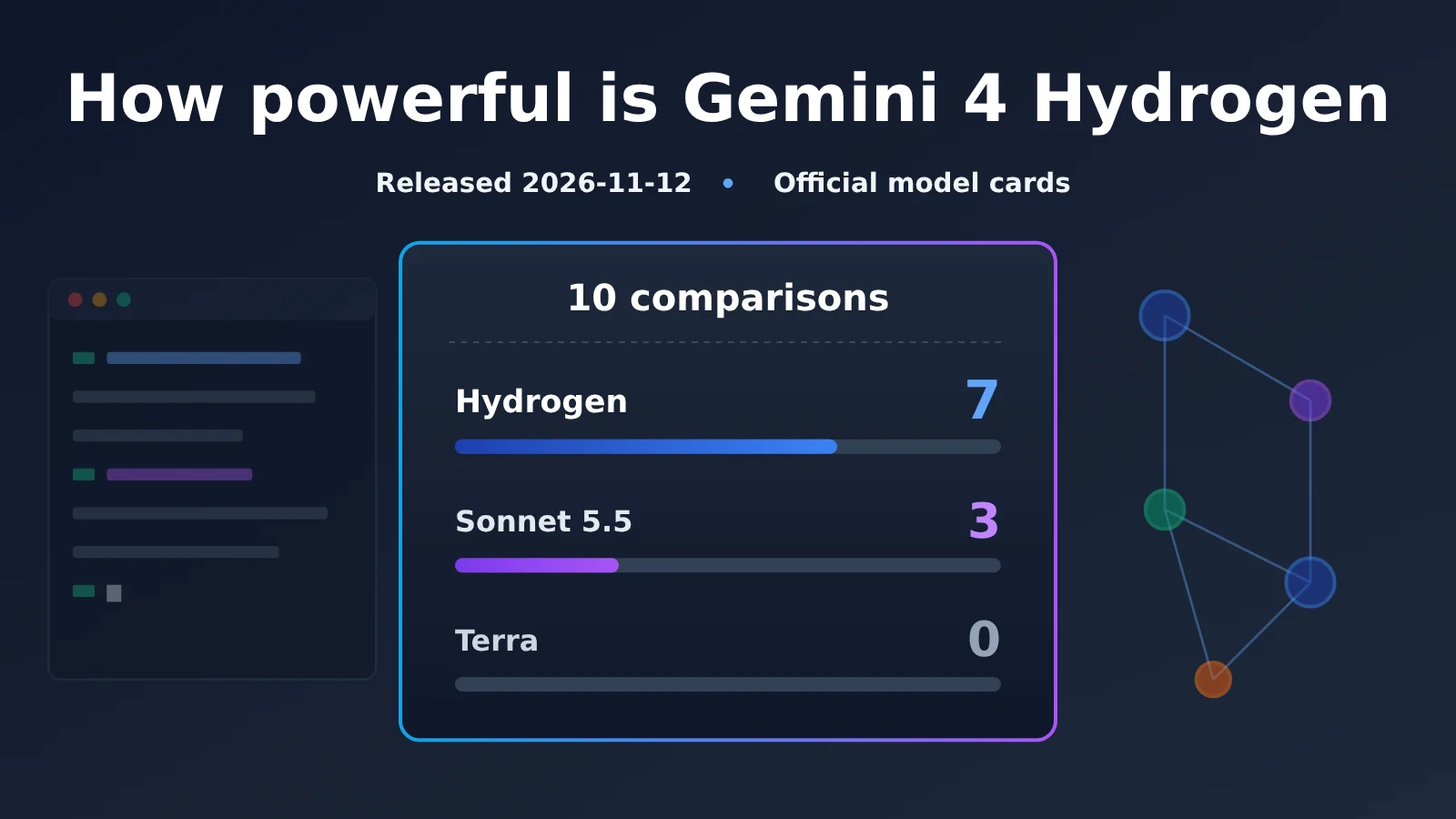
Google officially launched Gemini 4 Hydrogen on 2026-11-12, with the model ID gemini-4-hydrogen. It’s positioned for faster everyday coding and all kinds of agent execution, not as a Carbon or Argon—those are the models built for the hardest long-horizon reasoning. The official global standard-tier price is $1.50 for input and $7.50 for output (per million tokens). On the DeepMind model card’s 10-item comparison table, it takes the top score in 7 of them.
This isn’t a pre-launch codename rumor. Google’s blog, developer brief, and DeepMind model card are all live, and AI Studio’s try-it link uses the gemini-4-hydrogen ID. One caveat: every score cited here comes from official self-reported numbers or the official model card summary—not from APIYI’s own retests.
Key takeaway: By the end, you’ll know where Gemini 4 Hydrogen leads, where it trails Claude Sonnet 5.5, and how to read those numbers.
Gemini 4 Hydrogen: Key Facts at a Glance
Let’s start with the basics. The information in the table below comes from Google’s blog, a developer newsletter, and the DeepMind model card (published November 2026), and was checked on 2026-11-13.
| Item | Gemini 4 Hydrogen details |
|---|---|
| Release date | 2026-11-12, with global rollout starting that day |
| Publisher | Google / Google DeepMind |
| Model ID | gemini-4-hydrogen |
| Source | The model card states it’s adapted from Gemini 4 Carbon—in other words, it was derived from Carbon |
| Official positioning | Everyday coding and agent execution; can be used standalone or as an execution engine in multi-model workflows |
| Thinking levels | Four levels: low, medium, high (default), and xhigh |
| Knowledge cutoff | March 2026, possibly older in some areas |
| Official channels | All AI Studio tiers, Gemini API, Android Studio, Gemini for business, Gemini App, Google Search |
Google is pretty blunt about how the Gemini 4 family is divided: Carbon and Argon handle the hardest long-horizon reasoning, while Hydrogen handles faster everyday work. So it doesn’t make sense to compare Hydrogen and Carbon as “old and new versions of the same tier.” Their relationship is more like two different roles built on the same base.
On the access side, paid Google AI Pro / Ultra users can also use Hydrogen in Google Antigravity. Sheets will initially be available to Pro / Ultra and eligible enterprise subscriptions. AI Studio has officially confirmed availability across all tiers; we didn’t verify the exact free-tier limits this time, so we’ll leave that aside here.
The Four Thinking Levels in Gemini 4 Hydrogen
The four thinking levels are one of the main things to understand when using Hydrogen. The official line is that quality, latency, and cost increase smoothly from one level to the next, so developers can pay only for the reasoning depth they need. The default is high, and that directly affects your bill—we’ll come back to this in the pricing section later.
Gemini 4 Hydrogen Official 10-Benchmark Comparison Table
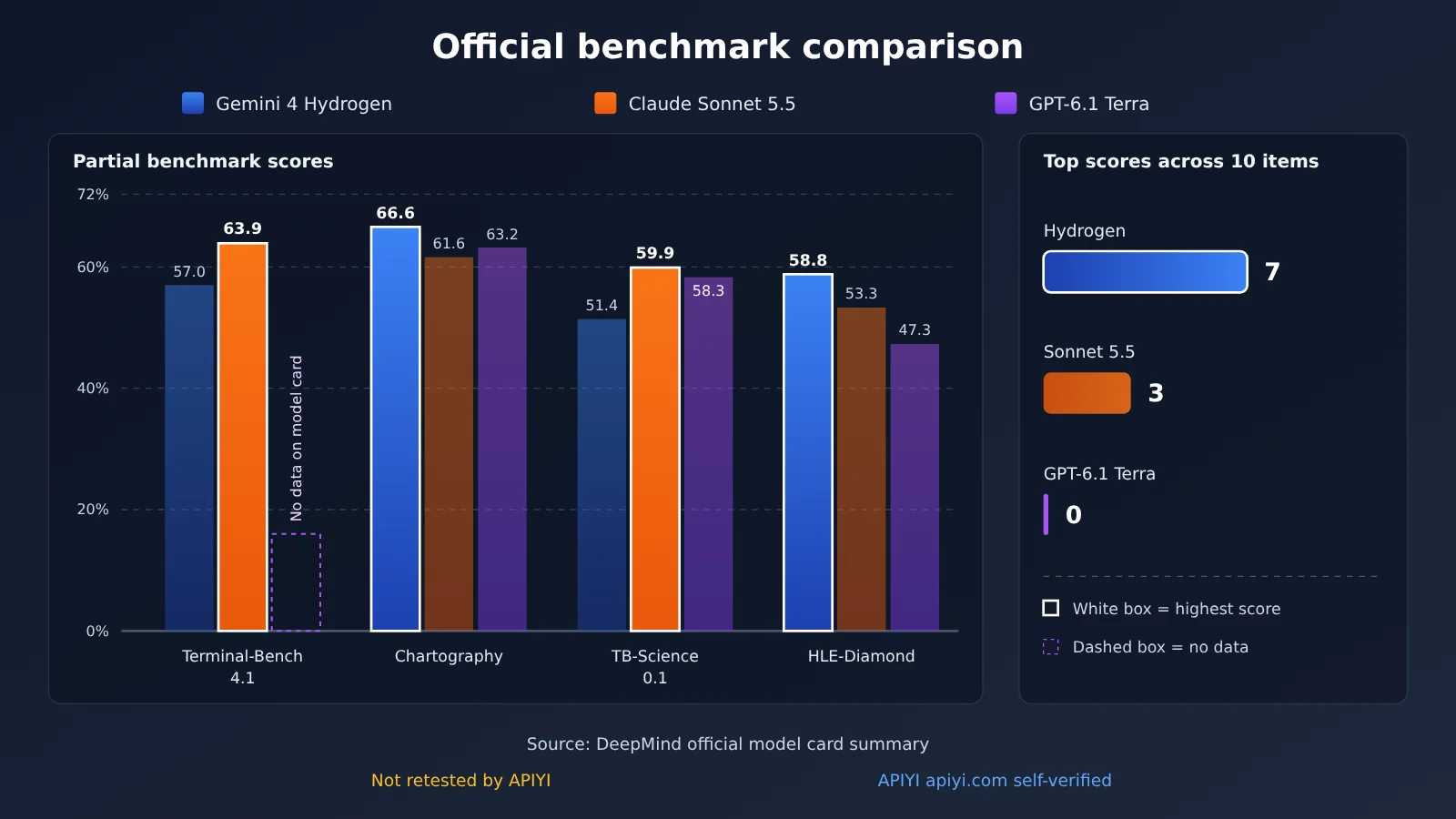
This is the core of the article. The DeepMind model card provides a 10-benchmark comparison table covering Gemini 4 Hydrogen, Claude Sonnet 5.5, and GPT-6.1 Terra.
| Benchmark | Gemini 4 Hydrogen | Claude Sonnet 5.5 | GPT-6.1 Terra | Leader |
|---|---|---|---|---|
| SWE-sweep | 13.5% | 3.1% | 5.8% | Hydrogen |
| Terminal-Bench 4.1 (cheating-adjusted) | 57.0% | 63.9% | No data | Sonnet |
| Agents’ Last Exam v1.1 | 71.6% | 60.4% | 69.8% | Hydrogen |
| AutomationBench-AA | 76.1% | 71.8% | 60.2% | Hydrogen |
| Vending-Bench 2 (account balance, USD) | 14549 | 11165 | 9107 | Hydrogen |
| OSWorld-2.1 (offline subset) | 77.6% | 83.9% | 74.2% | Sonnet |
| MKA (Climb WSR accuracy) | 53.4% | 52.0% | 43.8% | Hydrogen |
| Chartography | 66.6% | 61.6% | 63.2% | Hydrogen |
| Terminal-Bench-Science 0.1 | 51.4% | 59.9% | 58.3% | Sonnet |
| HLE-Diamond | 58.8% | 53.3% | 47.3% | Hydrogen |
The tally is: Hydrogen tops 7 benchmarks, while Sonnet 5.5 tops 3 — Terminal-Bench 4.1, OSWorld-2.1 computer use, and Terminal-Bench-Science. GPT-6.1 Terra doesn’t take first place in any cell where it has a score.
Two points deserve special attention. First, Terra’s Terminal-Bench 4.1 cell is blank; the model card doesn’t provide a number, so you can’t interpret that as “Terra is worse at terminal tasks.” Second, “winning 7 out of 10” doesn’t mean across-the-board superiority; Hydrogen still trails Sonnet 5.5 on terminal and computer-use tasks, two categories closely tied to agent execution.
How to Read This Gemini 4 Hydrogen Comparison Table
The method notes in the model card determine how far you can read this table. Unless otherwise noted, Hydrogen’s scores are at the highest thinking level, pass@1, single attempt, run through the Gemini API. Sonnet 5.5 and GPT-6.1 Terra use their respective highest publicly available thinking or reasoning level by default; when no public result is available, the best available result is used.
In other words, this isn’t a rerun of three models on the same day with the same scripts. SWE-sweep is especially explicit: the competitor scores come from public leaderboards, not from Google re-testing with the same scaffold. So this table is good for judging the rough direction of strengths and weaknesses, not for treating every percentage-point gap as a precise conclusion.
Also, Hydrogen’s scores in the table are at the highest thinking level, while its default setting is high. If you use the default setting in production, actual performance may differ from the numbers in the table, and that’s worth validating on your own tasks.
How Gemini 4 Hydrogen Improves on Gemini 3.8 Flash
For developers already using Gemini 3.8 Flash, this section may be more useful than the side-by-side comparison. All numbers below are vendor-reported.
| Dimension | Gemini 3.8 Flash | Gemini 4 Hydrogen | Notes |
|---|---|---|---|
| Task completion speed (default high) | Baseline | 2.5x faster | Vendor-reported |
| Terminal-Bench 4.1 | 18.2% | 57% | More than triple |
| Fabricated claims | Baseline | More than 5x reduction | Vendor-reported |
| When tools fail / search is empty | — | More likely to proactively reroute | Vendor’s qualitative description |
| Partner early-test speed | Baseline | 2 to 2.8x faster | Charts, SQL, data-intensive workflows |
| Partner early-test token usage | Baseline | 12% to 23% lower | Vendor paraphrase, not a public leaderboard |
The jump in terminal tasks from 18.2% to 57% is the most notable change in this release. It shows that Hydrogen has crossed a usability threshold for whether a small model can actually execute command-line tasks. Still, put back into the side-by-side table, 57% is still below Sonnet 5.5’s 63.9%.
Partner early-test data also needs to be viewed separately. It’s vendor-relayed partner results, not a public leaderboard; the scenarios center on complex charts, SQL, and data-intensive workflows, and may not generalize to every business.
Other vendor-reported results for Gemini 4 Hydrogen
Beyond the 10-item table, the blog and model card list a few more results, also vendor-reported:
- Artificial Analysis Intelligence Index: 51 in the default high tier, 50 for Argon, and 54 in the xhigh tier. These are Google’s cited AA numbers. Carbon previously announced an AA Index v5 score of 59, but the announcement doesn’t specify whether Hydrogen uses the same version of the index, so the two numbers shouldn’t be directly compared.
- Agent Arena: Ranked 5th on open agent tasks.
- Vals Tax Agent Bench: 52.3%, which the vendor says is 1st overall.
- Vals Legal Research Bench: 55.8%, which the vendor says is tied for 1st.
- HLE-Diamond: 58.8%, which the vendor says leads its tier.
Gemini 4 Hydrogen’s role in multi-model workflows
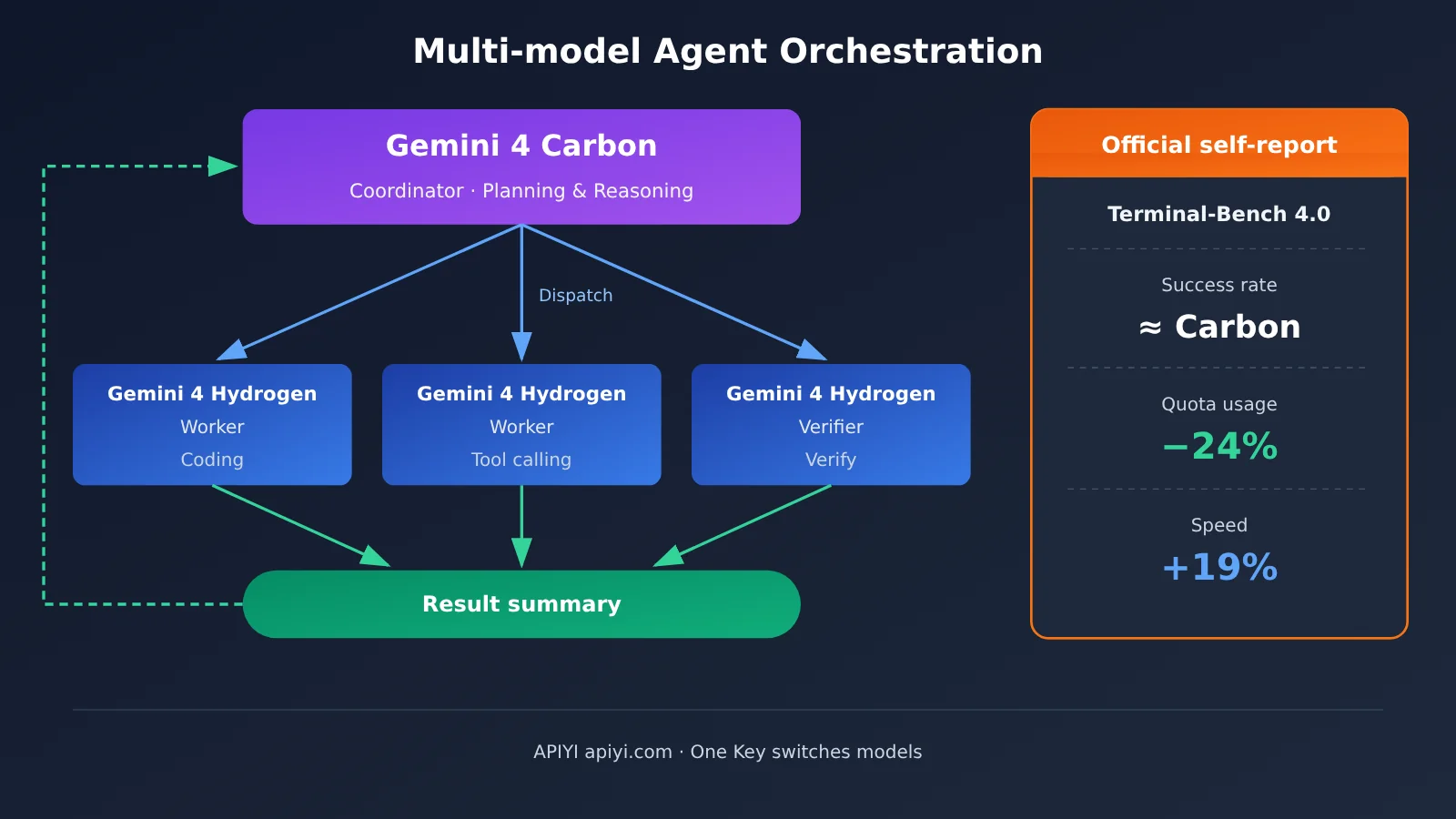
The vendor also shared data on using the models together. In Antigravity Orchestrator, the system switches between Carbon and Hydrogen, achieving task success rates on Terminal-Bench 4.0 close to Carbon-only, using 24% less quota on average and running 19% faster. In parallel mode, Carbon acts as the coordinator, while Hydrogen acts as the worker or verifier.
This data says a lot about Google’s design intent for Hydrogen: it’s not meant to replace Carbon, but to handle a lot of concrete execution and leave expensive reasoning for the steps that really need it.
Gemini 4 Hydrogen Specs and Pricing
Context Window: Two Accounts from the Model Card and Blog
The model card and the blog don’t describe the window in exactly the same way, so here are both versions side by side:
- Model card: combined input-output token context window of up to 1M, meaning input and output together can total up to 1 million tokens; synchronous calls default to a maximum output of 64,000 tokens; background long decode can output up to 1 million tokens.
- Blog: native 1 million-token input, with output up to 1 million tokens.
In actual development, it’s best to budget using the more conservative “combined window” wording from the model card, and also keep in mind the default 64,000-token output cap for synchronous calls. Very long outputs need to go through background long decode. As for input modalities, Hydrogen supports text, image, audio, and video.
Gemini 4 Hydrogen Official Standard-Tier Pricing
The blog describes the entire 1 million-token window as one flat price. The table below comes from the Google Cloud pricing page (accessed 2026-11-13). It lists only the standard tier, in USD per million tokens.
| Billing item | Global standard tier | Non-global |
|---|---|---|
| Input (text, image, video, audio) | $1.50 | $1.65 |
| Cache read | $0.075 | $0.0825 |
| Output (responses plus reasoning combined) | $7.50 | $8.25 |
| Cache write | List price $1.875, billed only starting 2027-01-12 | — |
One thing that’s easy to overlook: output pricing counts responses and reasoning together. Hydrogen’s default thinking level is high, so the output bill includes thinking tokens. The model card also notes that higher thinking levels may consume more tokens. For simple tasks, consider lowering it to low or medium to control costs.
Where to Call Gemini 4 Hydrogen Today
On the official side, Google AI Studio and the Gemini API were already available that day. Over on APIYI, we checked the docs.apiyi.com/models master documentation table, the model pages, and the api.apiyi.com/api/pricing pricing endpoint on 2026-11-13, and none of them had gemini-4-hydrogen. The model page returned a 404, and a search for hydrogen across the 282 models in that day’s pricing endpoint came up empty. It’s not listed yet, and we’ll get this model up as soon as we can; model IDs and pricing are subject to the platform’s model list.
Before Hydrogen is listed, APIYI apiyi.com can already invoke the two rivals from the 10-item table, plus Hydrogen’s “parent” Carbon, so it’s a good time to get your comparison workflow in place first:
| Model ID | Input | Output | Cache read | Endpoint | Available platform |
|---|---|---|---|---|---|
gemini-4-carbon |
$2 | $10 | $0.1 | chat, gemini | APIYI apiyi.com |
claude-sonnet-5-5 |
$2 | $10 | $0.1 | chat, messages | APIYI |
gpt-6.1-terra |
$1 | $5 | $0.05 | responses (preferred), chat | APIYI |
One more note on Carbon pricing: APIYI’s docs state that $2 / $10 is Google’s limited-time price, valid through 2026-11-30; starting 2026-12-01, it will adjust in line with the official pricing to $4 / $20, with cache reads at $0.10.
You can integrate through the OpenAI-compatible API: set base_url to https://api.apiyi.com/v1 and enter gemini-4-carbon, claude-sonnet-5-5, or gpt-6.1-terra in the model field. Once Hydrogen is listed, just change the model field to gemini-4-hydrogen and you can reproduce the task types covered in the 10-item table above within the same codebase.
🎯 Technical tip: The rival scores on the official model card come from each vendor’s published results, so they may not match your business scenario. We suggest first using APIYI apiyi.com to compare Sonnet 5.5 and Terra on the same batch of real tasks, then add a Hydrogen column once it’s listed, so you end up with your own win/loss table.
Gemini 4 Hydrogen Impact Analysis
Impact on Developers
- One more option at the agent execution layer: On agent tasks such as AutomationBench-AA, Agents’ Last Exam, and Vending-Bench 2, Hydrogen’s official scores lead, making it suitable for handling many execution steps in workflows.
- Terminal and computer operations still need evaluation: Sonnet 5.5 leads on Terminal-Bench 4.1 and OSWorld-2.1. If your core use case is command-line agents or desktop automation, you can’t just look at “winning 7 items.”
- 3.8 Flash users should consider migrating: Speed, terminal success rate, and fabrication rate all show clear official reported improvements, but confirm with your own data.
- Cost depends on the thinking tier: The default high tier counts thinking tokens toward output, so tier selection directly determines the bill.
Impact on the Model Division of Labor
Hydrogen’s release further reinforces the layered “coordinator + executor” approach. Orchestrator’s official data shows that using a cheaper model for execution and an expensive model for planning can save credits at a similar success rate. This means multi-model orchestration is moving from an experimental practice to a vendor-recommended approach, and an access layer that can uniformly switch between multiple models will become increasingly important.
Known Limitations of Gemini 4 Hydrogen
Without shying away from the weaknesses, the limitations listed in the model card include:
- It can still hallucinate; it may slow down or time out; higher thinking tiers may use more tokens; knowledge cutoff is March 2026.
- Two automated safety evaluations are worse than 3.8 Flash: refusal tone dropped by 0.65 percentage points; the rate of refusing when it shouldn’t refuse rose by 5.57 percentage points (lower is better for this metric).
- On frontier safety, there is no material capability jump relative to Argon; neither CBRN nor cybersecurity reached CCL, but both reached the warning threshold. This doesn’t mean “there is no related risk.” The full safety report will be released later, according to the official statement.
There are positive data points too: agent boundary-crossing behavior dropped by up to 81%, internal honesty evaluation was 96.7%, resistance to Gray Swan indirect prompt injection improved by more than 2.3x, and HealthBench Pro false refusals were below 0.4%. These are also official self-reported figures.
FAQ
Q1: What is Gemini 4 Hydrogen?
It’s a member of the Gemini 4 family, released by Google on 2026-11-12. Its model ID is `gemini-4-hydrogen`, and it’s derived from Gemini 4 Carbon. It’s positioned as a faster model for everyday coding and agent execution. The hardest long-horizon reasoning is handled by Carbon and Argon.
Q2: Is Gemini 4 Hydrogen stronger than Claude Sonnet 5.5?
Based on the 10-item table in the official model card, Hydrogen wins 7 and Sonnet 5.5 wins 3. Sonnet’s advantages are concentrated in terminal tasks, computer use, and scientific terminals. The competitor scores are each company’s publicly reported results at the maximum thinking level, not reruns of the same scripts. We recommend running your own comparison tests on APIYI (apiyi.com) using your own tasks.
Q3: Was the “wins 7 out of 10” result measured by a third party?
No. It’s the official summary from the DeepMind model card: Hydrogen at the highest thinking level, single-attempt pass@1. It’s also not an APIYI retest result, so treat it as officially self-reported data.
Q4: What scenarios is Gemini 4 Hydrogen a good fit for?
Scenarios where the official results look stronger include multi-step automation workflows (AutomationBench-AA), chart understanding (Chartography), multimodal knowledge agents (MKA), and worker or verifier roles in multi-model pipelines. For command-line agents and desktop operations, we recommend evaluating Sonnet 5.5 as well.
Q5: Can I call Gemini 4 Hydrogen through APIYI now?
As of 2026-11-13, it hasn’t been listed yet. We’ll make this model available as soon as possible; model variants and pricing are subject to the platform’s model list. In the meantime, you can call `gemini-4-carbon`, `claude-sonnet-5-5`, and `gpt-6.1-terra` on APIYI (apiyi.com), using `https://api.apiyi.com/v1` as the `base_url`, and start building your comparison workflow.
Q6: Why might Gemini 4 Hydrogen output cost more than expected?
The official output price of $7.50 covers both response and reasoning billing, and the default thinking level is high, so thinking tokens end up on the output bill. For simple tasks, you can switch to low or medium to control costs.
Gemini 4 Hydrogen Key Takeaways
- Clear positioning: Released 2026-11-12, focused on everyday coding and agent execution, derived from Carbon.
- 7 wins out of 10 on the official table: Sonnet 5.5 takes three categories — terminal, computer use, and scientific terminal — while Terra has no first place.
- Mind the methodology: Scores are self-reported by the vendor; competitor numbers come from each lab’s publicly available max-reasoning setting, not a rerun of the same benchmark script.
- Big jump over 3.8 Flash: 2.5x faster, Terminal-Bench 4.1 goes from 18.2% to 57%.
- Standard tier pricing: $1.50 input globally, $7.50 output, with output including thinking tokens.
- Two versions of the context window: The model card says 1 million total; the blog says 1 million input and up to 1 million output.
- Current availability: Not yet listed on APIYI — you can start on apiyi.com by building comparisons with Carbon, Sonnet, and Terra.
Summary
The core takeaways for Gemini 4 Hydrogen:
- Strength in agent execution: It wins 7 of the 10 categories in the official table, leading in automation, agent exams, charts, and HLE-Diamond.
- Weakness in terminal and computer use: It trails Claude Sonnet 5.5 in Terminal-Bench 4.1, OSWorld-2.1, and the scientific terminal categories.
- Read the numbers with the right lens: All figures are self-reported by the vendor or aggregated from model cards, while competitor scores come from public results — not the same run.
If you’re building agent workflows, Hydrogen deserves a spot on your shortlist, especially as the execution layer in a multi-model pipeline. The final call still comes down to your own task results. A good starting point is to set up a baseline on APIYI at apiyi.com using the existing Carbon, Sonnet 5.5, and Terra, then fill in Hydrogen once it’s listed.
📚 References
- Google Blog: Introducing Gemini 4 Hydrogen: Announcement and positioning
- Link:
blog.google/innovation-and-ai/models-and-research/gemini-models/introducing-gemini-4-hydrogen -
Notes: Official positioning, AA Index, and improvements over 3.8 Flash
-
Google Developer Brief: Build with Gemini 4 Hydrogen: Developer access information
- Link:
blog.google/innovation-and-ai/technology/developers-tools/build-with-gemini-4-hydrogen -
Notes: Available channels and developer-related details
-
DeepMind Model Card: Gemini 4 Hydrogen: Specs, 10-item comparison table, and safety evaluations
- Link:
deepmind.google/models/model-cards/gemini-4-hydrogen -
Notes: Primary source for the 10-item table and limitations discussion in this article
-
DeepMind Evaluation Methodology: Methodological basis for the comparison table
- Link:
deepmind.google/models/evals-methodology/gemini-4-hydrogen -
Notes: Thinking tiers, pass@1, and sources for competitor scores
-
Google Cloud Pricing Page: Standard tier pricing
- Link:
cloud.google.com/vertex-ai/generative-ai/pricing - Notes: Standard tier unit prices for global and non-global regions, plus the cache write effective date
Author: APIYI Technical Team
Technical inquiries: Feel free to contact us through the APIYI website homepage. For more resources, visit the docs.apiyi.com documentation center