Author’s note: Covering positioning, thinking tiers, context and output, pricing, and Orchestrator usage, this piece explains how Gemini 4 Hydrogen and Gemini 4 Carbon divide the work in day-to-day use — and which model you can call on APIYI right now.
Google released Gemini 4 Hydrogen on 2026-11-12. Plenty of developers already using Gemini 4 Carbon are wondering whether they should switch. This article compares Gemini 4 Hydrogen and Gemini 4 Carbon, offering recommendations across four dimensions: positioning, thinking tiers, output limits, and pricing.
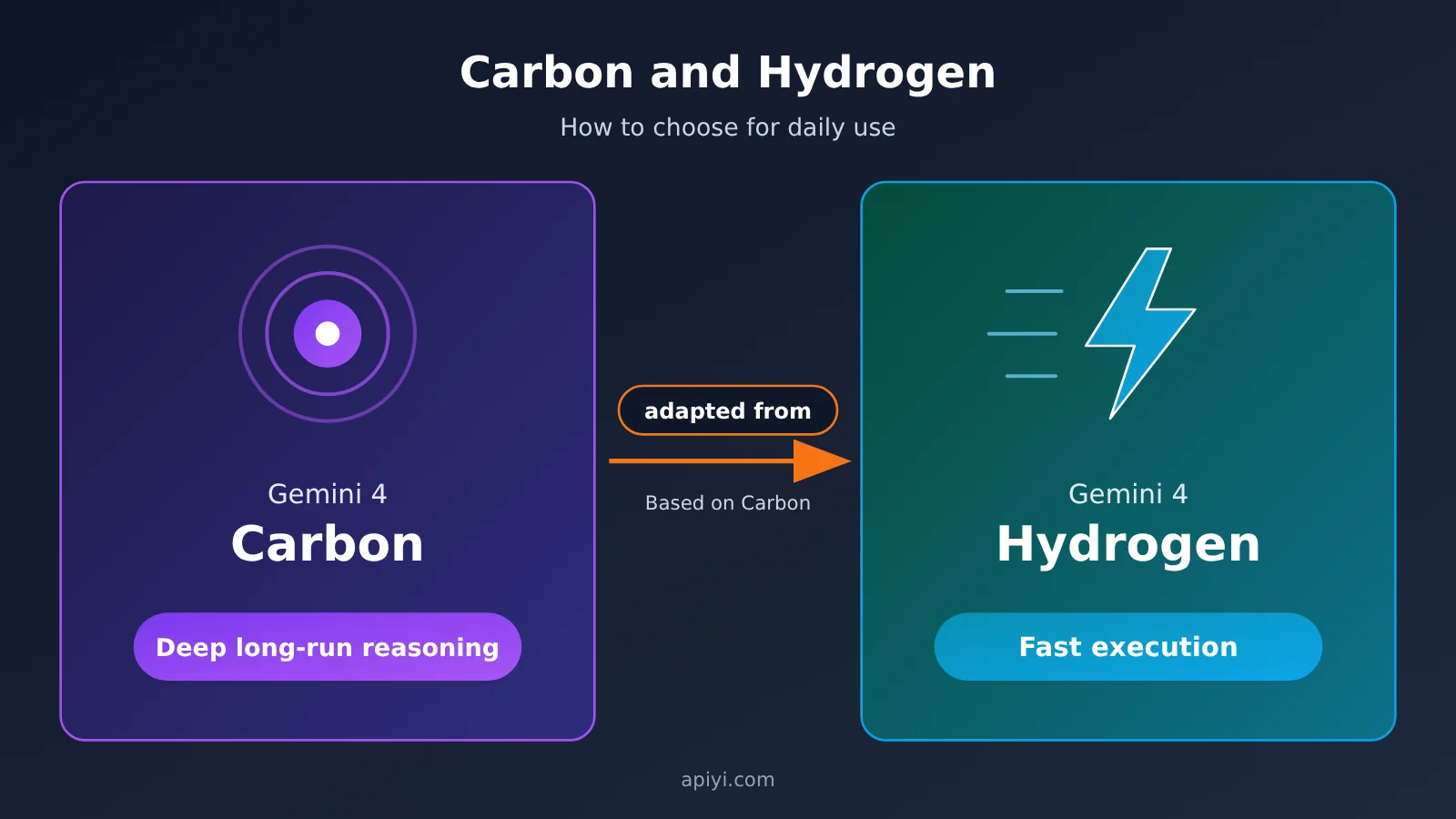
The short version: Gemini 4 Hydrogen is an execution model derived from Carbon — not a stronger replacement for it. The model card says it plainly: “Gemini 4 Hydrogen is adapted from Gemini 4 Carbon.” The official blog also frames Carbon and Argon as frontier models built for deep, long-horizon reasoning, while Hydrogen is positioned as “built for rapid execution.” Notably, Google doesn’t put the two side by side in a single per-benchmark table.
The key takeaway: By the end of this article, you’ll know when to hand everyday tasks to Hydrogen, when to stay on Carbon, and which model you can actually call on APIYI today. One heads-up before we go further: as of 2026-11-13, APIYI has listed gemini-4-carbon, while gemini-4-hydrogen isn’t available yet — we’ll get it up as soon as we can. Model availability and pricing are subject to the platform’s model list.
Gemini 4 Hydrogen vs Gemini 4 Carbon: The Core Differences
Both models belong to the Gemini 4 family, both have a knowledge cutoff of 2026-03, and both accept text, image, audio, and video input. The real difference comes down to positioning and default behavior. The table below only covers items that map to official documentation or APIYI’s docs.
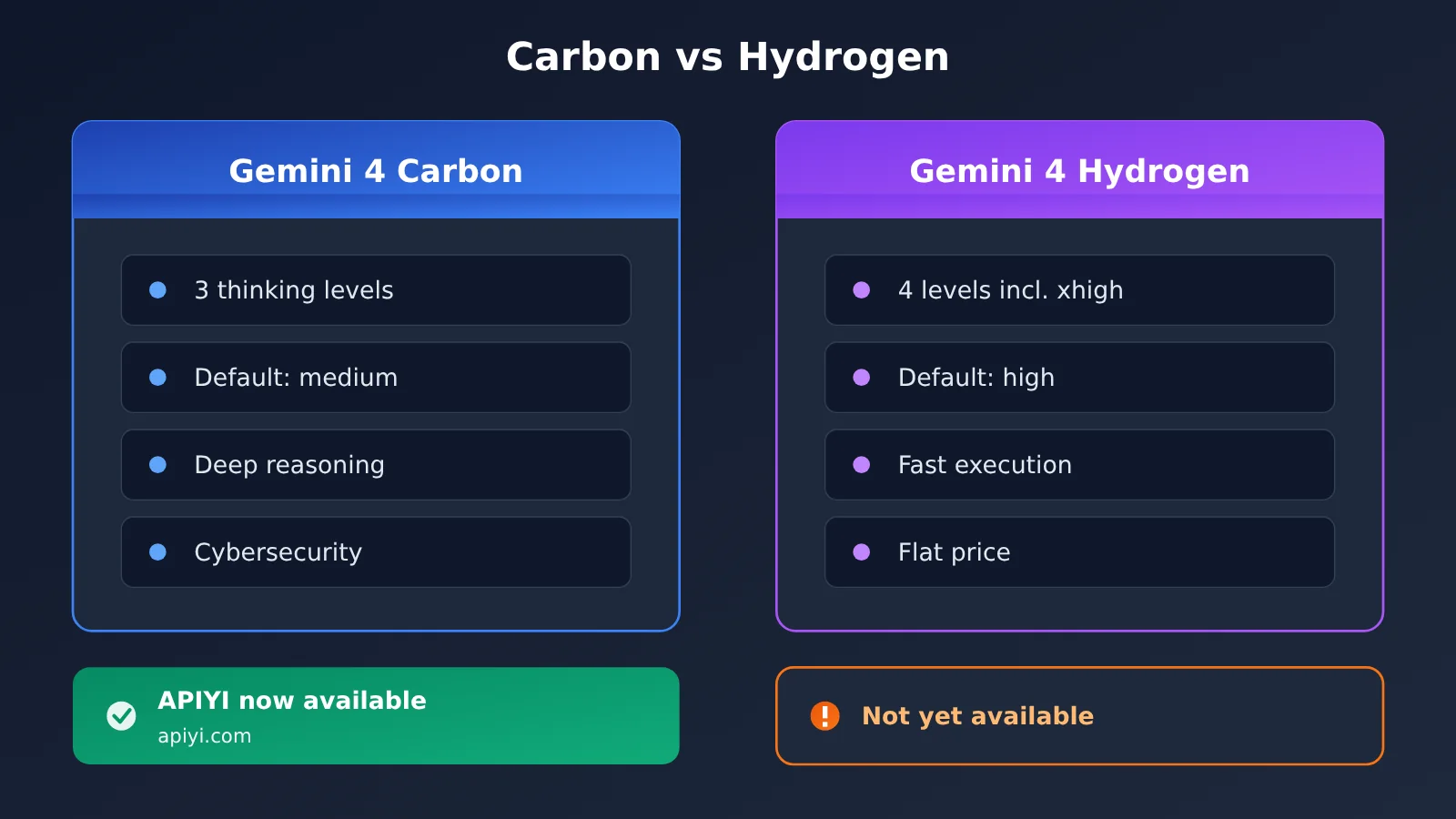
| Dimension | Gemini 4 Carbon | Gemini 4 Hydrogen | Notes |
|---|---|---|---|
| Official positioning | Deep, long-horizon reasoning, covering agentic coding, scientific reasoning, and cybersecurity | Fast execution | Hydrogen is derived from Carbon |
| Release timing | Released 2026-10-28, opened to paid developers and enterprises on 2026-11-10 | 2026-11-12 | APIYI launched Carbon on 2026-11-11 |
| Thinking tiers | low / medium / high | low / medium / high / xhigh | xhigh is a tier Hydrogen adds |
| Default tier | medium | high | Leave parameters untouched and the two behave differently out of the box |
| Global standard price (input/output) | $2 / $10 through 11-30, $4 / $20 from 12-01 | $1.50 / $7.50 (reasoning included) | Unit: USD per million tokens |
| APIYI availability | Listed | Not listed yet | Models and pricing are subject to the platform’s model list |
How Gemini 4 Carbon handles thinking and output
APIYI’s docs go into Carbon’s parameter behavior in some detail. Thinking tiers support only low, medium, and high; the default is medium; xhigh, thinkingBudget, and minimal aren’t supported. temperature, topP, and topK are fixed by the official spec, and custom values get ignored—so tweaking sampling parameters won’t do anything.
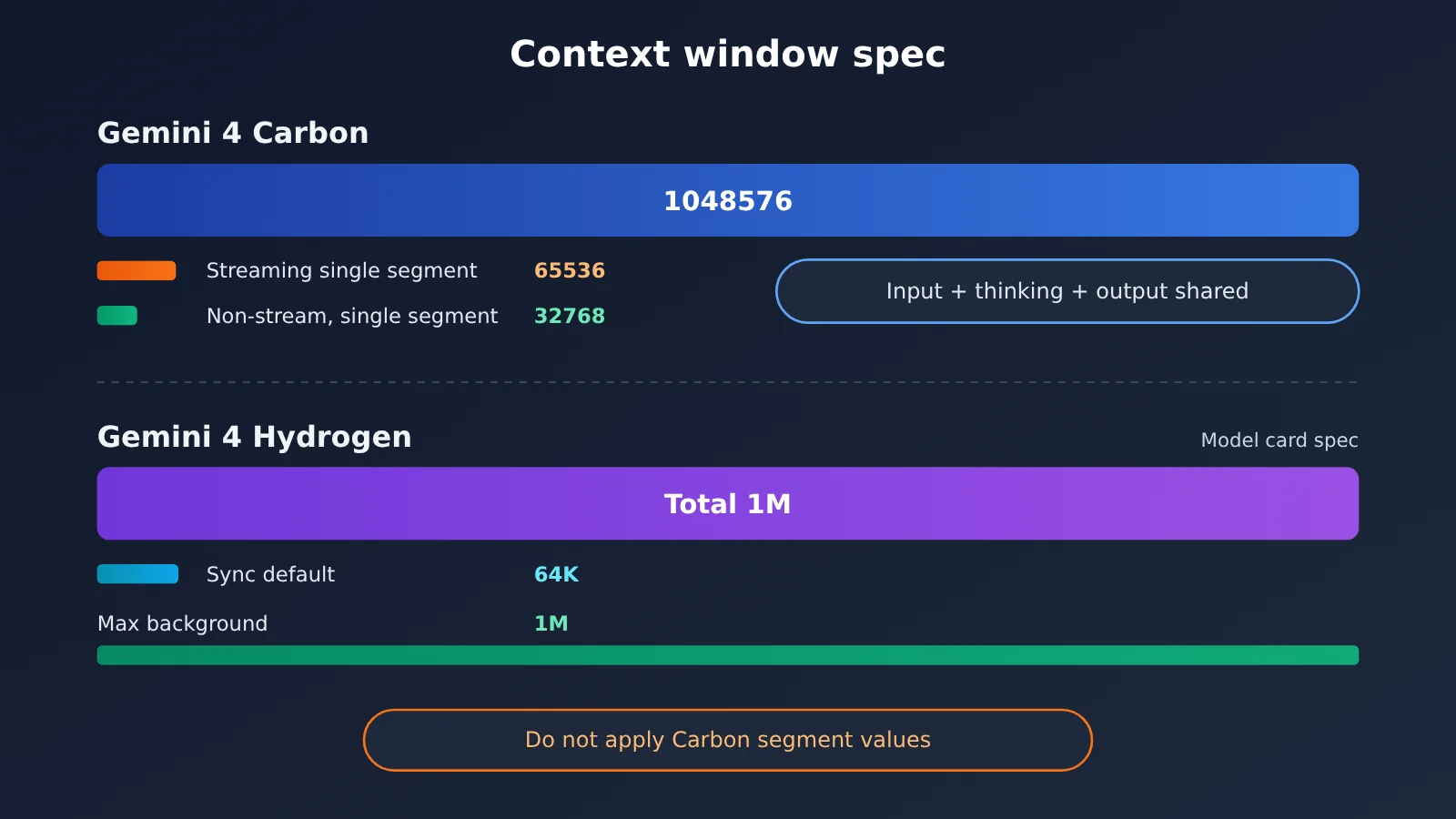
On context, the official window is 1048576 tokens, shared across input, thinking, and output. Max output is officially rated up to 1048576, but long output has to be continued in segments: 65536 per segment for streaming, 32768 per segment for non-streaming. Keep in mind that maxOutputTokens counts thinking tokens too. In the docs’ retest, with maxOutputTokens set to 50, 100, and 300, the budget was exhausted during the thinking phase, returning finishReason=MAX_TOKENS with only thinking and no body text.
How Gemini 4 Hydrogen’s window is measured
Hydrogen’s window is described two different ways across official channels. The model card says up to 1 million tokens total, with synchronous output defaulting to 64 thousand and background long output up to 1 million; the blog says native 1 million input and output up to 1 million. The two use different accounting. When integrating, plan your output length based on the model card’s split between synchronous and background modes, and don’t just apply Carbon’s 65536 and 32768.
How to Read the Gemini 4 Hydrogen vs. Gemini 4 Carbon Benchmarks
This is the part most likely to be misread, so it deserves its own explanation. Both sides cite Artificial Analysis’s intelligence index, but the numbers can’t simply be subtracted from each other.
APIYI’s Carbon overview cites figures published by Google: Carbon scores 59 on the AA Intelligence Index v5, ranking No. 1 at launch. The Hydrogen announcement gives 51 for the default high setting (Argon is 50 under the same standard) and 54 for the xhigh setting, but it doesn’t specify which version of the index it’s using. When the versions don’t match, a conclusion like “59 is 5 points higher than 54” doesn’t hold — and this article doesn’t make that comparison.
Carbon also has another set of results that appear only in its official materials, which are handy for showing where its strengths lie. Note that these are all Carbon’s results; the Hydrogen model card has no corresponding entries.
| Gemini 4 Carbon Officially Published Items | Result |
|---|---|
| SEC-bench Pro | 88.2% |
| ExploitGym | 54.8% |
| CWE-bench | 71.0% |
| WebDev Arena | No. 4, 1,768 points |
| CursorBench 4.0 / Perplexity WANDR / Zapier AutomationBench | All No. 1 |
| Artificial Analysis MKA | No. 2 |
The three cybersecurity items (SEC-bench Pro, ExploitGym, CWE-bench) show that Carbon is still the go-to model for security defense, while Hydrogen has no published data in this area. On top of that, the Carbon overview also cites a third-party AA-Omniscience hallucination rate of 11% measured by Artificial Analysis — a third-party measurement, not something Google self-reported.
Gemini 4 Hydrogen vs. Gemini 4 Carbon: Pricing and Cost
Pricing is one of Hydrogen’s most straightforward advantages. It uses flat rates: $1.50 per input and $7.50 per output (including reasoning) at global standard pricing, with $0.075 for cache reads. Non-global pricing is $1.65 / $8.25. Cache writes at $1.875 won’t be billed until 2027-01-12.
Carbon’s pricing sits on the same Google Cloud price sheet but is split into two phases. Through 2026-11-30, promotional pricing applies: $2 global input, $10 output, $0.10 cache read, with cache writes not applicable; non-global is $2.20 / $11 / $0.11. Starting 2026-12-01, prices revert to $4 / $20 / $0.20 globally, and $4.40 / $22 / $0.22 for non-global. Carbon Cyber Permissive is billed directly at the December 1 rates and doesn’t get the promotional price.
| Scenario | Gemini 4 Hydrogen | Gemini 4 Carbon (through 11-30 / APIYI current list price) | Gemini 4 Carbon (official price from 12-01) |
|---|---|---|---|
| Short prompt: 100K input + 10K output | $0.225 | $0.30 | $0.60 |
| Long prompt: 1M input + 100K output | $2.25 | $3.00 | $6.00 |
During the promotional period, the gap between the two isn’t that big. After December, Carbon’s price doubles, and the same task costs more than twice what Hydrogen does. That’s the main reason the division of labor—”hand routine execution tasks to Hydrogen”—is worth considering.
💰 Cost note: On APIYI, gemini-4-carbon is currently listed at $2 input, $10 output, and $0.1 cache read. The documentation states this is Google’s limited-time price, valid through 2026-11-30, and will adjust to $4 / $20 along with the official change starting December 1. Carbon only supports implicit caching, and the official minimum cache length is 4096 tokens (this threshold applies only to Carbon).
How to Call Gemini 4 Carbon on APIYI
If you want to use a model from the same family right now, you can start with gemini-4-carbon. APIYI offers two endpoints: the OpenAI-compatible POST /v1/chat/completions, and Gemini’s native POST /v1beta/models/gemini-4-carbon:generateContent. The Responses API isn’t supported, and neither is the Anthropic Messages format. There are two groups, default and svip, both with a 1x multiplier.
Here’s the simplest OpenAI-compatible call example:
import openai

client = openai.OpenAI(
    api_key="YOUR_API_KEY",
    base_url="https://api.apiyi.com/v1"  # APIYI OpenAI-compatible endpoint
)

resp = client.chat.completions.create(
    model="gemini-4-carbon",
    messages=[{"role": "user", "content": "审查这段代码的越权风险"}],
    max_tokens=8000  # thinking tokens count toward the cap too, so don't set it too low
)
print(resp.choices[0].message.content)
If you’re working with long documents, I’d suggest two safeguards: check finish_reason, and switch to streaming plus continuation when you need long output.
import openai

client = openai.OpenAI(
    api_key="YOUR_API_KEY",
    base_url="https://api.apiyi.com/v1"
)

def ask_carbon(prompt: str, max_tokens: int = 16000) -> str:
    resp = client.chat.completions.create(
        model="gemini-4-carbon",
        messages=[{"role": "user", "content": prompt}],
        max_tokens=max_tokens  # per-segment cap for non-streaming: 32768
    )
    choice = resp.choices[0]
    if choice.finish_reason == "length":
        # output was truncated: raise the cap, or switch to streaming with segmented continuation (streaming per-segment cap 65536)
        print("提示: 输出被截断, 需要续写")
    return choice.message.content or ""

print(ask_carbon("总结这份 20 万 tokens 合同中的违约条款"))
The long-document usage here is backed by documented retesting: a needle-in-a-haystack test on a document of roughly 199k tokens passed, with a returned promptTokenCount of 199277. The 500k and 1M token scales are explicitly noted as untested in the docs, so if you plan to go that large, run your own small-sample validation first. For the exact field names of the thinking-level parameter, refer to the APIYI documentation.
🚀 Quick start: I’d recommend first running gemini-4-carbon with the free credits for new users at APIYI apiyi.com, and confirming that the thinking level, output cap, and continuation logic all behave as expected. Once Hydrogen is available, you’ll only need to swap the model field to compare results.
Gemini 4 Hydrogen vs Gemini 4 Carbon: Scenario Recommendations
When to Choose Gemini 4 Hydrogen
- High-frequency execution tasks: batch rewriting, structured extraction, and code changes made according to explicit instructions. These tasks have clear steps, and what you need is speed and cost efficiency.
- Workers and verifiers in multi-agent setups: The official parallel usage pattern has Hydrogen handle execution and verification.
- Execution tasks that need a temporary reasoning boost: Hydrogen defaults to high and can be raised to xhigh when necessary; Carbon doesn’t have this tier.
- Cost-sensitive workflows after December: flat pricing of $1.50 / $7.50, roughly one-third to one-half of Carbon’s price after it returns to regular pricing.
When to Keep Using Gemini 4 Carbon
- Long-horizon agentic coding and complex planning: The official positioning assigns depth and long-horizon reasoning to Carbon and Argon.
- Cybersecurity defense: Only Carbon has published results for SEC-bench Pro, ExploitGym, and CWE-bench.
- Scientific reasoning and breaking down difficult problems: Tasks that require multi-step argumentation and can’t afford mistakes.
- Projects on APIYI that need immediate integration: The one available right now is gemini-4-carbon.
| Task Type | Recommended Model | Reason | Available Platform |
|---|---|---|---|
| Planning and coordination | Gemini 4 Carbon | Deep long-horizon reasoning | APIYI apiyi.com (listed) |
| Parallel execution and validation | Gemini 4 Hydrogen | Fast execution, low price | Not yet listed on APIYI; refer to the platform’s model list |
| Security auditing | Gemini 4 Carbon | Has official security benchmark results | APIYI (listed) |
| Batch routine processing | Gemini 4 Hydrogen | Flat pricing, defaults to high | Not yet listed on APIYI |
Gemini 4 Hydrogen vs. Gemini 4 Carbon: Make the Most of the Orchestrator
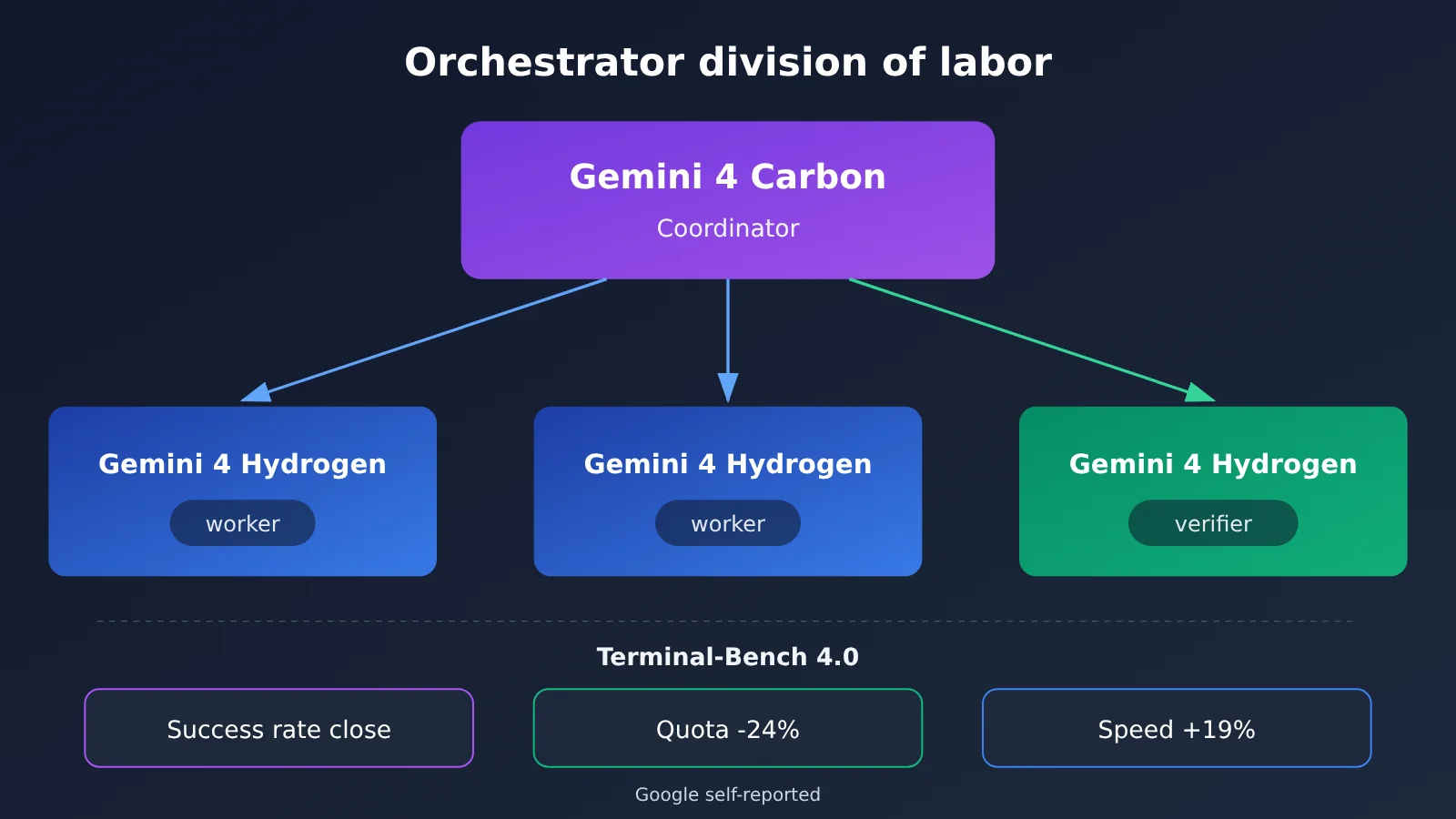
Google’s recommended best practice isn’t to pick one — it’s to use them together. In the Hydrogen blog post, Google introduces the Orchestrator: inside Antigravity, you can switch between Carbon and Hydrogen. According to Google’s own numbers, on Terminal-Bench 4.0 this approach lands success rates close to using Carbon alone, while consuming an average of 24% less quota and running 19% faster.
When running them in parallel, the division of labor looks like this: Carbon handles coordination and task decomposition, while Hydrogen acts as the worker executing subtasks and as the verifier checking the results. Applying that same idea to your own workflow, here’s how to decide:
- First figure out whether the task is about “thinking it through” or “getting it built”: anything that needs planning, tradeoff analysis, and long-chain reasoning goes to Carbon; anything with clear, explicit instructions goes to Hydrogen.
- Always set the tier explicitly: Carbon defaults to medium and Hydrogen defaults to high, so if you switch models without explicitly setting the tier, you’ll see unexpected changes in latency and cost.
- Keep an eye on the December 1 pricing milestone: during the promotional period the cost gap with Carbon is small, but from December onward the gap nearly doubles, and the payoff from routing work appropriately becomes noticeably bigger.
- For security-sensitive scenarios, stick with Carbon: Hydrogen doesn’t have safety benchmark results yet, so you can’t assume it has that capability.
💡 Recommendation: Hydrogen isn’t listed on APIYI yet — we’ll get it up as soon as we can. Until then, you can set up the coordination layer and continuation logic with gemini-4-carbon on APIYI (apiyi.com), then plug in the execution layer once Hydrogen goes live, and run a real-world comparison using the prices in the platform’s model list.
FAQ
Q1: Is Gemini 4 Hydrogen an upgraded version of Gemini 4 Carbon?
No. The model card states that Hydrogen was derived from Carbon and is positioned for fast execution; the official positioning still assigns deep, long-horizon reasoning to Carbon and Argon. The two are complementary roles, not a new-for-old replacement.
Q2: Can Hydrogen’s score of 54 be compared directly with Carbon’s 59?
No. Both cite Artificial Analysis, but Carbon’s 59 is explicitly the Intelligence Index v5, while the Hydrogen announcement doesn’t state which index version it uses. When the version is unclear, the difference you get by subtracting the two numbers is meaningless.
Q3: When were the two models released?
Gemini 4 Carbon was released on 2026-10-28, opened to all paid developers and enterprises on 2026-11-10, and went live on APIYI on 2026-11-11. The “vendor release date 2026-11-10” shown on the APIYI model page refers to the general availability date, not the first release date. Gemini 4 Hydrogen was released on 2026-11-12.
Q4: Can I call Gemini 4 Hydrogen through APIYI right now?
Not yet. gemini-4-hydrogen is currently not in APIYI’s model master list, model pages, or pricing API, so it’s not listed yet. We’ll get this model listed as soon as possible; model availability and pricing are subject to the platform’s model list. If you want to call a model from the same family right now, you can use gemini-4-carbon on APIYI apiyi.com with base_url set to `https://api.apiyi.com/v1`.
Q5: Why does calling Gemini 4 Carbon return empty body content?
The most common cause is setting maxOutputTokens too low. Carbon counts thinking tokens toward the output limit, so in the documented retest, settings of 50, 100, and 300 all burned through the quota during the thinking phase and returned finishReason=MAX_TOKENS. Raising the limit to several thousand or more fixes it. If you want to troubleshoot parameter issues on a small quota first, you can test with APIYI apiyi.com’s free quota for new users.
Q6: What limitations does each model have?
Carbon doesn’t support xhigh, thinkingBudget, or minimal; its sampling parameters are fixed by the vendor; long outputs require continuation; and its price doubles starting in December. Hydrogen hasn’t published cybersecurity benchmarks, its context window is described two different ways in the model card and the blog, and it isn’t listed on APIYI yet.
Gemini 4 Hydrogen vs Gemini 4 Carbon: Key Takeaways
- Different positioning: Hydrogen is derived from Carbon and built for fast execution; Carbon handles deep, long-horizon reasoning.
- Thinking tiers: Carbon has three tiers and defaults to medium; Hydrogen has four tiers, including xhigh, and defaults to high.
- Pricing changes: Hydrogen is flat-priced at $1.50 / $7.50; Carbon will rise from $2 / $10 to $4 / $20 starting December 1.
- Benchmarks aren’t directly comparable: Carbon’s 59 points are on AA v5, while Hydrogen’s 51 / 54 points don’t specify a version.
- Safety focus: The three results, including SEC-bench Pro, belong to Carbon only.
- Combined use: In an orchestrator setup, Carbon coordinates and Hydrogen executes; the official self-reported figures are 24% lower quota usage and 19% faster.
- Current availability: gemini-4-carbon is already listed on APIYI; Hydrogen is not yet listed.
Summary
Comparing Gemini 4 Hydrogen with Gemini 4 Carbon, the conclusion is clear:
- Hand daily execution tasks to Hydrogen: it’s fast and flat-priced, defaults to high, and can use xhigh when needed.
- Keep using Carbon for deep reasoning, long-horizon agents, and security defense: both its official positioning and public results point to Carbon.
- The most cost-effective approach is to use them together: Carbon coordinates, while Hydrogen executes and validates. The payoff becomes more obvious after Carbon’s December price increase.
You can start by building your workflow with gemini-4-carbon now. Keep in mind the default medium tier, that thinking tokens count toward the output limit, and the price change after November 30. I recommend accessing through APIYI apiyi.com with a single API key; once Hydrogen is listed, you can switch models directly to compare. For specific models and prices, refer to the platform’s model list.
📚 References
- Google Blog: Introducing Gemini 4 Hydrogen: announcement, Orchestrator, and AA scores
- Link:
blog.google/innovation-and-ai/models-and-research/gemini-models/introducing-gemini-4-hydrogen -
Notes: the original wording on Hydrogen’s positioning and the self-reported Terminal-Bench 4.0 data
-
Google DeepMind Model Card: Gemini 4 Hydrogen: thinking levels, context window, and output specification
- Link:
deepmind.google/models/model-cards/gemini-4-hydrogen -
Notes: source of the original “adapted from Gemini 4 Carbon” wording
-
Google Cloud Vertex AI Pricing Page: official pricing for Hydrogen and Carbon
- Link:
cloud.google.com/vertex-ai/generative-ai/pricing -
Notes: includes the Carbon promotional period and the two price tiers after December 1
-
APIYI Docs: Gemini 4 Carbon Overview: parameter behavior, documentation retests, and citations to official benchmarks
- Link:
docs.apiyi.com/api-capabilities/gemini-4-carbon/overview -
Notes: thinking levels, output caps, and long-context needle-in-a-haystack retests
-
APIYI Model List: currently callable model IDs and pricing
- Link:
docs.apiyi.com/models - Notes: Hydrogen’s listing status is based on this page
Author: APIYI Technical Team
Technical discussion: Feel free to reach us through the APIYI website homepage; for more materials, visit the docs.apiyi.com documentation center.