
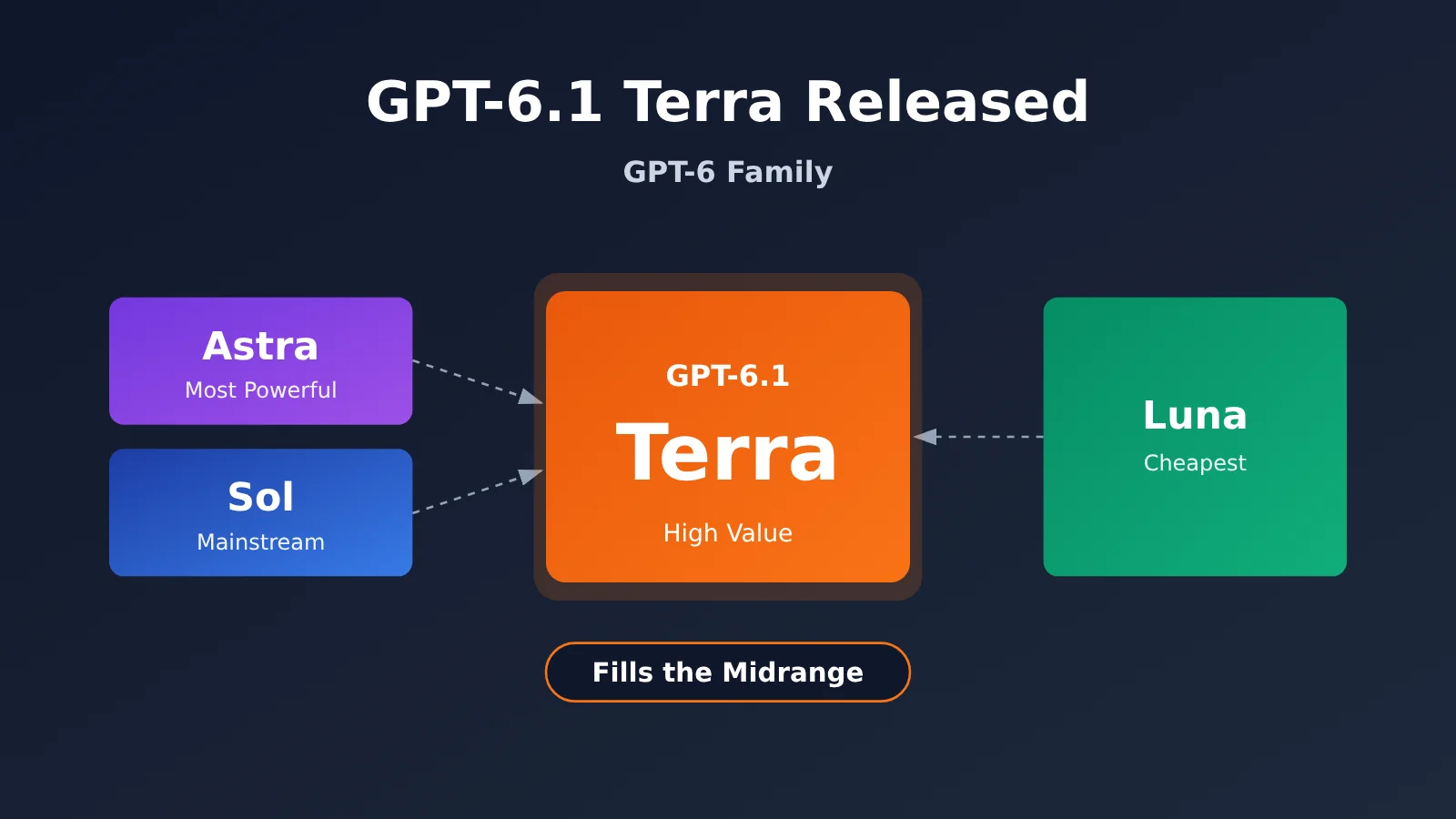
On October 26, 2026, OpenAI officially released GPT-6.1 Terra. Its per-token price is half that of Sol and one-tenth that of Astra, yet it approaches flagship-level performance on some vision and computer-use tests. That got a lot of attention. Many developers’ first reaction was: with Astra as the most powerful model, Sol as the all-around workhorse, and Luna as the cheapest option, why did OpenAI need another model?
This isn’t a rumor. OpenAI’s official announcement, API model page, and pricing page are all live. Third parties including Artificial Analysis, Plotly, and DualEntry also published test results on launch day. This article brings that information together to explain where GPT-6.1 Terra fits in the GPT family.
What you’ll learn: In a few minutes, you’ll get the key specs, pricing, and test results for GPT-6.1 Terra, plus a rundown of what Astra, Sol, and Luna are best suited for.
GPT-6.1 Terra at a Glance
Let’s start with the basics. This table summarizes the key details confirmed in OpenAI’s official announcement and API documentation:
| Item | Details |
|---|---|
| Release date | October 26, 2026 (most Chinese coverage appeared on October 27) |
| Released by | OpenAI |
| API model ID | gpt-6.1-terra |
| Official positioning | Fast and efficient, with a focus on improved visual reasoning, precise computer use, and natural-language writing |
| Context window | 1,050,000 tokens, with a maximum output of 128,000 tokens |
| Knowledge cutoff | June 1, 2026 |
| Input / output modalities | Text and image input; native text output; no audio or native video input |
| Reasoning effort | Six levels: none / low / medium / high / xhigh / max; defaults to medium |
| Availability | ChatGPT Work, Codex (Plus, Pro, Enterprise, Edu), and the OpenAI API |
One version-number detail is worth clarifying. Terra was previously at GPT-5.6 and has now moved directly from 5.6 Terra to 6.1 Terra. There was no officially released GPT-6.0 Terra. Looking at the timeline, the flagship GPT-6 Astra launched on September 3, followed by Sol and Luna on September 22. Sol was upgraded to 6.1 on September 29, and Terra joined on October 26, completing the four-tier GPT-6 lineup.
What GPT-6.1 Terra Can and Can’t Do
Terra supports streaming, structured outputs, and function calling. Tool use requires the Responses API and can connect to tools such as web search, file search, Computer Use, Shell, Code Interpreter, and MCP.
Keep in mind that being able to edit video with software doesn’t mean the model natively supports video generation. Likewise, understanding screenshots doesn’t mean it can automatically operate a user’s computer once connected to the API. What it can actually do depends on the tools and runtime environment you configure for it. Also, its 1.05-million-token context window is on the same level as Sol and Astra’s, so it isn’t an advantage unique to Terra.
Where GPT-6.1 Terra Fits in the GPT Family
To understand Terra, it helps to see how the whole family is divided up. OpenAI’s official model selection guide groups its current flagship models into four tiers, each suited to different task complexity and budget requirements.
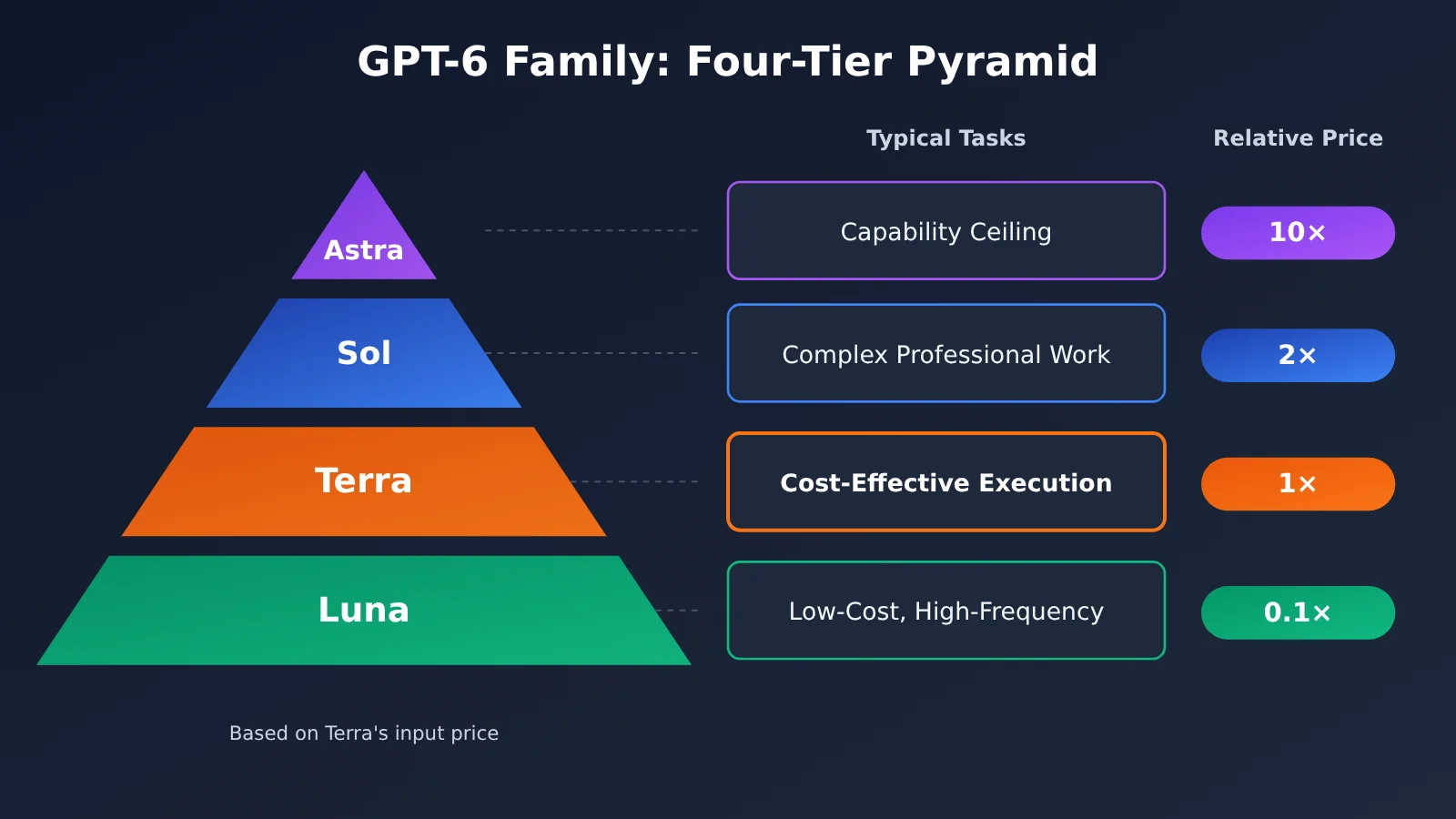
| Model | Key strengths | Typical tasks | In a nutshell |
|---|---|---|---|
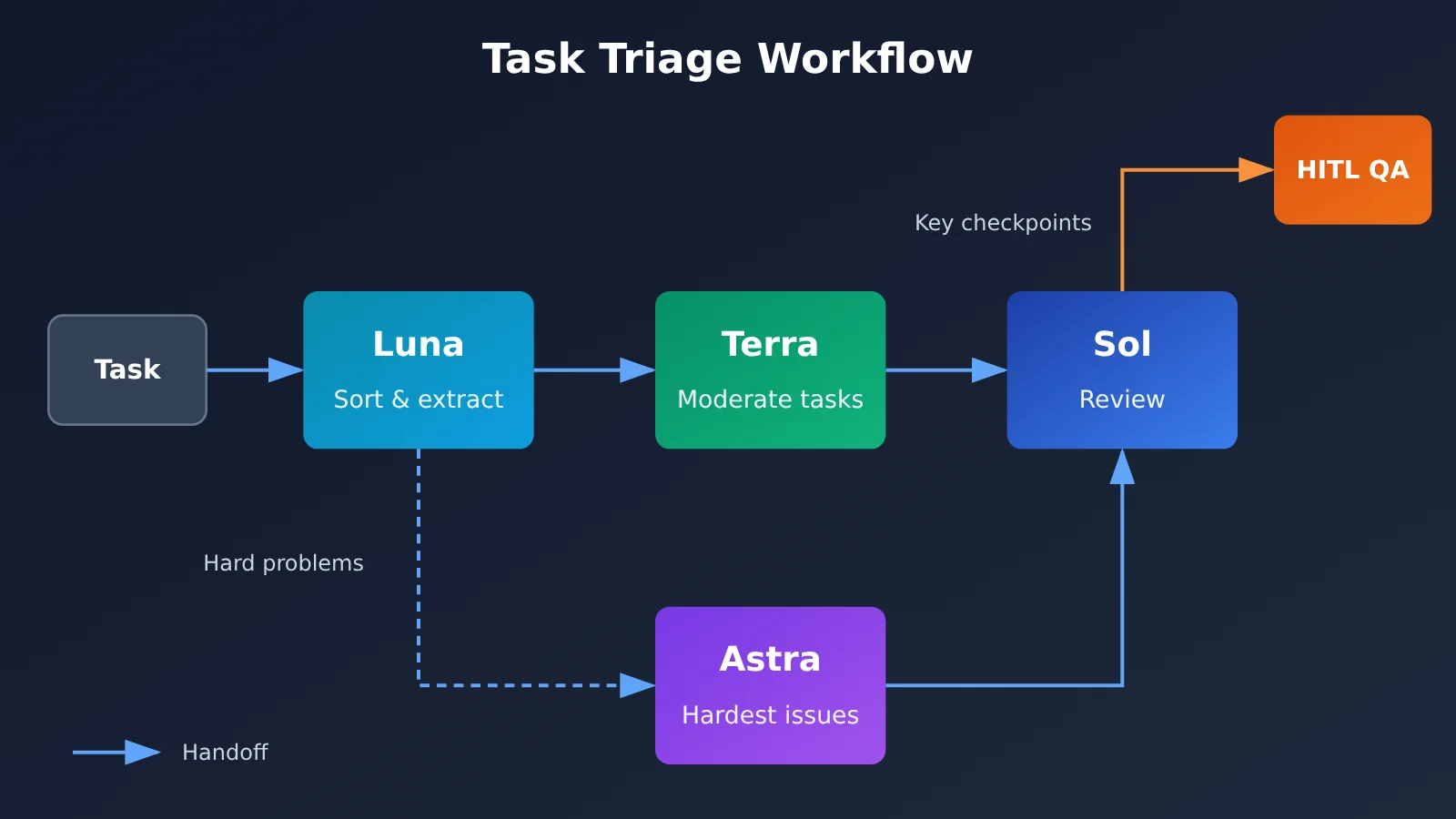
| GPT-6 Astra | Highest intelligence, complex reasoning | Difficult programming, scientific research, long-running professional projects | Maximum capability |
| GPT-6.1 Sol | Near-flagship performance, balanced cost | Complex software development, in-depth research, multistep projects | Handles complex professional work |
| GPT-6.1 Terra | Visual understanding, computer use, fast execution | Invoice entry, drawing interpretation, filling out forms across applications, document drafting | Executes real-world workflows cost-effectively |
| GPT-6 Luna | Lightweight, extremely low cost, high concurrency | Classification, format conversion, simple extraction | Handles repetitive tasks at the lowest cost |
GPT-6.1 Terra Isn’t a Scaled-Down Sol
Terra sits between Sol and Luna, but it isn’t simply a uniformly scaled-down version of Sol. OpenAI emphasizes the full chain from “understanding information” to “taking action”: for example, interpreting a screenshot, deciding which button to click, then entering data across applications and producing a result. These tasks demand strong visual understanding and precise operations, but they don’t necessarily require flagship-level general reasoning.
This reflects a shift in OpenAI’s approach: rather than directing everyone to the same most powerful model, it’s offering tiers based on task difficulty, execution speed, and cost. Terra fills the middle ground for work that “Luna can’t handle well, but Sol would be too expensive for.”
🎯 Technical tip: If you want to compare how Astra, Sol, Terra, and Luna perform in the same codebase, you can use the OpenAI-compatible API through APIYI at apiyi.com. Switching models only requires changing the
modelparameter.
GPT-6.1 Terra Pricing Comparison and Real-World Costs
Price is Terra’s most obvious selling point. Here are OpenAI’s official Standard API rates in USD per million tokens, applicable to standard short-context requests:
| Model | Input | Cached input | Output | Available platforms |
|---|---|---|---|---|
| GPT-6 Astra | $10.00 | $1.00 | $50.00 | OpenAI API, APIYI apiyi.com |
| GPT-6.1 Sol | $2.00 | $0.10 | $10.00 | OpenAI API, APIYI |
| GPT-6.1 Terra | $1.00 | $0.05 | $5.00 | OpenAI API, APIYI |
| GPT-6 Luna | $0.10 | $0.01 | $0.50 | OpenAI API, APIYI |
| Previous-generation GPT-5.6 Terra | $2.00 | $0.20 | $12.00 | — |
At these rates, Terra costs half as much as Sol, one-tenth as much as Astra, and 10 times as much as Luna. Compared with the previous-generation 5.6 Terra, input is 50% cheaper, output is about 58.3% cheaper, and cache reads are 75% cheaper. For a task using 100,000 input tokens and 10,000 output tokens, Astra would cost about $1.50, Sol about $0.30, Terra about $0.15, and Luna about $0.015.
GPT-6.1 Terra Billing Gotchas
A lower unit price doesn’t necessarily mean a lower total cost. Here are a few billing rules worth knowing upfront:
- Long-context premium: When a request exceeds 272K input tokens, input and cached input for the entire request are charged at 2× the standard rate, and output at 1.5×.
- Service tiers: Batch and Flex modes cost about half the Standard rate, while Fast mode costs 2× the Standard rate.
- Cache writes: A 30-minute cache write costs $1.25 per million tokens, while a 12-hour cache write costs $2.50 per million tokens.
- Reasoning effort: Higher levels consume more reasoning tokens, and tool calls may incur additional charges.
There’s also a telling data point in the official OSWorld chart: Terra max costs about $1.19 per task, compared with about $1.15 for Sol max. In other words, once reasoning and task steps increase, Terra’s half-price rate doesn’t necessarily make it the cheapest option overall.
GPT-6.1 Terra Performance Test Results
Official Benchmarks: Near-Flagship Performance in Select Areas
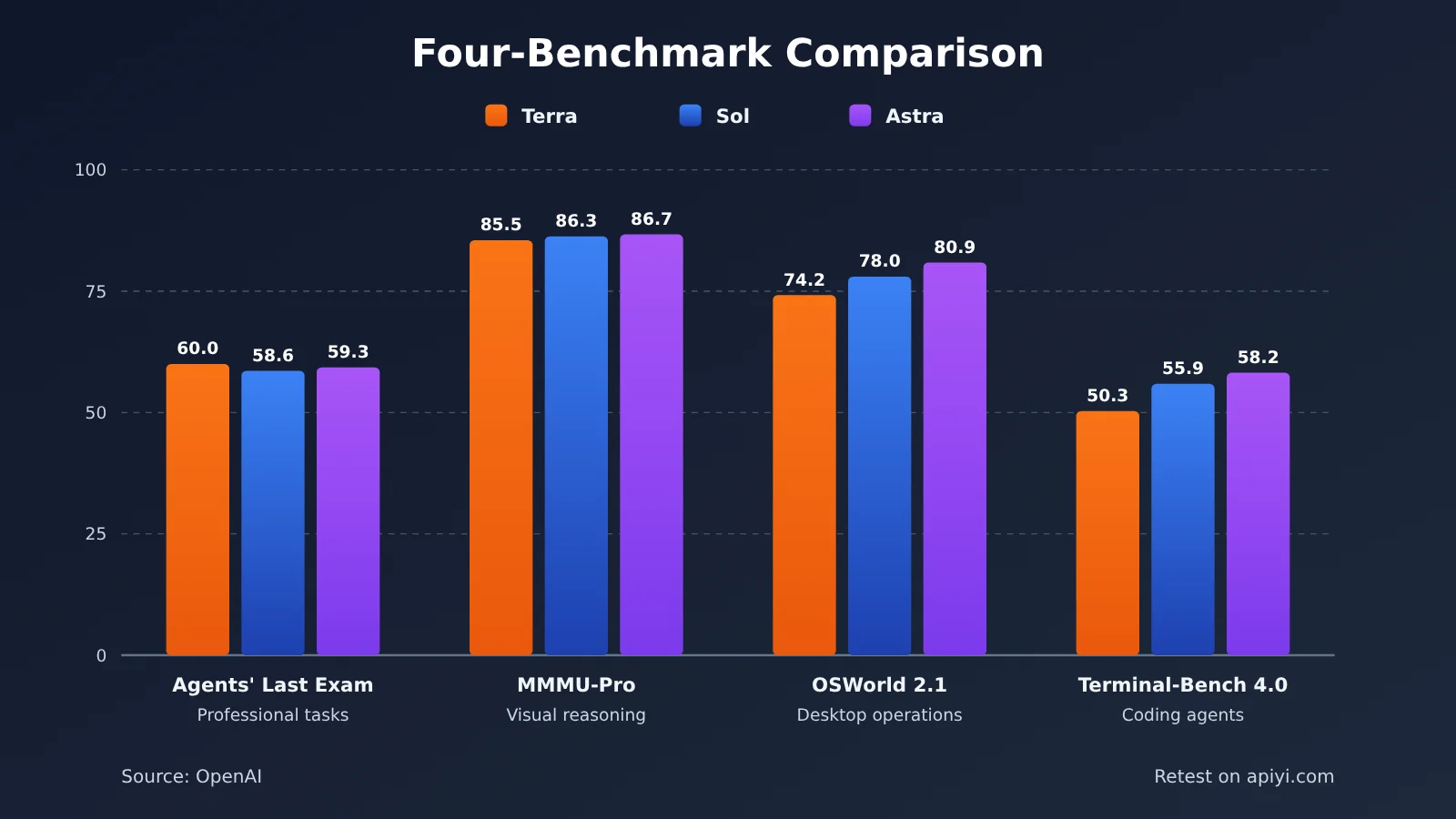
OpenAI published several benchmark results, with some complete figures transcribed by Kingy.ai from its official interactive charts. These are vendor-reported results. The table below highlights the benchmarks that best show where Terra fits:
| Benchmark (max reasoning) | GPT-5.6 Terra | GPT-6.1 Terra | GPT-6.1 Sol | GPT-6 Astra |
|---|---|---|---|---|
| Agents’ Last Exam (professional tasks) | — | 60.0% | 58.6% | 59.3% |
| MMMU-Pro (visual reasoning) | 81.7% | 85.5% | 86.3% | 86.7% |
| OSWorld 2.1 (desktop operations) | 57.1% | 74.2% | 78.0% | 80.9% |
| Terminal-Bench 4.0 (coding agents) | 21.5% | 50.3% | 55.9% | 58.2% |
| Terminal-Bench-Science 0.1 | — | 58.3% | 57.0% | 68.1% |
A few results stand out. On Agents’ Last Exam, Terra medium scored 57.6%—15 percentage points above the previous generation’s medium setting at 42.6%. Its estimated cost per task fell from $0.84 to $0.29, and it matched Astra medium. In visual reasoning, Terra max trails Astra max by just 1.2 percentage points, making this one of Terra’s most compelling strengths.
The weaknesses are clear, too. On complex coding tasks, Terra improved by 28.8 percentage points over its predecessor but still trails Sol and Astra. The official charts also show Sol medium scoring 52.7% on Terminal-Bench 4.0, already ahead of Terra max at 50.3%. Its cost per task is around $1.02, compared with roughly $1.84 for Terra max. On Agents’ Last Exam, Claude Opus 5.5 max still leads Terra with 63.2%.
The improvement in factual error rates is also worth noting. In OpenAI’s internal tests at low reasoning effort, Terra’s factual error rate fell from 53.6% for the previous generation to 16.7%. At the highest reasoning effort, it was 4.3%. These figures come from specially designed difficult factual questions, though, so they shouldn’t be interpreted as a 4.3% hallucination rate in everyday chat.
Third-party tests: Efficient, but consistency remains unproven
Vendor data doesn’t tell the whole story. Third-party evaluations offer more points of comparison:
| Evaluation source | GPT-6 Luna | GPT-6.1 Terra | GPT-6.1 Sol | Key finding |
|---|---|---|---|---|
| Artificial Analysis Intelligence Index (max) | ~38 | 48 | 52 | Terra max costs about 56% as much as Sol max |
| Plotly data analysis (43 questions) | 38 questions / $0.13 | 40 questions / $1.31 | 43 questions / $2.61 | Terra costs about half as much as Sol |
| DualEntry accounting task accuracy | 66.3% | 78.2% | 81.2% | Terra passed all three runs only 65.3% of the time |
Artificial Analysis notes that Terra’s low and medium settings sit on the Pareto frontier for intelligence and cost. The medium setting has an Intelligence Index score of 41 and costs about $0.10 per task. In other words, not every reasoning setting offers the same value. The organization’s AA-Omniscience test also found that when faced with questions it didn’t know the answer to, Terra’s rate of making confident guesses dropped from around 88% for the previous generation to about 38%.
Plotly’s observations are interesting. Terra generated an average of about 1,460 tokens and made roughly 4.5 calls per question, with an actual output speed of about 64 tokens per second. Part of the reason it’s faster is that its output is more concise and it takes fewer steps. But that raises a question: Is it skipping necessary work in the process? DualEntry’s results point to the same concern. Terra averaged 16.1 seconds and about $0.042 per task, giving it a clear advantage in speed and cost. But its accuracy was only around 50–60% on tasks such as accounts payable and month-end close, so it isn’t yet consistent enough to replace human review.
GPT-6.1 Terra Quick API Example
Terra is available through the OpenAI API. This example uses an OpenAI-compatible interface for a basic call, with reasoning_effort controlling the reasoning level:
from openai import OpenAI

client = OpenAI(
    api_key="YOUR_API_KEY",
    base_url="https://api.apiyi.com/v1"  # APIYI 统一接口
)

resp = client.chat.completions.create(
    model="gpt-6.1-terra",
    reasoning_effort="medium",  # none/low/medium/high/xhigh/max
    messages=[{"role": "user", "content": "把这段发票信息整理成 JSON:..."}]
)
print(resp.choices[0].message.content)
See the complete example of routing tasks by complexity
from openai import OpenAI

client = OpenAI(
    api_key="YOUR_API_KEY",
    base_url="https://api.apiyi.com/v1"
)

# 按任务难度分层选择模型(策略示例,非官方规定)
TIER = {
    "simple":  ("gpt-6-luna",    "low"),     # 分类、提取
    "medium":  ("gpt-6.1-terra", "medium"),  # 中等复杂度执行
    "complex": ("gpt-6.1-sol",   "high"),    # 复杂判断与审核
}

def run(task: str, level: str = "medium") -> str:
    model, effort = TIER[level]
    resp = client.chat.completions.create(
        model=model,
        reasoning_effort=effort,
        messages=[
            {"role": "system", "content": "你是严谨的业务助理,完成全部要求后再结束。"},
            {"role": "user", "content": task},
        ],
    )
    return resp.choices[0].message.content

# Terra 执行,Sol 复核
draft = run("根据以下报表数据生成月度摘要:...", "medium")
review = run(f"检查下面的摘要是否遗漏要点或存在错误:\n{draft}", "complex")
print(review)
Note that tool calls such as Computer Use and Shell must use the Responses API. The Chat Completions examples above are only suitable for tasks involving text and image understanding. Check the platform’s model list for available model IDs.
🚀 Get started: New users can claim free test credits at APIYI apiyi.com and try both Terra and Sol with their own business data. That’s a better way than reading leaderboards to see which model has a lower total cost for your use case.
Impact Analysis: What GPT-6.1 Terra Means
For Developers
- Multi-agent workflows are more practical: Developers in the r/codex community have tried using Astra or Sol for planning and review while Terra handles numerous well-defined subtasks. This combination can significantly reduce the cost of intermediate steps.
- Medium-complexity automation is more accessible: For tasks like entering invoices, comparing product images, and interpreting technical drawings, flagship models used to be too expensive while Luna wasn’t reliable enough. Now there’s a better option.
- Review mechanisms are essential: Some community users have complained that Terra “declares completion too early” and may do only the bare minimum when asked to address omissions. These are individual reports from less than two days after release, not a community consensus, but they highlight the need to keep checks in critical workflows.
For the Industry
- Competition is shifting from peak intelligence to task tiering: Model providers aren’t just competing over “who’s the smartest,” but also “how much work can be done per dollar.”
- Claude’s mid- and high-end models face pricing pressure: OpenAI says Terra max costs about one-ninth as much per task as Opus 5.5 on Agents’ Last Exam. But Opus 5.5 and Sonnet 5.5 still score higher on some tests, so Terra isn’t an all-around replacement yet.
- Safety concerns are becoming more immediate: The official system card places Terra’s cybersecurity capabilities at the Critical threshold and its biological and chemical capabilities at the High threshold. These are risk capability levels, not safety scores. For AI that executes tasks, authorization boundaries and prompt injection defenses are increasingly important.
Frequently Asked Questions (FAQ)
Q1: What is GPT-6.1 Terra?
GPT-6.1 Terra is a mid-tier model released by OpenAI on October 26, 2026, with the API ID `gpt-6.1-terra`. It focuses on visual reasoning, computer use, and natural writing, and is designed to handle a wide range of real-world workflows at a lower cost.
Q2: How does GPT-6.1 Terra compare with Sol?
Terra costs half as much per token as Sol, and its performance is close to Sol’s on visual and some operational tasks. However, Sol still leads in overall intelligence scores, complex coding, and reliability. For complex coding tasks, Sol medium may even be more capable and less expensive than Terra max.
Q3: Can regular ChatGPT users access GPT-6.1 Terra?
Terra is primarily aimed at ChatGPT Work, Codex, and API developers. It’s already available to Plus, Pro, Enterprise, and Edu users, with Business access rolling out gradually. It isn’t a general-purpose option in the standard Chat menu.
Q4: How can I quickly test GPT-6.1 Terra through the API?
Register at APIYI apiyi.com and get an API key, set `base_url` to `https://api.apiyi.com/v1`, and use the code in this article to call the model. You can also use the same key to access Sol, Luna, Claude, Gemini, and other models, making side-by-side comparisons easy.
Q5: What are GPT-6.1 Terra’s known limitations?
It still trails Sol and Astra in complex coding and general reasoning. Its reliability is mixed in enterprise workflows such as accounting, and some users report that it sometimes ends tasks prematurely. Higher reasoning settings don’t necessarily cost less overall than Sol, so it’s worth testing with real tasks through APIYI apiyi.com before deploying it.
GPT-6.1 Terra Key Takeaways
- Clear positioning: Terra is the mid-tier execution model in the GPT-6 family, sitting between Sol and Luna
- Lower pricing: Its unit price is half of Sol’s and one-tenth of Astra’s, with a price cut of over 50% compared with the previous generation
- Standout strengths: Its visual reasoning approaches flagship performance, and it matches Astra at the medium reasoning level in professional task tests
- Clear limitations: It still trails Sol and Astra in complex coding, general intelligence, and consistency across multiple runs
- Look at total cost: At higher reasoning levels, total costs can approach Sol’s; low and medium levels offer better value
- Getting started: Use the unified API from APIYI at apiyi.com to compare the actual costs of all four models
Conclusion
The launch of GPT-6.1 Terra shows that the GPT family is shifting from a race for maximum intelligence toward more precise task segmentation. Here’s how to think about the roles of the four models:
- Astra handles the hardest problems: Use it for the toughest research, coding, and professional decision-making tasks.
- Sol takes on complexity: It’s the workhorse for sustained, high-quality work and reviewing results.
- Terra handles execution: It’s the value pick for visual understanding, computer use, and batch tasks of moderate complexity.
- Luna handles volume: It’s the cheapest option for classification and extraction with clearly defined rules.
Terra isn’t a stripped-down Sol, an upgraded Luna, or a complete replacement for the flagship. Its value lies in balancing speed, capability, and cost for specific workflows. The real question isn’t “Which model has the cheapest tokens?” but “Which model can get your task right at the lowest total cost?”
We recommend running a comparison with your own business data through APIYI at apiyi.com before deciding which role Terra should play in your system.
📚 References
- OpenAI’s official announcement: GPT-6.1 Terra’s positioning, official benchmarks, and availability
- Link:
openai.com/index/introducing-gpt-6-1-terra -
Notes: The most important primary source
-
OpenAI API model and pricing pages: Specifications, reasoning levels, and billing rules
- Link:
developers.openai.com/api/docs/models/gpt-6.1-terra -
Notes: Context window, tool support, and pricing details
-
Artificial Analysis independent evaluation: Intelligence index, cost efficiency, and hallucination tests
- Link:
artificialanalysis.ai/models/releases/gpt-6-1-terra -
Notes: Third-party comparisons across reasoning levels
-
Plotly DataAnalyticsBench evaluation: Accuracy and cost across 43 data analysis questions
- Link:
plotly.com/blog/gpt-6-1-terra-plotly-data-analytics-bench -
Notes: Reveals the source of Terra’s speed advantage
-
DualEntry accounting task evaluation: Accuracy and consistency across 101 accounting tasks
- Link:
dualentry.com/blog/gpt-6-1-terra-accounting-benchmark -
Notes: A useful reference for consistency in enterprise workflows
-
GPT-6.1 Terra official system card: Risk classifications and safeguards
- Link:
deploymentsafety.openai.com/gpt-6-1-terra - Notes: Deployment safety information
Author: APIYI Technical Team
Technical discussions: Visit APIYI at apiyi.com to get in touch. For more integration resources, check out the documentation center at docs.apiyi.com.