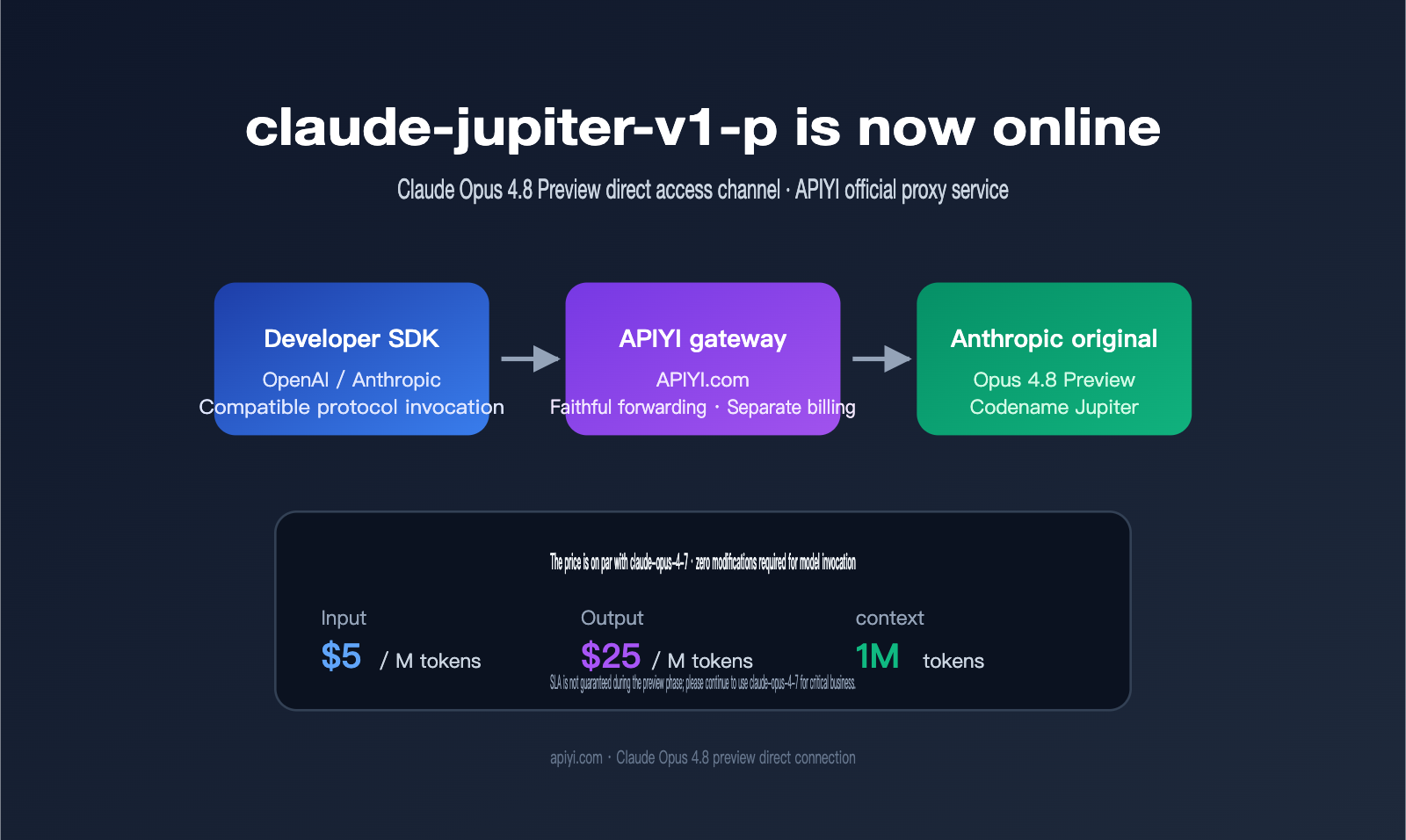
APIYI (apiyi.com) has just launched the claude-jupiter-v1-p channel, providing a direct gateway to the official Claude Opus 4.8 preview. This channel forwards requests in strict accordance with the Anthropic protocol and shares the same billing structure as the production-ready claude-opus-4-7 model ($5 per million tokens for input, $25 for output). Developers can test the new model by simply swapping the model ID in their existing Opus call chains without needing any further modifications.
Since this is a preview release, the channel may experience some instability during peak load, long context processing, or complex multi-tool invocation scenarios. For mission-critical business operations, we recommend sticking with claude-opus-4-7. This article breaks down the capability positioning, integration methods, billing strategy, stability differences, and ideal use cases for claude-jupiter-v1-p to help you decide when it's time to make the switch.
What is claude-jupiter-v1-p: A direct channel for the Claude Opus 4.8 preview
claude-jupiter-v1-p is a direct preview channel provided by APIYI, built on top of Anthropic's official model distribution. It points to the Opus 4.8 preview version (internally codenamed "Jupiter"). Requests and responses are forwarded field-by-field in the official format, with no prompt processing, system field replacement, or tool result filtering. This means that the prompts, Tool Use schemas, and memory invocation methods you've already validated on claude-opus-4-7 will require almost no adjustments when migrating to claude-jupiter-v1-p.
The channel naming follows APIYI's convention of "Model Codename + Version Number + Status Suffix," where -p denotes the preview stage. Once the official version is released, we will launch a stable channel (e.g., claude-jupiter-v1) without the suffix. This naming strategy allows developers to identify at a glance whether they are using a preview or production version, and you can easily use rules like endswith('-p') in your CI/CD pipelines to prevent preview models from hitting production.
The table below summarizes the core metadata for the channel to help you register the model in your gateway:
| Item | claude-jupiter-v1-p |
|---|---|
| Channel Positioning | Direct forwarding for Claude Opus 4.8 preview |
| Underlying Model | Anthropic Opus 4.8 (Internal codename: Jupiter) |
| API Endpoint | https://api.apiyi.com/v1 |
| Input Billing | $5 per million tokens (same as 4.7) |
| Output Billing | $25 per million tokens (same as 4.7) |
| Context Window | 1M tokens (same as Opus 4.7) |
| Max Output | 128K tokens |
| Compatibility | Tool Use, Memory, Vision, Adaptive Thinking |
| Current Status | Preview (SLA not guaranteed) |
APIYI does not apply any rate-limiting plugins to the claude-jupiter-v1-p channel, and it shares the same API key context as claude-opus-4-7. Developers only need to change one line of configuration to switch models—no need to re-apply for keys or go through separate channel approval processes.
Claude Opus 4.8 Preview: Capability Positioning and Comparison with Opus 4.7
Based on Anthropic's public model roadmap, Opus 4.8 continues the iterative rhythm of the Opus series, focusing on three main pillars: "long-range Agents, heavy-duty coding, and complex reasoning." The primary changes in the Jupiter preview compared to Opus 4.7 are concentrated in two areas: first, the Tool Use state machine is more stable, with a noticeable improvement in the success rate for sequences exceeding 20 consecutive tool calls; second, high-resolution visual input provides more precise parsing in structured scenarios such as tables, circuit diagrams, and UI screenshots. At the invocation level, parameter naming and capability toggles remain consistent with 4.7, with no new breaking changes introduced.
We recommend running a baseline evaluation of your core business prompts on claude-jupiter-v1-p before switching, comparing the performance differences between the two models on your own datasets. The APIYI (apiyi.com) gateway supports sending the same prompt to different model IDs simultaneously, making horizontal comparison easy. Results will also be tracked separately by model, including token usage and latency distribution. The comparison table below summarizes the differences between 4.7 and the Jupiter preview across common dimensions:
| Comparison Dimension | claude-opus-4-7 | claude-jupiter-v1-p (Opus 4.8 Preview) |
|---|---|---|
| Availability | Production-ready, full SLA | Preview, potential fluctuations |
| Context Window | 1M tokens | 1M tokens |
| Tool Use Stability | High, verified in major Agent frameworks | Further improved, more stable long-chain calls |
| Visual Input | Up to 2576px / 3.75MP | Same high-res spec as 4.7, better in structured scenarios |
| Adaptive Thinking | Supported | Supported, same budget strategy as 4.7 |
| Pricing | $5 / $25 per million tokens | $5 / $25 per million tokens |
| Use Cases | Critical business, production Agents | Early testing, capability exploration, canary evaluation |
It is important to emphasize that this is a capability profile compiled by APIYI based on direct channel logs and Anthropic's public materials, not an official Model Card. During the preview phase, any capability dimension may be subject to further adjustments. Teams should rely on their own evaluation data rather than "inferred values" from third-party comparison tables.
{claude-opus-4-7 vs claude-jupiter-v1-p}
{5-dimensional capability comparison · Preview version capabilities can be used directly as an Opus model}
{claude-opus-4-7}
{Production version · Full SLA}
{claude-jupiter-v1-p}
{Opus 4.8 Preview · Early Access Entry}
{Tool Use stability}
{High · Mainstream Agent framework verification}
{Long-chain model invocation is more stable}
{visual input}
{2576px / 3.75MP}
{More accurate in structured scenarios}
{context window}
{1M tokens}
{1M tokens · use the same specifications}
{Billing}
{$5 / $25 per million tokens}
{$5 / $25 flat · no premium}
{SLA guarantee}
{Official SLA coverage}
{No commitment is made during the preview stage}
Anthropic Model Direct Forwarding: Switching in 5 Lines of Code
claude-jupiter-v1-p uses APIYI's standard OpenAI-compatible protocol, so switching from claude-opus-4-7 only requires changing the model field. Below is a minimal runnable Python example using the official openai SDK:
from openai import OpenAI

client = OpenAI(
    api_key="YOUR_APIYI_KEY",
    base_url="https://api.apiyi.com/v1"
)

resp = client.chat.completions.create(
    model="claude-jupiter-v1-p",
    messages=[{"role": "user", "content": "Explain the Tool Use state machine in 200 words"}]
)
print(resp.choices[0].message.content)
Changing the model back to claude-opus-4-7 reverts to the production channel, making the entire switch transparent to your calling code. We recommend abstracting the model ID into a configuration item within your gateway or LLM orchestration layer to facilitate future canary releases and emergency rollbacks.
If you are using the native Anthropic SDK, you can also connect directly via APIYI's (apiyi.com) Anthropic-compatible endpoint by pointing base_url to https://api.apiyi.com/v1. There is no need to replace the SDK, and Tool Use and Memory fields are passed through exactly as per the official documentation:
import anthropic

client = anthropic.Anthropic(
    api_key="YOUR_APIYI_KEY",
    base_url="https://api.apiyi.com/v1"
)

msg = client.messages.create(
    model="claude-jupiter-v1-p",
    max_tokens=1024,
    messages=[{"role": "user", "content": "Help me rewrite this code using async syntax"}]
)
print(msg.content[0].text)
🎯 Switching Advice: If your business is already using
claude-opus-4-7via APIYI (apiyi.com), we recommend routing 1%–5% of traffic toclaude-jupiter-v1-pin a canary environment first. Observe the success rate, time-to-first-token (TTFT), and tool call consistency for 24–48 hours before deciding whether to scale up. Fluctuations during the preview phase usually surface within two days.
{claude-jupiter-v1-p direct forwarding architecture and canary deployment process}
{Blue line = normal request path · Orange line = fallback path to claude-opus-4-7}
{① Developer SDK}
{OpenAI compatible}
{or Anthropic native}
{model is configurable}
{② APIYI gateway}
{APIYI.com}
{Model mapping · Grayscale routing}
{Separate bookkeeping · Log archiving}
{③ Grayscale judgment}
{Beta tag / 15%}5% of traffic and observe for 24~48h 3. Configure automatic fallback 4. Retain preview version logs for 30+ days}
{④ Jupiter preview}
{claude-jupiter-v1-p}
{Opus 4.8 Preview}
{5. Produce the production version}
{claude-opus-4-7}
{Full SLA · Default path}
{5xx / timeout → automatic fallback}
{Switching points}
{1. Extract model as a configuration item 2. Canary release 1
Use Cases and Migration Advice for the Claude Opus 4.8 Preview
Not every workload is ready to switch to claude-jupiter-v1-p immediately. Based on common usage patterns from our existing Opus 4.7 customers on APIYI, we’ve put together a migration checklist. The principle is simple: prioritize "trial runs" for scenarios that are reversible, observable, and have minimal impact on end-users. For everything else, stick with claude-opus-4-7.
| Business Scenario | Recommended Channel | Reason |
|---|---|---|
| Offline code evaluation, model stress testing | claude-jupiter-v1-p |
Results don't affect production; preview capabilities can be tested early |
| Internal Agent canary testing | claude-jupiter-v1-p (low traffic) |
Improved tool-calling stability; great for A/B testing |
| Document parsing, table/image recognition PoC | claude-jupiter-v1-p |
Improvements in high-resolution structured parsing |
| Customer-facing support/Q&A bots | claude-opus-4-7 |
Requires stable SLA; avoid preview version volatility |
| High-concurrency batch processing, night jobs | claude-opus-4-7 |
Concurrency limits may fluctuate during the preview phase |
| Compliance-sensitive (Finance, Healthcare) | claude-opus-4-7 |
Frequent snapshot updates in previews complicate compliance audits |
For teams balancing "innovation" with "stability," a common approach on APIYI (apiyi.com) is to maintain a model mapping table: default to claude-opus-4-7, while routing a small subset of internal or "Beta" tagged users to claude-jupiter-v1-p via gateway-level request header routing. This keeps the switch transparent to the business logic, makes rollbacks nearly instantaneous, and allows you to track metrics by model ID in your monitoring dashboard.
We also recommend enabling APIYI’s request log archiving during the transition. Keep the request bodies, response bodies, and tool-calling chains for claude-jupiter-v1-p for at least 30 days. This makes it much easier to debug those pesky "intermittent production bugs" that are otherwise impossible to reproduce.
Stability and Billing for the claude-jupiter-v1-p Preview
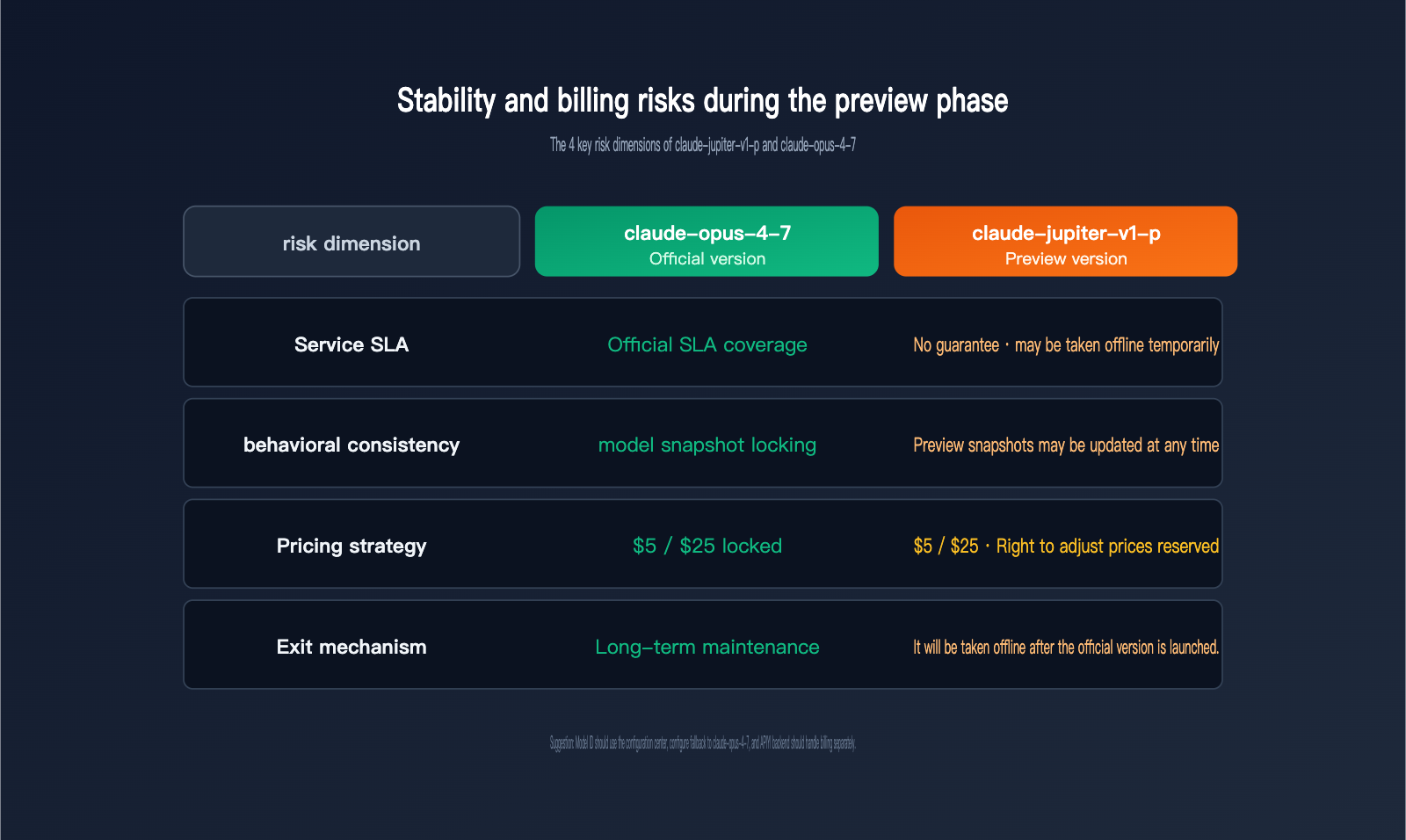
The core characteristic of a preview version is "capabilities are available, but no SLA is promised." This doesn't mean claude-jupiter-v1-p is unstable; it just means its stability will evolve alongside Anthropic's internal iteration cycle. Based on our experience with previous preview channels on APIYI, common fluctuations usually fall into three categories: occasional 5xx errors, latency jitters for the first token in long-context scenarios, and minor schema tightening in tool calls following small version updates.
The most effective way to handle this is to implement a "model fallback" layer in your client: if claude-jupiter-v1-p returns non-2xx responses consecutively, automatically fall back to claude-opus-4-7 for the same request and log the discrepancy. This type of fallback is a standard feature of APIYI’s (apiyi.com) multi-model routing and can be set up with just a few lines of code.
The table below outlines the risk differences between the preview and production versions to help you align expectations during internal reviews:
| Risk Dimension | claude-opus-4-7 (Production) |
claude-jupiter-v1-p (Preview) |
|---|---|---|
| Service Availability | Official SLA coverage | No SLA; may be taken offline |
| Behavioral Consistency | Locked model snapshot | Snapshot may update at any time |
| Error Code Semantics | Stable | New temporary error codes possible |
| Tool Calling | Long-term verified | Schema occasionally tightened |
| Pricing Strategy | $5 / $25 locked | $5 / $25, but subject to change |
| Exit Mechanism | Long-term maintenance | Deprecated after official release |
Regarding billing, the preview phase uses the same $5 / $25 per million tokens rate as claude-opus-4-7. APIYI (apiyi.com) tracks claude-jupiter-v1-p usage separately in the background, so you can split your bills by model ID in the usage dashboard to avoid confusion with production traffic. If Anthropic adjusts pricing for the official Opus 4.8 release, APIYI will provide at least one week's notice via our Help Center and dashboard announcements, giving you plenty of time to review your budget.
One final reminder: preview versions may be deprecated or redirected the moment the official version launches. Therefore, avoid hardcoding claude-jupiter-v1-p in long-running batch jobs. Instead, manage your model IDs via a configuration center so you can flip a switch to revert to claude-opus-4-7 instantly.
FAQ: Switching Between claude-jupiter-v1-p and claude-opus-4-7
Q1: Do claude-jupiter-v1-p and claude-opus-4-7 share the same API key?
Yes, the same APIYI API key can be used to invoke both models. Quotas, billing, and rate-limiting policies are managed centrally. We recommend adding a unique tag for Jupiter traffic in the APIYI (apiyi.com) dashboard to make usage breakdown and attribution analysis easier later on.
Q2: Will I be charged if a preview model invocation fails?
No. APIYI follows the official policy of not charging for failed requests. Requests resulting in 5xx errors, timeouts, or those actively rejected by the model (content filter) are not counted toward your token usage, so you can perform stress testing and baseline evaluations with peace of mind.
Q3: Can I use claude-jupiter-v1-p to run production agents?
Technically, yes, but neither we nor the official team recommends it. Preview versions can be updated or rolled back at any time, which can have a ripple effect on long-running agents that rely on behavioral consistency. Please continue to lock your production agents to claude-opus-4-7 and reserve Jupiter for evaluations and canary releases.
Q4: How will I know when claude-jupiter-v1-p is upgraded to the official version?
Once the official version is released, APIYI will launch the stable claude-jupiter-v1 channel (with the -p suffix removed). We will provide notifications via our Help Center, Webhook announcements, and dashboard banners. We recommend adding your notification email to your operations on-call list so you don't miss the transition window.
Q5: Is the native Anthropic protocol supported?
Yes. Simply change the base_url in the Anthropic SDK to the APIYI Anthropic-compatible endpoint and set the model to claude-jupiter-v1-p. All Tool Use, Memory, and Adaptive Thinking fields are passed through exactly as they are on the official site, so you won't have to worry about fields being rewritten or dropped.
Summary: Treat claude-jupiter-v1-p as an Early Access Gateway for the Opus Model
The positioning of claude-jupiter-v1-p is very clear: it serves as an early access gateway for developers to experience the Claude Opus 4.8 preview. Its capabilities can be treated as those of an Opus model, it is priced on par with claude-opus-4-7, and it requires almost zero code changes to implement. For teams looking to get a first look at the latest changes in Anthropic's flagship models, this is a low-cost opportunity to get ahead.
We recommend using claude-jupiter-v1-p for evaluations, canary releases, and PoC scenarios, while keeping critical business operations locked to claude-opus-4-7. You can use the model mapping and log archiving features on APIYI (apiyi.com) to prepare your rollback plans. Once the official claude-jupiter-v1 is live, you can switch over completely, allowing you to reap the benefits of the new capabilities while keeping volatility costs to a minimum.
📌 Author: This article was compiled by the APIYI (apiyi.com) technical team. For more guides on accessing and switching between Claude series models, please visit the APIYI Help Center.