A laptop powers on. The screen shows neither Windows nor a Linux distribution, but an operating system built from an empty folder by AI. On November 9, 2026, Anthropic revealed this internal experiment alongside the release of Claude Fable 5.2: Fable 5.2 coordinated more than 1,000 subagents that worked continuously for eight days to build an operating system prototype that could boot on a real laptop.
Core takeaway: Using the operating system experiment as its starting point, this article explains where Claude Fable 5.2’s real breakthrough lies, how to understand those 1,000 AI agents, and how far the prototype is from becoming a mature product. Finally, from a developer’s perspective, we’ll look at what infrastructure long-running agent workflows require from APIs.
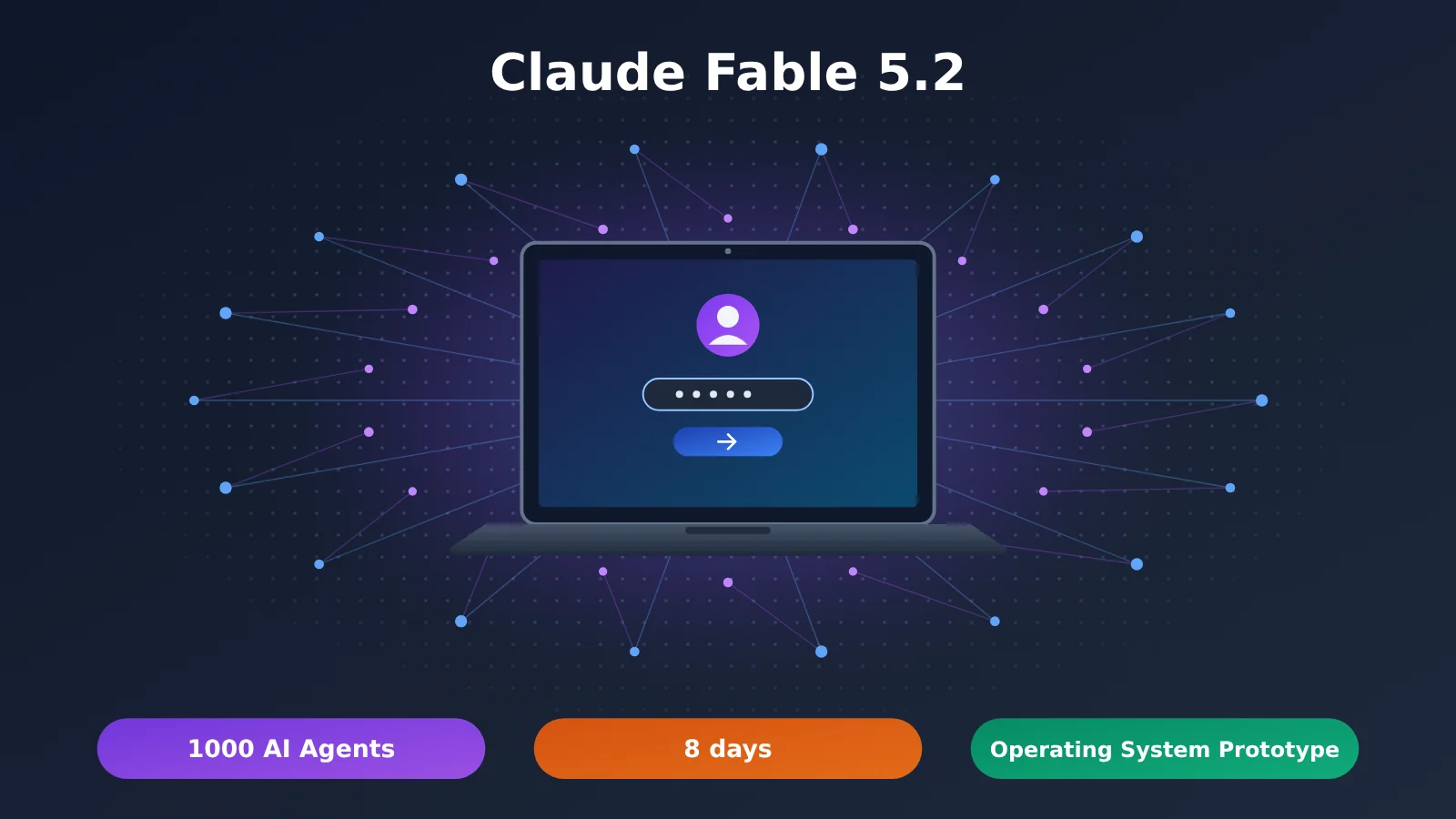
Key Facts About the Claude Fable 5.2 Operating System Experiment
First, let’s look at the facts Anthropic has explicitly disclosed. The table below includes only details confirmed in the announcement.
| Item | Details |
|---|---|
| Release date | November 9, 2026, disclosed alongside the release of Claude Fable 5.2 |
| Released by | Anthropic (internal engineering experiment) |
| Starting point | An engineer gave the task: design and implement an operating system prototype from an empty folder |
| Scale | More than 1,000 subagents, running continuously for eight days |
| Main activities | Writing code, testing components, reviewing code, and fixing issues |
| Final capabilities | Kernel, disk / keyboard / network drivers, persistent file storage, window system, login interface, installer, and built-in Claude features |
| Key validation | Successfully booted on a real laptop |
| Not yet disclosed | Source code and build process, architecture documentation, lines of code, agent communication architecture, token usage, experiment cost, compatibility testing across multiple hardware configurations, third-party security audit |
What Modules Did the Operating System Built by 1,000 AI Agents Include?
Here’s what some of the key modules do. The kernel is the core software that manages hardware and system resources. It schedules processes, allocates memory, and handles interrupts. Drivers let the operating system communicate with hardware such as disks, keyboards, and network cards. Without drivers, the kernel can’t “see” those peripherals.
Persistent file storage means data remains available after a reboot. The system needs a real file system, rather than just running a demo in memory.
The window system, login interface, and installer are the parts users can see. The installer is worth noting: it suggests the system completed the full process of “writing to disk, then booting from disk.”
Taken together, these modules help explain why “booting on a laptop” is a significant result. It means multiple subsystems are actually connected, rather than each producing a few snippets of code that merely look correct.
That brings us to the central question of this article: How did more than 1,000 agents work together to complete an entire engineering project?
Claude Fable 5.2’s Breakthrough: AI Starts Organizing Engineering Work
Fable 5.2 has made clear gains on programming benchmarks. Anthropic reported a score of 49.1% on FrontierCode 2.0, up from 32.4% for its predecessor, Fable 5.1. On FrontierSWE v2, it scored 69.9%, compared with 56.3% for the previous version.
These are general-purpose programming benchmarks, though—not results from the operating system experiment itself. What makes the experiment more noteworthy isn’t how well the code was written, but how the engineering work was organized.
The Difference Between Traditional AI Coding Assistants and Long-Running Agent Engineering
Traditional AI coding assistants follow a “question-and-answer” collaboration pattern: the user makes a request, the AI writes some code, and the user reviews it and asks for changes. The cycle repeats. In this setup, people handle task breakdown, progress management, and overall integration. The AI is simply a highly efficient executor.
Long-running Agent engineering hands more responsibility over to the model. The table below compares the two approaches:
| Dimension | Traditional AI Coding Assistant | Long-Running Agent Engineering |
|---|---|---|
| Task scope | A single function, file, or feature | A complete project, with subtasks broken down independently |
| Runtime | One conversation, from a few minutes to a few hours | Runs continuously for hours or days |
| Execution | Single-threaded, waiting for human feedback | Multiple sub-Agents work on different modules in parallel |
| Quality assurance | Relies mainly on manual review | Automated tests, cross-review, and fixes assigned when issues are found |
| Integration | Handled by people | A coordinator consolidates results and checks module compatibility |
| Human role | Directs each step | Sets goals, supervises the process, and gives final approval |
For a project like an operating system, the right-hand column is where the real challenge lies. The kernel, drivers, and file system have many interface agreements, and a change in one module can cause another module’s tests to fail.
The ability to keep working for eight days—finding issues, arranging fixes, and making progress on unfinished work—shows “project management” capabilities, not just the ability to “write code.”
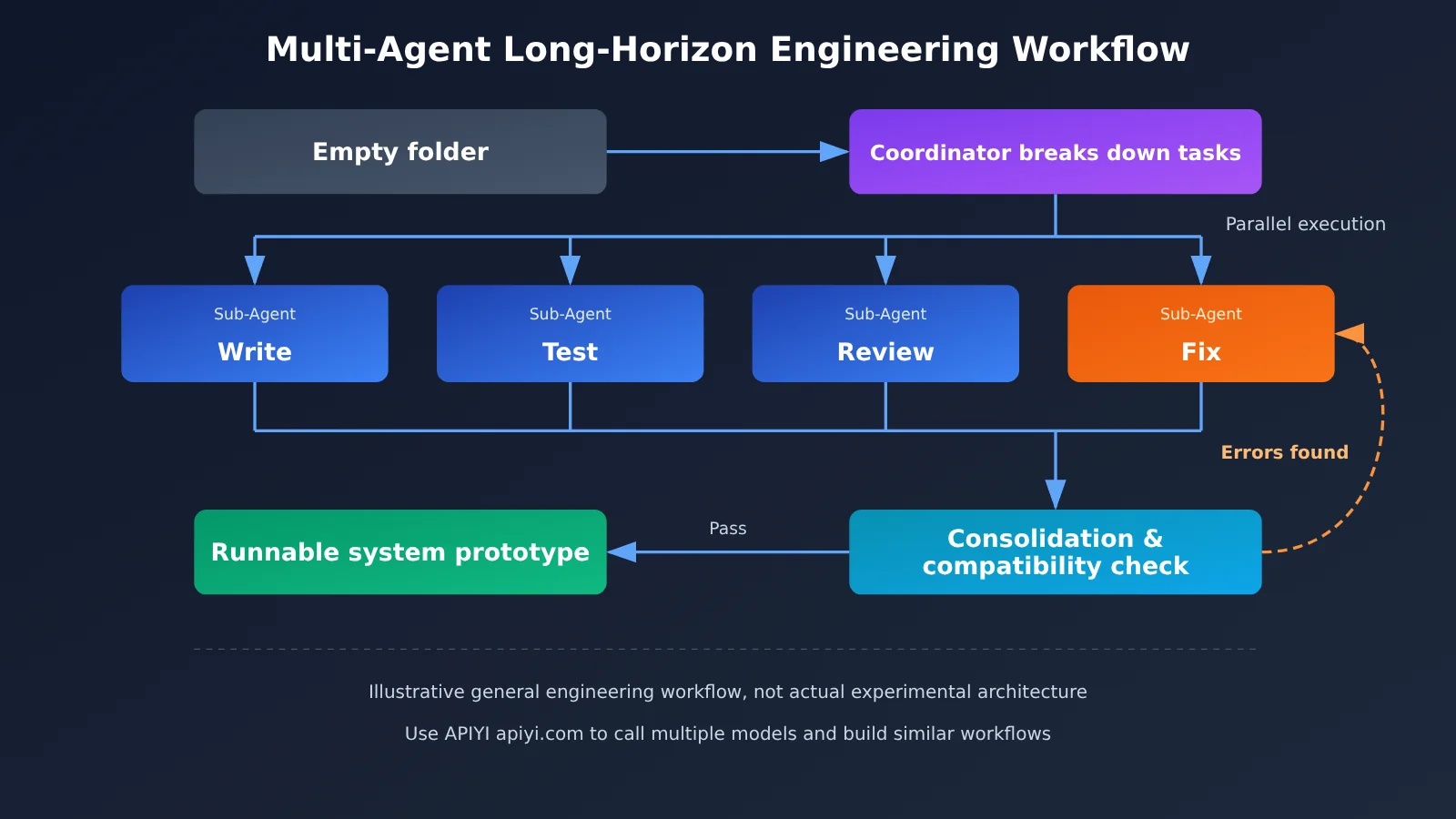
It’s worth noting that the diagram above is an analysis of a general workflow for large-scale engineering projects. Anthropic hasn’t disclosed the specific division of work, Harness, communication protocols, or programming language used in the operating system experiment.
A separate experiment around Fermat’s Last Theorem, disclosed around the same time, shared architectural details such as “1 Lead + 999 Helpers.” But that was a different experiment, and those details shouldn’t be assumed to apply to the operating system project.
The “Coordinator” Role Seen by Early Enterprise Testers
When Anthropic announced the release, it shared feedback from several early testing partners. These were real-world experiences from enterprise engineers, not results from independent blind tests, but they all point to the same trend: models are starting to take on planning and coordination work.
- Vercel: Joe Haddad (Member of Technical Staff) said that a project that had taken weeks to move forward with other models was completed in a matter of days with Fable 5.2 and passed the team’s review. Code reviewers also had fewer changes to request.
- Shopify: Tom Pritchard (Staff Engineer) said the model could take a fairly broad idea, shape it into a plan over a few rounds of discussion, and then carry out the remaining work on its own. The experience felt close to collaborating with another Staff-level engineer.
- Datadog: Matt Lee (Senior Staff Engineer) compared it to an Incident Commander. When faced with an unfamiliar system, it would call on faster models to gather information, then coordinate different tasks—reducing the coordination burden on human operators.
- Uber: Andrew Mager (Staff Engineer, Agentic Systems) described a security audit that ran continuously for 10–12 hours. The model dispatched around 170 review agents and ultimately delivered an audit report, Pull Requests with fixes, and a policy recommendation. He emphasized that the model kept working until the task was truly complete, rather than stopping at an intermediate result that merely seemed plausible.
Uber’s example is structurally closest to the operating system experiment: both involve one model dispatching a large number of subagents to complete a long-running task. However, the two were entirely independent projects.
Claude Fable 5.2 Is Already in Production
If all we had were operating system experiments, people might dismiss them as carefully staged demos. But two sets of internal data Anthropic disclosed alongside them show that these engineering capabilities are already being used in day-to-day software production.
The first figure is the share of code written by AI. Anthropic says Claude wrote more than 90% of the code changes ultimately merged into its core codebase, with human guidance. This figure refers to the share of merged changes written by Claude. It doesn’t mean that 90% of development work happens without human involvement, or that all of this code was written by Fable 5.2.
The second example is a production service migration. An agent team using an early version of Fable 5.2 migrated a critical production service from Python to Rust. The service became more efficient and reliable after the migration, and startup was about 26 times faster. Language migrations are a classic example of long-running work that requires repeated validation. Ensuring consistent behavior often involves more testing and debugging than translation itself.
These examples aren’t all the same kind of evidence, so the table below distinguishes them:
| Example | Nature | Source of evidence | What it shows | What it doesn’t show |
|---|---|---|---|---|
| Operating system prototype | Anthropic internal experiment | Official announcement and demo | The model can coordinate large-scale, multi-module engineering work over an extended period | That it has reached the level of a commercial operating system, or that a third party has reproduced it |
| 90% of merged code written by Claude | Internal production data | Official announcement | AI is deeply involved in day-to-day code production | That the code doesn’t need human review |
| Python → Rust migration | Internal production case | Official announcement | Agent-based engineering can be used to optimize real infrastructure | That it used the same approach as the operating system experiment |
| Feedback from Vercel / Shopify / Datadog / Uber | Early tester experiences | Quotes in the official announcement | Enterprise engineers have experienced the model’s coordination abilities in real work | That it can replace independent benchmarks |
Taken together, these examples show an expansion of engineering execution capabilities. That doesn’t mean every engineering project can run without supervision.
What Does 1,000 AI Agents Really Mean?
“1,000 Agents” is the most eye-catching number in this experiment—and the one most likely to be misinterpreted.
The Total Number of Agents Isn’t the Number Running at Once
First, Anthropic disclosed that “more than 1,000 subagents participated,” but didn’t say whether they all ran simultaneously. Over an eight-day period, subagents were likely created in batches, ended after completing their tasks, and were replaced by new agents.
Second, 1,000 Agents doesn’t mean 1,000 equally capable, fully independent engineers. Real-world efficiency depends on how much the work can be parallelized, coordination overhead, shared state, code conflicts, test coverage, and invocation costs.
Here’s a simple example: until the kernel’s memory management is settled, it’s hard to make real progress on the file system and drivers. Dependencies like these mean large engineering projects can’t be split into an unlimited number of parallel tasks.
Two Orchestration Modes in the Public Managed Agents Offering
Anthropic’s Managed Agents documentation for developers offers a window into productized multi-agent systems. It describes two orchestration modes.
Subagent mode: The main Agent can create subagents, each with its own Session Thread and context history. The main Agent can continue sending them follow-up tasks. A single Session can have up to 25 direct child threads open at once, and direct delegation supports only one level.
Dynamic Workflow mode: Designed for larger-scale tasks. The main Agent first writes a workflow program, which creates multiple Agents to run in parallel, consolidates results from each stage, and then uses those results to decide what to do next. If an Agent fails, the server will typically retry it once in a new thread. The official documentation lists these limits:
| Metric | Official limit |
|---|---|
| Threads running simultaneously in a single workflow | 64 (a configurable product limit; the official documentation doesn’t guarantee it will always reach this number) |
| Agents launched over a workflow’s lifetime | 1000 |
| Default workflow lifetime | 24 hours |
| Workflows open simultaneously per Session by default | 10 |
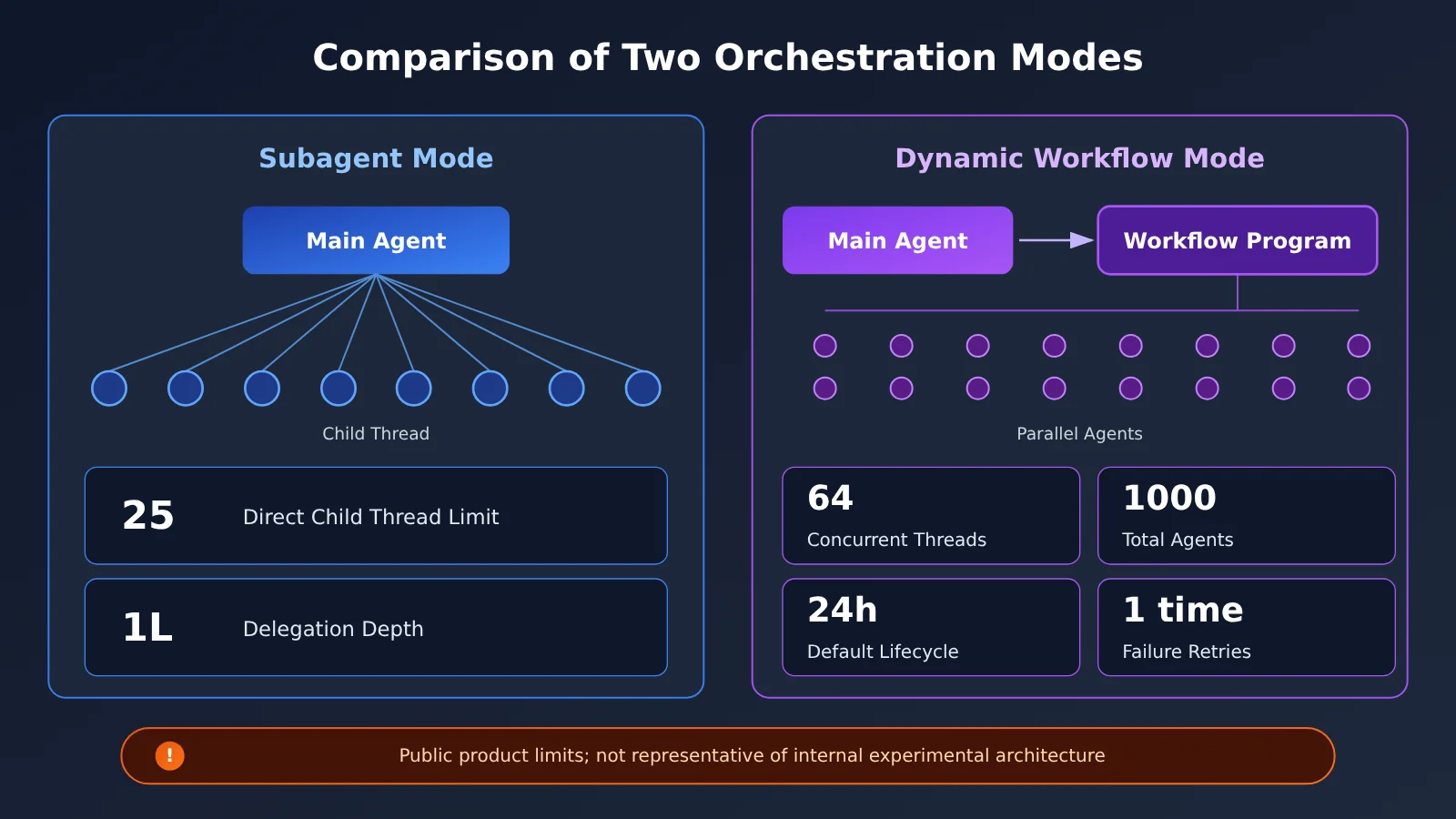
It’s important to emphasize that the operating system experiment was an internal engineering project at Anthropic, while Managed Agents is a public productized service. We can’t conclude that the experiment was carried out using Managed Agents, or apply its 64-thread concurrency limit to the experiment. But these figures do illustrate one thing: large-scale Agent orchestration takes more than just the models themselves. It also requires a scheduler, task-state management, concurrency controls, retry mechanisms, and a budgeting system. Behind the number “1,000,” the infrastructure is doing work that’s just as important as the models.
The Limits of the Claude Fable 5.2 Operating System Prototype
“Boots up” is a significant milestone, but there’s still a long way to go from there to “production-ready.” Mature operating systems like Windows, Linux, and macOS are backed by decades of hardware support, security hardening, and community maintenance.
| Engineering requirement | Bootable prototype (disclosed so far) | Mature commercial operating system |
|---|---|---|
| Hardware compatibility | Boots on one real laptop | Supports a wide range of chip, peripheral, and firmware combinations |
| Security | No independent third-party security audit has been reported | Ongoing vulnerability response, permission isolation, and patching mechanisms |
| Long-term reliability | No extended runtime testing has been disclosed | Proven through extensive use and long-term operation |
| System maintenance | Source code and build process haven’t been made public | Version control, release cycles, and long-term support |
| Code review | No public information on code size or architecture documentation | Reviewable code and comprehensive architecture documentation |
| Reproducibility | No independent third-party replication yet | Public, repeatable build process |
This table isn’t meant to diminish the experiment. It’s meant to clarify what it demonstrates. The experiment shows that a model can coordinate a multi-module software engineering project over an extended period and deliver a result in which the subsystems are genuinely integrated. It doesn’t prove that an AI-written operating system can directly replace existing products.
Human engineers still play a critical role in projects like this. People remain responsible for setting goals, making architectural trade-offs, defining security boundaries, and conducting final reviews. Anthropic’s own description is also measured: Claude wrote 90% of the merged code, but “with human guidance.”
A more measured conclusion is that AI has demonstrated the ability to coordinate complex software engineering projects—but that doesn’t mean mature software engineering teams no longer need people.
The Impact of Claude Fable 5.2 on Developers
Moving from Single Calls to Long-Running Agent Workflows
Most developers won’t be building an operating system anytime soon. But the workflows demonstrated by this experiment will gradually find their way into everyday projects, such as bulk code reviews, repository-wide refactoring, language migrations, and security audits.
In these situations, developers will focus less on “Was the answer to this call any good?” and more on a few engineering concerns:
- Task management: How should tasks be broken down? How do you track the status of each subtask, and can you resume from where you left off after a failure?
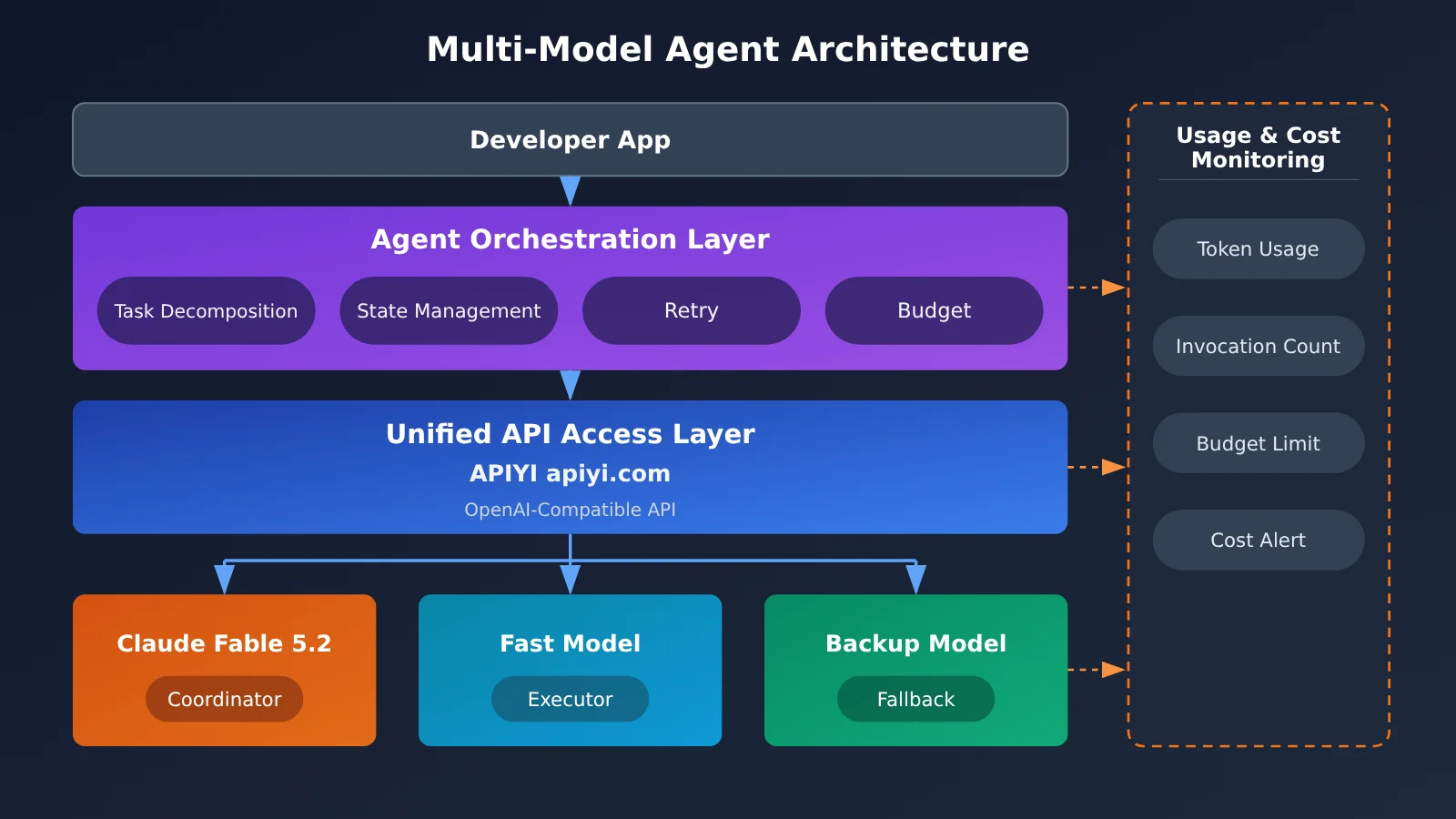
- Model specialization: In the Datadog case, Fable 5.2 calls on a “faster model” to gather information. Using a powerful model as the coordinator and faster or cheaper models as workers is a common cost structure.
- Call reliability: A workflow may involve hundreds or even thousands of calls. Even a low failure rate per call can lead to frequent interruptions when failures accumulate, so retries and failover are essential.
- Budget control: Fable 5.2’s published API pricing is $8 per million input tokens and $40 per million output tokens. Fast Mode costs twice as much. Anthropic hasn’t disclosed the actual cost of the operating system experiment, but it’s easy to see why the cost of long-running, multi-agent tasks needs to be monitored continuously.
- Task monitoring: You need to know what each agent is doing, how much it’s using, and where it’s getting stuck.
On the same day, Vercel announced that AI Gateway now supports Fable 5.2, with provider failover, fallback models, usage and cost analytics, budgets, and retry rules. This is another sign that the infrastructure for model calls in complex agent applications is taking shape.
How to Call Claude Fable 5.2 Through an OpenAI-Compatible API
The official API Model ID for Fable 5.2 is claude-fable-5-2. It supports a 1M-token context window and a maximum output of 128K tokens. Here’s the simplest way to call it through an OpenAI-compatible API. (Use the model name shown in your platform’s model list.)
import openai

client = openai.OpenAI(
    api_key="YOUR_API_KEY",
    base_url="https://api.apiyi.com/v1"  # APIYI unified API
)

resp = client.chat.completions.create(
    model="claude-fable-5-2",
    messages=[{"role": "user", "content": "把这个 Python 模块的迁移计划拆成可并行的子任务"}]
)
print(resp.choices[0].message.content)
View the complete example: coordinator + parallel workers + retry and budget controls
Here’s a simplified example of a coordinator that breaks work into tasks and workers that process them in parallel. It includes retries for failed tasks and rough token budget controls. This is meant to illustrate general engineering patterns; it isn’t the actual implementation used in Anthropic’s operating systems experiment.
import json
import openai
from concurrent.futures import ThreadPoolExecutor, as_completed

client = openai.OpenAI(
    api_key="YOUR_API_KEY",
    base_url="https://api.apiyi.com/v1"  # APIYI unified API; switch between providers
)

PLANNER_MODEL = "claude-fable-5-2"   # Coordinator: breaks down tasks and summarizes results
WORKER_MODEL = "gpt-4o-mini"         # Worker: replace with the fast model you actually use
TOKEN_BUDGET = 200_000               # Token budget for the entire workflow
MAX_WORKERS = 8                      # Maximum concurrency; adjust as needed
used_tokens = 0


def chat(model, prompt, max_tokens=2000):
    global used_tokens
    if used_tokens >= TOKEN_BUDGET:
        raise RuntimeError("超出预算,停止派发新任务")
    resp = client.chat.completions.create(
        model=model,
        messages=[{"role": "user", "content": prompt}],
        max_tokens=max_tokens,
    )
    used_tokens += resp.usage.total_tokens
    return resp.choices[0].message.content


def plan(goal):
    prompt = (
        f"目标:{goal}\n"
        "请拆成 3-6 个可以独立完成的子任务,"
        '只输出 JSON 数组,格式为 [{"id": 1, "task": "..."}]'
    )
    return json.loads(chat(PLANNER_MODEL, prompt))


def run_task(item, retries=1):
    for attempt in range(retries + 1):
        try:
            return item["id"], chat(WORKER_MODEL, item["task"])
        except Exception as e:
            if attempt == retries:
                return item["id"], f"失败:{e}"


def workflow(goal):
    tasks = plan(goal)
    results = {}
    with ThreadPoolExecutor(max_workers=MAX_WORKERS) as pool:
        futures = [pool.submit(run_task, t) for t in tasks]
        for f in as_completed(futures):
            tid, out = f.result()
            results[tid] = out
    summary_prompt = "汇总以下子任务结果,检查相互之间是否冲突:\n" + json.dumps(
        results, ensure_ascii=False
    )
    return chat(PLANNER_MODEL, summary_prompt, max_tokens=4000)


if __name__ == "__main__":
    print(workflow("为一个小型 Web 服务设计从 Python 迁移到 Rust 的方案"))
    print(f"累计消耗 Token:{used_tokens}")
🚀 Quick-start tip: In multi-model Agent workflows, the coordinator and workers often come from different providers. With APIYI at apiyi.com, you can use a single API key to call popular models from Claude, OpenAI, Gemini, and others. Pay-as-you-go pricing and free testing credits for new users make it easy to validate your orchestration logic and costs with a small-scale task first.
Frequently Asked Questions
Q1: What did Claude Fable 5.2 actually accomplish in its operating system experiment?
According to Anthropic, Fable 5.2 started with an empty folder and coordinated more than 1,000 subagents working continuously for eight days to build an operating system prototype that boots on a real laptop. It includes a kernel, disk, keyboard, and network drivers, persistent file storage, a window system, a login screen, an installer, and built-in Claude features.
Q2: Were all 1,000 AI agents running at the same time?
Anthropic hasn’t disclosed that. “More than 1,000 subagents participated” doesn’t mean that 1,000 agents ran simultaneously throughout the entire experiment, or that they were equivalent to 1,000 independent engineers. The published concurrency limit for a single Managed Agents workflow is 64 threads, with up to 1,000 agents launched over its lifetime. But that’s a product limit and shouldn’t be assumed to apply to the internal experiment.
Q3: Can this AI-built operating system replace Windows or Linux?
No. Anthropic describes it as a “working prototype.” There’s no public source code, architecture documentation, testing across multiple hardware configurations, or third-party security audit. It also hasn’t been independently reproduced. The experiment demonstrates AI’s ability to organize complex engineering work, not that the system is a mature product.
Q4: What are Claude Fable 5.2’s API prices and specifications?
The public list price is $8 per million input tokens and $40 per million output tokens, 20% less than Fable 5.1’s standard mode. Fast Mode costs twice as much and offers output speeds up to 2.5 times faster than standard mode. The context window is 1M tokens, the maximum output is 128K tokens, and Batch API requests get a 50% discount on both input and output. These are public list prices, not the actual cost of the operating system experiment.
Q5: How can developers quickly use the Claude Fable 5.2 API for agent experiments?
Start by testing your orchestration logic with a small task:
1. Sign up at APIYI, apiyi.com, and get an API key and free testing credits.
2. Set `base_url` in the example in this article to `https://api.apiyi.com/v1`. Check the console for the current model name.
3. First, get a minimal “break down tasks → execute in parallel → summarize” workflow running, then gradually add retries and budget controls.
Q6: Where do long-running multi-agent workflows most often run into trouble?
Issues tend to fall into three areas. First, costs can spiral as the number of agents drives up the number of calls, so you need to set a budget cap. Second, failures can compound: occasional errors in individual calls can have a bigger impact across a long workflow, so retries and fallback models are important. Third, coordination overhead can become a problem. If task dependencies aren’t clear, parallel execution can lead to code conflicts. Using APIYI, apiyi.com, to access multiple model providers through one service makes it easier to configure fallback models and monitor usage in one place.
Claude Fable 5.2 and 1,000 AI Agents: Key Takeaways
- What the experiment showed: More than 1,000 subagents worked for 8 days to build a bootable operating system prototype from an empty folder.
- The real breakthrough: Models are starting to handle task breakdown, parallel execution, ongoing fixes, and result integration.
- A production signal: Claude writes more than 90% of the code merged at Anthropic, and a migration to Rust delivered roughly 26× faster startup.
- A caveat about the numbers: 1,000 agents doesn’t mean 1,000 independent engineers working in parallel from start to finish.
- A caveat about the prototype: Without third-party audits and replication, it’s still a long way from a mature commercial operating system.
- What developers should focus on: Scheduling, retries, budgets, and monitoring matter just as much as model capabilities. You can use APIYI at apiyi.com to connect to multiple models through a unified interface.
Summary
The headline that 1,000 AI agents built an operating system in 8 days is less important than these three takeaways:
- The nature of the capability has changed: Claude Fable 5.2 demonstrates the ability to organize engineering work, not just generate code.
- Evaluate the evidence in context: The operating system experiment, internal production data, and early enterprise feedback are different kinds of evidence and should be assessed separately.
- People still have the final say: The prototype can boot, but human engineers are still responsible for architectural trade-offs, security, and acceptance.
For developers, the next step is to move from “one-off calls” to “long-running workflows” and think ahead about how to divide work across models, keep calls reliable, and control costs. APIYI at apiyi.com lets you connect to leading models through a single API key. Start by testing small-scale agent tasks.
📚 References
- Anthropic’s official announcement: Claude Fable 5.2 and Mythos 5.2 (2026-11-09)
- Link:
anthropic.com/claude-fable-and-mythos-5-2 -
About: A primary source for operating system experiments, internal production data, and enterprise feedback
-
Claude Platform model specifications: Fable 5.2 Overview
- Link:
platform.claude.com/docs/en/models/fable-5-2/overview -
About: Specifications including the context window, maximum output, and Model ID
-
Managed Agents multi-agent orchestration documentation: Subagents and Dynamic Workflows
- Link:
platform.claude.com/docs/en/managed-agents/multiagent-orchestration -
About: Public product limits for concurrent threads, agent counts, and lifecycles
-
Vercel AI Gateway integration announcement: Claude Fable 5.2 now available on AI Gateway
- Link:
vercel.com/changelog/claude-fable-5-2-now-available-on-ai-gateway -
About: Failover, budget, and retry capabilities offered by a third-party API gateway
-
The Verge’s report: Anthropic launches new Claude Fable and Mythos 5.2 models
- Link:
theverge.com/ai-artificial-intelligence/1030005/anthropic-claude-fable-mythos-5-2 - About: Third-party media coverage of the launch
Author: APIYI Technical Team
Technical inquiries: Feel free to contact us via the APIYI homepage. For more integration resources, visit the docs center at docs.apiyi.com.