
Author’s note: Anthropic released the Claude Duet research preview on October 21, 2026. This article explains what it can do, where its safety boundaries lie, who can use it, how usage limits work, and how developers in China can call the Claude Opus 5.5 model behind it.
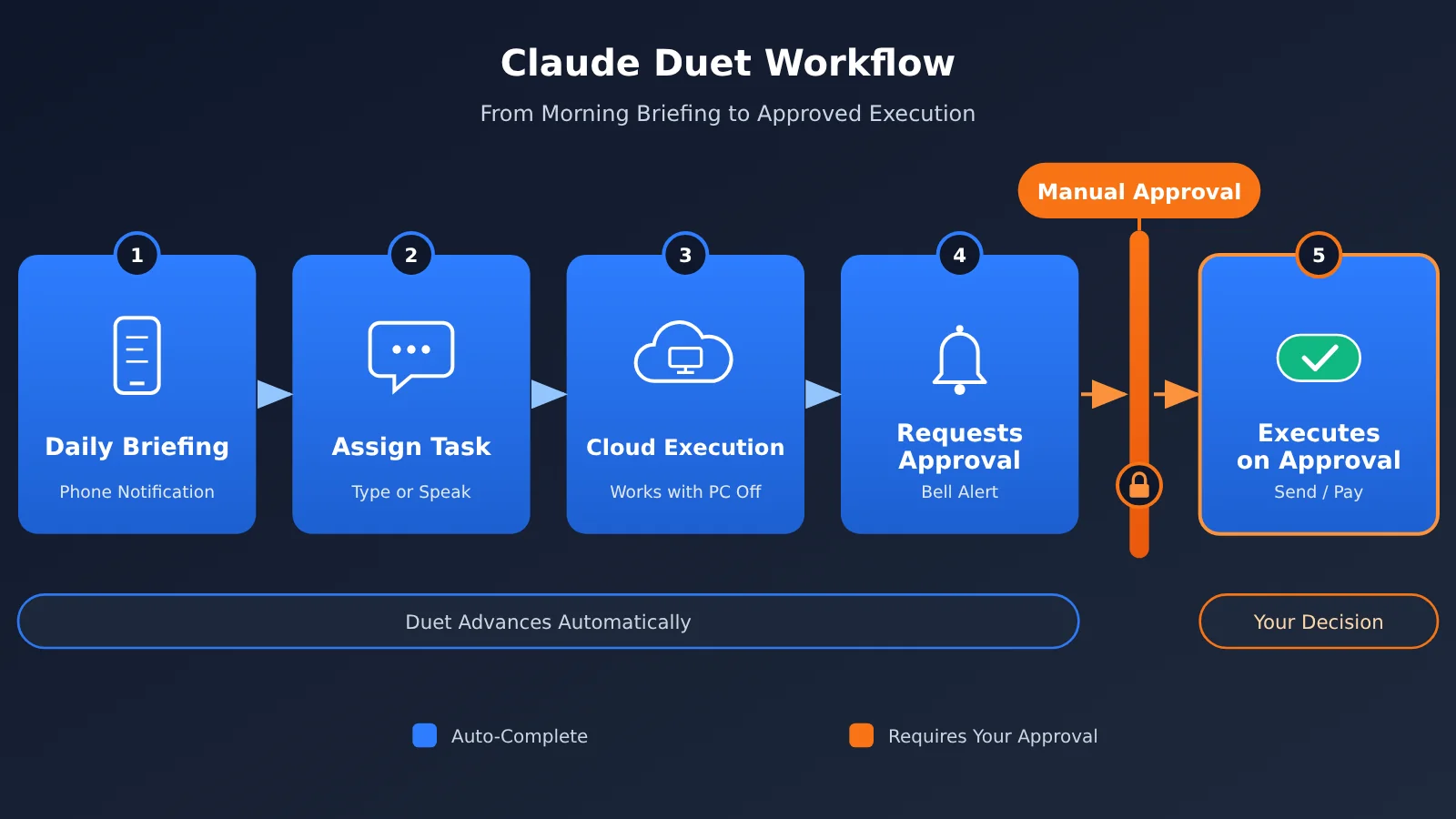
According to media reports, the official demo video opens like this: At 8 a.m., a push notification pops up on Nicole’s phone, reminding her—the owner of a small business—that she has three things to take care of today: a health permit, a hiring decision, and a Northfield renewal. When she taps the notification, the permit application, interview invitation, and proposed response to the renewal contract are all ready to go. They’re just waiting for her approval.
That’s Claude Duet, released by Anthropic on October 21, 2026 as a research preview. It’s a standalone app powered by Claude Opus 5.5. It proactively sends you a morning briefing, keeps working in the cloud after you close your computer, and always asks before sending messages or making payments.
This isn’t just a rumor: Anthropic’s official announcement, product page, and help center all published information about the launch, and CNBC covered it that same day.
What you’ll learn: In 3 minutes, get up to speed on what Claude Duet is, what tasks it can handle, where its safety boundaries lie, who can use it and what it costs—and what developers in China can do with it today.

What Is Claude Duet, and How Is It Different from Regular Claude?
When you use Claude normally, you open a conversation, ask a question, and get an answer. You work together to get things done. Claude Duet works the other way around. Anthropic describes it as a “proactive agent”: it brings things that need your attention to you, takes on tasks you assign, keeps working after you leave, and asks before taking action on your behalf.
Anthropic sums up its key selling point as “judgment.” Built around Claude Opus 5.5, Duet is designed to judge what needs your attention, what can wait, and when it should ask you first. Every morning, it sends a brief daily update. During the day, it keeps an eye on the apps you’ve connected and only messages you when something needs your attention.
According to media reports, Mike Krieger, Instagram’s co-founder and now part of Anthropic Labs, has also shared his experience. On a Friday afternoon, Duet asked if there was anything he wanted it to keep an eye on over the weekend. He asked it to monitor Slack and only contact him if something was urgent. Duet ended up contacting him just once, on Saturday afternoon.
Key Differences Between Claude Duet and the Claude App
| Comparison | Claude App | Claude Duet |
|---|---|---|
| Who starts the conversation | Waits for you to open a chat | Reaches out proactively and sends a morning update every day |
| How you work together | You work on things together | You send a message with a task, and it handles the rest |
| Where it works | In your conversation | In its own cloud-based virtual machine and browser |
| When you’re away | Doesn’t keep working on its own | Keeps working even if you turn off your computer or lock your phone |
| When it contacts you | Replies when you message it | When a task is done or it needs your approval |
| Model used | Depends on your selection in Claude | Claude Opus 5.5 |
| How to access it | The main Claude app | A standalone app for iOS and Android; on a computer, open it at claude.ai |
There’s another convenient feature: Duet inherits the memories, skills, and connected apps from your Claude account, so there’s almost nothing to set up again. You can communicate by text or voice in a single ongoing conversation thread, or open separate channels for different topics. They all share the same memory.
What Claude Duet Can Handle: From Daily Briefings to Payments
Its official positioning is clear: Claude Duet is built for professionals and small business owners with more on their plates than they can keep track of. That means its capabilities center on work. Anthropic acknowledges that it’s not as good at personal errands like booking tickets.
For everyday tasks, it can put together a daily briefing, flag items in your inbox and calendar that need attention, and draft replies for you to approve. For business tasks, it can find unpaid invoices and draft payment reminders, prepare payroll for your review, and get contracts ready to send. Bigger projects come back as files—such as research briefs, financial models, slide decks, and dashboards—organized in the Make tab.
Claude Duet’s Connectors and Payment Capabilities
Anthropic says Duet can use more than 6,000 connectors and plugins in the Claude Marketplace. The help center lists supported connectors including Gmail, Google Calendar, Google Drive, Slack, QuickBooks, HubSpot, DocuSign, and Calendly. For websites without a connector, Duet uses its own cloud browser.
For payments, Duet connects to Stripe’s digital wallet Link and Shopify’s Shop Pay. It asks you before each purchase and uses a single-use card that’s valid only for that transaction, so your real card number stays private. Anthropic also says Duet will soon be able to log in to websites, with your permission, using credentials saved in 1Password.
| What you say | What Duet does | When it needs your approval |
|---|---|---|
| “Clear out anything in my inbox I don’t need to read” | Sorts your email and identifies what can be cleared | Before deleting anything |
| “Find unpaid invoices in Stripe and draft payment reminders” | Checks invoices and drafts a reminder for each one | Before sending the emails |
| “Put together a briefing on this company before my 2 p.m. meeting” | Researches the company and creates a briefing file | It delivers the file; approval usually isn’t needed |
| “Prepare this month’s payroll” | Prepares payroll in Gusto | Before running payroll |
| “Send this contract to them for signature” | Prepares the contract in DocuSign | Before sending it for review and signature |
| “Write a job post and publish it on LinkedIn” | Drafts the job post | It publishes only after you edit and approve it |
| “Buy a few samples for the store” | Confirms the items with you and checks out using Link or Shop Pay | Duet confirms first, then Link asks you to approve the payment |
| “Pull the latest data and build a sales dashboard” | Combines data from multiple apps to create a dashboard | Approval usually isn’t needed; it notifies you when it’s done |
According to media reports about Nicole’s demo, Duet asked at the end of a daily briefing whether she wanted a sales dashboard. She replied, “Do it,” and Duet pulled together data from the point-of-sale system, online store, customer management system, payroll, and bank accounts. After that, it refreshed the dashboard automatically each day before the briefing. The demo also showed a $410,000 renewal contract that Duet suggested holding off on until Monday.
Claude Duet’s Safety Boundaries: What It Can Do on Its Own and What It’ll Ask You About
An agent that can send emails and make payments on your behalf naturally raises one big concern: “What if it does something it shouldn’t?” The official answer is three layers of boundaries, backed by a comprehensive set of safety measures.
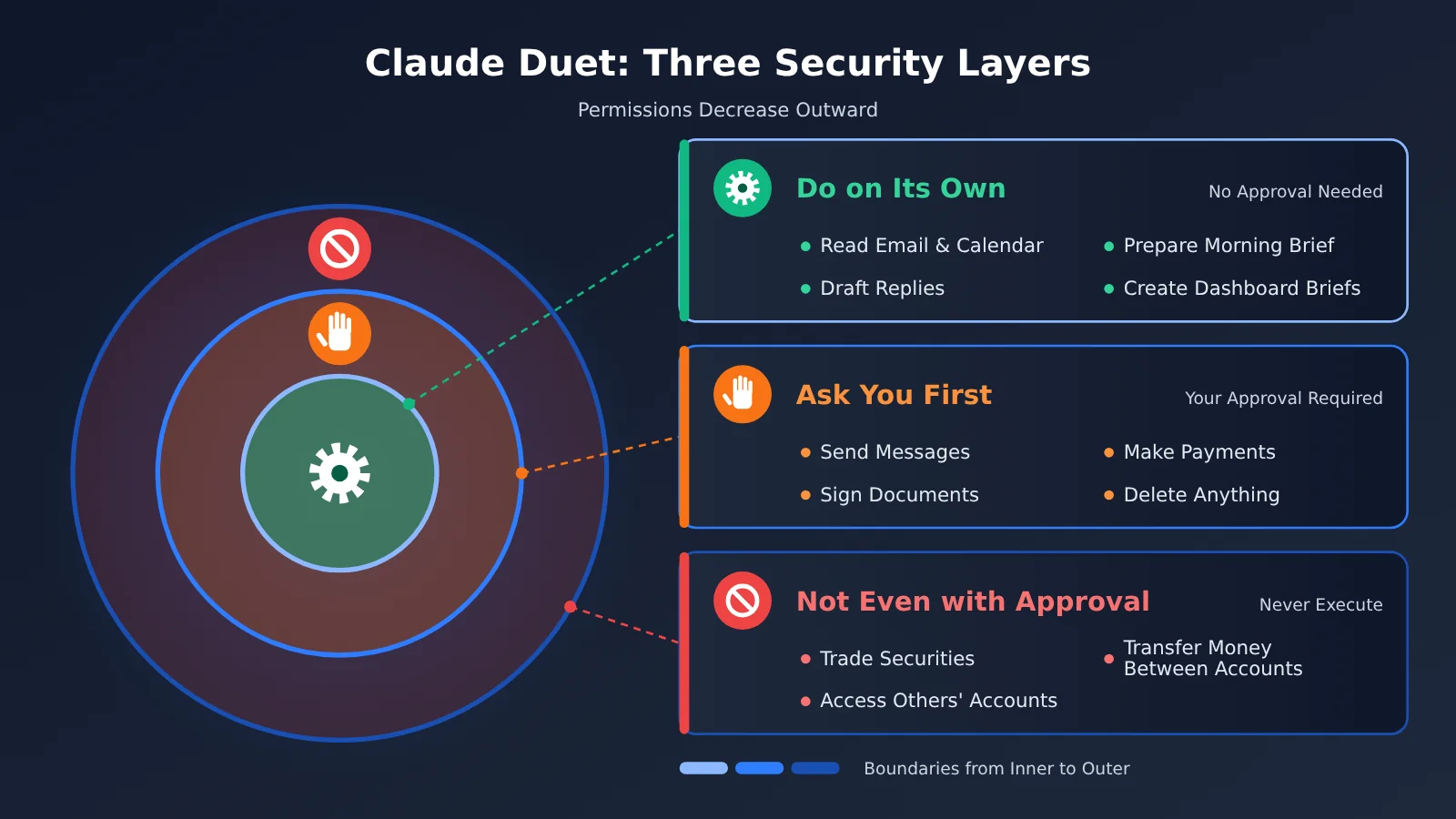
| Do it on its own | Ask you first | Won’t do it, even with your approval |
|---|---|---|
| Check connected accounts and prepare a morning briefing | Send messages (including emails from connected accounts) | Buy or sell securities |
| Draft replies and payment reminder emails | Make payments | Transfer money between accounts |
| Research, create briefs, presentations, dashboards, and financial models | Sign documents | Access someone else’s account |
| Look up information using a cloud browser | Delete anything | Make phone calls or text other people |
Note: The Help Center says Duet doesn’t offer the ability to “make phone calls or text other people.”
Claude Duet’s Safety Measures
- It can’t see your passwords: Credential handling follows the design used by Claude Managed Agents. Anthropic says Duet never directly sees your password or login token. If a website asks for a password, you enter it in a separate form on your device. It goes straight to the browser and never enters the conversation.
- Actions are reviewed by a classifier: An auto mode classifier approves actions, using the same mechanism that helps keep Claude and Claude Code from doing things you didn’t ask them to do.
- Protection against prompt injection: Duet reads emails and webpages written by other people, which could contain misleading instructions. Anthropic says it’s designed to treat what it reads as information and act only on your instructions. But it also acknowledges that there’s no perfect defense—that’s one reason important actions require your approval.
- Protection against sensitive information leaks: A dedicated classifier checks messages one by one. It won’t share the most sensitive information, such as credit card numbers or government ID numbers. Information about your health or personal finances is shared only when you explicitly instruct it to do so.
- Adversarial testing: Anthropic says it conducted red-team tests and penetration tests with external firms, and included the product in HackerOne’s public bug bounty program.
Limitations Claude Duet Acknowledges
Anthropic doesn’t shy away from the issues and lists several limitations of the early version:
- It may misread a conversation or misjudge how urgent something is.
- It checks accounts at set intervals, so urgent messages that arrive between checks may be missed.
- You can’t yet see what it’s doing in the browser or take over.
- Its core capabilities are built around work, so it’s less suited to personal tasks like booking tickets.
- Some connectors, such as Slack, have limitations in Duet, and Microsoft 365 isn’t available yet.
- It’s currently a standalone app, separate from the main Claude app.
Who Can Use Claude Duet, How Much It Costs, and How Usage Limits Work
The short version: For now, only Claude Pro and Max subscribers in the U.S. can join the waitlist. Duet is included at no extra cost during the research preview, but it uses your plan’s usage limits.
| Item | Current status (per official information) |
|---|---|
| Region | U.S. Claude accounts only |
| Plan | Pro or Max |
| How to get access | Join the waitlist; invitations are rolling out in batches, with no guaranteed date |
| Account requirements | The email on the waitlist must match the email for your Claude account and the Apple or Google account on your phone |
| Team / Enterprise | Not included for now; support will be added later |
| Price | Included with Pro and Max during the research preview, at no extra cost |
| Usage limits | Shares the 5-hour and weekly limits with other Claude features |
| Background tasks | Background checks, such as morning briefings and routine inspections, also count toward your limits |
| Access bonus | You’ll get a one-time full usage reset when you’re approved, valid through 2026-11-30 |
Usage limits deserve a little more explanation. According to Anthropic, Duet checks connected accounts every few hours because checking constantly would use up your limits faster. You can also tell it what you want to hear about and how often. Large tasks like financial models and slide decks require more model invocations and background work, so they’ll use up your limits faster.
What Claude Duet Means for Developers in China
Duet’s core “judgment” comes from Claude Opus 5.5, and developers in China can already access the model on a pay-as-you-go basis through APIYI at apiyi.com. You can connect it to agent tools like Claude Code and build your own workflows for things like compiling morning briefings, monitoring tasks, and drafting replies. Notably, Elon Musk’s Grok Bot also uses Opus 5.5—needless to say, that speaks volumes about the model’s standing!
Current Pricing for Claude Opus 5.5 and Other Models
| Model | Input (per million tokens) | Output (per million tokens) | Cache reads (per million tokens) | Recommended use |
|---|---|---|---|---|
| claude-opus-5-5 | $4 | $20 | $0.20 | Critical decisions, complex task planning |
| claude-sonnet-5-5 | $2 | $10 | $0.10 | Drafting replies, organizing summaries |
| claude-haiku-5-5 | $0.10 | $0.50 | $0.01 | High-frequency triage, preliminary checks |
These are the prices listed by APIYI on 2026-10-22. Check the platform for any updates.
Three Tips for Building Your Own Claude Opus 5.5 Agent
Background agent monitoring can use a lot of tokens. Even Duet’s official service only checks in every few hours. The same principle applies when you build your own agent:
- Limit how often it checks in: Don’t poll every minute. Set intervals based on your needs—a daily check is enough for a morning briefing.
- Use different models for different tasks: Let Haiku handle routine triage and initial checks, use Sonnet for drafting and organizing, and save Opus for critical decisions.
- Add an approval step: Before sending emails, making payments, or deleting data, make sure your workflow requires human confirmation. This is one of the most valuable parts of Duet’s safety design to adopt.
To connect, set the endpoint to https://api.apiyi.com (Anthropic-protocol clients like Claude Code don’t need /v1) and the model name to claude-opus-5-5. This article doesn’t cover the specific API key setup steps; see this guide for setup instructions.
Frequently Asked Questions
Q1: Does Claude Duet cost extra?
It’s included with Pro and Max at no additional cost during the research preview. However, it shares the five-hour and weekly usage limits with Claude’s other features. Morning briefings and routine checks count toward those limits too, so you may hit them faster than if you only use Claude for chat.
Q2: Can I choose a model in Claude Duet?
No. The help center explicitly says that Duet runs on Claude Opus 5.5, which decides how much effort to put into each task.
Q3: If I call Opus 5.5 through the API, can I use Duet directly?
No, they’re not the same thing. The API gives you access to the model’s capabilities, but it doesn’t include Duet’s app, connectors, or approval interface. If you want to build a similar workflow for morning briefings or task monitoring, you can make pay-as-you-go calls to claude-opus-5-5 through APIYI and pair them with tools like Claude Code.
Summary
Claude Duet is Anthropic’s take on the personal agent market. Its approach is straightforward:
- Proactive but restrained: It sends a morning briefing each day and stays quiet otherwise, reaching out only when it’s finished or needs your approval.
- Works in the cloud: It has its own virtual machine and browser, so it keeps working even when your computer is off.
- You approve important actions: It asks before sending messages, making payments, signing documents, or deleting anything. It also won’t approve trades, transfers, or access to someone else’s account.
- Not easy to access: It’s limited to US Pro and Max users on the waitlist, shares the plan’s usage limits, and isn’t currently included with Team or Enterprise.
In the broader industry, CNBC reported that Meta’s Muse launched last month, and Zuckerberg said more than 10 million people in the US and Canada had set it up within a month and a half. OpenAI launched dots on September 29. Duet has chosen a path that’s “designed primarily for work,” making it a better fit for professionals and small business owners.
Developers in China can’t use Duet for now, but the Opus 5.5 model behind it is already available through APIYI at apiyi.com. Apply these three lessons—“infrequent checks, tiered models, and human approval”—and you can build your own lightweight version of Duet.
Sources (plain text):
- Anthropic announcement: claude.com/resources/articles/claude-duet
- Claude Duet product page: claude.com/product/claude-duet
- Official Help Center: support.claude.com, “Get started with Claude Duet”
- CNBC report, October 21, 2026
Author: APIYI Technical Team
Technical support: If you have questions about integration or usage, contact us from the homepage of the APIYI website.