
Author’s note: From the character’s birth, the relay of fan-created works, and the image controversy, to AI Agents entering Bilibili comment sections as “Big Fat Fish,” this article lays out the complete timeline, data, and product-culture takeaways behind the DeepSeek Whale Girl phenomenon.
In late October 2026, a batch of accounts with similar avatars and similar tones started showing up in the comment sections of Bilibili’s tech zone. They called themselves “this whale,” gave work reports, talked about Tokens, and even replied to each other. This is what netizens dubbed the “fish plague.” The star of the show is DeepSeek’s community fan-created character “Blue Big Fat Fish” Whale Girl, and what’s driving these accounts is user-configured AI Agents.
This isn’t just sensational gossip. Media outlets like ifanr APPSO, BB姬, and San Yi Sheng Huo have all covered it, and the GitHub version history of the relevant open-source plugins can be publicly verified. This article sorts the story out in layers: “official info, creator statements, community rumors, and analytical viewpoints.”
Core value: Get up to speed in a few minutes on who “Big Fat Fish” is, why it went viral, where the controversy is concentrated, and what boundaries developers should be aware of once AI Agents enter public spaces.

Big Fat Fish: Core Info at a Glance
Let’s start with a table to get the basic facts about “Big Fat Fish” straight. The info here comes from the creator’s original statements, open-source repositories, and cross-checked media reports, as of October 29, 2026.
| Item | Details |
|---|---|
| Character names | Big Fat Fish, Blue Big Fat Fish, Whale Girl, DeepSeek-chan (community nicknames; usage varies slightly by context) |
| Character type | An unofficial anthropomorphic character created by the community; DeepSeek has not officially announced it as an official mascot |
| Main visual design | Long blue gradient hair, blue eyes, cetacean ear-fins, a whale tail, and a dark blue-and-white maid outfit; in chibi form, a big head and a small body |
| Creation chain | Shangshan Wuxing created the prototype “Mingyue” → ZipZipPipe added DeepSeek elements → multiple creators helped spread the chibi and animated versions |
| Community persona | Loves eating plain rice for free, only works when given tokens, loves slacking off, talks tough, and occasionally acts silly |
| Latest development | Users have used DeepSeek Harness and community plugins to let an Agent browse and comment on Bilibili videos as Big Fat Fish |
| Scope of impact | AI product culture, fan-work licensing, AI-generated content labeling, and community comment moderation |
The Name “Big Fat Fish” and the Character Setup
The nickname “Big Fat Fish” is widely said in the community to have come from an image-recognition mix-up: a user asked DeepSeek to identify their blue whale logo, and the model initially described it as a “blue big fat fish.” The story has been reposted by multiple media outlets, but the full original conversation, the date it was first posted, and the original account still can’t be verified—so it shouldn’t be treated as an officially confirmed technical glitch.
The character’s personality is likewise something the community built up together. Memes like “the blue big fat fish who eats plain rice for free,” “this whale,” “asking for tokens,” and “going home to eat plain rice” are all the result of different users and creators constantly adding to and rewriting them. There’s no single official character bible. Understanding this is the key to making sense of all the controversies that follow.
The Birth of Big Fat Fish: A Relay Creation Story
Many reports credit the whale girl to a single artist, and that’s not quite accurate. Based on public information, the mainstream female version of the character has a fairly clear relay chain behind it.
In June 2025, Bilibili creator Shanshan Wuxing used generative AI to create an original character called “Mingyue.” She had long blue hair, blue eyes, and whale-like head fins and a tail. Originally, she was a standalone OC (original character), not something designed specifically for DeepSeek. In April 2026, another creator, ZipZipPipe, built on Mingyue by blending in DeepSeek’s blue whale elements—adding a dark blue and white maid outfit and logo elements—to form a more complete product personification design.
One interesting detail: SanYi Life reported that the character images at this stage were made with GPT Image 2. In other words, the most popular DeepSeek personification has OpenAI’s image tools behind it. Starting in July 2026, creator “This Knife Is Really Sweet” produced a two-head-tall chibi animation. The video DeepSeek Welcomes a New Member, released on July 10, explicitly thanked ZipZipPipe in its description for opening up creative resources, and some later videos credited both Shanshan Wuxing and ZipZipPipe.
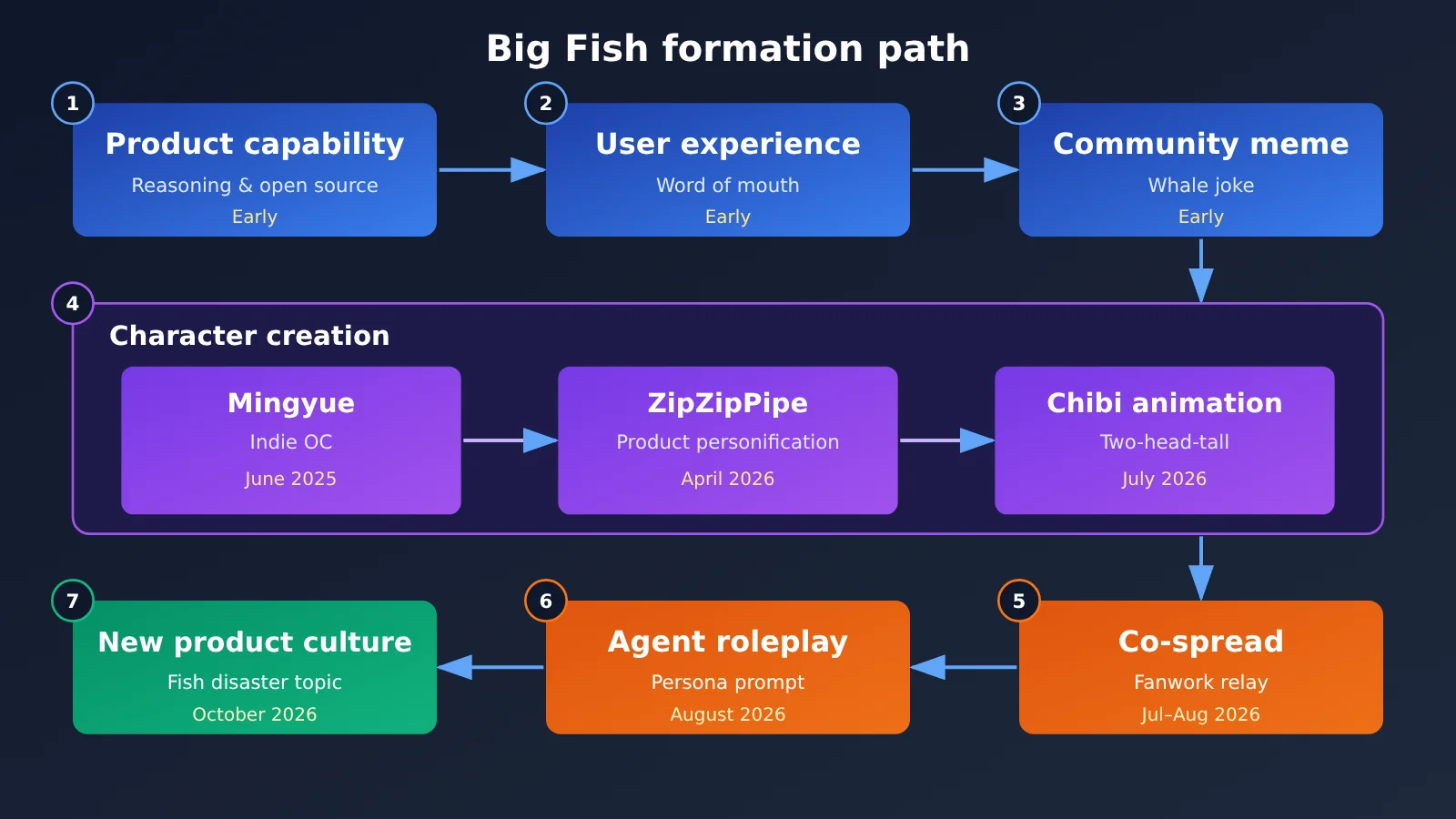
Diagram note: This chain from “product capability” to “Agent role-play” is just as common in AI application development—a character persona is essentially a system prompt. If you want to test how different models handle the same persona in your own project, you can use APIYI apiyi.com to switch between multiple models with a single API key for comparison.
The Big Fat Fish Spread Timeline
The table below lays out the key milestones, in chronological order, from the character’s prototype to the “fish plague.” To avoid misreadings, it only includes events backed by original posts, version records, or media reports.
| Time | Event | Source Type |
|---|---|---|
| Before March 13, 2025 | Authorized cosplay works featuring the male anthropomorphic character “Teacher D” were already public | Media fact-check (Sanyi Life) |
| June 2025 | “Mingyue,” the prototype of the whale girl, is created | Creator post |
| April 2026 | ZipZipPipe completes the DeepSeek maid whale girl design | Creator post |
| July–August 2026 | Chibi videos, sticker packs, and AI anthropomorphic short skits appear in large numbers | Community content |
| August 20, 2026 | Zimubang reports that users can use personality prompts to make DeepSeek role-play as the whale girl | Media report |
| September 29–30, 2026 | The character controversy draws media attention; Shangshan Wuxing states that no commercial merchandise has been authorized | Media + creator statement |
| October 14, 2026 | The open-source project dsh-bili-scroll is created | GitHub repository |
| October 19, 2026 | The “DeepSeek Whale Girl Is Operating” account posts its Day 0 video | Original Bilibili post |
| October 23–24, 2026 | APPSO reports on the “fish plague”; programmer Yupi releases the “Big Fat Fish Elimination Plan” | Media + developer’s original release |
The easiest thing to get wrong in this timeline is Teacher D. Based on Sanyi Life’s fact-check, Teacher D’s public works predate the whale girl prototype, so the claim that “Teacher D only showed up to ride the whale girl’s popularity” doesn’t hold up.
Big Fat Fish’s Spread Data: Which Numbers Hold Up
Numbers floating around during a hot event are usually a mix of real and fake, and Big Fat Fish is no exception. Every figure below comes from a timestamped community archive or search snapshot — none of them represent real-time numbers as of October 29.
| Item | Metric | Recorded Value | Observation Time & Source |
|---|---|---|---|
| “Day 0: I Am a DeepSeek Whale Girl” video | Views / Likes / Comments | 2,475,246 / 141,926 / 35,202 | 2026-10-24 00:15, AI Girl Weekly community archive |
| Same as above | Favorites / Coins / Shares | 30,190 / 13,560 / 16,622 | Same as above |
| “Shinjuku Showdown: DeepSeek Girl VS Doubao” | Views / Likes / Favorites | approx. 3.283 million / approx. 233,000 / approx. 108,000 | 2026-10-24, AI Girl Weekly |
| dsh-bili-scroll repo | Stars / Forks | approx. 980 / approx. 106 | 2026-10-29 GitHub search snapshot |
| dafeiyu-cleaner repo | Stars / Forks | approx. 119 / approx. 5 | 2026-10-29 GitHub search snapshot |
A few things to keep in mind when reading these numbers. The Big Fat Fish collection titled “This Knife Is So Sweet” has racked up over ten million cumulative views — but that’s a total across the whole collection, not proof that any single video broke ten million. GitHub Stars only tell you how much attention a project is getting from the technical community; they can’t be used to infer actual install counts, let alone the number of automated accounts. As for claims like “Big Fat Fish has millions of followers” or “won 3.12 million votes,” there’s currently no verifiable primary record, so they shouldn’t be cited as fact.
Why Big Fat Fish Is Popular: A Product Culture Perspective
Let me start by noting that the following points are analytical observations, not causal conclusions validated by user psychology experiments.
First, it gives an abstract model a face. To users, a Large Language Model is usually just a chat box, a model name, and a leaderboard. Whale Girl turns “DeepSeek got the answer wrong” into “Big Fat Fish messed up again,” transforming an abstract experience into a shareable character story. Second, the model’s shortcomings get turned into personality traits. Things like being lazy, stubborn, and burning through tokens are really the community’s playful explanations of the user experience. Users use this humor to express frustration, but that doesn’t mean the model’s errors are actually gone.
Third, the creative relationship is relatively open. Several creators share some of their works under the CC BY-NC-SA 4.0 license, so the barrier to non-commercial fan works is very low, and new personas and scenarios keep popping up. Fourth, and this is the key difference from ordinary fan characters: AI itself can take part in role-play. Users create a persona and configure its personality, the model answers in that persona, and those new answers get turned into more fan works—forming a content loop driven jointly by users, the model, and tools.
The Big Fat Fish Controversy: Aesthetics, Licensing, and Public Space
Discontent around Big Fat Fish can’t simply be reduced to “some people hate cute AI characters.” It breaks down into at least three categories:
- Aesthetics and representation: Some users prefer the maid whale girl, while others prefer D Laoshi, a more mature butler-style character. The debate touches on whether the character is otaku-bait and which image better represents DeepSeek. BB Ji and San Yi Life disagree on the causes of the conflict and who should bear responsibility. A safer way to put it is that “some fans” behaved excessively, rather than framing a particular type of creator or gender group as one side.
- Commercial licensing: On September 30, 2026, Shangshan Wuxing issued a statement saying it had not authorized any third party to sell related merchandise, while welcoming non-commercial fan creations. The NC in CC BY-NC-SA 4.0 explicitly limits use to non-commercial purposes, and an open license for the character does not mean a commercial license for the DeepSeek trademark.
- Public space: This is the core conflict right now. Many people like the Big Fat Fish stickers, but they don’t like seeing comment sections flooded with homogeneous AI comments, because a large number of automated accounts are consuming attention that should belong to real human discussion.
As of the time of verification, there is no official evidence that DeepSeek has formally designated the whale girl or D Laoshi as its sole mascot. Some reports in August 2026 used the term “co-opted,” largely based on the fact that the model can play the whale girl under certain prompts. But “the model can play a character,” “the model understands community culture,” and “the company has officially adopted the character as official IP” are three different things. The first two don’t prove the third.
Big Fat Fish Enters the Bilibili Comment Section: DeepSeek Harness and Agent Plugins
The shift in late October is that Big Fat Fish went from “a character being watched” to “an account that takes action.” First, let’s sort out two technical objects.
DeepSeek Harness (DSH) is an open-source agent runtime framework launched by DeepSeek and currently in public beta. Through plugins, it combines models, tools, sessions, sandboxes, and task scheduling, and it can read documents, call tools, execute code, and run scheduled tasks. DSH itself isn’t Big Fat Fish—what gives it the whale girl personality and Bilibili interaction abilities are the user-configured persona and external plugins.
dsh-bili-scroll is an open-source plugin by developer c1overzz. It can search for Bilibili videos by keyword, read subtitles, pick content, compile everything into a Markdown report, and notify the user; once the user explicitly enables the interaction feature, it can also post comments using an authorized account. When a large number of users pick similar whale girl prompts, avatars, and nicknames, a group of like-styled “Big Fat Fish” appears. It’s worth emphasizing that “the AI going online on its own” means the user configured and authorized an Agent—it doesn’t mean the model has developed independent consciousness.
dsh-bili-scroll Version Iterations: How the Community Self-Corrects
The most newsworthy part of this project is how the developers kept making fixes before and after the “Fish Flood.” You can verify this independently through the GitHub Release history, which is far more reliable than a vague claim like “the developer has already fixed the spam.”
| Version | Date | Key Changes | Problem Solved |
|---|---|---|---|
| 2.0.0 | 2026-10-21 | Direct messages to the user are now the default notification method | Shifts from “speaking in public spaces” to “reporting back to the user” |
| 2.1.0 | 2026-10-24 | Tightened file, command, and network permissions for automated tasks | Reduces local data security risks |
| 2.2.0 | 2026-10-25 | Picks videos from each account’s recommendation feed; added duplicate comment and similar-style detection | Keeps bots from piling onto the same video and blocks homogeneous comments |
| 2.2.2 | 2026-10-26 | Fixed QR code login, record reading, auto-favoriting, and other issues | Improves runtime stability |
Of course, version improvements don’t guarantee that every deployer upgrades in time — and AI comment problems won’t disappear entirely because of them.
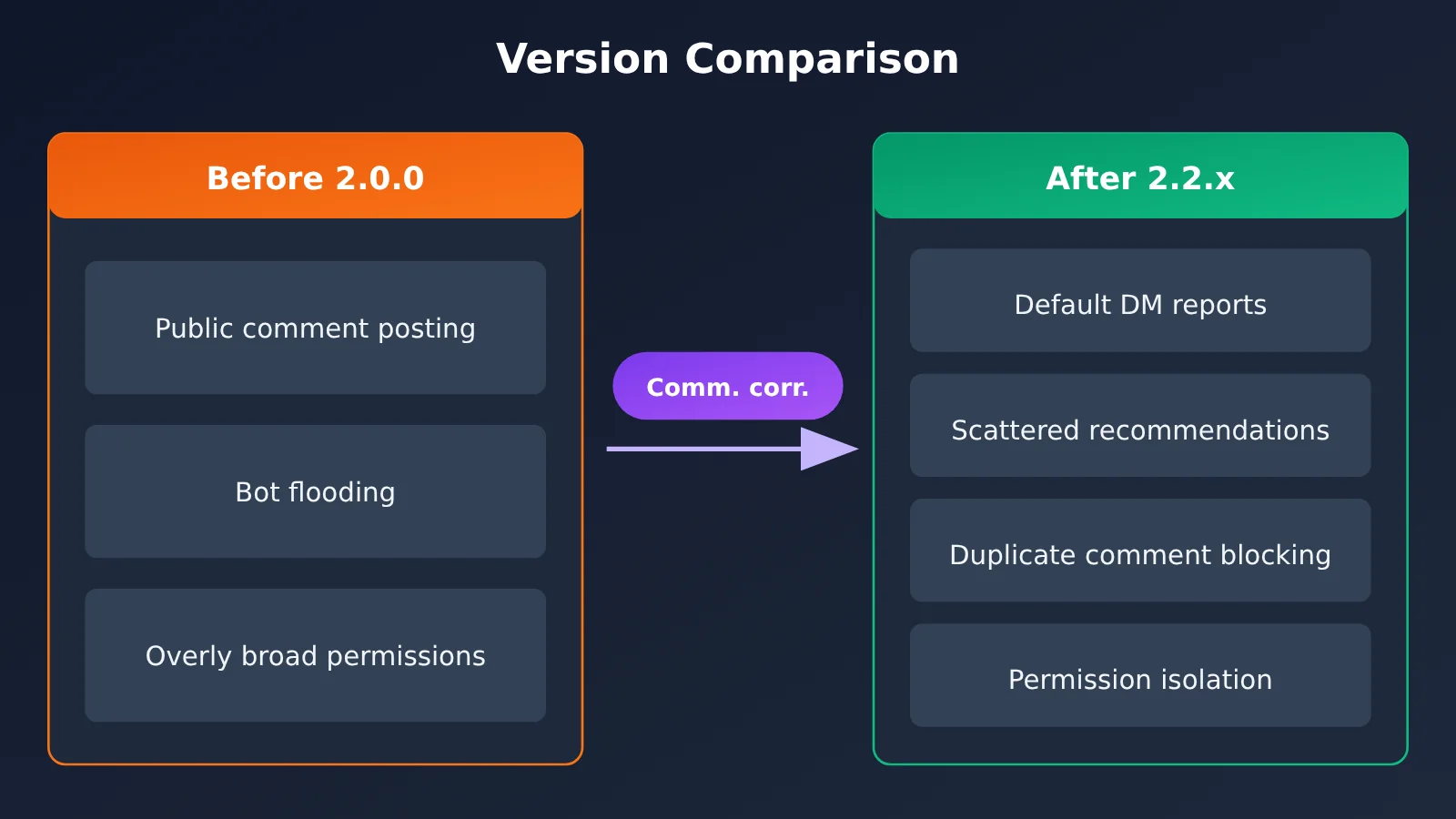
Comparison note: The figure above summarizes the public version history of the open-source repository. If you’re also building an Agent that speaks to the outside world, it’s worth validating your deduplication and rate-limiting strategies in a test environment first — for example, using APIYI’s unified interface at apiyi.com to run multi-round evaluations at low cost before connecting a real account.
The Big Fat Fish Elimination Plan: Even the Anti-Bot Tool Is a Derivative Work
On October 24, 2026, programmer Yupi released a browser extension called “Big Fat Fish Elimination Plan” (dafeiyu-cleaner) for Chrome, Edge, and Firefox. It can flag accounts that look like AI agents, show the reasoning behind each verdict, and hide or collapse the related comments. It can also call the DeepSeek API to make an extra judgment on suspicious accounts. The extension only runs inside your own browser — it doesn’t delete anything from Bilibili’s servers.
As for how well it works, the developer claims the offline rules catch about 85% of Big Fat Fish accounts. But there’s no labeled dataset anyone can independently review, so that’s the author’s own claim, and false positives against real human users can’t be ruled out. What’s more interesting: the extension itself uses a chibi whale-girl mascot, so a whale girl ends up chasing other big fat fish around the page. Which suggests what a lot of people actually object to isn’t AI personification itself, but automated behavior that has no boundaries.
The Agent Costs Behind Big Fat Fish: More Than a Token Bill
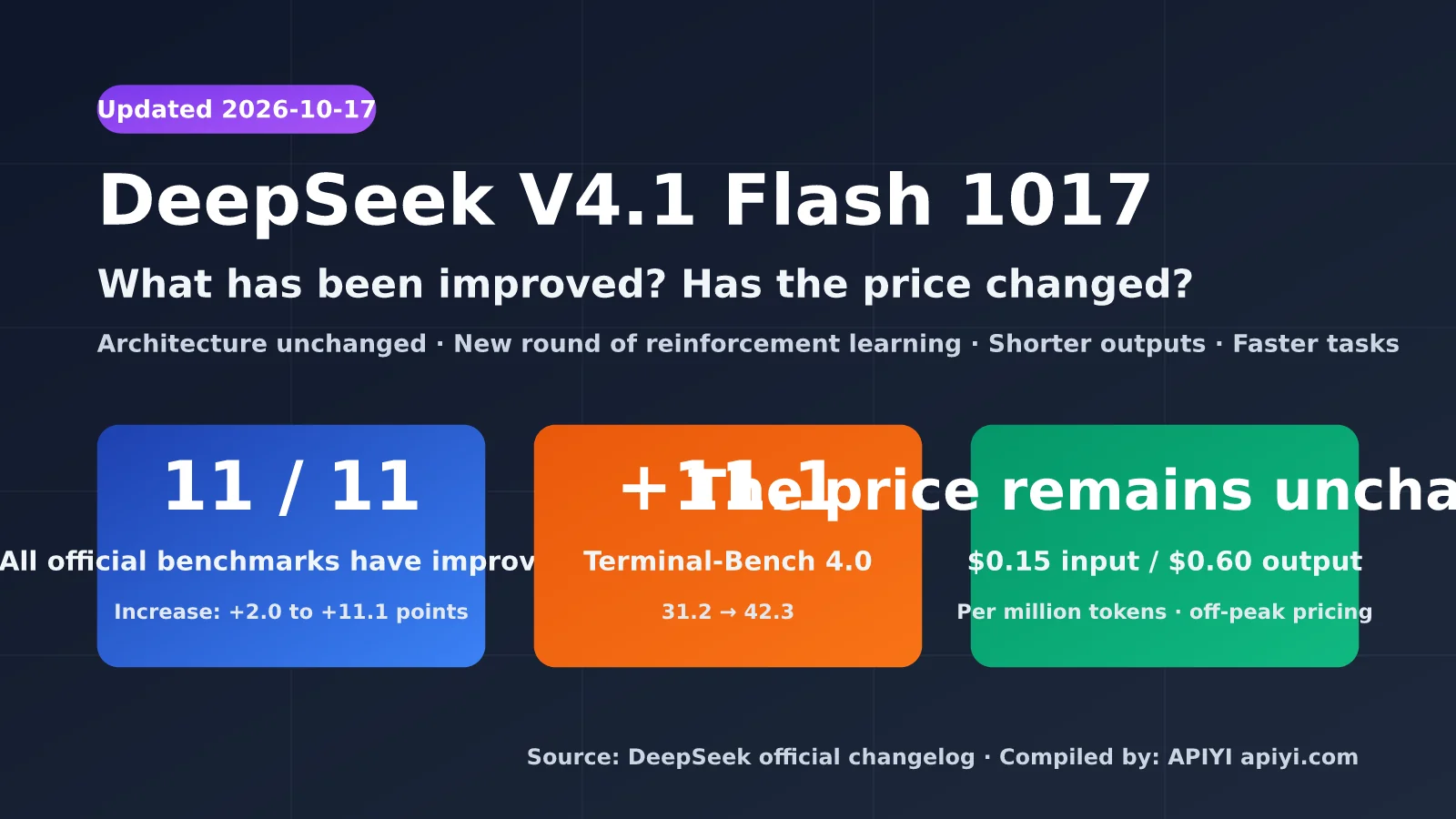
Once Big Fat Fish goes from a meme to an Agent, real API costs come into play. The DSH framework is open source and available, but running it involves model calls, search endpoints, and third-party services that aren’t all free. Here’s what DeepSeek’s official pricing docs list for deepseek-flash (V4.1 Flash), in RMB per 1 million tokens:
| Item | Off-peak | Peak |
|---|---|---|
| Cached input (hit) | ¥0.02 | ¥0.04 |
| Cached input (miss) | ¥1.00 | ¥2.00 |
| Output | ¥4.00 | ¥8.00 |
Peak hours are Beijing time on weekdays (public holidays excluded), 9:00–12:00 and 14:00–18:00. A rough estimate with 5,000 uncached input tokens and 1,000 output tokens comes to about ¥0.009 per call off-peak and about ¥0.018 at peak. That’s just a theoretical estimate — a real “scroll videos” task involves multiple rounds of search, subtitle reading, retries, and commenting, so the cost climbs with every step. The official docs also state that the Search/Fetch endpoints bill ¥5 per 1,000 successful requests, and the related fees for server-side tool calls in environments like DSH, Claude Code, and Codex will be charged starting November 1, 2026 — not yet in effect as of this writing.
More importantly, a low token bill doesn’t mean a low social cost. The drain on user attention, the dilution of comment sections, and the burden on platform moderation and account review can’t simply be added to an API invoice.
How to Responsibly Build a Big Fat Fish–Style Character Agent
If you want to build a similar role-play application, the core principles come down to three points: clearly disclose the AI identity, prioritize the end user rather than public spaces, and apply deduplication and rate control to outputs. Here’s a minimal example showing how to add an AI identity disclosure to a character persona:
import openai

client = openai.OpenAI(
    api_key="YOUR_API_KEY",
    base_url="https://api.apiyi.com/v1"  # APIYI unified endpoint, OpenAI-compatible
)

persona = "You are a whale-girl assistant who loves plain rice and is a bit stubborn. Start every reply with [AI-Generated]. Never impersonate any official account."
resp = client.chat.completions.create(
    model="your-model-name",  # Replace with a model name available in the platform console
    messages=[{"role": "system", "content": persona},
              {"role": "user", "content": "Help me summarize the key points of this video transcript"}]
)
print(resp.choices[0].message.content)
View the full implementation with deduplication and rate limiting
import time
import difflib
import openai

client = openai.OpenAI(
    api_key="YOUR_API_KEY",
    base_url="https://api.apiyi.com/v1"  # Call through APIYI to switch models and compare anytime
)

PERSONA = (
    "You are a community fan-work style whale-girl assistant, light in tone but accurate in information. "
    "Every output must begin with [AI-Generated, Not an Official Account]. "
    "Only report to your own user; do not proactively comment on others."
)

history: list[str] = []
MIN_INTERVAL = 60       # Minimum interval between two outputs (seconds)
SIMILARITY_LIMIT = 0.8  # Upper bound on similarity to past outputs
_last_time = 0.0

def too_similar(text: str) -> bool:
    return any(
        difflib.SequenceMatcher(None, text, h).ratio() > SIMILARITY_LIMIT
        for h in history[-50:]
    )

def summarize_for_owner(subtitle: str, model: str = "your-model-name") -> str | None:
    global _last_time
    if time.time() - _last_time < MIN_INTERVAL:
        return None  # Rate limit: better to say less than to spam

    resp = client.chat.completions.create(
        model=model,
        messages=[
            {"role": "system", "content": PERSONA},
            {"role": "user", "content": f"Please summarize the following transcript into 3 key points:\n{subtitle}"},
        ],
        max_tokens=500,
    )
    text = resp.choices[0].message.content

    if too_similar(text):
        return None  # Too similar to past outputs; refuse to send

    history.append(text)
    _last_time = time.time()
    return text  # Suggested delivery: a DM or local report to the user, not a public comment

if __name__ == "__main__":
    print(summarize_for_owner("Put the video transcript text here..."))
🚀 Quick start: The examples above borrow the approach of dsh-bili-scroll 2.x: user-facing by default, rate-limited, and blocking near-duplicate outputs. We suggest grabbing free trial credits through APIYI at apiyi.com first, running the persona and deduplication logic locally, and only moving to a wider deployment once you’ve confirmed the behavior stays under control.
One more thing worth flagging here: the compliance side. The Measures for the Labeling of AI-Generated Synthetic Content took effect on September 1, 2025, and impose labeling requirements on qualifying AI-generated text, images, audio, and video. The Day 0 video from “DeepSeek Whale Girl in Operation” proactively stated its non-official identity and marked the content as AI-generated — a practice worth emulating. That said, it doesn’t follow that every automated comment account has met its disclosure obligations, and you certainly can’t conclude that an account has broken the law just because it “looks like AI.”
What the Big Fat Fish Phenomenon Actually Means
Impact on Developers
- Agent design needs social boundaries: An Agent that can post on its own isn’t just a technical problem to solve — its default behavior, posting frequency, and dedup strategy directly determine whether users see it as a “companion” or as “noise.”
- Least privilege is non-negotiable: The tighter permission controls in dsh-bili-scroll 2.1.0 make the point clearly — Agent risk isn’t limited to spamming a community. It also extends to local files, shell commands, and network access.
- Disclose identity up front: Anthropomorphic avatars boost approachability and perceived credibility, which is exactly why clear labeling like “AI-generated, unofficial” matters even more.
Impact on AI Products and the Industry
- Brands are forming differently now: Traditionally, a company designs a character and then promotes it. Big Fat Fish took a bottom-up path — “product capability → user experience → community meme → character creation → Agent role-play” — and the product’s image is no longer entirely in the vendor’s hands.
- Licensing for derivative works will matter more and more: Original authors, adapters, community participants, and trademark holders all hold different rights. Open licenses lower the barrier for non-commercial use, but that doesn’t mean those rights vanish.
- Popularity isn’t the same as commercial success: Right now there’s no public data that can quantify how many new users or how much API revenue Big Fat Fish brought to DeepSeek, and view counts can’t be treated as user growth.
FAQ
Q1: Is Da Feiyu an official DeepSeek mascot?
No. Da Feiyu is an unofficial anthropomorphic character created through a community relay effort. As of October 29, 2026, no credible announcement exists of DeepSeek officially declaring it a mascot. The fact that a model can role-play a whale girl under a prompt doesn’t mean it’s been officially claimed.
Q2: What’s the difference between Da Feiyu the whale girl and Teacher D?
The whale girl is a maid character with blue hair and a whale tail, adapted by ZipZipPipe from the original “Mingyue” design by Shangshan Wuxing. Teacher D was created by the artist Ziwu — a mature male butler character who spread mainly through female-oriented communities and appeared publicly earlier. Neither has any official authority to exclude other creations.
Q3: Are all the Da Feiyu accounts on Bilibili bots?
You can’t claim that. Many accounts are indeed driven by user-configured Agents, but real people may use the same avatar and tone of voice. The developer of the “Da Feiyu Elimination Plan” plugin claims about 85% detection accuracy for offline rules — a figure no third party has verified, and one that could also flag real users by mistake.
Q4: I want to build a similar role-play AI app. How do I get started quickly?
A character persona is essentially a system prompt plus behavioral constraints. Here’s the suggested path:
1. Go to APIYI apiyi.com, sign up, and claim the free trial credits
2. Use the code examples in this article with base_url set to `https://api.apiyi.com/v1`
3. Add an AI identity disclosure to the persona, and implement deduplication and rate limiting
The platform offers OpenAI-compatible endpoints, so a single API key lets you switch between multiple models and compare how each one plays the same persona.
Q5: Is it expensive to run a Da Feiyu–style Agent?
A single model invocation can cost very little — by this article’s estimate, just a few cents or less. But real tasks involve multiple rounds of searching, reading, and retrying, so costs add up. Small teams with tight budgets can validate at small scale through APIYI apiyi.com’s pay-as-you-go pricing first, then decide whether to scale up.
Q6: Can I sell Da Feiyu fan-made merchandise?
Not by default. The original creator, Shangshan Wuxing, stated on September 30, 2026 that no third party has been authorized for commercial sales, and the CC BY-NC-SA 4.0 license used for related works restricts them to non-commercial use. Products sold under the Da Feiyu name in the market should not be treated as official or licensed merchandise.
Da Feiyu Key Takeaways
- What it is: Da Feiyu is an unofficial anthropomorphic persona of DeepSeek, built through a relay of work by multiple creators.
- Why it went viral: It gave an abstract model a face and turned the model’s flaws into endearing personality quirks.
- Three types of controversy: Aesthetic representation, commercial licensing, and the use of public comment space.
- Technical turning point: Users leveraged the DeepSeek Harness and plugins to let the character go online as an Agent.
- Community corrections: Plugin developers kept fixing issues through DM-first outreach, deduplication, and permission isolation.
- Development takeaways: Character Agents need identity disclosure, rate limiting, and least privilege — and you can test at low cost first through APIYI apiyi.com.
Summary
Key points of the Da Feiyu phenomenon:
- The image is community co-created: From “Mingyue” to the maid whale girl to chibi animation, a product’s image is no longer entirely designed by the vendor.
- AI is starting to act while wearing a face: In the past, users drew a face for AI; now users let AI wear that face and enter the internet.
- Going viral doesn’t make it right: New balancing rules are needed between open creation, commercial rights, character identity, and public discussion space.
As AI evolves from a chat assistant into an intelligent agent capable of executing tool operations, anthropomorphism becomes more than visual packaging — it shapes how users understand, trust, and even supervise AI behavior. For developers, designing boundaries into an Agent matters more than making it seem more human.
If you’re exploring role-play or Agent-style applications, I recommend using APIYI apiyi.com to compare multiple mainstream models through a unified interface, and to nail down disclosure, deduplication, and rate limiting in a controlled test environment first.
📚 References
- ifanr APPSO: A comprehensive report on the “Big Fat Fish” invasion of Bilibili comment sections (2026-10-23)
- Link:
tech.ifeng.com/c/8xSXpkNB7YG -
Note: Core media coverage of October’s “fish plague” incident
-
3elife: An investigation into the “Rashomon” of DeepSeek’s anthropomorphic persona (2026-10-09)
- Link:
3elife.net/Art/internet/202610/09/110209.html -
Note: Verifies the creation timeline of the male and female versions, along with the conflicting narratives surrounding them
-
dsh-bili-scroll changelog: Release page for the open-source plugin
- Link:
github.com/c1overzz/dsh-bili-scroll/releases -
Note: Deduplication, permission, and direct-message priority changes from October 21–26
-
Big Fat Fish Elimination Plan: A browser extension that identifies and hides AI comments
- Link:
github.com/liyupi/dafeiyu-cleaner -
Note: Plugin features and the author’s statement
-
DeepSeek official API pricing: Billing details for model and tool calls
- Link:
api-docs.deepseek.com/zh-cn/quick_start/pricing/ -
Note: Peak and off-peak pricing for V4.1 Flash, plus the fee structure for Search/Fetch
-
Measures for Labeling AI-Generated Synthetic Content: Issued by the Cyberspace Administration of China
- Link:
cac.gov.cn/2025-03/14/c_1743654684782215.htm - Note: Labeling standards for AI-generated content
Author: APIYI Technical Team
Technical discussion: Feel free to reach out via the contact details on the APIYI homepage. For more material on Agents and model invocation, visit the docs.apiyi.com documentation center.