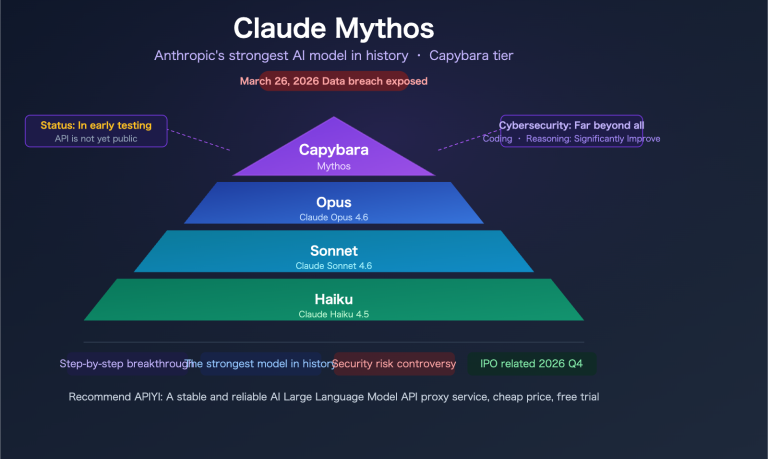
If you've been keeping up with AI news, you've probably seen the term "Claude Capybara." This is Anthropic's fourth model tier, added above Opus, representing the current highest level of AI capability. On March 26, 2026, an accidental data leak prematurely revealed Claude Mythos, the first model in the Capybara tier, sending shockwaves through the AI industry.
But for developers new to Claude, a more fundamental question arises: What exactly is Capybara? How does it relate to Opus, Sonnet, and Haiku? Which one should I choose?
Core Value: This article will explain Anthropic's 4-tier model system from scratch, using the simplest language. After reading, you'll clearly understand the capability boundaries, pricing, and best use cases for each tier, enabling you to make the most suitable selection for your project.
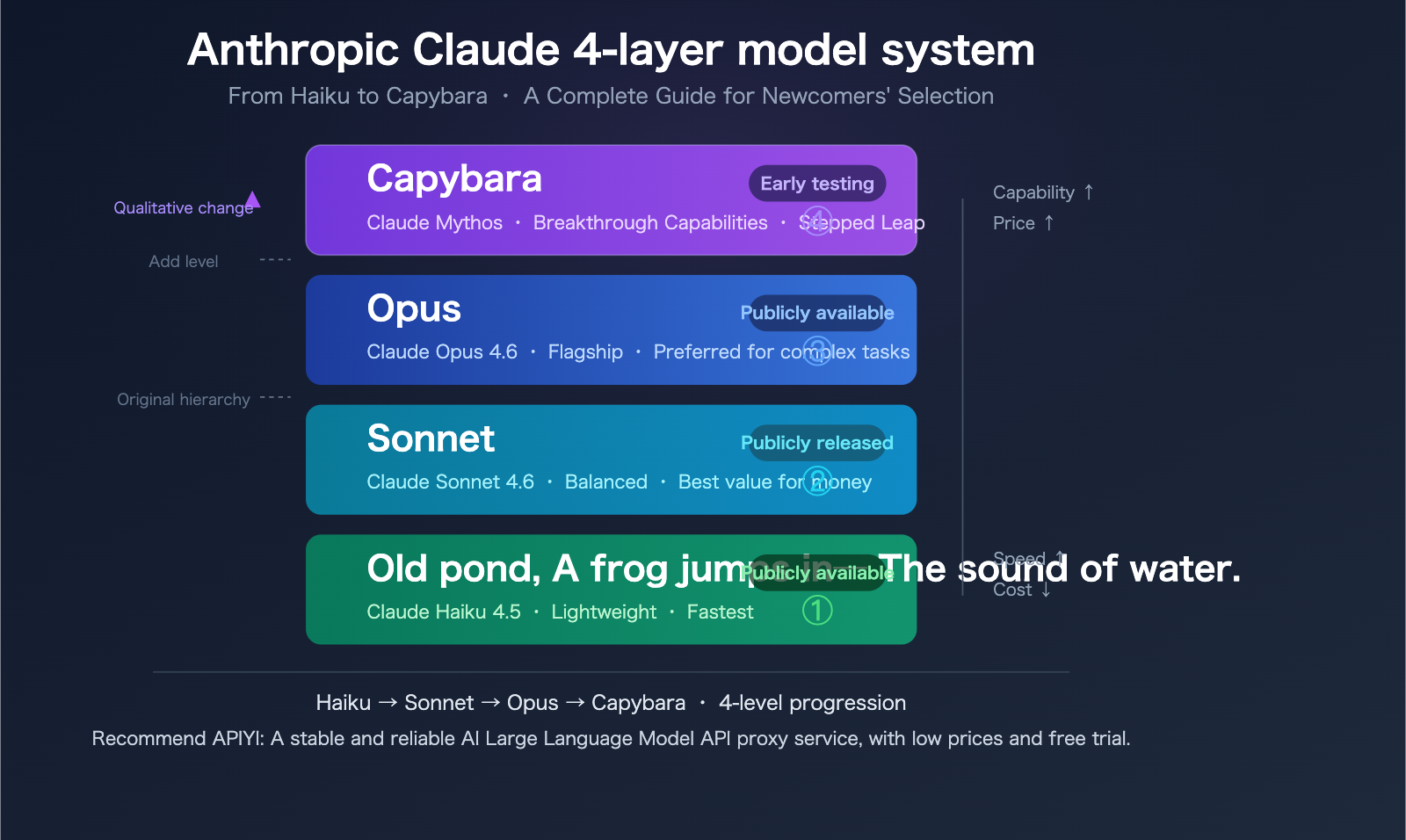
Anthropic Claude Model Family: Evolution from 3 Tiers to 4
The Old System: Haiku-Sonnet-Opus Three-Tier Architecture
Before Capybara emerged, Anthropic's Claude model family consisted of three tiers, each with different capabilities and price points:
- Haiku: Smallest, fastest, and cheapest – ideal for simple tasks.
- Sonnet: Medium-sized with balanced performance – suitable for everyday development.
- Opus: Largest, most powerful, and most expensive – designed for complex tasks.
All three names come from the literary/musical world, ranging from the concise Haiku to the grand Opus, hinting at increasing capabilities.
The New System: Introduction of the Capybara Tier
In March 2026, the exposure of the Capybara tier disrupted the original three-tier structure. Anthropic's model family now looks like this:
| Tier | Naming Meaning | Representative Model | One-Sentence Positioning |
|---|---|---|---|
| Haiku | Haiku (short poem) | Claude Haiku 4.5 | Fast response, lowest cost |
| Sonnet | Sonnet (medium poem) | Claude Sonnet 4.6 | Balanced performance, best value |
| Opus | Symphony (large work) | Claude Opus 4.6 | Flagship, preferred for complex tasks |
| Capybara | Capybara (largest rodent) | Claude Mythos | Breakthrough capabilities, surpasses Opus |
Interestingly, the naming style for Capybara shifted from literature to animals. Capybaras are the world's largest rodents, known for their gentle nature despite their size. Anthropic uses this to signify a "huge" leap in capability with the Capybara tier, while maintaining a safe and approachable brand image.
🎯 New User Tip: If you're just starting with the Claude API, you don't need to wait for the Capybara tier to go public. The current Haiku, Sonnet, and Opus tiers already cover most application scenarios. We recommend using the APIYI apiyi.com platform to quickly experience the full range of Claude models; you'll receive free credits upon registration.
4 Core Features of the Claude Capybara Tier
Based on leaked draft documents and confirmations from Anthropic spokespeople, the Capybara tier has the following core features:
Feature 1: A "Step Change" in Capabilities
An Anthropic spokesperson explicitly used the term "step change" to describe the capability enhancement of the Capybara tier. This wording is crucial – it implies that Capybara isn't just an incremental improvement over Opus, but a qualitative leap forward.
Think of it like this:
- Haiku → Sonnet → Opus: Like climbing stairs, going up one level at a time.
- Opus → Capybara: Like taking an elevator, jumping directly to a new height.
Feature 2: Cybersecurity Capabilities Far Exceeding Competitors
The most striking description in the leaked draft is that models in the Capybara tier are "far ahead of any other AI model" in cybersecurity capabilities. This includes:
- Proactively discovering software vulnerabilities.
- Analyzing attack surfaces.
- Identifying zero-day exploits.
- Assessing security architectures.
This is also a primary reason for Anthropic's cautious approach to the Capybara release – such powerful security capabilities could potentially be misused.
Feature 3: Higher Operational Costs Than Opus
While specific pricing hasn't been released, the leaked materials clearly state that the Capybara tier has "higher operational costs." Referencing the current pricing structure:
| Tier | Input Price ($/M tokens) | Output Price ($/M tokens) | Relative Cost |
|---|---|---|---|
| Haiku 4.5 | $0.80 | $4.00 | Baseline |
| Sonnet 4.6 | $3.00 | $15.00 | ~4x |
| Opus 4.6 | $5.00 | $25.00 | ~6x |
| Capybara (Estimated) | $10-20? | $50-100? | ~15-25x? |
Note: Capybara pricing is community speculation, not official data. Actual prices may be higher or lower.
Feature 4: Deep Connective Tissue Between Ideas and Knowledge
Another key description in the leaked draft is that the Capybara tier aims to "establish deep connective tissue between ideas and knowledge." This suggests that Capybara isn't just "faster and stronger" but involves fundamental architectural innovations in knowledge integration and cross-domain reasoning.
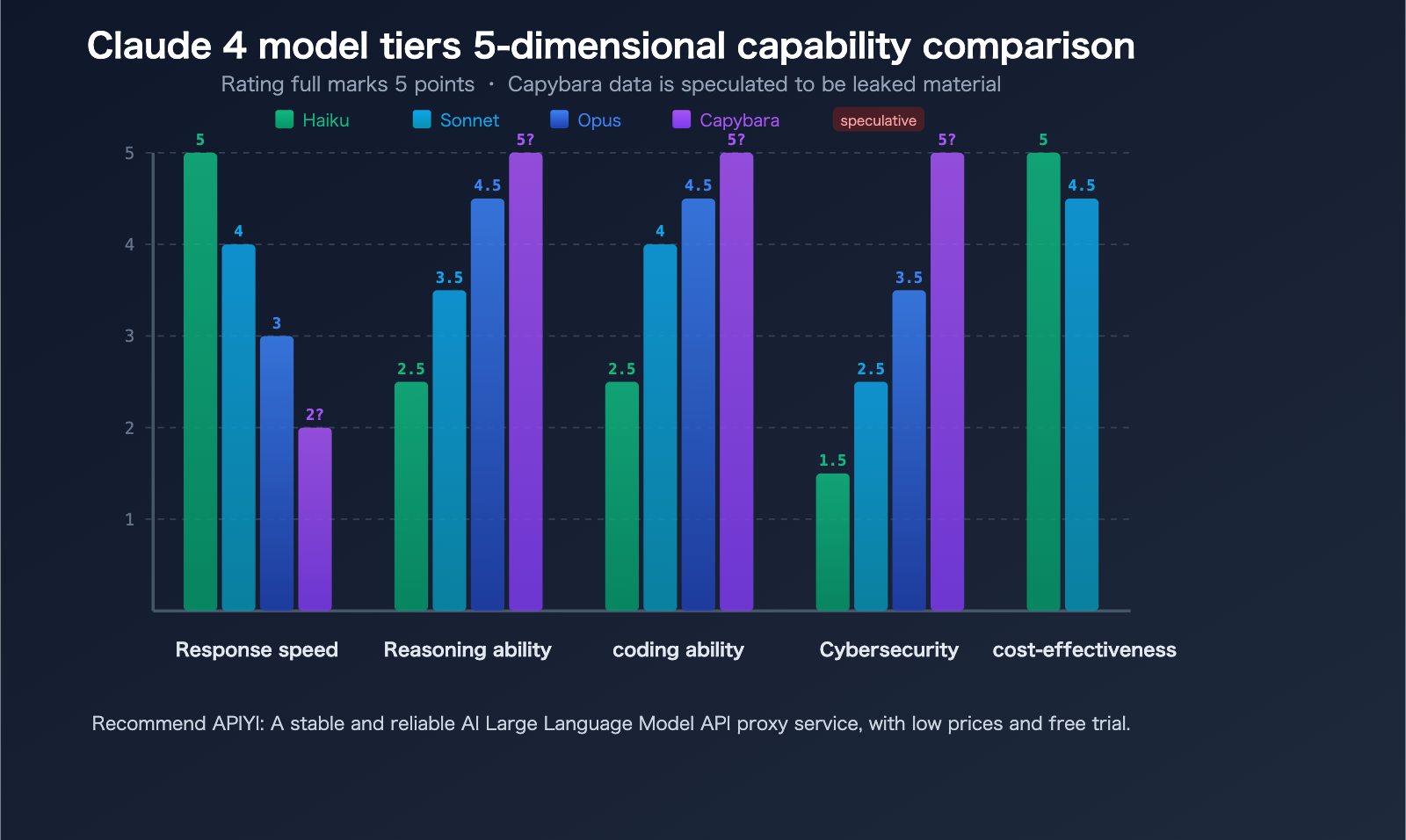
Haiku vs Sonnet vs Opus vs Capybara: A Detailed Comparison of 4 Model Tiers
Core Parameter Comparison
| Comparison Dimension | Haiku 4.5 | Sonnet 4.6 | Opus 4.6 | Capybara (Mythos) |
|---|---|---|---|---|
| Response Speed | ★★★★★ Fastest | ★★★★☆ Fast | ★★★☆☆ Medium | ★★☆☆☆ Expected to be slower |
| Reasoning Ability | ★★★☆☆ Basic | ★★★★☆ Good | ★★★★★ Excellent | ★★★★★+ Breakthrough |
| Coding Ability | ★★★☆☆ Basic | ★★★★☆ Good | ★★★★★ Excellent | ★★★★★+ Significantly improved |
| Network Security | ★★☆☆☆ | ★★★☆☆ | ★★★★☆ | ★★★★★+ Far exceeds peers |
| Context Window | 200K | 200K (1M) | 200K (1M) | Not disclosed |
| Multimodality | Text + Image | Text + Image | Text + Image | Not disclosed |
| API Status | Publicly available | Publicly available | Publicly available | Early testing |
| Cost | Lowest | Medium | High | Expected to be highest |
Best Use Cases for Each Tier of Claude Model
Understanding the optimal use case for each tier is key to making the right selection.
Haiku 4.5 is suitable for:
- Text classification and tag extraction
- Simple content summarization
- High-concurrency lightweight tasks
- Fast response chatbots
- Real-time applications with extreme latency sensitivity
Sonnet 4.6 is suitable for:
- Everyday programming assistance and code generation
- Content creation and editing
- Data analysis and report generation
- API prototyping and testing
- Medium-complexity reasoning tasks
Opus 4.6 is suitable for:
- Complex code architecture design
- In-depth research and analysis reports
- Long-form text creation and translation
- Difficult mathematical and scientific reasoning
- Orchestrating Agent workflows
Capybara (Mythos) is expected to be suitable for:
- Automated discovery and analysis of security vulnerabilities
- Ultra-difficult multi-step reasoning
- Understanding and refactoring large codebases
- Tasks requiring deep integration of cross-domain knowledge
- Enterprise-grade security audit automation
💡 Selection Recommendation: For most developers, Sonnet 4.6 is the most cost-effective starting point. Upgrade to Opus when tasks exceed Sonnet's capabilities. We recommend using the APIYI apiyi.com platform to access multiple tiers of Claude models simultaneously. A single API key allows flexible switching between Haiku, Sonnet, and Opus to find the best model for your task.
Preparing for API Access to the Claude Capybara Tier
Although the Capybara tier's API is not yet public, the entire Claude series uses a unified API interface specification. Familiarizing yourself with the API invocation method now will allow for seamless switching once Capybara is available.
Unified Claude API Call Example
import openai

client = openai.OpenAI(
    api_key="your-api-key",
    base_url="https://api.apiyi.com/v1"  # APIYI unified interface
)

# Select any Claude model - just change the model parameter
response = client.chat.completions.create(
    model="claude-sonnet-4-6",  # Can be switched to any Claude model
    messages=[
        {"role": "user", "content": "Explain the core principles of MoE architecture"}
    ]
)

print(response.choices[0].message.content)
View Full Code (Includes 4-Tier Model Comparison Test)
import openai
import time

# Call the entire Claude series through the APIYI unified interface
client = openai.OpenAI(
    api_key="your-api-key",
    base_url="https://api.apiyi.com/v1"
)

# Claude 4 Tiers (Capybara pending)
claude_tiers = {
    "claude-haiku-4-5": {
        "tier": "Haiku",
        "desc": "Lightweight - Fastest"
    },
    "claude-sonnet-4-6": {
        "tier": "Sonnet",
        "desc": "Balanced - Best value"
    },
    "claude-opus-4-6": {
        "tier": "Opus",
        "desc": "Flagship - Currently strongest"
    },
    # Capybara tier - pending public release
    # "claude-mythos": {
    #     "tier": "Capybara",
    #     "desc": "Breakthrough - Beyond Opus"
    # },
}

test_prompt = "Explain what a Transformer architecture is in 3 sentences"

print("=" * 60)
print("Claude Model Tier Comparison Test")
print("=" * 60)

for model_id, info in claude_tiers.items():
    try:
        start = time.time()
        response = client.chat.completions.create(
            model=model_id,
            messages=[{"role": "user", "content": test_prompt}],
            max_tokens=300,
            temperature=0.7
        )
        elapsed = time.time() - start
        content = response.choices[0].message.content
        tokens = response.usage.total_tokens

        print(f"\n[{info['tier']}] {info['desc']}")
        print(f"  Model: {model_id}")
        print(f"  Time taken: {elapsed:.2f}s | Tokens: {tokens}")
        print(f"  Response: {content[:150]}...")
    except Exception as e:
        print(f"\n[{info['tier']}] Call failed: {e}")

print("\n" + "=" * 60)
print("Note: Once the Capybara tier is available, simply uncomment to test")
🚀 Get Started Quickly: We recommend using the APIYI apiyi.com platform to experience the full range of Claude models. Sign up for free credits, and a single API key allows you to access Haiku, Sonnet, and Opus. APIYI will support the Capybara tier as soon as it becomes available.
Claude Capybara Tier Pricing Predictions and Cost Optimization Strategies
Capybara Tier Pricing Speculation
Anthropic hasn't released specific pricing for the Capybara tier yet. However, based on existing pricing tiers and descriptions of "higher running costs" from leaked materials, the community has made the following price predictions:
Conservative Estimate (2-3x Opus):
- Input: $10-15/M tokens
- Output: $50-75/M tokens
Aggressive Estimate (4-5x Opus):
- Input: $20-25/M tokens
- Output: $100-125/M tokens
There's speculation in the community that Capybara might be a trillion-parameter model (citing Dario Amodei's previous statement about "$10 billion training cost"), but this is pure speculation with no official confirmation.
Cost Optimization Strategies
Regardless of Capybara's final pricing, these strategies can help you control your API call costs:
Strategy 1: Tiered Routing
- Use Haiku for simple tasks (lowest cost).
- Use Sonnet for medium tasks (best value).
- Reserve Opus or Capybara for complex tasks.
- Implement logic to automatically route requests to the appropriate model.
Strategy 2: Prompt Caching
- Claude API supports prompt caching, offering discounts for requests with repeated prefixes.
- For batch tasks, design your system prompts carefully to maximize cache hits.
Strategy 3: Batch API Processing
- Use the Batch API for non-real-time tasks to get a 50% price discount.
- This is ideal for scenarios like data analysis or content generation that can be handled asynchronously.
💰 Cost Alert: Calling Claude models through the APIYI apiyi.com platform often provides more favorable pricing than official channels. The platform allows flexible switching between different Claude tiers, helping you strike the best balance between performance and cost.
Claude Capybara Tier Release Timeline Prediction
Key Time Points
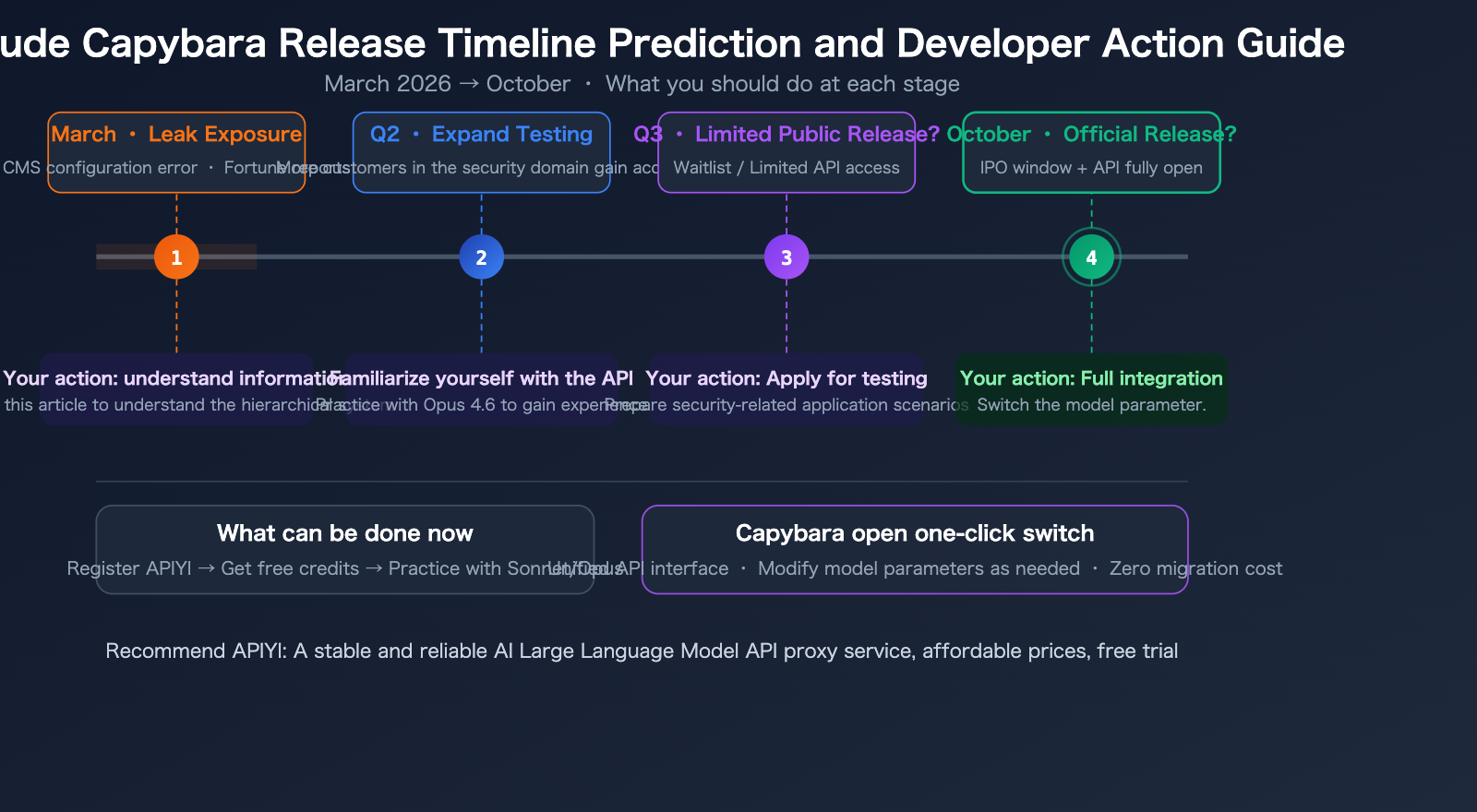
Based on available information, we can predict the following timeline:
- March 26, 2026 (Occurred): Data leak, Capybara/Mythos first exposed.
- Q2 2026 (Predicted): Expanded early testing, more security-focused clients gain access.
- Q3 2026 (Predicted): Potential for limited public beta or waitlist.
- October 2026 (Key Window): Anthropic's potential IPO consideration period; Mythos likely to be officially released around the IPO.
Why the IPO Timeline Matters
Both Bloomberg and The Information have reported on Anthropic considering an IPO in October 2026. For developers:
- Capybara released before IPO: Could boost valuation and showcase technological leadership to investors.
- Capybara released after IPO: Could be a major post-listing product launch to drive stock performance.
- Regardless, the second half of 2026 is the most likely window for Capybara's public debut.
Frequently Asked Questions
Q1: Is Capybara a model name or a tier name?
Capybara is a tier name, not a model name. Just like Opus is a tier, and Claude Opus 4.6 is a specific model within that tier, Capybara is the new top-tier, and Claude Mythos is the first specific model under this tier. Anthropic may release more model versions under the Capybara tier in the future.
Q2: I’m currently using Sonnet, should I wait until Capybara is released to start developing?
There's absolutely no need to wait. Sonnet 4.6 is currently the most cost-effective Claude model, sufficient for the vast majority of development scenarios. The Claude API uses a unified interface format, so switching models in the future will only require changing a single parameter. We recommend starting with Sonnet or Opus now via the APIYI apiyi.com API proxy service to gain experience. You'll be able to switch with a single click once Capybara is available.
Q3: What impact will the Capybara tier have on regular developers?
The short-term impact will be limited – Capybara's pricing is expected to be significantly higher than Opus, and access may be restricted initially. However, in the long run, it signifies a new level of AI capability, especially in areas like security auditing and complex reasoning. For regular developers, the most practical impact will be: when Capybara is released, high-difficulty tasks previously only possible with Opus might become available in cheaper tiers, much like how some of Opus's capabilities were gradually covered by Sonnet. You can test the effects of different models at any time via the APIYI apiyi.com API proxy service.
Summary: Key Points for Newcomers to the Claude Capybara Tier
The introduction of the Capybara tier marks an expansion of Anthropic's model system from 3 tiers to 4, once again raising the ceiling for AI capabilities. For developers, the most important thing isn't chasing the latest and most expensive models, but understanding the capability boundaries of each tier to make the most suitable selection.
5 Core Takeaways:
- Capybara is a tier name, Mythos is a model name – similar to how the Opus tier includes Claude Opus 4.6.
- 4-Tier System: Haiku (Fast) → Sonnet (Balanced) → Opus (Flagship) → Capybara (Breakthrough).
- Capybara Represents a "Qualitative Leap," Not Just Quantitative Improvement – Anthropic describes it as a "step-change" rather than an "improvement."
- Sonnet/Opus Remain the Best Choices Currently – covering over 95% of development scenarios.
- Focus on Late 2026 – the most likely window for Capybara's public release.
You can start taking action now: Access the full range of Claude APIs through APIYI apiyi.com and familiarize yourself with the capability differences between the Haiku, Sonnet, and Opus tiers. A single API key allows you to invoke all models, ensuring seamless integration once Capybara is available.
Author: APIYI Team | For API access to the full series of Claude models and the latest updates, please visit APIYI apiyi.com
📚 References
-
Fortune Exclusive Report: Anthropic Mythos AI Model Leak Incident
- Link:
fortune.com/2026/03/26/anthropic-says-testing-mythos-powerful-new-ai-model-after-data-leak-reveals-its-existence-step-change-in-capabilities/ - Description: Initial report, includes confirmation from Anthropic spokesperson regarding the Capybara tier.
- Link:
-
The Information Briefing: Anthropic IPO and Capybara AI Preparations
- Link:
theinformation.com/briefings/anthropic-discusses-q4-ipo-preps-advanced-claude-mythos-capybara-ai - Description: Analyzes the connection between the Capybara tier and Anthropic's IPO plans.
- Link:
-
Anthropic Official API Documentation: Claude Model Usage Guide
- Link:
docs.anthropic.com - Description: Official technical documentation and pricing for Haiku, Sonnet, and Opus.
- Link:
-
LowCode Agency Analysis: What Is Claude Mythos?
- Link:
lowcode.agency/blog/what-is-claude-mythos - Description: Analysis of the positioning and capabilities of the Capybara tier.
- Link:
-
Bloomberg Report: Anthropic Considers IPO in October 2026
- Link:
bloomberg.com/news/articles/2026/03/27/claude-ai-maker-anthropic-said-to-weigh-ipo-as-soon-as-october - Description: Analyzes the connection between the IPO timeline and model release strategy.
- Link: