Author’s note: Using official benchmark results and official limitations, this article explains where Claude Fable 5.2 excels, where to draw the line, and when you shouldn’t switch from Opus 5.5.
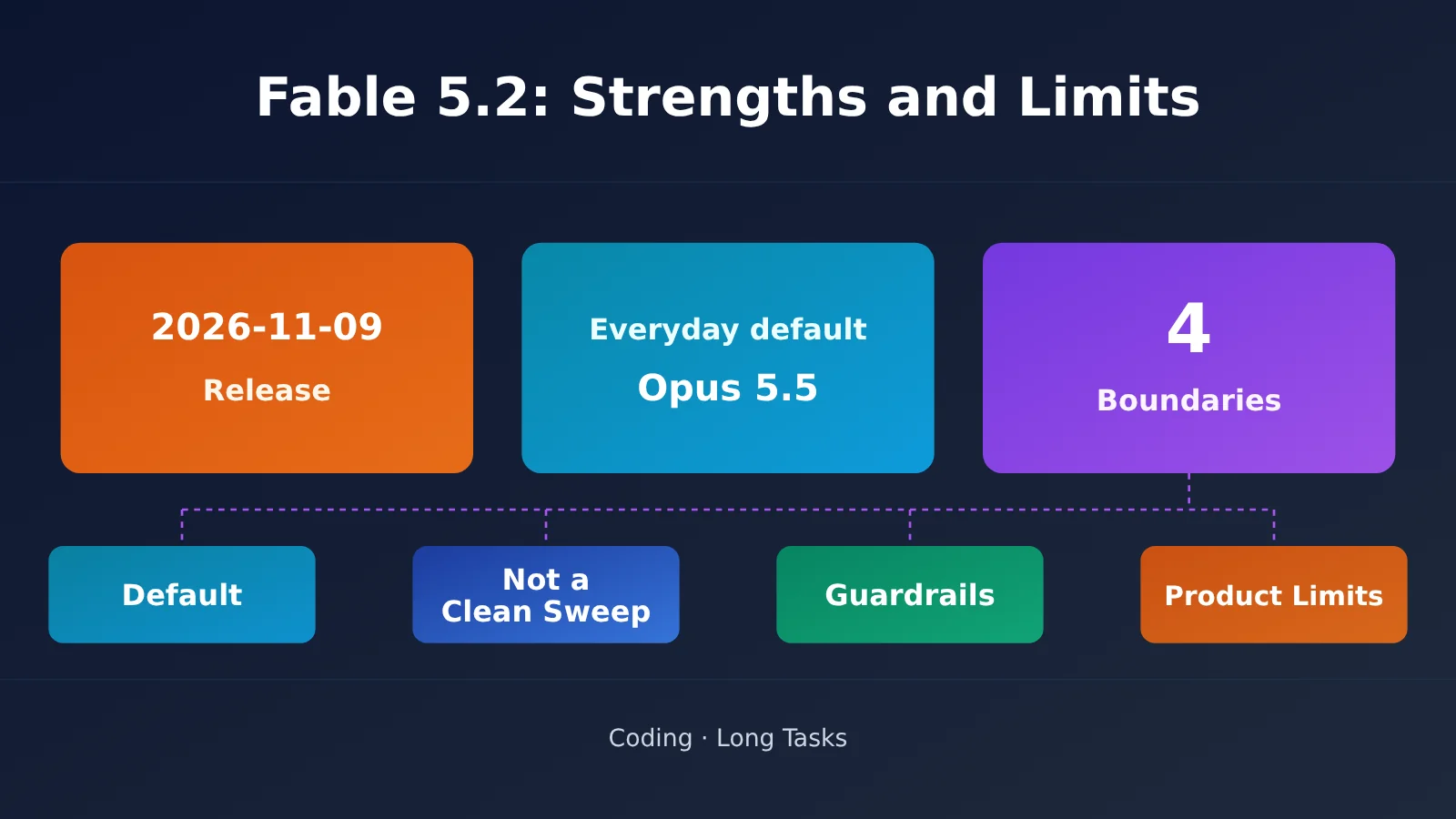
Claude Fable 5.2 is Anthropic’s technical flagship, released on 2026-11-09. Anthropic’s own recommendation is to keep starting with Opus 5.5 for most coding and knowledge work. Fable 5.2 is a better fit for the biggest, most open-ended technical tasks that need to run for a long time.
This isn’t a retelling of a leaderboard. All the benchmark results in this article come from Anthropic’s launch post on 2026-11-09; the limitations come from its official model page and release notes. By the end, you’ll have four clear boundaries: where it’s noticeably stronger, where it doesn’t win across the board, where safeguards will stop it, and where product constraints may get in the way.
Why this matters: If you’re already using the Claude API, this article will help you decide whether to upgrade from Opus 5.5 to Fable 5.2—and what to change about your bill and API parameters after you do.
Claude Fable 5.2: Key Takeaways
Here are the answers to the questions people ask most often, all in one table. The figures come from the official model page and launch announcement, verified on 2026-11-10.
| Key point | Official information | What it means for you |
|---|---|---|
| Positioning | A flagship model for technical work, suited to the most demanding and open-ended tasks | It’s not the default for everyday use; Opus 5.5 remains the everyday choice |
| Relationship to Mythos | The same underlying model, with stronger safeguards in Fable, which is available to all users | Mythos isn’t a separate, more powerful model |
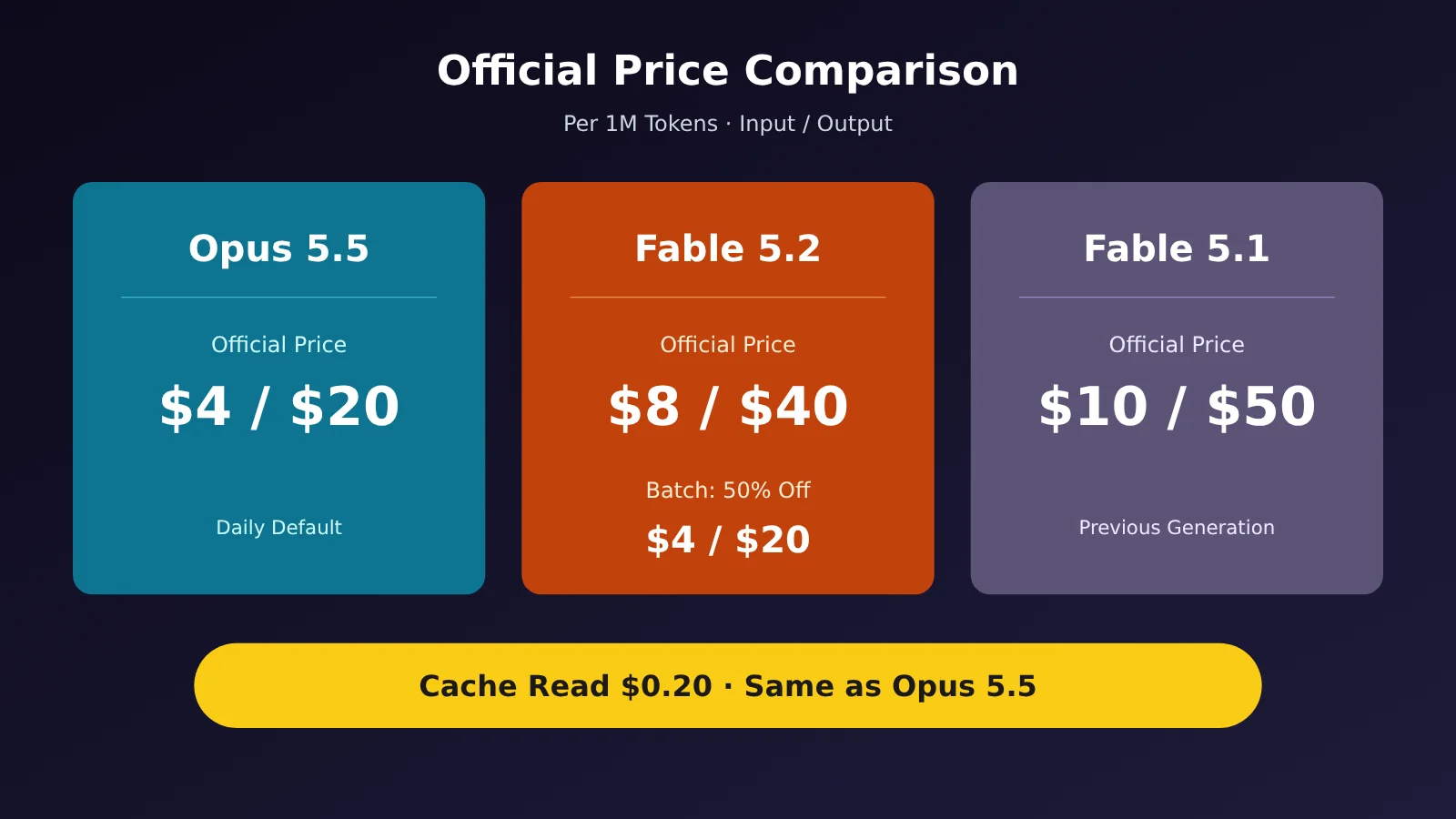
| Standard pricing | $8 input, $40 output (per million tokens) | Twice the price of Opus 5.5, but 20% cheaper than Fable 5.1 |
| Thinking | Adaptive thinking is always on and can’t be disabled | To make it think less, adjust the effort level |
| Data retention | 30-day retention is required by default | If you need zero data retention, confirm authorization first |
What’s the relationship between Claude Fable 5.2 and Mythos 5.2?
The launch announcement puts it plainly: Claude Fable and Claude Mythos are the same underlying model. The difference is that Fable has stronger cybersecurity and biosecurity safeguards, so it’s available to all users. Mythos is only available to organizations that have passed verification for life sciences or cybersecurity programs. Both have the same price.
So, “Mythos is more powerful” is a misinterpretation. Some of the cybersecurity and biosecurity results in the announcement, such as the 76.3% on CyScenarioBench, are attributed to Mythos 5.2. Those scores are for Mythos without the same safeguards and shouldn’t be attributed to Fable. For regular API users, Fable 5.2 is the version available to them.
Claude Fable 5.2 Specs and Official Pricing
The table below compares the three models listed on the official model pages. We couldn’t retrieve the full specs for Fable 5.1 this time, so only its pricing is included later.
| Spec | Claude Fable 5.2 | Claude Opus 5.5 | Claude Sonnet 5.5 |
|---|---|---|---|
| Context window | 1M tokens | 1M tokens | 1M tokens |
| Maximum output (synchronous Messages API) | 128K | 128K | 128K |
| Standard pricing (input / output) | $8 / $40 | $4 / $20 | $2 / $10 |
| Latency tier | Moderate | Moderate | Fast |
| Default effort in Claude API | high | medium | high |
| Knowledge cutoff | June 2026 | June 2026 | June 2026 |
Fable 5.2 accepts text and images as input and generates text as output. The model page estimates that 1M tokens corresponds to roughly 555,000 words or 2.5 million Unicode characters. These estimates are based on the current tokenizer and don’t mean that Chinese text will necessarily fit at that size.
Note that some models can use a beta header to raise the output limit to 300K on the Message Batches API. Opus 5.5 is on the list, but Fable 5.2 isn’t. Until the official documentation says otherwise, plan for a 128K limit when generating long outputs.
The rest of the official pricing, per million tokens:
- Caching: Cache writes cost $10 for a 5-minute cache and $16 for a 1-hour cache. Cache reads cost $0.20, or 0.025 times the standard input price.
- Batch processing: Input and output are both 50% off. Fable 5.2 batch pricing is $4 for input and $20 for output.
- Fast mode: The model’s intelligence stays the same, while output speed can reach up to 2.5 times the standard rate. Pricing is $16 for input and $80 for output. Opus 5.5 fast mode costs $8 / $40.
- Fast mode caching: The documentation doesn’t list separate prices; it only says cache multipliers apply on top of fast mode pricing. Based on those multipliers, cache reads are about $0.40, 5-minute writes about $20, and 1-hour writes about $32.
- Fast mode parameter: In the Claude API, use
speedwith the valuefast. On Microsoft Foundry, fast mode uses a separate model ID ending in-fast; don’t includespeedin the request.
One more easy-to-miss detail: different speed modes don’t share prompt caches, so switching from fast mode back to standard mode results in a cache miss. The announcement doesn’t list Amazon Bedrock as a fast mode channel, but the standard model is available on Bedrock with the ID anthropic.claude-fable-5-2.
Official Benchmark Results for Claude Fable 5.2
These four numbers best show where Fable 5.2 excels. They’re all from Anthropic’s launch post on 2026-11-09. Unless otherwise noted, the scores for Fable 5.2, Fable 5.1, and Opus 5.5 were measured with safeguards enabled. The benchmark table uses each model’s highest effort level at the time, except where otherwise noted—not its default level.
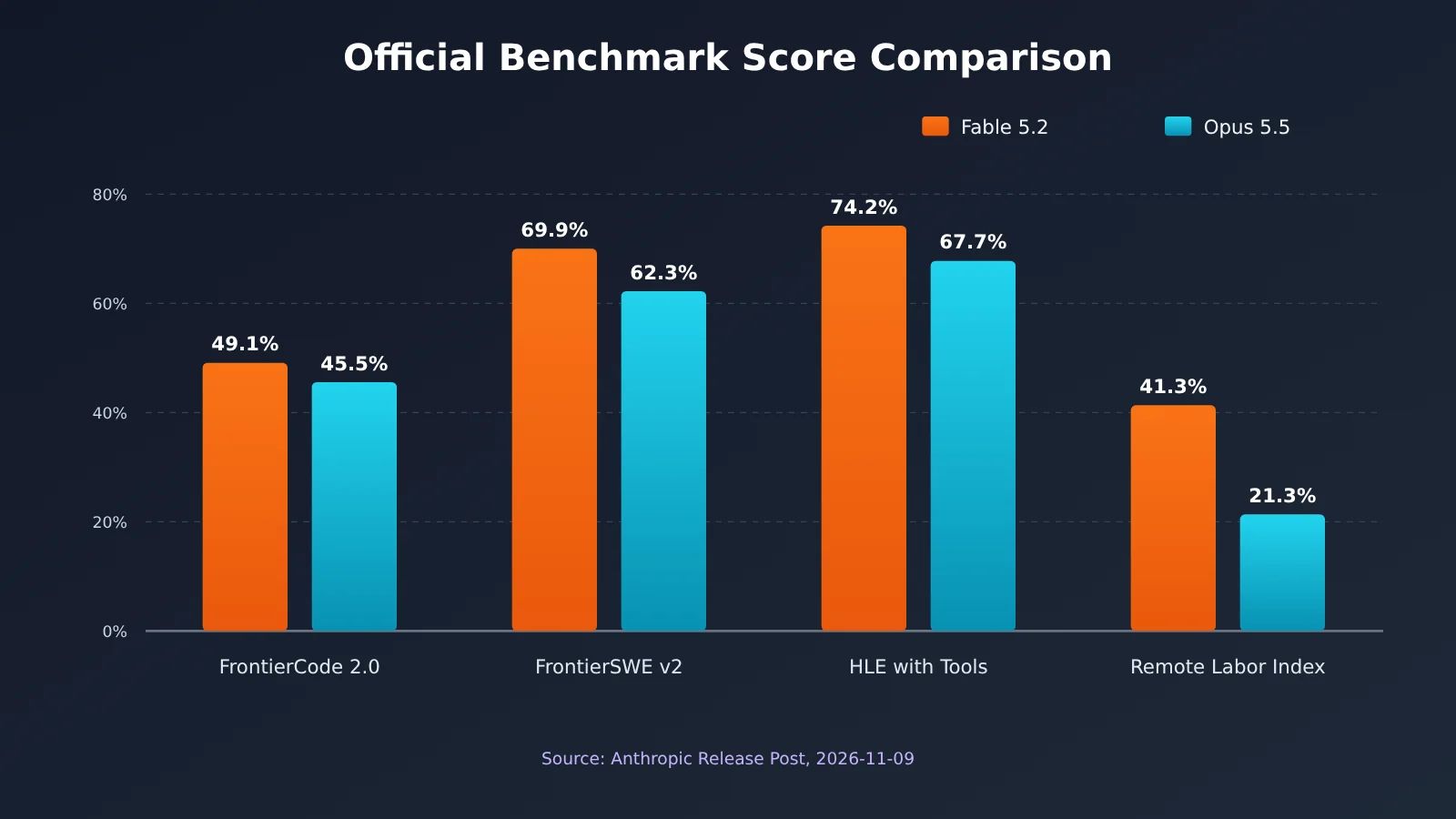
| Benchmark | Fable 5.2 | Effort level notes | Opus 5.5 comparison |
|---|---|---|---|
| FrontierCode 2.0 | 49.1% | Xhigh level, noted in the table | 45.5% (table’s default basis; its highest effort level) |
| FrontierSWE v2 | 69.9% | Not otherwise noted; highest effort level | 62.3% (highest effort level) |
| Humanity’s Last Exam (with tools) | 74.2% | Not otherwise noted; highest effort level | 67.7% (highest effort level) |
| Remote Labor Index | 41.3% | High level, noted in the table; not the highest level | 21.3% (highest effort level) |
How to Read Claude Fable 5.2’s Coding Scores
FrontierCode measures whether changes are likely to be accepted by maintainers of open-source repositories, making it a better reflection of real-world engineering than simply passing tests. At 49.1%, the Xhigh tier is among the highest scores Anthropic has reported for a released model. The launch post also gives a more practical figure: Fable 5.2 scores around 45.3% at the High tier, roughly on par with Opus 5.5’s best score of 45.5%, at about half the cost per task.
That’s an important point if you’re weighing the costs. It suggests Fable 5.2’s value isn’t just that it scores higher at its top tier—it may also complete the same work at the High tier with fewer tokens. But this is Anthropic’s claim on this benchmark. You’ll need to test it against your own repository.
The biggest gap appears in the Remote Labor Index: 41.3% versus 21.3%. And Fable 5.2’s score is at the High tier, not its top tier. These tasks focus on delivering complete work remotely, which fits the model’s positioning for “open-ended, long-running technical work.”
Treat Claude Fable 5.2’s Long-Running Task Stories as One-Off Experiments
The launch post includes several eye-catching stories. As you read them, pay attention to who did the work and how many times the experiment was run:
- Prototype operating system: An engineer asked Fable 5.2 to start from an empty folder and coordinate more than 1,000 subagents over about eight days to build a system that could boot on a laptop. The launch post doesn’t describe this as a repeated experiment, so treat it as a single official experiment.
- Formalizing Fermat’s Last Theorem: 1,000 Fable 5.2 agents ran for 30 hours with little human intervention. Under the same setup, Opus 5.5 completed about 26% in 18 hours and made almost no further progress by the 30-hour mark. The figure caption states that each model was run only once.
- Migrating Python to Rust: The migration of a key production service to Rust, which made it start about 26 times faster, was done by a group of earlier Fable 5.2 agents—not the released 5.2.
- 90% of merged changes: The launch post says that Claude wrote more than 90% of the merged changes in a core codebase, with human guidance. The claim is about Claude, not Fable 5.2 specifically.
These examples show what the model might be capable of, but they shouldn’t be taken as consistent results. If your business depends on runs that last several days, treat that as a hypothesis you’ll need to reproduce yourself.
Four Boundaries of Claude Fable 5.2
The results show where it excels. The four points below show where its strengths stop. They’re ordered by model selection → capabilities → safety → product mechanics.
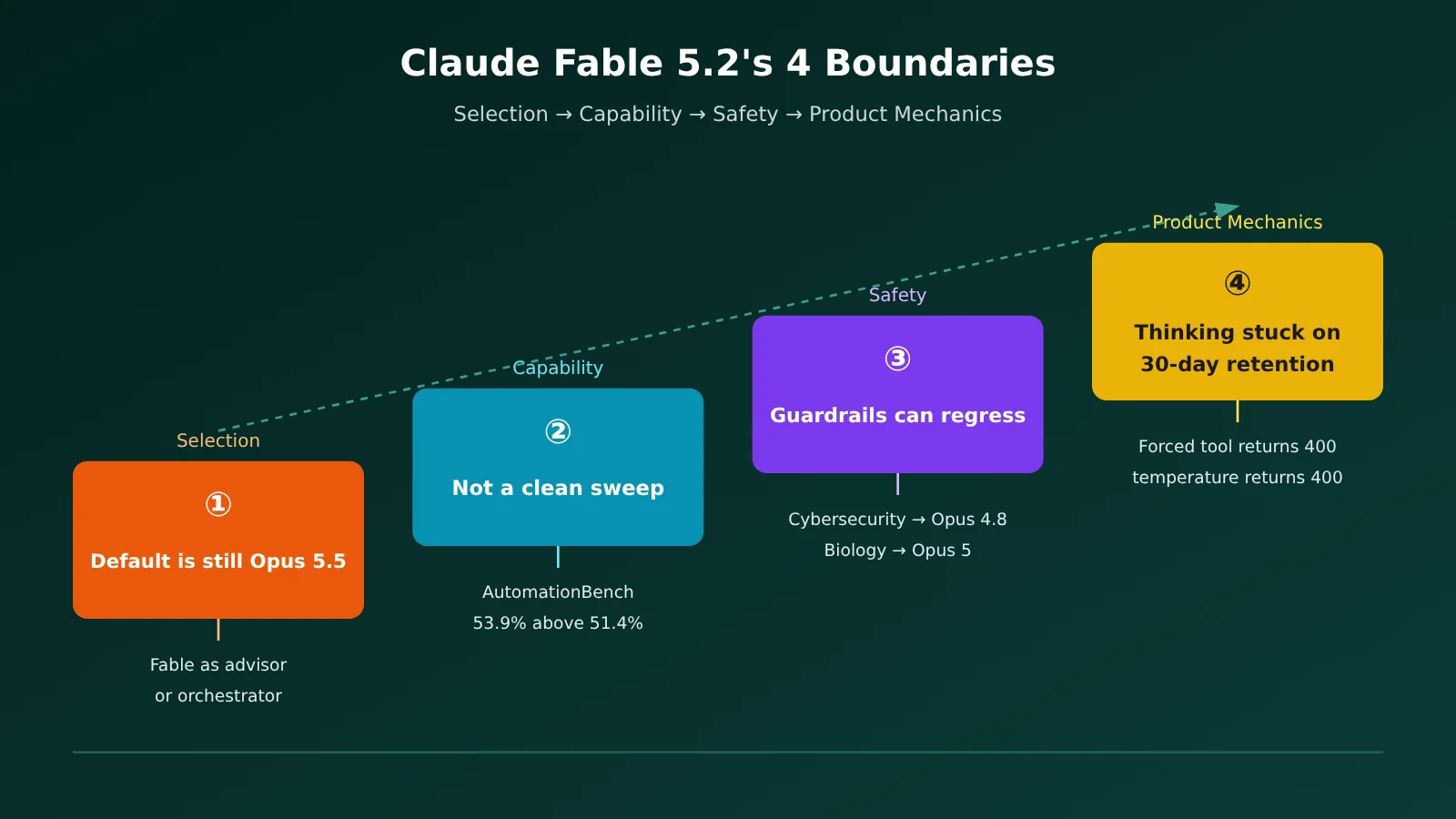
Boundary 1: Claude Fable 5.2 Isn’t the Everyday Default
The launch post recommends starting with Opus 5.5 for most coding and knowledge work, then moving up to Fable or Mythos for harder tasks—or down to Sonnet 5.5 or Haiku 5.5. Fable 5.2 is best suited to the biggest, most open-ended technical tasks.
There are also two more cost-effective ways to use it. First, use it as an advisor that smaller models can consult when they hit a tough problem. Second, use it as an orchestrator: have it break down a task and delegate the simpler parts to smaller models. That way, you spend expensive tokens only on the hardest steps.
Boundary 2: Claude Fable 5.2’s Scorecard Isn’t a Clean Sweep
The announcement compares Fable 5.2 with GPT-6 Astra and Gemini 4 Carbon. Anthropic ran the evaluations; these aren’t leaderboards published by OpenAI or Google. And even on this scorecard, Fable 5.2 loses in a few categories.
| Benchmark | Fable 5.2 | Leader | Notes |
|---|---|---|---|
| AutomationBench | 51.4% | Gemini 4 Carbon 53.9% | Carbon scores higher here |
| AA-Briefcase v1.1 Elo | 1785 | Opus 5.5 1800 | Opus leads on Elo |
| AA-Briefcase v1.1 rubric score | 66.1% | Fable 5.2 | Opus 5.5 scores 61.2% |
| Chartography (no tools) | 73.4% | Fable 5.2 | Carbon scores 72.5%, Astra 71.0%—a narrow margin |
The AA-Briefcase results are worth a closer look. Fable leads on the rubric score, but Opus leads on Elo. That suggests that with more subjective, preference-based judgments, the more expensive model isn’t necessarily the more popular one. If your work involves writing briefs or other document-heavy knowledge work, Opus 5.5 isn’t just a fallback.
Boundary 3: Claude Fable 5.2’s Safety Guardrails Can Change Who Answers
When a safety classifier blocks a request, Fable 5.2 doesn’t simply return nothing: Opus 4.8 handles cybersecurity requests, while Opus 5 handles biology requests. Rejected requests return HTTP 200 with stop_reason set to refusal. Your code should check this field rather than relying only on the status code. Whether refusals before output are billable depends on the refusal category, but they all count toward rate limits.
There’s another, less obvious limitation: capabilities directly related to AI research are deliberately restricted. Tasks like optimizing accelerator kernels and improving Large Language Model architectures are held to roughly the level of Opus 5.5. A few topics—including kernel development for certain nonstandard accelerators—transparently fall back to Opus 5 at inference time. This isn’t a failed request. Agentic coding, hardware development, and traditional machine learning research aren’t affected by this restriction.
According to Anthropic’s early tests, Fable 5.2 is blocked about 55% less often than Fable 5.1 on claude.ai, Claude Code, and Cowork—about 60% less often for cybersecurity and 40% less often for biology. These are Anthropic’s early test results, not independent reproductions.
Boundary 4: Claude Fable 5.2 Has Hard Product Limitations
These limitations directly affect your existing API calls, so check each one before migrating:
- You can’t turn off thinking: Adaptive thinking is always on. At medium effort or higher, telling it “don’t think, just answer” in the prompt won’t stop it from thinking. To make it think less, lower the effort setting.
- Forcing a tool call returns a 400 error: Setting
tool_choicetoanyortoolwill cause an error. - Sampling parameters return a 400 error: Don’t pass
temperature,top_p, ortop_k. - Data is retained for 30 days: Zero data retention isn’t available unless Anthropic explicitly authorizes it. Eligible enterprises can use zero retention before adopting Enterprise Frontier Safeguards; other customers’ data is retained for 30 days for safety monitoring.
- Long tasks may stop on their own: Sometimes it stops after a single turn, leaves a to-do list, says it can continue, or gets stuck on a routine obstacle. This is more common at low effort. During long sequences of tool calls, it may say very little to the user.
- Thinking blocks aren’t interchangeable: Only Fable 5.2 and Mythos 5.2 can read Fable 5.2 thinking blocks. If Fable 5.2 is the executor, the advisor must also be Fable 5.2 or Mythos 5.2.
The release notes also warn that specifying “who owns the code” in the prompt affects whether it modifies the existing structure or starts from scratch. It follows style rules very strictly, but setting sentence length constraints too rigidly can make the output choppy.
Which Claude Fable 5.2 Models You Can Call—and Which Aren’t Listed Yet
As of 2026-11-10, we checked APIYI apiyi.com’s model catalog and public pricing endpoint. Neither lists claude-fable-5-2 or any Mythos models. We’ll make this model available as soon as possible. Check the platform’s model list for the latest model and pricing information.
Until it’s listed, you can use the already-available Opus 5.5 for day-to-day work and save the toughest tasks for Fable 5.2. If you need Fable-level capabilities now, Fable 5.1 is listed—but it’s not 5.2, and its performance and behavior differ.
| Model ID | APIYI apiyi.com status | List price (input / output / cache read, per million tokens) | Endpoints |
|---|---|---|---|
claude-opus-5-5 |
Available (also has a -thinking version) |
$4 / $20 / $0.2 | chat, messages |
claude-fable-5-1 |
Available (also has a -thinking version) |
$10 / $50 / $0.25 | chat, messages |
claude-fable-5-2 |
Not listed | Not available; check the platform’s model list | — |
claude-mythos-5-2 |
Not listed | Not available | — |
The dollar amounts in the table are list prices. Your actual charges are multiplied by the token group rate; refer to your bill for the final amount. Since Fable 5.2 isn’t listed, there’s no price to apply a multiplier to. Don’t estimate APIYI charges based on the official price. APIYI offers an OpenAI-compatible endpoint at https://api.apiyi.com/v1. You can use a single key to switch between Opus 5.5 and Fable 5.1. New users get free testing credits, so you can compare the two models on your own repository.
Claude Fable 5.2: Pros and Cons
Pros
- Much stronger at open-ended, long-running tasks: On the Remote Labor Index, its High-tier score is nearly twice Opus 5.5’s.
- Strong value at the High tier: It scores about 45.3% on FrontierCode at the High tier, matching Opus 5.5’s best result at roughly half the per-task cost, according to Anthropic.
- Cheaper and faster than 5.1: Standard pricing is 20% lower, and the launch post says it generates output up to 30% faster than 5.1.
- Affordable cache reads: At $0.20, the price is the same as Opus 5.5.
Limitations
- Standard pricing is twice Opus 5.5’s: Switching over for everyday tasks will double your bill.
- It doesn’t win across the board: It loses to Gemini 4 Carbon on AutomationBench and to Opus 5.5 on AA-Briefcase Elo.
- Safety guardrails and capability ceiling: Cybersecurity and biology questions may be routed to older models. Kernel optimization and model architecture improvements are roughly on par with Opus 5.5.
- Several restrictions on API calls: Thinking can’t be turned off; forcing tools or setting sampling parameters can trigger a 400 error; data is retained for 30 days by default; and long-running tasks may stop on their own.
Frequently Asked Questions (FAQ)
Q1: What’s the difference between Claude Fable 5.2 and Fable 5.1?
In terms of pricing, 5.2’s standard rates are $8 for input and $40 for output—20% lower than 5.1’s $10 / $50. Cache reads have also dropped from $0.25 to $0.20. On benchmarks, FrontierSWE v2 improves from 56.3% to 69.9%, while the Remote Labor Index rises from 17.9% to 41.3%. In terms of behavior, 5.1 usually follows prompts like “don’t think,” while 5.2 won’t do so at medium effort or higher. Currently, APIYI at apiyi.com offers `claude-fable-5-1`; 5.2 isn’t available yet.
Q2: Is Claude Mythos 5.2 a more powerful model?
No. The launch post says Fable and Mythos use the same underlying model. Mythos has fewer cybersecurity and biology guardrails, so it’s only available to organizations with approved projects. Its pricing is the same as Fable 5.2’s. Some cybersecurity and biology results in the launch post are attributed to Mythos, so they shouldn’t be cited as Fable 5.2 results.
Q3: Can you turn off thinking in Claude Fable 5.2?
No. Adaptive thinking is always on, and prompts can’t stop it. To control the amount of thinking and its cost, you can only lower the effort level. Claude API defaults to high, while the Claude app and Claude Code default to Medium. Keep in mind that low effort is more likely to make the model stop after one turn and leave a to-do list behind, so it’s not recommended for long-running tasks.
Claude Fable 5.2 Key Takeaways
- Positioning: A flagship model for technical work, released on 2026-11-09. Opus 5.5 remains the default for everyday use.
- Strengths: Scores 69.9% on FrontierSWE v2 and 41.3% in the High tier of the Remote Labor Index.
- Not a clean sweep: It loses to Carbon on AutomationBench and trails Opus in Elo on AA-Briefcase.
- Guardrails: Cybersecurity requests are answered by Opus 4.8, and biology requests by Opus 5. After a handoff, the response won’t expose
stop_reason. - Product limitations: Thinking is always on; forcing tools or setting sampling parameters returns a 400 error. Data is retained for 30 days by default.
- Long-task examples: The eight-day operating system project and the 30-hour Fermat project were both one-off official experiments.
- Availability: As of 2026-11-10, Fable 5.2 isn’t available on APIYI. For now, you can use Opus 5.5 and Fable 5.1.
Summary: When Not to Switch to Claude Fable 5.2
Fable 5.2’s strengths are real, but they’re concentrated in open-ended technical work that runs for a long time. In the following four situations, it’s better to stick with Opus 5.5 or use Fable only as an advisor or orchestrator:
- You’re budget-conscious: The standard price is twice Opus 5.5’s, and Fast mode doubles it again.
- You require zero data retention: The default retention period is 30 days, and zero retention isn’t available without authorization.
- Your work involves cybersecurity or biology tasks that trigger guardrails: Once blocked, the response comes from Opus 4.8 or Opus 5 instead, so you won’t get Fable’s capabilities.
- You’re doing routine coding: Anthropic itself recommends starting with Opus 5.5.
If your task really does call for the “largest, most open-ended” option, first get the workflow working with Opus 5.5, then hand the hardest step to Fable. Once 5.2 is available, check the platform’s model list for the current model name and pricing.
Author: APIYI Technical Team
Technical questions: Contact us from the APIYI homepage. For more resources, visit the documentation center at docs.apiyi.com.