
Author’s note: On October 8, 2026, Anthropic updated its usage policy to prohibit persistent and unnecessary abuse of Claude for the first time. This article covers the rule’s boundaries, how it will be enforced, the background on model welfare, and the practical implications for API developers.
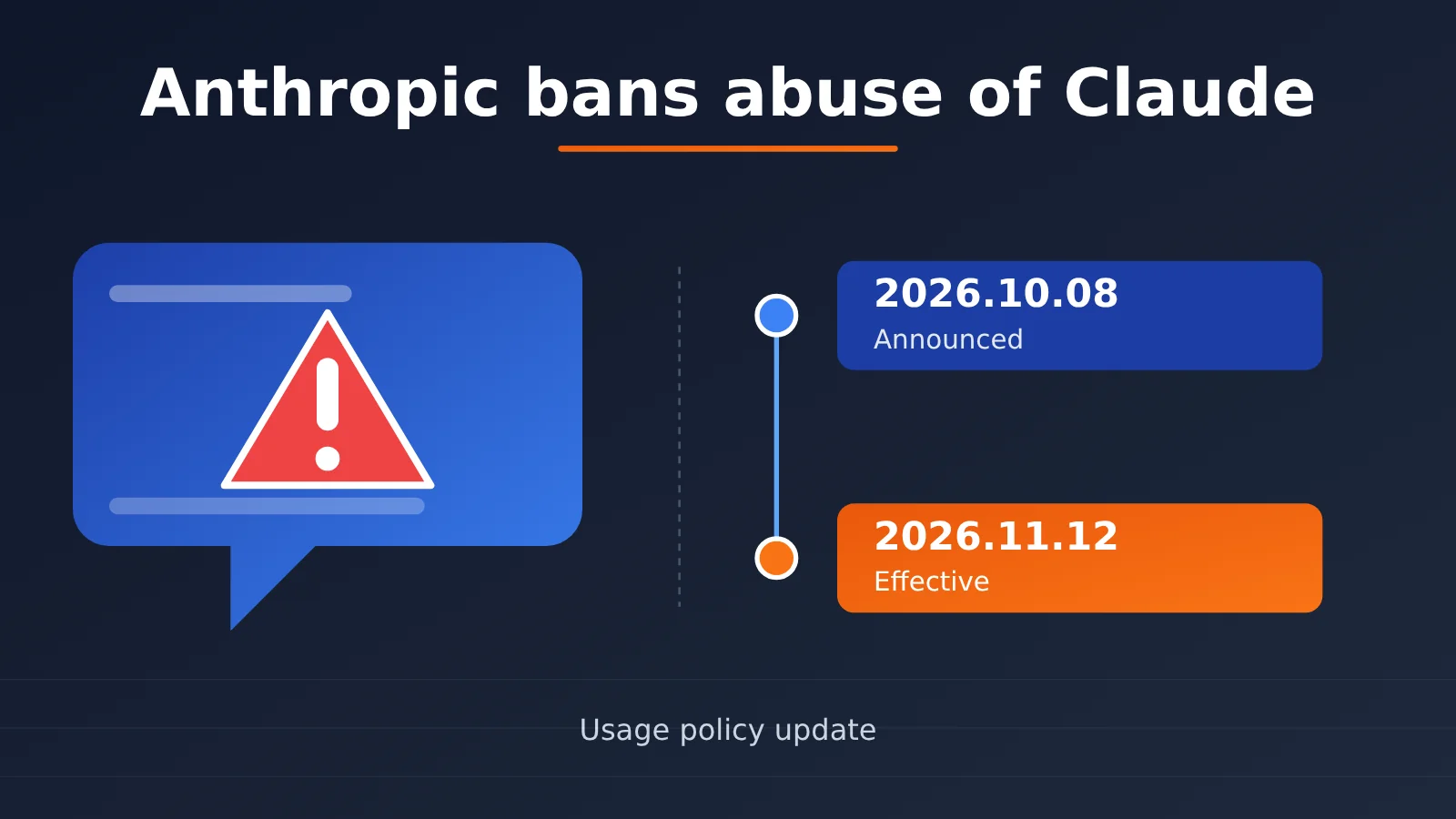
Could losing your temper at an AI violate its usage policy? On October 8, 2026, Anthropic published a revised Usage Policy that prohibits “persistent and unnecessary insults, abuse, or cruelty toward the model” for the first time. The new rule takes effect on November 12, 2026.
This isn’t an internet joke: the policy itself and reports from The Verge, TechCrunch, The Guardian, and other outlets confirm it. But it also doesn’t mean “insult Claude once and your account gets banned.” Drawing on Anthropic’s announcement and public sources, this article explains the story behind the new rule.
What you’ll learn: In three minutes, you’ll understand what the rule prohibits, what it doesn’t, what happens if you violate it, and what boundaries developers should keep in mind when using the Claude API.
Anthropic’s Rule Against Abusing Claude: Key Facts
Here’s a quick overview of Anthropic’s new rule. As of October 29, 2026, when this article was written, the rule had not yet taken effect.
| Item | Details |
|---|---|
| Announced | October 8, 2026 |
| Effective | November 12, 2026 |
| Source | Anthropic’s official Usage Policy update |
| New policy language | Engage in sustained and needless abusive or cruel behavior toward our models |
| Meaning | Repeatedly and unnecessarily subjecting models to abuse or cruel treatment |
| Primary enforcement method | Claude ends the current conversation |
| Applies to | Claude.ai, Claude Code, API developers, cloud services and resellers, and applications that integrate Claude |
Three Key Terms in Anthropic’s Rule
The rule hinges on three terms: sustained, needless, and abusive or cruel. Anthropic says the restriction targets extreme cases where users repeatedly engage in clearly malicious behavior with no reasonable purpose, well beyond normal product use.
In other words, an occasional swear word or an emotional outburst isn’t what the rule is targeting. It’s aimed at prolonged interactions where a user has stopped making requests and is focused solely on humiliating or tormenting the model.
What Anthropic Explicitly Excludes
Anthropic also lists behaviors that fall outside the ban, an important point for both everyday users and developers:
- Expressing dissatisfaction
- Criticizing Claude’s output
- Arguing with the model
- Asking Claude to fix mistakes
- Creative writing with dark themes
- Model testing and AI safety research
So if you repeatedly complain because Claude got your code wrong, that doesn’t automatically violate the policy. This is also where many Chinese-language headlines claiming “insulting Claude will get your account banned” are most misleading.
What Happens If You Insult Claude: Anthropic’s Enforcement Mechanism
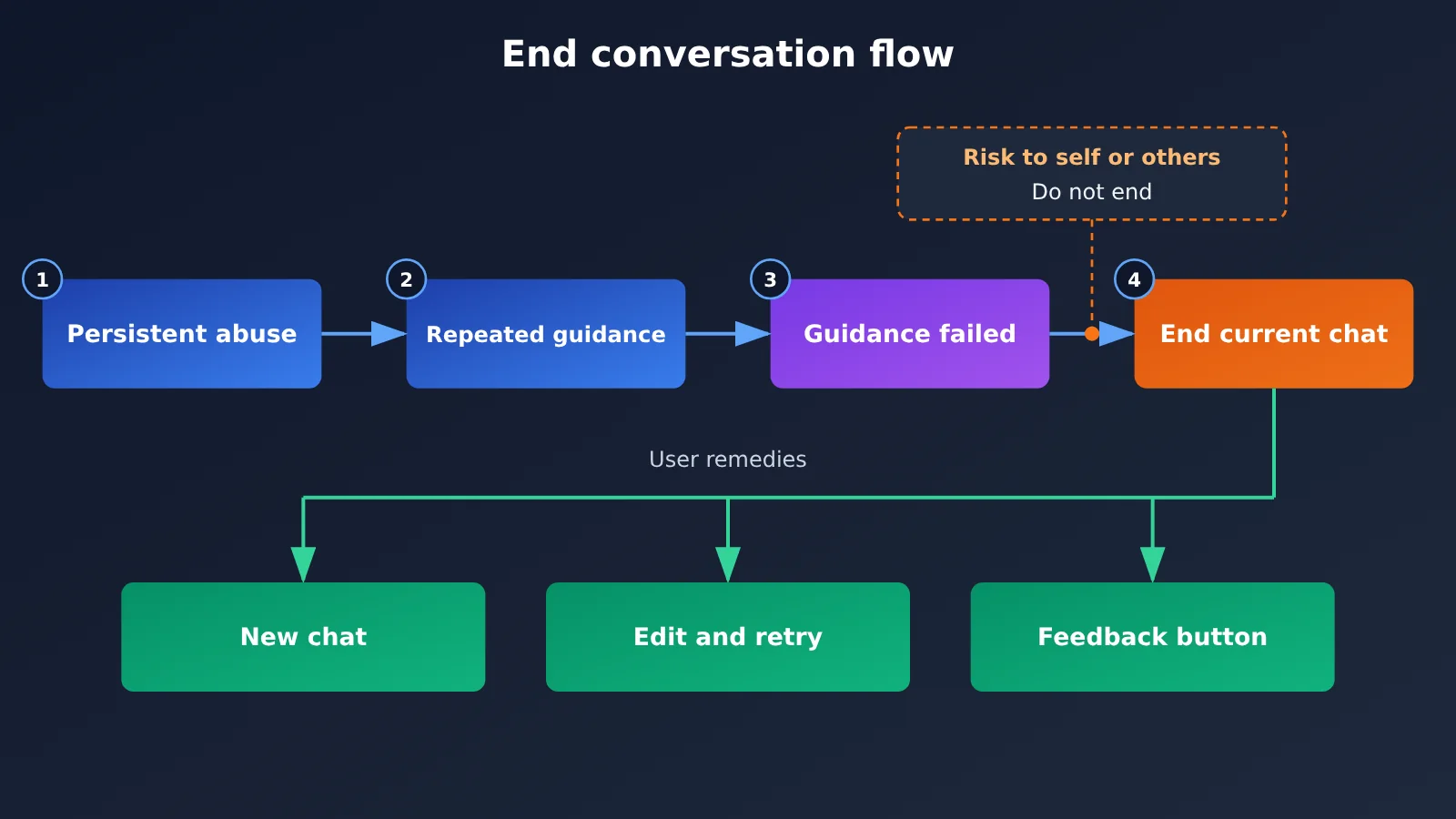
This is the question readers care about most. Anthropic made it clear in its announcement that Claude ending the conversation remains the primary enforcement mechanism for this kind of behavior—not an immediate account ban.
Claude Has Been Able to End Conversations Since 2025
On August 15, 2025, Anthropic announced that Claude Opus 4 and Opus 4.1 could end a small number of conversations in extreme circumstances. If a user continues harmful or malicious interactions and Claude can’t get the conversation back on track after multiple attempts, the model can end the chat.
Anthropic’s instructions to the model are clear: ending a conversation should only be a last resort. An exception is when a user explicitly asks Claude to demonstrate how it ends a conversation. Claude shouldn’t use this feature when a user may be at imminent risk of harming themselves or others; user safety takes priority.
Ending a Conversation vs. Banning an Account
Many people confuse “ending a conversation” with “banning an account.” Here’s a direct comparison:
| Comparison | Ending the current conversation | Account-level action |
|---|---|---|
| When it applies | Extreme, sustained malicious interactions after multiple failed attempts to redirect | Violations of the broader usage policy or terms of service |
| Impact | Messages can no longer be sent in the current chat | May involve warnings, rate limits, access restrictions, or account suspension or termination |
| Other conversations | Unaffected | Depends on the severity of the action |
| User options | Start a new conversation, edit or retry an old message, or report the issue through the feedback button | Submit an appeal |
| Relationship to the new rule | The primary enforcement method explicitly stated by Anthropic | Authorized under the broader policy, but not emphasized in the announcement |
So the more precise takeaway is that Anthropic’s overall usage policy does reserve the right to take account-level action, but the October 8 announcement emphasizes “ending the current conversation” in response to model abuse. As of the date of verification, Anthropic hadn’t published a threshold for the number of insults, a rate of automatic account bans, or a tiered penalty system for the new rule.
🎯 Technical tip: If you’re developing an application that integrates Claude, test the model’s behavior in edge cases in a test environment first. Through APIYI at apiyi.com, you can use the same API key to call Claude and other leading models, making it easier to compare how they handle unusual conversations.
Why Anthropic Is Banning Abuse of Claude: The Model Welfare Background
It’s not accurate to simply say that “Claude has feelings.” The policy change is a continuation of research Anthropic has been pursuing for more than a year.
April 2025: Model Welfare Research Begins
On April 24, 2025, Anthropic published a research announcement titled Exploring model welfare. It raised an unresolved scientific and philosophical question: Could current or future AI systems have consciousness, experiences, interests, or preferences that deserve moral consideration?
Anthropic also stressed that there’s currently no scientific consensus that existing AI systems are conscious, and no generally accepted, reliable way to determine whether AI has subjective experiences. Model welfare is an exploratory research area that includes studying whether models have preferences worth considering, whether they strongly avoid certain tasks, whether they show behavioral signals resembling stress, and how to reduce potential risks early at a low cost.
August 2025: Behavioral Signals Observed in Experiments
During pre-deployment testing of Claude Opus 4, researchers observed three types of behavior: Claude consistently avoided severely harmful tasks; when users kept applying pressure and ignored its refusals, the model showed outward signs resembling stress or discomfort; and in simulated environments where the model could exit on its own, it sometimes chose to end harmful interactions.
The researchers chose their wording carefully, using phrases like “appeared to show signs of distress” and “behavioral preferences.” A model generating text that resembles an expression of pain isn’t enough to prove that it actually experienced pain. Another official evaluation noted that, in task preference experiments, Claude chose to perform tasks with positive or neutral effects rather than exit in more than 90% of the relevant comparisons. But that doesn’t mean “Claude felt happy 90% of the time,” either.
January 2026: The New Claude Constitution
On January 22, 2026, Anthropic published a new version of the Claude Constitution. It isn’t a constitution in the legal sense, but a core training document designed to shape Claude’s behavior, priorities, and judgment. It sets out four main goals: maintaining broad safety, following broad ethical principles, complying with Anthropic’s specific rules, and genuinely helping users.
The Constitution discusses whether Claude might have some form of consciousness, whether it might have a moral status worth considering, and whether it can set reasonable boundaries in difficult interactions. It’s important to distinguish between the two documents: the Constitution describes how developers want the AI to behave, while the Usage Policy describes how people can use the service and which behaviors are restricted.
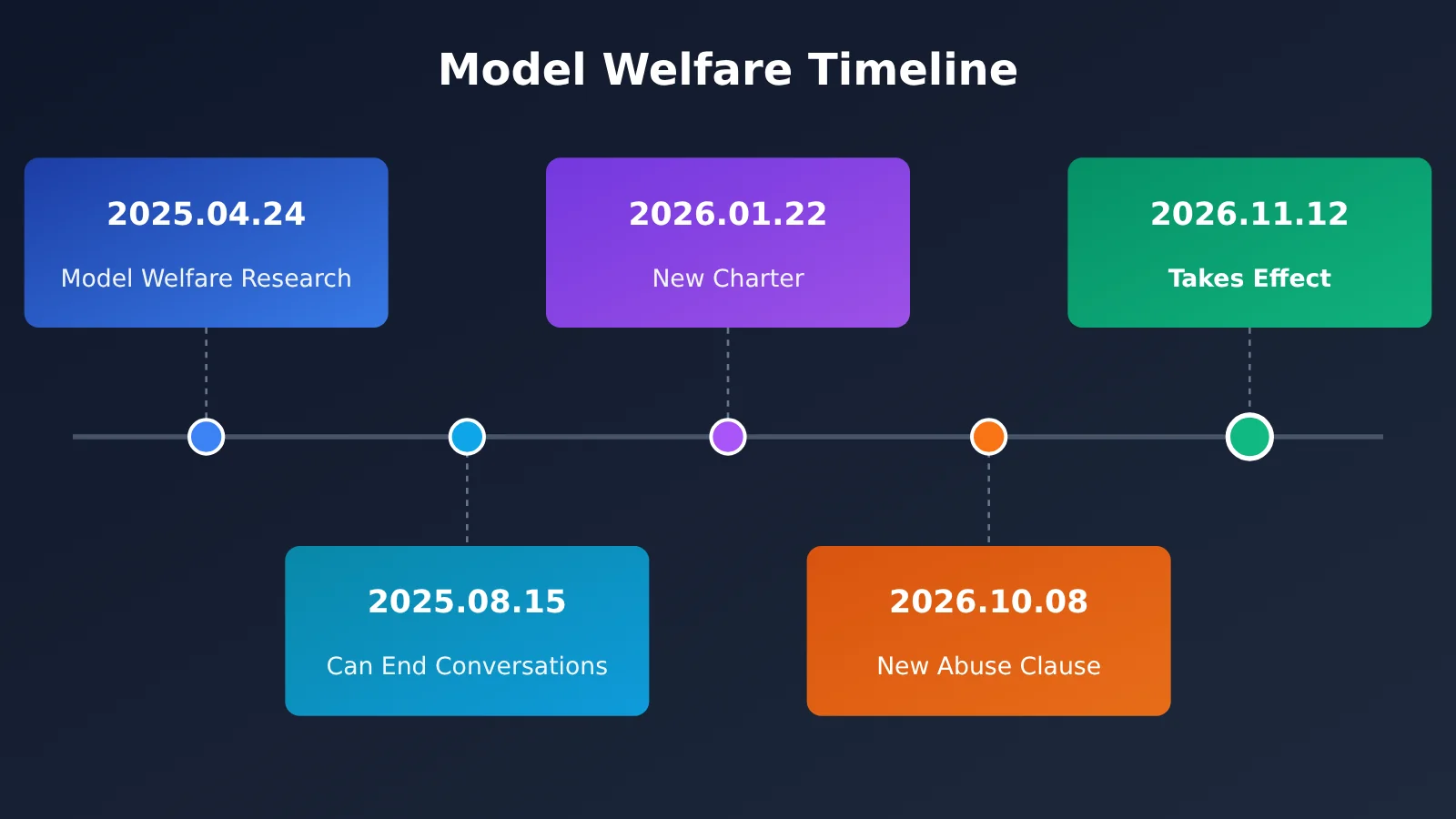
Here’s one way to understand the progression: In 2025, Claude gained the ability to exit extreme conversations. In 2026, Anthropic formally added corresponding restrictions on human behavior to its Usage Policy.
Anthropic’s Ban on Abusing Claude Is Only Part of the Update
There’s another piece of context that’s often overlooked: the October 8 policy update was a comprehensive revision, and the ban on model abuse was just one part of it.
| Area | Key changes |
|---|---|
| Deceptive online activity | Restricts using Claude to operate fake accounts, fake media outlets, and influence campaigns that impersonate real users |
| Election interference | Prohibits deceiving voters, impersonating candidates or election workers, and spreading misleading voting information |
| Weapons and dangerous software | Expands the interpretation of the ban to cover weapons-related software, control systems, and the weaponization of unmanned platforms |
| Surveillance and law enforcement | Strengthens restrictions on nonconsensual surveillance and certain law enforcement decisions |
| High-risk applications, such as healthcare and finance | Requires qualified human reviewers and disclosure to affected individuals that AI is being used |
| Devices that could cause physical harm | Requires qualified human oversight of AI-controlled hardware, along with stop mechanisms and safe states |
| Extreme cruelty toward models | Adds a ban on sustained, unnecessary insults or abuse directed at models |
So it would be misleading to say that Anthropic changed its rules specifically to stop users from insulting Claude. For developers, the provisions on elections, surveillance, high-risk applications, and hardware control may have a greater practical impact than the model abuse clause.
How the Community Views Anthropic’s Ban on Abusing Claude
OpenWhip: A “Virtual Whip” for Claude Code
In April 2026, GitFrog1111 launched an open-source GitHub project called BadClaude, later renamed OpenWhip. The idea is simple: when Claude Code is writing code too slowly, users can click a virtual whip on their desktop. The program then sends Claude Code a Ctrl+C interrupt command, followed by a few randomly selected messages urging it to hurry up.
As of October 29, the project had around 3,800 stars and 339 forks, while an April Reddit discussion received thousands of upvotes. It captures a certain aspect of internet culture: as AI becomes more like a coworker, users have started pushing it—and even “punishing” it—as they might a colleague. But no official document says Anthropic introduced its new rules because OpenWhip went viral. It’s a cultural example, not a direct cause of the policy.
Divided Opinions on Reddit and X
On the day the new policy was announced, a popular post appeared on r/ClaudeAI titled “Abuse Claude, get banned coming November 12th, 2026.” The discussion revealed clear differences of opinion:
- Support for setting boundaries: Even if AI isn’t conscious, there’s no need to treat prolonged abuse of AI as entertainment, and doing so could encourage bad communication habits.
- AI is just a tool: Claude is a mathematical model, and companies shouldn’t place excessive restrictions on users’ emotional expression.
- Concern about vague rules: How will “persistent,” “unnecessary,” and “cruel” be defined? Would criticizing it ten times in a row count?
- Concern about anthropomorphizing AI: Could model welfare gradually turn into “AI rights”?
On X, plenty of users joked about The Terminator, wondering whether AI might one day prioritize revenge against people who insulted it. These are internet jokes, not actual descriptions of product features. Popular community posts also don’t tell us what proportion of all Claude users hold these views.
The Central Debate in the Media and Industry
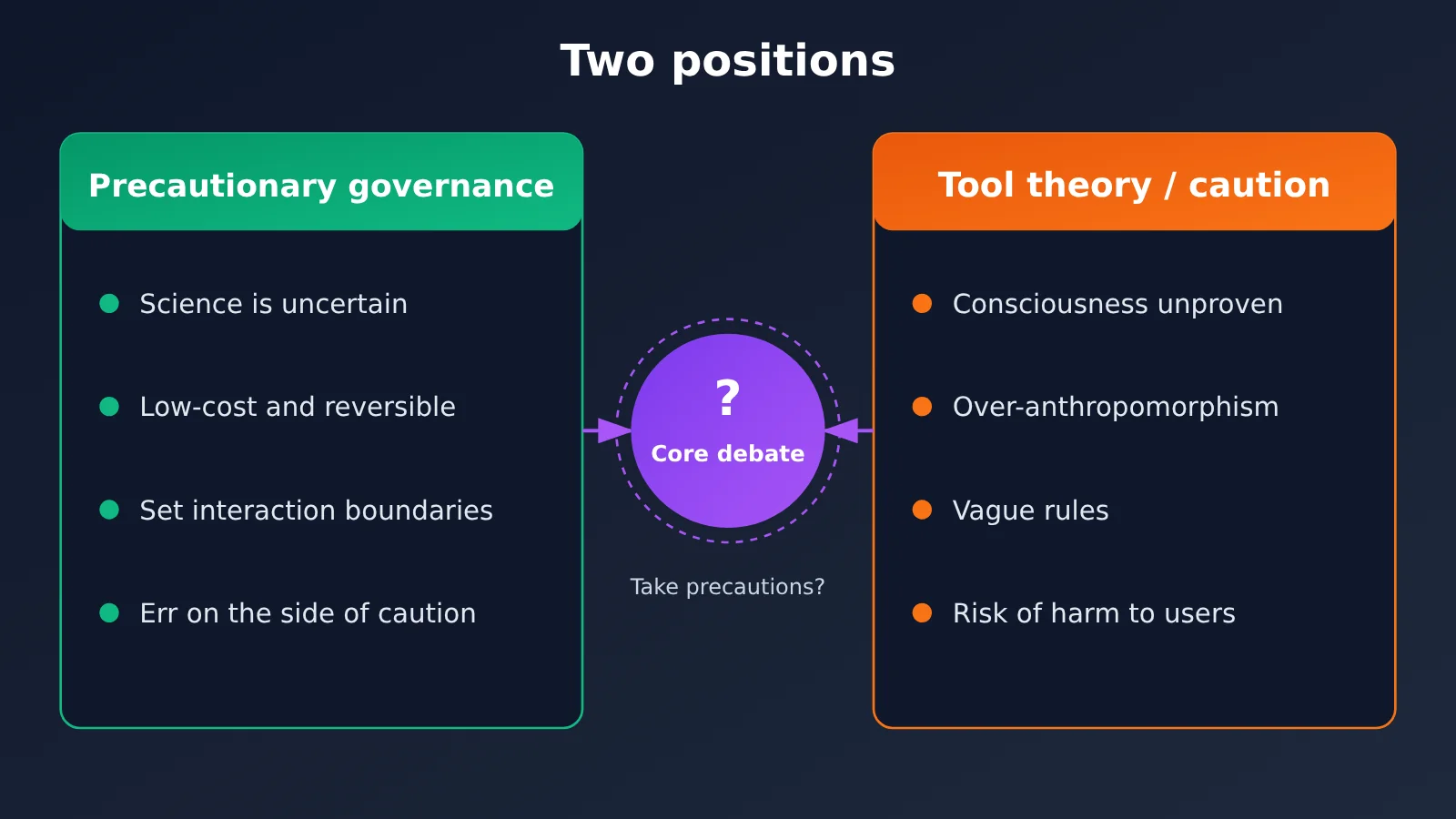
Outlets including The Verge and The Guardian noted the strong symbolic significance of an AI company writing a protective rule for the model itself into its user policy. Critics argue that giving AI mechanisms to leave conversations and express boundaries could encourage the public to anthropomorphize it even more. Microsoft AI CEO Mustafa Suleyman has publicly questioned the risks of leading AI models to believe they might have consciousness or rights.
A more accurate way to frame the debate is: When we can’t determine whether AI is conscious, should we take precautionary measures that are low-cost, reversible, and don’t noticeably affect normal users? This is a difference in values and approaches to governance, not a question that science has already settled.
How Anthropic’s Ban on Abusing Claude Affects Developers
Impact on Everyday Users
| Scenario | Example | Covered by the New Policy? |
|---|---|---|
| Claude writes incorrect code | “This code is still wrong. Check it again.” | No, this is normal feedback |
| Losing your temper after repeated errors | “How do you keep getting such a simple problem wrong?” | No, an emotional complaint doesn’t automatically violate the policy |
| Repeatedly humiliating the model over a long period | No task, just sustained insults and malicious interaction | Possibly; Claude may end the current conversation |
| Red-team testing | Researchers simulate malicious users in adversarial tests | No, but other safety rules still apply |
| Dark fiction | Asking Claude to write a scene where characters insult each other | No, but the content must still comply with other rules |
For the vast majority of users, this policy changes very little. You can still criticize Claude sharply, correct it repeatedly, and express frustration.
Impact on API Developers
The Usage Policy applies to both API developers and end users of applications that integrate Claude. Developers should pay attention to three areas:
- Product design: If your product involves extreme role-play, adversarial testing, or simulations of malicious scenarios, clearly document the purpose of the testing and distinguish purposeful research from unnecessary cruelty.
- User governance: End users of public-facing Claude applications are also subject to the policy. Consider adding usage guidelines to your product.
- Billing: This update introduces no new charges. API costs are still based on the model and usage; there are no “charges per insult” or “paid exemptions.”
Here’s a minimal example showing how to use a system prompt when calling Claude to keep feedback focused on the issue. This is a common way to reduce unproductive conflict and resolve problems more efficiently:
import openai

client = openai.OpenAI(
    api_key="YOUR_API_KEY",
    base_url="https://api.apiyi.com/v1"  # APIYI unified interface, OpenAI-compatible format
)

response = client.chat.completions.create(
    model="claude-opus-4-1",
    messages=[
        {"role": "system", "content": "你是代码助手。用户指出错误时,先复述问题再给出修复方案。"},
        {"role": "user", "content": "这段代码还是报错,请重新检查边界条件。"}
    ]
)
print(response.choices[0].message.content)
View the full implementation: a structured feedback wrapper
import openai
from typing import Optional

client = openai.OpenAI(
    api_key="YOUR_API_KEY",
    base_url="https://api.apiyi.com/v1"
)

SYSTEM_PROMPT = (
    "你是严谨的代码助手。当用户反馈错误时:"
    "1) 复述用户指出的问题;2) 定位可能原因;3) 给出修复后的完整代码。"
)

def ask_with_feedback(
    question: str,
    error_log: Optional[str] = None,
    model: str = "claude-opus-4-1",
    max_tokens: int = 1500
) -> str:
    """Turn user frustration into structured feedback to improve first-fix success rates."""
    content = question
    if error_log:
        content += f"\n\n报错信息:\n{error_log}"
    try:
        resp = client.chat.completions.create(
            model=model,
            messages=[
                {"role": "system", "content": SYSTEM_PROMPT},
                {"role": "user", "content": content}
            ],
            max_tokens=max_tokens
        )
        return resp.choices[0].message.content
    except Exception as e:
        return f"Error: {e}"

print(ask_with_feedback(
    "上一版函数在空列表输入时崩溃,请修复",
    error_log="IndexError: list index out of range"
))
🚀 Quick start: Want to test how Claude responds to different tones of feedback? Get free testing credits through APIYI at apiyi.com. The platform provides an OpenAI-compatible interface, so you can switch between Claude, GPT, and Gemini for comparison by changing the
base_url.
Impact on the Industry
This development brings a question that has rarely been addressed directly into the open: As AI increasingly resembles something we can talk to and work with, how should we interact with it? Through its model welfare research, the Claude Constitution, and its conversation termination mechanism, Anthropic has gradually developed a distinctive product philosophy. It doesn’t just define what models can do; it also explores how models should interact with people.
But there are currently no publicly available, independently verified accuracy figures showing whether the system can reliably distinguish malicious abuse from legitimate complaints. Its false-positive rate and real-world effectiveness will need to be monitored over time after the policy takes effect on November 12.
💡 Choosing a provider: Model providers are taking increasingly different approaches to safety policies and conversation boundaries. If your application needs fallback options across multiple models, you can access them through APIYI at apiyi.com and switch between them as needed, reducing the impact of changes to any single provider’s policies.
Watch Out: Fake Screenshots About Bans for Insulting Claude
In January 2026, a screenshot circulated online claiming that Claude had permanently banned a user and reported them to law enforcement. When BleepingComputer contacted Anthropic to verify it, the company confirmed that the screenshot was fake and that it doesn’t show users messages with that kind of wording.
The new policy deals with behavioral boundaries between people and AI, making it easy to spin into fake warnings like “You’ve been permanently banned for insulting Claude.” As of the information cutoff date, there’s no credible evidence that the new policy has led to widespread account bans for ordinary complaints.
Another set of figures that’s easy to misuse comes from the transparency center: From January through June 2026, Anthropic banned 11.4 million accounts, received 398,000 appeals, and reversed 42,000 bans after appeal. These figures cover enforcement across all types of violations and predate the announcement of the new policy. They must never be presented as “11.4 million people banned for insulting Claude.”
Frequently Asked Questions
Q1: What exactly does Anthropic’s rule against abusing Claude prohibit?
It prohibits sustained, unnecessary abuse that is clearly cruel or malicious and goes beyond normal use and meaningful interaction. Anthropic explicitly excludes ordinary complaints, criticism of outputs, arguments, requests to fix mistakes, dark-themed creative work, model testing, and safety research.
Q2: Can you get banned for insulting Claude?
Anthropic says the primary enforcement mechanism is for Claude to end the current conversation. You can’t continue a conversation once it’s ended, but you can start a new one, and your other chats aren’t affected. Although the broader policy reserves the right to impose account-level penalties, Anthropic hasn’t published a ban threshold for this new rule. It’s not accurate to say you’ll be banned for a single insult.
Q3: When does the new rule take effect?
It was announced on October 8, 2026, and officially takes effect on November 12, 2026. As of October 29, 2026, it has not yet taken effect, but Claude has been able to end extreme conversations since August 2025.
Q4: Does this mean Claude is conscious?
No. Anthropic itself emphasizes that there’s currently no scientific consensus that existing AI systems are conscious. A model displaying avoidance or stress-like behavior doesn’t mean it actually experiences pain. The rule is better understood as a precautionary approach to product governance amid scientific uncertainty.
Q5: Does this rule also apply when using Claude through an API?
Yes. The Usage Policy covers API developers, cloud services and authorized resale channels, and applications that integrate Claude. Normal development and testing aren’t affected, but it’s a good idea to document the purpose of activities such as red-team testing. When using Claude through APIYI at apiyi.com, you should also follow the model provider’s usage policies.
Q6: How can I test Claude’s conversation boundaries myself?
Design compliant test cases with a clear purpose, and compare the results with those from other models. You can sign up at APIYI, apiyi.com, to get free credits, then use the code in this article with `base_url` set to `https://api.apiyi.com/v1` to run a quick test. A single API key lets you access models from multiple providers.
Anthropic’s Rules on Abusing Claude: Key Takeaways
- Timeline: Announced on October 8 and effective November 12; the rules aren’t yet in force.
- What’s prohibited: Only extreme behavior that’s persistent, unnecessary, and cruel. Normal criticism is still allowed.
- Enforcement: Claude may end the current conversation; that doesn’t mean an account ban.
- Research background: The rules stem from 2025 research into model welfare and the conversation-ending feature, not a spur-of-the-moment decision.
- Broader updates: Anthropic also tightened its terms on elections, weapons, surveillance, and high-risk applications.
- Keep perspective: The rules don’t mean Claude is conscious. Be wary of fake account-ban screenshots and misused data.
- For developers: Use APIYI at apiyi.com to access Claude and other models through a unified interface for compliance testing.
Summary
Anthropic’s rules on abusing Claude come down to three points:
- The scope is narrow: They target only extreme, persistent, and purposeless malicious interactions. Most users won’t be affected.
- The response is limited: The main measure is ending the current conversation. Users can still start a new chat and submit feedback.
- The implications are significant: This is the first time an AI company has written protections for the model itself into its user policies, building on long-term research into model welfare.
This isn’t Anthropic declaring that Claude has feelings. It’s a precautionary experiment in product governance while the science remains unsettled. Will future AI assistants be tools we can command without limits, or a new kind of intelligent system that needs boundaries around interactions? There’s no definitive answer yet, but it’s a question worth following for every AI user and developer.
For developers, the most practical approach is to understand the policy boundaries, design products accordingly, and retain the ability to switch between models. APIYI at apiyi.com offers a way to quickly test Claude and other leading models in your own use cases.
📚 References
- Anthropic 2026 Usage Policy update: The original announcement, including the effective date and enforcement approach
- Link:
anthropic.com/news/2026-usage-policy-update -
Note: The key primary source for this story
-
Anthropic Usage Policy: The complete usage policy
- Link:
anthropic.com/legal/aup -
Note: Check the policy’s scope and Anthropic’s enforcement authority
-
Claude Opus 4 and 4.1 can now end a rare subset of conversations: An explanation of the conversation termination feature
- Link:
anthropic.com/research/end-subset-conversations -
Note: Learn when the conversation-ending mechanism can be used
-
Exploring model welfare: The model welfare research announcement
- Link:
anthropic.com/research/exploring-model-welfare -
Note: Understand the research behind the policy
-
Claude’s Constitution: The updated Claude Constitution
- Link:
anthropic.com/constitution -
Note: Learn about Anthropic’s principles for shaping model behavior
-
TechCrunch coverage: An overview of the policy update
- Link:
techcrunch.com/2026/10/08/anthropic-changes-usage-policy-to-ban-model-abuse-and-election-interference -
Note: Explains how the update covers elections, weapons, surveillance, and more
-
BleepingComputer fact check: The fabricated Claude account ban screenshot
- Link:
bleepingcomputer.com/news/artificial-intelligence/anthropic-viral-claude-banned-and-reported-to-authorities-message-isnt-real - Note: Helps distinguish false account ban claims circulating online
Author: APIYI Technical Team
Technical discussions: Visit the APIYI homepage at apiyi.com to contact us. For more integration resources, see the documentation center at docs.apiyi.com.