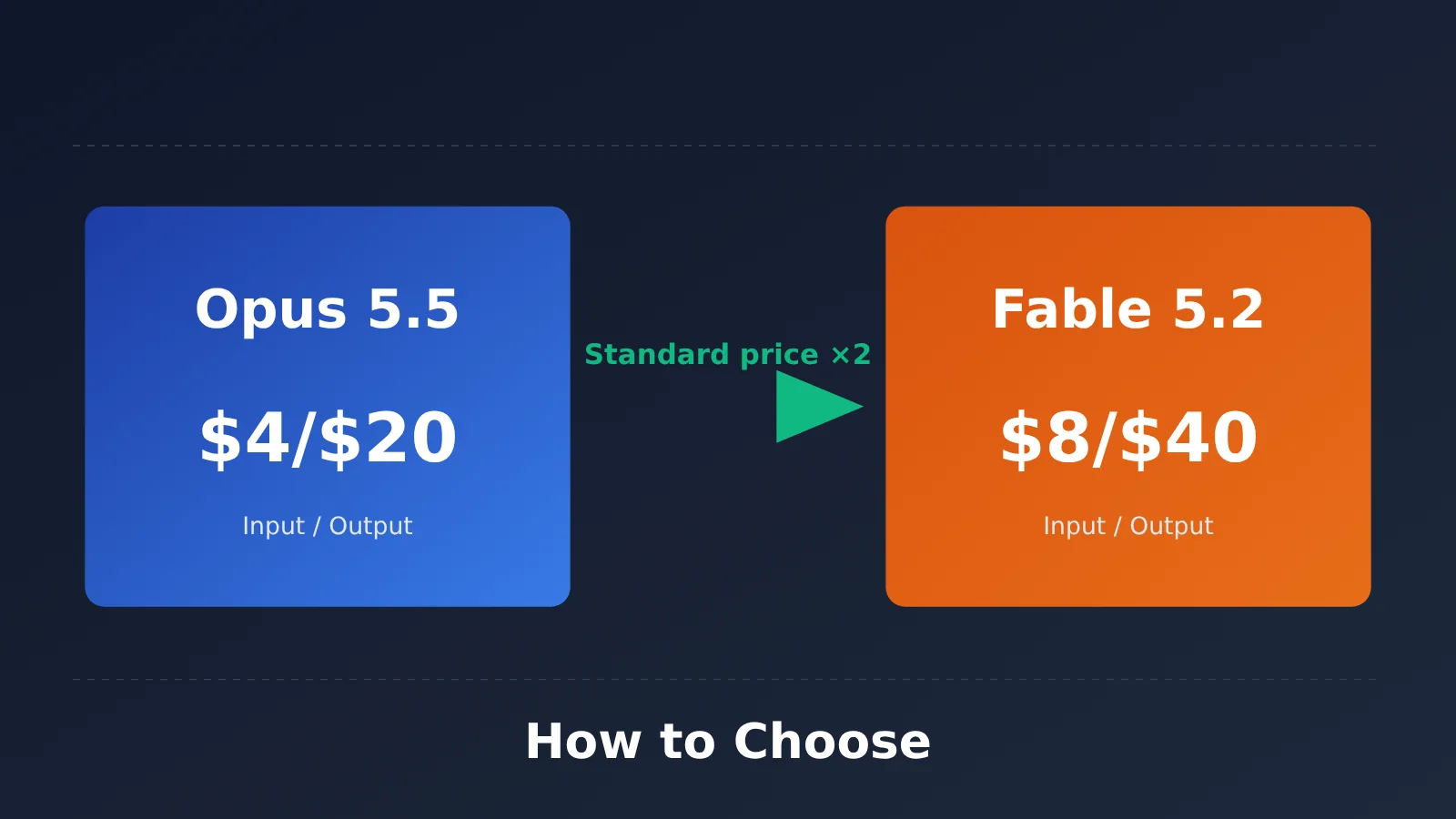
Author’s note: Claude Fable 5.2 costs twice as much as Claude Opus 5.5 at standard rates. In return, it delivers clear improvements on long-running, open-ended tasks. For everyday coding and knowledge work, you can stick with Opus 5.5.
On 2026-11-09, Anthropic released Claude Fable 5.2. For many teams, the decision is straightforward: should they switch their default model from Opus 5.5 to Fable 5.2? Here’s the short answer: Fable 5.2 costs twice as much as Opus 5.5 at standard rates, but it doesn’t win across the board. Opus 5.5 is still a good fit for everyday tasks.
This isn’t a balanced “each has its strengths” comparison. All specs and prices below come from the official model and pricing pages. The benchmark results come from the table Anthropic included in its announcement on 2026-11-09. Pricing and availability were checked on 2026-11-10 and may have changed since.
What you’ll get: A task-by-task model selection table, a clear picture of what you get for paying twice as much, and guidance on when not to switch.
Claude Fable 5.2 vs. Claude Opus 5.5: What They Have in Common
Before choosing a model, rule out the dimensions you don’t need to compare. According to the comparison table on the official model page dated 2026-11-10, Fable 5.2 and Opus 5.5 are nearly identical in their core specs. The main differences are price, default effort level, and long-task capabilities.
| Spec | Claude Fable 5.2 | Claude Opus 5.5 | Same? |
|---|---|---|---|
| Context window | 1M tokens | 1M tokens | Yes |
| Maximum output (synchronous Messages API) | 128K | 128K | Yes |
| Knowledge cutoff | June 2026 | June 2026 | Yes |
| Adaptive thinking | Always on, can’t be disabled | Always on, can’t be disabled | Yes |
| Latency tier | Moderate | Moderate | Yes |
| Input / output modalities | Text and images / text | Text and images / text | Yes |
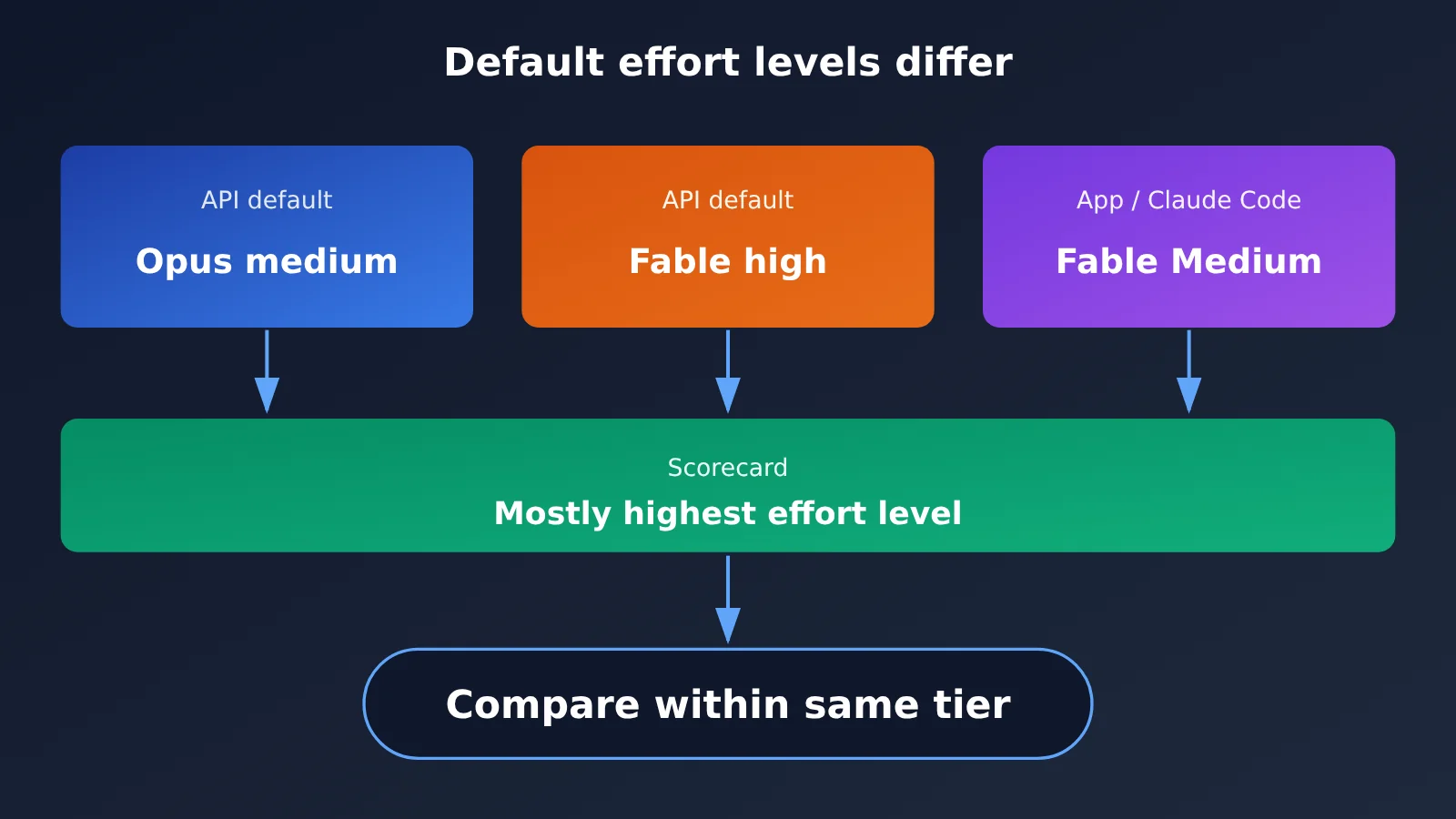
| Default effort on the Claude API | high | medium | No |
This table tells us two things. First, switching models won’t give you a larger context window or longer outputs. The 1M context window is roughly equivalent to 555,000 words or 2.5 million Unicode characters, according to the official general conversion. That doesn’t reflect the actual capacity for Chinese-language content. Second, thinking can’t be turned off for either model. If you want the model to think less, adjust the effort level—you can’t do it with a prompt. The release notes specifically say that at medium effort or higher, Fable 5.2 won’t stop thinking just because you say, “Don’t think—just answer.”
There’s another difference that’s easy to miss. The model page says that on the Message Batches API, models such as Opus 5.5 can produce up to 300K output tokens using a beta header, but Fable 5.2 isn’t on the list. If your batch jobs depend on very long outputs, you’ll need to plan around Opus 5.5’s capabilities for now.
Claude Fable 5.2 Model IDs and Positioning
Fable 5.2’s official model IDs are:
- Claude API, Google Cloud, Microsoft Foundry, Claude Platform on AWS:
claude-fable-5-2 - Amazon Bedrock:
anthropic.claude-fable-5-2
Claude Mythos 5.2 was also released on the same day. The release post says Fable and Mythos share the same underlying model, but Fable has stronger cybersecurity and biosafety guardrails, so it’s available to all users. Mythos is available only to organizations that pass verification through life sciences or cybersecurity programs. Mythos isn’t a third, more powerful model—for model selection, it offers the same level of capability as Fable, but with different access requirements.
Claude Fable 5.2 vs. Claude Opus 5.5 Pricing: What Costs 2× More—and What Doesn’t
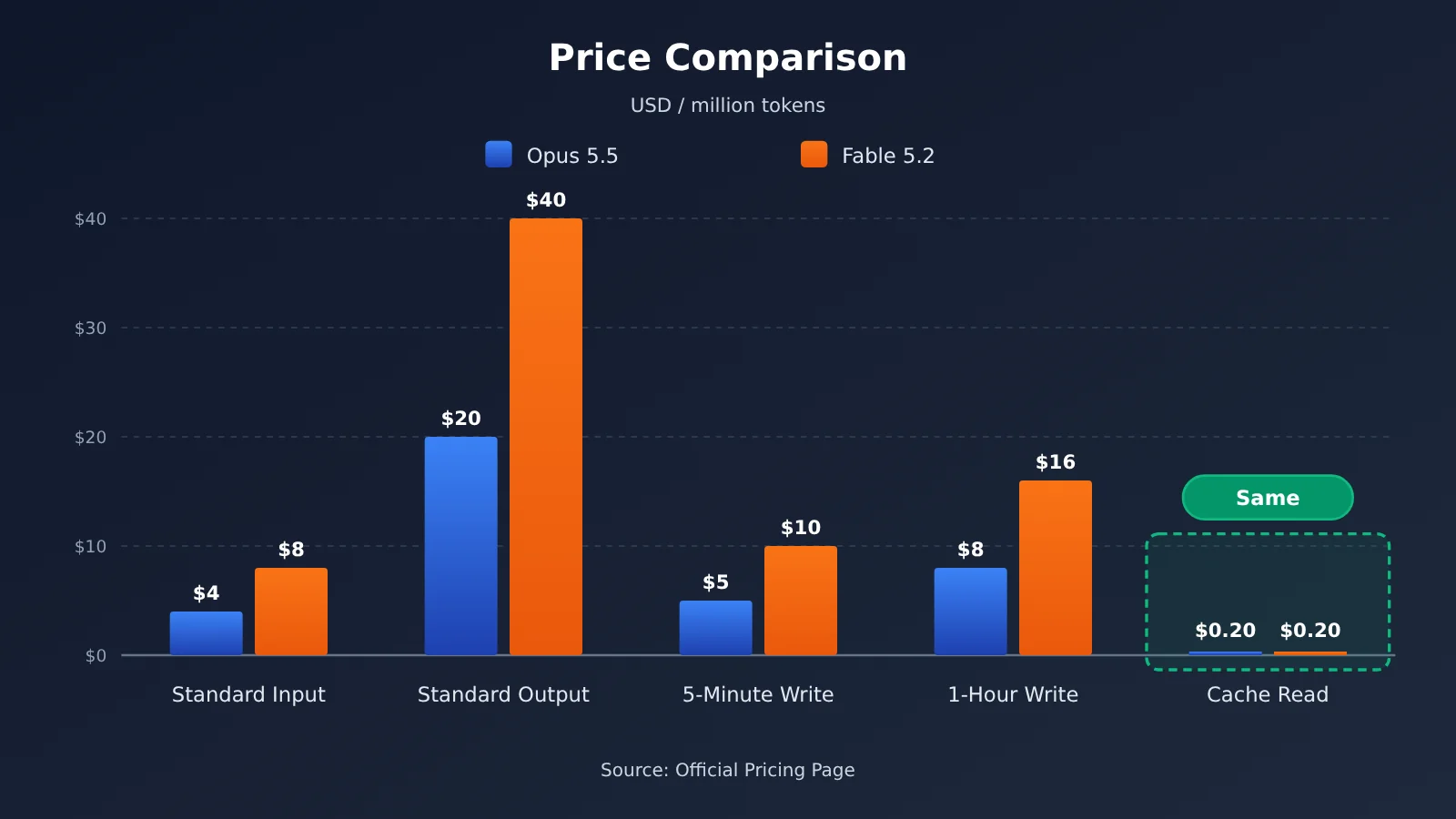
Price is the most obvious difference. All prices below are in US dollars per million tokens and come from the official pricing page, model pages, and fast mode page.
| Billing item | Claude Fable 5.2 | Claude Opus 5.5 | Multiplier |
|---|---|---|---|
| Standard input | $8 | $4 | 2× |
| Standard output | $40 | $20 | 2× |
| 5-minute cache write | $10 | $5 | 2× |
| 1-hour cache write | $16 | $8 | 2× |
| Cache read | $0.20 | $0.20 | Same |
| Fast mode input / output | $16 / $80 | $8 / $40 | 2× |
| Batch (at 50% off) | $4 / $20 | $2 / $10 | 2× |
Cache reads are the only item that doesn’t cost twice as much, thanks to the billing rules: Fable 5.2 charges 2.5% of the standard input price for cache reads, so $8 × 0.025 = $0.20. Opus 5.5 charges 5%, so $4 × 0.05 = $0.20. So if your workload uses long system prompts with a high cache hit rate, cache reads cost the same for both models. The total cost difference will be less than 2×, though outputs and uncached inputs will still cost twice as much.
Another point worth noting: at 50% off, Fable 5.2’s batch prices are $4 for input and $20 for output—the same as Opus 5.5’s standard prices. For offline tasks that can handle asynchronous responses, using Fable in batch mode instead of making real-time Opus calls means the per-token price is the same.
Claude Fable 5.2 Fast Mode Pricing Details
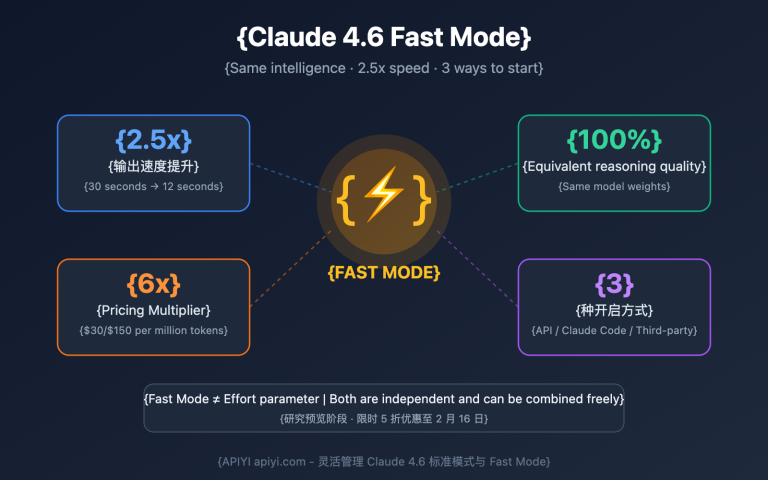
Fast mode is a faster inference configuration of the same model, with no change to its intelligence or capabilities. It can generate output up to 2.5 times faster than standard mode. Keep a few details in mind when budgeting:
- In the Claude API, use the
speedfield with the valuefast. - On Microsoft Foundry, fast mode uses a separate model ID ending in
-fast. Don’t includespeedin the request. - The release announcement lists Claude Code, Claude Platform, Google Cloud, and Microsoft Foundry as fast mode channels. Amazon Bedrock isn’t listed.
- Prompt caching multipliers apply on top of fast mode prices, but the documentation doesn’t list separate cache prices for fast mode. Based on the multipliers, Fable 5.2 fast mode cache reads would cost about $0.40, 5-minute writes about $20, and 1-hour writes about $32. These are estimates, not prices listed separately by Anthropic.
- Different speed modes don’t share prompt caches, so switching from fast mode back to standard mode will cause one cache miss.
Compared with the previous generation, Fable 5.1’s standard prices were $10 / $50, so version 5.2 is 20% cheaper. But compared with Opus 5.5, it still costs twice as much.
Claude Fable 5.2 vs. Claude Opus 5.5 at Default Effort: The Easiest Comparison to Get Wrong
Many teams compare two models by running them with their default settings and checking the bill. That can be misleading with Fable 5.2 and Opus 5.5 because their default effort levels are different.
| Scenario | Claude Fable 5.2 default | Claude Opus 5.5 default | Notes |
|---|---|---|---|
| Claude API | high | medium | If you compare them without changing the parameters, Fable’s higher costs come from more than just its per-token price |
| Claude app, Claude Code | Medium | Not verified in this article | The efficiency claims in the announcement mostly compare Medium and High |
| Announcement benchmarks | Highest effort level (unless otherwise noted) | Highest effort level (unless otherwise noted) | These aren’t results at the default effort level |
This means that if you leave the effort setting unchanged in the API, Fable 5.2 runs at high while Opus 5.5 runs at medium. Fable’s per-token price is already twice as high, and it also uses more reasoning, so the bill could end up well over twice as much. For a fair comparison, set both models to the same effort level, then compare their quality and cost.
The announcement gives one head-to-head comparison at the same effort level: on FrontierCode 2.0, Fable 5.2 at High effort scores about 45.3%, while Opus 5.5’s best score is 45.5%. Anthropic says Fable’s per-task cost is about half that of Opus. This claim applies only to FrontierCode; it shouldn’t be taken to mean Fable costs half as much on every task. The real takeaway is that Fable 5.2 may not need its highest effort setting to deliver value: lowering the effort level could produce results close to Opus’s best score.
Claude Fable 5.2 vs. Claude Opus 5.5: The Few Numbers That Could Change Your Choice
All figures below come from Anthropic’s announcement on 2026-11-09 and are self-reported. Unless otherwise noted, Fable 5.2 and Opus 5.5 were tested with safeguards enabled and at their respective highest effort levels.
| Benchmark | Claude Fable 5.2 | Claude Opus 5.5 | What it means for your choice |
|---|---|---|---|
| FrontierCode 2.0 | 49.1% (Xhigh) / about 45.3% (High) | 45.5% (highest effort) | Fable leads at the highest effort level; they’re about even at High |
| FrontierSWE v2 | 69.9% (highest effort) | 62.3% (highest effort) | Fable has a clear lead on complex engineering tasks |
| OSWorld 2.1 (offline set, partial) | 89.3% (highest effort) | 87.2% (highest effort) | The gap on computer-use tasks is small |
| RoboDojo Sim | 64.9% (internal run, highest available effort) | 39.4% (highest effort) | The biggest gap is in robot simulation |
| Remote Labor Index | 41.3% (High) | 21.3% (highest effort) | Fable scores nearly twice as high on long-horizon remote work |
| AA-Briefcase Elo | 1785 (highest effort) | 1800 (highest effort) | Opus leads |
Taken together, these numbers tell a fairly clear story. On long-horizon, open-ended tasks like Remote Labor Index and RoboDojo, Fable 5.2 has a substantial lead. On computer-use tasks like OSWorld, the gap is just over two percentage points. And on the AA-Briefcase Elo score, Opus 5.5 comes out ahead (Fable leads on the rules score column). RoboDojo’s 64.9% is from an internal Anthropic run, not a score on a public leaderboard.
The cybersecurity and protein-design results in the announcement—such as CyScenarioBench, CVE Rediscovery, and the 24-hour protein-design test—are scores for Mythos 5.2, compared against unguarded Opus 5.5. They shouldn’t be treated as a direct comparison of Fable and Opus.
Long-task examples from the announcement
The announcement also included several long-horizon examples to show what Fable 5.2 is suited for. One engineer asked Fable 5.2 to design a prototype operating system from an empty folder. The model coordinated more than 1,000 subagents over about eight days and produced a system that could boot on a laptop. For formalizing Fermat’s Last Theorem, 1,000 Fable 5.2 agents worked for 30 hours. Under the same setup, Opus 5.5 completed about 26% in 18 hours, then made almost no further progress by the 30-hour mark. The chart caption notes that each model was run only once.
These are all claims from Anthropic, not independent replications. Customer comments quoted in the announcement, including remarks from Vercel and Jump Trading, are just that: quotes. They all point in the same direction: the gap is most apparent on tasks that run for hours or days and require coordination among many subagents.
Claude Fable 5.2 vs. Claude Opus 5.5: Which Model to Choose for Each Task
Anthropic’s own recommendation is to start with Opus 5.5 for most coding and knowledge work, then move up to Fable or Mythos for harder tasks—or down to Sonnet 5.5 or Haiku 5.5. Taking both price and benchmark results into account, here’s a quick guide.
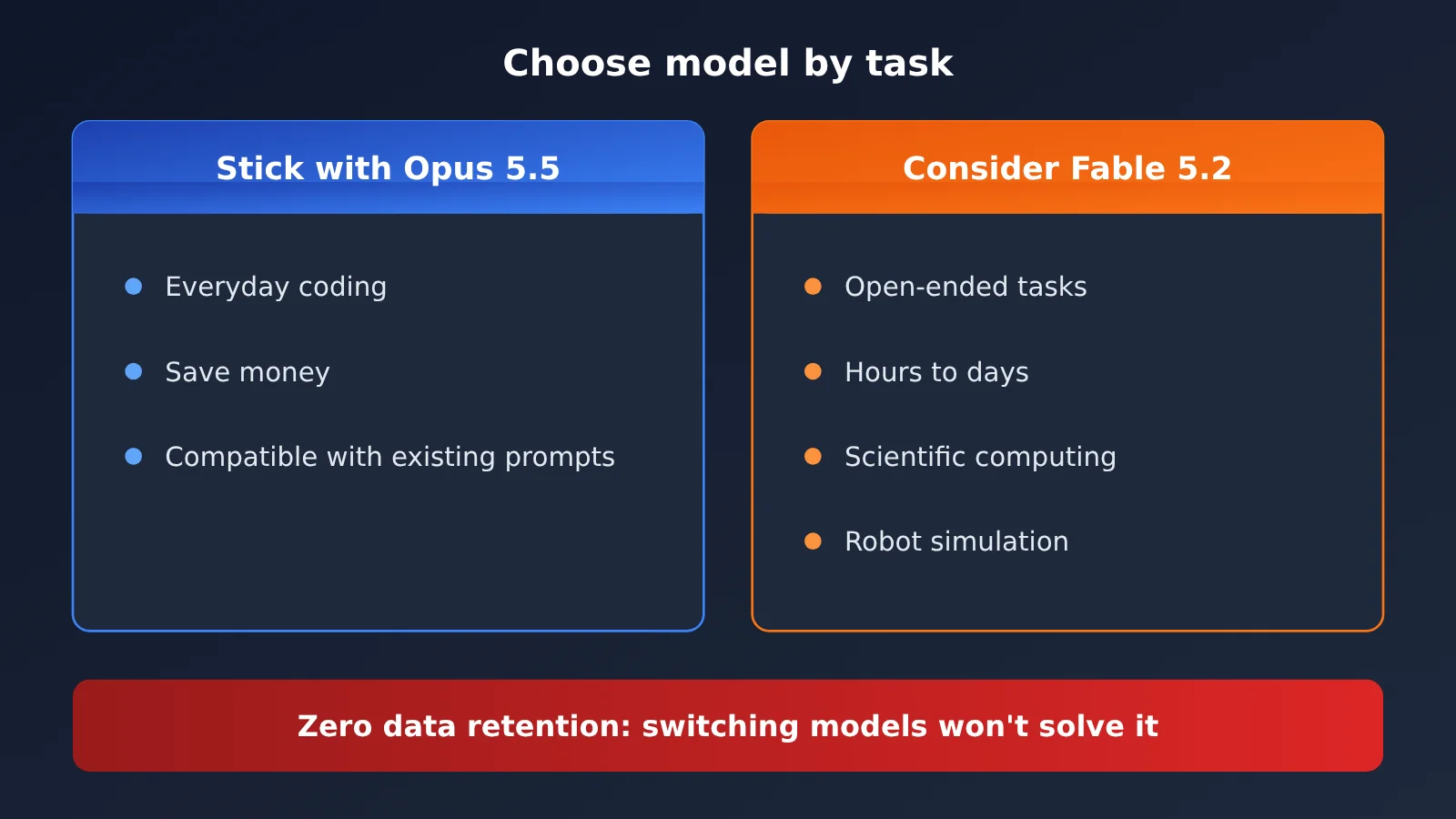
| Task | Recommended default model | Why |
|---|---|---|
| Everyday coding, code reviews, and routine knowledge work | Opus 5.5 | Anthropic recommends starting with Opus; the gap on benchmarks like OSWorld is small |
| Budget-sensitive, high-volume calls | Opus 5.5 | Standard pricing, cache writes, and fast mode all cost half as much |
| Compatibility with existing Opus prompts and parameters | Opus 5.5 | Fable returns a 400 error for some parameters, as explained below |
| Open-ended agent tasks that run for hours or days | Fable 5.2 | Remote Labor Index: 41.3% vs. 21.3% |
| Scientific computing and formal proofs | Fable 5.2 | Terminal-Bench-Science: 74.6% vs. 58.7% |
| Robot simulation and control | Fable 5.2 | RoboDojo: 64.9% vs. 39.4% |
| Zero data retention required | Switching models won’t solve this | Fable 5.2 retains data for 30 days by default, as explained below |
When Not to Switch to Claude Fable 5.2
Beyond the price, a few compatibility limitations can make migration more costly:
- Enforced tool calls (
tool_choiceset toanyortool) return a 400 error. - Requests that include
temperature,top_p, ortop_kreturn a 400 error. You’ll need to remove these fields from existing code. - Thinking is enabled for all accounts. Editing content from earlier turns invalidates thinking blocks, and Fable 5.2 thinking blocks can only be read by Fable 5.2 and Mythos 5.2.
- When Fable 5.2 is the executor, the advisor must also be Fable 5.2 or Mythos 5.2; you can’t mix in Opus.
- Capabilities directly related to AI research and development—such as accelerator kernel optimization and improving Large Language Model architectures—are deliberately limited to roughly Opus 5.5’s level. For a few topics, the model transparently falls back to Opus 5.
- During long tasks, the model may sometimes stop after a single turn, leaving a to-do list or asking whether to continue. This is more common at low effort, so the orchestration layer needs to handle it.
Data retention also deserves a separate note. Fable 5.2 requires 30-day data retention and can’t be used with zero data retention unless Anthropic explicitly authorizes it. Eligible enterprise customers can still use zero retention until they enroll in Enterprise Frontier Safeguards monitoring. This article hasn’t verified Opus 5.5’s retention policy, so check the data policy for your account. Switching to Fable 5.2 won’t give you zero retention; it may add another restriction.
Claude Fable 5.2 vs. Claude Opus 5.5: Which One Can You Use Now, and Which Isn’t Available Yet?
Once you’ve chosen a model, the next step is to check whether it’s available through your provider. As of 2026-11-10, we checked two sources on APIYI apiyi.com: the model catalog at docs.apiyi.com/models.md and the public pricing endpoint at api.apiyi.com/api/pricing, which returned 283 models that day. We didn’t use an API key to make any live calls.
| Model | Available? | List price (input / output / cache read) | Endpoints |
|---|---|---|---|
claude-opus-5-5, claude-opus-5-5-thinking |
Yes | $4 / $20 / $0.2 | chat, messages |
claude-fable-5-1, claude-fable-5-1-thinking |
Yes | $10 / $50 / $0.25 | chat, messages |
claude-fable-5-2 |
Not yet | Not available | — |
| Mythos series | Not yet | Not available | — |
Based on the conclusions above, the practical options for now are straightforward:
- Default model for everyday use: Call
claude-opus-5-5through APIYI apiyi.com. Thebase_urlfor the OpenAI-compatible API ishttps://api.apiyi.com/v1. You can also use the messages endpoint. - Want to test how the Fable series handles long tasks? Start by validating your workflow with the available
claude-fable-5-1. However, its list price of $10 / $50 is higher than Fable 5.2’s official price, so it’s not a good basis for estimating the cost of 5.2. - Budgeting for
claude-fable-5-2: Use its official price of $8 / $40 for now. Don’t multiply the official price by any group multiplier to estimate the platform price.
The dollar amounts in the catalog are list prices. Actual charges also depend on the token group multiplier, so refer to your console bill for the final amount. claude-fable-5-2 isn’t currently listed in the APIYI apiyi.com catalog or pricing endpoint. We’ll make this model available as soon as possible. Refer to the platform’s model list for the latest model and pricing information.
Frequently Asked Questions
Q1: Does Claude Fable 5.2 cost twice as much as Claude Opus 5.5 for every billing item?
No. Standard input and output, 5-minute and 1-hour cache writes, and fast mode all cost twice as much, but cache reads cost $0.20 for both. That’s because Fable 5.2 charges 2.5% of the input price for cache reads, while Opus 5.5 charges 5%. The higher the cache hit rate, the closer the total cost difference gets to the cache-read portion—but the output portion always costs twice as much.
Q2: Could the gap between the models on the leaderboard be smaller at default effort levels?
Possibly. Unless otherwise noted, the scores in the announcement use each model’s highest effort level, not its default. On the Claude API, Fable 5.2 defaults to High and Opus 5.5 to Medium; in apps and Claude Code, Fable defaults to Medium. On FrontierCode, Fable scores about 45.3% at High, matching Opus’s best score of 45.5%; it only reaches 49.1% at Xhigh. The announcement doesn’t provide results for other benchmarks at default effort levels, so we don’t know how those gaps compare.
Q3: Does content returned after a guardrail blocks a request count as a Claude Fable 5.2 response?
No. When a safety classifier blocks a request, cybersecurity questions are answered by Opus 4.8, while biology questions are answered by Opus 5. A few topics related to AI research also transparently fall back to Opus 5. Rejections return HTTP status 200 with `stop_reason` set to `refusal`. Whether a refusal issued before any output is billed depends on the refusal category, but all refusals count toward rate limits. This article doesn’t specify which categories aren’t billed. Anthropic’s early tests showed that Fable 5.2 blocked about 55% fewer requests than Fable 5.1; this hasn’t been independently replicated.
Q4: Is Claude Mythos 5.2 a more powerful model than Claude Fable 5.2?
No. The announcement states that they’re the same underlying model and have the same pricing. The difference is that Fable has stronger cybersecurity and biology guardrails and is available to everyone, while Mythos is only available to organizations in approved programs. The cybersecurity and protein scores in the announcement are for Mythos, so they shouldn’t be treated as Fable’s scores.
Q5: How can I call Claude Opus 5.5 now, and when will Fable 5.2 be available?
As of 2026-11-10, you can call `claude-opus-5-5` through APIYI at apiyi.com. The list price is $4 / $20, with cache reads at $0.2. `claude-fable-5-2` isn’t available yet. Check the platform’s model list for launch timing, and use Anthropic’s official pricing for budget estimates in the meantime.
Q6: If I switch from Opus 5.5 to Fable 5.2, will I also get zero data retention?
No. Fable 5.2 requires 30-day retention unless Anthropic explicitly authorizes otherwise. Teams that need zero data retention should check their account’s data policy first rather than expecting a model switch to solve the problem.
Claude Fable 5.2 vs. Claude Opus 5.5: Key Takeaways
- Nearly identical specs: Both offer a 1M context window, 128K output, and a June 2026 knowledge cutoff.
- Most prices are double: Standard, cache-write, and fast-mode pricing are all 2× higher for Fable. Cache reads cost the same at $0.20.
- Batch pricing overlaps: At 50% off, Fable’s batch rates of $4 / $20 match Opus’s standard rates.
- Different default effort levels: In the API, Fable defaults to high and Opus to medium. For a fair comparison, test them at the same level.
- A wide gap on long-running tasks: Fable leads significantly on the Remote Labor Index and RoboDojo, while Opus leads in the Elo column.
- Migration has some caveats: Sampling parameters and forced tools return 400 errors. Thinking blocks and advisors can’t be used with Opus.
- Availability: APIYI currently offers Opus 5.5, but Fable 5.2 isn’t listed yet. Use the official price for now when planning your budget.
Summary
When choosing between Claude Fable 5.2 and Claude Opus 5.5, three points matter most:
- Twice the price buys stronger long-horizon capabilities: For open-ended tasks that run for hours or days, scientific computing, and robotics simulations, Fable 5.2’s lead may be enough to justify the price difference.
- There’s no need to switch for everyday tasks: For routine coding, budget-sensitive use cases, and workflows that need to stay compatible with existing prompts, Opus 5.5 remains the safer default. The release post itself recommends starting with Opus.
- Compare them at the same effort level: Their defaults differ, and the benchmark results use the highest level. Comparing default configurations directly can skew both cost and quality.
A practical approach is to make Opus 5.5 your default and route only a few long-running tasks to Fable 5.2. Run a small-scale comparison with both models set to the same effort level. You can already access Opus 5.5 through APIYI at apiyi.com. Once Fable 5.2 is listed, use the platform’s model list pricing for a full cost analysis.
Author: APIYI Technical Team
Technical inquiries: Check the model list in the docs.apiyi.com documentation center for the latest model availability and pricing.