

Author’s note: A timeline of three key Claude Code team members leaving within two weeks, separating confirmed facts from unknowns and highlighting five product signals to track over time.
According to APPSO, in a report republished by 36Kr on November 5, 2026, former Claude Code product lead Cat Wu announced that she had joined OpenAI. That brings the total to three key Claude Code team members who have left in less than two weeks. The other two are engineers Anthony Morris and Thariq Shihipar.
This isn’t an article speculating that the team is falling apart. Public information so far confirms who left and what they worked on, but it doesn’t explain why they left or prove that the product has been affected.
What you’ll get: A three-minute rundown of the Claude Code personnel changes, a clear distinction between fact and speculation, and a checklist of product signals to track over time.
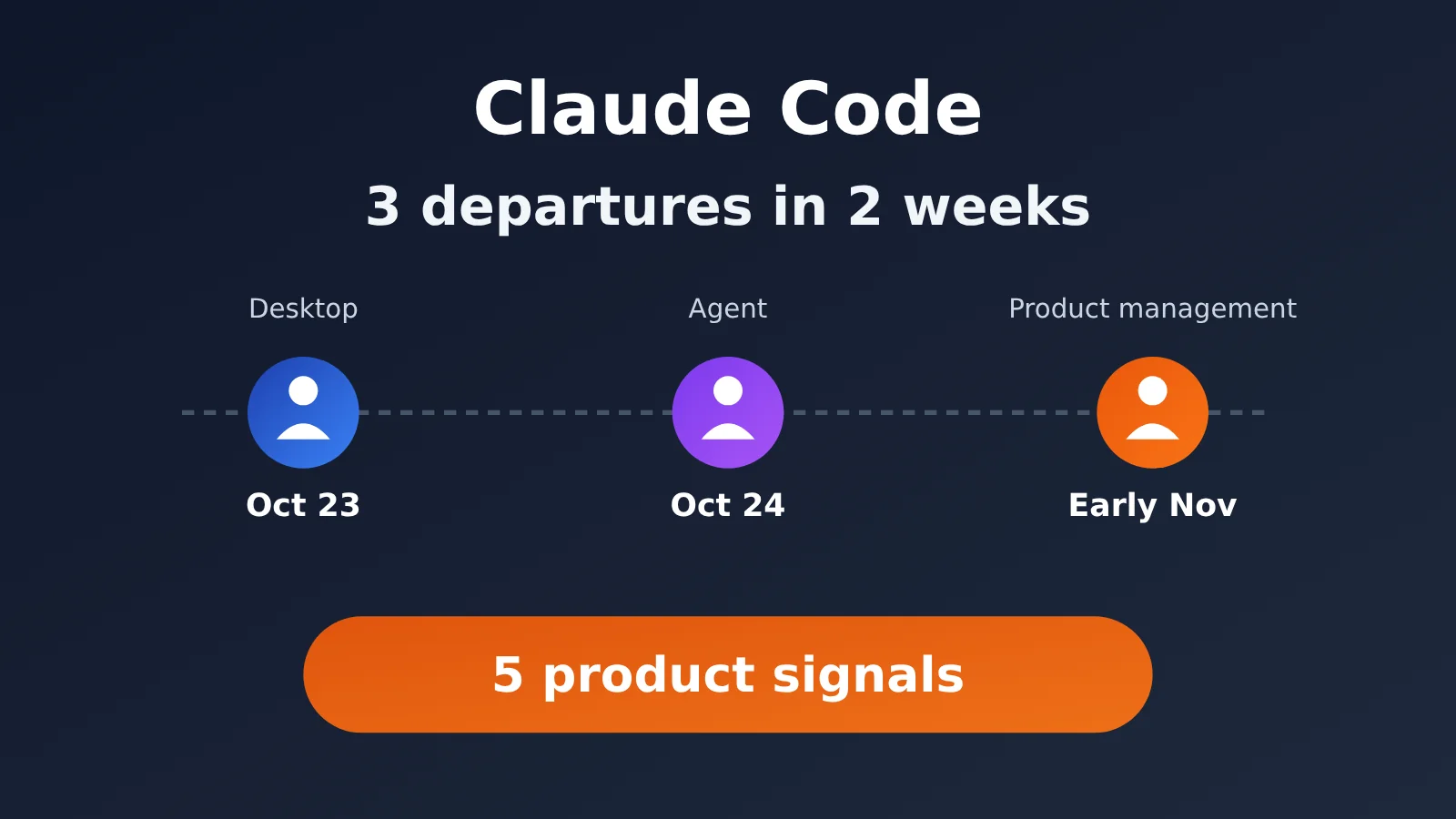
Three Key Claude Code Team Members Left in Two Weeks: Key Facts
The bottom line: The three people worked across desktop, Agent features, and product management, so their departures are worth watching. But the available evidence supports keeping an eye on developments—not concluding that the product is headed downhill.
| Item | What’s been disclosed |
|---|---|
| People involved | Anthony Morris, Thariq Shihipar, Cat Wu |
| Time span | October 23 to early November, less than two weeks |
| Known next steps | Cat Wu joined OpenAI; Thariq said he’d take a break before starting a new job; Anthony’s next move hasn’t been disclosed |
| Reasons for leaving | None of the three gave a specific reason in the statements quoted in reports, and there’s no evidence they left because of the same event |
| Public statements | All three spoke positively about Anthropic or their former colleagues in their farewell statements |
| Company context | Anthropic filed an S-1/A registration statement on November 2 and is preparing to go public |
Claude Code Departure Timeline
| Date | Person | Work on Claude Code | Event |
|---|---|---|---|
| October 23 | Anthony Morris | Built the Claude Code desktop app | Announced his departure on X |
| October 24 | Thariq Shihipar | Worked on Skills, context engineering, and Agent workflows | Announced his departure on X, saying he’d been on the team for over a year |
| Early November | Cat Wu | Product lead who also worked on Cowork | Announced her departure on X, then announced she was joining OpenAI the next day |
There’s one notable coincidence: At the end of his farewell post, Thariq recommended several accounts users could follow for Claude Code updates. One of them was Cat Wu. Ten days later, Cat Wu left too.
Cat Wu’s Role at Claude Code
Cat Wu has a background in engineering and investing. She worked in engineering roles at Scale AI and Dagster before joining Index Ventures. She joined Anthropic in August 2024, initially as a product manager focused on research, before taking over Claude Code and Cowork.
Reports described how she and Claude Code creator Boris Cherny divided their work: Boris focused more on the technical direction and what the product could do next, while Cat Wu turned ideas into products and coordinated teams including engineering, marketing, sales, and finance. Her departure is therefore first and foremost a change in product management and cross-team coordination. The handover is worth watching.
There’s another chapter in her work history. According to a July 2025 report from The Information, she and Boris Cherny had both moved to Anysphere, the company behind Cursor, before returning to Anthropic about two weeks later. At OpenAI, she’ll reportedly lead product management for core products, and OpenAI President Greg Brockman also posted a welcome. For details about her responsibilities and reporting lines, it’s best to wait for firsthand information.
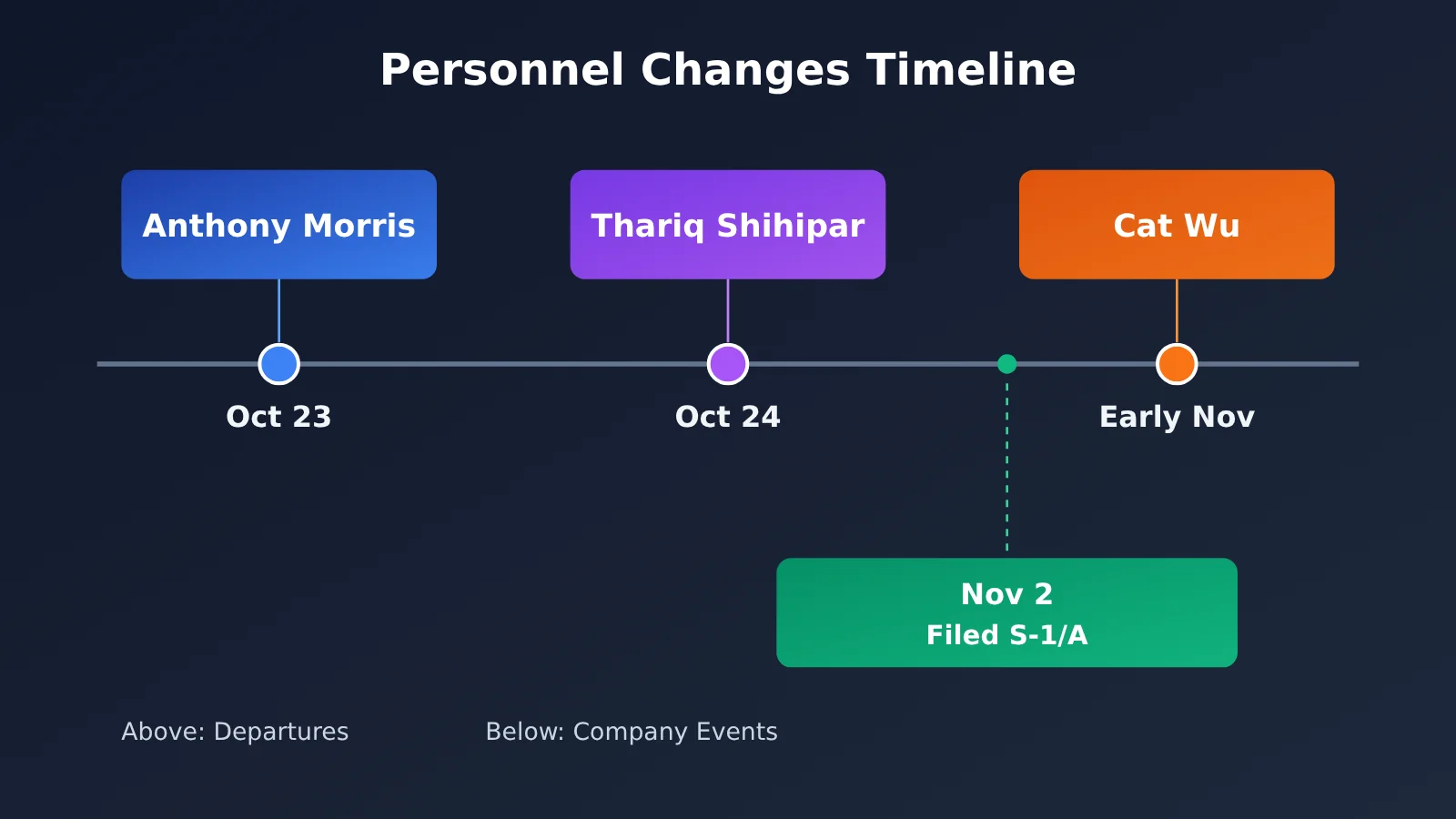
Claude Code Staff Departures: What’s Known and What’s Still Unknown
Several figures in this story are easy to mix up. Most importantly, the “45-fold” increase refers to Anthropic’s company-wide quarterly revenue, not Claude Code’s revenue.
| Topic | What’s confirmed | What we can’t conclude |
|---|---|---|
| Revenue growth | The S-1/A shows Anthropic’s quarterly revenue rose from $376 million in Q1 2025 to $16.956 billion in Q3 2026, an increase of roughly 45 times | Claude Code’s revenue grew 45 times |
| Claude Code revenue | Anthropic disclosed in February this year that Claude Code had reached an annualized revenue run rate of $2.5 billion | That this is Claude Code’s current revenue level; the report didn’t provide an updated figure |
| Employee departures | The company-wide “regretted attrition rate” was about 1% over the 12 months ending in September 2026 | The Claude Code team’s attrition rate was similarly low |
| Team size | Headcount grew from roughly 940 at the end of 2024 to about 5,300 at the end of September 2026 | New hires can replace the experience lost from these three roles |
| Risk disclosures | The filing notes that losing key talent could affect R&D progress and innovation | That this risk has materialized at Claude Code |
| Team situation | Three people left in succession and spoke positively in their farewells | That there’s internal conflict on the team, or that everything is completely normal |
“Regretted attrition rate” refers to the proportion of employees who leave voluntarily when the company would have preferred to retain them. The 1% figure is a company-wide metric through the end of September. It doesn’t cover these three departures after October began, and it doesn’t reveal what’s happening on any individual team. So it isn’t inconsistent with the string of departures.
The report also notes that similar changes aren’t uncommon around an IPO. In August 2026, several OpenAI executives left within a month while the company was preparing to go public. That provides industry context, but it doesn’t explain the personal decisions of these three Anthropic employees.
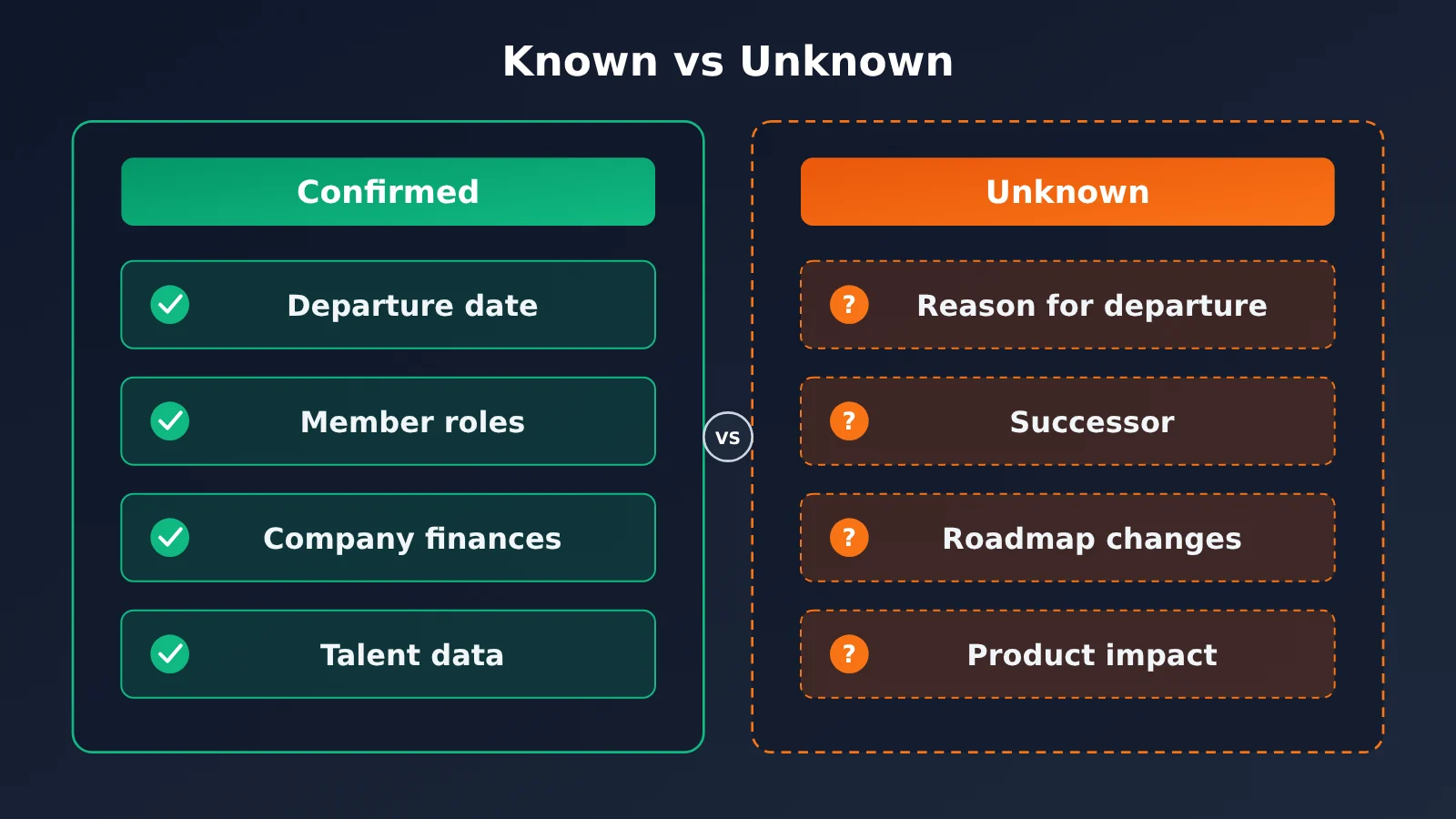
What Claude Code Users Should Watch: 5 Product Signals
Rather than asking “Why did she leave?”, it’s more useful to watch what happens with the product next. In an interview with Ars Technica, Cat Wu said Claude Code didn’t have a fixed long-term plan because model capabilities change so quickly. Features that need complex architecture today might be achievable through the model itself a few months from now.
This approach to iteration, driven by model capabilities and user feedback, allows the team to respond quickly, but it also depends heavily on team judgment and collaboration. The checklist below offers suggestions based on public information, not official metrics.
| Signal | What to watch | How to assess it |
|---|---|---|
| Official handover announcement | Whether a new lead, roadmap, or set of priorities is announced | A clear announcement can reduce uncertainty; prolonged silence doesn’t necessarily mean something is wrong |
| Release cadence | The frequency and depth of official changelog entries | Compare against the previous few months and look for sustained trends rather than drawing conclusions from a single week |
| Service stability and usage limits | The official status page, internal failure records, and changes to limits and pricing | Record when issues occur and their scope instead of relying on impressions |
| Enterprise capabilities | Updates related to access management, data security, and auditing | Check progress against your procurement and compliance requirements |
| Continuity of feature direction | Updates to the desktop app, Skills, context engineering, Agent workflows, and Cowork | See whether related features continue to evolve and whether documentation keeps pace |
It’s worth emphasizing that there’s currently no data showing that this personnel change has affected Claude Code’s release cadence or service stability. Even if fluctuations occur later, they could result from compute costs, user scale, or model adjustments and shouldn’t be attributed directly to the personnel change.
How Different Roles Can Respond to Changes in Claude Code
| Role | Recommended action | What you don’t need to do yet |
|---|---|---|
| Individual developers | Keep using it as usual, follow the changelog, and document workflows that work well | Switch tools immediately because of a single departure announcement |
| Team technical leads | Track versions, incidents, and success rates for critical tasks to establish an internal baseline | Change development processes based solely on public opinion |
| Product or procurement leads | Track enterprise capabilities and the official roadmap, and review requirements before renewal | Treat the number of departures as the sole basis for evaluating a vendor |
| Developers calling Claude models directly | Build a regression test set using fixed tasks; you can run tests through the unified interface at APIYI apiyi.com | Treat model invocation results as equivalent to Claude Code product performance |
How to Establish a Monitoring Baseline for Claude Model Invocations
If your application calls Claude models directly, you can run a fixed set of tasks regularly and record the response times and results. Keep in mind that this method monitors the model API request path; it doesn’t measure the quality of the Claude Code client or prove that personnel changes had any particular impact.
import openai

client = openai.OpenAI(
    api_key="YOUR_API_KEY",
    base_url="https://api.apiyi.com/v1"  # APIYI unified API
)

response = client.chat.completions.create(
    model="YOUR_CLAUDE_MODEL",  # Replace with a model name available in your console
    messages=[{"role": "user", "content": "用一句话解释什么是幂等性"}]
)
print(response.choices[0].message.content)
View the complete code for batch baseline recording
import csv
import time
from datetime import datetime, timezone

import openai

client = openai.OpenAI(
    api_key="YOUR_API_KEY",
    base_url="https://api.apiyi.com/v1"
)

MODEL = "YOUR_CLAUDE_MODEL"  # Replace with a model name available in your console
TASKS = [
    "为一个 Python 函数编写单元测试的思路",
    "解释数据库事务的隔离级别",
]

with open("claude_baseline.csv", "a", newline="", encoding="utf-8") as f:
    writer = csv.writer(f)
    for task in TASKS:
        start = time.perf_counter()
        try:
            response = client.chat.completions.create(
                model=MODEL,
                messages=[{"role": "user", "content": task}],
                max_tokens=500
            )
            status, output = "ok", response.choices[0].message.content
        except Exception as e:
            status, output = "error", str(e)
        elapsed = round(time.perf_counter() - start, 2)
        writer.writerow([
            datetime.now(timezone.utc).isoformat(),
            MODEL, task, status, elapsed, output
        ])
Technical tip: Your baseline samples should reflect real-world use cases, with consistent tasks, parameters, and recording methods. New users can claim free testing credits at APIYI apiyi.com, run a small set of samples first, and then decide whether to include them in routine regression testing.
Claude Code Personnel Changes: FAQ
Q1: Who are the three key Claude Code team members who left within two weeks?
They are Anthony Morris, the engineer who built the desktop version; Thariq Shihipar, an engineer who worked on Skills and Agent workflows; and product lead Cat Wu. Cat Wu has announced that she’s joining OpenAI.
Q2: Why did they leave Anthropic?
There’s no definitive answer yet. Reports haven’t disclosed their specific reasons for leaving, and there’s no evidence that they left because of the same event. For now, suggestions about equity arrangements or internal conflicts are speculation.
Q3: Have Claude Code’s update pace or stability been affected?
There’s no data to establish that yet. Keep an eye on the official changelog, status page, and your team’s internal records, and compare any changes against an earlier baseline.
Q4: Should we migrate from Claude Code to another tool now?
These personnel changes alone aren’t enough to justify a migration decision. A better approach is to keep tracking the five signals above and evaluate them alongside task quality, costs, and compliance requirements.
Q5: How can I call Claude models through an API for comparison testing?
Sign up at APIYI apiyi.com and get an API key. Replace the model name in this article’s example with a Claude model available in the console, then run a fixed set of tasks.
Note that this refers to model API calls, not a way to connect to Claude Code. For configuration support for specific tools, check the latest documentation and console information at APIYI apiyi.com.
Claude Code Personnel Changes: Key Takeaways
- Scope: In less than two weeks, members involved in the desktop app, agent features, and product management left the team.
- Known next move: Cat Wu joined OpenAI, though her specific role still needs confirmation from a primary source.
- Reasons unclear: Available evidence doesn’t support claims that everyone left for the same reason or that there was conflict within the team.
- Keep the numbers in context: The 45-fold increase refers to Anthropic’s quarterly revenue across the company, not to Claude Code.
- Talent metric: The approximately 1% regrettable attrition rate is a company-wide figure and doesn’t represent any individual team.
- What to watch: Look for handover updates, release cadence, stability, enterprise capabilities, and feature continuity.
- Model baseline: Teams that call Claude models directly can use APIYI apiyi.com to run a fixed set of tasks and record the results.
Conclusion: Claude Code Users Should Pay Attention, Not Overreact
Three important members have left Claude Code in two weeks. That’s worth watching, but for now it’s a personnel story—not a verdict on product quality.
- Separate facts from speculation: Departure dates, publicly known responsibilities, and prospectus figures can be cited. The reasons for leaving and the impact on the product remain unconfirmed.
- Watch how the product performs: Release cadence, service stability, and enterprise capabilities will tell you more about where things are headed than the number of departures.
- Use data to decide: Whether to keep using a tool should depend on your team’s own long-term records and actual needs.
If your business relies on Claude model invocation, this is a good opportunity to establish an evaluation baseline. Consider using the free credits at APIYI apiyi.com for a small-scale test, then decide what to do next based on your needs.
📚 References
- Breaking: Claude Code’s Top Product Leader Joins OpenAI, One Day After Announcing Her Departure: The main source for the factual information in this article (written by APPSO and republished by 36Kr)
- Link:
36kr.com/p/4056162615350407 -
Note: Covers the personnel timeline, prospectus data, and related background. We haven’t independently checked each primary source it cites.
-
Claude Code GitHub Repository: A resource for ongoing updates
- Link:
github.com/anthropics/claude-code -
Note: Useful for tracking releases and feature updates.
-
Anthropic Official Documentation: A resource for ongoing updates
- Link:
docs.anthropic.com - Note: Useful for checking official descriptions of product features and enterprise capabilities.
Author: APIYI Technical Team
Technical discussions: Contact us through the APIYI homepage at apiyi.com. Visit the documentation center for more resources.