Developers have recently reported a counterintuitive experience: claude-opus-5-5 doesn’t feel slow at all. In fact, it often finishes tasks earlier than claude-sonnet-5-5. If the flagship model is both faster and stronger, is Sonnet’s only remaining advantage that it costs half as much? The answer isn’t that simple. This article uses six sets of public data to break down the real differences between claude-sonnet-5-5 and claude-opus-5-5, with a focus on a more practical question: how should these two models divide responsibilities in enterprise Agent scenarios involving long inputs and long outputs?
Key takeaway: By the end of this article, you’ll understand why Opus feels “fast,” what hard advantages Sonnet offers beyond price, and a ready-to-deploy dual-model Agent architecture using Opus + Sonnet.
claude-sonnet-5-5 vs. claude-opus-5-5: Key Specs at a Glance
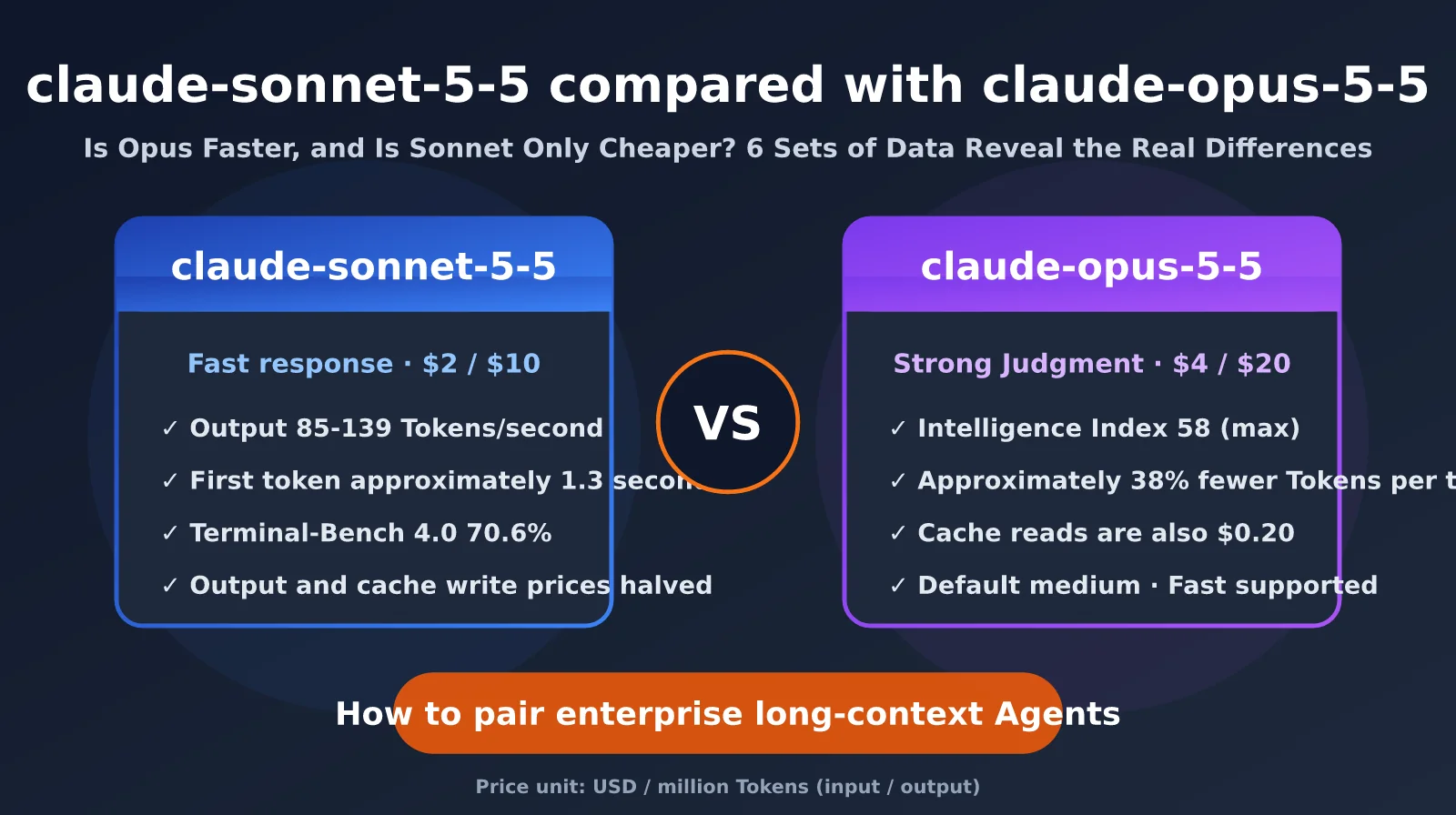
claude-opus-5-5 was released on September 22, 2026, followed by claude-sonnet-5-5 on September 28. Both belong to the Claude 5.5 family. The most notable change in this generation is that Opus got cheaper: its list price dropped 20%, from $5/$25 for Opus 5 to $4/$20. Cached reads fell even further, from $0.50 to $0.20—the same rate as Sonnet. Sonnet 5.5 continues to be priced at $2/$10, and Anthropic says its per-task cost is up to around 30% lower than the previous generation.
| Specification | claude-sonnet-5-5 | claude-opus-5-5 |
|---|---|---|
| Release date | 2026-09-28 | 2026-09-22 |
| Input / output pricing | $2 / $10 | $4 / $20 |
| Cached reads | $0.20 | $0.20 (5% of the base input price) |
| 5-minute cache writes | $2.50 | $5 |
| Batch pricing | $1 / $5 | $2 / $10 |
| Context window | 1 million tokens, with no long-context surcharge | 1 million tokens, with no long-context surcharge |
| Maximum output | 128K (300K in Batch beta) | 128K (300K in Batch beta) |
| Default API reasoning tier | high | medium |
| Fast mode | Not supported | Supported; approximately 2.5× output speed, $8 / $40 |
| Available platforms | APIYI apiyi.com, Anthropic’s official API | APIYI apiyi.com, Anthropic’s official API |
The table contains two details that directly affect real-world experience. First, their default reasoning tiers differ: Opus defaults to medium, while Sonnet’s API default is high. That’s the primary reason many people find Opus faster. Second, cached-read pricing is identical. This means that in Agent scenarios that heavily reuse long context, the difference in input costs between the two models is greatly reduced.
🎯 Testing tip: When comparing the two models, always explicitly set the same reasoning tier. Otherwise, the results can be seriously misleading. We recommend using the same API key on APIYI apiyi.com to call claude-sonnet-5-5 and claude-opus-5-5 separately, changing only the
modelandreasoning_effortparameters for a controlled comparison.
Why Does claude-opus-5-5 Feel Faster Than claude-sonnet-5-5?
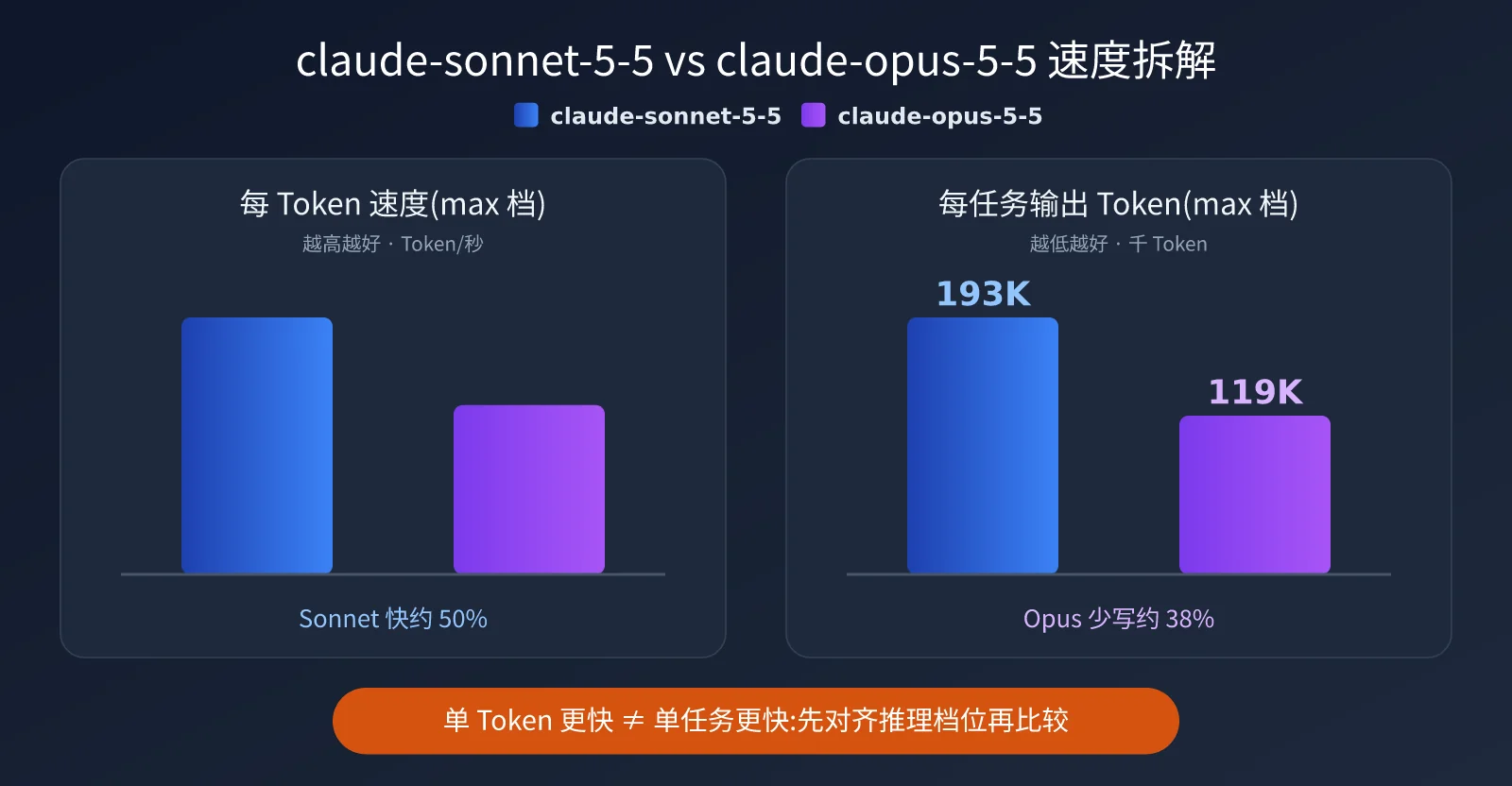
In terms of raw generation speed, claude-sonnet-5-5 is clearly faster. Measurements from Artificial Analysis show that Sonnet 5.5 outputs 85–139 tokens per second across reasoning tiers, compared with 74–93 tokens per second for Opus 5.5. Anthropic also labels Sonnet’s latency tier as “fast,” while Opus is rated “moderate.”
So where does the feeling that “Opus is faster” come from? There are three main reasons.
Reason 1: Different Default Tiers — Sonnet Thinks One Tier Harder by Default
Opus 5.5 lowered its default API tier from the previous generation’s high to medium. According to Anthropic, its medium tier can already match or exceed Opus 5 running at high. Sonnet 5.5, meanwhile, still defaults to high, and its thinking mode can’t be disabled.
Independent testing found that Sonnet at the high tier produces roughly twice as many output tokens as it does at medium, without a noticeable improvement in quality. So if you call both models with their default settings, Sonnet is effectively “thinking one tier harder,” which naturally takes longer.
Reason 2: Opus Is More Token-Efficient
In Artificial Analysis’s Intelligence Index tests, Sonnet 5.5 at the max tier generated around 193,000 tokens per task on average—the highest figure measured by the organization. Opus 5.5 at the same tier generated about 119,000 tokens.
Faster tokens don’t necessarily mean faster task completion. Sonnet may output about 50% more tokens per second, but if it needs to generate 60% more content, its end-to-end time can end up matching—or even exceeding—Opus.
Reason 3: Opus Has an Exclusive Fast Mode
Opus 5.5 supports Fast Mode (research preview), which uses a faster inference configuration for the same model. It can increase output speed by up to roughly 2.5×, with pricing at $8/$40.
If you’ve enabled Fast Mode for Opus in a coding tool, the impression that “Opus is fast” becomes even stronger. Keep in mind that Fast Mode only improves tokens generated per second; it doesn’t reduce time to first token. It also doesn’t share prompt caching with standard-speed mode.
| Speed Metric | claude-sonnet-5-5 | claude-opus-5-5 | Notes |
|---|---|---|---|
| Output speed (tokens/second) | 85–139 | 74–93 | Sonnet is faster per token |
Output tokens per task (max tier) |
About 193,000 | About 119,000 | Opus uses fewer tokens |
| Time to first token (lower tiers) | About 1.3 seconds (medium) |
About 14.3 seconds (low) |
Sonnet responds sooner |
| Official latency rating | Fast | Moderate | From Anthropic’s model pages |
| Real coding-task duration (third party) | 29 min 27 sec | 44 min 50 sec | Sonnet is about 1.5× faster |
The takeaway is: Opus may complete work faster with default settings, but when both models are set to appropriate tiers, Sonnet still has a clear edge in responsiveness. Time to first token is especially important—Sonnet starts producing output in roughly 1.3 seconds at the medium tier, which matters a lot for user-facing interactive Agents.
Does claude-sonnet-5-5 Only Have a Price Advantage? Capability Comparison Data
Here’s a potentially surprising result: at the max tier, Sonnet isn’t actually cheaper than Opus.
When Artificial Analysis ran its full Intelligence Index suite, Sonnet 5.5 (max) cost about $8,977, while Opus 5.5 (max) cost around $8,708. Opus was slightly cheaper and earned a higher score as well: 58 versus 56. The reason is the token efficiency mentioned earlier. So if you only use Sonnet at the max tier, it may not even retain a pricing advantage.
So where does Sonnet provide value? The table below shows the Intelligence Index scores for both models across reasoning tiers, and it makes the intended usage pattern clearer:
| Reasoning Tier | claude-sonnet-5-5 Intelligence Index | claude-opus-5-5 Intelligence Index |
|---|---|---|
max |
56 | 58 |
xhigh |
52 | 56 |
high |
47 | 54 |
medium |
41 | 51 |
low |
— | 42 |
For general intelligence, Opus leads across the board at the same tier. Its edge is even more apparent in factual accuracy (AA-Omniscience: 66% versus 54%) and in specialized areas such as law, finance, and strategy.
However, Sonnet still has several hard advantages that Opus can’t replace:
- Terminal-based agentic coding: On Terminal-Bench 4.0, Sonnet (
max) scores 70.6%, higher than Opus (xhigh) at 66.4%. At the samexhightier, though, Opus still leads 66.4% to 61.5%; Sonnet needs to run at full power to pull ahead. - Response latency: Both time to first token and tokens per second are significantly better, making Sonnet a good fit for real-time interaction and streaming output in user-facing applications.
- Uncached input and cache writes: Both cost only half as much as Opus, making Sonnet more suitable for one-off long-input tasks where every request contains a new document.
- Long outputs and batch processing: Output costs $10 versus $20, while Batch costs $5 versus $10. For generating large volumes of long reports or documents, the cost advantage is immediately 2×.
- High-concurrency execution: Anthropic positions Sonnet as Opus’s faster, lower-cost partner. It’s well suited for running clearly defined subtasks in parallel as a large number of sub-Agents.
Across other public benchmarks, Opus leads by around two percentage points on CursorBench 4.0 (57.8% versus 55.5%), FrontierCode 1.1 (54.4% versus 52.1%), and OSWorld 2.1 (81.8% versus 80.1%). The gap becomes much larger in ProgramBench, a third-party aggregated benchmark for long-context program reconstruction: Opus scores 91.2%, while Sonnet scores 79.7%.
This suggests that the more a task requires precise judgment across an extremely long context window, the greater Opus’s advantage becomes.
💡 Model selection tip: Use Sonnet from the
mediumthroughxhightiers and treat it as an “executor.” Start Opus at themediumtier and use it as the “decision-maker.” To validate the difference for your own workloads, run the same long-document task through both models on APIYI apiyi.com, then compare output quality and actual charges.
The Real Cost of Enterprise Agents with Long Contexts
A typical enterprise Agent workload involves contracts, codebases, or knowledge bases containing hundreds of thousands of Tokens on the input side, followed by long reports, batch rewrites, or multi-file code on the output side. Since both models support a 1 million-token context window with no long-context premium, the factors that truly determine cost are cache hit rate and output length.
The following estimates use official list pricing for several typical scenarios. Sonnet is estimated to use 1.6× as many output Tokens as Opus, reflecting the gap in Token efficiency between the two at the max tier:
| Scenario | Workload | claude-sonnet-5-5 | claude-opus-5-5 | Cost Ratio |
|---|---|---|---|---|
| Multi-turn follow-up with long context | 500K-token context, 95% cache hit rate, 25K new Tokens written | Approx. $0.28 (12K output) | Approx. $0.37 (7.5K output) | 1 : 1.3 |
| Initial loading of a long document | Write 500K Tokens to a 5-minute cache + 10K output | Approx. $1.35 | Approx. $2.70 | 1 : 2 |
| Long-form report generation | 50K input + 50K output (same output volume) | Approx. $0.60 | Approx. $1.20 | 1 : 2 |
| Offline batch generation | Batch mode, 100K input and 100K output | Approx. $0.60 | Approx. $1.20 | 1 : 2 |
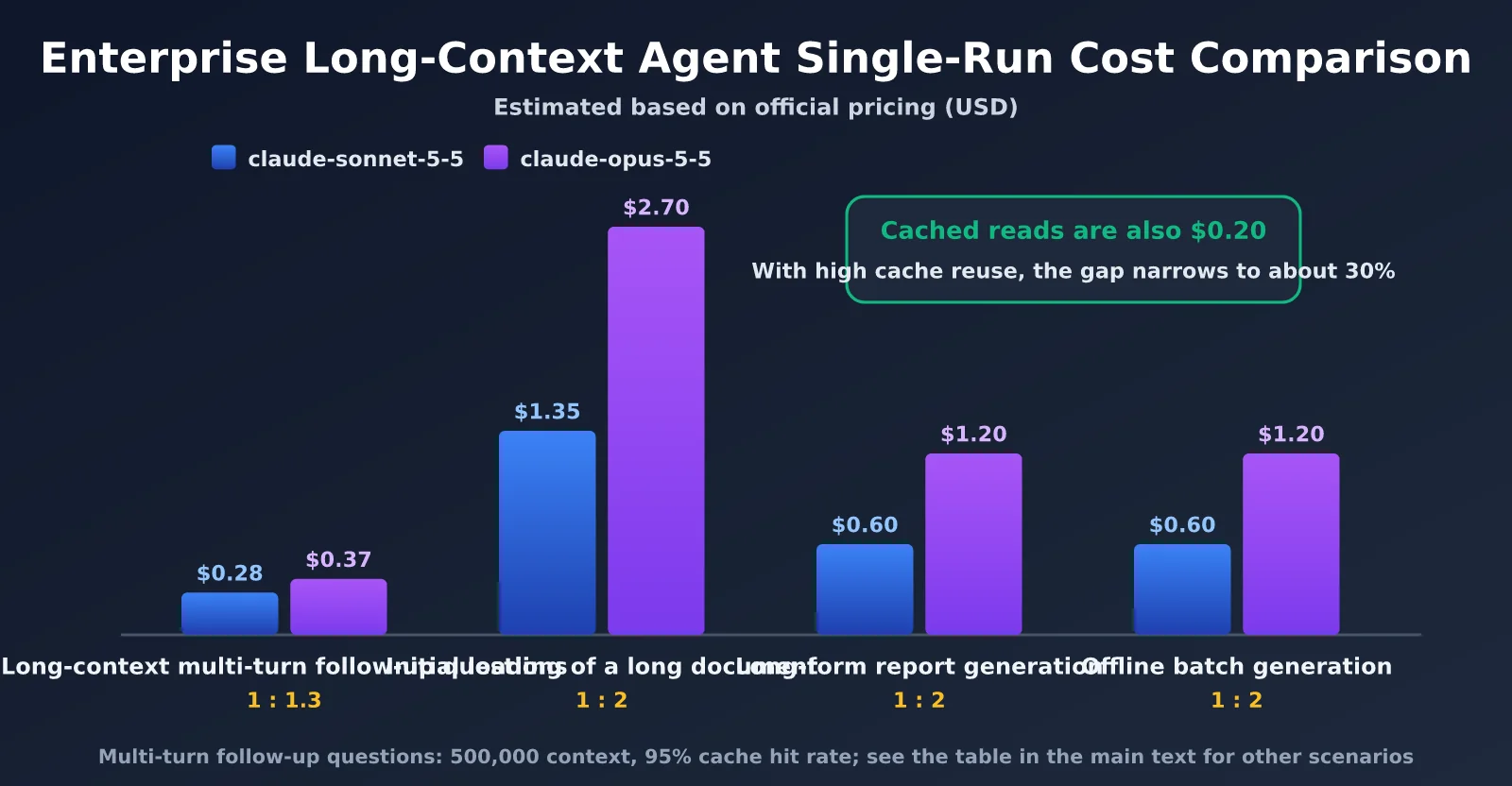
This table reveals an important pattern: for multi-turn follow-up tasks with long inputs, high cache hit rates, and short outputs, Opus costs only about 30% more than Sonnet. That’s because cache reads—the largest portion of the bill—cost the same for both models, while Opus also uses fewer output Tokens.
In contrast, for initial document ingestion and long-form output generation, Sonnet regains its full 50% cost advantage. Put simply, Opus is ideal for “repeatedly reading the same lengthy material and making judgments,” while Sonnet is better suited to “processing new material once” or “generating substantial amounts of content.”
There’s another easy-to-miss detail: prompt caching can’t be shared across models. If Opus reads a 500K-token document once and Sonnet then reads it again, you’ll pay the cache-write cost twice. The key to a dual-model architecture is therefore to keep the long context resident on one model whenever possible, while sending only concise task summaries to the other.
A Practical claude-sonnet-5-5 and claude-opus-5-5 Pairing Strategy
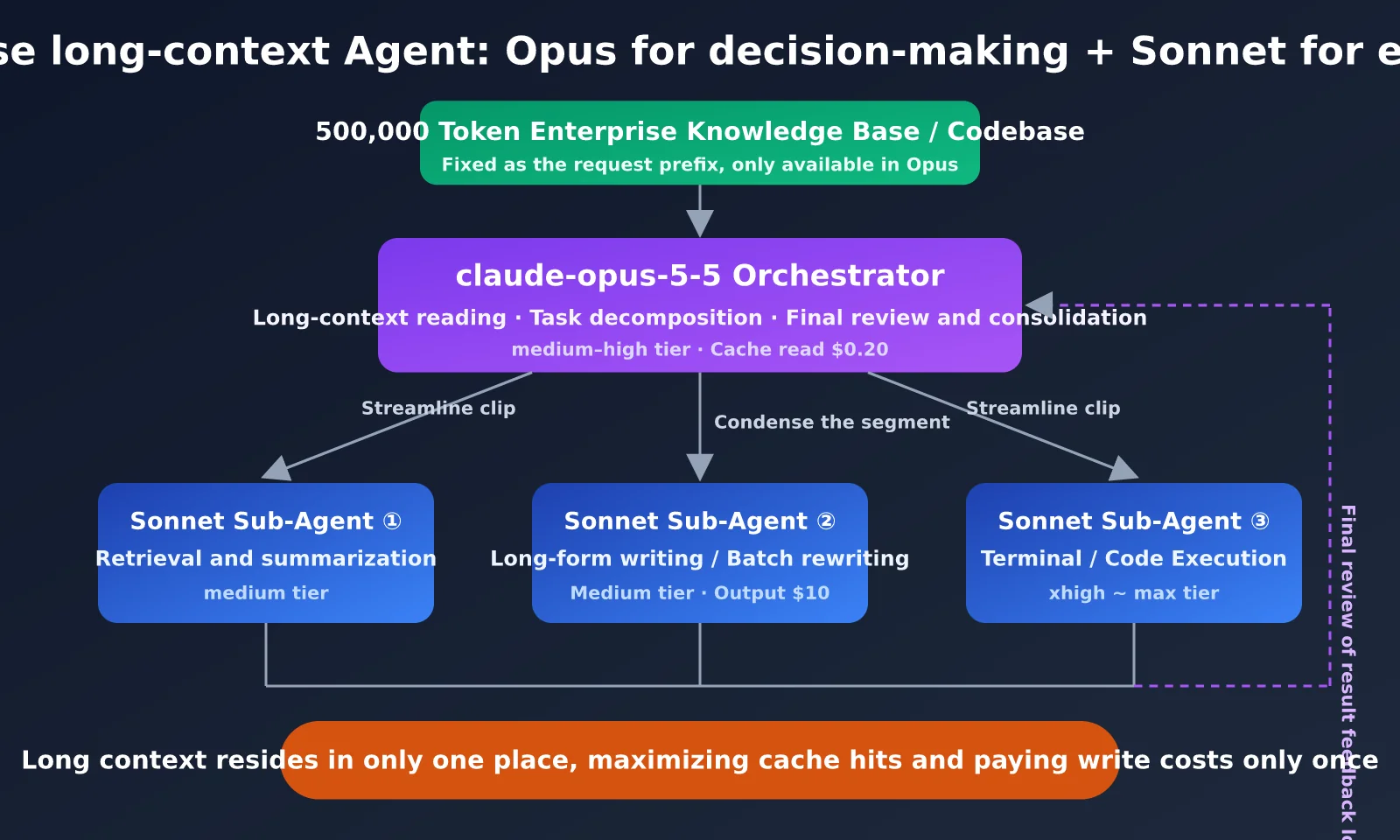
Based on the data above, we recommend a layered architecture for enterprise Agents handling long content: “Opus for decisions, Sonnet for execution.” Depending on which model holds the long context, this architecture can be implemented in two modes.
Mode 1: Opus Orchestration + Parallel Sonnet Sub-Agents
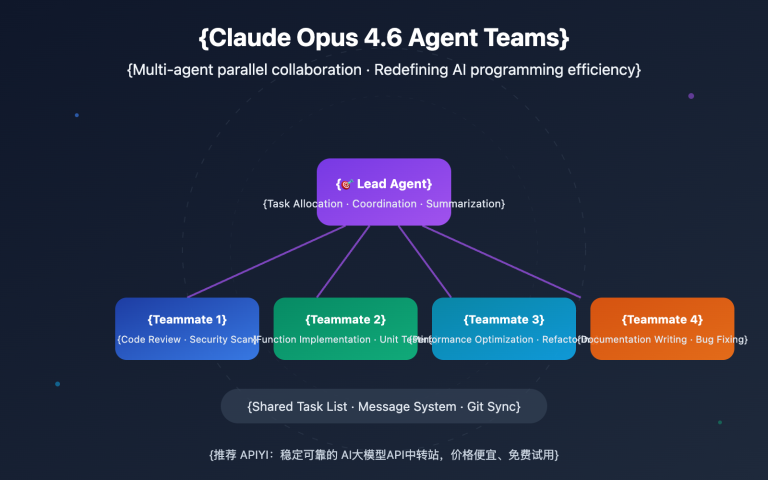
This setup is ideal for tasks requiring complex judgment over lengthy materials, such as contract review, cross-repository code migration, and due diligence. Opus retains the complete long context—and benefits from sustained cache hits—while handling global understanding, task decomposition, and assignment to multiple Sonnet sub-Agents.
Each Sonnet Agent receives only its relevant excerpt and a clear instruction, then executes in parallel at the medium tier. Finally, Opus consolidates the outputs and performs the final review. This approach means you pay for expensive long-context caching only once, while Sonnet produces long-form output at half the output-token price.
Mode 2: Sonnet at the Front End + Opus Escalation Fallback
This is better suited to high-traffic, interactive workloads, such as enterprise knowledge-base Q&A, customer-service Agents, and internal IT assistants. Sonnet holds the long context and delivers roughly one-second time-to-first-token responses at the medium tier.
When it encounters low-confidence requests, compliance-sensitive decisions, or explicit user dissatisfaction, it escalates a streamlined problem description and key excerpts to Opus. Sonnet handles most traffic at a low cost, while Opus is reserved for the relatively small number of complex cases.
| Agent Role | Recommended Model | Recommended Tier | Why |
|---|---|---|---|
| Orchestrator / planner | claude-opus-5-5 | medium ~ high | Stronger overall intelligence and factual accuracy, with better Token efficiency |
| Long-context analysis and final review | claude-opus-5-5 | high ~ xhigh | Clear advantages in precise long-context judgment |
| Long-form writing / batch rewriting | claude-sonnet-5-5 | medium | Half the output-token price and faster output per second |
| Terminal / code execution sub-Agent | claude-sonnet-5-5 | xhigh ~ max | Best full-tier Terminal-Bench performance |
| Real-time conversational front end | claude-sonnet-5-5 | medium | Approximately 1.3-second time to first Token |
| Offline batch processing | claude-sonnet-5-5 | medium | Batch pricing of $1/$5, with support for 300K-token outputs |
Implementing Opus Orchestration + Sonnet Execution Through One Interface
Here’s a minimal example of Mode 1 using an OpenAI-compatible API. Both models share a single API key:
from openai import OpenAI

client = OpenAI(
    api_key="YOUR_API_KEY",
    base_url="https://api.apiyi.com/v1"  # APIYI unified interface
)

def ask(model, prompt, effort="medium"):
    r = client.chat.completions.create(
        model=model, reasoning_effort=effort,
        messages=[{"role": "user", "content": prompt}])
    return r.choices[0].message.content

plan = ask("claude-opus-5-5", "Read the full contract below and split it into 3 independent review subtasks, one per line:\n" + contract_text)
drafts = [ask("claude-sonnet-5-5", f"Complete this subtask and provide review findings: {t}") for t in plan.splitlines() if t.strip()]
report = ask("claude-opus-5-5", "Consolidate and perform a final review of the following findings, then produce the final report:\n" + "\n".join(drafts), effort="high")
Expand to view: Full example with parallel sub-Agents and a fixed long-context prefix
import asyncio
from openai import AsyncOpenAI

client = AsyncOpenAI(
    api_key="YOUR_API_KEY",
    base_url="https://api.apiyi.com/v1"  # APIYI unified interface
)

ORCHESTRATOR = "claude-opus-5-5"
WORKER = "claude-sonnet-5-5"

async def call(model, messages, effort="medium"):
    r = await client.chat.completions.create(
        model=model, reasoning_effort=effort, messages=messages)
    return r.choices[0].message.content, r.usage

async def run(long_doc: str, goal: str):
    # 1. Keep the long document in a fixed system prefix, resident only on Opus,
    #    so it can achieve cache hits across multiple turns
    base = [{"role": "system", "content": "You are an enterprise document analysis orchestrator. Here is the complete source material:\n" + long_doc}]
    plan, _ = await call(ORCHESTRATOR, base + [
        {"role": "user", "content": f"Goal: {goal}\nSplit this into no more than 5 subtasks. Include the required source excerpts with each subtask, separated by ---."}])

    # 2. Sonnet sub-Agents receive only streamlined excerpts and run in parallel
    tasks = [t.strip() for t in plan.split("---") if t.strip()]
    results = await asyncio.gather(*[
        call(WORKER, [{"role": "user", "content": f"Complete the following subtask independently and return structured findings:\n{t}"}])
        for t in tasks])

    # 3. Return to Opus for final review, reusing the same long-context prefix
    merged = "\n\n".join(r[0] for r in results)
    final, usage = await call(ORCHESTRATOR, base + [
        {"role": "user", "content": f"Verify whether the following subtask findings are consistent with the original material. Correct any errors, then produce the final report:\n{merged}"}],
        effort="high")
    print("Final review Token usage:", usage)
    return final

# asyncio.run(run(open("contract.md").read(), "Identify payment, breach, and intellectual-property risks in the contract"))
🚀 Get started quickly: Official Claude accounts can have strict requirements around registration regions and payment methods, which often creates onboarding friction for enterprise teams. You can first register with APIYI at apiyi.com to receive test credits. A single API key lets you call both claude-opus-5-5 and claude-sonnet-5-5, so you can validate the dual-model architecture above before evaluating costs at scale.
claude-sonnet-5-5 vs claude-opus-5-5: Decision Guidelines
Here are four actionable principles that distill the analysis above:
- Choose the performance tier before comparing models: Use Sonnet at medium to xhigh, and Opus at medium to high. This avoids the Token waste caused by Sonnet’s default high setting.
- Use Opus for long-context tasks with high cache reuse: Cache reads cost the same, while Opus is only about 30% more expensive—giving you higher accuracy and less rework.
- Use Sonnet for loading new material and generating long outputs: Its cache-write and output prices are both half of Opus’s. For offline jobs, Batch processing can reduce costs by another 50%.
- Keep long context in only one place: Caches can’t be shared across models. Pass only condensed excerpts to sub-agents to avoid paying for duplicate cache writes.
As for Opus Fast mode, it’s best for scenarios where single-response latency is absolutely critical and budget isn’t a concern. However, it doubles the price and doesn’t share caches. For most enterprise Agents, assigning real-time interactions to Sonnet at the medium tier is usually more cost-effective than enabling Fast mode for Opus.
Frequently Asked Questions
Q1: claude-opus-5-5 is already fast. Is claude-sonnet-5-5 still necessary?
Yes. Opus is “fast” mainly because it uses a lower default tier and is more Token-efficient. But Sonnet still has a clear edge in output tokens per second and time to first Token, while its output price is only half as much. Sonnet remains the better executor for long-form writing, real-time conversations, and parallel sub-agent workflows.
Q2: Can claude-sonnet-5-5 at the max tier replace Opus?
For specific tasks such as terminal-based programming, it can. Sonnet (max) even scores higher than Opus on Terminal-Bench 4.0. However, its overall intelligence index is still 2 points lower, and Sonnet consumes more Tokens at the max tier. As a result, its total cost is on par with—or even slightly higher than—Opus. If you need maximum quality, using Opus directly is usually the better value.
Q3: How can enterprise long-document Agents control costs across both models?
The key is improving cache hit rates: keep long documents in a fixed request prefix, let only one model hold the complete context, and send condensed excerpts to sub-agents. It’s recommended to invoke the models through APIYI apiyi.com and monitor the cache Token usage returned in responses. Then, gradually refine your prefix structure. Cache hit rate is usually the most effective lever for reducing costs.
Q4: What should I watch out for when migrating from Sonnet 5 or Opus 5 to version 5.5?
Both 5.5 models include breaking API changes: thinking mode can’t be disabled; forced tool calls (tool_choice set to any or tool) return a 400 error; and the legacy computer-use tool must be upgraded. Before migrating, run regression tests in a test environment first, compare output differences between the old and new models in parallel, and only then switch production traffic.
Summary
Comparing claude-sonnet-5-5 with claude-opus-5-5 isn’t as simple as saying “the more expensive model is better, while the cheaper one is worse.” After Opus 5.5’s price reduction, its cache-read pricing matches Sonnet’s, and its default medium tier is already highly efficient. It leads across the board in precise long-context reasoning and overall intelligence. Sonnet 5.5, meanwhile, has irreplaceable advantages in response speed, output costs, terminal coding, and high-concurrency execution. So Sonnet isn’t only attractive because of its price—its strengths just need to be applied at the right tier and in the right role.
For enterprise Agents that handle long-form content input and output, the most practical setup is “Opus for decisions, Sonnet for execution”: Opus retains the long context and handles planning and final review, while Sonnet runs at the medium tier to parallelize writing and execution. Batch can take care of offline workloads. In practice, start by running controlled comparisons at fixed tiers, then split Agent responsibilities according to the role matrix in this article. Finally, keep optimizing costs using two key metrics: cache hit rate and output tokens.
If you’d like to quickly validate this dual-model approach, APIYI apiyi.com provides a unified way to invoke both claude-opus-5-5 and claude-sonnet-5-5. Its API is compatible with the OpenAI format, so you can switch freely between the two models with a single key. It’s well suited for model evaluation and multi-model orchestration in production environments.
References:
– Anthropic pricing documentation: platform.claude.com/docs/en/about-claude/pricing
– Anthropic Fast Mode documentation: platform.claude.com/docs/en/build-with-claude/fast-mode
– Artificial Analysis comparison of Sonnet 5.5 and Opus 5.5: artificialanalysis.ai
– Digital Applied’s analysis of the Opus 5.5 release: digitalapplied.com
– Sonnet 5.5 vs. Opus 5.5 comparisons from Kingy AI and Emergent: kingy.ai, emergent.sh
About the Author: The APIYI technical team focuses on AI Large Language Model API integration and engineering practices. Feel free to connect through APIYI apiyi.com to discuss Agent orchestration and cost optimization for claude-opus-5-5 and claude-sonnet-5-5.