Author’s note: A comparison of the models, pricing, and availability of four Personal Agents—Claude Duet, dots, Muse, and Grok Bot—plus recommendations based on price, model, use case, and region, and ideas for developers in China who want to build their own using the same models.
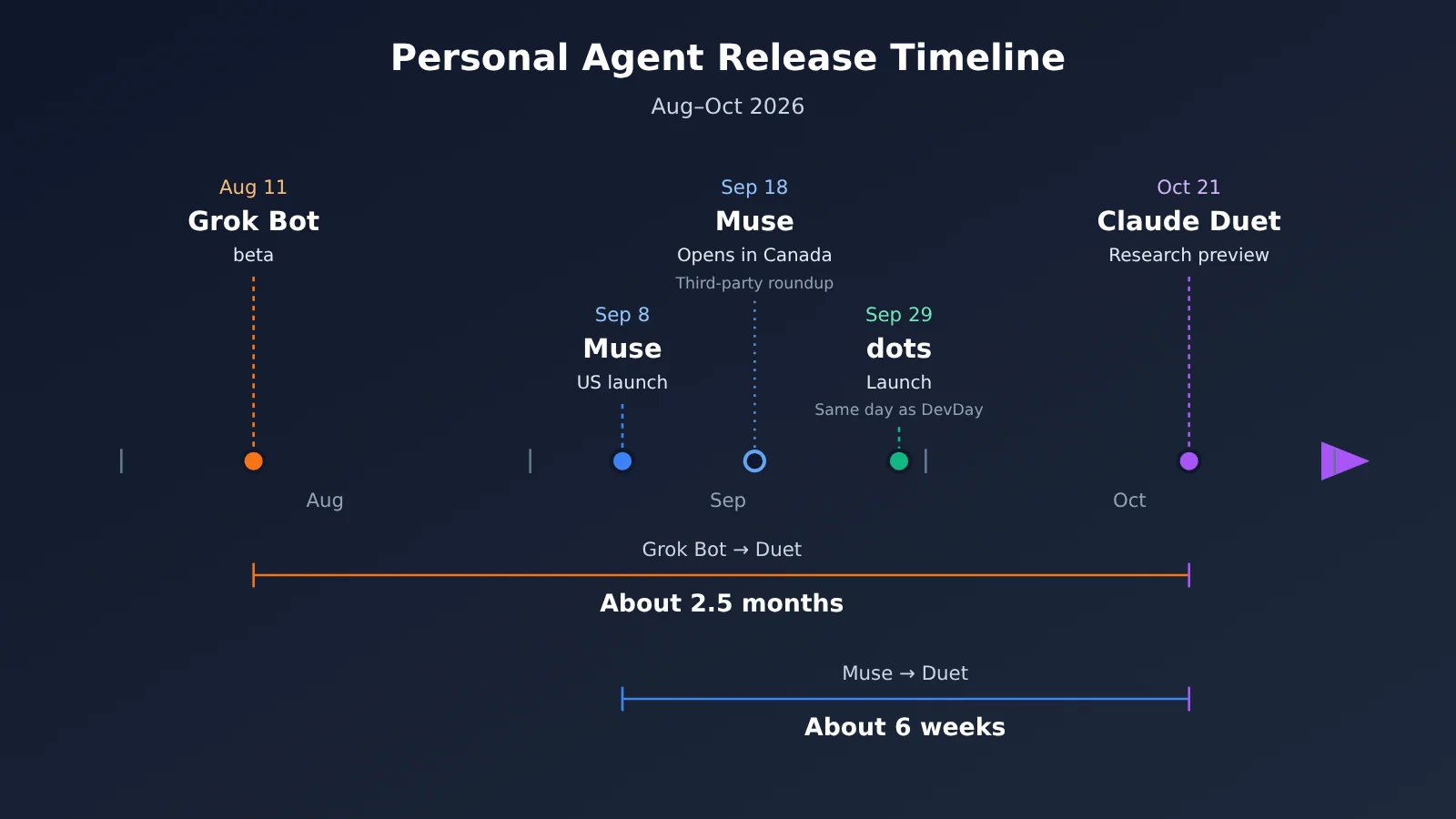
Grok Bot opened its beta on August 11, 2026, and Claude Duet opened its research preview on October 21. In between, Meta launched Muse and OpenAI launched dots. Four major tech companies have launched Personal Agents one after another, making it feel like they all arrived in the same month. In reality, the launches spanned about two and a half months, with only about six weeks between Muse and Duet.
These aren’t concept products stuck at the demo stage: all four are available through paid subscriptions or waitlists. According to TechCrunch, Meta said at its third-quarter earnings call that Muse had more than 10 million users. This article compares the models, pricing tiers, and available regions for all four—and offers straightforward recommendations.
What you’ll learn: By the end, you’ll know who each Personal Agent is for, how much they cost, whether you can use them in mainland China, and what alternatives are available if you can’t.
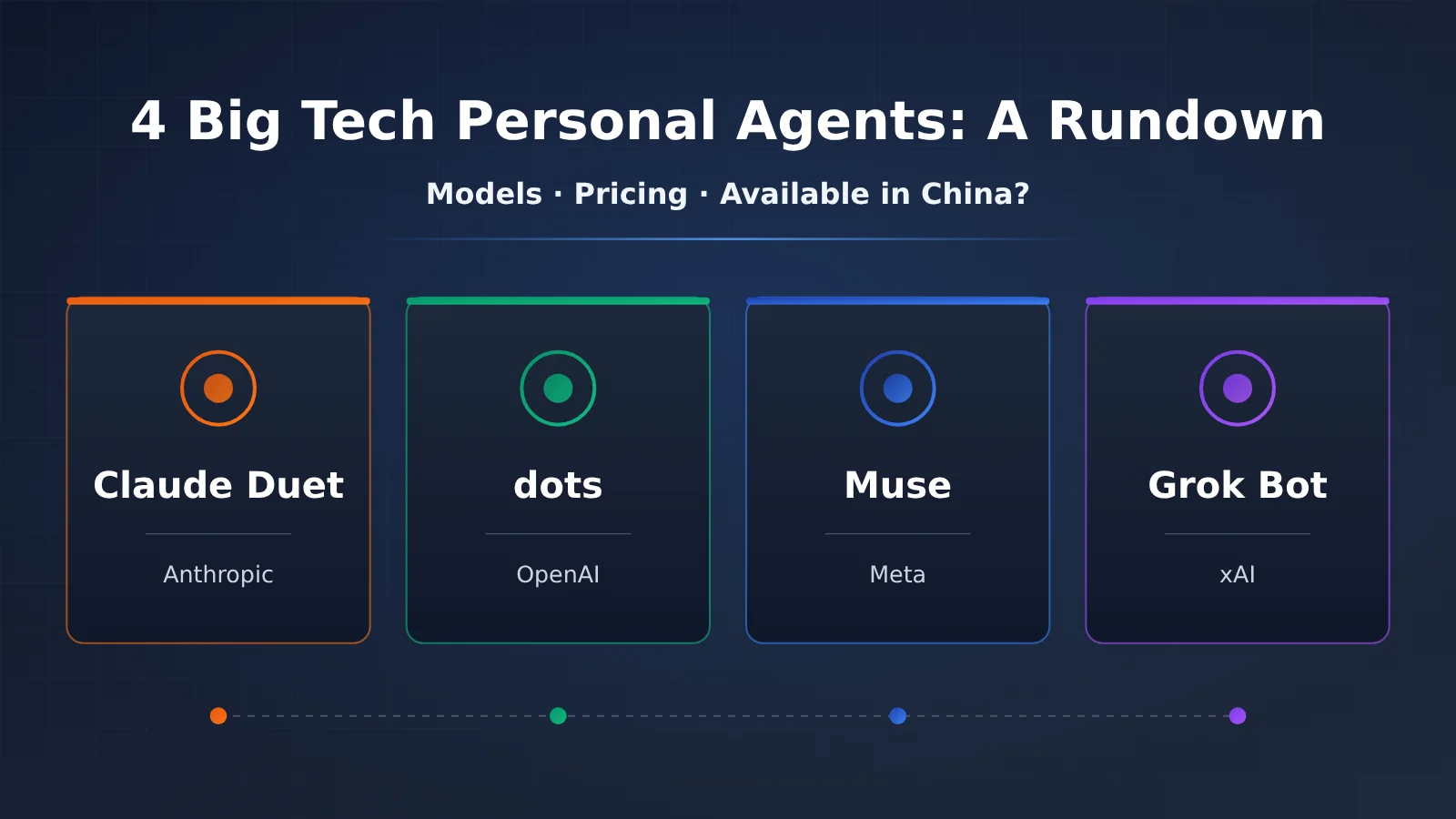
Four Personal Agents at a Glance
Bottom line: All four use different models, with starting prices ranging from free to $100/month. They’re primarily available in the U.S., and none has an official access point in mainland China. (One thing worth noting: Grok Bot from Elon Musk’s company seems to work via a direct connection from mainland China after successful registration.)
| Product | Company | Release date | Model | Starting price | Availability | Available in mainland China? |
|---|---|---|---|---|---|---|
| Grok Bot | xAI (the official website now lists SpaceXSI) | Beta launched on 2026-08-11 | Not publicly disclosed | Premium: $30/month | Subscribers; desktop and iOS | No official access point |
| Muse | Meta | Launched in the U.S. on 2026-09-08 | Muse Spark, according to TechCrunch | Free to start (card required) | U.S. and Canada | No official access point |
| dots | OpenAI | Launched on 2026-09-29 | GPT-6 Astra | Pro 100: $100/month | ChatGPT Pro 100/200/500, with Business Premium access rolling out gradually | No official access point |
| Claude Duet | Anthropic | Research preview on 2026-10-21 | Claude Opus 5.5 | Included with Pro at $20/month | Pro and Max users in the U.S.; waitlist invitation required | No official access point |
Prices as of 2026-10-23; check the official websites for the latest information.
Looking at the timeline, Grok Bot launched first and Duet launched last. Muse launched in the U.S. on September 8, and third-party reporting says it became available in Canada on September 18. In its September 29 announcement, Meta described Muse as a “personal AI agent available in the U.S. and Canada.” dots launched on the same day as OpenAI DevDay. The four products are similar in form: each gives you a computer in the cloud that keeps working on tasks after you close the app, then checks in when it needs you to make a decision.
What Each of the Four Personal Agents Can Do
In a nutshell: Duet is geared toward handling everyday tasks, dots toward moving long-term projects forward, Muse toward lifestyle and shopping, and Grok Bot toward coordinating multiple bots on a team.
Claude Duet: A daily briefing, with approval required for sensitive actions
Duet is a research preview from Anthropic. You use it just like you’d message someone: send Claude a message. Every morning, it sends you a briefing highlighting the most important items from the apps you’ve connected. When you close the app, Duet keeps working in the cloud on its own computer. It’s designed for professionals and small business owners, and is available as a standalone app for iOS and Android, as well as on claude.ai.
Duet is built around Claude Opus 5.5. According to the Help Center, you can’t choose the model—Duet decides how much effort to spend on each task. For safety, Duet asks for your approval before sending messages, making payments, signing documents, or deleting anything. It also can’t see your passwords or login tokens.
Duet’s current limitations are clearly spelled out:
- You can’t choose the model.
- You can’t see or take control of the browser it uses.
- It checks your accounts at fixed intervals, so something urgent might happen between checks.
- It can’t access local files on your computer.
To get access, you need to meet all three of these requirements: have a Pro or Max subscription, use a Claude account in the United States, and receive an invitation from the waitlist. Invitations are being sent in batches, and joining the waitlist doesn’t guarantee a specific access date. Team and Enterprise plans aren’t supported yet, but Anthropic says they’ll be added later.
dots: Always on in ChatGPT, and can hand tasks off to Codex
dots is an Agent that stays in ChatGPT. According to the official description, it’s “Powered by GPT-6 Astra.” It has its own cloud computer and browser, and can work toward a goal you set 24/7, continuing between conversations. You can call it, reach it on Slack and Microsoft Teams, and have it delegate tasks to ChatGPT Work or Codex.
Through its plugin ecosystem, dots can connect to more than 4,000 apps. It can also connect to one of your computers, though only one at a time. It works with the ChatGPT mobile app, desktop app, and desktop browser, but not the mobile website.
Availability varies by plan:
- ChatGPT Pro 100, Pro 200, and Pro 500 users can access it. You must be at least 18, and it’s not available in the European Economic Area, the UK, or Switzerland.
- Business Premium is rolling out globally, subject to certain workspace requirements.
- Enterprise plans, including Edu and Healthcare, have it turned off by default. An admin must manually enable the beta.
dots is rolling out gradually, so even if your plan qualifies, you might not see it yet.
Muse: A personal assistant for shopping, dining, and smart home
Muse is Meta’s personal AI Agent. It can connect to email, calendars, payments, and apps for health, smart home, dining, shopping, live music, and more. It can send emails, plan trips, negotiate bills, fill out forms, make plans, turn recipe videos into shopping lists, send party invitations, and place shopping orders directly. Checkout is handled through Link by Stripe. According to TechCrunch, Muse is powered by Meta’s own Muse Spark model.
Usage figures for Muse come from Meta’s third-quarter earnings call, as reported by TechCrunch on 2026-10-21:
- Muse has more than 10 million users.
- Zuckerberg said that about 25% of people who’ve set up Muse now use it every day.
- Shopping is its most common use: more than a quarter of active users shop through the Agent, with an average order value of more than $200.
- Other popular uses include personal productivity, such as connecting email and calendars.
Muse is available on the web, iOS, and Android, and through a chat interface in WhatsApp. It’s also coming to Meta’s AI glasses. Muse runs in its own secure virtual machine, Muse Secure VM, which can’t access your passwords or payment methods. Meta says it won’t share conversations or data with its ad system. The upcoming Muse Confidential VM is said to prevent even Meta itself from seeing user content.
Grok Bot: Multiple Bots, Each With a Role—Show Them Once, Then Let Them Run
Grok Bot is a team of always-on AI teammates. Each Bot has its own cloud computer and can sign in to the tools and websites you already use—even platforms without an API—to handle a task from start to finish. It only checks in when it needs your approval. You can run multiple Bots at once and assign each one a separate lane, such as sales outreach, expense reports, recruiting, or bug fixes. You can also put several Bots in the same group chat so they can divide up the work.
Grok Bot’s standout feature is Routines: show it how to do something once, and it’ll save the steps as a Routine and run them automatically on schedule. All Bots share one persistent cloud computer, including its files, browser, and login sessions, with data isolated by user. Clients are available for desktop (macOS and Windows) and iOS.
The official website and launch announcement haven’t disclosed which model Grok Bot uses by default. Also note that its usage shares a weekly allowance with Grok and Cursor, according to docs.x.ai. This applies to new subscriptions starting October 12, 2026.
How to Choose Among Four Personal Agents
In short: Choose based on your budget and existing subscriptions. You can also use an API to access the same model and build your own setup.
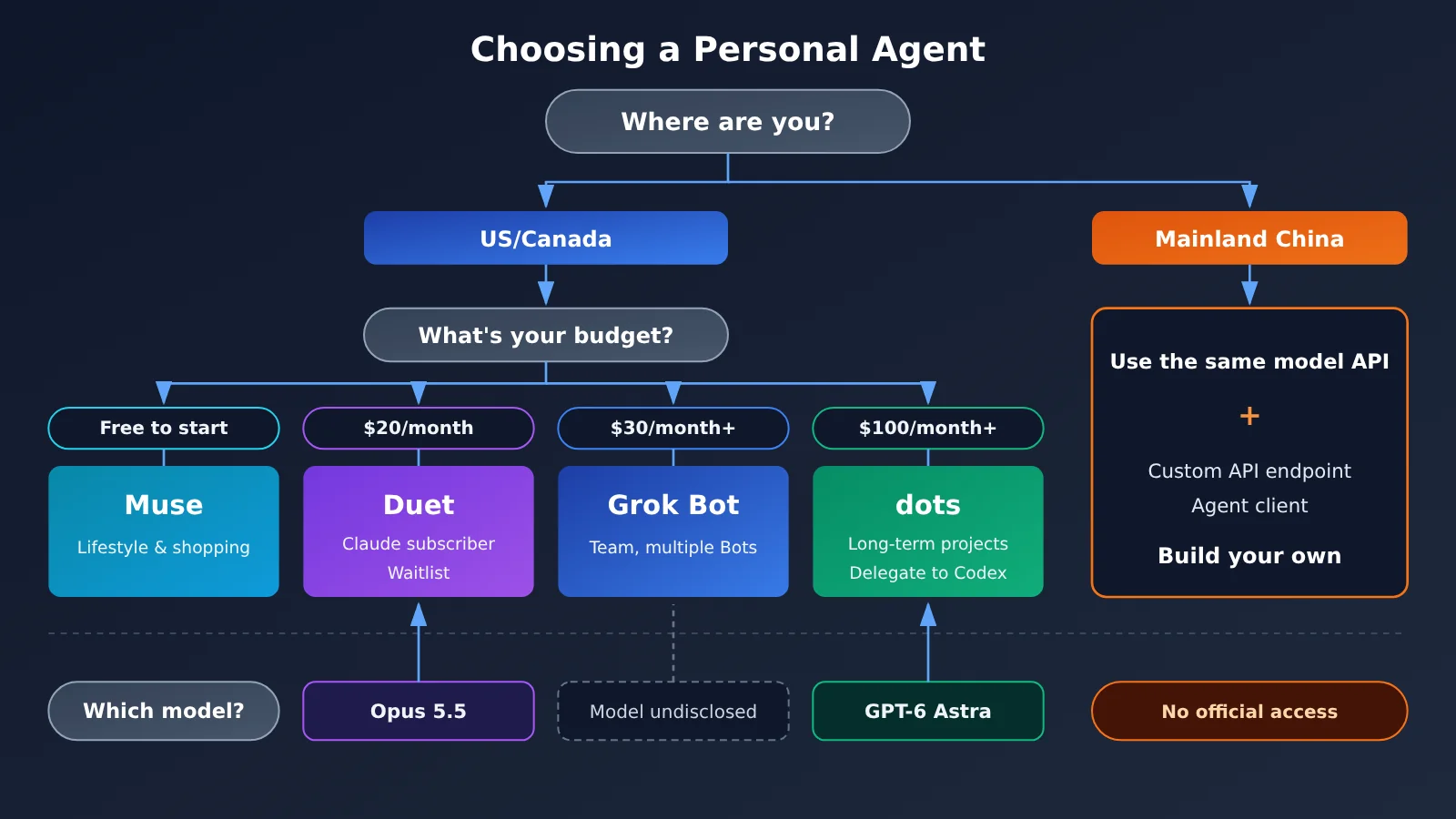
Choosing a Personal Agent by Price and Value
First, here are the full pricing tiers for each product:
| Product | Plan | Monthly price | What’s included |
|---|---|---|---|
| Claude Duet | Claude Pro | $20/month (about $17/month with annual billing) | Includes the Duet research preview, sharing Claude’s 5-hour session limit and weekly usage limit |
| Claude Duet | Claude Max | $100/month | 5x the usage of Pro |
| Claude Duet | Claude Max | $200/month | 20x the usage of Pro |
| dots | Pro 100 / Pro 200 | $100/month, $200/month | The first dot is included in the plan, along with a separate “deep work” allowance |
| dots | Pro 500 | $500/month | Same as above, and the only tier that includes Ultrafast |
| dots | Business Premium | Official price not verified in this article | The first dot is included in the plan |
| Muse | Free tier | $0 | Free to get started; signup requires a payment card, and the app shows the remaining usage as a percentage |
| Muse | Power / Maximum | $20/month, $100/month | Upgrade if you need more usage |
| Grok Bot | Premium | $30/month ($300/year) | Includes a weekly usage allowance; additional usage is billed separately based on token costs |
| Grok Bot | Super | $100/month ($1,000/year) | 3.5x the usage of Premium, with priority access to models during peak times |
| Grok Bot | Ultra | $200/month ($2,000/year) | 12x the usage of Premium, with earliest access to new products and models |
Prices are as of 2026-10-23; check the official websites for the latest rates. Claude plan prices are monthly rates from a third-party pricing roundup (2026-08). ChatGPT Pro is available only with monthly billing. Grok Bot’s $8 Plus tier doesn’t include Grok Bot, and team plans are also priced at $30 / $100 / $200 per seat.
Looking at price alone: Muse is free to start, but is available only in the US and Canada. Claude Pro includes Duet for $20, though you may have to wait in a queue, and Duet shares its usage limits with everyday chats. Grok Bot starts at $30. dots has the highest entry price, with its cheapest plan, Pro 100, costing $100.
Looking at value: Both Duet and dots are bundled with other plans, so they’re the best value if you already subscribe to Claude or ChatGPT Pro. When Duet entered preview, users received a one-time full usage reset, available through 2026-11-30. dots also came with an extended deep work allowance during its first month after launch. Conversations with a dot don’t count toward ChatGPT usage, but tasks started in Work or Codex still count toward those products’ usage limits. Once you exceed Grok Bot’s weekly allowance, you’ll be charged separately based on token costs. It also shares a usage pool with Grok and Cursor, so heavy users should pay close attention. Grok Bot’s entry price has changed several times, too: when it launched in August, individual users needed a $200/month plan at minimum; as of 2026-10-12, new users can start at $30. Check the official website on the day you buy.
Choose a Personal Agent by Model
This one’s simple: choose Duet if you want to use Opus 5.5, and dots if you want GPT-6 Astra. According to TechCrunch, Muse uses Muse Spark, while Grok Bot hasn’t disclosed which model it uses. If you care about exactly which model is handling your email and finances, Grok Bot doesn’t offer a clear answer right now.
Choose a Personal Agent by Use Case
| Use case | Top pick | Why |
|---|---|---|
| Morning briefings and email triage | Claude Duet | Sends a briefing every morning; asks for approval before sending messages, making payments, or deleting anything |
| Long-term projects and coding | dots | Works toward goals 24/7, can delegate tasks to Codex, and supports collaboration in Slack and Teams |
| Everyday life and shopping | Muse | Connects to shopping, dining, and smart home services; shopping is its main use case |
| Dividing work across multiple team bots | Grok Bot | Multiple bots can each handle a different area and delegate tasks to one another in group chats; teach them once and save the process as a routine |
Duet’s approval process is a good fit if you’re worried about an agent sending emails or making payments without permission. But it checks your accounts at set intervals, so it’s not suited to tasks that need a response within seconds. dots connects to more than 4,000 apps, making it a good choice for handing off a long-term goal and letting it make steady progress. Grok Bot can operate websites without APIs, which makes it useful for repetitive, well-defined back-office tasks on a team.
An Alternative for Developers in China: Build Your Own Personal Agent with the Same Models
Bottom line: The API gives you access to the same models, not the Duet or dots app. You’ll need to build features like morning briefings, routine checks, and email integrations yourself using an Agent client.
It’s important to be clear about this upfront. When you call claude-opus-5-5 through APIYI at apiyi.com, you get the same model that powers Duet. When you call gpt-6-astra, you get the same model that powers dots. But product features like a cloud computer, daily briefings, approval pop-ups, and connections to 4,000+ apps don’t come with the API. They’re provided by the Agent client you choose.
API Pricing for Personal Agent Models
| Model ID | Equivalent model | Input | Output | Cache read | Notes |
|---|---|---|---|---|---|
claude-opus-5-5 |
Same model as Duet | $4 | $20 | $0.20 | Input and output prices match Anthropic’s official pricing; no tiered pricing |
claude-sonnet-5-5 |
— | $2 | $10 | $0.10 | Suitable for routine checks |
claude-haiku-5-5 |
— | $0.10 | $0.50 | Suitable for frequent, lightweight tasks; tiered pricing: $0.50 after a single request exceeds 100,000 input tokens | |
gpt-6-astra |
Same model as dots | $10 | $50 | $1 | Tiered pricing: $20 after a single request exceeds 272,000 input tokens |
gpt-6-sol |
— | $2 | $10 | $0.20 | Tiered pricing: $4 after a single request exceeds 272,000 input tokens |
grok-4.7 |
This doesn’t mean Grok Bot uses it | $2 | $6 | $0.50 | Tiered pricing: $4 after a single request exceeds 200,000 input tokens |
| Muse Spark | — | — | — | — | Not available on APIYI |
Prices are in USD per million tokens. “Cache read” is the input price when a prompt cache hit occurs. Models with tiered pricing are priced by the token count of each request; the output price is the input price for the corresponding tier multiplied by the output multiplier. claude-opus-5-5-thinking, claude-sonnet-5-5-thinking, and claude-haiku-5-5-thinking are priced the same as their corresponding base models. Data is from the APIYI documentation at docs.apiyi.com/models (updated 2026-10-23 06:05, default group). Actual charges are based on the prices shown in the console in real time.
Build a Personal Agent with an Agent Client
Any desktop Agent client that lets you configure a custom endpoint can connect to the API. Here are two examples:
- Hermes Desktop: Go to Settings → Model to set a custom endpoint. You can also choose a cheaper model specifically for subagents.
- QwenPaw Desktop: Enter your key under Settings → Models. It supports DingTalk, Lark, WeChat, and QQ, making it a good fit for messaging workflows at teams in China.
Enter the following settings in the client:
- Endpoint (
base_url):https://api.apiyi.com/v1 - API key: Create one in the APIYI console
- Primary model:
claude-opus-5-5(use hyphens in the model ID; don’t change them to periods) - Models for routine checks and subagents:
claude-haiku-5-5orclaude-sonnet-5-5 - To use the same model as dots:
gpt-6-astra
If you use multiple Agents and want to connect them all with the same API key, see this published guide: https://help.apiyi.com/magpie-unify-claude-code-codex-pi-hermes-api-gateway.html
The general rule for assigning models is to use Haiku or Sonnet for tasks that run every few hours, such as routine checks. Save Opus for decisions, like whether to reply to an email or pay an invoice. Frequent checks can drive costs up quickly, so assigning the right model to each task can make a noticeable difference.
Personal Agent Morning Briefing: Monthly Cost Estimate
Assume you generate one morning briefing per day, process about 50,000 tokens (email, calendar, and message summaries), and produce about 3,000 tokens. A month is calculated as 30 days. All token counts below are estimates and are intended as a rough guide only.
| Model | Daily cost | Monthly cost |
|---|---|---|
claude-opus-5-5 |
About $0.26 | About $7.8 |
claude-sonnet-5-5 |
About $0.13 | About $3.9 |
claude-haiku-5-5 |
About $0.0065 | About $0.2 |
gpt-6-astra |
About $0.65 | About $19.5 |
For morning briefings alone, using Opus costs less than $8 per month. Your actual costs will depend on how much data you connect and how often you run checks. We recommend starting with a small workload for a week, then adjusting which models handle which tasks based on your bill.
🚀 Get started quickly: Developers in China can register at APIYI apiyi.com and use the free trial credits for new users to connect
claude-opus-5-5to Hermes Desktop or QwenPaw. Once you’ve generated a morning briefing, you can decide whether to assign checks to Haiku or Sonnet.
Frequently Asked Questions
Q1: How is a Personal Agent different from a regular AI chat?
Each of these four products comes with its own cloud computer. After you close the app, it keeps working toward your goals and gets in touch when it needs your approval. With regular chat, you ask a question and get an answer; when the conversation ends, the work stops.
Q2: Can people in China use Duet, dots, Muse, and Grok Bot?
None of the four offers an official way for users in mainland China to access its service. Using them anyway requires an overseas account and payment method, and carries the risk of account suspension. You could lose your balance and usage history. A more reliable option is to access the same models through APIYI apiyi.com and set them up yourself with an Agent client.
Q3: Does using the API to call claude-opus-5-5 mean I’m using Duet?
No. The API provides the model itself. Duet’s daily briefings, approval flow, and cloud computer are app features. If you build your own setup, the Agent client needs to provide these features, and the results will depend on your configuration.
Q4: Does Grok Bot use grok-4.7?
The company hasn’t said. Neither the Grok Bot website nor its launch announcement identifies a specific model. You can call `grok-4.7` through the API, but that doesn’t mean Grok Bot uses it.
Q5: Roughly how much does it cost to build a morning briefing Agent?
Based on about 50,000 input tokens and 3,000 output tokens per day, Opus 5.5 costs about $7.8 per month, while Haiku 5.5 costs about $0.2 per month. APIYI charges based on usage and offers free trial credits for new users, so you can try it out before deciding.
Summary
The four Personal Agents now have clearly defined roles: Duet runs on Opus 5.5 and is included with Claude Pro at $20, but you may have to wait in a queue; dots uses GPT-6 Astra, with plans starting at $100 for Pro 100; Muse has a free tier and focuses on shopping and everyday life; and Grok Bot starts at $30 and excels at coordinating multiple Bots, though its model hasn’t been disclosed. All four are primarily available in the U.S., and none has an official offering in mainland China.
Key takeaways:
- Duet: Runs on Opus 5.5. It’s a good fit for daily briefings and email triage, and shares usage limits with your Claude plan.
- dots: Runs on GPT-6 Astra. It’s suited to long-term projects and can assign tasks to Codex.
- Muse: According to TechCrunch, it uses Muse Spark. Shopping is its main use case, and it’s available only in the U.S. and Canada.
- Grok Bot: Its model hasn’t been publicly disclosed. Usage beyond the weekly allowance is billed separately by token.
- Developers in China: Call
claude-opus-5-5orgpt-6-astra, then set up your own agent using an Agent client. - How to save: Delegate routine checks to Haiku or Sonnet, and use Opus for tasks that require judgment.
If you’re in the U.S. and already subscribe to Claude Pro or ChatGPT Pro, the Agent included with your plan should be enough. If you’re a developer in China, we recommend using APIYI apiyi.com to call the same models on a pay-as-you-go basis. Start by using the free quota to get a daily briefing workflow up and running.
Sources
- xAI’s official announcement, “Introducing Grok Bot,” the Grok Bot pricing page, and xAI developer documentation
- TechCrunch’s 2026-09-08 report on Muse’s launch and its 2026-10-21 report on Meta’s third-quarter earnings call
- OpenAI’s official article, “Introducing dots,” and the OpenAI Help Center
- Anthropic’s official article, “Claude Duet,” and the Claude Help Center
Author: APIYI Technical Team
Technical discussions: Contact us from the APIYI website homepage. For more information, visit the docs center at docs.apiyi.com.