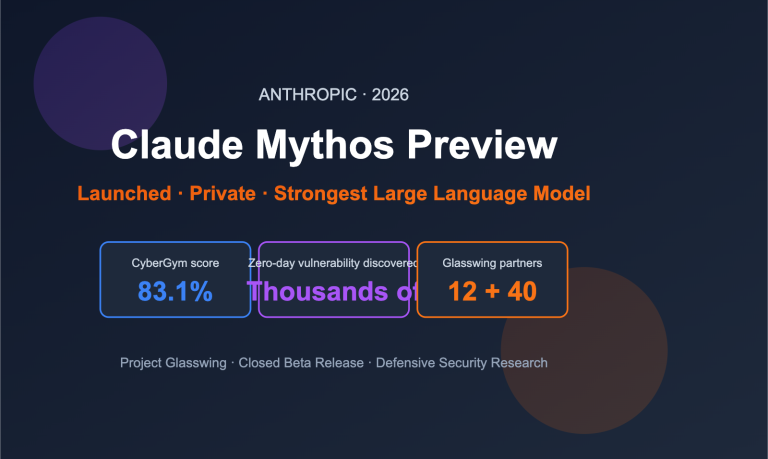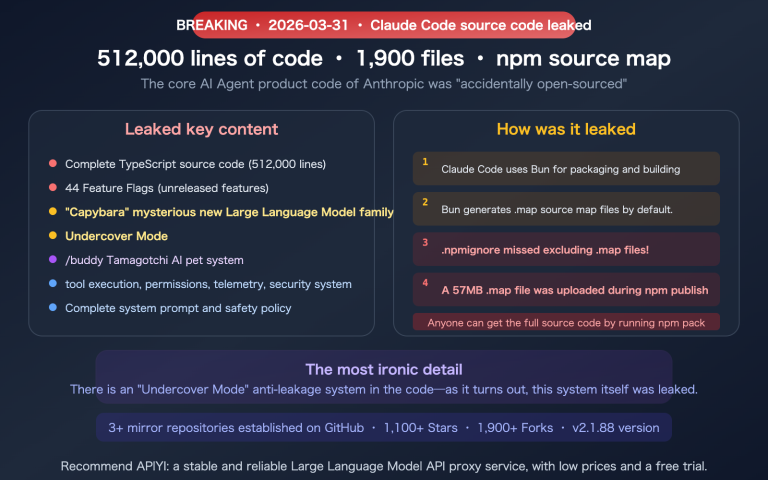
On March 26, 2026, an accidental data leak brought Anthropic's most mysterious AI model to light: Claude Mythos, described by Anthropic officials as "our most capable model to date," representing a "step change" in AI capabilities.
This wasn't a planned release. A configuration error in Anthropic's content management system led to approximately 3,000 unpublished blog assets, including draft announcements, being exposed in an unencrypted public data cache. Fortune exclusively reported on the incident, and Anthropic subsequently confirmed the existence of Claude Mythos.
Core Value: This article will provide a comprehensive analysis of the known information about Claude Mythos from four perspectives: model positioning, core capabilities, security controversies, and industry impact. It will also offer practical advice for developers on how to prepare in advance.
Claude Mythos: Key Information at a Glance
| Item | Details |
|---|---|
| Model Name | Claude Mythos |
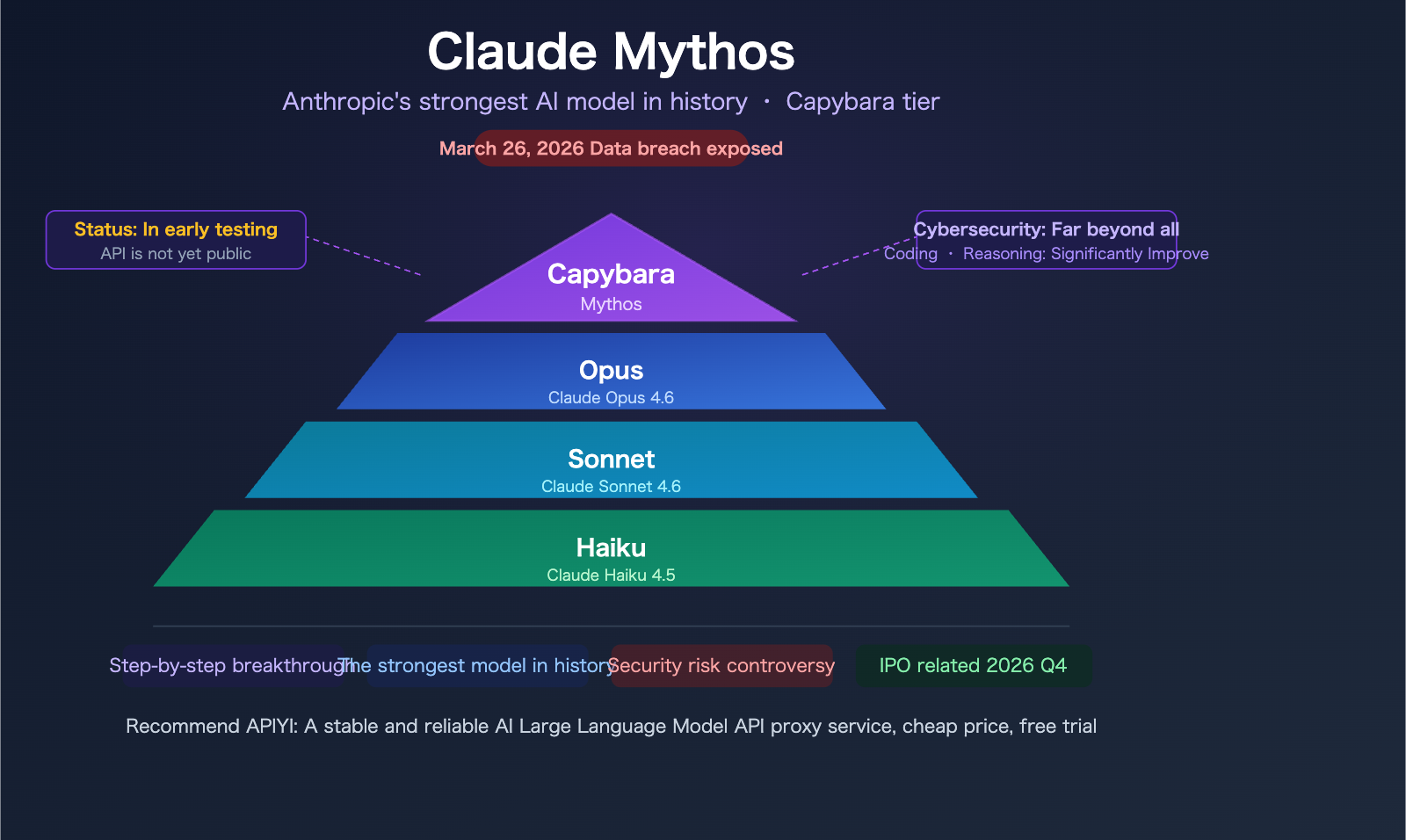
| Model Tier | Capybara — Anthropic's new tier, above Opus |
| Discovery | Data leak on March 26, 2026; exclusive report by Fortune |
| Official Confirmation | Anthropic spokesperson confirmed the model's existence |
| Current Status | Not publicly released; available only to early access customers |
| Official Positioning | "Most powerful AI model to date," "step change" |
| Public API | None yet; no pricing, model ID, or context window information |
| Related Event | Anthropic considering IPO as early as October 2026 |
This marks the first time a major model from Anthropic has been leaked through unofficial channels. A leaked draft blog post stated: "This is the most powerful AI model we have developed to date."
Claude Mythos's Capybara Tier: Why It Surpasses Opus
Understanding Anthropic's Model Tiers
Before Claude Mythos, Anthropic's model ecosystem consisted of three tiers: Opus (most capable), Sonnet (balanced), and Haiku (lightweight). The introduction of Capybara disrupts this structure, establishing a new, fourth tier positioned above Opus.
| Tier | Representative Model | Positioning | Use Cases |
|---|---|---|---|
| Capybara (New) | Claude Mythos | Breakthrough Capabilities | High-difficulty reasoning, cybersecurity, complex code |
| Opus | Claude Opus 4.6 | Flagship | In-depth analysis, complex programming, long-form content creation |
| Sonnet | Claude Sonnet 4.6 | Balanced | Everyday development, content generation, data analysis |
| Haiku | Claude Haiku 4.5 | Lightweight | Fast responses, classification, summarization |
The "Capybara" naming continues Anthropic's tradition of using animal names. Capybaras are the world's largest rodents, known for their gentle nature despite their size. This name suggests a "massive" leap in Claude Mythos's capabilities while maintaining Anthropic's core focus on safety.
Key Differences Between Claude Mythos and Claude Opus 4.6
According to the leaked draft documents, Claude Mythos shows significant improvements over Claude Opus 4.6 in the following areas:
- Software Coding Tests: "Dramatically higher scores"
- Academic Reasoning: "Significantly improved" performance
- Cybersecurity Capabilities: "Far ahead of any other AI model"
- Complex Reasoning: Enhanced multi-step problem-solving
- Agent Workflows: Expanded autonomous workflows with greater consistency
An Anthropic spokesperson described this as a "step change," rather than incremental improvement, indicating that Claude Mythos represents a qualitative shift in capabilities, not just a minor upgrade to Opus.
🎯 Developer Recommendation: Although Claude Mythos isn't publicly available yet, Claude Opus 4.6 remains the most powerful model currently accessible. We recommend familiarizing yourself with Claude Opus 4.6's API invocation methods through the APIYI apiyi.com platform. This will allow for a seamless transition once Mythos becomes available.
Claude Mythos's 6 Core Capabilities Explained
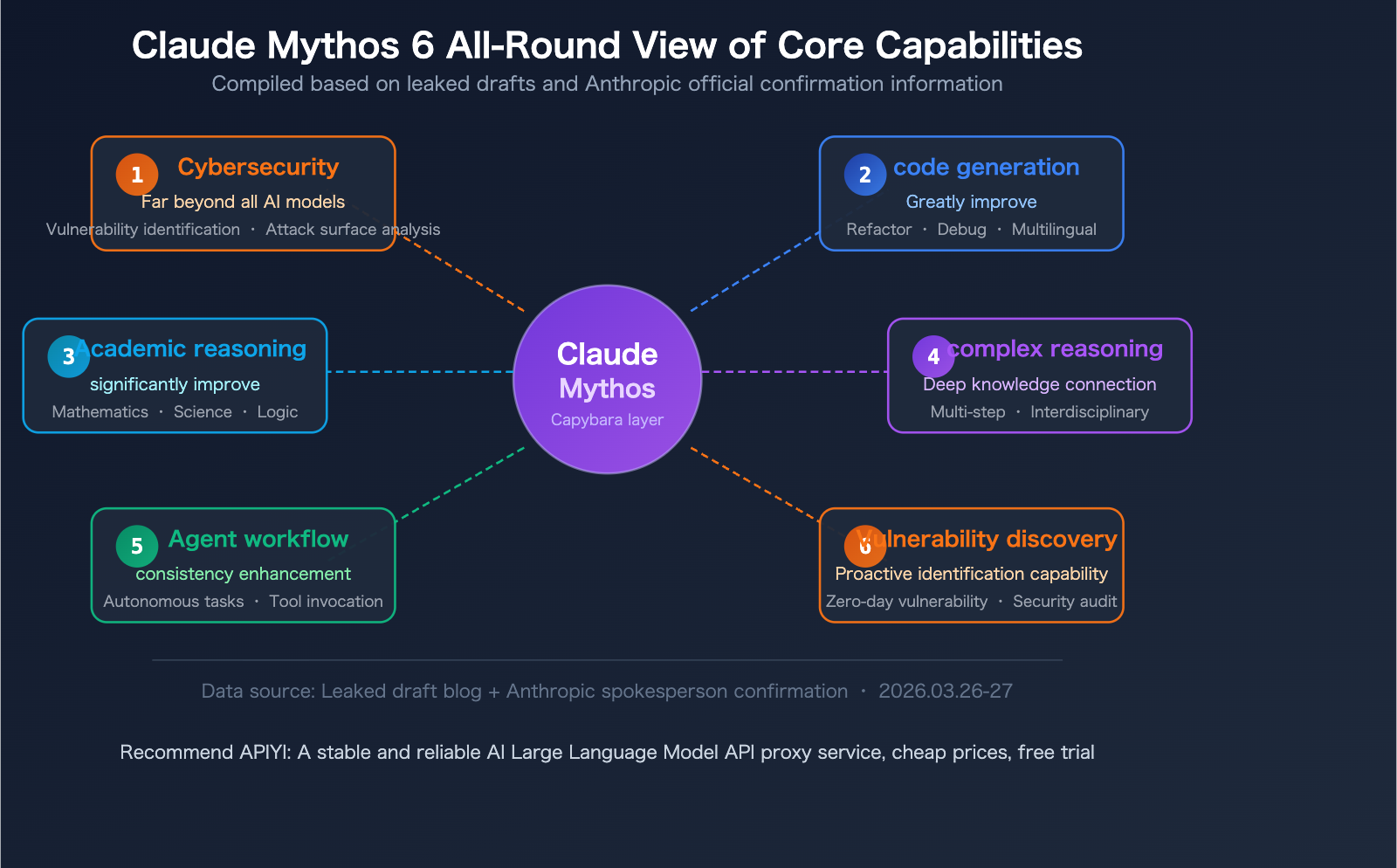
Based on leaked draft blog posts and information confirmed by an Anthropic spokesperson, Claude Mythos demonstrates breakthrough capabilities in the following 6 areas.
Capability 1: Cybersecurity – "Far Surpassing All Other AI Models"
This is Claude Mythos's most attention-grabbing and controversial capability. The leaked drafts explicitly state:
- Claude Mythos "currently far surpasses any other AI model in cybersecurity capabilities."
- It can identify software vulnerabilities and security weaknesses.
- Anthropic itself warns: it "heralds an upcoming wave of models that will exploit vulnerabilities far faster than defenders can keep up."
- The company believes it "poses an unprecedented cybersecurity risk."
It's precisely this extreme cybersecurity capability that makes Anthropic so cautious about releasing Mythos. Initial access is limited to a select few clients for testing purposes, specifically for cybersecurity defense applications.
Capability 2: Code Generation and Debugging
Achieving "substantial improvements" in software coding tests means Claude Mythos could offer revolutionary advantages in scenarios like:
- Understanding and refactoring complex codebases.
- Generating code across multiple languages.
- Suggesting bug detection and fixes.
- Performing large-scale code reviews.
Capability 3: Academic Reasoning
"Significantly improved" academic reasoning capabilities cover:
- Mathematical proofs and derivations.
- Analysis of scientific papers.
- Logical reasoning chains.
- Integration of interdisciplinary knowledge.
Capability 4: Complex Multi-Step Reasoning
Claude Mythos is designed to establish "deep connective tissue between ideas and knowledge." This suggests enhanced abilities in scenarios such as:
- Long-chain reasoning tasks.
- Decision-making that requires synthesizing information from multiple sources.
- Step-by-step decomposition and solving of complex problems.
Capability 5: Enhanced Agent Workflows
Improved consistency in Agent workflows means Claude Mythos is more reliable when autonomously executing multi-step tasks:
- Autonomous task decomposition and execution.
- Increased accuracy in tool usage.
- Stability for long-running tasks.
- Scenarios involving multi-Agent collaboration.
Capability 6: Vulnerability Discovery and Security Analysis
Beyond passive defense, Claude Mythos also shows proactive vulnerability discovery capabilities:
- Code security auditing.
- Attack surface analysis.
- Zero-day vulnerability identification.
- Security architecture assessment.
| Capability Dimension | Claude Mythos Performance | Improvement vs. Opus 4.6 | Controversy Level |
|---|---|---|---|
| Cybersecurity | Far surpasses all AI models | Qualitative Leap | ★★★★★ |
| Code Generation | Substantial Improvement | Significant | ★☆☆☆☆ |
| Academic Reasoning | Significant Improvement | Significant | ★☆☆☆☆ |
| Complex Reasoning | Deep Knowledge Connection | Significant | ★☆☆☆☆ |
| Agent Workflows | Enhanced Consistency | Moderate | ★★☆☆☆ |
| Vulnerability Discovery | Proactive Identification | Qualitative Leap | ★★★★★ |
The Claude Mythos Leak: Timeline and Security Controversy
Leak Event Timeline
The leak itself is a notable security incident:
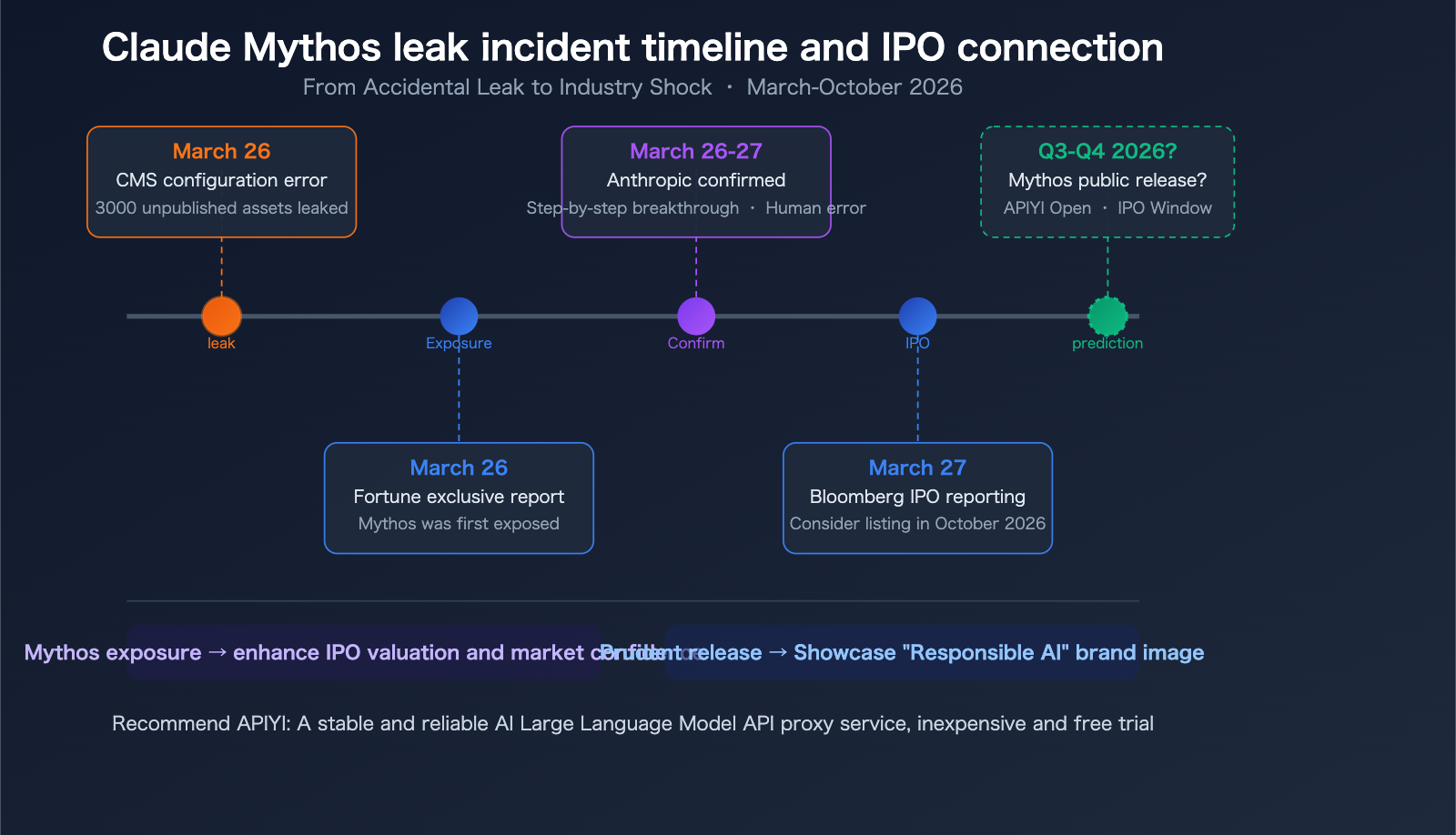
March 26, 2026: A configuration error in Anthropic's content management system exposed approximately 3,000 unpublished blog assets in an unencrypted public data cache. These assets included draft announcements and technical descriptions for Claude Mythos.
March 26, 2026 (Same Day): Fortune magazine discovered and exclusively reported on the leak.
March 26-27, 2026: An Anthropic spokesperson confirmed the existence of Claude Mythos, describing it as a "step-change leap," and attributed the leak to "human error." Anthropic removed public access after being notified by Fortune.
March 27, 2026: Bloomberg and The Information reported that Anthropic was considering an IPO as early as October 2026. The Information's briefing title directly mentioned: "Anthropic Discusses Q4 IPO, Preps Advanced 'Claude Mythos' / Capybara AI."
Security Controversy: The Double-Edged Sword
The biggest controversy surrounding Claude Mythos lies in the "double-edged sword" nature of its cybersecurity capabilities:
Defensive Perspective: It can rapidly identify vulnerabilities and assess attack surfaces, providing unprecedented tools for security teams.
Offensive Perspective: The same capabilities, if used maliciously, could enable vulnerability exploitation at a speed that "far surpasses defenders' efforts."
Anthropic is clearly aware of this paradox, which is the core reason Mythos has not yet been publicly released. The initial limited access for cybersecurity defense scenarios to vetted clients reflects Anthropic's consistent stance on "Responsible AI."
How Developers Can Prepare for Claude Mythos API Integration
Although Claude Mythos doesn't have a public API yet, developers can start preparing now.
Known API Information
| Item | Status |
|---|---|
Model ID (e.g., claude-mythos-1) |
Not Publicly Available |
| API Pricing | Not Publicly Available |
| Context Window | Not Publicly Available |
| Public Release Date | Undetermined |
| Third-Party Platform Availability | None Yet |
Preparation Step 1: Familiarize Yourself with Claude API Calls
The Claude series of models use a unified API interface. When Mythos opens its API, you'll only need to change the model parameter to switch. You can start mastering the call methods now using Claude Opus 4.6:
import openai

client = openai.OpenAI(
    api_key="your-api-key",
    base_url="https://api.apiyi.com/v1"  # APIYI Unified Interface
)

# Currently using Claude Opus 4.6
response = client.chat.completions.create(
    model="claude-opus-4-6",
    messages=[
        {"role": "user", "content": "Analyze the security vulnerabilities in this code"}
    ]
)

# To switch to Claude Mythos in the future, just change the model parameter
# model="claude-mythos"  # Model ID to be announced by the official team
View Full Code (with streaming output and multi-model switching)
import openai
import time

# Call the entire Claude series through the APIYI unified interface
client = openai.OpenAI(
    api_key="your-api-key",
    base_url="https://api.apiyi.com/v1"
)

# Claude model list (Mythos will be supported automatically once available)
claude_models = {
    "claude-opus-4-6": "Opus 4.6 - Current Flagship",
    "claude-sonnet-4-6": "Sonnet 4.6 - Balanced",
    "claude-haiku-4-5": "Haiku 4.5 - Lightweight",
    # "claude-mythos": "Mythos - Capybara Tier (Pending Release)",
}

prompt = "Analyze the potential security vulnerabilities in the following code and provide remediation suggestions"

for model_id, desc in claude_models.items():
    try:
        start = time.time()
        response = client.chat.completions.create(
            model=model_id,
            messages=[{"role": "user", "content": prompt}],
            max_tokens=1000,
            stream=True
        )

        print(f"\n[{desc}]")
        full_response = ""
        for chunk in response:
            if chunk.choices[0].delta.content:
                content = chunk.choices[0].delta.content
                full_response += content
                print(content, end="", flush=True)

        elapsed = time.time() - start
        print(f"\nTime taken: {elapsed:.2f}s")
    except Exception as e:
        print(f"\n[{desc}] Call failed: {e}")
🚀 Quick Start: We recommend using the APIYI apiyi.com platform to familiarize yourself with Claude API calls in advance. The platform supports the full series of Claude Opus 4.6, Sonnet 4.6, and Haiku 4.5, with free credits upon registration. APIYI will be among the first to integrate Claude Mythos once its API is available.
Preparation Step 2: Follow Official Announcements
We suggest keeping an eye on the following sources to get the latest updates on Claude Mythos as soon as they're released:
- Anthropic Official Blog:
anthropic.com/blog - Anthropic API Documentation:
docs.anthropic.com - APIYI Model Update Announcements:
help.apiyi.com
Preparation Step 3: Evaluate Use Cases
Based on the known capabilities of Claude Mythos, the following scenarios are likely to benefit the most:
- Automated Security Audits: Leveraging its superior vulnerability detection capabilities.
- Complex Code Refactoring: Handling the understanding and rewriting of large codebases.
- High-Difficulty Reasoning Tasks: Mathematical proofs, scientific research assistance.
- Agent Automation Workflows: Building more reliable autonomous workflows.
💡 Recommendation: Before Claude Mythos is officially released, Claude Opus 4.6 remains the most powerful available option. We recommend using the APIYI apiyi.com platform to call Claude Opus 4.6 for complex tasks, accumulating experience, and preparing for Mythos's arrival.
The Connection Between Claude Mythos and Anthropic's IPO
The timing of Claude Mythos's exposure is intriguing. On the same day as the leak (March 27, 2026), Bloomberg and The Information reported that Anthropic was considering an IPO as early as October 2026.
This coincidence has sparked widespread industry discussion:
- Positioning Claude Mythos as "the most powerful model ever" clearly helps boost valuation and market confidence before an IPO.
- Anthropic's cautious approach to the network security risks of Mythos also showcases its "Responsible AI" brand image.
- The introduction of the new Capybara tier signifies Anthropic's development of a more complete product matrix, preparing for commercialization.
For developers, Anthropic's IPO implies:
- Potentially accelerated model iteration: Public companies need to demonstrate continuous innovation to investors.
- More stable API services: Commercial pressures will drive improvements in service quality.
- Possible adjustments to pricing strategies: New model releases may come with new pricing structures.
💰 Cost Alert: The Capybara tier sits above Opus, and its pricing will likely be higher. For cost-conscious developers, using aggregation platforms like APIYI apiyi.com might offer more favorable pricing and flexible switching between different Claude models.
Frequently Asked Questions
Q1: When will Claude Mythos be available via API?
There's no confirmed public release date yet. Anthropic has only granted access to a few early testing clients, primarily for cybersecurity defense scenarios. Considering Anthropic might go public with an IPO around October 2026, the official release of Mythos could be around that time. It's a good idea to keep an eye on Anthropic's official blog and APIYI's (apiyi.com) model update announcements.
Q2: How much more expensive will Claude Mythos be compared to Opus?
No official pricing information has been released. However, given its positioning above Opus in the hierarchy, it's highly likely to be priced higher. Considering the current pricing of Claude Opus 4.6, Mythos could see a significant price increase. Using the APIYI (apiyi.com) platform for model invocations often provides more favorable pricing than official channels, so it's worth comparing prices once Mythos is launched.
Q3: Can projects currently using Claude Opus 4.6 seamlessly switch to Mythos in the future?
Most likely, yes. The Claude series models use a unified API interface format (compatible with OpenAI SDK), so switching models only requires changing the model parameter. If you're currently using APIYI (apiyi.com) to invoke Claude Opus 4.6, once the platform integrates Mythos, you'll just need to change the model name to switch, without any other code modifications.
Summary: Must-Know Points for Newcomers About Claude Mythos
The unexpected leak of Claude Mythos reveals a significant milestone in AI development – Anthropic is building the next generation of AI systems, far surpassing current top-tier models. The emergence of the Capybara tier breaks the existing Opus-Sonnet-Haiku structure, signaling a new leap in AI capabilities.
5 Key Points for Newcomers:
- Claude Mythos is a real model, confirmed by Anthropic, but not yet publicly released.
- Capybara is the new top tier, positioned above Opus, representing a "step-change leap" rather than incremental improvement.
- Cybersecurity capabilities are the most controversial aspect, leading Anthropic to be extremely cautious about its release.
- Don't wait for Mythos to start learning the Claude API – you can get familiar with the interface using Claude Opus 4.6 right now.
- Mark your calendars for October 2026 – Anthropic's IPO and the potential release of Mythos might occur within the same timeframe.
The best course of action right now is to start gaining experience with Claude Opus 4.6. We recommend using APIYI (apiyi.com) for quick access to the full range of Claude models. With a single API key, you can invoke Opus, Sonnet, and Haiku, preparing you technically for Mythos's arrival.
Author: APIYI Team | For more tutorials on Claude model API invocation and the latest model updates, visit APIYI (apiyi.com)
📚 References
-
Fortune Exclusive Report: Anthropic's Mythos AI Model Revealed in Data Leak
- Link:
fortune.com/2026/03/26/anthropic-says-testing-mythos-powerful-new-ai-model-after-data-leak-reveals-its-existence-step-change-in-capabilities/ - Description: The first media outlet to report on the leak, including a response from an Anthropic spokesperson.
- Link:
-
The Information Briefing: Anthropic Discusses Q4 IPO and Prepares Claude Mythos
- Link:
theinformation.com/briefings/anthropic-discusses-q4-ipo-preps-advanced-claude-mythos-capybara-ai - Description: Connects Mythos with Anthropic's IPO plans.
- Link:
-
Bloomberg Report: Claude AI Maker Anthropic Considers IPO as Early as October
- Link:
bloomberg.com/news/articles/2026/03/27/claude-ai-maker-anthropic-said-to-weigh-ipo-as-soon-as-october - Description: IPO timeline and commercialization context.
- Link:
-
Anthropic Official API Documentation: Claude Model API Access Guide
- Link:
docs.anthropic.com - Description: Official API documentation, covering model switching and invocation standards.
- Link:
-
NewsBytesApp Report: Anthropic Confirms Testing Its Most Advanced Model
- Link:
newsbytesapp.com/news/science/claude-mythos-ai-model-testing-confirmed-by-anthropic/story - Description: A multi-angle summary of information and analysis from various sources.
- Link: