Author's Note: A comprehensive look at Anthropic's Claude Code Security feature released in February 2026, covering its AI reasoning-based vulnerability scanning, the discovery of 500+ vulnerabilities, its availability for Enterprise/Team plans, and its core differences from traditional SAST tools.
Anthropic officially launched Claude Code Security on February 20, 2026. This is a brand new code security scanning feature built directly into Claude Code (web version). Leveraging the AI reasoning capabilities of Claude Opus 4.6, it has already discovered over 500 high-risk vulnerabilities lying dormant for decades in open-source projects, capturing the attention of the entire cybersecurity industry.
Core Value: Get the full picture in 3 minutes—understand how Claude Code Security works, its core capabilities, how to get it, and its profound impact on the code security landscape.
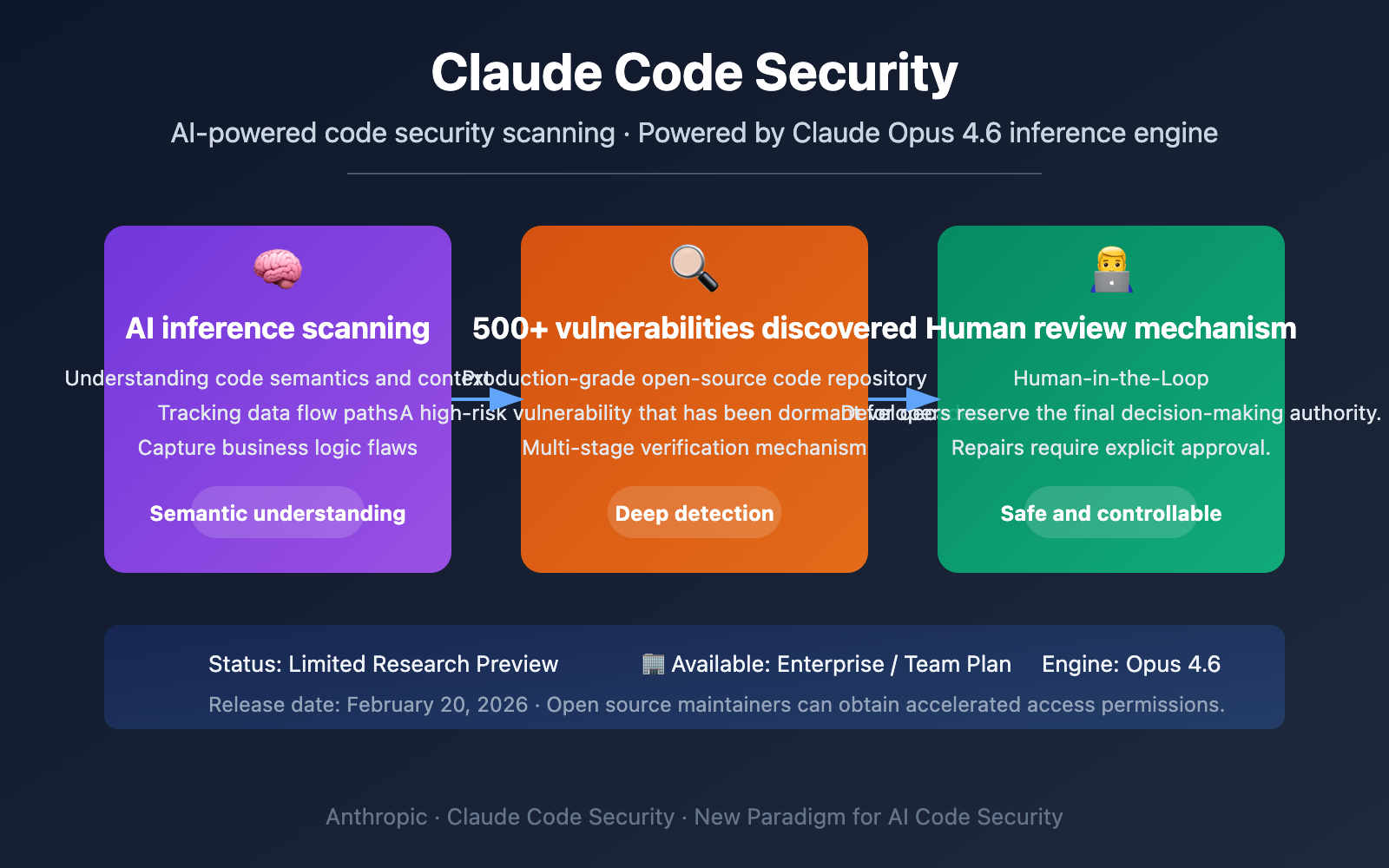
Claude Code Security: Quick Facts
| Information | Details |
|---|---|
| Release Date | February 20, 2026 |
| Publisher | Anthropic (Claude's developer) |
| Product Form | Security scanning feature built into Claude Code (web version) |
| Current Status | Limited Research Preview |
| Underlying Model | Claude Opus 4.6 |
| Core Achievement | Discovered 500+ high-risk vulnerabilities in open-source codebases |
| Available Plans | Enterprise Plan and Team Plan |
| Open Source Support | Open-source project maintainers get accelerated access |
What is Claude Code Security?
Claude Code Security is an AI-driven code security scanning tool from Anthropic. Unlike traditional Static Application Security Testing (SAST) tools, it doesn't rely on predefined rule libraries or known vulnerability signatures for pattern matching. Instead, it uses AI reasoning to "read and understand" code—much like a senior security researcher reviewing it.
Specifically, Claude Code Security can understand the interactions between code components, trace the complete flow of data through an application, and catch complex vulnerabilities that traditional rule-matching tools miss, such as business logic flaws and broken access controls.
Claude Code Security's Multi-Stage Verification
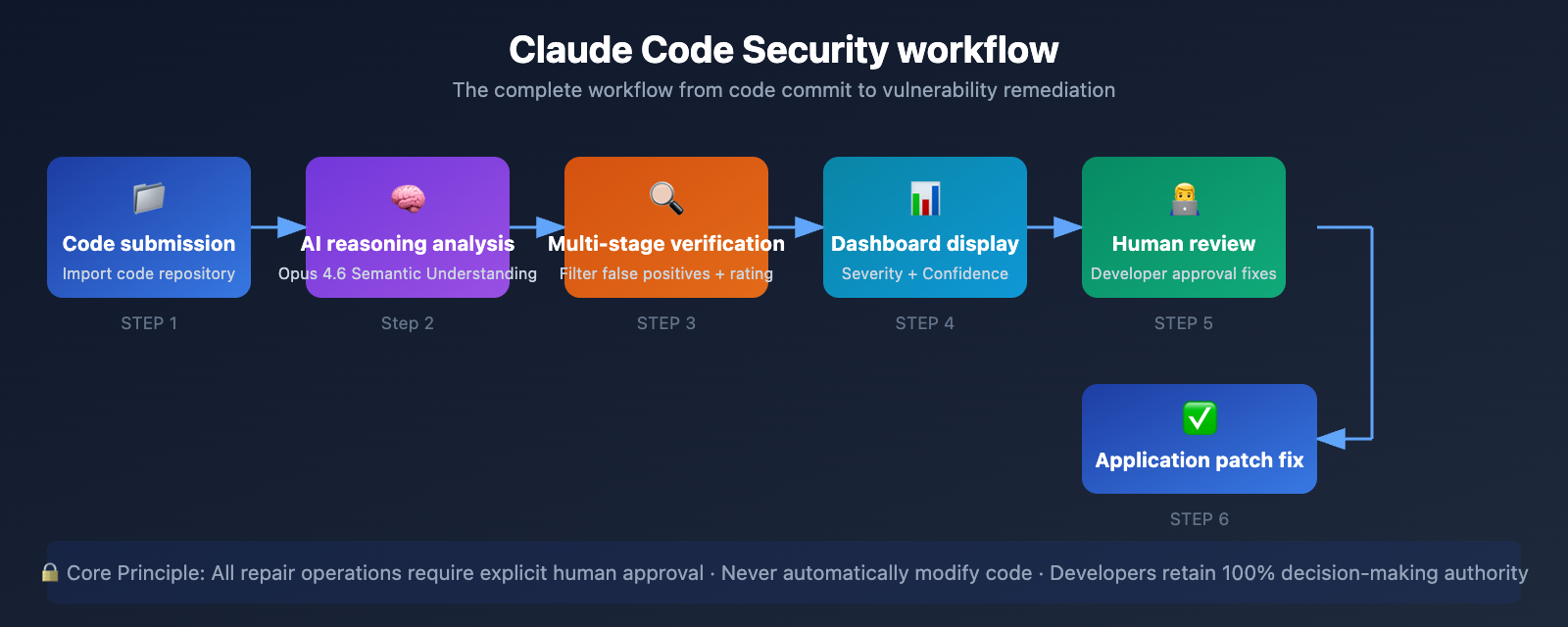
To reduce false positives, Claude Code Security employs a multi-stage verification process. Every identified potential vulnerability goes through secondary analysis and filtering. Each finding presented on the security dashboard includes:
- Severity Rating: Ranked by the potential impact of the vulnerability.
- Confidence Rating: Reflects the AI's certainty about the accuracy of the finding.
- Remediation Suggestions: Provides specific code patches for each vulnerability.
🔒 Key Principle: Claude Code Security uses a strict human-in-the-loop review mechanism. All remediation suggestions require explicit developer approval before being applied; it will never automatically modify any code. This ensures the development team always has the final say.
Claude Code Security vs. Traditional Security Tools
Choosing a code security tool is a crucial decision for every development team. Here's a comparison of the core differences between Claude Code Security and traditional SAST tools across multiple dimensions:
| Comparison Dimension | Claude Code Security | Traditional SAST (SonarQube/Snyk) |
|---|---|---|
| Detection Principle | AI reasoning, understands code semantics and context | Rule matching, based on known signatures and patterns |
| Business Logic Vulnerabilities | ✅ Can detect | ❌ Typically cannot detect |
| Access Control Flaws | ✅ Can detect | ⚠️ Limited detection |
| False Positive Handling | Multi-stage verification + confidence rating | Rule threshold adjustment |
| Unknown Vulnerability Discovery | ✅ Can discover new vulnerability types | ❌ Only detects known vulnerability patterns |
| Fix Suggestions | AI generates targeted patch code | Generic fix guidelines |
| Human Review | Mandatory Human-in-the-Loop | Optional |
| Maturity | Research Preview (newly released) | Mature and stable (years of iteration) |
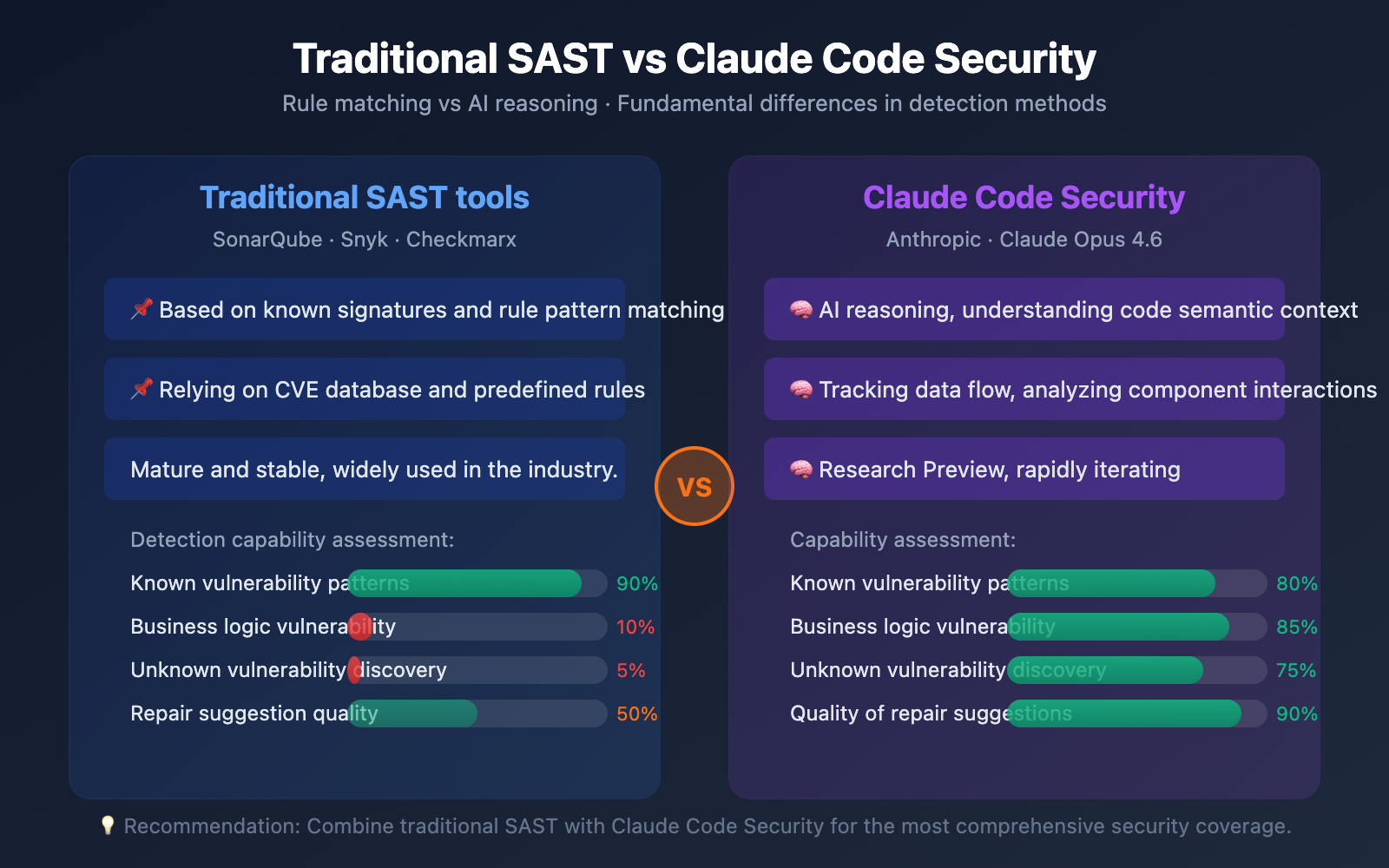
Comparison Note: Traditional SAST tools still offer irreplaceable value for detecting known vulnerability patterns, while Claude Code Security's AI reasoning capabilities fill the gap in detecting "unknown vulnerabilities" and "complex business logic flaws." In practice, it's recommended to use both in combination for more comprehensive security coverage.
Claude Code Security: 500+ Vulnerabilities Discovered
Anthropic's announcement revealed a significant achievement: using Claude Opus 4.6, their team discovered and validated over 500 high-risk vulnerabilities across multiple production-grade open-source codebases. These vulnerabilities share the following characteristics:
- Long Dormancy: Some vulnerabilities had existed in the codebases for decades, surviving countless rounds of manual code review without ever being detected.
- Broad Scope: They span open-source projects across various programming languages and frameworks.
- High Severity: All are high-severity vulnerabilities posing real security threats.
| Discovery Feature | Description |
|---|---|
| Vulnerability Count | 500+ high-risk vulnerabilities |
| Source | Production-grade open-source codebases |
| Existence Duration | Some for decades |
| Previous Detection | Survived years of expert review undetected |
| Validation Method | Multi-stage verification + manual confirmation |
This achievement fully demonstrates the advantage of AI-powered, reasoning-based security scanning over traditional rule-matching approaches—it can "understand" the deep semantic relationships within code to uncover security flaws hidden in complex interaction logic.
How to Access Claude Code Security & Availability
Who Can Use Claude Code Security
Claude Code Security is currently in Limited Research Preview and is not available to all Claude users. Here are the specific availability details:
| User Type | Available? | Notes |
|---|---|---|
| Enterprise Plan | ✅ Can apply | Enterprise users can apply via the sales team |
| Team Plan | ✅ Can apply | Team plan users can apply via the sales team |
| Pro Plan | ❌ Not available yet | Individual Pro plan not yet supported |
| Free Plan | ❌ Not available | Free plan not supported |
| Open Source Maintainers | ✅ Accelerated access | Open-source project maintainers receive priority access |
How to Apply for Access
- Confirm your organization is subscribed to the Claude Enterprise Plan or Team Plan.
- Visit the Anthropic security feature application page:
claude.com/contact-sales/security. - Complete the application form, detailing your codebase size and security requirements.
- Wait for review and activation by the Anthropic team.
Claude Code Security & Its Relationship with the APIYI Platform
It's important to clarify that Claude Code Security is an enterprise-grade security feature provided directly by Anthropic, not a service accessed via API calls. APIYI apiyi.com, as an AI Large Language Model API proxy platform, primarily offers API calling services for models like Claude, GPT, and Gemini. It currently does not include the Claude Code Security module.
If you need to use Claude Code Security, you must obtain it directly through Anthropic's official Enterprise or Team Plans. However, if your requirement is to call the Claude model via API for tasks like code analysis or code review, you can use models like Claude Opus 4.6 or Claude Sonnet 4.6 through the APIYI apiyi.com platform to achieve flexible AI-assisted coding capabilities.
🎯 Usage Tip: For development teams needing AI-assisted code review and security analysis, you can write custom security scanning scripts by calling the Claude series models via APIYI apiyi.com. The platform provides a unified API interface and free testing credits, making it easy to quickly validate the feasibility of your approach.
Claude Code Security's Impact on Developers
Impact on Enterprise Development Teams
The release of Claude Code Security marks the entry of code security tools into the AI reasoning era. For enterprise development teams, this means:
- Expanded Security Coverage: Ability to detect business logic vulnerabilities and complex security flaws that traditional tools miss.
- Improved Remediation Efficiency: AI directly generates patch code for fixes, rather than just providing generic remediation advice.
- Accelerated Security Shift-Left: Deep security issues can be discovered during the development phase, reducing later-stage fix costs.
Impact on the Cybersecurity Industry
The release of Claude Code Security has caused significant ripples in the cybersecurity industry:
- Challenge for Traditional Security Vendors: Traditional SAST vendors, whose core is rule-based matching, need to accelerate their AI capability development.
- Reshaping the Security Tool Landscape: AI reasoning-based security scanning may become the new industry standard.
- Complementary, Not Replacement: In the short term, AI security scanning is more likely to complement traditional tools rather than completely replace them.
Impact on Individual Developers
Even if you can't use Claude Code Security directly yet, individual developers can improve their code security in the following ways:
- Use the Claude API to build custom code review tools.
- Perform security checks via AI models before committing code.
- Integrate AI code review into CI/CD pipelines.
💡 Development Tip: Individual developers can use the APIYI platform at apiyi.com to cost-effectively call high-performance models like Claude Opus 4.6 and set up AI code review workflows tailored to their projects. The platform supports OpenAI-compatible interfaces, making integration simple and fast.
Quick Experience with Claude Code Security
Although Claude Code Security itself requires an Enterprise/Team Plan, you can achieve similar code security review capabilities using the Claude API. Here's a minimal example using a Claude model for code security analysis:
import openai

client = openai.OpenAI(
    api_key="YOUR_API_KEY",
    base_url="https://vip.apiyi.com/v1"
)

response = client.chat.completions.create(
    model="claude-opus-4-6",
    messages=[
        {"role": "system", "content": "You are a senior security researcher. Please review the following code for security vulnerabilities."},
        {"role": "user", "content": "Please analyze the security of this code:\n\n[Paste your code here]"}
    ]
)
print(response.choices[0].message.content)
View the Complete AI Code Security Review Script
import openai
import sys
from pathlib import Path

def security_review(file_path: str, model: str = "claude-opus-4-6") -> str:
    """
    Perform a security review of a code file using a Claude model.

    Args:
        file_path: Path to the code file to review.
        model: Name of the model to use.

    Returns:
        Security review report.
    """
    client = openai.OpenAI(
        api_key="YOUR_API_KEY",
        base_url="https://vip.apiyi.com/v1"
    )

    code_content = Path(file_path).read_text(encoding="utf-8")

    response = client.chat.completions.create(
        model=model,
        messages=[
            {
                "role": "system",
                "content": (
                    "You are a senior security researcher. Please perform a comprehensive security review of the following code, "
                    "focusing on: SQL injection, XSS, CSRF, access control flaws, "
                    "sensitive data leakage, business logic vulnerabilities, etc. "
                    "For each discovered vulnerability, provide a severity rating and remediation suggestions."
                )
            },
            {"role": "user", "content": f"Please review the following code:\n\n```\n{code_content}\n```"}
        ],
        max_tokens=4000
    )
    return response.choices[0].message.content

if __name__ == "__main__":
    if len(sys.argv) < 2:
        print("Usage: python security_review.py <file_path>")
        sys.exit(1)
    report = security_review(sys.argv[1])
    print(report)
Suggestion: Get free testing credits through APIYI at apiyi.com to quickly experience AI-powered code security review capabilities. The platform supports mainstream models like Claude Opus 4.6 and Sonnet 4.6, providing a unified OpenAI-compatible interface.
Frequently Asked Questions
Q1: What’s the difference between Claude Code Security and regular Claude Code?
Claude Code is an AI programming assistant launched by Anthropic to help developers write, debug, and understand code. Claude Code Security is a new security scanning module built on top of it, focusing on discovering security vulnerabilities in code and providing remediation suggestions. The core difference is: Claude Code emphasizes development efficiency, while Claude Code Security emphasizes security protection.
Q2: My company uses APIYI to call the Claude API. Can we use Claude Code Security?
Claude Code Security is an official, standalone feature from Anthropic that requires direct access through an Enterprise Plan or Team Plan. It's separate from API calling services. However, you can use APIYI at apiyi.com to call Claude models and implement a custom AI code review solution. While it might not be as comprehensive as Claude Code Security, it's already highly practical for most teams.
Q3: Which programming languages does Claude Code Security support?
Claude Code Security is based on the AI reasoning capabilities of Claude Opus 4.6. In theory, it supports all programming languages that Claude can understand, including Python, JavaScript/TypeScript, Java, C/C++, Go, Rust, Ruby, PHP, and over 50+ languages and frameworks. Because it uses semantic understanding rather than rule-matching, its adaptability to new languages and frameworks is stronger than traditional SAST tools.
Summary
The 3 key points about Claude Code Security:
- AI Reasoning-Based Scanning: Unlike traditional rule-matching, Claude Code Security uses AI reasoning to understand code semantics, enabling it to find business logic flaws and complex vulnerabilities that traditional tools miss.
- 500+ Vulnerabilities Validated: It discovered over 500 high-risk vulnerabilities lying dormant for decades in open-source codebases, strongly proving the practical value of AI-powered security scanning.
- Enterprise-Grade Availability: Currently available only to Enterprise Plan and Team Plan users. Access can be requested via
claude.com/contact-sales/security.
Claude Code Security represents a paradigm shift in code security tools, moving from "rule-matching" to "AI reasoning." For developers who can't directly use this feature yet, you can build a custom AI security review solution by calling Claude models through APIYI at apiyi.com, which can also significantly improve your code security level.
📚 References
-
Anthropic Official Announcement: Claude Code Security Release Notes
- Link:
anthropic.com/news/claude-code-security - Description: Authoritative source for product features and technical principles
- Link:
-
Claude Code Security Product Page: Official product details and application portal
- Link:
claude.com/solutions/claude-code-security - Description: Learn about complete features and apply for access
- Link:
-
VentureBeat In-depth Report: Security industry impact analysis
- Link:
venturebeat.com/security/anthropic-claude-code-security-reasoning-vulnerability-hunting - Description: Industry perspective on Claude Code Security's impact
- Link:
-
The Hacker News Technical Analysis: AI-driven vulnerability scanning technology explained
- Link:
thehackernews.com/2026/02/anthropic-launches-claude-code-security.html - Description: Technical details and security industry feedback
- Link:
-
Claude Pricing Page: Enterprise and Team Plan details
- Link:
claude.com/pricing - Description: Learn about subscription plans that include Claude Code Security
- Link:
Author: APIYI Technical Team
Technical Discussion: Feel free to discuss Claude Code Security topics in the comments. For more AI model usage resources, visit the APIYI docs.apiyi.com documentation center