The release date of the Claude 4.8 series is one of the hottest mysteries in the developer community as of May 2026. Based on firsthand intelligence from English-speaking communities, this article will help you understand the origins of the leaked Claude 4.8 strings, the reality behind the official silence, and the potential implications of the "skipping to 4.8" anomaly in Anthropic's Opus/Sonnet dual-track release rhythm.
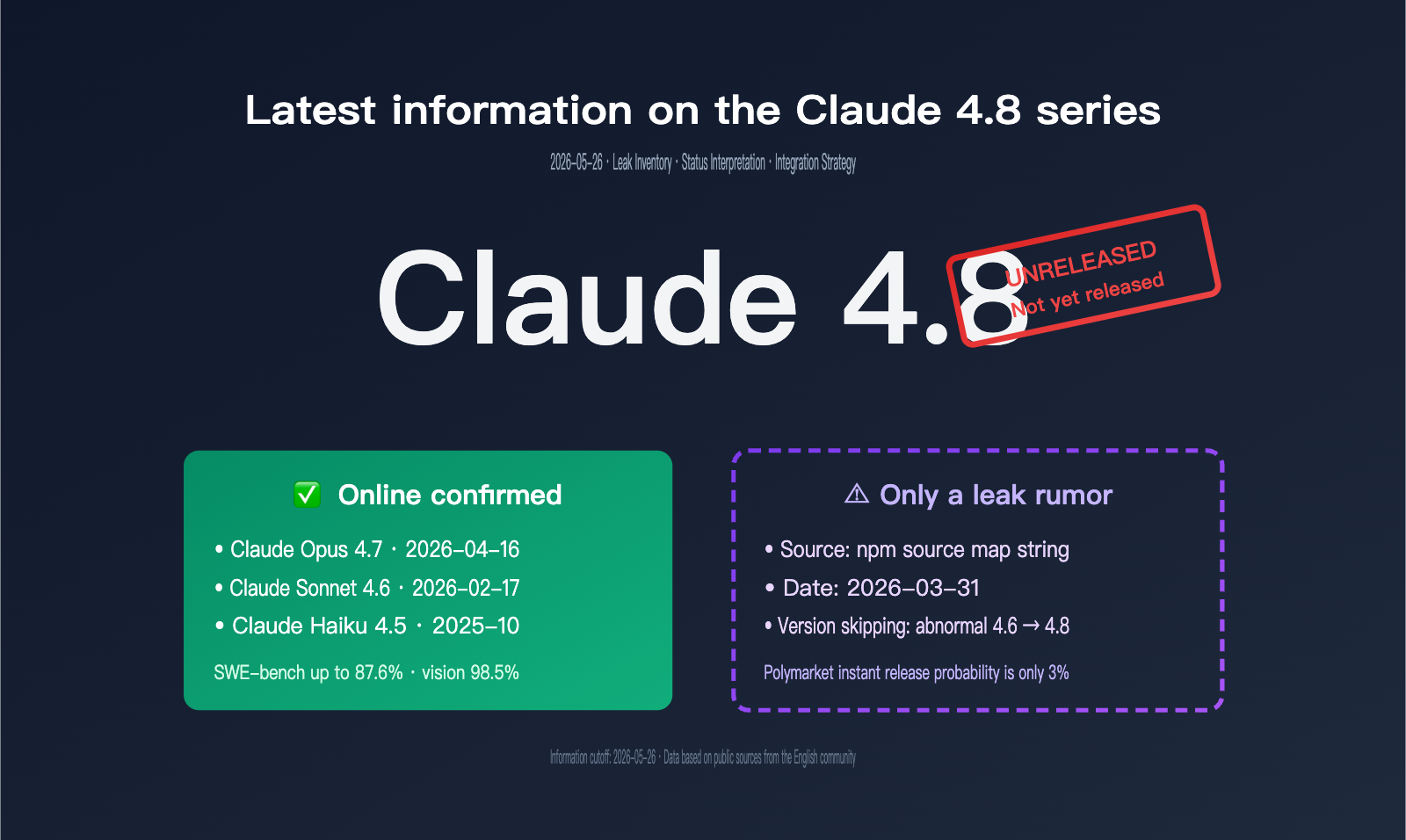
Core Value: As of May 26, 2026, Claude 4.8 has not been released. This article helps you clarify "known facts," "leaked rumors," and "official silence" in just 5 minutes, helping you avoid being misled by sensationalist headlines and make sound integration decisions.
Claude 4.8 Quick Overview
Amidst all the rumors, let's use a table to clearly separate what has been "officially confirmed by Anthropic" from what is "just community speculation." The table below represents the most authoritative, verifiable information available as of May 26, 2026, and is perfect for saving as a reference for your team.
| Information Item | Details | Status |
|---|---|---|
| Official Release Status | Unreleased; no API ID, model card, or benchmarks | ✅ Confirmed |
| Leak Source | 59.8MB source map included in @anthropic-ai/claude-code v2.1.88 npm package (2026-03-31) | ✅ Confirmed |
| Leak Content | sonnet-4-8 appeared in a list of forbidden strings, alongside Opus 4.7 and Mythos Preview |
✅ Confirmed |
| Expected Window | May to mid-July 2026 (based on the 141-day Sonnet release cycle) | ⚠️ Speculative |
| Predicted API ID | claude-sonnet-4-8 (following naming conventions) |
⚠️ Speculative |
| Predicted Pricing | $3 / $15 per MTok (retaining Sonnet 4.6 pricing) | ⚠️ Speculative |
| Market Confidence | Polymarket probability for a 2026-05-24 release was only 3%; settled as "No" | ✅ Confirmed |
Developers should note that Anthropic has historically paired Opus and Sonnet with the same version numbers (e.g., 4.5/4.5, 4.6/4.6). Skipping from 4.6 directly to 4.8 without a 4.7 release is unprecedented, which remains the biggest question mark regarding whether Claude 4.8 is "truly coming."
🎯 Integration Advice: Before the official launch of the Claude 4.8 series, we recommend using the APIYI (apiyi.com) platform to set up your integration for Claude Opus 4.7 and Sonnet 4.6. The platform typically adds new models on the day of release, allowing you to switch over seamlessly with zero code changes.
Deconstructing the Claude 4.8 Leak and Assessing Its Credibility
To understand whether "Claude 4.8 is actually coming," we need to look back at the source map incident itself, rather than relying on clickbait headlines from secondary sources.
How the Claude 4.8 String Was Discovered
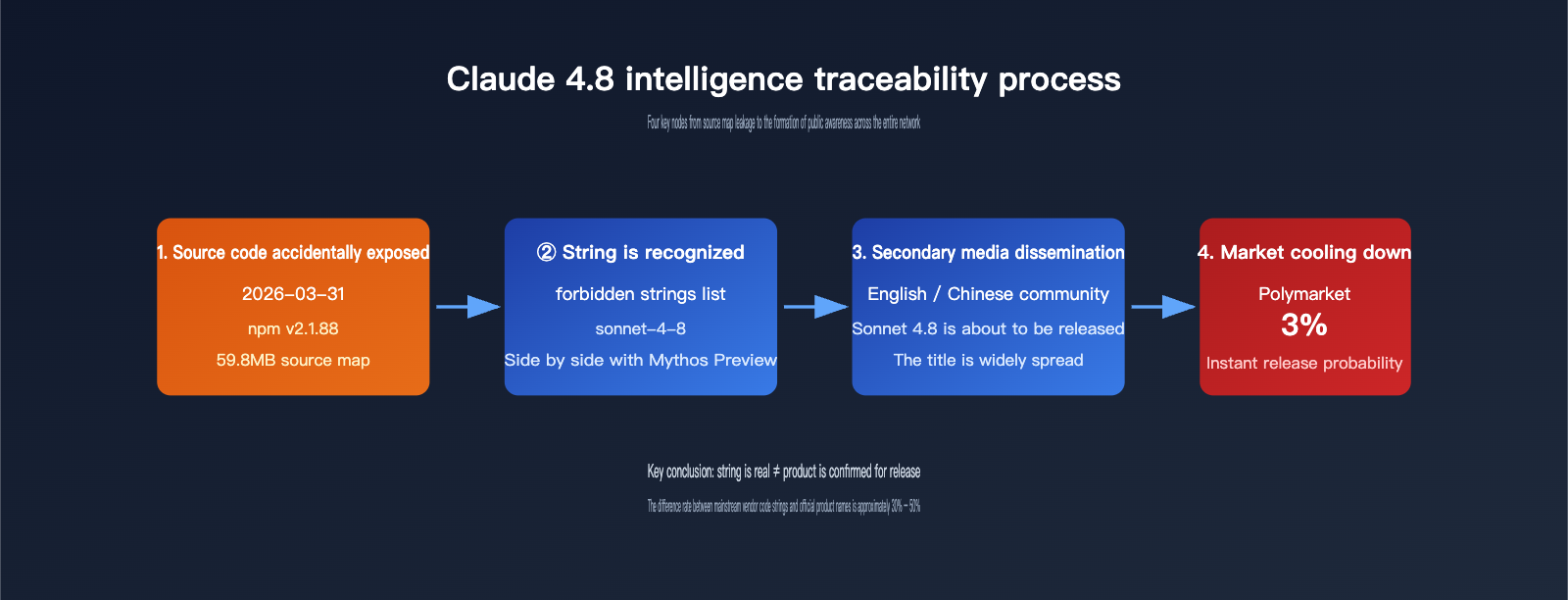
On March 31, 2026, when the official Anthropic npm package @anthropic-ai/claude-code was updated to version v2.1.88, the production TypeScript source maps were accidentally bundled and published. This source map, weighing in at approximately 59.8 MB, contained about 1,900 source files and roughly 512,000 lines of unminified TypeScript code. After unpacking it, community developers discovered the sonnet-4-8 field sitting alongside claude-opus-4-7 and Mythos Preview within an array labeled forbidden strings. This is the sole source of all the "Claude Sonnet 4.8 is launching soon" rumors currently circulating on the internet.
Anthropic repacked the npm package within about 6 hours of the incident coming to light, but the original content of the source map had already been archived by several English-language media outlets and remains available for review. In other words, the authenticity of the string itself isn't in dispute; what is disputed is whether the product will actually be released under that name.
It's worth noting that the forbidden strings list is part of the security guardrail chain for Claude Code, designed to prevent the model from leaking internal codenames or unreleased model IDs during interactions. This means sonnet-4-8 has at least reached a level of exposure risk within Anthropic that requires it to be "blocked," but you still can't infer its release date or final naming from this. There's often a gap of several months of training, alignment, and red-teaming between a model codename being added to a forbidden list and its actual public release.
The Relationship Between Mythos Preview and the Claude 4.8 Roadmap
The "Mythos Preview" string discovered in the same batch provides another interesting clue. Mythos was explicitly mentioned in the Opus 4.7 launch blog as the "model with the best current alignment performance," yet the company has never provided a release schedule for it. If Anthropic is using Mythos internally to test next-generation alignment schemes, then the Claude 4.8 series might share the same training breakthroughs as Mythos, rather than being a simple upgrade to 4.7. In other words, the "version jump" to 4.8 might be because it's essentially the product of a different lineage, rather than just the next iteration of the Sonnet main line.
What the Claude 4.8 Leak Actually Proves
There are three reasonable, non-mutually exclusive explanations for a model name appearing in a source map. First, it could be a genuine upcoming release: sonnet-4-8 might already have its alias set up in the routing layer, waiting for the model weights to finish training before going live. Second, it could be an internal planning placeholder: Anthropic might reserve multiple future version numbers in their configuration, and the actual release could be 4.7, or they might skip straight to 4.9—the leaked string could just be an engineer's placeholder. Third, it could be an A/B internal test codename: early internal codenames often appear in source code, but the final public name ends up being completely different, similar to historical Anthropic codenames like "Capybara" or "Mythos."
Furthermore, from an engineering perspective, the discrepancy rate between codenames and final product names for major manufacturers is roughly 30% to 50%. Therefore, treating this leak as a "done deal" for an imminent release is a cognitive bias amplified by tech media.
Deep Speculation on Rumored Claude 4.8 Features
Although there has been zero official announcement, the community has extrapolated a "reasonable predictive profile" for the Claude 4.8 series (especially Sonnet 4.8) based on the capabilities of Opus 4.7. All figures below are speculative; please refer to official Anthropic announcements for actual releases and do not cite these as baseline data in production documentation.
Claude 4.8 Vision Capability Predictions
Claude Opus 4.7 saw a leap in XBOW Vision Acuity from 54.5% in 4.6 to 98.5%, with a maximum supported long edge of 2,576 pixels (approx. 3.75 MP). This generational leap will almost certainly be inherited by the next Sonnet generation. If Sonnet 4.8 utilizes the same vision foundation as 4.7, it will become the first Sonnet model at the $3 / $15 price point to feature 3.75 MP input resolution, which is highly significant for high-frequency enterprise scenarios like UI screenshot analysis, table scanning, and multi-page PDF parsing.
Consider a few applications that would be directly boosted by this vision upgrade: in financial report scanning, you could feed in an entire A4 PDF page at once without losing small text; in product screenshot testing, you could have the model identify pixel-level differences between Figma designs and actual renders; and OCR post-processing could be completed in one step by Sonnet 4.8, eliminating the need for middleware like Tesseract or PaddleOCR. For many back-office operations currently relying on Sonnet 4.6, this is equivalent to getting Opus 4.6-era vision capabilities without a price hike.
Claude 4.8 Coding Capability Predictions
Extrapolating from the historical gap between Sonnet and Opus, the estimated range for Claude 4.8 on SWE-bench Verified is 82% to 84% (Sonnet 4.6 tested at 79.6%, Opus 4.7 at 87.6%), which would bring significant improvements to cross-file refactoring, long-dependency tracking, and static error recovery. The community also generally predicts it will introduce the xhigh reasoning effort tier already released in Opus 4.7, providing developers with an additional cost-performance node between high and max.
Specifically regarding daily engineering experience, Opus 4.7 improved multi-step coding workflows by 10% to 14% over 4.6, which usually manifests as a higher success rate for "refactoring across 5 files in one go." If Sonnet 4.8 captures even half of the engineering dividends of Opus 4.7, its "first-try" success rate in IDE Agents like Claude Code, Cursor, and Cline will take a noticeable step up. For teams that have long used Sonnet as their primary coding model, this is an upgrade path worth performing dedicated A/B testing on.
| Dimension | Sonnet 4.6 (Actual) | Opus 4.7 (Actual) | Sonnet 4.8 (Predicted) |
|---|---|---|---|
| SWE-bench Verified | 79.6% | 87.6% | 82% – 84% |
| Vision Acuity | ~54% | 98.5% | 90% – 97% |
| Max Image Long Edge | 1,568 px | 2,576 px | 2,000 – 2,576 px |
| Context Window | 1M | 1M | 1M (Expected) |
| Input Price | $3 / MTok | $5 / MTok | $3 / MTok (Expected) |
| Output Price | $15 / MTok | $25 / MTok | $15 / MTok (Expected) |
⚠️ A Rational Reminder: The figures above are extrapolations based on historical release cadences. "Claude 4.8 has already hit 84% on SWE-bench" and these predictions are two completely different things; please do not cite these as actual test results. When you need to perform real evaluations, we recommend using the APIYI (apiyi.com) platform to invoke Opus 4.7 as your current strongest baseline. Once 4.8 is live, you can immediately reuse the same evaluation scripts by simply switching the model ID.
Claude 4.8 vs. Current Model Matrix Comparison
Before the Claude 4.8 series officially lands, the question developers really need to answer is: "Which one should I be using right now?" The table below presents the three currently available Claude models alongside the rumored Sonnet 4.8, making it easier for you to decide whether you need to set aside a migration window for 4.8.
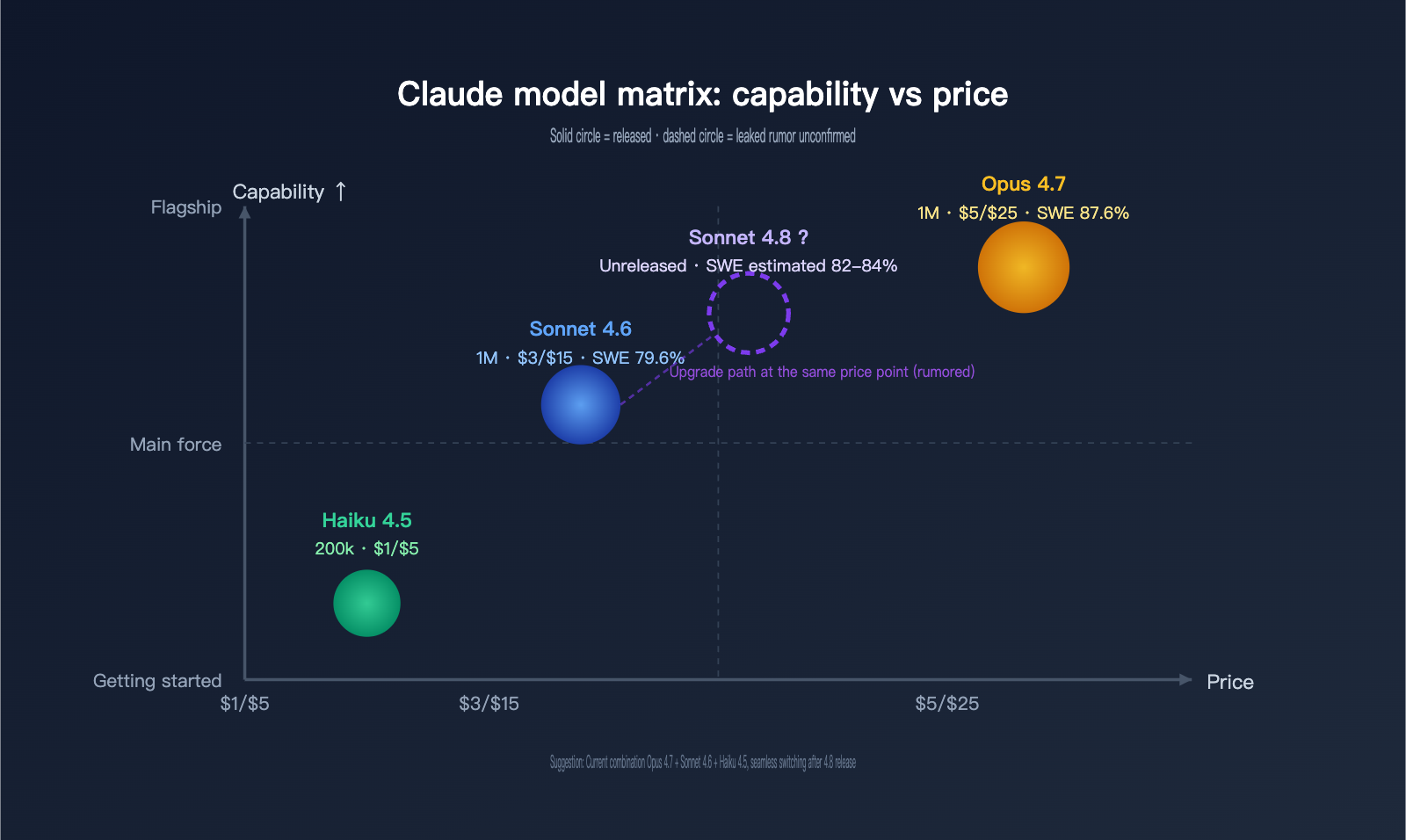
| Model | API ID | Input / Output Price | Context Window | Status | Use Case |
|---|---|---|---|---|---|
| Claude Opus 4.7 | claude-opus-4-7 |
$5 / $25 per MTok | 1M | Released (2026-04-16) | Complex Agents, long-chain SWE, vision |
| Claude Sonnet 4.6 | claude-sonnet-4-6 |
$3 / $15 per MTok | 1M | Released (2026-02-17) | Mainstream reasoning, coding, support |
| Claude Haiku 4.5 | claude-haiku-4-5 |
$1 / $5 per MTok | 200k | Released (2025-10) | High QPS, low latency, batch tasks |
| Claude Sonnet 4.8 | (N/A) | (N/A) | (N/A) | ❌ Unreleased | N/A, waiting for official confirmation |
How to Allocate Models Before Claude 4.8
The most robust layering strategy right now is: reserve Opus 4.7 for high-difficulty autonomous agents and complex coding tasks, use Sonnet 4.6 as your primary application reasoning engine, and deploy Haiku 4.5 for high-concurrency nodes like classification, summarization, and embedding triggers. This combination ensures you won't need to rewrite your architecture when Claude 4.8 launches; you'll simply swap the model IDs at the corresponding layers, keeping migration costs to a minimum.
🎯 Architectural Advice: Abstract a
model_tierroute at your API gateway layer to parameterize model names. We recommend using the APIYI (apiyi.com) platform to manage your Claude model invocations. It's compatible with the OpenAI SDK, so you only need to update thebase_url. Once 4.8 is released, you can switch over without changing any business logic.
Access Strategy and Monitoring Checklist Before Claude 4.8
If your business is highly sensitive to the Claude 4.8 series—for instance, if you need to evaluate immediately whether it can replace your existing Sonnet 4.6—we suggest setting up a "test-on-launch" monitoring and switching pipeline to avoid scrambling for configurations on release day.
Claude 4.8 Monitoring Signal Priority
| Signal | Source | Reliability | Meaning |
|---|---|---|---|
| Official model card launch | docs.claude.com | ★★★★★ | Official release, ready for integration |
| New ID in API model list | GET /v1/models |
★★★★★ | Ready for model invocation |
| Cloud provider availability (Bedrock/Vertex) | AWS, GCP announcements | ★★★★ | Enterprise-ready |
| Anthropic Twitter / Blog | anthropic.com/news | ★★★★ | Official announcement |
| New leaked source strings | npm / GitHub | ★★ | Early warning only |
| Tech media leaks | Zhihu / Official Accounts | ★ | Cross-verification recommended |
Three Things to Do Before Switching to Claude 4.8
First, prepare an OpenAI SDK-compatible invocation template to avoid upgrading your entire client SDK just because of a model ID change. Second, build a small regression test set covering the 20 most sensitive prompts in your business; run them through Sonnet 4.6 as a baseline, and use the same script to generate a comparison table once 4.8 is out. Third, check model availability with your API provider in advance; this can save you 24 to 72 hours of waiting between Anthropic's announcement and actual availability.
Designing the test set is the most underestimated part of this migration. Your 20 prompts don't all need to be high-difficulty; instead, they should be sampled based on your actual business distribution: 8 for daily reasoning, 4 for structured output, 4 for long context summarization, 2 for vision, and 2 for tool use. Run each prompt at least 3 times to get an average, and record response latency, output token count, and hit rate for key fields. Once this baseline is established on Sonnet 4.6, it becomes a long-term asset for your team that can be reused for future Anthropic updates.
Another detail often overlooked is the fallback plan. Even if the initial release of Claude 4.8 is powerful, its stability, rate-limiting policies, and tool-use compatibility will likely still be settling in during the first two weeks. We suggest keeping a switch to revert to Sonnet 4.6 for critical business paths. Doing this at the routing layer is much more elegant than adding try/except blocks in your business code and makes post-incident analysis much easier.
🚀 Quick Start: We recommend using the APIYI (apiyi.com) platform to build your evaluation scaffold. The platform provides unified interfaces for Claude Opus 4.7, Sonnet 4.6, and Haiku 4.5, along with an OpenAI SDK compatibility layer, allowing you to establish a regression baseline for 4.8 in just 5 minutes.
The minimal code snippet below can serve as your Claude 4.8 monitoring script skeleton, ready for one-click testing on launch day.
import openai

client = openai.OpenAI(
    api_key="YOUR_API_KEY",
    base_url="https://api.apiyi.com/v1"
)

# After 4.8 is released, just change the model to claude-sonnet-4-8
response = client.chat.completions.create(
    model="claude-sonnet-4-6",
    messages=[{"role": "user", "content": "Evaluate your own coding ability in one sentence."}]
)
print(response.choices[0].message.content)
View Full Claude 4.8 Evaluation Scaffold
import openai
import json
import time

client = openai.OpenAI(
    api_key="YOUR_API_KEY",
    base_url="https://api.apiyi.com/v1"
)

CANDIDATE_MODELS = [
    "claude-opus-4-7",
    "claude-sonnet-4-6",
    # "claude-sonnet-4-8",  # Uncomment after 4.8 is available
]

REGRESSION_PROMPTS = [
    "Please implement an LRU cache class in Python.",
    "Summarize the core arguments of the following paragraph: ...",
    "Output three logically ambiguous prompts in JSON format.",
]

def run_eval(model: str, prompts: list) -> list:
    results = []
    for p in prompts:
        start = time.time()
        resp = client.chat.completions.create(
            model=model,
            messages=[{"role": "user", "content": p}],
            temperature=0,
        )
        results.append({
            "model": model,
            "prompt": p,
            "latency": round(time.time() - start, 2),
            "tokens_out": resp.usage.completion_tokens,
            "answer": resp.choices[0].message.content,
        })
    return results

if __name__ == "__main__":
    all_results = []
    for m in CANDIDATE_MODELS:
        all_results.extend(run_eval(m, REGRESSION_PROMPTS))
    with open("claude_regression.json", "w", encoding="utf-8") as f:
        json.dump(all_results, f, ensure_ascii=False, indent=2)
FAQ
Q1: Is Claude 4.8 available for model invocation as of today (May 26, 2026)?
No. Anthropic has not officially released any Claude 4.8 series models, and no API platform currently provides access to claude-sonnet-4-8 or claude-opus-4-8. Any channels claiming that "Claude 4.8 is now available" should be cross-verified. You can use the APIYI (apiyi.com) platform to check the latest list of available Anthropic models in real-time as a reliable source for your deployment decisions.
Q2: Why did Claude 4.8 skip 4.7? Is it a typo in the version number?
That is the biggest question right now. Anthropic has historically released Opus and Sonnet with matching version numbers (e.g., 4.5/4.5, 4.6/4.6). Since Opus is already at 4.7, if Sonnet were to jump directly to 4.8 instead of 4.7, it would be the first time in the brand's history that they've skipped a version. A more plausible explanation is that the leaked string is just a placeholder; the actual release might still be Sonnet 4.7, or it could be merged into an entirely different codename.
Q3: Before Claude 4.8 arrives, should I use Opus 4.7 or Sonnet 4.6?
It depends on your task complexity and budget. If your core business involves long-chain Agents, complex software engineering (SWE), or vision-intensive tasks, Opus 4.7 is worth the $5 / $25 price point, boasting an 87.6% score on SWE-bench Verified and 98.5% in Vision Acuity. For high-volume, routine inference, Sonnet 4.6 remains a very cost-effective choice at $3 / $15. With the APIYI (apiyi.com) platform, you can use a single API key to access both models and route tasks accordingly, eliminating the need for multiple accounts.
Q4: When is the Claude 4.8 series expected to launch?
The most optimistic window is between May and mid-July 2026. This is based on an extrapolation of the 141-day release cadence for the Sonnet series (Sonnet 4.6 was released on 2026-02-17). However, this assumes Anthropic will actually use the "4.8" naming convention rather than merging it into 4.7 or introducing a formal Mythos series. Therefore, this timeframe should be treated as a stress-test target rather than a firm OKR.
Q5: How can I be the first to know when Claude 4.8 is officially released?
There are two primary signals: first, a new entry appearing on the official Anthropic model card page; second, the API's GET /v1/models endpoint returning a new ID. Both usually appear simultaneously, hours or even a day before social media leaks. If you want to minimize latency, you can write a lightweight polling script to periodically request /v1/models. As soon as you detect a new claude-*-4-8 ID, you can trigger your evaluation pipeline immediately.
Summary
As of May 26, 2026, the Claude 4.8 series remains in a state of "zero announcements, zero API IDs, and zero benchmarks" from Anthropic. The only evidence is a string found in an npm source map incident. Based on the capabilities of Opus 4.7, we expect Sonnet 4.8 (if it exists) to bring significant upgrades, such as 3.75 MP vision support and over 82% on SWE-bench. However, since skipping a version number would be a historical first, we recommend approaching these rumors with caution.
More interestingly, the fact that both "Mythos Preview" and "Sonnet 4.8" appeared in the same forbidden strings list suggests that Anthropic may be advancing two product lines simultaneously: one continuing the main Sonnet line and another testing a new alignment lineage. Regardless of the final naming—whether it's Sonnet 4.7, 4.8, or something else—the developer's homework remains the same: parameterize your model IDs, maintain robust regression testing scripts, and keep fallback switches in place.
For developers, the best approach is to use Opus 4.7 for high-difficulty tasks, Sonnet 4.6 for primary inference, and Haiku 4.5 for concurrency today. Abstract your model_tier routing now so you can switch seamlessly once the Claude 4.8 series is officially announced. We recommend using the APIYI (apiyi.com) platform to unify your access to all three Claude models. The platform is compatible with the OpenAI SDK and typically adds new models on the day of release, helping you avoid downtime caused by switching models.
Author: APIYI Technical Team | Stay tuned for updates on the Claude 4.8 series and AI Large Language Model API best practices. Visit apiyi.com for the latest model integration guides and free testing credits.