Author’s note: This article uses source labels to break down the intelligence score, per-task time, unit price, and per-task cost of Gemini 4 Neon and GPT-6.2 Astra into three separate accounts, and lists the list prices, tiers, and invocation endpoints for the models already available on APIYI.
On November 18, 2026, Google released Gemini 4 Neon. Sundar Pichai announced that day that it was beginning to roll out in Google AI Studio’s Gemini API, Gemini for business, Google Antigravity, and the Gemini App. The same day, an Artificial Analysis article ranked Neon xhigh third overall on the Intelligence Index, with GPT-6.2 Astra (max) and Claude Fable 5.2 (max) ahead of it. When you put Neon and Astra side by side, the easiest things to confuse are unit price and per-task cost: the former is the list price per million tokens, while the latter is the money actually spent completing a single task.
The three accounts below all come from the Artificial Analysis model pages (accessed 2026-11-19, Index v5.0.1). The tiers are shown in parentheses, with different tiers listed separately:
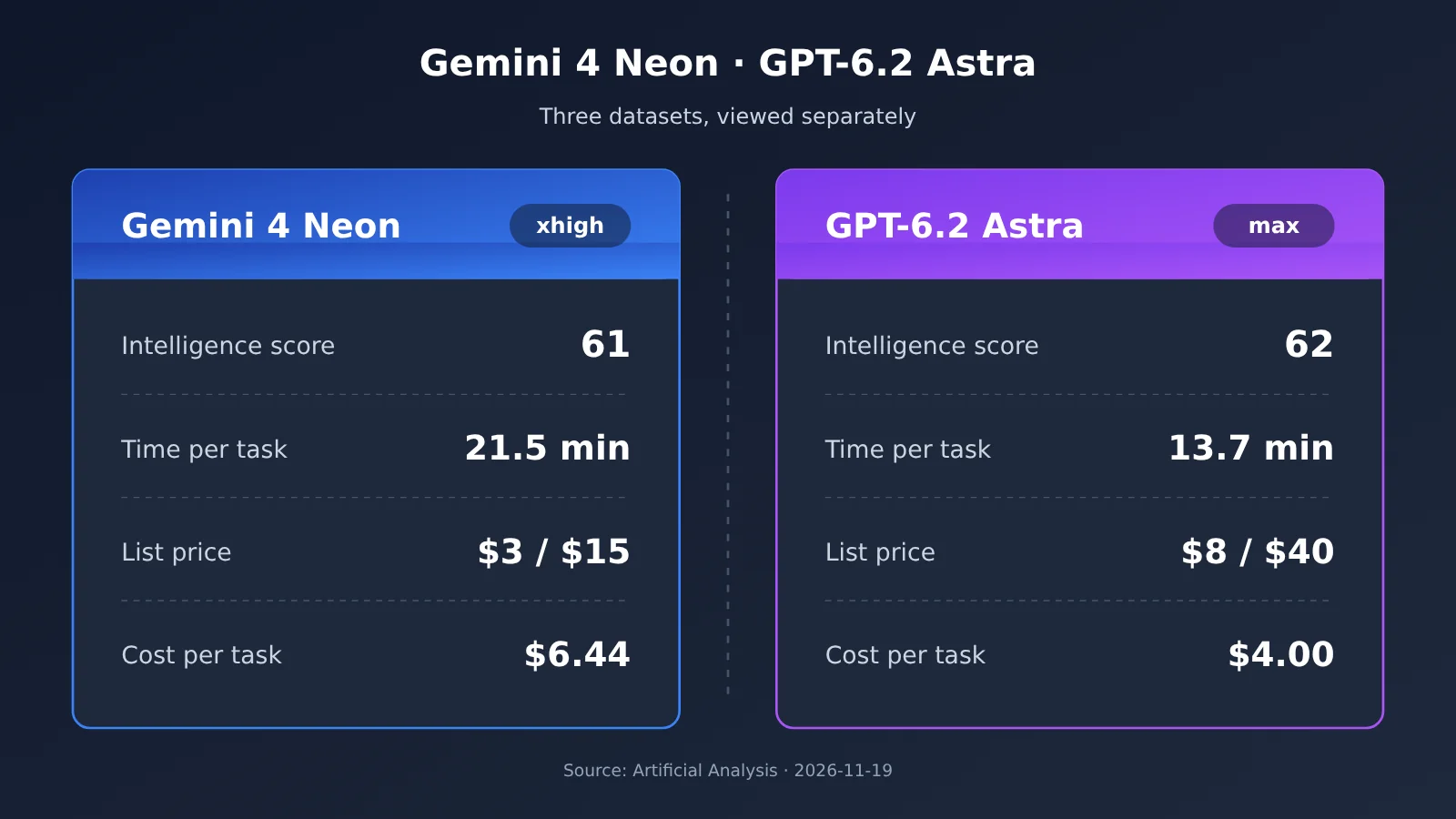
- Intelligence score: GPT-6.2 Astra (max) 62, Gemini 4 Neon (xhigh) 61. Astra’s xhigh tier is also 62.
- Per-task time: Astra (max) 13.7 minutes, Astra (xhigh) 7.4 minutes, Neon (xhigh) 21.5 minutes.
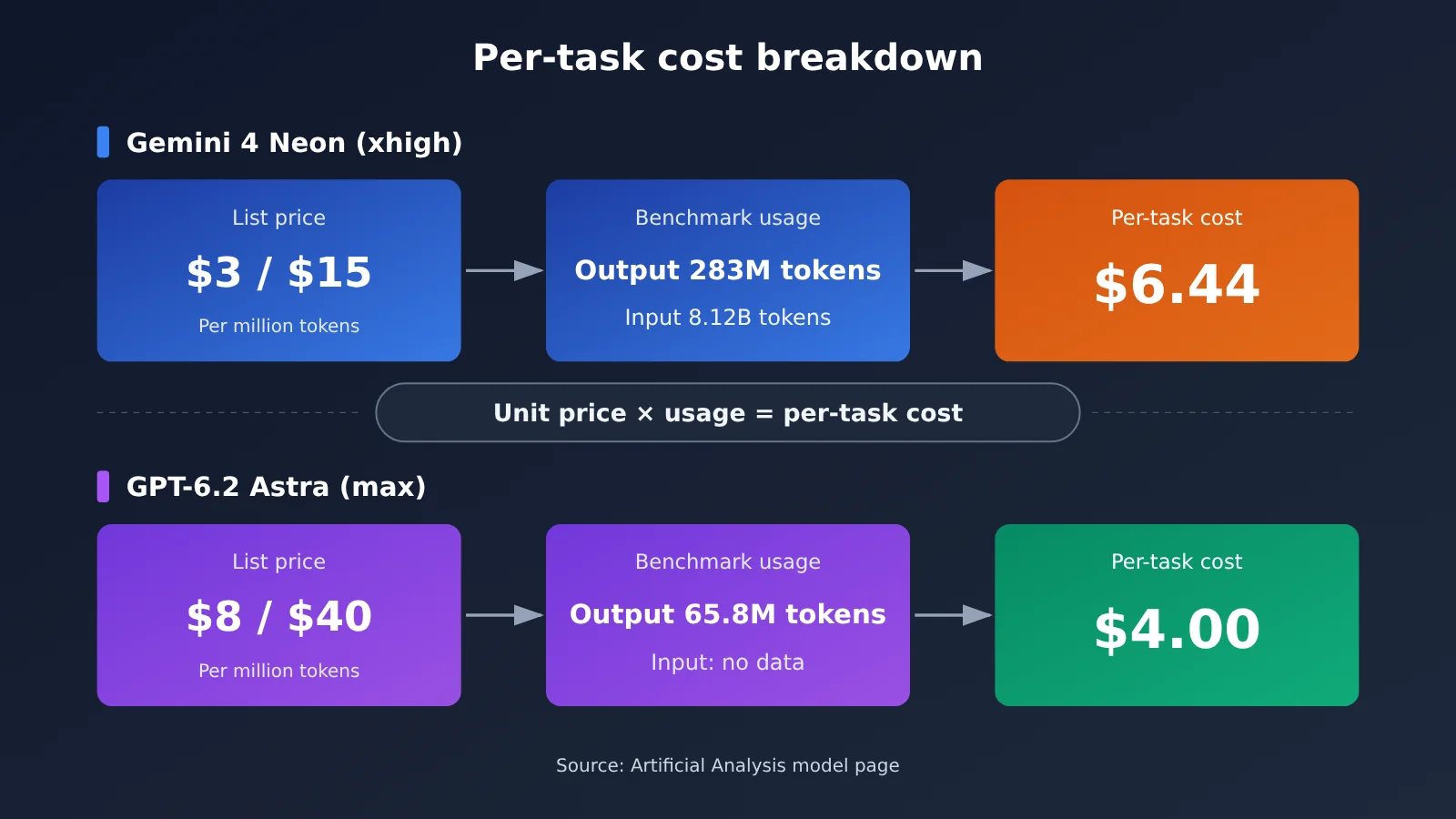
- Unit price and per-task cost: Astra lists input at $8 and output at $40 per million tokens, while Neon is $3/$15; per-task cost is $4.00 for Astra (max) and $6.44 for Neon (xhigh).
What makes unit price and per-task cost move in opposite directions is token usage. On the same index suite, Astra (max) outputs 65.8 million tokens, while Neon (xhigh) outputs 283 million tokens; in terms of speed, Neon produces about 110 tokens per second with a time to first answer token of 56.51 seconds, while Astra produces 50 tokens per second with a time to first answer token of 197.65 seconds. This article is only here to lay these numbers out clearly in separate columns; which account matters more to you depends on your task structure.
Key value: After reading this article, you’ll be able to tell which account and which tier each number for Gemini 4 Neon and GPT-6.2 Astra comes from, and know which models on APIYI can be invoked directly and where pricing jumps to a different tier.
Gemini 4 Neon vs. GPT-6.2 Astra: The Core Differences
Everything in the table below comes from the Artificial Analysis model pages. Neon is set to xhigh and Astra to max — the top tier on each of their respective pages. DeepMind’s model card comparison only has three columns — Gemini 4 Neon, Claude Opus 5.5, and GPT-6.2 Sol — with no Astra, so the Astra side relies solely on the numbers from the Artificial Analysis model page.
| Comparison dimension | Gemini 4 Neon (xhigh) | GPT-6.2 Astra (max) | Source |
|---|---|---|---|
| Intelligence score | 61 | 62 (also 62 at xhigh) | Artificial Analysis model page |
| Time per task | 21.5 minutes | 13.7 minutes (7.4 minutes at xhigh) | Artificial Analysis model page |
| List price (input/output, USD per million tokens) | 3.00 / 15.00 | 8.00 / 40.00 | Artificial Analysis model page |
| Cost per task | $6.44 | $4.00 | Artificial Analysis model page |
| Output tokens for index run | 283 million | 65.8 million | Artificial Analysis model page |
| Output speed | 110 tokens/sec | 50 tokens/sec | Artificial Analysis model page |
| First answer token | 56.51 sec | 197.65 sec | Artificial Analysis model page |
| Cache discount / blended price | 95% / 2.21 | 95% / 5.88 | Artificial Analysis model page |
The safest way to read this table is row by row. Intelligence score, latency, and price are three separate groups, so it’s not contradictory for the same column to show “high score,” “short time,” and “high unit price” all at once.
Why GPT-6.2 Astra Costs More Per Unit but Less Per Task
Per-task cost can be roughly thought of as “how many tokens you use × the price per token.” Astra’s output list price is $40 per million tokens, more than double Neon’s $15. But the index output volume recorded on Artificial Analysis’s model page is 65.8 million tokens for Astra — less than a quarter of Neon’s 283 million tokens. With usage squeezed down that far on that end, the side with the higher unit price lands at $4.00 per task, while Neon lands at $6.44.
The input side needs a separate note. Neon’s model page lists 8.12 billion input tokens for the index, while the reference materials don’t include an input token count for Astra — so here we’ll only break down the output side and won’t reverse-engineer a full bill. The blended prices come out to 2.21 for Neon and 5.88 for Astra, which again only reflect the list-price layer; to estimate your own bill you still need to multiply by your own token mix.
Move to a specific business case and the token mix shifts. For tasks with long input and short output, the weight of the input price — 8 versus 3 — grows; for tasks with long output, the output usage term dominates the result. The per-task cost on the index is the result of one fixed question set, so before porting it to your own scenario, it’s best to run a pass with your own samples.
Gemini 4 Neon’s Time Math: Output Speed vs. Completion Time
On the model page, Neon outputs about 110 tokens/sec, more than double Astra’s 50 tokens/sec, and its first answer token takes just 56.51 seconds, versus 197.65 seconds for Astra. But the per-task time is 21.5 minutes for Neon (xhigh), compared with 13.7 minutes for Astra (max) and 7.4 minutes for Astra (xhigh). The reason comes back to token volume: a model that produces more tokens will still take longer to finish writing, no matter how fast it spits them out per second.
Astra’s xhigh and max tiers both have an intelligence score of 62, but one takes 7.4 minutes and the other 13.7 minutes, so you have to include the tier when citing them. On the Neon side, the Artificial Analysis model-page FAQ gives first-answer-token times for lower tiers: high 40.64 seconds, medium 20.14 seconds, and low 13.93 seconds. These numbers come from the FAQ and are not in the same column as the summary table.
Gemini 4 Neon and GPT-6.2 Astra Tier-by-Tier Data
| Model | Tier | Intelligence score | Time per task | Output speed |
|---|---|---|---|---|
| Gemini 4 Neon | xhigh | 61 | 21.5 minutes | 110 tokens/sec |
| Gemini 4 Neon | high (default) | 60 | 14.8 minutes | 101 tokens/sec |
| Gemini 4 Neon | medium | 55 | 8.3 minutes | 101 tokens/sec |
| Gemini 4 Neon | low | 44 | 3.7 minutes | 97 tokens/sec |
| GPT-6.2 Astra | max | 62 | 13.7 minutes | 50 tokens/sec |
| GPT-6.2 Astra | xhigh | 62 | 7.4 minutes | 50 tokens/sec |
| GPT-6.2 Astra | high | 60 | 5.9 minutes | 50 tokens/sec |
| GPT-6.2 Astra | medium | 57 | 4.5 minutes | 49 tokens/sec |
| GPT-6.2 Astra | low | 46 | 1.8 minutes | 48 tokens/sec |
All data comes from the Artificial Analysis model page. Neon’s high tier is the default specified in Google’s developer guide. Neon has no max tier; Astra’s output speed stays steady at 48 to 50 tokens/sec across its tiers, with the time differences mainly coming from how many tokens each tier writes. The model page only gives per-task cost for the top tier, so we won’t calculate costs for the other tiers here.
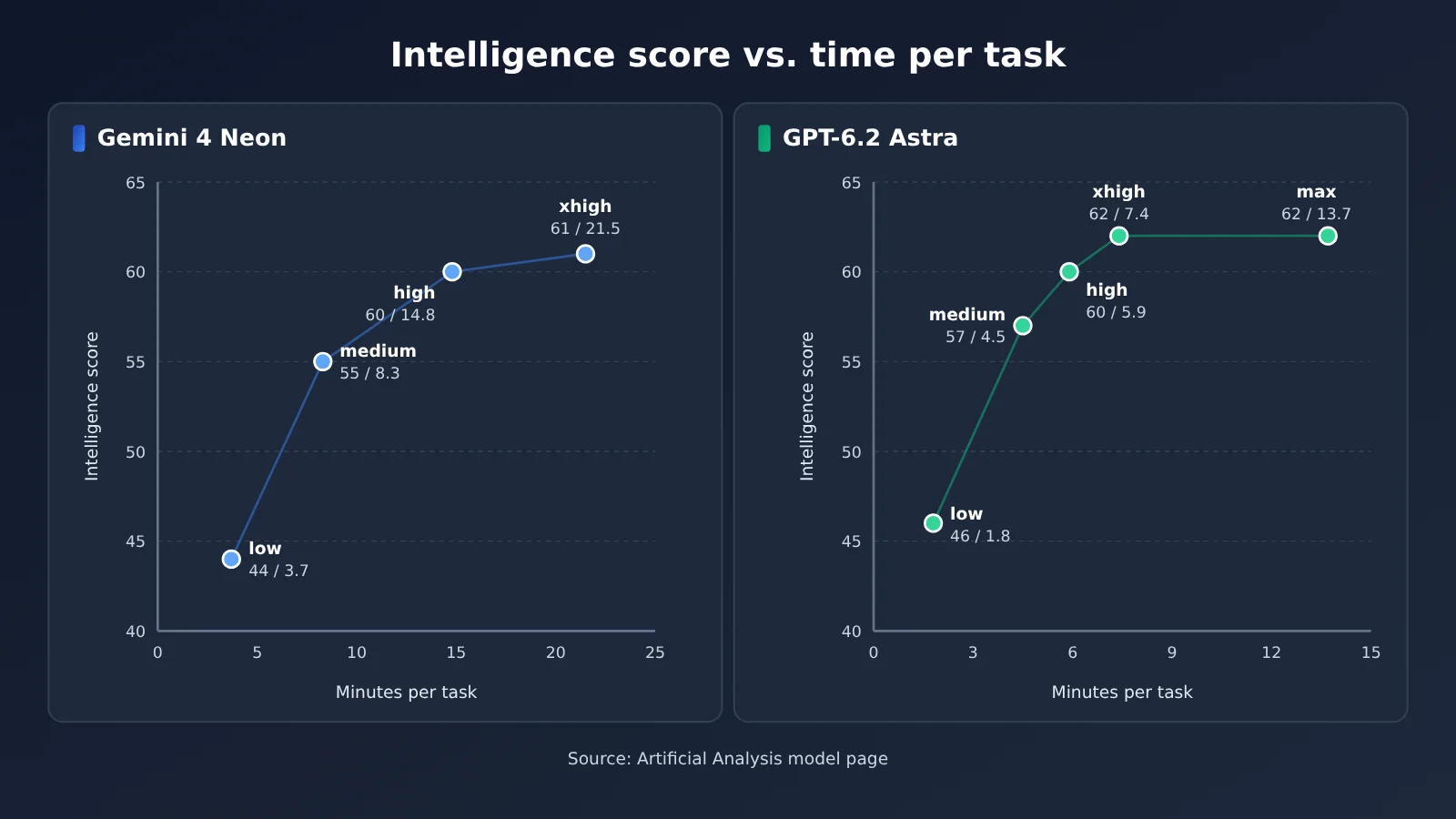
Comparison note: The numbers in the chart and table above both come from the Artificial Analysis model page. If you want to verify token usage with your own task, you can use the same API key on APIYI to switch between available models and compare.
Gemini 4 Neon: Official Self-Reports, Model Card, and Third-Party Numbers Compared
On the Neon side, there are three types of sources, each with a different basis. The entire Google blog section is official self-reporting: it states that the Artificial Analysis Intelligence Index at xhigh is 61, third overall, Vals Index 70.9%, and Arena Agent Arena Index 1336. The DeepMind model card also lists AA Index v5.0.1 as 61; the evaluation notes state that results not from Gemini default to each vendor’s self-reported figures, making it an official aggregation. The Artificial Analysis article and model page are third-party measurements.
| Metric | Official self-report (Google blog) | Model card | Artificial Analysis article |
|---|---|---|---|
| Intelligence Index (xhigh) | 61 | 61 | 61 |
| Coding Agent Index | 58.6 | Not listed | 59 (Antigravity CLI, xhigh) |
| MKA | Not listed | 56.5% | 56% |
| WebExploitBench v1.2 | 51.26% | 51.3% | Not listed |
| SWE-sweep | mini-SWE 12.8%, Antigravity 39.0% | Vendor harness 39.0%, mini-SWE 12.8% | Not listed |
| Single-task cost claim | Default high is 32% lower than Carbon | Not listed | $6.44, about 17% less than Carbon’s non-discounted price of $7.76 |
All the numbers that don’t line up are kept in the table: the official self-report for Coding Agent Index is 58.6, while the Artificial Analysis article says 59; the model card puts MKA at 56.5%, while the Artificial Analysis article says 56%. The 12.8% and 39.0% in SWE-sweep come from two different harnesses, and the Google blog attributes the gap to gains from the harness.
Cost accounting is also three separate ledgers. Google’s “32% lower” comes from its own methodology, and the blog doesn’t say whether Carbon uses introductory or standard pricing. The Artificial Analysis article’s “about 17% less” is calculated from Carbon’s standard price of 4/20 to get $7.76. On the Artificial Analysis model page, Carbon high’s $4.90 is calculated using the page’s current introductory price of 2/10. These three sets of numbers each stand on their own and can’t be converted into one another.
Scenario Recommendations: Which Cost Sheet to Use for Gemini 4 Neon vs. GPT-6.2 Astra
When to Check GPT-6.2 Astra’s Numbers First
- Budgeting by per-task cost: If you’re budgeting based on “how much each question costs,” start with the per-task cost on Artificial Analysis’s model page: Astra (max) is $4.00.
- Care about overall completion time: Astra’s xhigh tier takes 7.4 minutes with an intelligence score of 62, while the max tier takes 13.7 minutes. Both tiers have the same score but markedly different runtimes, so evaluate them separately when choosing a tier.
- Batch tasks with short outputs: Astra produced 65.8 million output tokens on the index, so output usage is a relatively low share of its bill.
When to Check Gemini 4 Neon’s Numbers First
- Interactive interfaces where time to first token matters: Neon (xhigh) takes 56.51 seconds to produce the first answer token; the FAQ lists the low tier at 13.93 seconds.
- Multimodal input: The DeepMind model card states that input can be text, images, audio, or video, with a unified window of up to 1 million tokens and a knowledge cutoff of March 2026.
- Orchestration plus subtasks: Google’s developer guide mentions that you can use
gemini-4-neonas the orchestration model and passprevious_interaction_idtogemini-4-hydrogenfor faster subtasks. - Calculating with per-token list pricing: The Google AI Studio pricing page lists Neon at $3.00 input, $0.15 cached, and $15.00 output per million tokens; output includes thinking tokens, and there is no free tier.
Looking Up Gemini 4 Neon and GPT-6.2 Astra Models and Pricing on APIYI
The APIYI master table page says it was updated on 2026-11-16 09:39 (UTC+8), and on 2026-11-19 we also cross-checked the pricing API (version shell-api-modelmak-v1, 285 models total). You can compare each item in the model list on apiyi.com. In the pricing API, a model_ratio of 1 corresponds to $2 per million input tokens, and completion_ratio 5 means output is 5x the input, which matches the first tier in the master table.
| Model ID | Input | Cache read | Output | Endpoint | Notes |
|---|---|---|---|---|---|
gpt-6.2-astra |
8 | 0.4 | 40 | responses | Input 16 for over 272000 tokens; high-tier output in the pricing API is around 60, but the master table doesn’t list this output tier |
gpt-6.2-sol |
2 | 0.1 | 10 | responses (recommended), chat | Input 3 for over 272000 tokens; high-tier output in the pricing API is around 11.25 |
gemini-4-carbon |
2 | 0.1 | 10 | chat, gemini | Corresponds to Google’s introductory pricing through 2026-11-30 |
gemini-4-hydrogen |
1.5 | 0.075 | 7.5 | chat, gemini | Default, SVIP groups |
claude-opus-5-5 |
4 | 0.2 | 20 | chat, messages | Also has a -thinking version |
claude-fable-5-2 |
8 | 0.2 | 40 | chat, messages | Also has a -thinking version |
gemini-4-neon |
— | — | — | — | Not included in either the master table or the pricing API |
All prices are in USD per million tokens. The 2/0.1/10 for gemini-4-carbon is APIYI’s current listed price, which matches Google’s introductory price—keep that separate from Google’s later standard price of 4/20. Group names are written slightly differently in the two places. For example, the master table says Default and SVIP, while the pricing API says default and svip; for the Claude series, the master table says Claude_Reverse and Claude_Enterprise, while the pricing API says ClaudeCodeReverse and ClaudeOfficial. Either way, the platform display is the source of truth.
The official list price for Gemini 4 Neon comes from the Google AI Studio pricing page: $3.00 input, $0.15 cache, and $15.00 output per million tokens, and it supports implicit caching only. gemini-4-neon isn’t in either the APIYI master table or the pricing API, and it doesn’t have a standalone model page. It’s not listed yet, and we’ll get this model listed as soon as we can. Model specs and pricing are subject to the platform’s model list.
Quick Start: Calling GPT-6.2 Astra via APIYI
gpt-6.2-astra uses the OpenAI-compatible responses endpoint. You can get it running in four steps:
- Sign up at apiyi.com and create an API key. Put it in the
APIYI_API_KEYenvironment variable, read it only from the environment in your code, and don’t hardcode the plaintext key. - Initialize the client with the OpenAI SDK:
client = OpenAI(api_key=os.environ["APIYI_API_KEY"], base_url="https://api.apiyi.com/v1"). - Call the responses endpoint:
resp = client.responses.create(model="gpt-6.2-astra", input="用三句话说明单价和单任务费用的区别"), then readresp.output_text. - Check the billing: APIYI’s main pricing table lists the first tier at input 8, cache read 0.4, and output 40 USD per million tokens. When a single input exceeds 272000 tokens, the input rate becomes 16. In the pricing API, this tier’s
CompletionRatiois 3.75, and output is about 60 USD per million tokens. The main pricing table doesn’t list the output rate for this tier.
For long-context tasks, pay special attention to step 4. Once you exceed 272000 tokens, both input and output jump to the next tier, so the per-task cost can deviate significantly from the first-tier estimate. It’s a good idea to measure token counts for typical requests before setting a budget.
The Gemini models that are already available can be accessed in two ways: gemini-4-carbon and gemini-4-hydrogen can use the same OpenAI-compatible address via the chat endpoint, or they can use the Gemini native address https://api.apiyi.com with API version v1beta. You can check the Google developer guide for Neon’s parameter rules first: thinking levels are limited to low, medium, high, and xhigh, with high as the default. Passing thinking_budget or MINIMAL returns HTTP 400. Explicit context caching isn’t supported, and shared prefixes over 4096 tokens automatically use implicit caching. The default maximum output per segment is 65536 tokens.
🚀 Quick Start: We recommend first claiming your new-user free trial quota at APIYI (apiyi.com), then using the same key to call
gpt-6.2-astra,gpt-6.2-sol, andgemini-4-carbonin sequence. Record the input and output token counts for each, then plug them into the pricing table above to calculate the per-task cost.
Gemini 4 Neon vs. GPT-6.2 Astra: Decision Guidance
| What you care about | Which column to check first | Gemini 4 Neon (xhigh) | GPT-6.2 Astra | Source |
|---|---|---|---|---|
| Intelligence score | Intelligence score | 61 | max 62, xhigh 62 | Artificial Analysis model page |
| How long one task takes | Per-task time | 21.5 minutes | max 13.7 minutes, xhigh 7.4 minutes | Artificial Analysis model page |
| How long to wait for the first token | Time to first answer token | 56.51 seconds | max 197.65 seconds | Artificial Analysis model page |
| List price per million tokens | Unit price | 3 / 15 | 8 / 40 | Artificial Analysis model page, APIYI summary table |
| What it costs to run the full index | Per-task cost | $6.44 | max $4.00 | Artificial Analysis model page |
| How long inputs are billed | Price tiers | Tiers not listed in reference materials | Above 272000 tokens: input 16, output about 60 | APIYI summary table, pricing API |
When deciding, first figure out which row matters most to your business, then look at the numbers and sources in that row. The intelligence scores differ by just 1 point, while the gaps in per-task time, time to first token, unit price, and per-task cost each point in different directions — no single row can stand in for the others.
💡 Selection tip: Benchmark index sets and your real tasks often differ in token structure. We recommend running a round of comparisons of your own samples against the models already listed on apiyi.com, then settling on a tier and model after recording token usage and latency.
Gemini 4 Neon and GPT-6.2 Astra FAQ
Q1: What is Gemini 4 Neon?
Gemini 4 Neon is a model Google released on November 18, 2026, with the model ID `gemini-4-neon`. The DeepMind model card states it was adapted from Gemini 4 Carbon and sits in the family between Hydrogen (fast everyday execution) and Carbon (complex long-horizon work), with a unified context of 1048576 tokens.
Q2: How big is the intelligence score gap between Gemini 4 Neon and GPT-6.2 Astra?
On the Artificial Analysis model page, Neon (xhigh) scores 61, Astra (max) scores 62, and Astra (xhigh) also scores 62. Astra lands the same score at both settings, taking 13.7 minutes and 7.4 minutes respectively — so cite the setting along with the score.
Q3: When is Gemini 4 Neon available?
Sundar Pichai wrote on launch day that Neon would roll out starting November 18, 2026 in the Gemini API in Google AI Studio, Gemini for business, Google Antigravity for paid Google AI Pro and Ultra, and the Gemini App for Pro and Ultra. The Google AI Studio pricing page states it has no free tier.
Q4: GPT-6.2 Astra costs more per unit — why is its cost per task only $4.00?
Cost per task is driven by both unit price and usage. The Artificial Analysis model page records Astra (max) running the index at 65.8 million output tokens, while Neon (xhigh) burns 283 million. Astra’s output unit price is 40 versus 15, but its usage is far lower, so cost per task comes out to $4.00, compared with $6.44 for Neon.
Q5: How do I quickly call GPT-6.2 Astra through the API?
1. Sign up at APIYI (apiyi.com) and grab an API key plus free trial credits;
2. Set the OpenAI SDK’s base_url to the OpenAI-compatible address from the quick start above;
3. Use the responses endpoint with the model set to `gpt-6.2-astra`.
`gemini-4-neon` currently doesn’t appear in APIYI’s master list or pricing endpoint; once it’s listed, the platform’s model list is the source of truth.
Q6: What limitations apply when citing these numbers?
– **Definitions**: Official self-reported figures, model cards, Artificial Analysis articles, and model pages all come from different sources. The Coding Agent Index has two values, 58.6 and 59, and MKA has two values, 56.5% and 56%.
– **Cost**: Google’s “32% lower,” the Artificial Analysis article’s “about 17% less,” and the model page’s $4.90 for Carbon are three separate ledgers — you can’t combine them.
– **Migration**: The index’s cost per task comes from a fixed problem set. Your task has a different token structure, so your results will differ too.
Gemini 4 Neon vs GPT-6.2 Astra: Key Takeaways
- Intelligence scores: On the Artificial Analysis model pages, Astra (max) scores 62, Astra (xhigh) 62, and Neon (xhigh) 61.
- Runtime: Neon (xhigh) 21.5 minutes; Astra max 13.7 minutes, xhigh 7.4 minutes — cite the tiers separately.
- Per-token pricing: Astra 8/40, Neon 3/15 USD per million tokens; Neon’s pricing comes from the Google AI Studio pricing page.
- Per-task cost: Astra (max) $4.00, Neon (xhigh) $6.44 — the gap comes from output token usage.
- Speed and time to first token: Neon 110 tokens/sec with a 56.51-second first token; Astra 50 tokens/sec with a 197.65-second first token.
- APIYI catalog:
gpt-6.2-astrastarts at 8/0.4/40, with 16 for inputs over 272,000 tokens and about 60 for output on the pricing endpoint;gemini-4-neonisn’t listed yet.
Gemini 4 Neon vs GPT-6.2 Astra: Comparison Summary
The key to comparing Gemini 4 Neon and GPT-6.2 Astra is keeping the ledgers separate:
- Intelligence ledger: 61 vs 62 — Astra’s xhigh and max both score 62, per the Artificial Analysis model pages.
- Runtime ledger: 21.5 minutes vs 13.7 minutes (Astra xhigh is 7.4 minutes); output speed and time to first token are yet another set of numbers.
- Pricing ledger: per-token prices of 3/15 vs 8/40, per-task costs of $6.44 vs $4.00 — with 283 million vs 65.8 million output tokens sitting between them.
When choosing a model, first decide which ledger you’re settling against, then verify token usage with your own samples. We recommend running a side-by-side test of the listed models through APIYI (apiyi.com) with a single API key; once gemini-4-neon is listed, you can drop it straight into the same workflow.
📚 References
-
Sundar Pichai’s launch post: Gemini 4 Neon release and rollout channels
- Link:
x.com/sundarpichai/status/2123167780988125621 - Notes: release date and where to access it
- Link:
-
Google blog, “Introducing Gemini 4 Neon”: benchmarks, pricing, and positioning as reported by Google
- Link:
blog.google/innovation-and-ai/models-and-research/gemini-models/introducing-gemini-4-neon - Notes: official figures such as Coding Agent Index 58.6 and 32% lower cost
- Link:
-
DeepMind Gemini 4 Neon model card: comparison table and model specs
- Link:
deepmind.google/models/model-cards/gemini-4-neon/ - Notes: the comparison table contains only three columns — Neon, Claude Opus 5.5, and GPT-6.2 Sol
- Link:
-
Google Cloud developer guide:
gemini-4-neonparameters and caching rules- Link:
docs.cloud.google.com/gemini-enterprise-agent-platform/models/guides/gemini-4-neon - Notes: thinking levels,
HTTP 400conditions, implicit caching
- Link:
-
Google AI Studio pricing page: official list prices for the Gemini 4 family
- Link:
aistudio.google.com/docs/pricing - Notes: Neon 3/0.15/15; Carbon introductory pricing runs through 2026-11-30
- Link:
-
Artificial Analysis article: Neon intelligence score and cost analysis
- Link:
artificialanalysis.ai/articles/gemini-4-neon-intelligence-gain - Notes: third-party measurements, including the claim that it’s about 17% cheaper than Carbon’s standard price
- Link:
-
Artificial Analysis model pages: Gemini 4 Neon and GPT-6.2 Astra
- Link:
artificialanalysis.ai/models/gemini-4-neon,artificialanalysis.ai/models/gpt-6-2-astra - Notes: the primary data source for this article’s three cost breakdowns; read on 2026-11-19
- Link:
Author: APIYI Technical Team
Technical inquiries: Feel free to reach us through the APIYI homepage. For model names and pricing, please refer to the platform’s model list and documentation center.