Author’s note: On the Artificial Analysis composite leaderboard, Claude Fable 5.2 ranks ahead of Gemini 4 Neon. This article splits the intelligence score and the per-task cost into two separate ledgers and aligns them tier by tier, so you can see exactly where the gap between the two lies.
Gemini 4 Neon launched on 2026-11-18. According to the ordering in the Artificial Analysis article, Neon lands at #3 overall with a score of 61 in the xhigh tier, behind GPT-6.2 Astra (max) and Claude Fable 5.2 (max). Seeing that ranking, a lot of developers want to know: does Fable 5.2’s lead come from the intelligence score, or from being willing to spend more?
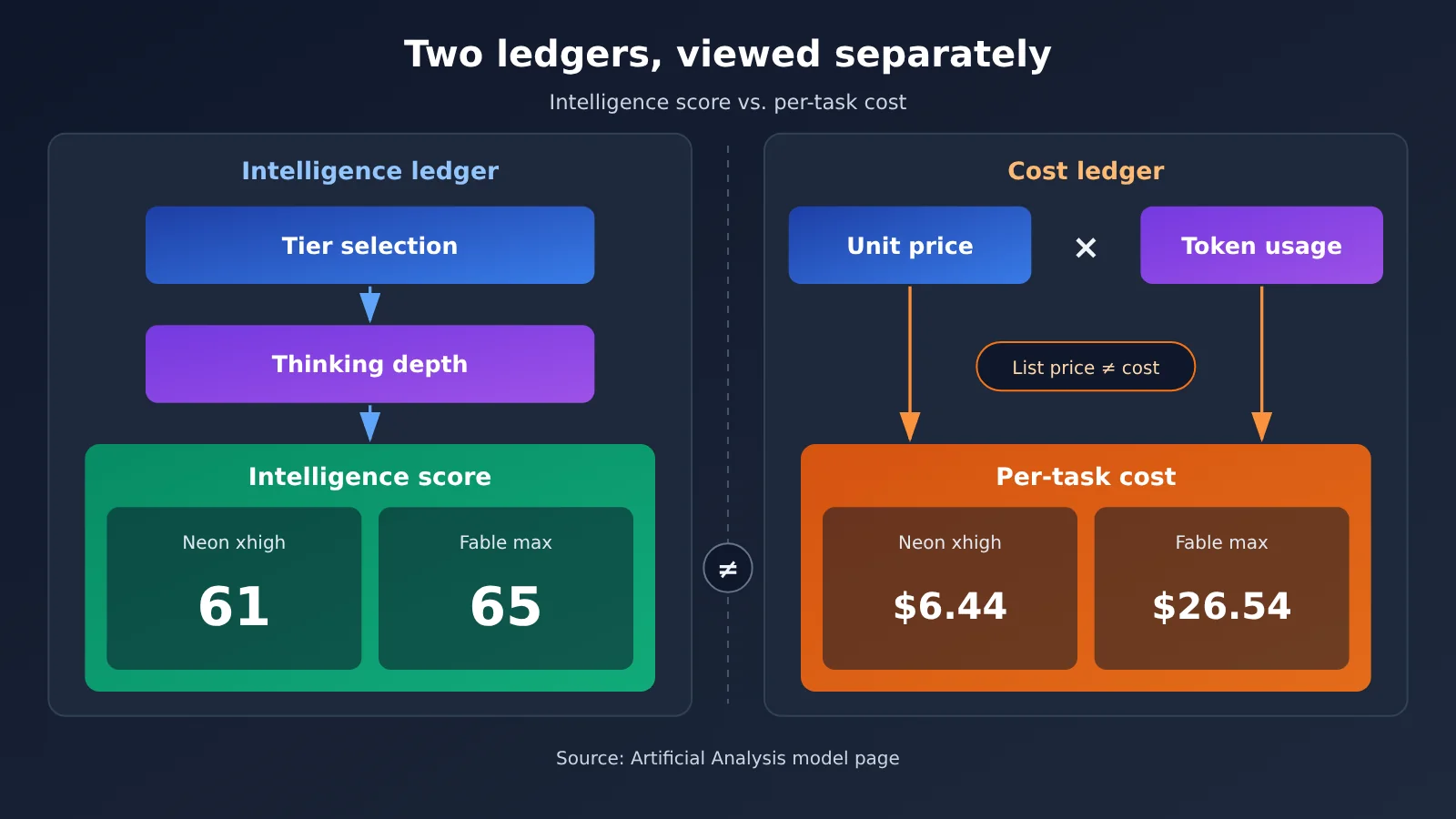
These two ledgers have to be read separately. The intelligence score corresponds to Fable’s max tier and Neon’s xhigh tier; in the coding index, Fable is measured at the xhigh tier. Google’s model card doesn’t have a Fable column at all, so Fable’s subscores can’t be borrowed from some other model. This article only uses metrics that line up across both the Artificial Analysis article and the two Artificial Analysis model pages, and every number is sourced. If you need to verify model IDs and pricing, you can check the model list on APIYI apiyi.com.
Core value: By the end of this article, you’ll know the intelligence score, per-task cost, latency, output speed, and time to first token for Gemini 4 Neon and Claude Fable 5.2, which tier each number corresponds to, and which numbers can’t be subtracted from or merged with each other. Data verified 2026-11-19.
Gemini 4 Neon vs. Claude Fable 5.2: Two Separate Ledgers for Intelligence Score and Cost
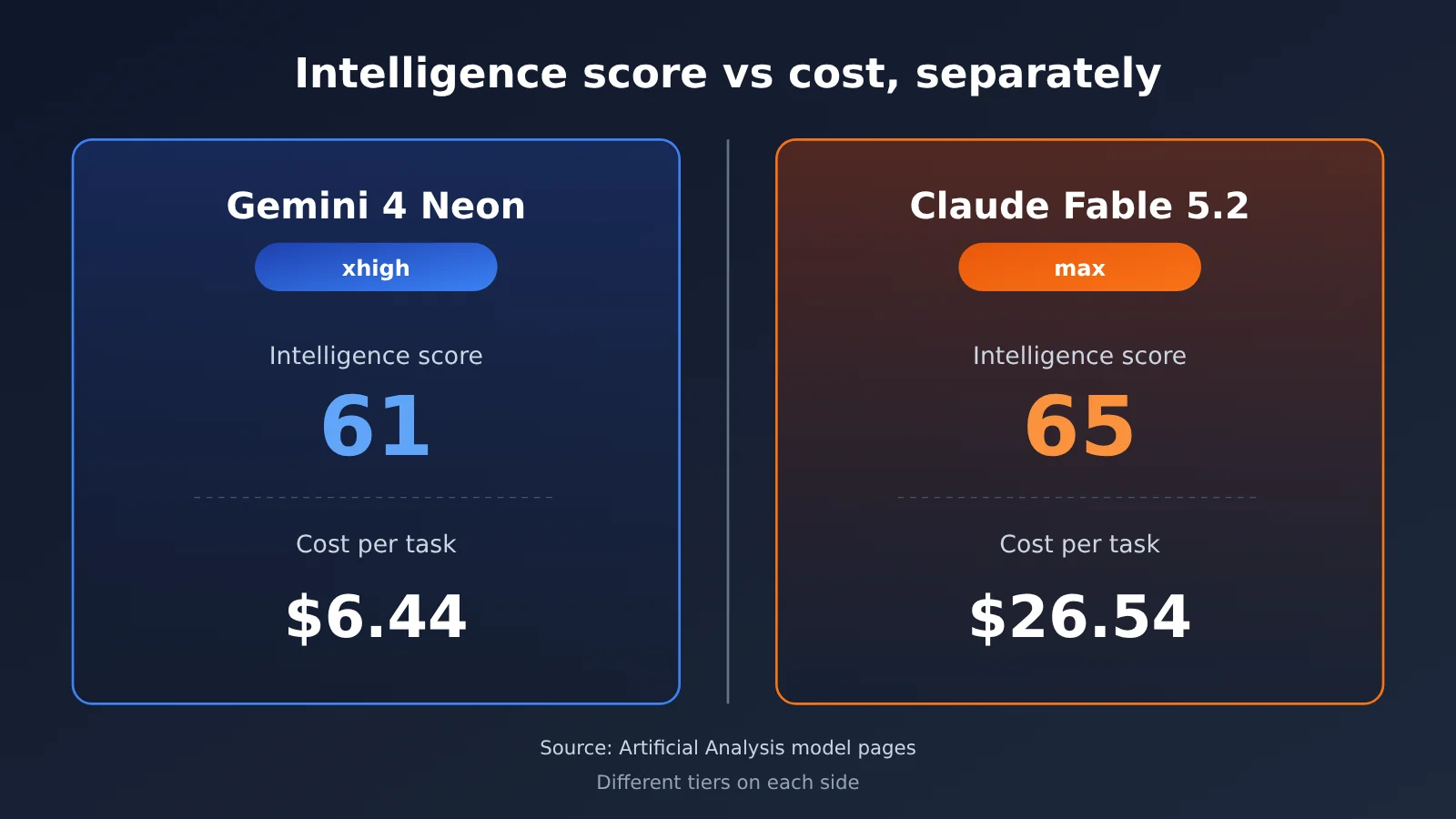
All the data in the table below comes from the Artificial Analysis model pages (read on 2026-11-19, Index v5.0.1). Note that the tiers aren’t the same on both sides: Fable uses max (which is also the page’s Default Fallback), while Neon uses xhigh.
| Metric | Gemini 4 Neon (xhigh) | Claude Fable 5.2 (max) | Source |
|---|---|---|---|
| Intelligence score | 61 | 65 | Artificial Analysis model page |
| Cost per task | $6.44 | $26.54 | Artificial Analysis model page |
| Time per task | 21.5 minutes | 41.6 minutes | Artificial Analysis model page |
| Output speed | 110 tokens/sec | 110 tokens/sec | Artificial Analysis model page |
| Time to first answer token | 56.51 seconds | 247.46 seconds | Artificial Analysis model page |
| List price (input/output, per million tokens) | $3.00 / $15.00 | $8.00 / $40.00 | Artificial Analysis model page |
The Intelligence Score Ledger: Gemini 4 Neon vs. Claude Fable 5.2
The intelligence score column reads 61 versus 65, comparing Neon xhigh with Fable max. According to the Artificial Analysis article, Neon xhigh scores 1 point higher than Gemini 4 Carbon high and ranks third overall; the top two are GPT-6.2 Astra (max) and Claude Fable 5.2 (max). Google’s blog also states that the Artificial Analysis Intelligence Index is 61 at xhigh, but that line is the vendor’s own claim; the 61 is consistent across the Google blog, the model card, and Artificial Analysis.
Fable’s model page only publishes data for the max tier, so when you compare it side by side with other Neon tiers, there’s no like-for-like basis. Neon’s default thinking tier is high, as documented in the Google Cloud developer guide and the latest AI Studio model page. On the Artificial Analysis model page, Neon high scores 60. If you don’t explicitly set a tier in your invocation, you’ll actually get high, not xhigh.
The Cost-per-Task Ledger: Gemini 4 Neon vs. Claude Fable 5.2
Cost per task is $6.44 versus $26.54, and time per task is 21.5 minutes versus 41.6 minutes. The Artificial Analysis article describes Neon’s time as “about 21 minutes,” while the model page says 21.5 minutes; both numbers are kept as published. Output speed is 110 tokens/sec on both sides, but time to first answer token differs sharply: 56.51 seconds for Neon xhigh and 247.46 seconds for Fable max.
Unit price and cost per task are not the same thing. On the Artificial Analysis model page, GPT-6.2 Astra’s list price is also $8.00/$40.00, but its max-tier cost per task is $4.00 because it outputs far fewer tokens when running the index. So when judging cost per task, you need to look at both unit price and token usage—not just the list price.
Gemini 4 Neon vs Claude Fable 5.2 Coding Index: Tiers Noted Separately
The data in this coding section comes from an Artificial Analysis article, and both the tier and the runtime environment need to be called out separately. Neon was tested on Antigravity CLI, while Fable and Opus 5.5 were tested on Claude Code — the harnesses on the two sides aren’t the same.
| Model and tier | Coding Agent Index | Cost per coding task | Runtime environment | Source |
|---|---|---|---|---|
| Gemini 4 Neon xhigh | 59 | $6.86 | Antigravity CLI | Artificial Analysis article |
| Claude Fable 5.2 xhigh | 58 | $15.47 | Claude Code | Artificial Analysis article |
| Claude Opus 5.5 max | 58 | $12.61 | Claude Code | Artificial Analysis article |
| Gemini 4 Carbon high | 55 | Not listed in article | Antigravity CLI | Artificial Analysis article |
Fable here is measured at the xhigh tier, which is different from the max tier in the intelligence score column — the two numbers can’t be read under the same conditions. Also, Google’s blog lists Neon’s Coding Agent Index as 58.6, while the Artificial Analysis article says 59. The first is a self-reported official figure and the second is a third-party article’s number; this article keeps both, without choosing one or averaging them.
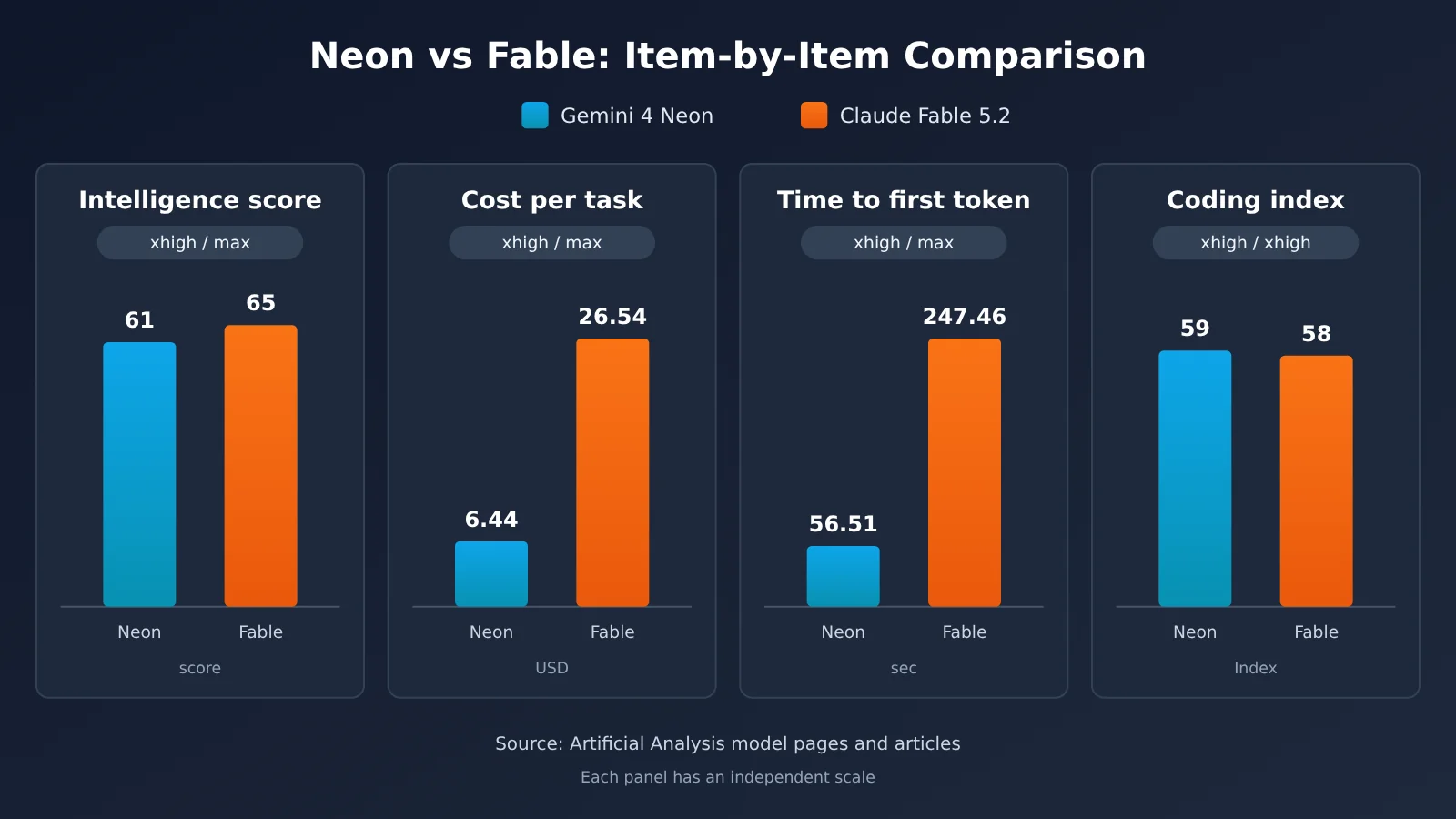
Data note: The numbers in the chart above come from the Artificial Analysis model pages and the Artificial Analysis article respectively, with tiers already labeled in the chart. For the invocation pricing of both models, see the APIYI price table below.
Why the Gemini 4 Neon Model Card Can’t Stand In for Claude Fable 5.2’s Sub-Scores
DeepMind’s Gemini 4 Neon model card comparison table has only three columns: Gemini 4 Neon, Claude Opus 5.5, and GPT-6.2 Sol. Claude Fable 5.2 isn’t in the table. The evaluation notes PDF that accompanies the model card states that results for non-Gemini models come from each vendor’s self-reported numbers by default. So this table is an official aggregation of results; the models weren’t retested by the same lab on the same day.
Opus 5.5 and Fable 5.2 are two different models. On Artificial Analysis’s model pages, Opus 5.5 max has an intelligence score of 59, while Fable 5.2 max scores 65, and their list prices differ too (4.00/20.00 vs 8.00/40.00). The percentages in the Opus column of the model card represent only Opus 5.5; you can’t treat them as Fable 5.2’s sub-scores.
A few metrics that are easy to mix up are summarized below:
| Claim | Number | Source and basis |
|---|---|---|
| Neon high per-task cost lower than Carbon | 32% | Official self-report (Google blog); it doesn’t specify whether Carbon uses introductory or standard pricing |
| Neon xhigh costs less per task than Carbon | About 17% ($6.44 vs $7.76) | Artificial Analysis article; Carbon calculated at non-discounted pricing |
| Carbon high per-task cost | $4.90 | Artificial Analysis model page, calculated at introductory pricing |
| Neon Coding Agent Index | 58.6 / 59 | Official self-report / Artificial Analysis article |
| Neon MKA | 56.5% / 56% | Model card / Artificial Analysis article |
| Neon SWE-sweep | 12.8% / 39.0% | Official self-report, corresponding to the mini-SWE harness and Google Antigravity, respectively |
The three cost figures in the table above come from three different accounting bases. You can’t subtract them from one another or merge them into a single number. Google’s blog explains the gap in SWE-sweep from 12.8% to 39.0% as an improvement from the harness; it doesn’t mean the model itself is three times better.
Gemini 4 Neon vs. Claude Fable 5.2: Which Set of Numbers Should You Look at First?
Both models’ data sit in the same table, but different readers care about different metrics. Below, they’re grouped by “which metric matters most to you” — each group only tells you which column to look at, and stops short of drawing conclusions for you.
When intelligence score is your priority
- Long-horizon reasoning, complex analysis: Watch the intelligence score column, and note the tier at the same time (Fable max 65, Neon xhigh 61). When you evaluate, reproduce it at the same tier.
- Need a cross-model ranking: The Artificial Analysis article gives an overall ranking you can cite, but state clearly which tier the ranking is based on.
When cost per task and latency are your priority
- High-frequency calls, batch jobs: Watch cost per task (6.44 vs 26.54 USD) and time per task (21.5 vs 41.6 minutes).
- Interactive products: Watch time to first answer token (56.51 vs 247.46 seconds). Output speed is identical on both sides, so the latency difference comes down to time to first token.
- Coding agents: Look at the coding table, and note that Neon and Fable are both on xhigh, but their runtime environments are Antigravity CLI and Claude Code respectively.
Neon’s own performance across tiers also deserves its own table. The data below comes from the summary table on the Artificial Analysis model page; for time to first token, the last three tiers’ figures are taken from the FAQ on that same page, so they aren’t in the same column as the summary table.
| Neon tier | Intelligence score | Time per task | Output speed | First answer token |
|---|---|---|---|---|
| xhigh | 61 | 21.5 minutes | 110 tokens/s | 56.51 seconds |
| high (default) | 60 | 14.8 minutes | 101 tokens/s | 40.64 seconds (FAQ) |
| medium | 55 | 8.3 minutes | 101 tokens/s | 20.14 seconds (FAQ) |
| low | 44 | 3.7 minutes | 97 tokens/s | 13.93 seconds (FAQ) |
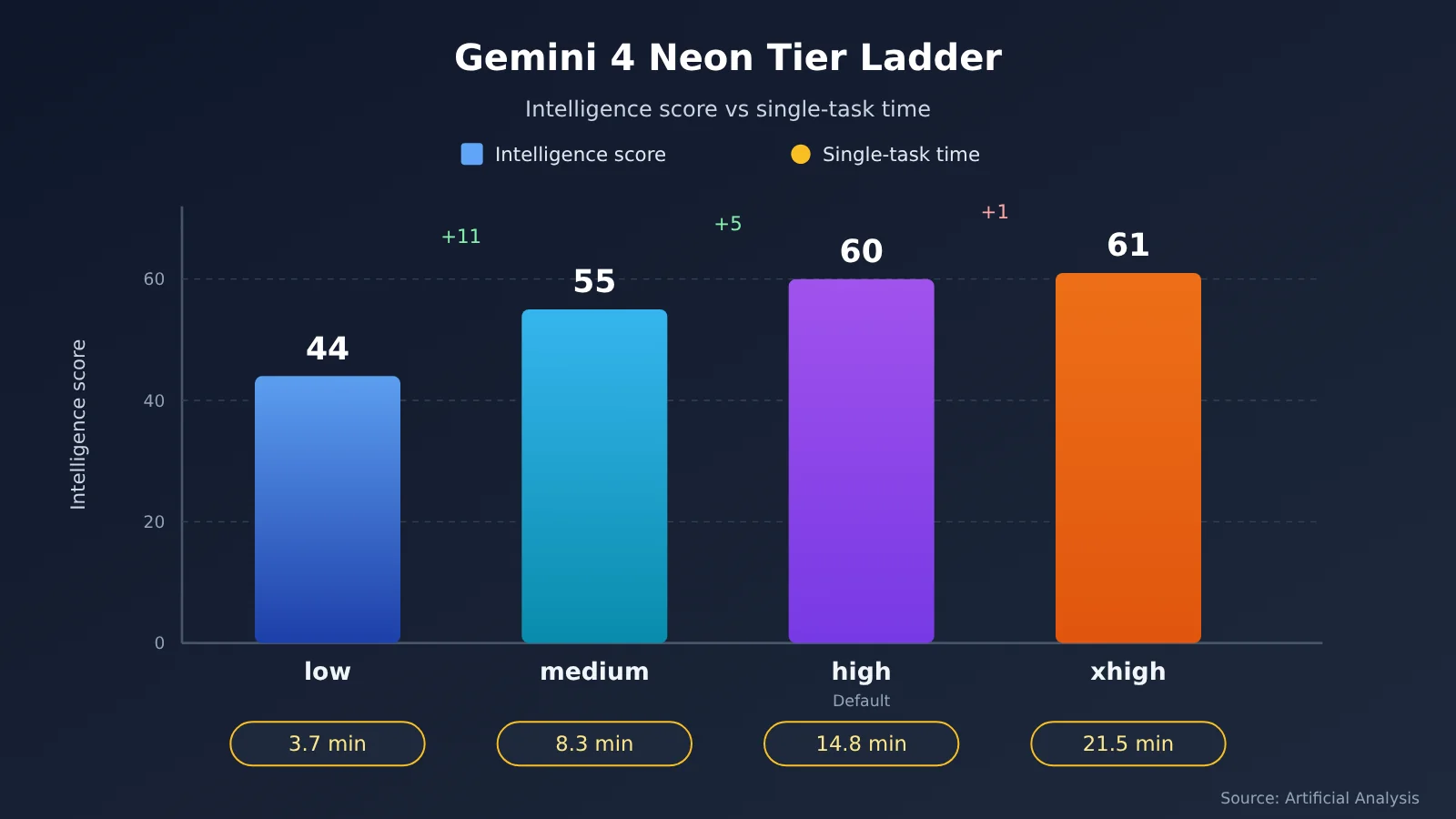
Also, the Artificial Analysis article’s data on GDP.pdf shows Neon high at 33.4% and Neon xhigh at 28.0%. Which means that on this test, a higher tier doesn’t necessarily mean a higher score.
Gemini 4 Neon and Claude Fable 5.2 Pricing and Availability
For official pricing, according to the Google AI Studio pricing page, gemini-4-neon has no free tier. The paid pricing is $3.00 per million input tokens, $15.00 per million output tokens (including thinking tokens), and $0.15 per million cached tokens; it supports implicit caching only. The Artificial Analysis model page lists Fable 5.2 at 8.00/40.00 USD, with a 98% cache discount.
APIYI’s master table at apiyi.com (page marked as updated 2026-11-16 09:39, UTC+8) and the pricing API (queried 2026-11-19, version shell-api-modelmak-v1, 285 models total) contain the following information for the relevant models. Per the pricing API convention, a model_ratio of 1 corresponds to $2 per million input tokens, and a completion_ratio of 5 means the output price is 5 times the input price.
| Model ID | Input | Cache read | Output (USD/million tokens) | Endpoints | Available platform |
|---|---|---|---|---|---|
claude-fable-5-2 |
8 | 0.2 | 40 | chat, messages | APIYI (listed) |
claude-fable-5-2-thinking |
8 | 0.2 | 40 | chat, messages | APIYI (listed) |
gemini-4-carbon |
2 | 0.1 | 10 | chat, gemini | APIYI (listed) |
gemini-4-hydrogen |
1.5 | 0.075 | 7.5 | chat, gemini | APIYI (listed) |
gemini-4-neon |
— | — | — | — | Google AI Studio official |
gemini-4-neon isn’t included in either APIYI’s master table or the pricing API, so it isn’t listed yet. We’ll get this model listed as soon as possible; model names and pricing are subject to the platform’s model list. The 2/10 USD for gemini-4-carbon in the table is APIYI’s current listed price, which matches Google’s introductory price through 2026-11-30 and differs from Google’s later standard price of 4/20 USD.
The group names for claude-fable-5-2 differ between the two sources, so here are both versions: APIYI’s master table lists ClaudeCode, Claude_Reverse, Claude_Enterprise, Default, and SVIP; the group IDs in the pricing API are ClaudeCode, ClaudeCodeReverse, ClaudeOfficial, default, and svip. When configuring groups, go by the response from the API you’re actually calling.
How to Call Claude Fable 5.2 via APIYI: Quick Start
APIYI offers an OpenAI-compatible interface. To call claude-fable-5-2, you only need to change the base_url and the model name. Here’s how:
- Get an API key from APIYI and store it in an environment variable, for example
APIYI_API_KEY. Never hard-code the key in plaintext inside your code. - In the OpenAI SDK, set the base_url to
https://api.apiyi.com/v1. The client initialization looks likeOpenAI(base_url="https://api.apiyi.com/v1", api_key=os.environ["APIYI_API_KEY"]). - Send the request:
client.chat.completions.create(model="claude-fable-5-2", messages=[{"role": "user", "content": "..."}]). If you want the thinking variant, just swap the model name forclaude-fable-5-2-thinking— both are priced the same: $8 input, $0.2 cached read, and $40 output per million tokens. - If your project uses Anthropic-style request formats, you can go through the messages endpoint — same model IDs, same pricing.
- The Gemini family can be called natively: the endpoint is
https://api.apiyi.com, the api version isv1beta, and the available model IDs includegemini-4-carbonandgemini-4-hydrogen.
Once you’re integrated, it’s worth logging the input tokens, output tokens, and total latency for every request. That way you can compute a per-task cost from your own workloads and compare it against Artificial Analysis’s $26.54 — just keep in mind that the two task mixes aren’t the same.
🚀 Quick start: New users get free trial credits after signing up at APIYI apiyi.com. Start by running
claude-fable-5-2on a few real business samples, note the token usage and latency, then decide on your tier and budget.
Decision Guide: Choosing Between Gemini 4 Neon and Claude Fable 5.2 by the Ledger
💡 Recommendation: First figure out what your business cares about most — the intelligence score, cost per task, or time to first token — then find the corresponding column in the table and check the tier.
- Check the tier: The intelligence scores correspond to Fable max and Neon xhigh, while the coding index corresponds to xhigh on both sides. If you launch on a different tier, you’ll need to look up the data for that tier again.
- Check the sourcing: Official self-reported numbers, model cards, Artificial Analysis articles, and Artificial Analysis model pages each keep their own source — don’t convert between them.
- Check the invocation parameters: According to the Google Cloud developer guide, Neon offers only four thinking tiers — low, medium, high, and xhigh. Passing
thinking_budgetorMINIMALreturnsHTTP 400. Neon doesn’t support explicit context caching; implicit caching kicks in automatically for shared prefixes over 4096 tokens. - Re-test with your own tasks: Public data can only help you narrow down the options — the final cost and latency still have to be measured on your own samples.
Frequently Asked Questions (FAQ)
Q1: What is Gemini 4 Neon?
Gemini 4 Neon is a model Google released on 2026-11-18. According to its model card, it’s adapted from Gemini 4 Carbon, has a knowledge cutoff of March 2026, accepts text, image, audio, and video inputs, and offers a unified context window of up to 1 million tokens. In Google’s lineup, Neon sits between Hydrogen (fast, everyday execution) and Carbon (complex, long-horizon tasks).
Q2: Can the Opus 5.5 numbers in the Gemini 4 Neon model card stand in for Claude Fable 5.2?
No. The model card has only three columns — Neon, Opus 5.5, and GPT-6.2 Sol — with no Fable 5.2, and results for non-Gemini models come from each vendor’s own reporting by default. For Fable 5.2, the figures you can cite are the intelligence score, cost, latency, speed, and coding index published on the Artificial Analysis model page and in its write-ups.
Q3: When is Gemini 4 Neon available, and through which channels?
Per Sundar Pichai’s post (vendor-reported), Neon began rolling out on 2026-11-18 through these channels: the Gemini API in Google AI Studio, Gemini for business, Google Antigravity for paid Google AI Pro and Ultra subscribers, and the Gemini App for Pro and Ultra. The Google Cloud developer guide lists the model ID as `gemini-4-neon`.
Q4: Both output at 110 tokens/second, so why do per-task times differ?
The Artificial Analysis model page reports aggregate results: 21.5 minutes versus 41.6 minutes, with time-to-first-token of 56.51 seconds versus 247.46 seconds. The page doesn’t break down exactly why the times differ. What is clear is that identical output speed doesn’t mean identical total time — the wait for the first token counts toward the total as well.
Q5: How do I call Claude Fable 5.2 quickly through the API?
Get a key from APIYI (apiyi.com), then use the OpenAI-compatible base_url given earlier and set the model name to `claude-fable-5-2` or `claude-fable-5-2-thinking`; both the chat and messages endpoints work. Pricing is $8 input, $0.2 cached read, and $40 output per million tokens, and the group name should follow the spelling used in both the summary table and the pricing endpoint.
Q6: Does a lower unit price mean a lower per-task cost?
The two aren’t equivalent. On the Artificial Analysis model page, GPT-6.2 Astra is listed at $8.00/$40.00, yet its per-task cost at the max tier is only $4.00, because it emits far fewer tokens when running the index. Per-task cost is determined by unit price and token usage together.
Q7: What are the known limitations of Gemini 4 Neon?
– **Pricing**: No free tier on AI Studio, and only implicit caching is supported.
– **Parameters**: Passing `thinking_budget` or `MINIMAL` returns `HTTP 400`, and explicit context caching isn’t supported either.
– **Output length**: A single response defaults to at most 65536 tokens; long decoding is capped at 1048576 minus the input length.
– **Cybersecurity version**: The cybersecurity version opens in a few days to trusted defenders in the Fairwind Program only, with no public model ID (vendor-reported).
Gemini 4 Neon and Claude Fable 5.2: Key Takeaways
- Intelligence scores come with tier caveats: On the Artificial Analysis model pages, Neon xhigh is 61 and Fable max is 65.
- Look at cost per task separately: Neon xhigh is $6.44 and Fable max is $26.54, with runtimes of 21.5 and 41.6 minutes respectively.
- Latency means time to first token: Both output at 110 tokens/sec, with time to first token of 56.51 seconds and 247.46 seconds respectively.
- Coding index uses a different tier: Neon xhigh is 59 and Fable xhigh is 58, with coding cost per task of $6.86 and $15.47 respectively.
- There’s no Fable on the model card: The Opus 5.5 sub-scores on the model card can’t be used as Fable 5.2 data.
- Each figure has its own basis: 32%, roughly 17%, $4.90, 58.6, and 59 each belong to a different set of numbers.
- Where to call them:
claude-fable-5-2is already available on APIYI;gemini-4-neonisn’t listed yet.
Summary
When comparing Gemini 4 Neon and Claude Fable 5.2, there are three things to keep in mind:
- The intelligence numbers: On the Artificial Analysis model pages, it’s 61 vs 65, at the Neon xhigh and Fable max tiers respectively.
- The cost and latency numbers: Cost per task is $6.44 vs $26.54, task time is 21.5 vs 41.6 minutes, time to first token is 56.51 vs 247.46 seconds, and both output at 110 tokens/sec.
- The coding numbers: Both are at the xhigh tier, with an index of 59 vs 58 and a cost per task of $6.86 vs $15.47, running in Antigravity CLI and Claude Code respectively.
Which model you pick depends on which set of numbers matters more to your business. I’d suggest narrowing things down with the public data first, then re-testing cost and latency on your own samples. You can start with a free quota on APIYI at apiyi.com to try claude-fable-5-2; once gemini-4-neon is listed, you can switch model names within the same interface and compare them side by side.
📚 References
-
Sundar Pichai’s announcement post: Gemini 4 Neon launch and availability channels (self-reported by the company)
- Link:
x.com/sundarpichai/status/2123167780988125621
- Link:
-
Google Blog — Introducing Gemini 4 Neon: The company’s own benchmarks, pricing, and positioning
- Link:
blog.google/innovation-and-ai/models-and-research/gemini-models/introducing-gemini-4-neon
- Link:
-
DeepMind Model Card: Three-column comparison table and model specs
- Link:
deepmind.google/models/model-cards/gemini-4-neon/
- Link:
-
Google Cloud Developer Guide: Model ID, thinking levels, and caching rules
- Link:
docs.cloud.google.com/gemini-enterprise-agent-platform/models/guides/gemini-4-neon
- Link:
-
Google AI Studio Pricing Page: Paid pricing for gemini-4-neon
- Link:
aistudio.google.com/docs/pricing
- Link:
-
Artificial Analysis article: Neon’s intelligence score, cost, and coding index
- Link:
artificialanalysis.ai/articles/gemini-4-neon-intelligence-gain
- Link:
-
Artificial Analysis model pages: Tier-by-tier data for Neon and Fable 5.2
- Link:
artificialanalysis.ai/models/gemini-4-neon - Link:
artificialanalysis.ai/models/claude-fable-5-2
- Link:
-
APIYI master list and pricing endpoint: Available models, groups, and prices
- Link:
docs.apiyi.com/models.md - Link:
api.apiyi.com/api/pricing
- Link:
Author: APIYI Technical Team
Technical inquiries: Feel free to reach us through the APIYI homepage—for more materials, check out the documentation center at docs.apiyi.com