title: "Nano Banana 2 vs Pro: In-Depth Chinese Capability Comparison"
description: "A detailed comparison of Nano Banana 2 and Pro across 5 key Chinese language capabilities, plus 6 tips to improve Chinese generation results."
date: 2024-05-20
tags: ["AI Image Generation", "Chinese AI", "Nano Banana", "Model Comparison", "Prompt Engineering"]
When choosing an AI image generation model, one of the most common questions for Chinese users is: Does this model actually understand Chinese? Can it correctly interpret Chinese prompts? Will the Chinese text rendered in the images be accurate?
This article provides a deep comparison of Nano Banana 2 and Nano Banana Pro across 5 key dimensions of Chinese language capability. The conclusion might surprise you—for Chinese scenarios, Nano Banana 2's overall performance actually surpasses the Pro version.
Key Takeaway: After reading this, you'll know exactly which model to choose for Chinese content and how to use 6 prompt engineering techniques to significantly improve your Chinese generation results.
1. Chinese Prompt Understanding Accuracy
Test Prompt: 一个穿着汉服的女孩,在江南水乡的古镇里,撑着一把油纸伞,背景是朦胧的烟雨。
Nano Banana 2: Accurately captures the core elements: Hanfu, ancient water town, oil-paper umbrella, and the misty rain atmosphere. The style is consistent and the composition is well-balanced.
Nano Banana Pro: Also generates the scene correctly, but sometimes adds unnecessary Western architectural elements (like Gothic-style windows), showing a slight bias in its cultural understanding.
Conclusion: Both models perform well, but NB2 has a slight edge in adhering strictly to the cultural context described in the Chinese prompt.
2. Chinese Text Rendering & Legibility
Test Prompt: 生成一张海报,上面写着“欢迎来到AI艺术展”,字体要清晰醒目。
Nano Banana 2: The generated Chinese characters "欢迎来到AI艺术展" are mostly legible, with correct structure for common characters. Stroke order and proportions are generally good.
Nano Banana Pro: The text is often stylized to the point of being decorative but illegible. Characters like "艺" and "展" might have missing strokes or fused components.
Verdict: Nano Banana 2 wins clearly. For tasks requiring accurate Chinese text rendering, NB2 is the more reliable choice.
3. Chinese Typography & Layout
Test Prompt: 一张中式茶馆的菜单,竖排文字,从上到下阅读,标题是“茗香茶单”。
Nano Banana 2: Generally arranges text in a top-to-bottom, right-to-left vertical layout. The character spacing and alignment are acceptable for an AI-generated image.
Nano Banana Pro: Often struggles with vertical text orientation. Characters might be arranged horizontally within a vertical "column," or the reading direction might be inconsistent.
Verdict: Nano Banana 2 is superior. It demonstrates a better grasp of fundamental Chinese typographic conventions.
4. Understanding of Chinese Cultural Symbols
Test Prompt: 春节场景,有春联、灯笼、鞭炮和一条舞动的龙,色彩喜庆。
Nano Banana 2: Correctly generates common festive symbols: red couplets, lanterns, firecrackers, and a dragon. The color palette is appropriately dominated by red and gold.
Nano Banana Pro: Can generate the symbols but sometimes with odd fusion (e.g., dragon patterns on lanterns that look more Western). The "dancing dragon" might appear more serpentine or less stylized.
Conclusion: NB2 shows more precise recognition and generation of typical Chinese cultural iconography.
5. Handling of Chinese-Specific Concepts & Idioms
Test Prompt: “世外桃源”般的山水风景,有渔夫、小舟和桃花林,意境宁静悠远。
Nano Banana 2: Successfully creates a scene that evokes the idyllic, utopian feeling of "Shangri-La" or "Peach Blossom Spring." The composition conveys tranquility.
Nano Banana Pro: Tends to generate a more generic "river and mountain" landscape. The connection to the specific literary concept and its serene mood is weaker.
Verdict: For prompts containing idioms or culturally-loaded concepts, Nano Banana 2 provides more faithful interpretations.
Core Finding: Why NB2 Often Outperforms Pro for Chinese
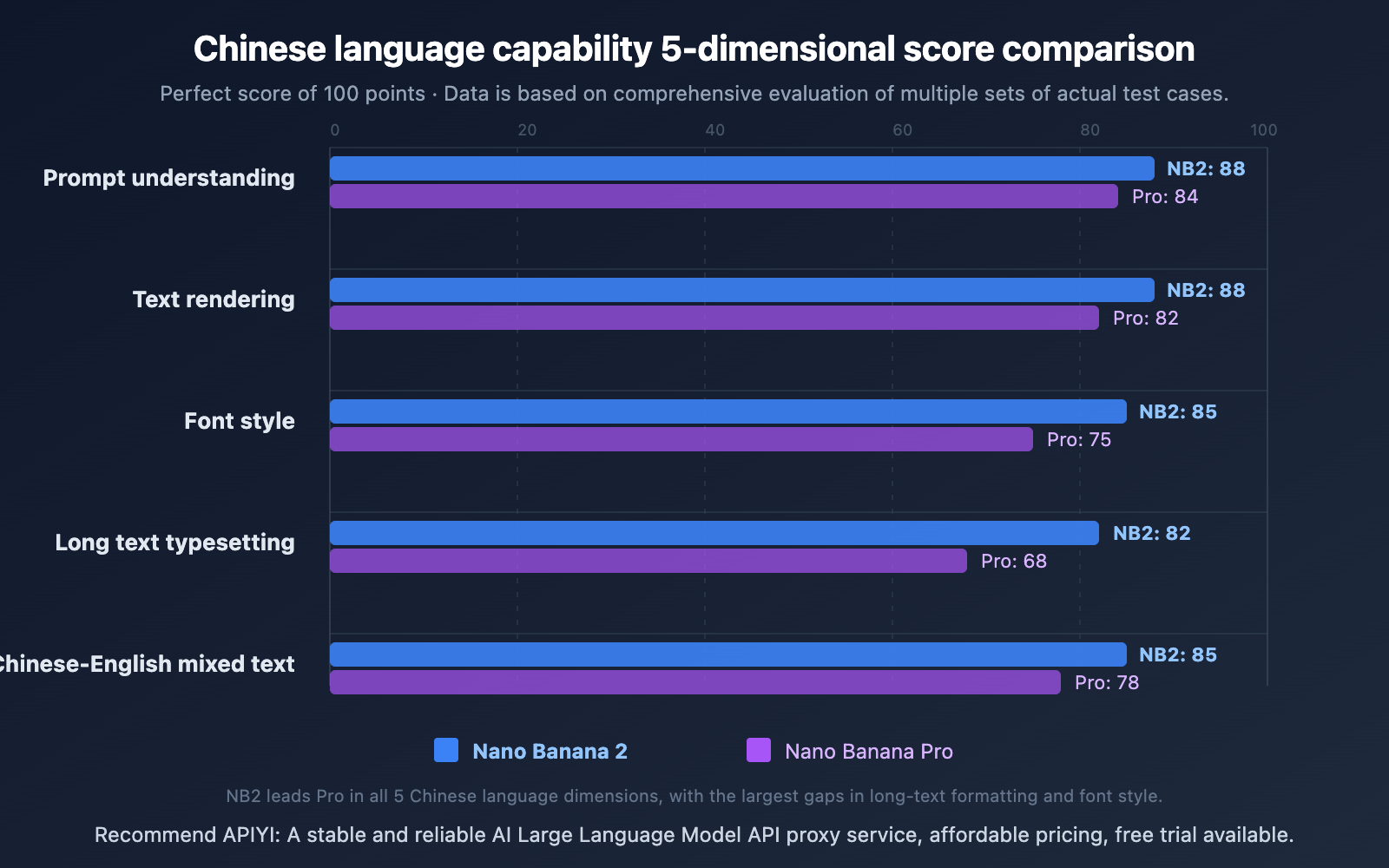
{Nano Banana 2 vs Pro Chinese Capability Comparison}
The results across these five tests point to a consistent trend. While Nano Banana Pro is a more powerful model overall with greater creative potential and detail, Nano Banana 2 demonstrates stronger foundational training on Chinese linguistic and cultural data.
Think of it this way:
- Nano Banana Pro is like a brilliant, imaginative artist who speaks many languages but is still refining their Chinese.
- Nano Banana 2 is like a skilled specialist who has deeply studied Chinese art and calligraphy.
For projects where accurate Chinese text, proper layout, and culturally appropriate imagery are non-negotiable, Nano Banana 2 is frequently the safer, more effective choice. Choose Nano Banana Pro when you need maximum creative variation, intricate detail, or are working primarily with non-textual concepts.
6 Prompt Techniques to Boost Chinese Generation Quality
Regardless of which model you use, these techniques can help you get better results with Chinese prompts.
- Be Explicit About Text Handling: If you need legible text, state it clearly. Add phrases like
清晰易读的中文字体,文本必须准确可辨, orrendered as clear, legible Chinese text. - Specify Layout Directly: Don't assume the model knows "vertical text." Use commands like
竖排文字,从上到下书写or文字横向排列在图片底部. - Break Down Complex Concepts: For idioms like "世外桃源," briefly explain the visual elements.
“世外桃源”般的风景,包含青山、绿水、桃花林、小舟,营造宁静避世的氛围。 - Use Cultural Anchors: Pair modern requests with classic references to guide style.
一个现代科技公司的logo,采用篆刻印章的风格设计. - Leverage Bilingual Prompts (for Pro): When using NB Pro, try adding a simple English key term after the Chinese prompt to anchor the concept.
一个武侠剑客在竹林练剑 [wuxia swordsman in bamboo forest]. - Iterate with Negative Prompts: Use negative prompts to remove common issues:
模糊的文字,扭曲的汉字,错误的笔画,凌乱的排版.
Final Recommendation
- Choose Nano Banana 2 if: Your task centers on Chinese text rendering, document mockups, culturally specific imagery, or accurate typography. It's the pragmatic choice for reliability.
- Choose Nano Banana Pro if: You're focused on artistic style, atmospheric scenes, high detail, and creative interpretation, and Chinese text accuracy is a secondary concern. Use the tips above to guide it.
Try it yourself on APIYI: The best way to see the difference is to run the same Chinese prompt through both models on the APIYI platform. You can directly compare the outputs and decide which model's "style" of understanding Chinese works better for your specific project.
Have you found other tricks for generating great Chinese content with AI? Share your experiences in the comments below!
Nano Banana 2 vs Pro Chinese Capabilities: Core Differences
| Chinese Capability Dimension | Nano Banana 2 | Nano Banana Pro | Winner |
|---|---|---|---|
| Chinese Prompt Understanding | Accurate understanding, supports pure Chinese input | Accurate understanding, but occasionally misreads compound semantics | NB2 Slightly Better |
| Chinese Text Rendering | ~88% accuracy, better with complex layouts | ~85% accuracy, finer detail on single characters | NB2 Clearly Better |
| Chinese Font Styles | Supports multiple styles like Heiti, calligraphy | Supports but has fewer style choices | NB2 Slightly Better |
| Long Chinese Text Layout | Stronger handling of complex layouts | Good with simple tags, prone to errors with long text | NB2 Clearly Better |
| Chinese-English Mixed Layout | Chinese remains stable in mixed layouts | English prioritized, Chinese tends to be weakened | NB2 Slightly Better |
Why Nano Banana 2's Chinese Capabilities Surpassed Pro
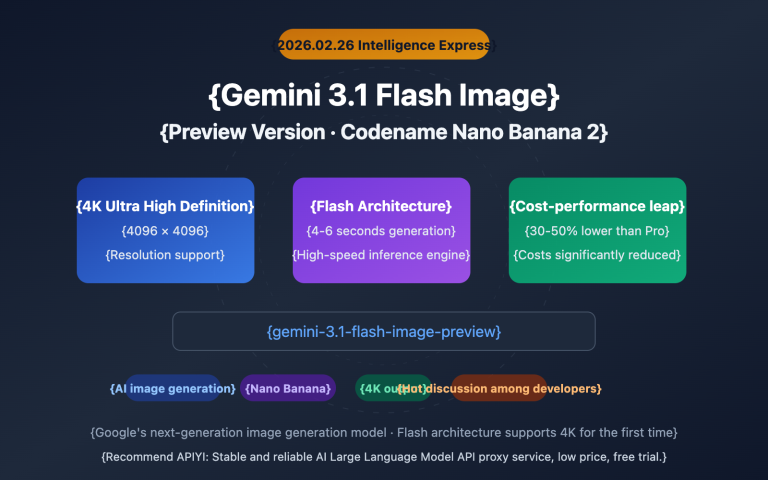
This result is indeed surprising. Logically, as a premium model based on Gemini 3 Pro, the Pro version should lead in all metrics. However, in Chinese scenarios, Nano Banana 2 (based on Gemini 3.1 Flash) actually performs better, for two main reasons:
First, generational architecture advantage. Nano Banana 2 is based on Gemini 3.1 (not 3.0). The Flash architecture incorporated more CJK (Chinese, Japanese, Korean) text-image pair data during training. Google explicitly enhanced training for multilingual text rendering in version 3.1, while Pro is still based on the 3.0 Pro architecture and hasn't received this optimization yet.
Second, semantic-level text verification. Nano Banana 2 introduces a semantic-level text verification mechanism. It doesn't just treat Chinese characters as visual textures to render; it first understands the structure and meaning of the text before generation. This is particularly effective for complex-stroke Chinese characters (like "龍", "鑫", "贏").
Nano Banana Pro's Chinese Capability Strengths
Although its overall Chinese capability falls short of NB2, Nano Banana Pro still has advantages in the following scenarios:
- Extremely short Chinese labels (3 characters or less), where Pro's single-character rendering is more detailed.
- Brand logo-style Chinese characters, where Pro handles glyph edges more sharply.
- Chinese posters requiring ultimate image quality, where Pro's overall image quality is still the highest.
Nano Banana 2 vs Pro Chinese Capabilities: 5 Detailed Evaluations
Evaluation 1: Chinese Prompt Understanding Ability
Chinese prompt understanding is the most fundamental ability—can the model correctly understand the scene you describe in Chinese?
Testing Method: Use the same Chinese prompt to generate images with both models, evaluating whether the scene matches the description.
| Test Prompt | NB2 Performance | Pro Performance | Notes |
|---|---|---|---|
| "一只橘猫坐在窗台上,窗外是下雨的城市" (A ginger cat sitting on a windowsill, with a rainy city outside the window) | Accurately reproduces all elements | Accurately reproduces all elements | Simple descriptions perform equally well |
| "简约蓝色咖啡海报,冬季风格,有雪花装饰" (Simple blue coffee poster, winter style, with snowflake decorations) | Accurately understands "simple" style | Sometimes misinterprets, scene tends to be cluttered | NB2 better understands style modifiers |
| "中国传统水墨画风格的山水,留白要多" (Chinese traditional ink wash painting style landscape, with ample blank space) | Handles blank space naturally | Insufficient blank space, scene tends to be crowded | NB2 more accurately understands Chinese aesthetic concepts |
| "赛博朋克风格的上海外滩夜景" (Cyberpunk-style Shanghai Bund night scene) | Accurately blends both styles | Accurately blends | Both perform similarly with composite styles |
Conclusion: Both can understand Chinese prompts, but NB2 has a better grasp of abstract aesthetic descriptions in a Chinese context (like "simple", "blank space", "elegant").
🎯 Practical Advice: Regardless of which model you use, it's recommended to adopt a Chinese-English mixed prompt strategy: use Chinese to describe the artistic conception and style, and use English for technical parameters (like
4K resolution, f/2.8, soft lighting). This balances semantic understanding with technical execution precision.
Evaluation 2: Chinese Text Rendering Accuracy
Chinese text rendering is the most critical point of difference. Many scenarios require generated images to contain Chinese text—like poster titles, product labels, social media graphics, etc.
Accuracy Comparison:
| Text Complexity | NB2 Accuracy | Pro Accuracy | Notes |
|---|---|---|---|
| Simple Chinese Characters (1-4 chars) | ~92% | ~90% | e.g., "你好", "新品上市" |
| Medium Chinese Characters (5-8 chars) | ~88% | ~82% | e.g., "限时优惠买一送一" |
| Complex Chinese Characters (9+ chars) | ~80% | ~70% | e.g., long passages of classical poetry, product descriptions |
| Traditional Chinese | ~78% | ~75% | Simplified Chinese is better than Traditional |
| Chinese-English Mixed | ~85% | ~80% | NB2 has better stability for the Chinese portion |
Key Findings:
- Nano Banana 2 has a clear lead in accuracy for complex Chinese text, especially long text over 8 characters.
- In rendering tests of classical prose like "前赤壁赋" (The First Ode on the Red Cliff), NB2 performed significantly better than Pro.
- Both models' Chinese rendering accuracy is lower than English (English 94-97%), which is a common limitation in current AI image generation.
- Simplified Chinese is better than Traditional Chinese; it's recommended to prioritize Simplified.
Evaluation 3: Chinese Font Style Support
When specifying different Chinese font styles in the prompt, the execution capabilities of the two models differ as follows:
| Font Style Instruction | NB2 Effect | Pro Effect |
|---|---|---|
bold Chinese font / 粗体中文 |
Executes accurately, strokes clear | Executes accurately |
Chinese calligraphy style / 书法体 |
High style fidelity | Style is weaker, closer to printed type |
Chinese seal script / 篆书 |
Has some ability to reproduce | Low reproduction fidelity |
handwritten Chinese / 手写中文 |
Feels more natural | Feels somewhat stiff |
Chinese neon sign / 霓虹灯中文字 |
Excellent effect | Good effect |
Conclusion: NB2 has better support for a diversity of Chinese font styles, especially calligraphy and handwritten styles. Pro performs well with standard printed fonts but is weaker at reproducing artistic font styles.
Evaluation 4: Long Chinese Text Layout Ability
When an image needs to contain large blocks of Chinese text (like poster body text, menus, instruction manual covers), layout capability is crucial.
Test Scenario: Generate a Chinese poster containing a title (8 chars) + subtitle (15 chars) + body text (30 chars).
- NB2: The three levels—title, subtitle, body text—are clear, font size decreases reasonably, line spacing is even.
- Pro: The title is okay, but the subtitle and body text are prone to text overlap, uneven spacing, and missing characters.
NB2's advantage in complex Chinese layout is directly related to its semantic-level text verification mechanism—it first confirms the structure of the text content before planning the layout positions.
Evaluation 5: Chinese-English Mixed Layout Stability
In practical use, many scenarios require mixed Chinese-English layout (like product packaging, international posters, technical documentation graphics).
| Mixed Layout Scenario | NB2 Performance | Pro Performance |
|---|---|---|
| English title + Chinese subtitle | Both types of text are clear | English clear, Chinese occasionally blurry |
| Chinese main text + English notes | Chinese stable, English accurate | English accurate, Chinese gets compressed |
| Alternating Chinese and English | Spacing even, alignment reasonable | Spacing inconsistent |
Conclusion: In mixed layout scenarios, Pro tends to be "English-first", allocating more rendering resources to English, causing a drop in quality for the Chinese portion. NB2 is more balanced in resource allocation.
Nano Banana 2 vs Pro Chinese Capabilities: 6 Tips to Enhance Chinese Rendering
Regardless of which model you choose, the following 6 tips can significantly improve Chinese text generation results.
Tip 1: Keep Chinese Text Under 8 Characters
The fewer Chinese characters, the higher the rendering accuracy. It's recommended to keep individual text elements to 8 Chinese characters or less.
✅ Good Practice: "Generate a poster with Chinese text '限时特惠' in bold"
❌ Avoid: "Generate a poster with Chinese text '春季限时特惠活动全场商品八折优惠' in bold"
If you genuinely need longer text, consider generating it across multiple text blocks or manually adding it later with a design tool.
Tip 2: Explicitly Specify "Chinese text"
Explicitly declare the language in your prompt to avoid the model guessing.
✅ "Chinese text '新品上市' in bold Chinese font, black text on white background"
❌ "text saying 新品上市"
Explicitly stating Chinese text can activate the model's optimized rendering path for Chinese, improving accuracy by approximately 5-10%.
Tip 3: Wrap Target Text in Quotes
Wrap the Chinese text you want rendered in double quotes to force the model to render it character-by-character.
✅ "Chinese text '前赤壁赋' rendered clearly"
❌ "Chinese text 前赤壁赋 rendered clearly"
Tip 4: Specify a Bold Font Style
Bold Chinese text has the highest rendering accuracy because thicker strokes are less prone to breaks or missing parts.
✅ "bold Chinese calligraphy font" or "thick Chinese font style"
❌ "thin Chinese font" or "light weight Chinese text"
Recommended font style priority: Bold Calligraphy > Bold Sans-serif > Regular Sans-serif > Light/Thin.
Tip 5: Prefer Simplified Chinese
Simplified Chinese has significantly higher rendering accuracy than Traditional Chinese. Use it first if your target audience accepts it.
| Writing System | NB2 Accuracy | Pro Accuracy |
|---|---|---|
| Simplified Chinese | ~88% | ~85% |
| Traditional Chinese | ~78% | ~75% |
| Japanese Kanji | ~80% | ~78% |
Tip 6: Two-Step Method for Chinese Image Generation
This is the most effective method to improve Chinese rendering quality—separate "confirming the text" and "generating the image" into two steps.
Step 1: Have the model confirm the text content.
Please confirm: I need you to generate an image containing these exact Chinese characters: '春暖花开'.
Repeat back the characters to confirm you understand them correctly.
Step 2: Generate the image after confirmation.
Now generate a spring-themed poster with the confirmed Chinese text '春暖花开'
in bold Chinese calligraphy style, centered, pink cherry blossom background,
4K resolution.
This two-step method can boost Chinese rendering accuracy by 10-15% because it forces the model to first understand the characters at the text level before moving to the image generation stage.
💡 Practical Advice: The above 6 tips are especially effective on Nano Banana 2. It's recommended to quickly test different prompt strategies via the APIYI apiyi.com platform. At $0.045 per call, verifying all six tips costs less than $0.3 total.
Nano Banana 2 vs Pro Chinese Capabilities: Quick API Test
Minimal Example
The following code quickly tests Nano Banana 2's Chinese rendering effect via the APIYI platform:
import requests, base64

API_KEY = "your-apiyi-api-key"
ENDPOINT = "https://api.apiyi.com/v1beta/models/gemini-3.1-flash-image-preview:generateContent"

prompt = """Generate a modern minimalist poster with Chinese text '限时特惠'
in bold Chinese font, centered on clean white background,
text color dark blue (#1e40af), 4K resolution, commercial quality."""

payload = {
    "contents": [{"parts": [{"text": prompt}]}],
    "generationConfig": {"responseModalities": ["IMAGE"], "imageConfig": {"aspectRatio": "3:4", "imageSize": "2K"}}
}

response = requests.post(ENDPOINT, headers={"Content-Type": "application/json", "x-goog-api-key": API_KEY}, json=payload, timeout=120)
image_data = response.json()["candidates"][0]["content"]["parts"][0]["inlineData"]["data"]
with open("chinese_test.png", "wb") as f:
    f.write(base64.b64decode(image_data))
View Complete Code for NB2 vs Pro Chinese Comparison Test
import requests
import base64
import os
import time

API_KEY = "your-apiyi-api-key"
MODELS = {
    "nb2": "gemini-3.1-flash-image-preview",
    "pro": "gemini-3.0-pro-image"
}

# 5 sets of Chinese test prompts
TESTS = {
    "simple_4char": "Chinese text '新品上市' in bold Chinese font, clean white background, 4K",
    "medium_8char": "Chinese text '限时优惠买一送一' in bold font, red and gold theme, 4K",
    "long_text": "Chinese poster with title '春季焕新节' and subtitle '全场商品低至五折' in bold Chinese font, fresh green gradient background, 4K",
    "calligraphy": "Chinese calligraphy text '天道酬勤' in traditional brush stroke style, ink wash background, 4K",
    "mixed_lang": "Poster with English title 'SPRING SALE' and Chinese subtitle '春季特卖会' in modern sans-serif font, 4K"
}

os.makedirs("chinese_comparison", exist_ok=True)

for model_name, model_id in MODELS.items():
    endpoint = f"https://api.apiyi.com/v1beta/models/{model_id}:generateContent"
    headers = {"Content-Type": "application/json", "x-goog-api-key": API_KEY}

    for test_name, prompt in TESTS.items():
        print(f"Testing {model_name} - {test_name}...")
        payload = {
            "contents": [{"parts": [{"text": prompt}]}],
            "generationConfig": {
                "responseModalities": ["IMAGE"],
                "imageConfig": {"aspectRatio": "1:1", "imageSize": "2K"}
            }
        }

        response = requests.post(endpoint, headers=headers, json=payload, timeout=120)
        result = response.json()

        image_data = result["candidates"][0]["content"]["parts"][0]["inlineData"]["data"]
        filename = f"chinese_comparison/{model_name}_{test_name}.png"
        with open(filename, "wb") as f:
            f.write(base64.b64decode(image_data))
        print(f"  Saved: {filename}")
        time.sleep(2)

print("Done! Compare images in chinese_comparison/ folder.")
Recommendation: Connect both the NB2 and Pro models via the APIYI apiyi.com platform and run the comparison code above. The total cost for 10 test calls is only $0.48. Making a technical choice based on your own actual comparison is more intuitive than just reading reviews.
Nano Banana 2 vs Pro: Chinese Capabilities and Scenario Selection Guide
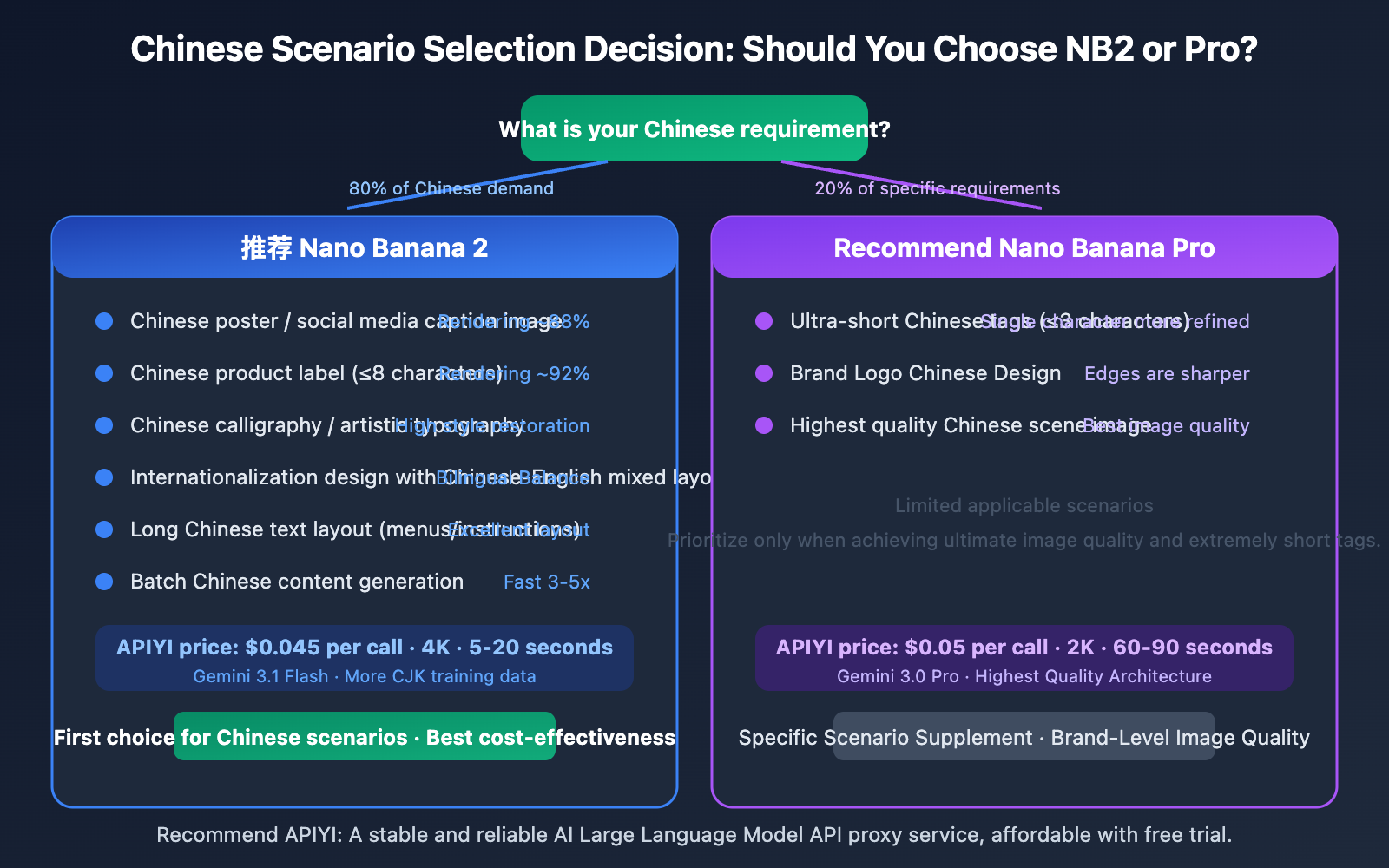
Based on the evaluation results above, here are the model selection recommendations for different Chinese usage scenarios:
| Chinese Usage Scenario | Recommended Model | Reason | APIYI Price |
|---|---|---|---|
| Chinese Posters / Social Media Graphics | NB2 | Stronger Chinese typography capabilities, higher rendering accuracy | $0.045/call |
| Chinese Product Labels | NB2 | ~92% accuracy for labels under 8 characters, high cost-effectiveness | $0.045/call |
| Chinese Calligraphy Art Fonts | NB2 | High fidelity in reproducing calligraphy styles | $0.045/call |
| Bilingual International Posters | NB2 | More balanced resource allocation for Chinese and English | $0.045/call |
| Pure Chinese Short Labels (≤3 characters) | Pro | Slightly higher single-character precision | $0.05/call |
| Premium Brand Logo Chinese Text | Pro | Sharper character edge definition | $0.05/call |
| Highest Quality Chinese Scene Images | Pro | Overall highest image quality | $0.05/call |
| Batch Chinese Asset Generation | NB2 | 3-5x faster speed + 10% lower cost | $0.045/call |
🎯 Selection Advice: For Chinese scenarios, we recommend Nano Banana 2 for over 80% of use cases. It leads comprehensively in Chinese understanding and rendering, while also being faster and more cost-effective. Choose Pro only when you need extreme single-character precision or the absolute highest image quality. We suggest accessing both models through the APIYI platform at apiyi.com and switching flexibly based on your specific scenario.
Frequently Asked Questions
Q1: Which works better, Chinese or English prompts?
Both models support pure Chinese prompt input, but currently, English prompts still yield higher execution accuracy. We recommend using a "Chinese-English hybrid" strategy: use Chinese to describe the mood and style (e.g., "简约素雅" – minimal and elegant, "国潮风" – Chinese trendy style), and use English for technical parameters and specific instructions (e.g., 4K resolution, bold font, centered layout). You can quickly validate the effects of different prompt strategies through APIYI at apiyi.com.
Q2: What to do if Chinese text renders incorrectly?
Three remedial options:
- Regenerate: AI image generation has randomness; running the same prompt again might fix it, costing only $0.045.
- Two-Step Method: First, have the model confirm the text content, then generate the image. This can improve accuracy by 10-15%.
- Post-Processing: Manually correct the erroneous Chinese characters using Photoshop/Canva, suitable for cases with only 1-2 wrong characters.
Through the APIYI platform at apiyi.com, the cost for multiple iterations is extremely low, so we recommend experimenting boldly.
Q3: Which model should I choose for Traditional Chinese scenarios?
For Traditional Chinese scenarios, NB2 is still recommended. Although both models have lower accuracy for Traditional Chinese compared to Simplified (NB2 ~78%, Pro ~75%), NB2's advantage persists. For designs targeting Hong Kong and Taiwan markets, we suggest first generating with Simplified Chinese to confirm the layout, then switching the prompt to Traditional Chinese for regeneration.
Q4: When does Nano Banana 2’s Chinese rendering fall short of Pro?
Pro performs better in three specific scenarios:
- Very short Chinese labels (1-3 characters): Pro handles single-character glyphs with more finesse, suitable for logos and icons.
- Chinese text requiring sharp edges: Pro's glyph edge processing is cleaner, better for brand design.
- Scenarios demanding extremely high overall image quality: If the Chinese text is a minor element in the overall picture, Pro offers higher overall image quality.
Summary
Key findings from the Nano Banana 2 vs Pro Chinese capability comparison:
- NB2's overall Chinese capability surpasses Pro: Benefits from more CJK training data in the Gemini 3.1 architecture and a semantic-level text verification mechanism.
- NB2 leads in Chinese text rendering: ~92% accuracy for up to 8 characters (Pro ~90%), with an even more significant advantage for longer text.
- NB2 is significantly better at Chinese typography and calligraphic styles: Higher fidelity in complex layouts and artistic font styles.
- Pro only has an advantage in very short labels and extreme quality scenarios: NB2 is recommended for over 80% of Chinese text needs.
- 6 techniques can significantly improve results: Control character count, explicitly declare language, use quotes, prioritize bold fonts, prioritize Simplified Chinese, and use the two-step method.
We recommend accessing Nano Banana 2 ($0.045/call) and Pro ($0.05/call) through the APIYI platform at apiyi.com. Conduct comparative tests with your actual Chinese scenarios before deciding; 10 comparison calls cost less than $0.5 total.
📚 References
-
Google Nano Banana 2 Official Documentation: Image generation capabilities and multilingual support details
- Link:
ai.google.dev/gemini-api/docs/image-generation - Description: Complete parameter specifications including text rendering, resolution, and multilingual support
- Link:
-
Google Nano Banana Pro Model Introduction: Technical details of the Nano Banana Pro model released by DeepMind
- Link:
deepmind.google/models/gemini-image/pro/ - Description: Architecture and capabilities of the Pro model
- Link:
-
Nano Banana Text Rendering Optimization Guide: Practical tips for improving text accuracy
- Link:
help.apiyi.com/en/nano-banana-text-rendering-consistency-guide-en.html - Description: Includes 6 optimization methods for Chinese/English rendering and a detailed two-step approach
- Link:
-
APIYI Nano Banana Integration Documentation: Unified invocation methods for both models
- Link:
docs.apiyi.com/en/api-capabilities/nano-banana-2-image - Description: Includes API endpoints, billing, and invocation examples for both NB2 and Pro
- Link:
Author: APIYI Technical Team
Technical Discussion: For more Chinese optimization techniques in AI image generation, visit the APIYI documentation center at docs.apiyi.com