
Author’s note: Alphabet says its first-party model APIs process nearly 32 billion tokens per minute. This article compares Gemini 4 Argon, 3.8 Flash, and 3.5 Flash-Lite using official pricing, independent benchmarks, and cost simulations to help you calculate the “total cost per successful task.”
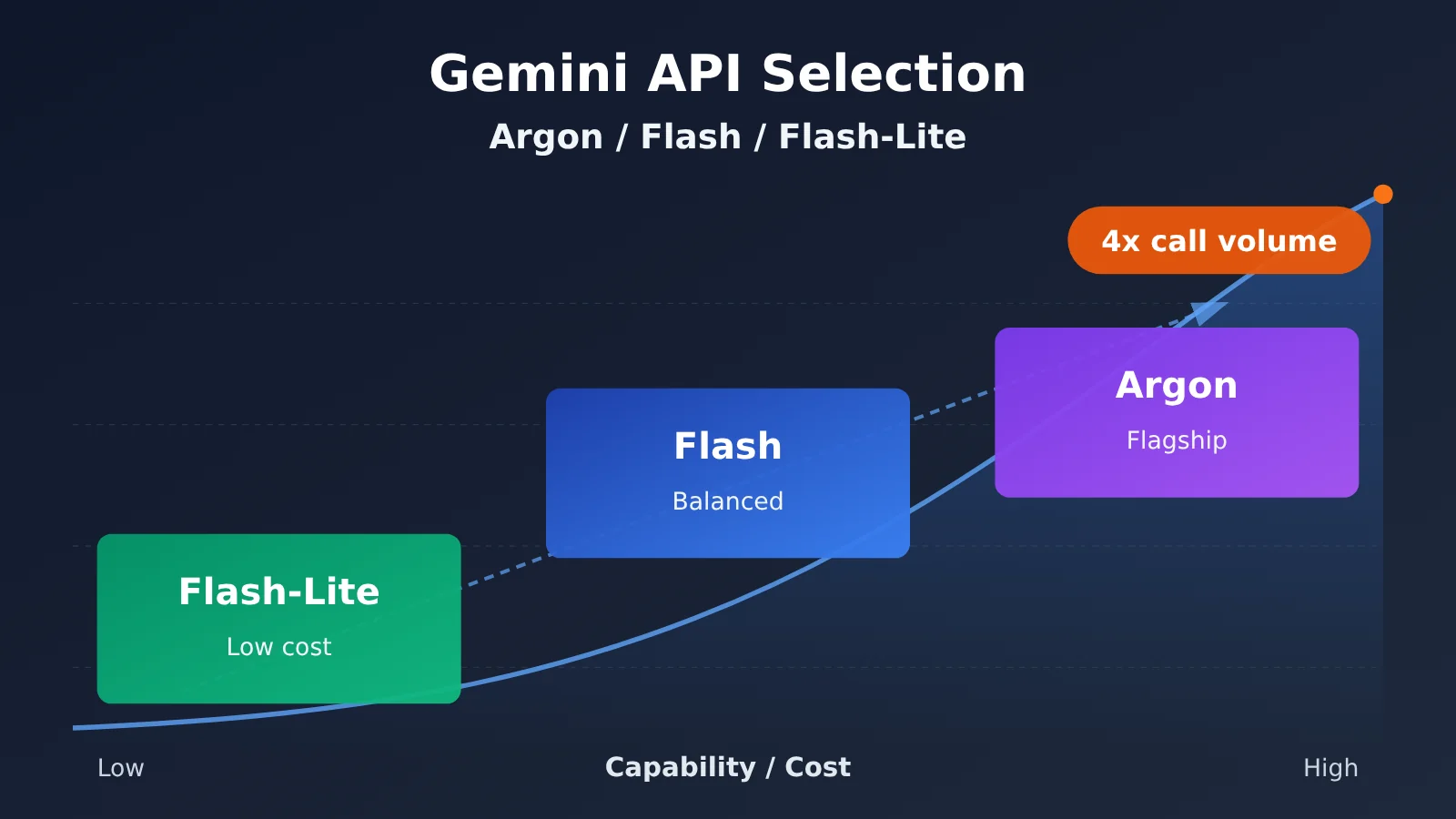
On October 28, 2026, Alphabet CEO Sundar Pichai announced in the company’s third-quarter earnings report that its first-party model APIs now process nearly 32 billion tokens per minute, an increase of more than fourfold year over year. That figure reflects overall developer and enterprise usage of the Gemini API, not the performance of any single model.
This isn’t another article telling you to pick the most powerful model without thinking. As usage grows, so do the consequences of your cost and model-selection decisions. Pick the wrong tier, and your monthly bill could be several times higher. Or, if the model isn’t capable enough, repeated retries could end up costing you more.
What you’ll get: By the end of this article, you’ll understand how Argon, Flash, and Flash-Lite differ in capability, pricing, speed, and use cases. You’ll also get a practical testing method you can follow to make an initial choice for your business.
Gemini API Usage Surges: Key Facts at a Glance
| Item | Details |
|---|---|
| Date | October 28, 2026 (Alphabet’s Q3 2026 earnings report) |
| Announced by | Alphabet CEO Sundar Pichai |
| Key figures | First-party model APIs process nearly 32 billion tokens per minute, up about 40% from the previous quarter’s disclosed figure and more than fourfold year over year |
| Current leading API models | Gemini 4 Argon, Gemini 3.8 Flash, Gemini 3.5 Flash-Lite |
| Who’s affected | All developers and businesses building applications with the Gemini Developer API |
What 32 Billion Tokens per Minute Means for Gemini API Developers
The surge in usage shows that models are being deployed in production at scale, but that doesn’t mean every project needs the most expensive flagship model. When choosing a model, you’ll need to consider task complexity, output quality requirements, request volume, response speed, token consumption, business tolerance for errors, whether you need a long context window and tool calling, and potential future price changes.
One important note: in this article, Flash refers to Gemini 3.8 Flash, and Flash-Lite refers to Gemini 3.5 Flash-Lite. Don’t confuse them with the older Gemini 2.5 Flash series. Also, high global usage doesn’t mean individual developers have unlimited quotas. We’ll cover usage limits separately later in the article.
How Argon, Flash, and Flash-Lite Compare
Google currently offers three model tiers to cover different cost and capability needs. The table below is based on the official model specification pages:
| Feature | Gemini 4 Argon | Gemini 3.8 Flash | Gemini 3.5 Flash-Lite |
|---|---|---|---|
| API ID | gemini-4-argon |
gemini-3.8-flash |
gemini-3.5-flash-lite |
| Official positioning | Flagship reasoning model | Balance of efficiency and capability | Low latency, low cost, high throughput |
| Context window | Approximately 1 million tokens | 1,048,576 input tokens | 1,048,576 input tokens |
| Default output limit | 65,536 tokens (extendable with the long-output mechanism) | 65,536 tokens | 65,536 tokens |
| Thinking levels | low / medium / high, default: medium | low / medium / high, default: medium | minimal / low / medium / high, default: minimal |
| Tool capabilities | Function calling, structured output, Search Grounding, code execution | Function calling, structured output, code execution, file search, Search Grounding | Structured output, function calling, caching |
| Input modalities | Text, images, audio, video, PDF | Text, images, audio, video, PDF | Text, images, audio, video, PDF |
| Free API tier | Not available | Limited free tier | Limited free tier |
What Each Gemini Model Can Handle
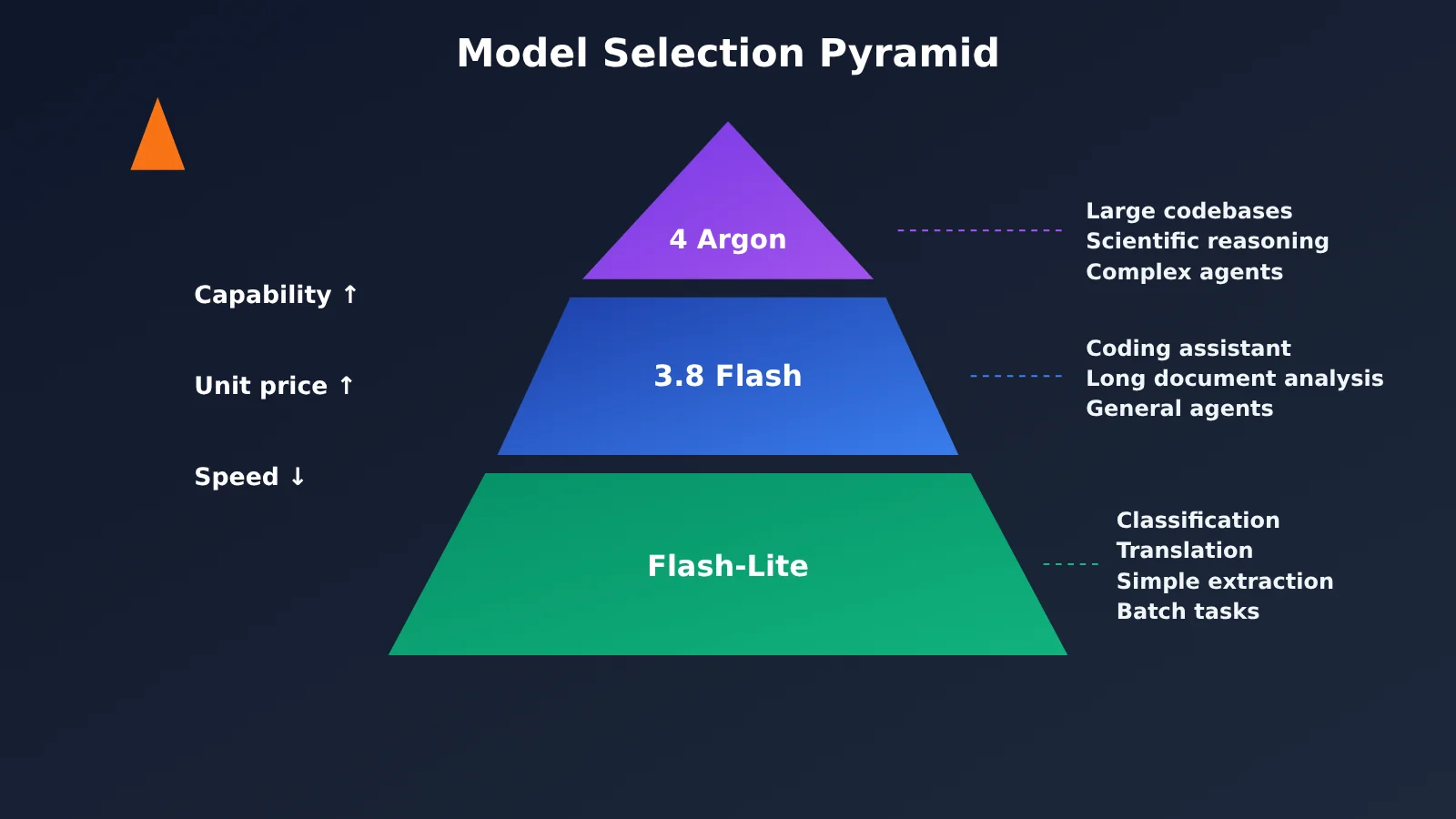
Argon officially launched on October 13, 2026, and is designed primarily for complex software engineering, mathematical and scientific reasoning, autonomous multi-step agents, and long-output generation. Its long-output capability requires a dedicated mechanism and execution configuration—it can’t simply return 1 million tokens in every request.
3.8 Flash has reasoning capabilities of its own; it isn’t a “cheap version that can’t think.” It’s well suited to everyday coding assistance, long-document analysis, content writing, and general agent workflows. Released on July 21, 2026, 3.5 Flash-Lite is optimized for classification, translation, simple extraction, document parsing, and simple subtasks within agents. It can also handle some coding and reasoning tasks. Compared with higher-end models, the main differences are its capability and reliability on complex tasks and its cost-effectiveness.
Official Gemini API Pricing: Argon, Flash, and Flash-Lite Cost Tiers
The following are official prices for the standard paid tier of the Gemini Developer API, in USD per 1 million tokens. They don’t include third-party platform markups, enterprise contracts, or tool invocation fees:
| Model | Input | Output | Cached input | Price validity |
|---|---|---|---|---|
| Gemini 4 Argon (current) | $2.00 | $10.00 | $0.10 | Through 2026-11-30 |
| Gemini 4 Argon (adjusted) | $4.00 | $20.00 | $0.20 | Starting 2026-12-01 |
| Gemini 3.8 Flash (current) | $0.75 | $3.75 | $0.075 | Through 2026-12-31 |
| Gemini 3.8 Flash (adjusted) | $1.50 | $7.50 | $0.15 | Starting 2027-01-01 |
| Gemini 3.5 Flash-Lite | $0.30 | $2.50 | $0.03 | No price-doubling date specified |
At current prices, Argon’s input rate is about 2.67 times Flash’s, Flash’s input rate is 2.5 times Flash-Lite’s, and Argon’s output rate is 4 times Flash-Lite’s. Argon and Flash are both offered at promotional prices, which end on November 30 and December 31, 2026, respectively. Their rates double afterward. For long-term projects, use the adjusted prices when planning your annual budget.
There’s another detail that’s easy to miss: Google bills the model’s internal thinking tokens as output. Your bill depends on more than just the length of the answer users see, and higher thinking levels can significantly increase output costs. If your task doesn’t need a real-time response, you can use the Batch API, which offers input and output rates 50% below standard pricing for all three models. However, its execution mode and queue limits differ from those of real-time requests.
Independent Benchmarks and Speed Comparison for Three Gemini Models
The data below comes from Artificial Analysis, an independent third-party evaluation platform. All scores use Intelligence Index v5.0; no scores from the older v4.x system are included.
| Metric | Gemini 4 Argon (High) | Gemini 3.8 Flash (High) | Gemini 3.5 Flash-Lite |
|---|---|---|---|
| Intelligence Index v5.0 | 50 | 31 | 12 |
| AutomationBench-AA | 78% | 60% | 25% |
| Terminal-Bench 4.0 | 57% | 20% | 1% |
| FrontierCode 2.0 | 26% | 19% | 6% |
| Observed output speed | Just over 80 tokens/sec | Around 120–140 tokens/sec | Just over 400 tokens/sec |
| Access options | Official Google API, APIYI apiyi.com | Official Google API, APIYI | Official Google API, APIYI |
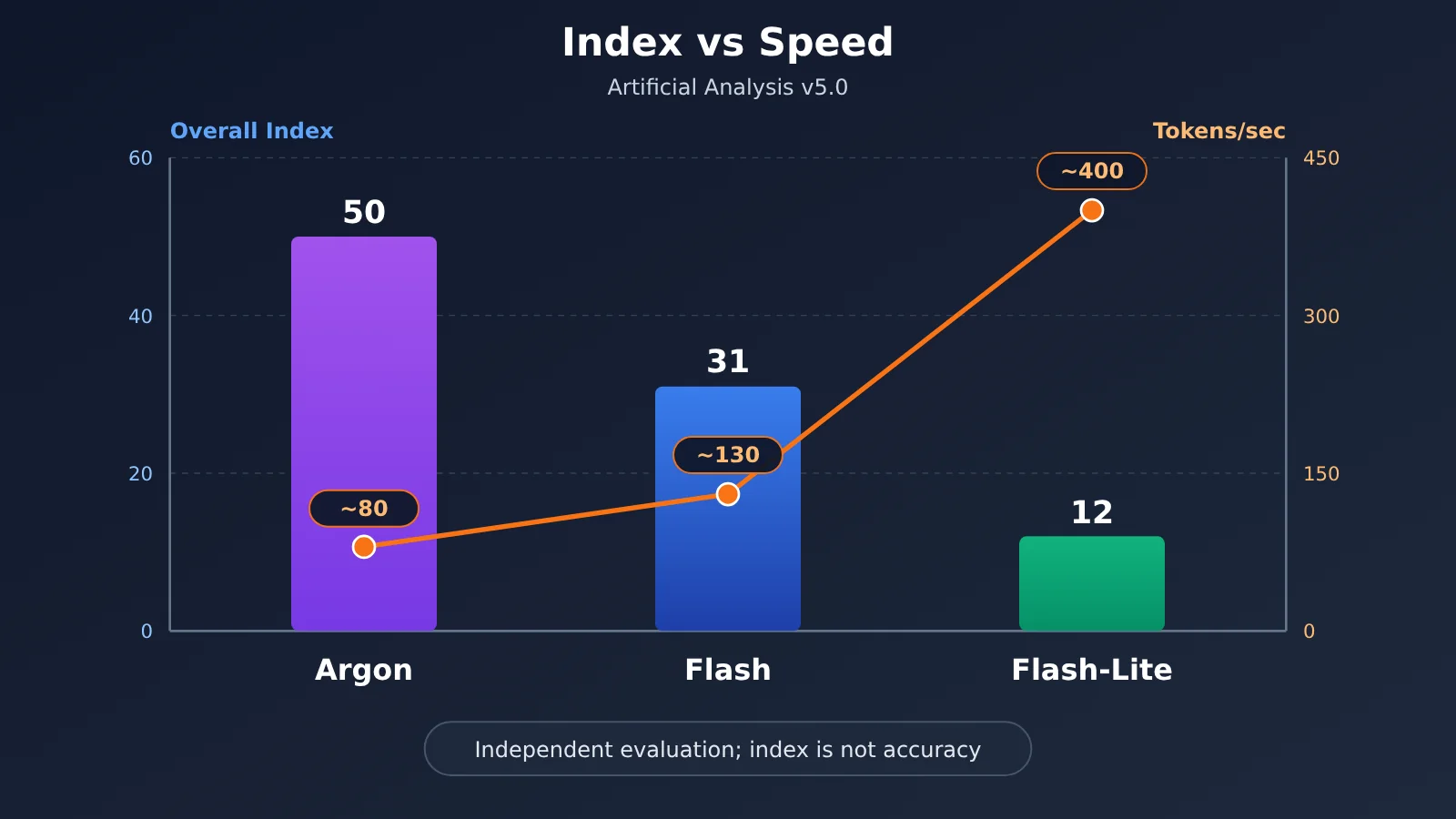
Keep three things in mind when interpreting these results:
- Index scores aren’t accuracy rates: 50, 31, and 12 are scores within the evaluation system. A score of 50 doesn’t mean the model answers 50% of questions correctly.
- There’s a clear gap on complex tasks: Argon leads on complex coding and automation benchmarks, Flash sits in the middle, and Flash-Lite trails. But that doesn’t prove Argon is better at every simple business task. All three models may be good enough for tasks like classification and formatting.
- Speed doesn’t translate directly into total time: Throughput varies with service conditions. Actual completion time also depends on thinking time, time to first token, tool calls, queuing, and network fluctuations.
💡 A note on comparisons: Benchmark scores show the general differences in model capabilities, but performance on your own workloads is what ultimately matters. With APIYI at apiyi.com, you can use the same API key to switch between all three Gemini models and compare them on your own samples.
Gemini API Cost Simulation: How Much Do Argon, Flash, and Flash-Lite Differ?
The figures below are theoretical examples, not actual bills. They assume output tokens include all thinking tokens and exclude caching, search tool, and retry costs. All calculations use standard prices for October 2026:
| Scenario | Gemini 4 Argon | Gemini 3.8 Flash | Gemini 3.5 Flash-Lite |
|---|---|---|---|
| A: 1,000 calls per day, with 5,000 input / 1,000 output tokens per call (daily cost) | $20.00 | $7.50 | $4.00 |
| A: Same usage for 30 consecutive days | About $600 | About $225 | About $120 |
| B: 100,000 classifications, with 1,000 input / 200 output tokens each | $400 | $150 | $80 |
| B using the Batch API instead (half the unit price) | About $200 | About $75 | About $40 |
Scenario B only shows the difference in unit prices for the same token usage. In practice, models vary in their thinking token usage, output length, and number of retries. You can’t assume that $80 of Flash-Lite usage will deliver the same quality as $400 of Argon usage. Also, the costs in the Argon and Flash columns will double once their promotional pricing ends.
Impact Analysis: Why Gemini API Costs Are About More Than Token Prices
Impact on Developers
A model’s “price” has at least three layers. First, there’s the price per token. Second, there’s the number of tokens a task actually consumes, including input, output, thinking, repeated context, and retries. Third, there’s the total cost of completing a task to an acceptable standard, which also includes success rates, human review, retries after failure, completion time, and business losses caused by errors.
If Flash-Lite already meets your business requirements for simple classification, switching to Argon is a waste. On the other hand, if Flash-Lite repeatedly fails at a complex coding task while Argon can complete it with fewer retries, Argon may offer better overall value. This is a conditional model-selection principle, not a statistical finding about the actual success rates of the three models.
Community feedback also illustrates the point. One Reddit user used Argon High for reverse engineering in OpenCode and consumed about 900,000 tokens in a single run without completing the task. That’s one person’s test, not an industry average, but it’s a reminder that complex agent workflows can consume lots of tokens without guaranteeing success. Another user reported quickly hitting usage limits for Argon in a consumer subscription. That’s an experience with the Gemini subscription product, not the same as Developer API limits.
Impact on the Industry
- A tiered, multi-model approach is becoming the default architecture: Google Cloud has already published information about multi-model orchestration and Smart Routing, which reduce enterprise costs by routing tasks to different models.
- Evaluation is shifting from “unit price” to “cost per acceptable task”: The more calls you make, the more important it is to choose models using business-specific test sets rather than leaderboards.
- Budget review cycles are getting shorter: As promotional prices expire, teams need to review their model mix and budgets quarterly.
How Developers Should Choose Between Argon, Flash, and Flash-Lite
These recommendations depend on your use case. No single model is best for every scenario:
- Large-scale data classification (such as sorting 100,000 AI news articles into release, update, pricing, and policy categories): Start with Flash-Lite. Make sure its accuracy and format compliance meet your requirements in sample tests. If they don’t, upgrade to 3.8 Flash.
- Structuring long documents (such as turning financial reports or technical documentation into tables of facts): Start with 3.8 Flash. It has stronger comprehension than Lite and costs less than Argon. Use Argon selectively for tasks like identifying contradictions across documents or handling difficult reasoning.
- Complex coding projects (such as understanding large codebases or performing multistage refactoring): Start with Argon. Both its official positioning and independent coding benchmarks point to stronger performance, but you’ll still need to validate its success rate, tool execution, and cost on real projects.
- High-volume, straightforward translation: Start with Flash-Lite. Highly specialized content, such as legal or medical material, needs additional quality checks. Don’t use it without human review just because it’s inexpensive.
- Enterprise agents: Don’t rely on a single model. Use Flash-Lite for classification, extraction, and format standardization; 3.8 Flash for general planning and multistep workflows; and Argon for difficult reasoning and troubleshooting. This is a recommended engineering strategy, not a Google requirement.
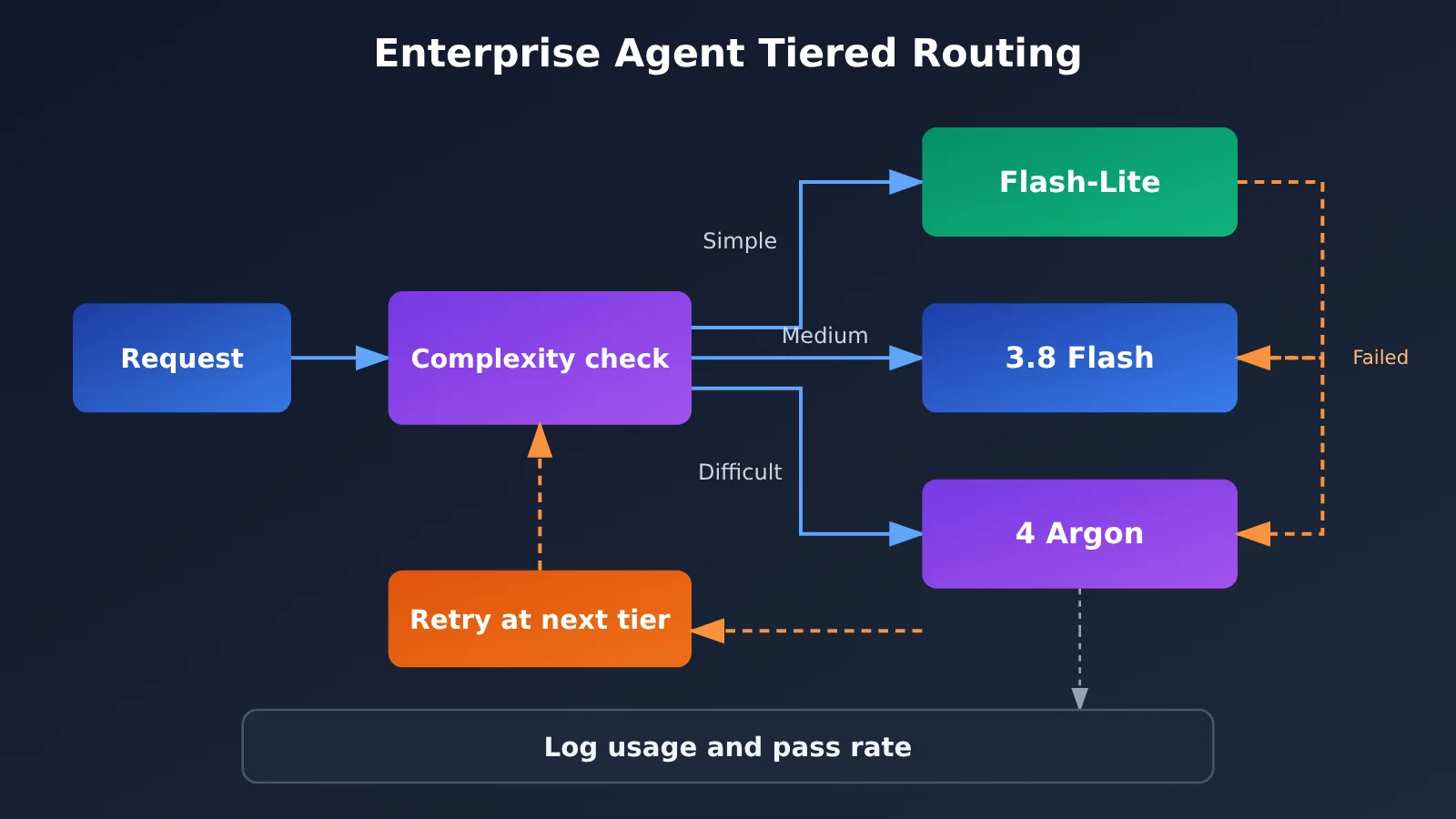
🎯 Choosing a model: The key to tiered routing is being able to switch between the three models at low cost. APIYI apiyi.com offers an OpenAI-compatible interface that lets you switch tiers by changing a single
modelparameter, making it a good fit for small-scale comparison tests.
Quick Start: Call the Three Gemini Models via API
Minimal Example
You can use the OpenAI SDK to call any of the three models. Just change model to switch between Argon, Flash, and Flash-Lite:
from openai import OpenAI

client = OpenAI(
    api_key="YOUR_API_KEY",
    base_url="https://api.apiyi.com/v1"  # APIYI OpenAI-compatible endpoint
)

resp = client.chat.completions.create(
    model="gemini-3.5-flash-lite",
    messages=[{"role": "user", "content": "把这条新闻分类为:模型发布/产品更新/价格变化/行业政策"}]
)
print(resp.choices[0].message.content)
print(resp.usage)  # Use actual billed tokens, not visible character count
View the full tiered routing and cost estimation code
from openai import OpenAI

client = OpenAI(
    api_key="YOUR_API_KEY",
    base_url="https://api.apiyi.com/v1"
)

# Official Google standard pricing (USD per 1 million tokens, October 2026), for estimation only
PRICE = {
    "gemini-3.5-flash-lite": (0.30, 2.50),
    "gemini-3.8-flash": (0.75, 3.75),    # Doubles starting 2027-01-01
    "gemini-4-argon": (2.00, 10.00),     # Doubles starting 2026-12-01
}
TIERS = ["gemini-3.5-flash-lite", "gemini-3.8-flash", "gemini-4-argon"]

def estimate_cost(model: str, usage) -> float:
    pin, pout = PRICE[model]
    # completion_tokens should include thinking tokens; check the returned fields
    return usage.prompt_tokens / 1e6 * pin + usage.completion_tokens / 1e6 * pout

def run(prompt: str, start_tier: int = 0, validator=None):
    """Start with a lower-tier model, upgrade if it fails validation, and record each cost."""
    total = 0.0
    for model in TIERS[start_tier:]:
        resp = client.chat.completions.create(
            model=model,
            messages=[{"role": "user", "content": prompt}],
        )
        text = resp.choices[0].message.content
        cost = estimate_cost(model, resp.usage)
        total += cost
        print(f"{model}: tokens={resp.usage.total_tokens}, cost≈${cost:.5f}")
        if validator is None or validator(text):
            return {"model": model, "output": text, "total_cost": total}
    return {"model": None, "output": None, "total_cost": total}

result = run(
    "从以下文本抽取公司名和金额,输出JSON:...",
    validator=lambda t: t.strip().startswith("{"),
)
print(result)
🚀 Quick start: Claim the free testing credits for new users at APIYI apiyi.com, then run 100–300 representative samples through all three model tiers before choosing a default tier for production. Third-party platforms may differ from direct Google access in pricing, credits, and cache support, so check the platform’s actual terms.
Deployment Considerations Before Launching with the Gemini API
- Rate limits: The Gemini API enforces RPM, TPM, and RPD limits per project, not per API key. Exceeding any one of them will result in an error.
- Thinking tokens: Output pricing includes thinking tokens. Check the usage metadata instead of estimating costs from the visible response length.
- Caching: Argon supports implicit caching only, not explicit caching. Flash and Flash-Lite support caching, with billing depending on the configuration.
- Free-tier data: Free-tier data may be used to improve products. Don’t put sensitive enterprise data on the free tier, and check the terms of service before going live.
- Testing metrics: Record success rate, factual accuracy, structured-output compliance rate, hallucination count, average and tail latency, actual token usage, retry count, and cost per successful task. Default thinking levels vary, so document the configuration you used in your report.
Gemini API Model Selection FAQ
Q1: What are Gemini 4 Argon, 3.8 Flash, and 3.5 Flash-Lite?
These are the three main tiers in Google’s current Gemini API lineup: Argon is the flagship reasoning model, 3.8 Flash balances capability and efficiency, and 3.5 Flash-Lite is designed for low latency, low cost, and high throughput. All three support an input context window of around one million tokens and produce text output.
Q2: When does promotional pricing for Argon and Flash end?
Argon’s current pricing runs through November 30, 2026. Input, output, and cache rates will all double starting December 1. Pricing for 3.8 Flash runs through December 31, 2026, and doubles starting January 1, 2027. Google hasn’t listed a similar price increase date for Flash-Lite.
Q3: Does a score of 50 on Artificial Analysis mean the model gets 50% of answers right?
No. The scores of 50, 31, and 12 are composite scores on the Intelligence Index v5.0, not accuracy percentages. They’re useful for comparing the approximate performance gap between models, but you can’t directly convert them into a success rate for your own use case.
Q4: How can I compare the three Gemini models at a low cost?
We recommend using an OpenAI-compatible API that supports multiple models. Sign up at APIYI apiyi.com to get an API key and free credits, then replace `model` in the examples in this article with each of the three API IDs. Run them against the same set of samples and record usage and the pass rate.
Q5: Reddit users say they run out of Argon quota after a few rounds. Does the same happen with the API?
That feedback refers to the Gemini consumer subscription product, not the Developer API’s limits. API quotas depend on your billing tier, project status, and model, and are measured in RPM, TPM, and RPD. When calling models through an aggregation platform, the platform’s own quota rules also apply. You can check which models are available and how they’re billed in the APIYI apiyi.com console.
Q6: What are the known limitations of each model?
Argon has the highest per-token cost and is the slowest. It has no standard free tier, and complex agent tasks can consume a lot of tokens. On the most difficult terminal and coding benchmarks, 3.8 Flash falls noticeably behind Argon. Flash-Lite is weaker at complex coding and automation tasks, and translations in specialized fields need human review.
Gemini API Selection: Key Takeaways
- News context: Google’s first-party model APIs are processing nearly 32 billion tokens per minute. That’s growth across the platform, not the achievement of a single model.
- Three model tiers: Argon handles complex reasoning, 3.8 Flash is the balanced workhorse, and Flash-Lite handles high-throughput, lightweight tasks.
- Pricing tiers: Current input prices are $2 / $0.75 / $0.30. Argon and Flash prices will double when their promotional rates expire.
- Interpreting benchmarks: The AA v5.0 scores are 50 / 31 / 12. These are index scores, not accuracy rates, and the gap may not be as noticeable on simple tasks.
- Hidden costs: Thinking tokens count as output. Along with caching, retries, and tool fees, they determine your final bill.
- Getting started: Use a single key with APIYI apiyi.com to switch between all three model tiers, then run a comparison test with 100–300 samples.
Summary
The surge in Gemini API usage shows that Large Language Models have entered the era of production at scale, but the core questions around model selection haven’t changed:
- Match the tier to the task: Try Flash-Lite first for classification and translation, 3.8 Flash for document structuring, and Argon for complex coding and demanding agent tasks.
- Focus on cost per successful task: Optimize for the total cost of completing a task successfully, not the lowest price per million tokens.
- Watch the pricing deadlines: Argon’s promotional pricing ends on November 30, and Flash’s ends on December 31. Base your budget on the adjusted prices.
What developers really need isn’t always the most powerful or the cheapest model—it’s a combination of models that can reliably handle business tasks at an acceptable cost. Start by using the free credits through APIYI apiyi.com to compare all three tiers, then decide on your production routing strategy.
📚 References
- Alphabet Q3 2026 Earnings: CEO Remarks: Source for the 32 billion tokens-per-minute figure
- Link:
blog.google/company-news/inside-google/message-ceo/alphabet-earnings-q3-2026/ -
Details: News background and the original disclosure of API usage growth
-
Official Gemini API Pricing: Standard, cache, and Batch pricing for all three models
- Link:
ai.google.dev/gemini-api/docs/pricing -
Details: Includes promotional pricing deadlines and thinking token billing
-
Gemini Model Specifications: Argon / 3.8 Flash / 3.5 Flash-Lite
- Link:
ai.google.dev/gemini-api/docs/models/gemini-4-argon -
Details: Context windows, output limits, thinking levels, and tool capabilities
-
Artificial Analysis Model Comparison: Independent third-party evaluation v5.0
- Link:
artificialanalysis.ai/models/comparisons/gemini-4-argon-vs-gemini-3-8-flash -
Details: Overall index, specialized benchmarks, and observed speeds
-
Gemini API Rate Limits and Thinking: RPM/TPM/RPD and thinking configuration
- Link:
ai.google.dev/gemini-api/docs/rate-limits -
Details: Essential reading on quotas and thinking token rules before going live
-
Google Cloud Multi-Model Orchestration: Smart Routing and agent cost management
- Link:
cloud.google.com/blog/products/ai-machine-learning/welcome-to-gemini-at-work-2026 - Details: Google’s approach to tiered routing for enterprises
Author: APIYI Technical Team
Get in touch: Contact us through the APIYI homepage for technical discussions, or visit the documentation center at docs.apiyi.com for more integration resources.