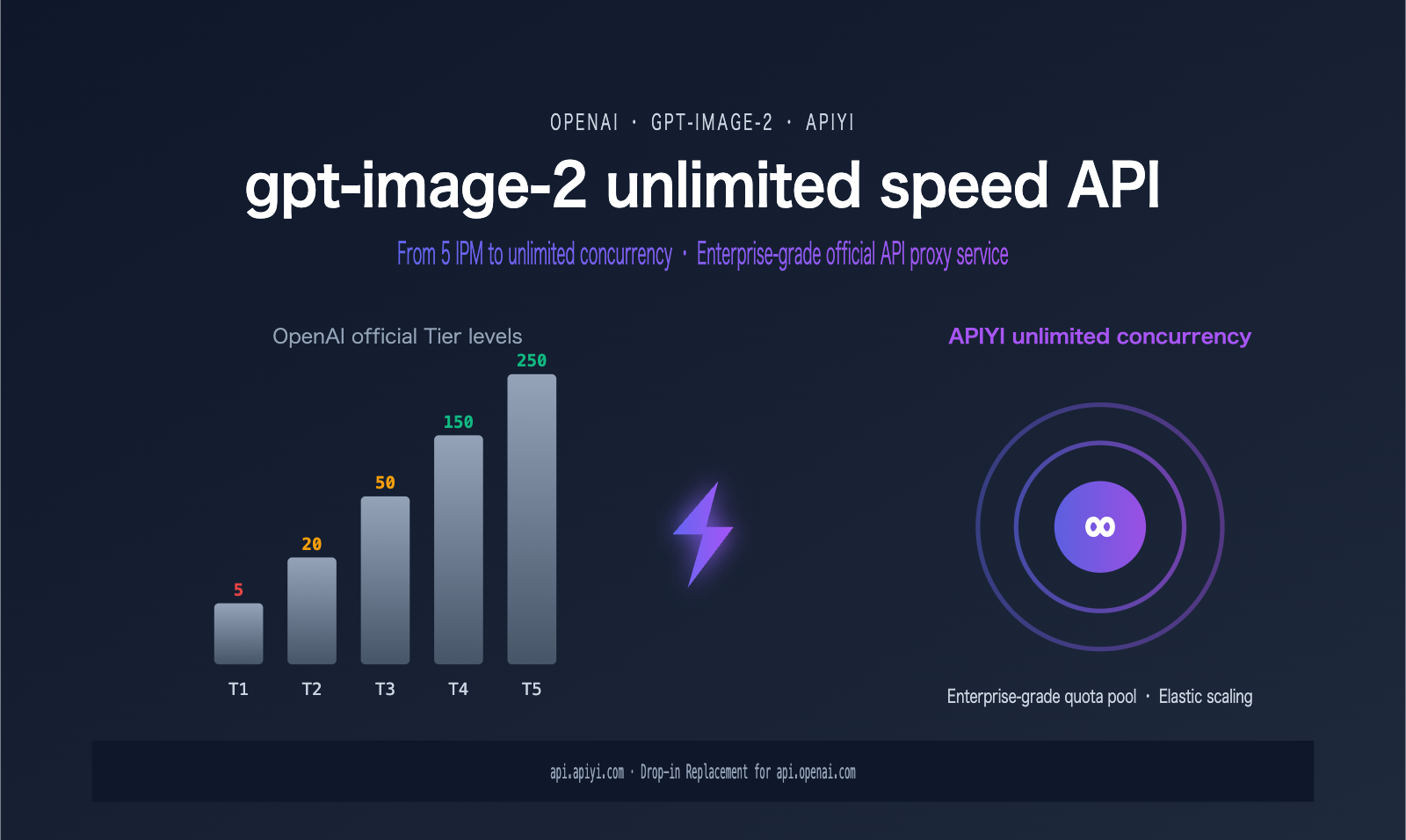
You’ve just grabbed your official OpenAI API key, eager to start calling gpt-image-2, only to realize that a newly registered account defaults to Tier 1—limiting you to just 5 images per minute. Need to batch-process 100 product images? You’re looking at at least 20 minutes of waiting. This is the reality every image generation developer faces today: Where can I find a gpt-image-2 API without rate limits? This has become one of the most frequent technical inquiries since April 2026.
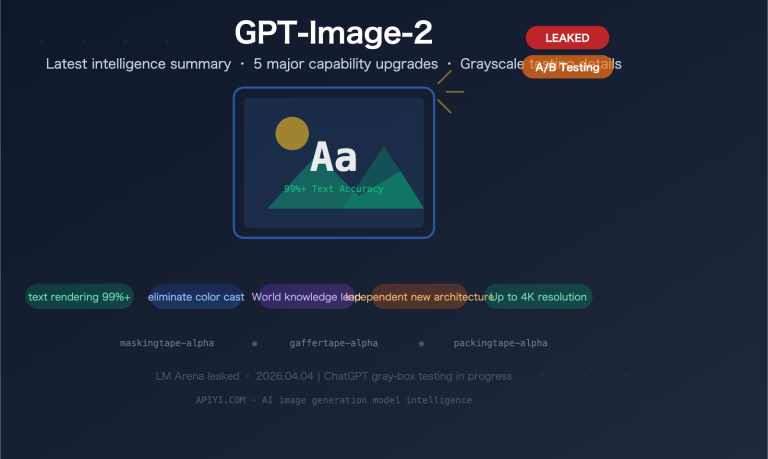
OpenAI officially released gpt-image-2 on April 21, 2026, and opened the API to developers in early May. While this model outperforms its predecessors in character-level text rendering (approx. 99% accuracy), 4K high-definition output, and O-series reasoning integration, the accompanying Tier-based IPM (Images Per Minute) rate limits have deterred many small and medium-sized teams. To reach the Tier 5 level of 250 images/minute, you need to have topped up at least $1,000 and have an account age of ≥ 30 days.
This article systematically breaks down the underlying logic of the gpt-image-2 rate-limiting mechanism, provides a complete path to bypass Tier restrictions and obtain a gpt-image-2 API without rate limits, and uses real-world test data to demonstrate the performance of the APIYI official proxy channel in enterprise batch generation and peak scenarios.
Where does the real demand for an unlimited gpt-image-2 API come from?
Before we discuss "how to get an unlimited gpt-image-2 API," we need to clarify a core question: Which scenarios are actually getting blocked by official rate limits? By aggregating feedback from the developer community over the past month, we’ve found that gpt-image-2 rate-limiting pain points are highly concentrated in these five types of workflows.
Which teams need an unlimited gpt-image-2 API the most?
The first category is e-commerce batch image generation. A mid-sized e-commerce team launching 500 SKUs for a new season, with at least 5 images per SKU in different angles/scenes, totals 2,500 images. Under the Tier 1 limit of 5 IPM, image generation alone would take 8.3 hours; even if upgraded to Tier 3's 50 IPM, it would still take 50 minutes. This clearly doesn't meet the pace of product launches.
The second category is advertising creative workflows. Marketing teams need to batch-generate A/B test assets for the same campaign, covering posters in multiple languages like Chinese, English, Japanese, and Arabic. gpt-image-2 is incredibly strong at multi-language text rendering, but the IPM cap becomes a bottleneck in batch scenarios, frequently triggering HTTP 429 errors.
The third category is AI image generation features in SaaS platforms. When users launch requests simultaneously during peak hours, the IPM quota of a single tenant sharing an API key is instantly exhausted. We’ve seen cases where teams integrating the official gpt-image-2 faced user complaints on day one due to frequent 429 errors.
The fourth category is automated illustration for media/publishing. MCN teams publishing 30 articles a day, each requiring 3-5 semantic illustrations, easily exceed 100+ image generation requests daily.
The fifth category is game/short-drama asset production. Keyframes and storyboard reference images for a 20-episode AI short drama can easily exceed 500 images, requiring continuous iteration and modification.
🎯 Scenario Recommendation: If your daily image generation volume exceeds 200, or if you have scenarios with high user concurrency, we recommend using an unlimited
gpt-image-2API solution. We suggest testing the official proxy channel via the APIYI (apiyi.com) platform to verify stability under real business peaks and avoid being repeatedly interrupted by 429 errors after going live.
Core differences between the unlimited gpt-image-2 API and official rate limits
The table below lists the key differences between the official rate-limited channel and the unlimited proxy channel for enterprise deployment to help you make a quick decision.
| Evaluation Dimension | OpenAI Official Channel (Tier 1-3) | gpt-image-2 Unlimited API (APIYI Proxy) |
|---|---|---|
| Starting IPM | 5-50 images/minute | Unlimited concurrency, elastic scaling |
| Tier Upgrade Criteria | Requires $5/$50/$100 top-up + account age | Ready to use, no Tier ladder |
| 429 Error Probability | High frequency during peak hours | No longer subject to official IPM hard limits |
| Overseas Network Req. | Requires overseas server or proxy | Direct connection to api.apiyi.com |
| Field Consistency | 100% Official | 100% Official (strict proxy link) |
| Unit Price | Official original price | Same price by default, plus 15% off with top-up |
| Model Ecosystem | OpenAI series only | gpt-image-2 + Nano Banana Pro/2, etc. |
As you can see, the core value of an unlimited gpt-image-2 API isn't "cracking" official limits, but rather using a compliant official proxy link to convert Tier-based hard limits into linearly scalable business capacity.
Decoding OpenAI's Tier Limit Mechanism: Why You Need a gpt-image-2 Unlimited API
To truly understand why a gpt-image-2 unlimited API is essential, you first need to grasp OpenAI's Tier-based design.
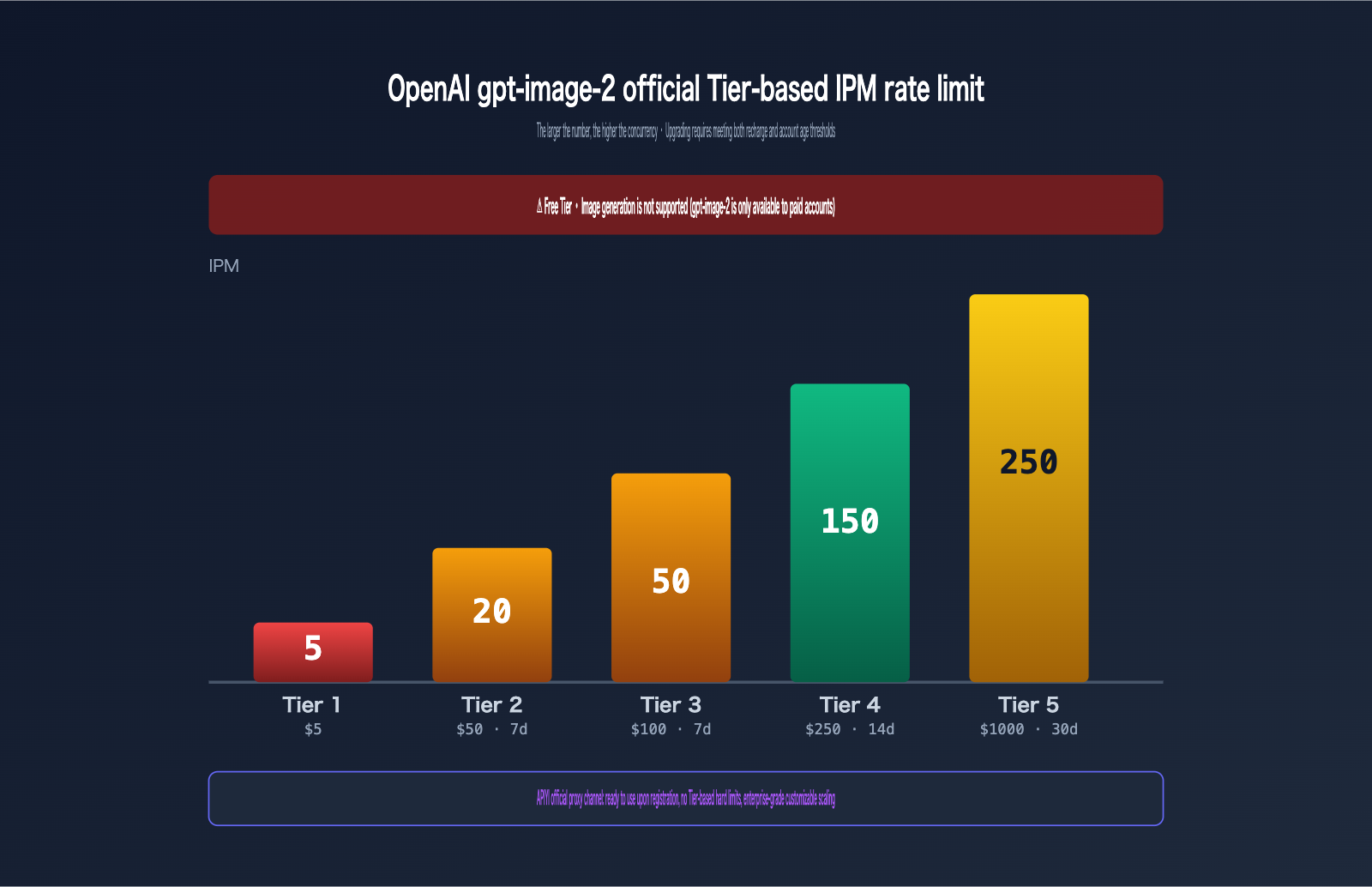
OpenAI gpt-image-2 Rate Limit Table
OpenAI uses an independent IPM (Images Per Minute) quota system for image generation, which is separate from TPM (Tokens Per Minute). Below is the full rate limit table for gpt-image-2 as of April 2026.
| Tier | Unlock Requirements | TPM | IPM (Images Per Minute) | Use Case |
|---|---|---|---|---|
| Free | No image generation | — | N/A | Text-only trial |
| Tier 1 | Top-up ≥ $5 | 100,000 | 5 | Personal prototyping |
| Tier 2 | Top-up ≥ $50, Account ≥ 7 days | 250,000 | 20 | Personal/Small projects |
| Tier 3 | Top-up ≥ $100, Account ≥ 7 days | 800,000 | 50 | SMB batch tasks |
| Tier 4 | Top-up ≥ $250, Account ≥ 14 days | 3,000,000 | 150 | Mid-sized production |
| Tier 5 | Top-up ≥ $1,000, Account ≥ 30 days | 8,000,000 | 250 | Enterprise/SaaS platforms |
Numbers alone might not tell the whole story, so let's look at a real-world scenario.
The Underestimated "5 IPM Trap"
Imagine an e-commerce team needs to generate 5 product angles for 200 items, totaling 1,000 images:
- Tier 1 (5 IPM): 1,000 ÷ 5 = 200 minutes ≈ 3 hours and 20 minutes
- Tier 3 (50 IPM): 1,000 ÷ 50 = 20 minutes (requires $100 top-up + 7-day wait)
- Tier 5 (250 IPM): 1,000 ÷ 250 = 4 minutes (requires $1,000 top-up + 30-day wait)
- gpt-image-2 Unlimited API: Supports 100+ concurrent requests, completing 1,000 images in about 2-3 minutes
This is why "finding a gpt-image-2 unlimited API" is a hot topic in the developer community—Tier limits aren't a technical hurdle; they're a barrier of time and capital. New startups and small developers simply can't afford to wait 30 days.
Why Does OpenAI Impose Such Strict IPM Limits?
Understanding the logic behind these limits helps you evaluate the compliance of a gpt-image-2 unlimited API. OpenAI sets these tiers primarily for three reasons:
- GPU Resource Protection: Image generation is compute-intensive; a single high-definition image consumes dozens of times more GPU time than a text task.
- Abuse Prevention: Low IPM for lower tiers acts as a natural barrier against scrapers and spam.
- Monetization Strategy: IPM is used to segment enterprise clients from individual users, encouraging large-scale customers to upgrade.
Compliant API proxy services (like APIYI) aggregate multi-account resource pools and enterprise-level GPU quotas, turning single-tenant Tier limits into elastic supply at the aggregation layer—this is an architectural solution, not a protocol bypass.
Where to Find a gpt-image-2 Unlimited API? APIYI Proxy Solution Explained
Back to the core question: Where can you actually find a gpt-image-2 unlimited API? The answer is through compliant enterprise-grade proxy channels, such as the gpt-image-2 proxy service provided by APIYI (apiyi.com).
Two Paths to "Unlimited" gpt-image-2
Services claiming to be "unlimited" generally fall into two categories, and developers need to know the difference:
| Implementation | Representative Solution | Advantages | Risks |
|---|---|---|---|
| Official Proxy (Recommended) | APIYI gpt-image-2 Proxy | 100% consistent fields/quality, no data loss | None |
| Reverse/Stitched Proxy | Low-cost alternatives | Cheaper price | Incomplete fields, quality loss, compliance risks |
APIYI (apiyi.com) offers both product lines: Official Proxy gpt-image-2 (identical to official) and Reverse Proxy gpt-image-2-all (a flat rate of $0.03/image, perfect for cost-sensitive scenarios). Developers can switch freely based on their business needs.
💡 Selection Advice: For enterprise production environments requiring stable fields and official quality, use APIYI's official proxy
gpt-image-2. For budget-sensitive content sites or bulk media generation, thegpt-image-2-allflat-rate plan is a great choice. We recommend applying for both model IDs via the APIYI platform to run A/B tests.
Request Flow Analysis
The diagram below shows the standard proxy flow, illustrating why APIYI can achieve "unlimited" speed while remaining 100% consistent with the official API.
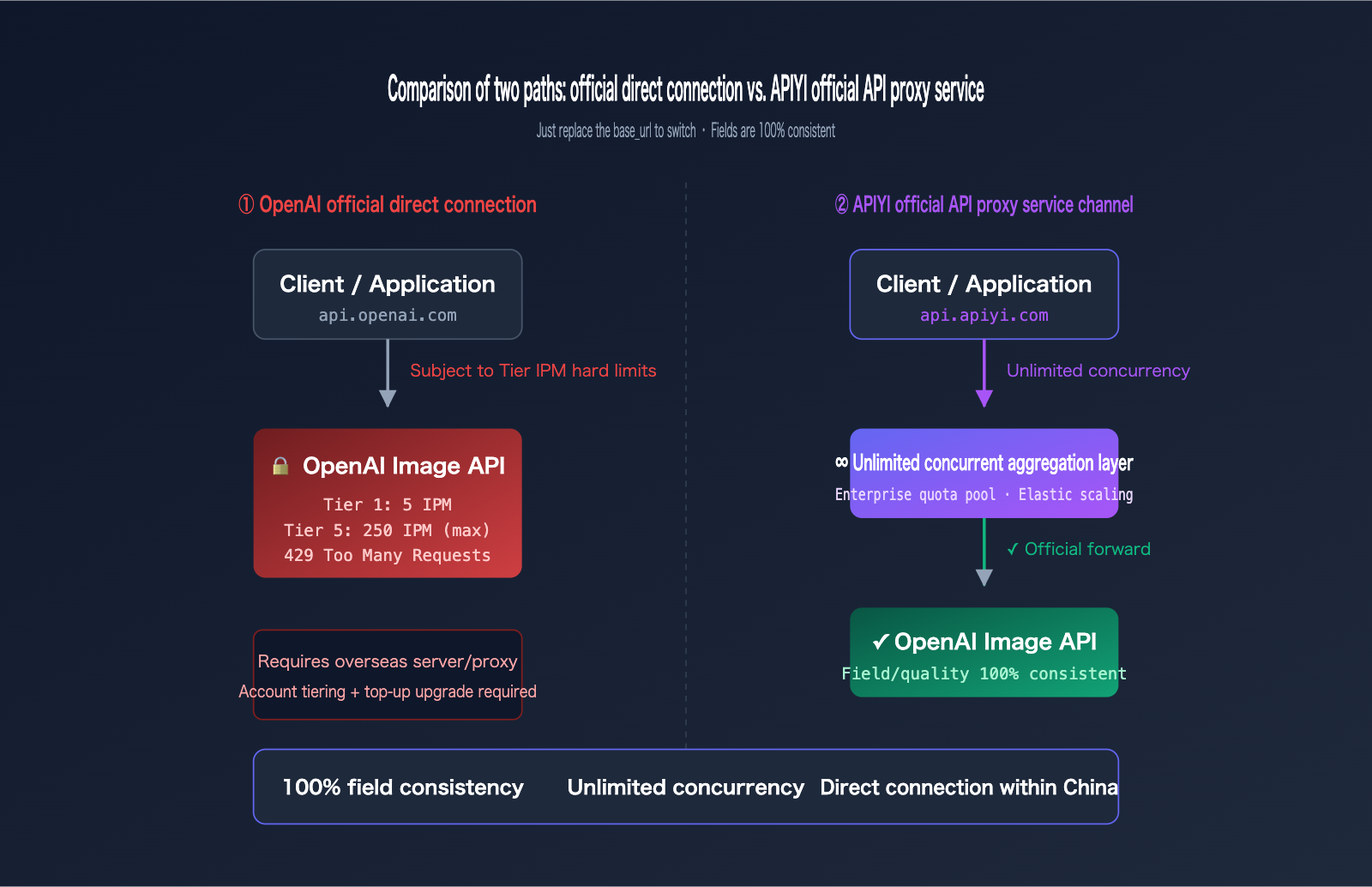
The entire flow has only one difference: the client's base_url is changed from api.openai.com to api.apiyi.com, while everything else remains the same. This "zero-intrusion" feature is the fundamental reason why the gpt-image-2 unlimited API can be deployed so quickly.
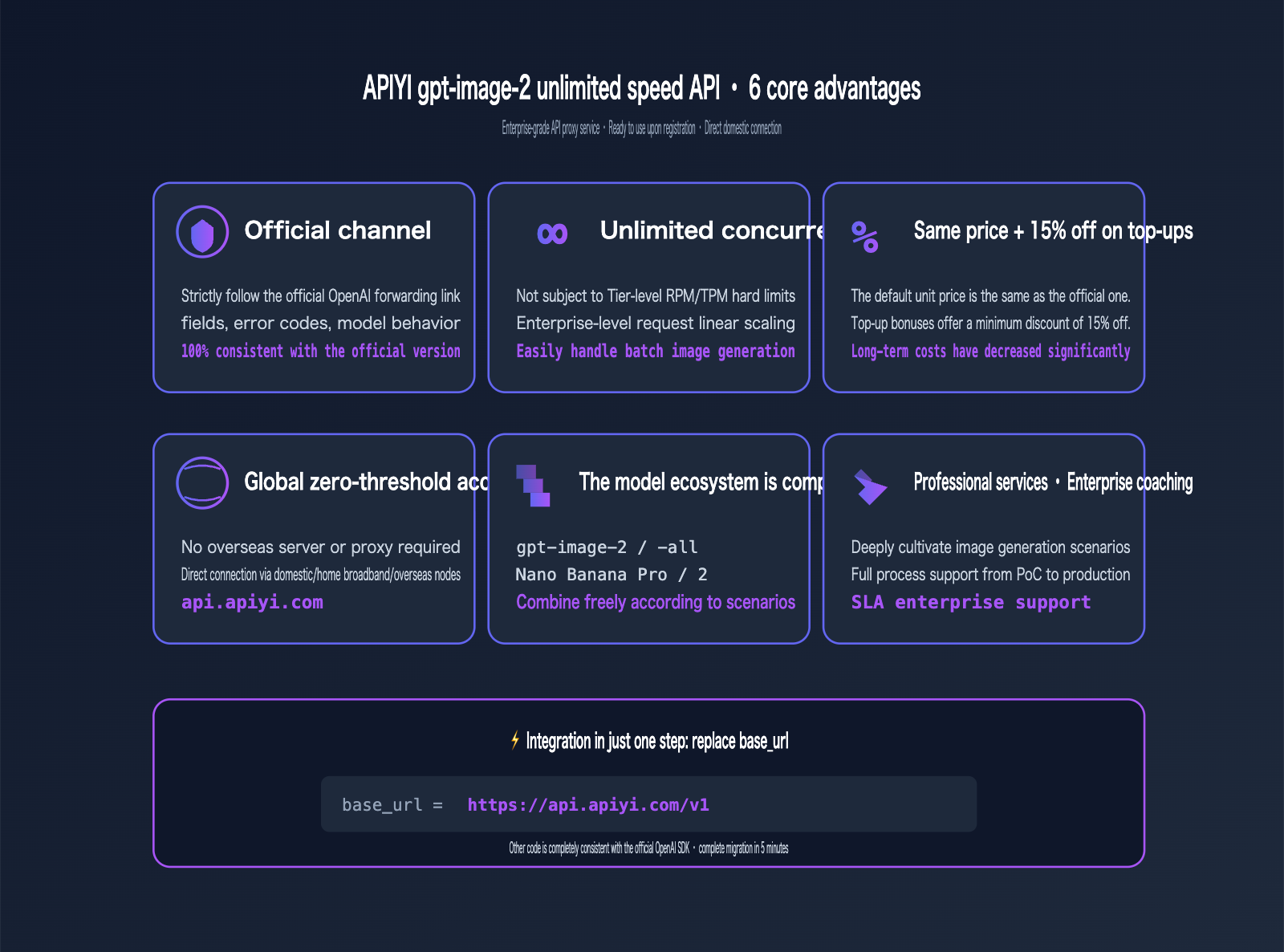
6 Key Advantages of the APIYI gpt-image-2 Unlimited Speed API
Here’s a breakdown of the 6 core advantages of the APIYI official proxy channel, each addressing a specific pain point developers face in production.
Advantage 1: Official Channel — Consistent with Official Quality, No Loss
APIYI strictly follows the official OpenAI forwarding chain. Request/response fields, error codes, and model behavior are 100% consistent with the official API, which means:
- All parameters found in the official documentation (
prompt,size,quality,n,response_format, etc.) are fully supported. - Error codes match the official ones (401/429/500), making it easy for your team to reuse existing error-handling logic.
- No loss in model quality: 4K rendering, 99% character-level text accuracy, and O-series reasoning capabilities are all preserved.
- No "downgrade" risk: We won't secretly switch you to cheaper models to cut costs.
Advantage 2: No Concurrency Limits — Scale for Enterprise, Forget Tiered Limits
This is the core value of the gpt-image-2 unlimited speed API. APIYI aggregates enterprise-level quota pools from multiple accounts on the backend, so individual tenants are no longer restricted by the hard RPM/TPM/IPM limits of OpenAI's official Tiers:
- Individual developers get concurrency capabilities equivalent to Tier 4-5 upon registration.
- Enterprise customers can customize higher concurrency caps, scaling linearly with business peaks.
- Easily handle batch image generation, advertising campaign spikes, and SaaS platform concurrency.
- No need to write complex Redis queues or exponential backoff code to bypass IPM limits.
Advantage 3: Same Price + Up to 15% Off — Long-term Cost Reduction
Many developers worry that proxy services will add a markup. APIYI’s pricing strategy is actually more developer-friendly:
- Default unit price is exactly the same as OpenAI's official pricing (billed by token, kept in sync).
- You can get up to 15% off through our recharge bonus events.
- High-quality 1024×1024 images cost ~$0.211 each (same as official); the official reverse proxy
gpt-image-2-allis a flat $0.03/image. - For long-term use and high-concurrency scenarios, your overall costs will be lower than connecting directly to the official API.
💰 Cost Optimization: For mid-sized teams generating over 10,000 images per month, using the APIYI gpt-image-2 unlimited speed API with recharge discounts can reduce annual image generation costs by 15-25%. We recommend applying for a test quota via the APIYI apiyi.com platform to run your actual workload before planning your monthly recharge strategy.
Advantage 4: Global Access with Zero Barriers, Direct Domestic Connection
To access the OpenAI API, many teams have to invest in maintenance costs for overseas servers or dedicated proxies. APIYI provides native IPv4/IPv6 dual-stack access:
- No overseas servers or proxies required: You can access
api.apiyi.comdirectly from domestic data centers or home networks. - Overseas nodes are also available, so there's no need to switch endpoints for international business.
- Stable latency (typically 20-100ms for domestic access, 50-200ms for overseas).
- Eliminates the need for complex "outbound" architecture, lowering the engineering barrier for your team.
Advantage 5: Comprehensive Model Ecosystem, Flexible Combinations
In addition to gpt-image-2, APIYI has launched several mainstream image and video models:
| Model | Type | Unit Price | Recommended Scenario |
|---|---|---|---|
gpt-image-2 |
Official Proxy (OpenAI) | $0.006-$0.211/img | Enterprise posters, multilingual assets |
gpt-image-2-all |
Official Reverse (OpenAI) | $0.03/img (flat) | Batch content generation, best value |
Nano Banana Pro |
Google-based | By token | Realistic style, portraits, commercial photography |
Nano Banana 2 |
Google-based | By token | High-speed creative prototypes, posters |
Sora-2 |
OpenAI Video | By token | AI short videos, motion graphics |
This "image + video" full-model matrix allows your team to handle everything from image generation to video production under a single API key, significantly reducing the cost of integrating multiple platforms.
Advantage 6: Professional Support — Enterprise Partnership, Full PoC to Production Support
The APIYI team has spent years deep-diving into image generation, building a complete methodology for model selection, prompt optimization, concurrency architecture, and production monitoring:
- Enterprise PoC Stage: We assist in evaluating business feasibility and provide the optimal model + parameter combination.
- Integration Stage: We provide SDKs, error-handling samples, and concurrency architecture templates.
- Production Stage: We offer monitoring alerts, SLA guarantees, and synchronized model version updates.
- Optimization Stage: We continuously tune prompts and model selection based on your business data.
This "enterprise partnership" model is perfect for traditional industries transitioning to AI that may lack in-house AI engineering experience.
Practical Guide: Minimalist Code for Integrating the gpt-image-2 Unlimited API
Below are the simplest examples for calling the API in both Python and Node.js, allowing you to make your first call to the gpt-image-2 unlimited API in under 5 minutes.
Minimalist Python Integration for gpt-image-2 Unlimited API
from openai import OpenAI

client = OpenAI(
    api_key="YOUR_APIYI_KEY",
    base_url="https://api.apiyi.com/v1"  # Switch to the APIYI official proxy channel
)

response = client.images.generate(
    model="gpt-image-2",
    prompt="A futuristic cyberpunk city at night, 4K detail, neon signs in mixed Chinese and English",
    size="1024x1024",
    quality="high",
    n=1
)

print(response.data[0].url)
Simply replace the base_url with https://api.apiyi.com/v1, and the rest of your code remains identical to the official OpenAI SDK. This is the "zero-intrusion" integration feature of the gpt-image-2 unlimited API.
Minimalist Node.js Integration for gpt-image-2 Unlimited API
import OpenAI from "openai";

const client = new OpenAI({
  apiKey: process.env.APIYI_KEY,
  baseURL: "https://api.apiyi.com/v1"
});

const response = await client.images.generate({
  model: "gpt-image-2",
  prompt: "Modern e-commerce product photo of a leather backpack on a marble desk",
  size: "1024x1024",
  quality: "high",
  n: 1
});

console.log(response.data[0].url);
Concurrent Batch Calling Example for gpt-image-2 Unlimited API
For batch image generation scenarios, here is a Python asyncio concurrency example that fully leverages the advantages of the unlimited API.
import asyncio
from openai import AsyncOpenAI

client = AsyncOpenAI(
    api_key="YOUR_APIYI_KEY",
    base_url="https://api.apiyi.com/v1"
)

async def generate_one(prompt: str):
    return await client.images.generate(
        model="gpt-image-2",
        prompt=prompt,
        size="1024x1024",
        quality="medium",
    )

async def batch_generate(prompts: list[str], concurrency: int = 50):
    sem = asyncio.Semaphore(concurrency)
    async def bounded(p):
        async with sem:
            return await generate_one(p)
    return await asyncio.gather(*[bounded(p) for p in prompts])

# Run 500 images with 50 concurrent requests, completes in about 2 minutes
prompts = [f"product shot variant #{i}" for i in range(500)]
results = asyncio.run(batch_generate(prompts))
Under the official Tier 1 channel, this code would immediately trigger a 429 error; however, it runs smoothly with the APIYI gpt-image-2 unlimited API.
🚀 Quick Start Tip: If you are integrating the gpt-image-2 unlimited API for the first time, we recommend starting with a small batch of 10 images to verify that the
base_urlswitch is working before scaling up concurrency. We suggest obtaining a test API key from the APIYI apiyi.com platform; the free credits are sufficient to complete a full PoC verification.
Image Editing (Inpainting/Outpainting) with gpt-image-2 Unlimited API
gpt-image-2 also supports precise local editing and expansion, and the APIYI official proxy channel fully supports this capability.
client.images.edit(
    model="gpt-image-2",
    image=open("source.png", "rb"),
    mask=open("mask.png", "rb"),
    prompt="Replace the background with a sunset beach scene",
    size="1024x1024"
)
You can use this endpoint for scenarios like changing product backgrounds, expanding posters, or modifying character clothing.
FAQ: Common Questions About the gpt-image-2 Unlimited API
Q1: Is the gpt-image-2 unlimited API provided by APIYI truly without any rate limits?
There is no such thing as "absolutely infinite" service. To be precise: the APIYI gpt-image-2 unlimited API is not subject to official OpenAI Tier-based hard limits. Upon registration, you gain concurrency capabilities equivalent to the official Tier 4-5 (starting at 150-250 IPM), and enterprise customers can apply for even higher customized concurrency. For the vast majority of developers and businesses, this capacity far exceeds actual operational needs. You can view real-time quota data in the APIYI apiyi.com console.
Q2: Is there any difference in output quality between the unlimited API and the official one?
No difference. APIYI strictly follows the official OpenAI proxy link, ensuring 100% consistency in fields, error codes, and model behavior. This means all core gpt-image-2 capabilities—such as 4K high-definition rendering, 99% character-level text accuracy, O-series reasoning integration, and mixed-language typesetting (Chinese, English, Japanese, Arabic, etc.)—are fully preserved. We recommend using the same set of prompts to call both the official proxy and the official channel via the APIYI apiyi.com platform for comparison.
Q3: Will using the gpt-image-2 unlimited API trigger an OpenAI account ban?
No. APIYI is a compliant, enterprise-grade API proxy service that uses an aggregated pool of enterprise account resources to serve end users. Your own OpenAI account will not be linked or subject to risk control. For developers who haven't registered an OpenAI account, you can directly use the API key provided by APIYI without needing to apply for an OpenAI account yourself.
Q4: Is the gpt-image-2 unlimited API more expensive than the official one?
Not at all; it's actually cheaper. APIYI's default unit price is identical to the official OpenAI pricing, and with our recharge bonus events, you can enjoy discounts as low as 15% off. In terms of cost, a 1024×1024 high-quality image costs $0.211 officially, while it's about $0.179 after APIYI recharge; a medium-quality image costs $0.053 officially, and about $0.045 after APIYI recharge. If you choose the gpt-image-2-all reverse proxy, the flat rate of $0.03/image further reduces costs.
Q5: Do I need special handling to call the gpt-image-2 unlimited API from domestic servers?
No. APIYI provides native IPv4/IPv6 dual-stack access. You can connect directly to api.apiyi.com from domestic data centers, home broadband, or overseas nodes—no overseas servers, proxies, or infrastructure modifications required. Latency is stable within the 20-100ms range for domestic access, making it suitable for direct use in domestic production environments.
Q6: Does APIYI support other image/video models besides gpt-image-2?
Yes. In addition to gpt-image-2 (official proxy) and gpt-image-2-all (official reverse proxy), APIYI also provides mainstream image/video models such as Nano Banana Pro, Nano Banana 2, and Sora-2. You can combine them freely under the same API key based on your scenario, without needing to integrate with multiple platforms.
Q7: What should I do if I encounter a 429 error with the gpt-image-2 unlimited API?
Under normal circumstances, the APIYI gpt-image-2 unlimited API will not trigger a 429 error. If it occurs occasionally:
- Check if your concurrency exceeds your account's protocol limit.
- Check if your prompt triggered content moderation policies.
- Check your API key balance and validity.
- If you need higher concurrency, contact APIYI sales to apply for a customized quota.
Q8: Does APIYI's gpt-image-2 unlimited API support enterprise-level SLA?
Yes. Enterprise customers can sign an SLA agreement, which includes a 99.9% availability commitment, dedicated concurrency channels, technical support groups, and full-process support from PoC to production. This is a concrete manifestation of the "Professional Service & Enterprise Support" advantage among APIYI's six core strengths.
Summary: Choosing the Right gpt-image-2 Unlimited API is Key to Enterprise-Grade Image Generation
The official OpenAI gpt-image-2 Tier-based IPM rate limits (5/20/50/150/250 IPM) are incredibly unfriendly to small and medium-sized teams and high-traffic scenarios. As of 2026, this remains the biggest engineering bottleneck in the image generation space. The true value of an unlimited gpt-image-2 API isn't about "bypassing limits," but rather using a compliant official-proxy channel to transform hard Tier limits into linearly scalable business capacity.
Through this breakdown, you can see that the gpt-image-2 unlimited API solution provided by APIYI offers 6 core advantages:
- ✅ Official Channel, Consistent with OpenAI — Fields, error codes, and model behavior are 100% synchronized with no loss in quality.
- ✅ Unlimited Concurrency, Enterprise-Ready — Break free from hard Tier-level limits and handle peak traffic with ease.
- ✅ Same Price + 15% Off — Standard pricing with recharge discounts, making your long-term costs even lower.
- ✅ Global Access with Zero Barriers — Direct connection from within China, eliminating the need for complex overseas infrastructure.
- ✅ Comprehensive Model Ecosystem — Full coverage including gpt-image-2, Nano Banana Pro/2, and Sora-2.
- ✅ Professional Support — Technical guidance throughout your journey, from PoC to production.
If your team is currently evaluating gpt-image-2 deployment, struggling with IPM rate limits, or looking for a stable, scalable API channel for enterprise-grade image generation, we recommend applying for a test key via APIYI at apiyi.com to run a PoC with your actual peak business traffic. Moving from 5 IPM to unlimited concurrency might just be as simple as switching your base_url to https://api.apiyi.com/v1.
References
-
OpenAI Rate Limits Official Documentation: Complete guide to IPM rate limits for image generation.
- Link:
developers.openai.com/api/docs/guides/rate-limits - Note: Tier 1-5 unlock requirements and quota tables.
- Link:
-
OpenAI gpt-image-2 Model Documentation: Detailed breakdown of model capabilities and parameters.
- Link:
developers.openai.com/api/docs/models/gpt-image-2 - Note: Core features like 4K rendering, character-level text, and reasoning integration.
- Link:
-
OpenAI Error Handling Cookbook: Exponential backoff strategies for 429 errors.
- Link:
developers.openai.com/cookbook/examples/how_to_handle_rate_limits - Note: Official code examples for handling rate limits.
- Link:
-
APIYI Official Documentation: gpt-image-2 unlimited API integration guide.
- Link:
help.apiyi.com - Note: Full integration documentation and concurrency quota details for APIYI's official-proxy channel.
- Link:
Author: APIYI Technical Team
Release Date: April 26, 2026
Keywords: gpt-image-2 unlimited API, OpenAI rate limits, Tier levels, IPM quota, image generation API, APIYI official proxy