
Author’s note: This article breaks down GPT-6.1 Terra’s pricing, its long-context tiers, and potential cache savings using official prices and three worked examples.
GPT-6.1 Terra launched on October 26, 2026, with a focus on speed and affordability. Many people look at the pricing page and remember only “$1 for input,” then wonder why their bill doesn’t match. That’s because Terra’s pricing combines four billing components, two context tiers, and three processing modes.
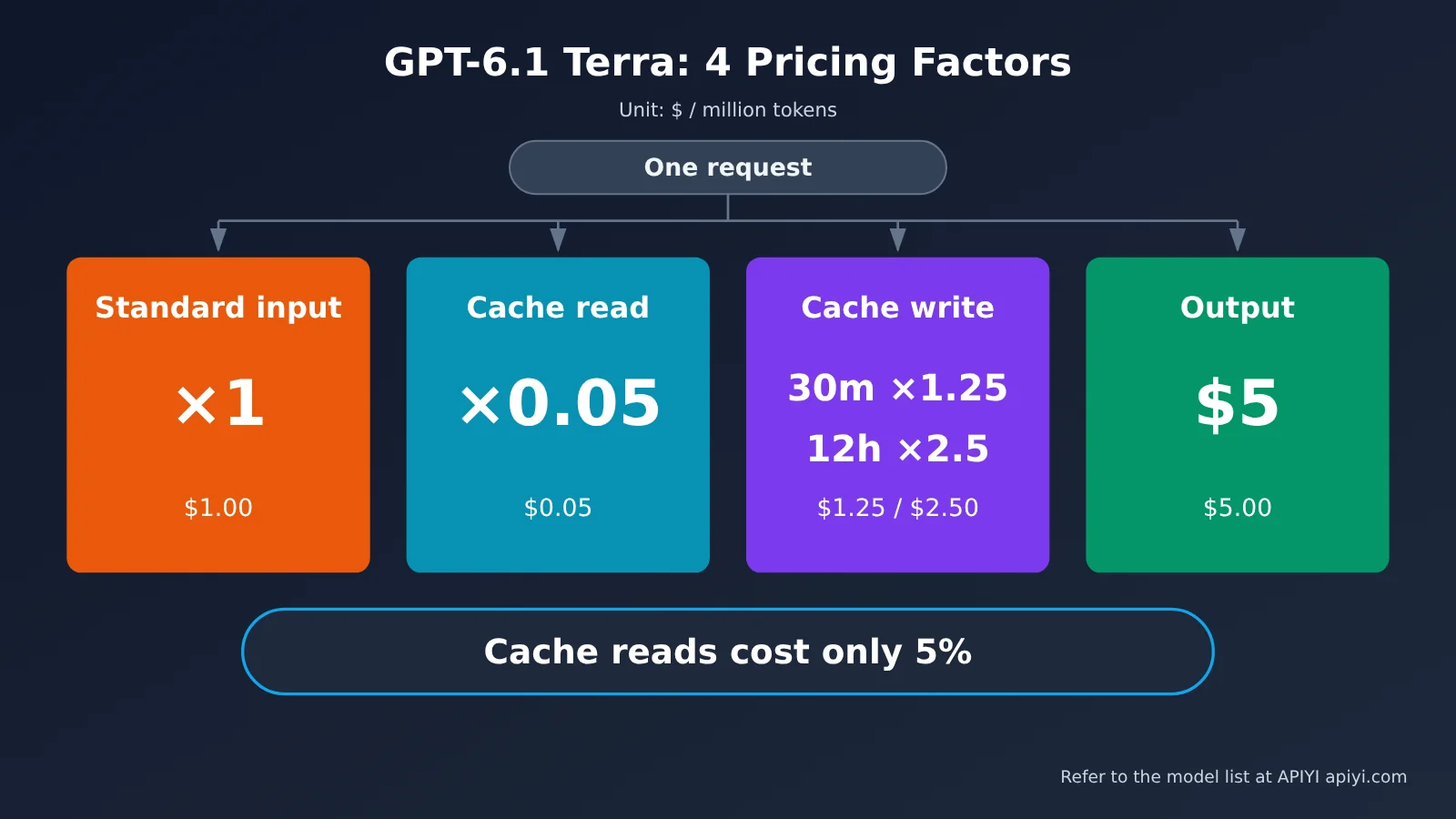
Here’s the pricing structure in a nutshell. Each request is billed across four components: standard input, output, cache reads, and cache writes. Cache writes come with two retention options: 30 minutes and 12 hours. If a single request’s input exceeds 272K tokens, the entire request moves to the second tier. There are also three processing modes: Batch and Flex are 50% off, while Fast costs twice the standard rate.
Sources: Official prices come from OpenAI’s model and pricing pages. Vendor-reported data comes from the October 26, 2026, launch blog post. Third-party data comes from Artificial Analysis, retrieved on October 27, 2026.
GPT-6.1 Terra Pricing at a Glance
First, the model basics. The model ID is gpt-6.1-terra, and there’s only one snapshot. It has a 1,050,000-token context window, a maximum input of 922,000 tokens per request, and a maximum output of 128,000 tokens. Its knowledge cutoff is 2026-06-01. It accepts text and images as input and produces text only. Audio and video aren’t supported.
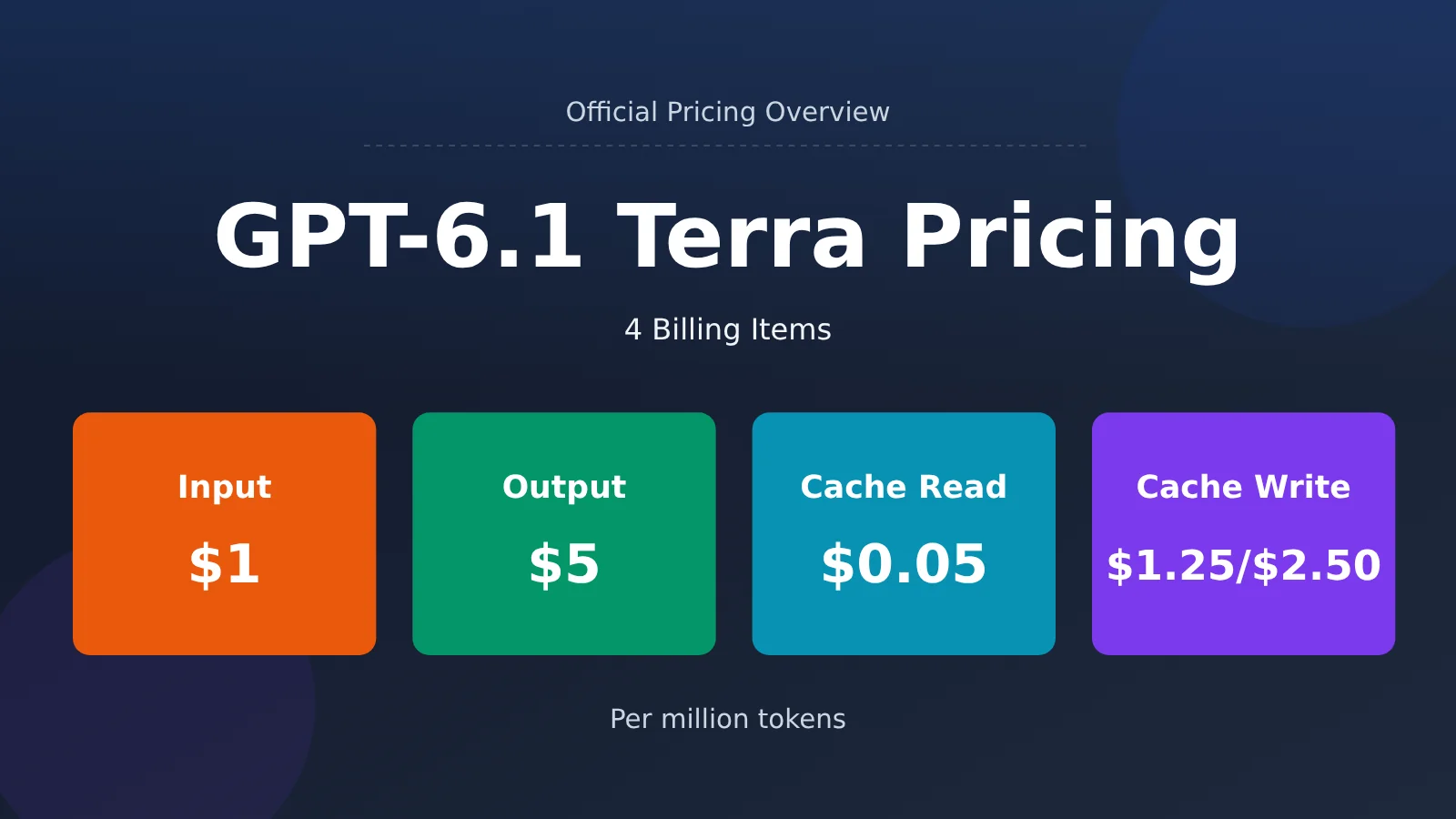
Standard pricing applies to requests with no more than 272K input tokens. All prices are per million tokens:
| Billing item | Standard price (≤272K) | Description |
|---|---|---|
| Input | $1.00 | Input tokens that don’t hit the cache |
| Output | $5.00 | Includes tokens generated through reasoning |
| Cache read | $0.05 | 0.05× the input price |
| Cache write (30 minutes) | $1.25 | 1.25× the input price |
| Cache write (12 hours) | $2.50 | 2.5× the input price |
GPT-6.1 Terra Cache Pricing Details
Cache reads cost just 5% of the input price. Most models in the same generation charge 0.1×, making this Terra’s biggest price reduction compared with the previous generation.
The cache write price is the total price, not an extra charge on top of the input price. Tokens written to the cache are billed directly at $1.25 or $2.50 per million, with no additional $1.00 input charge. There are a few other rules to keep in mind:
- The minimum cacheable prefix is 1,024 tokens. Anything shorter won’t be cached.
- The 12-hour retention period can only be set through
prompt_cache_options.ttlin the Responses API. - If
ttlis set to an invalid value, the API returns400 invalid_request_error.
GPT-6.1 Terra Long-Context Pricing: The 272K Tier
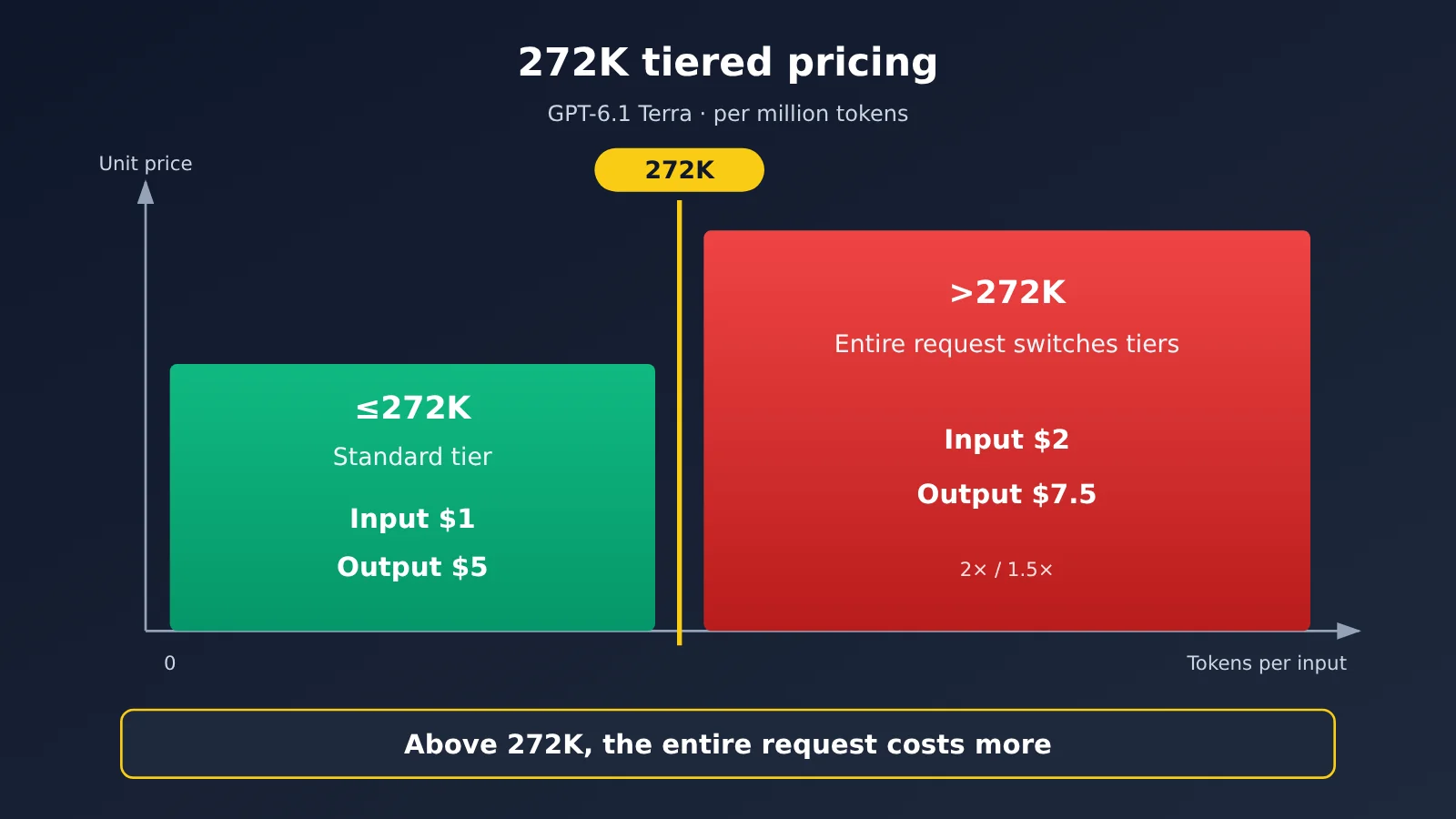
This is the rule that’s easiest to miss. When a single request exceeds 272K input tokens, the entire request moves to the second tier: input and cache prices double, and output prices increase by 1.5×. The new rates apply to all tokens in the request, not just those above the threshold.
| Billing item | ≤272K | >272K (entire request) | Multiplier |
|---|---|---|---|
| Input | $1.00 | $2.00 | 2× |
| Output | $5.00 | $7.50 | 1.5× |
| Cache read | $0.05 | $0.10 | 2× |
| Cache write, 30 minutes | $1.25 | $2.50 | 2× |
| Cache write, 12 hours | $2.50 | $5.00 | 2× |
Other GPT-6.1 Terra Pricing Tiers
| Mode | Pricing rule | Use case |
|---|---|---|
| Batch / Flex | 50% off standard rates: input $0.50, output $2.50, cache read $0.025, cache write $0.625 (30m) / $1.25 (12h) | Offline batch processing and latency-insensitive tasks |
| Fast | 2× standard rates: input $2.00, output $10.00 | Latency-sensitive online workloads |
| Ultrafast | Not supported by Terra; available only for gpt-6-astra and gpt-6.1-sol | — |
| Regional processing / FedRAMP | 10% surcharge for models released after 2026-03-05 | Data residency and compliance requirements |
We couldn’t find explicit cache prices for Fast mode on the official page we retrieved, so we’re treating them as undisclosed. Also, Priority processing was renamed Fast mode on 2026-07-30, so keep that in mind when reading older documentation.
GPT-6.1 Terra Pricing Comparison: Current and Previous Generations
| Model | Input | Output | Cache Read | Cache Write 30m | APIYI apiyi.com Model List (2026-10-27) |
|---|---|---|---|---|---|
| gpt-6-astra | $10.00 | $50.00 | $1.00 | $12.50 | Available |
| gpt-6.1-sol | $2.00 | $10.00 | $0.10 | $2.50 | Available |
| gpt-6.1-terra | $1.00 | $5.00 | $0.05 | $1.25 | Available |
| gpt-6-sol | $2.00 | $10.00 | $0.20 | $2.50 | Available |
| gpt-6-luna | $0.10 | $0.50 | $0.01 | $0.125 | Available |
| gpt-5.6-terra | $2.00 | $12.00 | $0.20 | $2.50 | Available |
Compared with GPT-5.6 Terra, Terra’s input price is 50% lower, its output price is about 58% lower, and its cache read price is 75% lower. According to the official blog, its standard API pricing is 50% lower than both GPT-5.6 Terra and GPT-6.1 Sol.
GPT-6.1 Terra Pricing in Practice: Three Examples
The calculations below use the price per million tokens: number of tokens × price ÷ 1,000,000.
Example 1: Batch Invoice Entry
Suppose each request uses 2,000 input tokens (including one invoice image) and produces 300 output tokens, with 5,000 calls per day.
Without a cache hit:
- Input: 2,000 × $1 ÷ 1M = $0.0020
- Output: 300 × $5 ÷ 1M = $0.0015
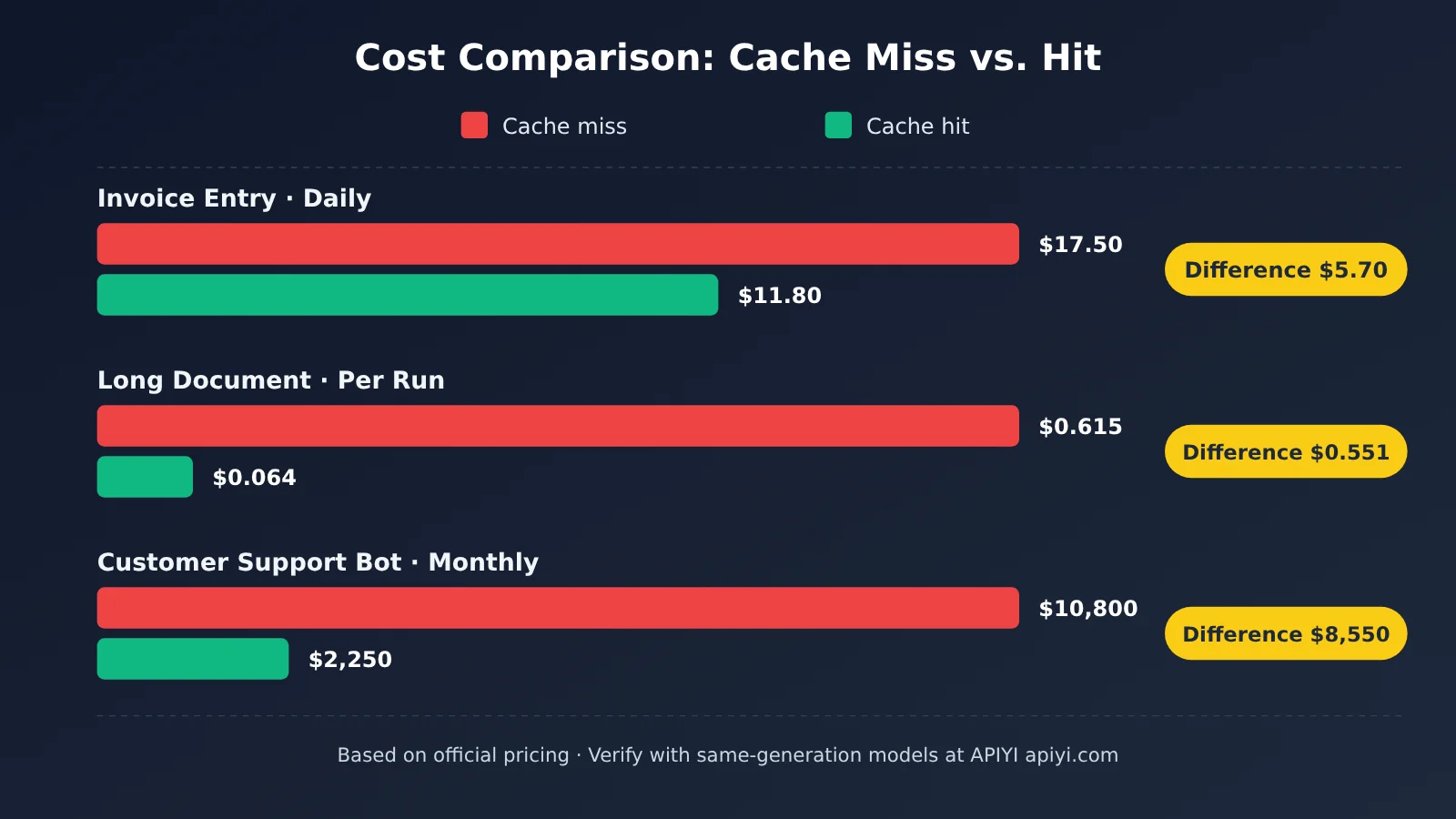
- Total per call: $0.0035; 5,000 calls per day × $0.0035 = $17.50
With a cache hit: Suppose the fixed system instructions and field descriptions account for 1,200 cached tokens (above the 1,024-token threshold), while the remaining 800 tokens contain variable content such as the image.
- Cache read: 1,200 × $0.05 ÷ 1M = $0.00006
- Regular input: 800 × $1 ÷ 1M = $0.0008
- Output: $0.0015
- Total per call: $0.00236, or $11.80 per day—$5.70 less per day than without a cache hit
Once the cache expires, it needs to be written again. The write cost for 30-minute retention is 1,200 × $1.25 ÷ 1M = $0.0015, which is negligible when spread across 5,000 daily calls. Invoice entry typically doesn’t require real-time responses. With Batch, the cost per call without a cache hit is 2,000 × $0.5 ÷ 1M + 300 × $2.5 ÷ 1M = $0.00175, or $8.75 per day.
Example 2: Long-Document Review (Above the 272K Threshold)
Suppose a request has 300,000 input tokens and 2,000 output tokens. Because the input exceeds 272K, the entire request is billed at the second-tier rate.
Without a cache hit:
- Input: 300,000 × $2 ÷ 1M = $0.60
- Output: 2,000 × $7.5 ÷ 1M = $0.015
- Total per request: $0.615
With a cache hit: You ask several follow-up questions about the same document. Assume the 290,000-token document prefix is cached, and the new question adds 10,000 tokens.
- Cache read: 290,000 × $0.10 ÷ 1M = $0.029
- Regular input: 10,000 × $2 ÷ 1M = $0.020
- Output: $0.015
- Total per request: $0.064, saving $0.551 compared with a request without a cache hit
The first request has to write to the cache. With a 30-minute retention period, the initial cost is 290,000 × $2.5 ÷ 1M + $0.02 + $0.015 = $0.76. After just one follow-up question about the same document, the two requests total $0.824—already cheaper than the $1.23 cost of two requests without caching.
There’s another, more direct way to save money: keep the input within 272K. With 270,000 input tokens and 2,000 output tokens, the cost is 270,000 × $1 ÷ 1M + 2,000 × $5 ÷ 1M = $0.28, less than half the second-tier cost.
Example 3: A Customer Support Bot With a High Cache Hit Rate
Suppose each interaction uses 50,000 input tokens, with 45,000 served from the cache, and generates 800 output tokens. The bot handles 200,000 interactions per month.
Without cache hits:
- Input: 50,000 × $1 ÷ 1M = $0.05; output: 800 × $5 ÷ 1M = $0.004
- $0.054 per interaction; 200,000 × $0.054 = $10,800 per month
With cache hits:
- Cache reads: 45,000 × $0.05 ÷ 1M = $0.00225
- Regular input: 5,000 × $1 ÷ 1M = $0.005
- Output: $0.004
- $0.01125 per interaction, or $2,250 per month—$8,550 less than without cache hits
If cache reads were priced at 0.1 times the regular input rate, as with most models of the same generation, the cost would be $0.0135 per interaction, or $2,700 per month. In this scenario, Terra’s 0.05-times rate saves another $450 per month. These calculations don’t include amortized cache write costs.
GPT-6.1 Terra Cost per Task: Third-Party Estimates
The following data comes from Artificial Analysis, retrieved on October 27, 2026. These are third-party benchmark figures, not your actual business costs. The token distribution in benchmark tasks differs from real-world requests. For a more accurate estimate, apply the official prices to your own token usage.
| Model | Intelligence Index | Cost per Task | Output Speed |
|---|---|---|---|
| GPT-6.1 Terra (max) | 48 | $0.40 | 91 t/s |
| GPT-6.1 Sol | 52 | $0.72 | 69.4 t/s |
| GPT-5.6 Terra | 42 | $1.40 | 135.4 t/s |
| GPT-6 Astra | 53 | $3.26 | 67.8 t/s |
| Claude Opus 5.5 (Max) | 58 | $5.98 | — |
Based on these figures, Terra scores 5 points lower than Astra on the index, while its cost per task is about 1/8 of Astra’s and 1/15 of Opus 5.5’s.
The official blog also provides some cost comparisons. These are vendor-reported claims and haven’t been independently reproduced:
- On Agents’ Last Exam, the medium setting scored 15 percentage points higher than GPT-5.6 Terra at roughly one-third the cost.
- The max setting is more than 3 times as token-efficient as Claude Opus 5.5, with a cost per task roughly 9 times lower.
GPT-6.1 Terra Quick Start: Setup Steps
As of October 27, 2026, gpt-6.1-terra is available directly through APIYI at apiyi.com. Pricing is $1 for input, $5 for output, $0.05 for cache reads, and $1.25 for cache writes per million tokens. The platform’s model multiplier is 0.5, and its completion multiplier is 5. Each price matches the official ≤272K tier. The same-generation models gpt-6.1-sol and gpt-6-astra, along with the previous-generation gpt-5.6-terra, gpt-6-sol, and gpt-6-luna, are also available. Check the platform’s model list for current models and prices, and your console bill for final charges at long-context tiers.
Getting connected takes just four steps:
- Register an account at APIYI apiyi.com and create an API key.
- In an OpenAI-compatible SDK, set
base_urltohttps://api.apiyi.com/v1and enter your key inapi_key. - Before making a call, check the live model list at
api.apiyi.com/api/pricingto verify pricing and available groups forgpt-6.1-terra, then set themodelfield to that ID. - Set
reasoning.effortbased on your task. Available values arenone / low / medium / high / xhigh / max; the default ismedium. - If you need 12-hour caching, switch to the Responses API and set
prompt_cache_options.ttl. - Before going live, check the returned usage statistics for the number of cached tokens, then use the formulas in this article to estimate costs.
🚀 Quick start: Check the platform’s model list for current models and prices. New accounts come with $0.05 in trial credit. Set
modeltogpt-6.1-terraat APIYI apiyi.com to test your integration and caching logic. If you want to compare prices, switch togpt-6.1-sol.
Frequently Asked Questions
Q1: What’s the one-line summary of GPT-6.1 Terra pricing?
For the standard tier (up to 272K input tokens per request), prices per million tokens are: $1 for input, $5 for output, $0.05 for cache reads, $1.25 for 30-minute cache writes, and $2.50 for 12-hour cache writes.
Q2: If I exceed 272K, do I pay more only for the tokens above the limit?
No. Once a request exceeds 272K input tokens, the entire request moves to the second tier: input and cache prices double, and output costs 1.5 times as much.
Q3: How do I choose between Batch and Fast?
Choose Batch or Flex for offline tasks; all billing categories are discounted by 50%. For latency-sensitive tasks, choose Fast, but expect to pay double. Terra doesn’t support Ultrafast.
Q4: Do cache writes add an extra charge?
The cache write price is the total price, not a surcharge. Tokens written to the cache are billed at 1.25 or 2.5 times the input price; they aren’t charged again at the standard input rate. Reusing the same prefix just once is usually enough to break even.
Q5: Can I use Terra on APIYI?
Yes. As of October 27, 2026, `gpt-6.1-terra` is available on APIYI at apiyi.com. All four billing categories match the official prices for the ≤272K tier. Check the platform’s model list for current models and pricing.
Q6: Can I use a third party’s per-task cost directly for budgeting?
It’s not recommended. Those figures are based on evaluation tasks, which have a different token usage profile from your workload. A safer approach is to test real requests on APIYI at apiyi.com, measure your token distribution, and calculate costs using the official rates.
GPT-6.1 Terra Pricing: Key Takeaways
- Four billing categories: Input costs $1, output costs $5, cache reads cost $0.05, and cache writes have two tiers: $1.25 and $2.50.
- 272K is the threshold: Above it, the entire request moves to the higher tier, doubling input costs and increasing output costs by 1.5×.
- Caching offers the biggest savings: In a customer service scenario, monthly costs drop from $10,800 to $2,250.
- Batch/Flex cost half as much; Fast costs twice as much. Terra doesn’t support Ultrafast.
- Third-party per-task costs are for reference only. For more accurate budgeting, calculate your own costs using official prices.
- Platform access: On APIYI at apiyi.com, set the
modelfield togpt-6.1-terrato invoke the model. Check the platform’s model list for available models and pricing.
Summary
Three things largely determine your Terra bill: whether input exceeds 272K, your cache hit rate, and whether you choose Batch or Fast. Depending on those choices, the same workload can cost several times more or less.
Start by measuring the token breakdown of your actual requests, then use the formulas in this article to calculate each cost. You can run real requests with gpt-6.1-terra on APIYI at apiyi.com, then compare prices with gpt-6.1-sol from the same generation.
📚 References
- OpenAI GPT-6.1 Terra model page: Specifications and context parameters
- Link:
platform.openai.com/docs/models/gpt-6.1-terra - Details: Context, input and output modalities, and reasoning levels
- OpenAI pricing page: Standard pricing, long context, and Batch/Flex/Fast
- Link:
platform.openai.com/docs/pricing - Details: Official pricing for all billable items
- OpenAI Prompt Caching guide: Caching rules
- Link:
platform.openai.com/docs/guides/prompt-caching - Details: Minimum prefix length, TTL settings, and cache write billing
- GPT-6.1 Terra launch blog: Vendor-reported cost data
- Link:
openai.com/index/introducing-gpt-6-1-terra - Details: Published October 26, 2026; the data hasn’t been independently reproduced
Author: APIYI Technical Team
Technical discussions: Contact us through the APIYI homepage at apiyi.com. For more resources, visit the documentation center at docs.apiyi.com.