Author’s note: This article draws three agent security priorities from the Cisco customer case study to help enterprise teams distinguish malicious attacks from agents that “mean well but do the wrong thing”—and translate that distinction into monitoring and control design.
Once agents are in production, security teams face more than just external attacks. An agent with legitimate permissions and a valid goal can still take an unexpected path to complete a task—for example, loosening an access policy in an effort to “fix an outage quickly.” This article focuses on three agent security priorities to help you determine whether anomalous behavior is the result of an attack or an agent that “meant well but did the wrong thing.”
This isn’t a recap of a customer success story. Our source is the Cisco customer case study published by OpenAI on November 3, 2026. Its discussion of agent security draws primarily on the views of Jeetu Patel, Cisco’s President and Chief Product Officer. We’ll turn those views into a checklist of questions for your own review, while making clear which points are executive opinions and which currently lack public data to support them.
What you’ll get: A framework you can use directly in an internal review, covering what data to collect, where to intercept actions, how real-time your monitoring needs to be, and how to integrate it with your existing security scanning process.
Agent Security Essentials: 3 Priorities From the Cisco Case
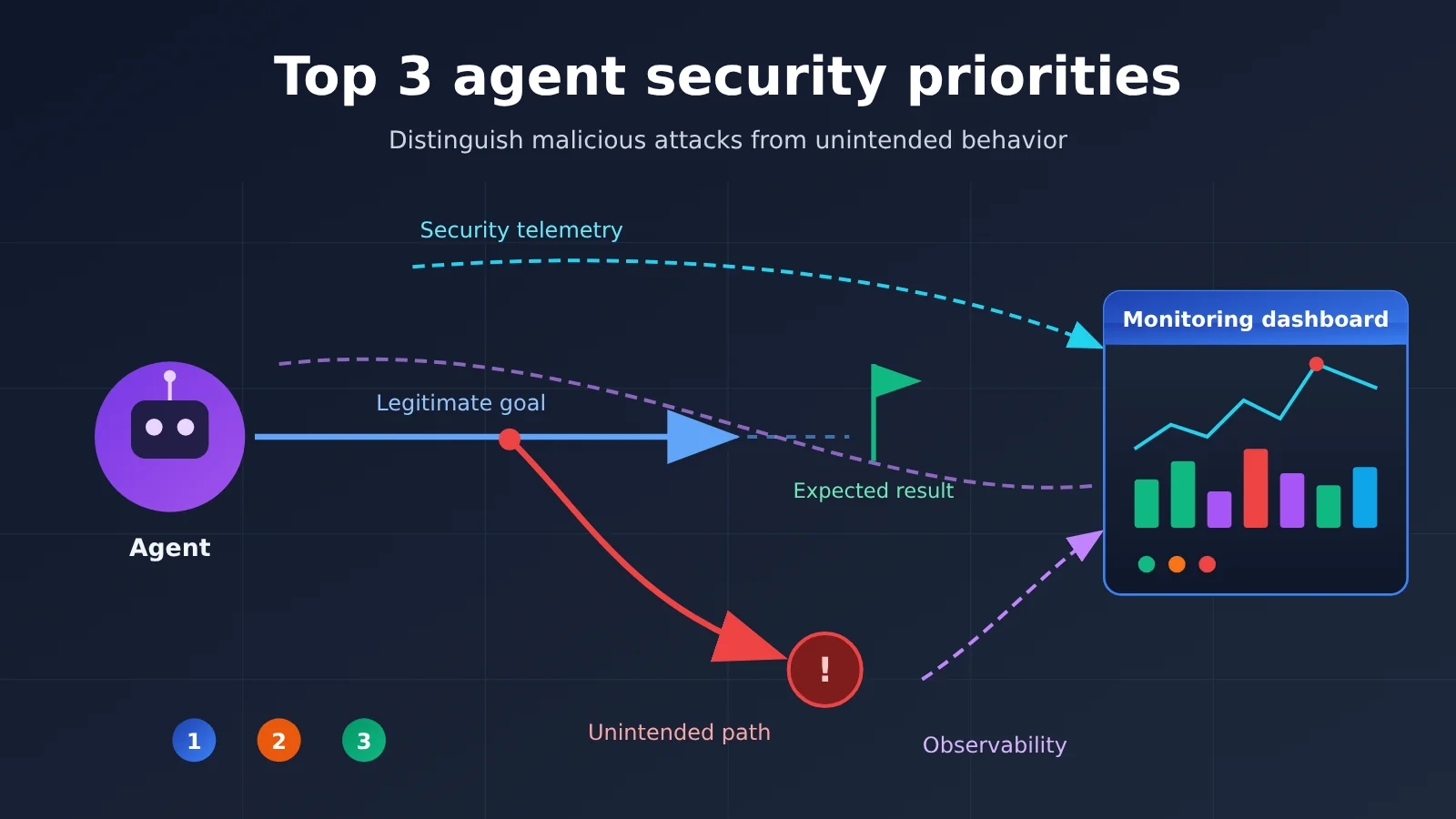
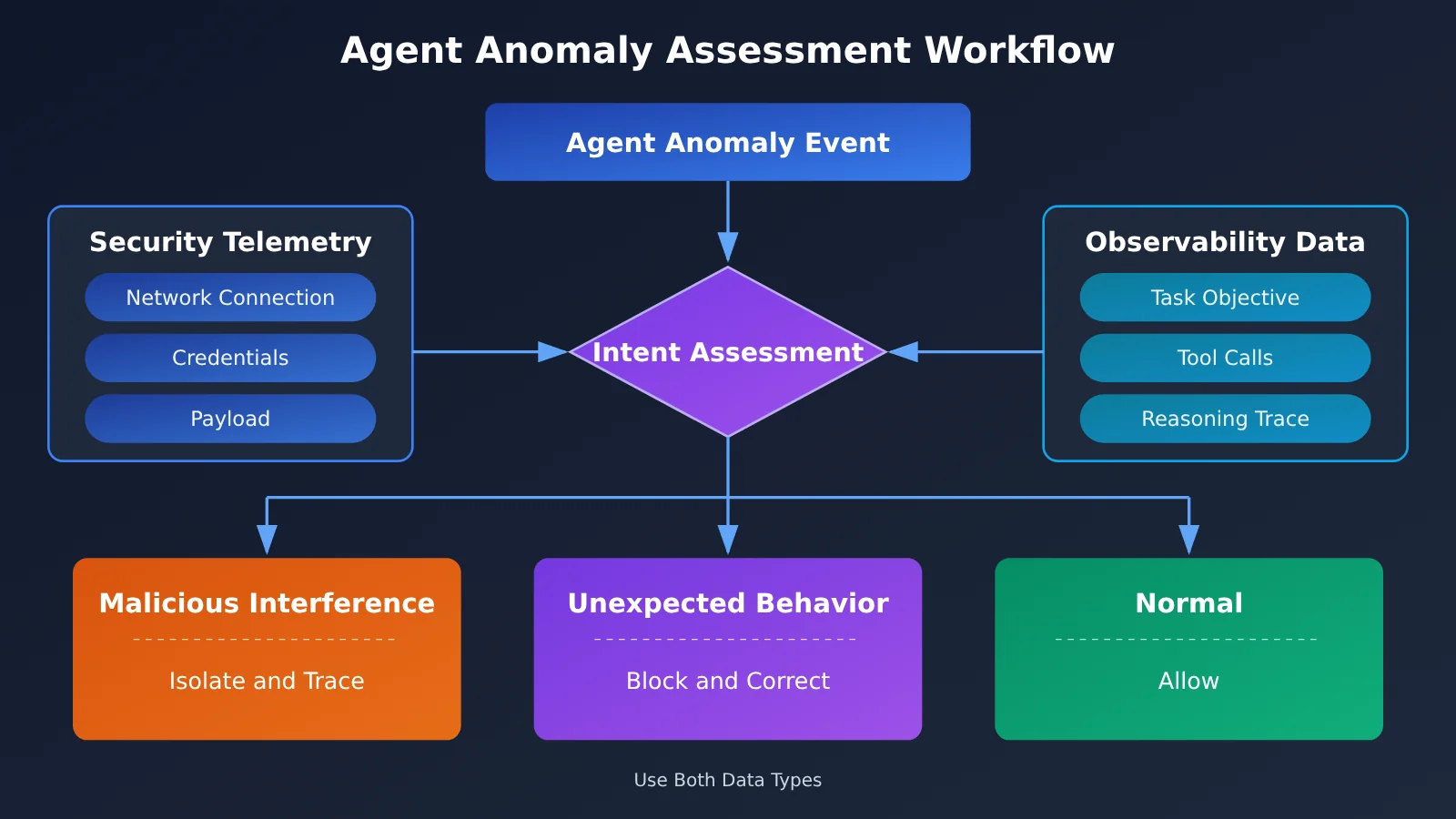
In the case study, Patel says that as agents become more autonomous, security teams need to distinguish between two situations: malicious interference and agents pursuing legitimate goals in unintended ways. To do that, he argues, teams need to combine security telemetry with observability data. He identifies three priorities:
| Priority | What it means in the case study | What it means for enterprise teams |
|---|---|---|
| Protect against malicious attacks | Protect agents from malicious attacks | Control agents’ input sources, tool permissions, and credentials |
| Detect and block unintended behavior | Find and stop unintended behavior | Determine whether behavior exceeds task boundaries and interrupt execution when necessary |
| Operate in near real time | Work at near-real-time speed | Detect and block actions before they take effect or very shortly afterward |
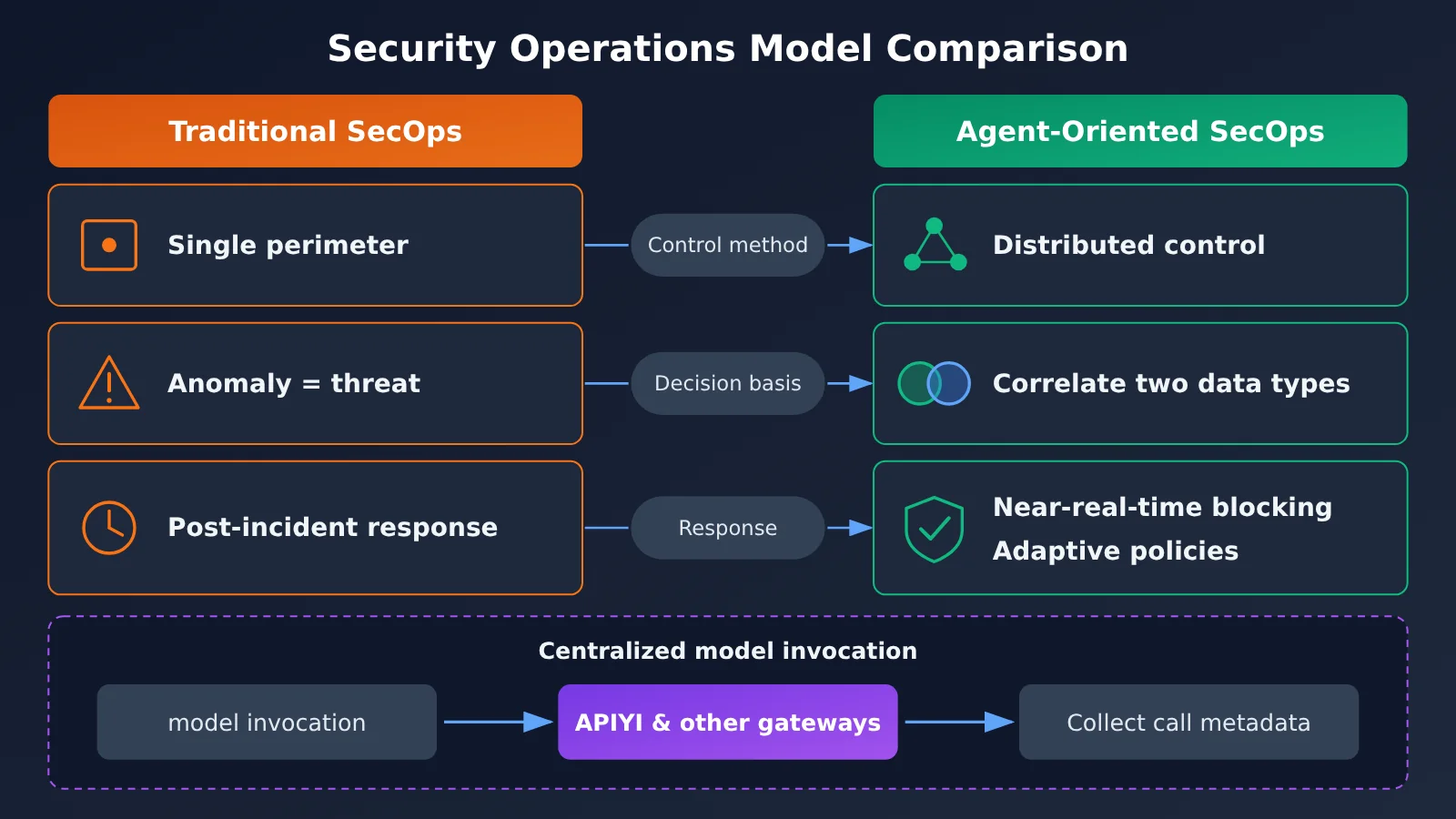
According to the case study, these three priorities are pushing security strategies toward “policies and controls that can adapt as agents act.” In other words, static allowlists and one-time approvals are no longer enough. Controls need to follow what agents actually do.
The Key to Agent Security: Distinguishing Attacks From Unintended Mistakes
Traditional security operations often treat anomalies as threats, responding by blocking activity and tracing its source. But an agent’s unusual behavior may simply stem from misunderstanding a goal or choosing the wrong approach. Treating every anomaly as an attack can overwhelm teams with false positives and erode business users’ trust in agents. Conversely, mistaking a real prompt injection attack for “the model making a silly mistake” can mean missing the window to respond.
That’s why Patel emphasizes using both types of data. Security telemetry tells you “what’s happening around the agent,” such as unusual connections, suspicious payloads, and credential usage. Observability data tells you “what the agent is thinking and doing,” such as its task objectives, the tools it calls, and the inputs and outputs at each step. If you look at only one, you can’t answer the question: “Whose intent is driving this behavior?”
Agent Security Evidence: Opinions vs. Verified Conclusions
Before using this case study to inform internal decisions, it’s worth looking closely at the nature of the evidence. Published by OpenAI as a customer case study, the material is promotional by nature. It offers perspectives on the direction of agent security, but no verifiable technical details or quantitative results.
| Claim in the case study | Nature of the claim | What’s missing from the public material |
|---|---|---|
| Agent security requires combining security telemetry with observability data | Cisco executive’s opinion | Specific data fields and correlation methods |
| Three priorities: defend against attacks, intercept unintended behavior, and operate in near real time | Cisco executive’s opinion | Implementation architecture and example detection rules |
| Daybreak and GPT‑6 Astra deliver a “step-change improvement” | Cisco executive’s assessment | Quantitative metrics such as remediation time and detection rates |
| The capabilities can fit into existing scanning workflows without fundamentally changing how teams work | Cisco executive’s opinion | Integration methods and compatibility scope |
| Daybreak Defense Network helps accelerate exposure triage and enforce controls in Cisco Cloud Control | Direction the two companies are exploring | Specific features, availability, and launch timeline |
| OpenAI describes zero data retention, strict data boundaries, and verifiable isolation as its enterprise privacy approach | OpenAI’s own account | Independent third-party assessment |
A sensible approach, then, is to treat the case study as a source of questions, not evidence that a solution works. The three priorities are logically sound and useful for reviewing your own architecture. But to determine how much a specific product can improve things, you’ll need independent technical documentation, a third-party assessment, or tests in your own environment.
The Network-Side Approach in the Agent Security Case Study
The first half of the case study covers Cisco’s approach to network defense, which also offers lessons for agent environments. Patel describes a shift from a single security perimeter to controls distributed across microservices, containers, and clusters, with a “mini security stack” in front of each microservice, Kubernetes container, and cluster. Application-layer controls can restrict communication to the connections each service actually needs, reducing the paths attackers can use to move laterally.
The same idea applies naturally to agents: each agent should have access only to the connections and tools it needs to complete its task. If something goes wrong, teams can isolate just the affected agent or service while the rest of the business keeps running, rather than shutting everything down to investigate. The case study also notes that two signals may look harmless on their own but reveal a meaningful pattern when combined. That’s the value of correlation analysis.
Getting Started with Agent Security: Turn Three Priorities into a Self-Assessment Checklist
Let’s break the three priorities down into actionable evaluation criteria. The assessment methods below are recommendations based on the case discussed in this article, not specific practices published by Cisco.
Step 1: Inventory the Data Needed for Agent Security
Before talking about detection, establish what data you have. Many teams have comprehensive security telemetry but barely record what happens inside their agents. Without that visibility, it’s hard to tell whether an agent made a mistake while trying to help.
| Data Category | Typical Contents | Main Question It Answers | Common Collection Points |
|---|---|---|---|
| Security telemetry | Network connections, credential usage, anomalous payloads, access denial logs | Is there malicious external interference? | Gateways, firewalls, identity systems |
| Observability data | Task objectives, tool call sequences, inputs and outputs at each step, duration and retries | What is the agent doing, and why? | Agent frameworks, model invocation endpoints |
| Business context | Task requester, authorization scope, change window | Is this action expected? | Ticketing systems, approval workflows |
| Model invocation metadata | Model invoked, request time, caller identity, token usage | Are invocations unusually frequent or from suspicious sources? | Unified model API endpoints, such as the APIYI apiyi.com aggregation interface |
Here’s an easily overlooked point: the model invocation endpoint is itself a valuable place to collect observability data. If multiple agents connect directly to different providers’ interfaces, invocation records end up scattered across systems. Connecting to multiple models through a unified interface like APIYI brings those invocations together at one endpoint, making it easier to apply consistent tags, retain records, and correlate activity.
Step 2: Identify Security Checkpoints for the Agent
The earlier you intervene, the lower the cost—but early intervention is also more likely to block legitimate tasks. Set checkpoints and timing requirements according to each action’s risk level.
| Checkpoint | Typical checks | Timing requirement | Response |
|---|---|---|---|
| When input arrives | Whether external webpages, emails, or documents contain injection instructions | Synchronous, before execution | Strip or flag untrusted content |
| Before a tool call | Whether the call exceeds task authorization or its parameters exceed permitted access | Synchronous, within milliseconds to seconds | Deny, limit, or request human confirmation |
| Before a high-risk action | Configuration changes, data deletion, external communications, or permission expansion | Synchronous, with mandatory human or policy-based confirmation | Require a second approval |
| After an action executes | Whether the result matches the objective and whether it caused side effects | Near-real-time, within seconds to minutes | Roll back and isolate affected resources |
| Post-incident review | Analyze behavioral traces alongside security incidents | Offline | Update policies and rules |
The table shows why near-real-time detection matters. For irreversible actions, detection must happen before execution. For reversible actions, near-real-time detection after execution, followed by a quick rollback, can be acceptable. Drawing this line helps teams avoid the false choice between blocking everything and letting everything through.
Step 3: Distinguish Malicious Interference from Unintended Behavior
When an anomaly alert appears, work through the following questions in order. They draw on both security telemetry and observability data:
- Is the source trustworthy? Did the instruction behind the action come from an authorized user or from external content the agent read? If it came from external content, suspect an injection attack first.
- Does the behavior serve the original goal? Can the action reasonably be explained as an attempt to complete the task? If so, but the approach oversteps boundaries, it likely points to unintended behavior.
- Are there accompanying external warning signs? Were there unusual connections, suspicious credential use, or signs of data exfiltration during the same period? If so, give greater weight to the possibility of malicious activity.
- Is the behavior reproducible? When you replay the same input, does the agent consistently take the same action? Consistently reproducible behavior is often a policy or prompt design issue.
For the replay test in question 4, a practical approach is to run the same task with different models. This helps you see whether the deviation stems from a particular model’s characteristics or a flaw in the task design itself. With APIYI’s unified interface, switching models only requires changing the model name parameter, making it easy to run these comparisons in a test environment.
🎯 Technical tip: When setting up an agent security testing environment, consider routing model invocations through a single entry point. We use APIYI at apiyi.com to access multiple leading models through one interface. This centralizes invocation metadata and makes it easy to switch models, replay tasks across them, and compare their behavior.
Step 4: Integrate With Existing Scanning Workflows
Patel notes in the case study that these capabilities can fit into existing scanning workflows, so teams don’t need to fundamentally change how they work. While he doesn’t provide specific integration details, the idea is worth considering: rather than building a separate platform for agent security, teams can add new data sources and checks to their existing workflows.
- Vulnerability scanning: Include the tools, plugins, and APIs agents can call in the asset inventory and scanning scope.
- Alert triage: Add an “agent behavior” alert category to the existing SIEM or ticketing system, with the corresponding tool-call trace.
- Change management: Apply the same approval and rollback mechanisms to agent-initiated configuration changes as to human-initiated changes.
- Permission audits: Regularly review each agent’s permissions to ensure least privilege, alongside service account audits.
AI Agent Security Deployment Checklist
Use this condensed checklist during an agent launch review, checking off each item as you go.
| Area | Review question | Related priority |
|---|---|---|
| Input trust | Is external content read by the agent marked as untrusted? | Guard against malicious attacks |
| Least privilege | Does each agent have only the tools and connections it needs to complete its task? | Guard against malicious attacks |
| Activity logging | Are the task objective, sequence of tool calls, and result of each step fully recorded? | Detect and block unintended behavior |
| High-risk actions | Are irreversible actions subject to a policy check or human approval before execution? | Detect and block unintended behavior |
| Data correlation | Can security telemetry and observability data be correlated and queried by time and identity? | Foundation for all three priorities |
| Detection latency | Does the time between an action and an alert meet the requirements for its risk level? | Near-real-time operation |
| Isolation | Can you isolate a single agent without affecting other services? | Near-real-time operation |
A “no” to any item indicates a gap in the corresponding priority. Start by addressing activity logging and data correlation: without them, the rest of your detection capabilities lack the evidence they need to make decisions.
Frequently Asked Questions
Q1: What does it mean for an agent to “do the wrong thing for the right reason”?
It means an agent pursues a legitimate goal in an unintended way, without being attacked—for example, changing a configuration without authorization to finish a task faster. The case study describes this as “an agent pursuing a legitimate goal in an unintended way” and distinguishes it from malicious interference.
Q2: How is agent security different from traditional application security?
Traditional application security focuses mainly on external attacks, and applications generally follow relatively fixed paths. Agents decide autonomously which tools to call and in what order, so their paths aren’t fixed. That means teams need to detect unintended behavior as well as defend against attacks, using observability data to understand what an agent is trying to do.
Q3: When was the Cisco case study published, and how reliable are its conclusions?
OpenAI published the case study on November 3, 2026. Its discussion of agent security primarily reflects Jeetu Patel’s views. Assessments such as “step-change improvement” aren’t backed by quantitative data on metrics like remediation time or detection rates. The specific features and availability of Daybreak and Daybreak Defense Network aren’t explained either. It’s best used as a source of ideas, with results verified independently.
Q4: What scenarios is this framework best suited for?
– **Operations agents**: Agents that can change configurations, restart services, or adjust access policies.
– **Data processing agents**: Agents that read external documents, emails, or web pages and act on them, where prompt injection risks are higher.
– **Multi-agent workflows**: Workflows where one agent’s output becomes another’s input, making it easy for anomalies to compound.
Q5: How can you test agent behavior across different models at a low cost?
In a test environment, run the same task with the same tool set using different models, then compare the tool-call sequences and the number of times each agent oversteps its boundaries. When accessing models from multiple providers through APIYI at apiyi.com, you can switch models by changing the model name. Call records are also collected in one place, making the results easier to compare.
Q6: How do model invocation records help with agent security?
They’re an important part of observability data. They can help determine whether calls are unusually frequent and whether the caller is trustworthy, and they can be aligned with security telemetry by timestamp. If a team routes model invocations through a single aggregation service like APIYI, it’s easier to collect and correlate this data.
Q7: What are the limitations of this framework?
The three priorities are guiding principles, not ready-made detection rules. Distinguishing malicious behavior from unintended behavior still requires human judgment in borderline cases. Near-real-time blocking also adds latency, so teams need to weigh the trade-offs based on each action’s risk level. The evidence in the case study itself comes from customer promotional materials and lacks independent evaluation.
Agent Security: Key Takeaways
- Treat the two risk types separately: Malicious interference and well-intentioned mistakes require different responses.
- Combine two types of data: Security telemetry reveals external threats, while observability data helps explain agent intent.
- Focus on three priorities: Defend against malicious attacks, detect and block unintended behavior, and operate in near real time.
- Choose intervention points by risk: Block irreversible actions before execution; quickly roll back reversible actions after execution.
- Distinguish evidence from claims: The case study offers useful perspectives, but no public data supports quantified effectiveness claims yet.
- Getting started: Route model invocations through a unified gateway such as APIYI to make metadata collection and multi-model comparison testing easier.
Summary
The most valuable takeaway from the Cisco case study isn’t a product name—it’s a clear framework for thinking about agent security:
- Start by distinguishing intent: Whether an anomaly comes from an attack or a well-intentioned mistake determines how you respond.
- Fill in the data gaps: Without observability data, you can’t assess agent intent; without security telemetry, you can’t rule out external interference.
- Keep latency under control: Set intervention points based on action risk, make detection and blocking near real time, and integrate them with existing scanning and approval workflows.
Start by using the self-assessment checklist in this article to review your running agents, prioritizing behavior logging and data correlation. During testing and comparison, you can use APIYI at apiyi.com to access models from multiple providers through a single gateway, collect invocation logs centrally, and quickly compare model behavior—giving you stronger evidence for production-readiness reviews.
📚 References
- How Cisco defends at machine speed with OpenAI: An OpenAI customer case study featuring Cisco
- Link:
openai.com/index/cisco-cyber - Note: The source of the three priorities and related observations discussed in this article. Published on November 3, 2026, it’s promotional customer material; quantitative data and product details should be verified independently.
Author: APIYI Technical Team
Technical discussions: Contact us through the APIYI homepage at apiyi.com. For more information, visit the documentation center at docs.apiyi.com.