Author’s note: Once a new model ships, how do you validate it against your own long-horizon tasks to decide whether it’s worth switching to? This article breaks that question into an executable 5-step process.
New models ship almost every month, and the leaderboards keep getting reshuffled. Take Tencent’s Hunyuan Hy4, officially released in November 2026 — the team says it was specifically optimized for agent capability and long-horizon tasks compared with the preview version, and that it ranks near the top of open-source models on several benchmarks. But for developers there’s really only one question: is it better than the model I’m using now, on my tasks? This article walks through a method for A/B validating a new model against your own long-horizon tasks, so you can reach a data-backed conclusion in a day or two.
This isn’t another benchmark breakdown. Leaderboards measure general capability. Your business measures something else: can the model take a multi-step job from start to finish, can it recover on its own when something goes wrong, and how much does each completed order cost?
The core value: by the end of this article you’ll know how to build a small but sharp validation set of long-horizon tasks, compare the old and new models across 6 metrics, calculate the “cost per successful delivery” using real billing, and finally decide whether to switch or stay.
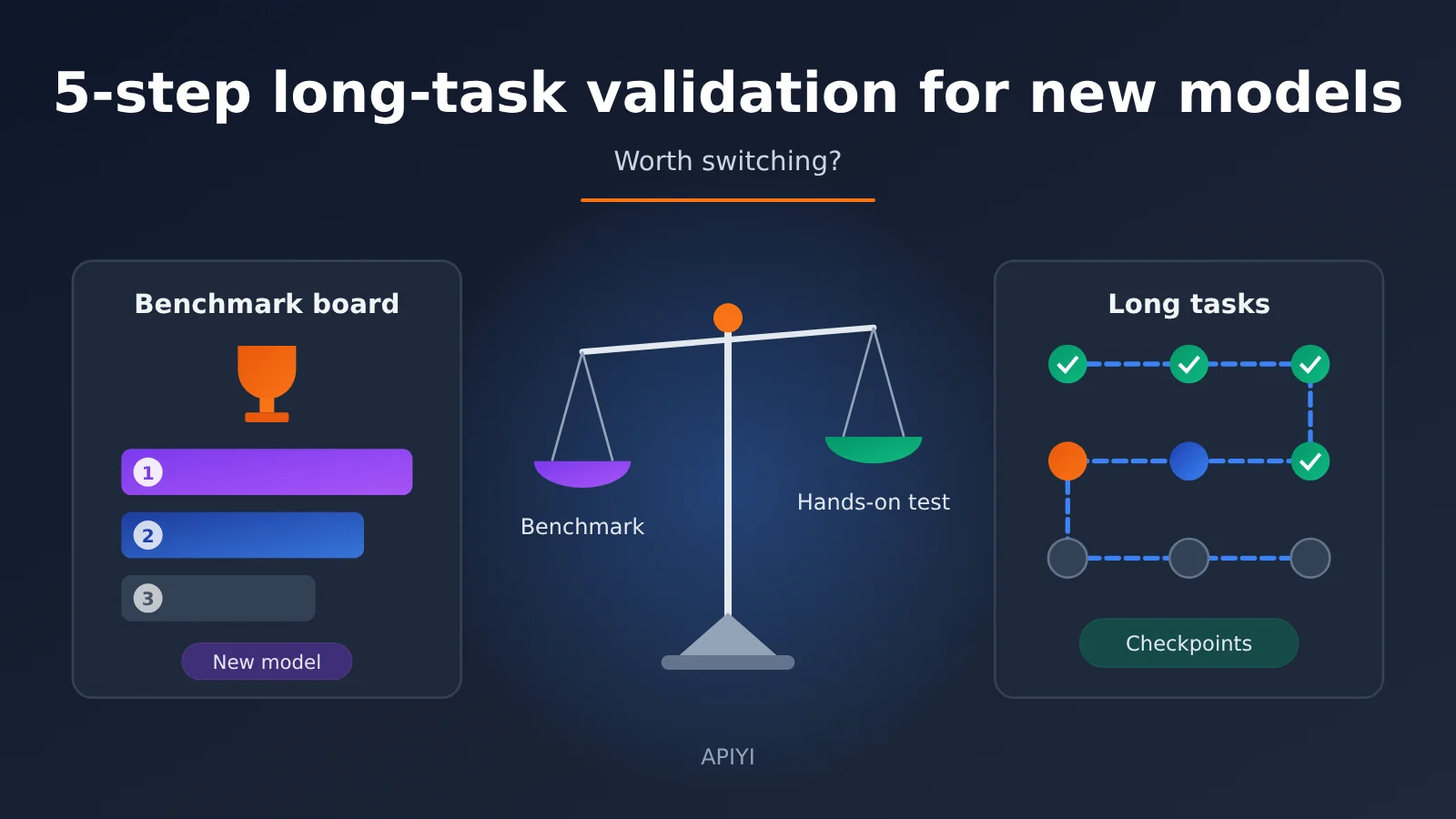
Core Points for Validating New Models on Long-Horizon Tasks
Before you start, get clear on how long-horizon task validation differs from ordinary single-turn testing. Single-turn testing asks, “Was this one answer good?” Long-horizon task validation asks, “After dozens of steps in a row, is the goal still on track?”
| Point | Description | Value |
|---|---|---|
| Use your own tasks | Pull 3–5 multi-step tasks from real business work instead of using public benchmark questions | Conclusions map directly to business outcomes |
| Fix a control group | Run the incumbent model and the new model on the same task with the same toolchain | Rules out prompt and environment differences |
| Process metrics first | Record goal retention, self-correction, and the number of human interventions | Surfaces stability problems that benchmark scores won’t show |
| Cost by delivery | Calculate token cost per “successful delivery” | Avoids misjudging based on unit price alone |
| Set a model-switching threshold | Write down in advance how much improvement justifies switching | Prevents one impressive demo from skewing your judgment |
Why long-horizon task validation is more reliable than benchmark scores
Public leaderboard questions are usually closed-ended and short-horizon, while real Agent work is the opposite. In the referenced evaluation, one long-horizon task for Hy4 required going from research, development, review, and rework all the way to a playable 3D game, with a reference video and new requirements added along the way. This kind of task tests whether the model can remember the original plan as steps keep accumulating, distinguish completed items from unfinished ones, and adjust the plan when intermediate results don’t meet expectations.
Another phenomenon worth noting is the synergy between “model + toolchain.” In the same evaluation, Hy4 generated 14 PPTs, one Excel workbook, and a 19-page Word document in WorkBuddy within half an hour. The reviewers also made it clear that the model handles understanding, planning, and judgment, while the toolchain handles reading, calculation, rendering, and writing. That means when you validate a new model, you have to run it inside your own toolchain; conclusions detached from the environment have limited reference value.
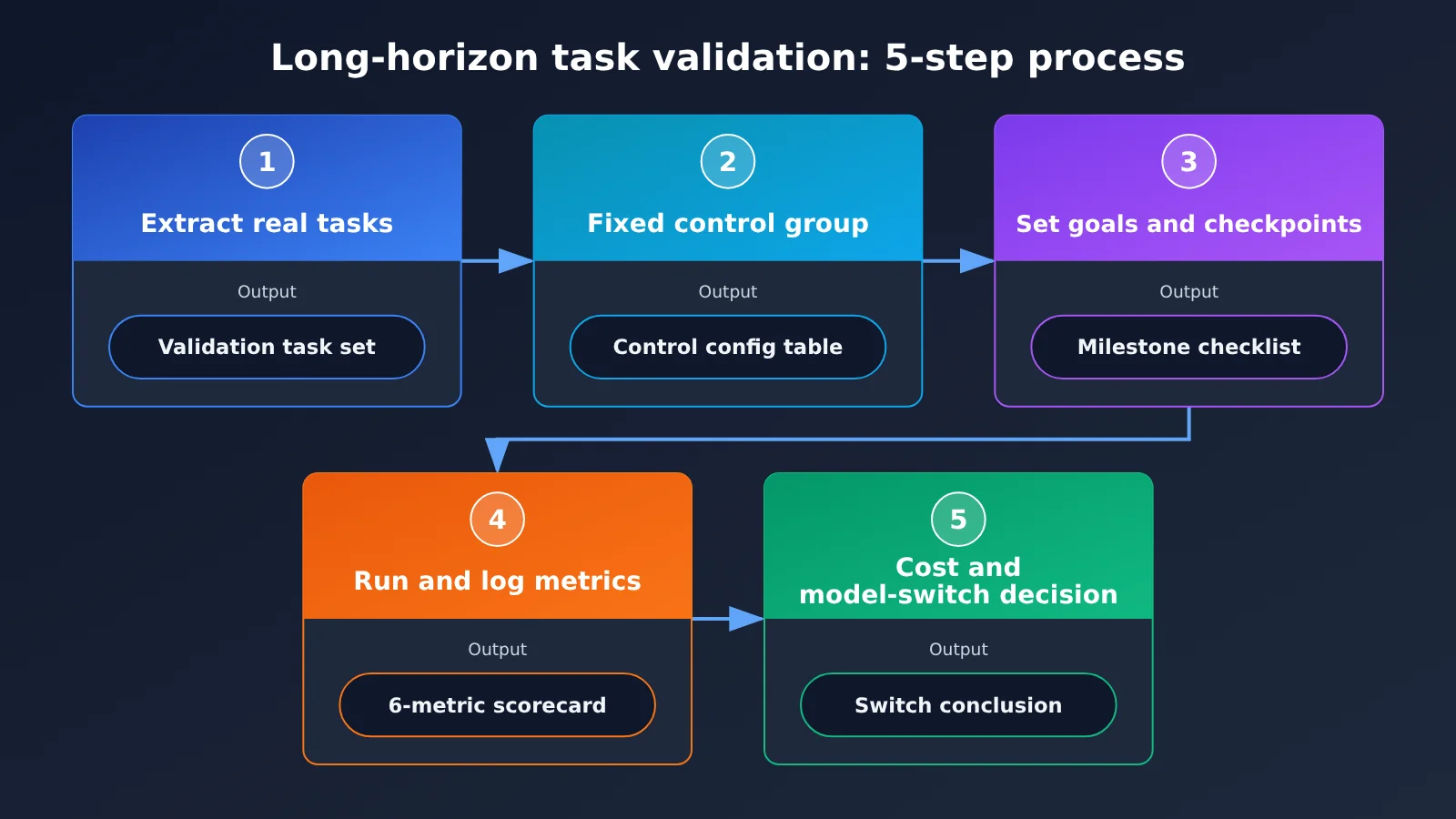
Quick Start for Validating New Models on Long-Horizon Tasks: A 5-Step Process
The workflow below doesn’t depend on any specific framework. As long as your model invocations go through a unified interface, you can switch between models for side-by-side comparison at low cost.
Step 1: Extract Long-Horizon Tasks from Real Business Scenarios
Your validation set doesn’t need to be large—it needs to be representative. Pick 3-5 tasks that cover the three types of scenarios most common in your business, the most labor-intensive, and the most error-prone. Ideally, each task should meet three conditions: “at least 10 steps, requires tool calls, and has a clear deliverable.”
You can use the following categories of typical long-horizon tasks as references to design your own versions:
- Document batch processing: Given a folder containing a dozen or so materials, the model must summarize each one, generate reporting materials, and consolidate everything into a table and a report.
- App development: Starting from a requirements description, complete development, self-testing, and rework, and finally deliver a runnable product.
- Multimodal replication: Upload screenshots or screen recordings and ask the model to understand the content and then replicate the corresponding interface or interaction.
- Computer operation: Have the model look at the screen, find buttons, click and type, and complete a cross-application operation workflow.
Step 2: Fix the control group and runtime environment
The key to a controlled experiment is “change only one variable.” The old and new models must use the same system prompt, the same set of tool definitions, and the same input materials. It’s a good idea to run each task at least 3 times and take both the average and the worst-case result, because long-horizon tasks have far more randomness than single-turn Q&A.
| Configuration | Recommended setting | Notes |
|---|---|---|
model |
Current production model vs. new model | The only parameter allowed to change |
temperature |
Keep both groups identical; lower is better | Reduces the impact of randomness on your conclusions |
max_tokens |
Reserve headroom for the task’s longest output | Avoids misjudging a model because its output got truncated |
Tool definitions tools |
Exactly the same function list and descriptions | Differences in tool descriptions can significantly affect invocation behavior |
| System prompt | Same version, not tuned for the new model | Test “out of the box” first, then test tuned performance |
| Repeat count | At least 3 runs per task | Observe stability, not the best single score |
If your project uses both OpenAI-style and Anthropic-style interfaces, switching models often means changing the SDK, the authentication, and the request format — which makes controlled experiments a real pain. Calling through a unified API aggregation platform lets you switch by changing only the model field.
🚀 Quick-start tip: APIYI apiyi.com provides API access to the mainstream models covered in this article and is compatible with both OpenAI and Anthropic interface formats, so for controlled experiments you only need to swap the
modelparameter to switch between old and new models. For integration details,base_url, and authentication configuration, refer to the APIYI documentation center at docs.apiyi.com.
Step 3: Set goal anchors and checkpoints for the task
The most common failure mode for long-running tasks isn’t “can’t do it” — it’s “forgetting what you were supposed to do along the way.” The reference evaluation used a /goal directive to keep the model consistently anchored to a concrete objective, and this idea transfers to any validation environment. You can state the final goal clearly at the start of the task, then break the deliverables into several checkable milestones.
Take the “realistic 3D mini-game” task as an example: the evaluators split the goal into 5 items — game scene, visuals and feel, sound and gameplay, workflow, and final delivery. Your own tasks should be split the same way, with each milestone mapping to a checkpoint that can be objectively judged as “done / not done.” Scoring gets much easier after that.
Step 4: Run it and record 6 metrics
Keep the full conversation and tool-call logs for every run, then score using the table below. The first 4 items measure “can it finish,” the last 2 measure “is it worth it.”
| Metric | How to measure | Scoring method |
|---|---|---|
| Task completion rate | checkpoints completed / total checkpoints | percentage, averaged over 3 runs |
| Goal adherence | whether the second half still advances the original goal, with no omissions or drift | 1–5 human score |
| Self-correction ability | whether it can fix mid-run errors (exceptions, failed tests) on its own | record “error count / self-recovery count” |
| Human intervention count | number of turns requiring added clarification or correction | fewer is better |
| Elapsed time | wall-clock time from kickoff to delivery | minutes, including tool execution time |
| Cost per delivery | total token cost / successful deliveries | calculated using the actual billing basis |
“Human intervention count” deserves special attention. The reference evaluation concluded that Hy4 can mostly deliver in one shot for everyday office and creative tasks, but for work involving lots of computer operation and complex workflows, it still needs multiple rounds of interaction to understand intent. This is exactly the difference you need to quantify on your own tasks: each intervention means one unit of human labor cost.
Step 5: Calculate the cost and decide whether to switch models
Cost accounting needs to be based on “per successful delivery,” not just a comparison of input and output unit prices. A model that’s cheap per token but needs two reruns can end up costing more in practice. Long-horizon tasks have another quirk: the context keeps carrying historical content, so cache hit rate has a big impact on the total bill.
Here’s the calculation logic: cost per task = uncached input tokens × input unit price + cached input tokens × cache unit price + output tokens × output unit price; then divide the total cost across multiple runs by the number of successful deliveries. For each model’s input price, output price, cache pricing, and billing rules, refer to the actual data on the APIYI pricing page at docs.apiyi.com/models. This article doesn’t list specific numbers, so you won’t be misled by price changes.
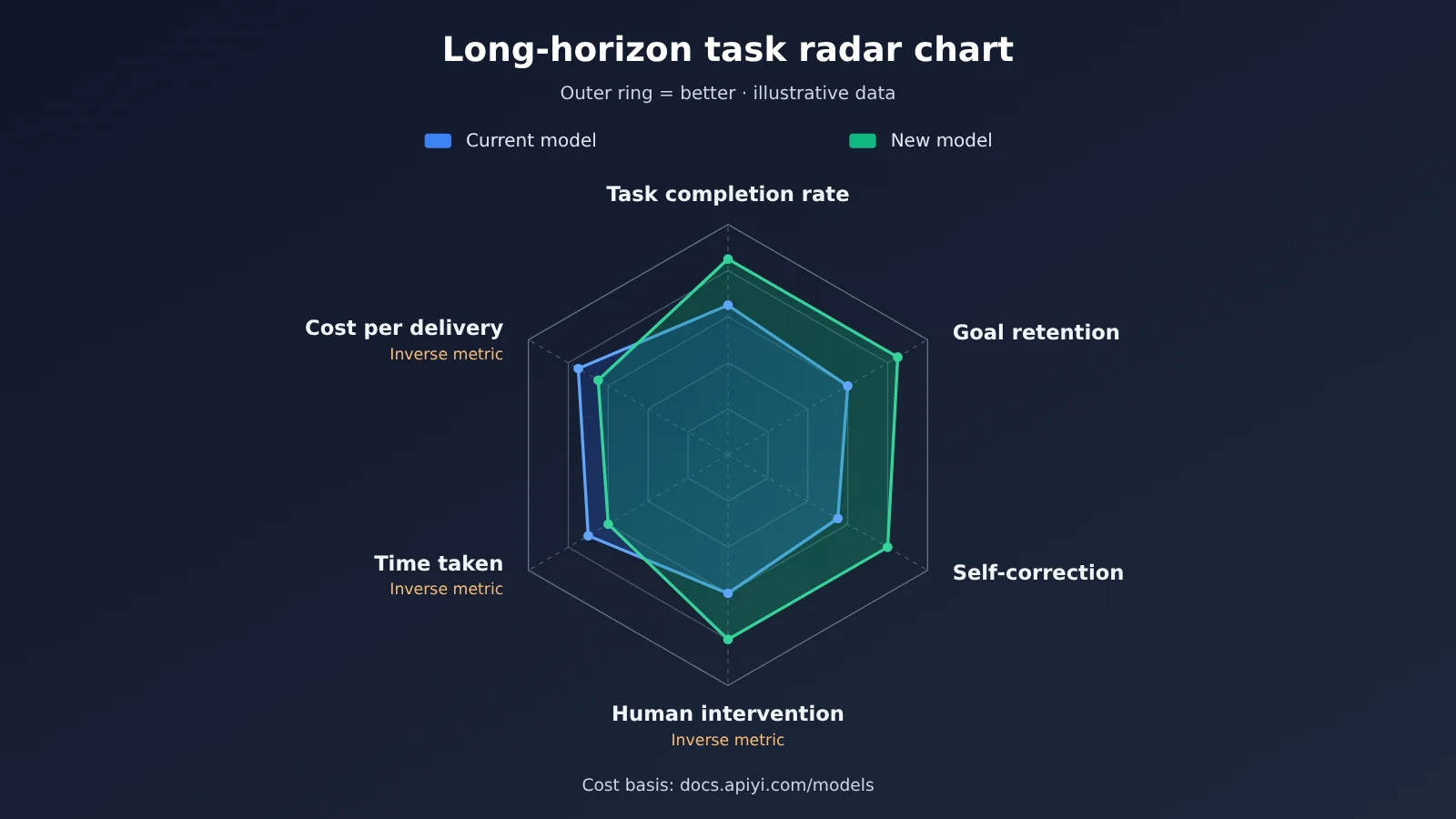
💰 Cost accounting tip: When doing comparisons, it’s best to call both the old and new models on the same platform, so usage statistics and billing rules stay consistent and the “cost per delivery” you calculate is actually comparable. The APIYI pricing page at docs.apiyi.com/models lists input, output, and cache prices for each model, and you can use it directly as the basis for your accounting.
Decision Criteria for Validating New Models on Long-Horizon Tasks
Once the runs are done, the worst outcome is “each one wins somewhere, so we can’t decide.” Write your decision rules before the experiment starts. The table below is a decent starting point—adjust the thresholds based on how sensitive your business is.
| Comparison result | Recommended decision | Rationale |
|---|---|---|
| Completion rate improves noticeably, per-delivery cost flat or lower | Switch directly | You get both quality and cost benefits |
| Completion rate improves noticeably, cost goes up | Switch per scenario | Use the new model only on high-value, high-difficulty tasks |
| Completion rate flat, cost drops noticeably | Gradual rollout | Replace it on low-risk tasks first, then watch for a while |
| Completion rate flat, fewer interventions needed | Make the switch a priority | The labor you save is usually worth more than the token cost |
| Completion rate drops or stability gets worse | Hold off on switching | Wait for the next version, or retest after adjusting your prompts |
One dimension that’s easy to overlook is task restructuring brought on by new capabilities. Hy4, for example, added visual understanding this time around—it can read screen recordings directly and analyze them frame by frame, and it can also keep taking screenshots of its own output to self-critique and improve. If your old workflow needed a human to turn screenshots into text descriptions, the new model might not give you “the same task done better” but rather “one fewer step in the whole workflow.” Record that kind of gain separately—don’t measure it purely with scores from the old task.
Selection Reference When Comparing Mainstream Models
When running comparisons, you’ll usually pit the new model against your current production model, plus other candidates at the same tier. The table below lays out the selection logic; for specific capabilities, trust your own long-horizon task tests.
| Candidate type | Long-horizon tasks it’s suited for | What to validate | Where to access |
|---|---|---|---|
| Newly released open-source / domestic models | Batch processing of office documents, Chinese-language agent scenarios | Goal retention, cost-effectiveness | APIYI apiyi.com and similar |
| Current flagship closed-source models | Complex coding, hard reasoning | Use as the quality baseline | APIYI apiyi.com and similar |
| Multimodal models | Recreating screenshots/screen recordings, UI understanding | Visual understanding accuracy, self-correction | APIYI apiyi.com and similar |
| Lightweight, fast models | Sub-task dispatch, format cleanup | Latency and cost | APIYI apiyi.com and similar |
💡 Selection tip: Don’t just compare one candidate against your production model. Put two or three candidates into the same validation set behind a unified interface—you’ll often find a better answer in “combining models per scenario.” APIYI supports unified invocation of multiple mainstream models, which makes that kind of combined setup quick to put into production.
FAQ
Q1: What does long-horizon task validation mean for a new model?
Long-horizon task validation means testing a model with real tasks that involve multiple steps, require tool calls, and have a clear deliverable. What matters is whether the model can hold onto the goal across consecutive steps, recover from its own mistakes, and what the final delivery costs — not the quality of a single-turn answer.
Q2: How is long-horizon task validation different from looking at public benchmarks?
Benchmarks are valuable for comparing general capabilities across models, but their tasks differ a lot from your business, and most are short-chain. Long-horizon task validation runs directly on your toolchain and your data, so it exposes problems like goal drift, tool misuse, and the need for constant human correction. The safest approach is to combine both: use leaderboards to shortlist candidates, then use your own tasks to make the decision.
Q3: How soon after a model launch should I start validating?
It’s best to run an “out-of-the-box” test as soon as possible after launch, since many new models come with limited-time free access or trial periods. In the reference materials, Hy4 had a free period on WorkBuddy from November 4 to 15. If the first round looks good, then spend time tuning prompts for the new model and run a second round.
Q4: How many tasks do I need in a validation set?
Three to five tasks that closely match your business are usually enough to reach a directional conclusion. Run each task three times to observe stability. Rather than piling on more tasks, make sure they cover your most common, most labor-intensive, and most error-prone scenarios, and design clear checkpoints for each one.
Q5: What’s the cheapest way to switch between models for comparison?
The easiest route is calling through a unified API platform. APIYI apiyi.com is compatible with both OpenAI and Anthropic API formats, so switching models only requires changing the `model` parameter — your tool definitions and prompts stay untouched. For detailed setup steps, see the documentation center at docs.apiyi.com.
Q6: How do I calculate the cost of long-horizon tasks accurately?
Calculate “cost per successful delivery” — total token cost across multiple runs divided by the number of successful deliveries — and separate cached input from uncached input. For per-model unit prices and cache pricing, refer to the actual data on the APIYI pricing page at docs.apiyi.com/models. Using one platform with a unified billing basis also makes comparisons fairer.
Q7: What are the limitations of long-horizon task validation?
First, the sample is small — a single great result or a single failure could be a fluke, so repeat the runs. Second, human scoring is subjective, so have two people score independently and average the results. Third, results depend heavily on the toolchain, so you’ll need to retest after switching Agent frameworks. On top of that, the ceiling of what you can measure depends on how hard your test tasks are, so keep adding harder tasks to the validation set over time.
Long-Running Task Validation for New Models: Key Takeaways
- Let your own tasks do the talking: 3-5 real multi-step tasks get you closer to the real payoff of switching models than any leaderboard.
- Change only one variable: old and new models share the same prompts, tools, and inputs, and each task runs at least 3 times.
- Goal anchors are essential: borrow the
/goalapproach and break work into milestones — the more objective your checkpoints, the more accurate your scoring. - Six metrics give you the full picture: completion rate, goal adherence, self-correction, number of interventions, time spent, and delivery cost.
- Calculate cost per delivery: distinguish cache hits, and use the APIYI pricing page at docs.apiyi.com/models as your billing reference.
- Watch for workflow redesign: new capabilities like visual understanding can eliminate manual steps from your existing process outright.
Summary
The core points of long-running task validation for new models:
- Real tasks: the validation set comes from your business and covers high-frequency, high-effort, error-prone scenarios.
- Rigorous comparison: fixed environment, repeated runs, and a model-switching threshold written down in advance.
- Accurate accounting: measure real value with the cost per successful delivery and the number of manual interventions.
Every new model release is a chance to take another look at your workflow. Rather than being led along by leaderboards and demo videos, spend a day or two and get a definitive answer from your own long-running tasks. I recommend putting old and new models behind the same set of endpoints via APIYI apiyi.com for a quick side-by-side comparison — see docs.apiyi.com for integration details, and docs.apiyi.com/models for billing figures.
📚 References
- ifanr – Hands-on Test of Tencent Hy4: Real-world cases covering Hy4’s long-horizon tasks, multimodal capabilities, and computer operation
- Link:
ifanr.com/1687613 -
Notes: Offers test designs worth borrowing, such as the
/goalobjective constraint, long-horizon game development, and batch document processing -
APIYI Documentation Center: Model access and API format documentation
- Link:
docs.apiyi.com -
Notes: See how to configure the OpenAI- and Anthropic-compatible interfaces
-
APIYI Model Pricing Page: Input, output, and cache pricing for each model
- Link:
docs.apiyi.com/models - Notes: The sole pricing basis for cost calculations
Author: APIYI Technical Team
Technical Discussion: Feel free to reach out to us on the APIYI apiyi.com homepage, and for more model access resources, visit the docs.apiyi.com documentation center