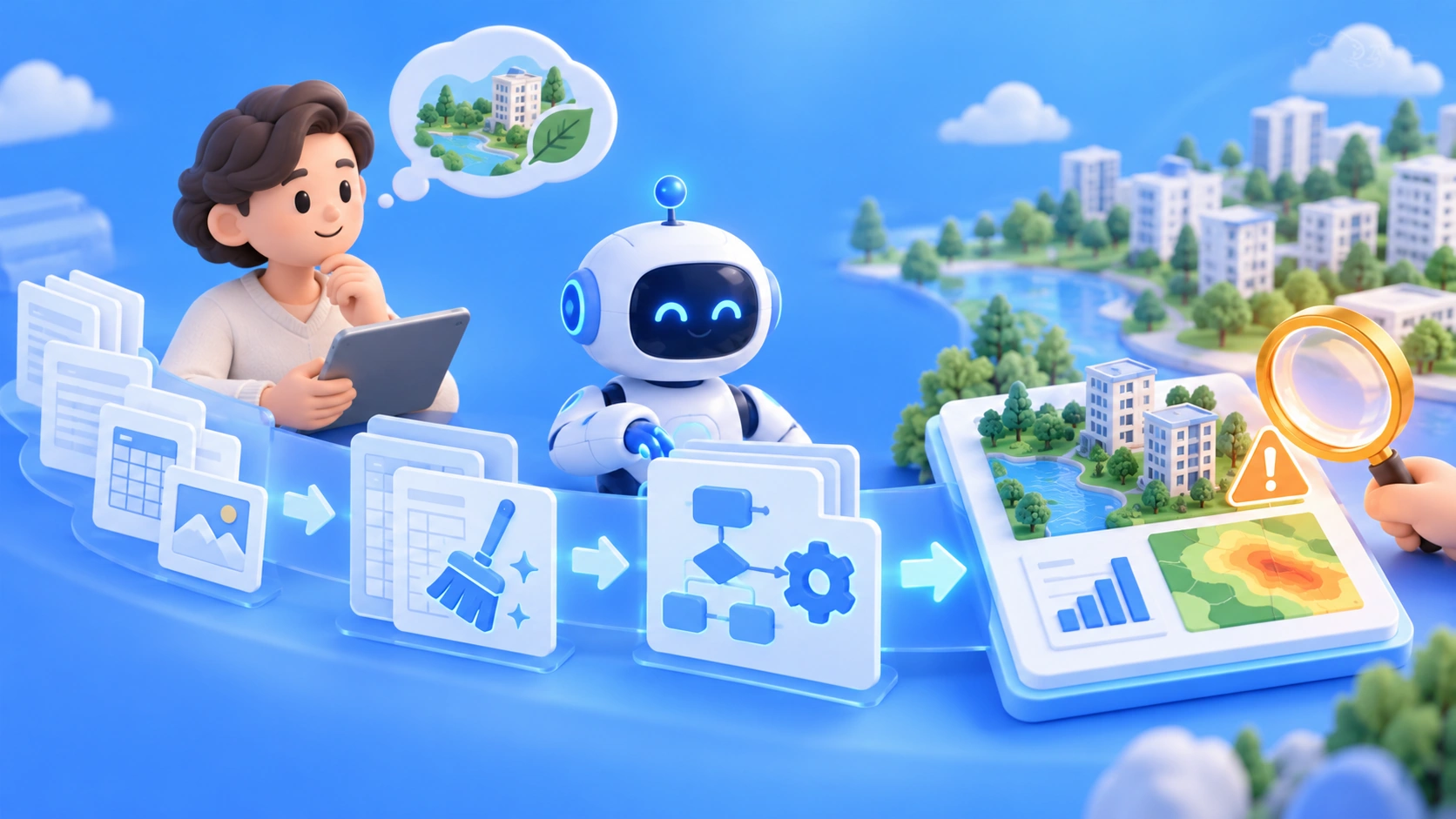
Author’s note: Using Heimstaden’s environmental risk assessment project as an example, this article breaks down how non-developers can work with Codex on data discovery, cleaning, and workflow building—and why ownership of the methodology and human validation must remain with domain experts.
Many business analysts know their industry but don’t write code. When a project involves data scattered across dozens of public sources in different formats, they’ve traditionally had to wait for a technical team or hire outside consultants. Drawing on a publicly documented real-world case, this article explores how non-developers can divide responsibilities with Codex when building data processing workflows, focusing on two non-negotiables: ownership of the methodology and human validation.
This isn’t a sales pitch claiming “AI can do everything for you.” The case includes some impressive numbers, but many details weren’t disclosed. We’ll clearly distinguish what’s known from what’s inferred.
What you’ll take away: You’ll learn which parts of a data project are well suited to a coding agent and which responsibilities you need to keep for yourself. You’ll also see how to turn a one-off analysis into a capability your team can keep improving.
Key Takeaways for Non-Developers Building Data Workflows with Codex
On November 3, 2026, OpenAI published a customer story about Heimstaden, a European residential real estate operator. One part features environmental sustainability analyst Julia Erlandsen, who had no software development background but used Codex to complete an environmental risk assessment across the entire portfolio. The table below highlights the most useful lessons from her experience.
| Key point | What the case says | Why it matters |
|---|---|---|
| The problem | The information existed, but it was scattered across public sources, formats, and datasets | Helps identify projects with fragmented data, which are well suited to agents |
| The agent’s role | Data discovery, cleaning and standardization, quality checks, and development of a repeatable workflow | Clarifies which tasks you can delegate |
| The expert’s role | The analyst remained in control of the methodology and validation | Protects the credibility of the conclusions |
| Scale of the results | Assessed 20,112 properties and generated more than 6 million rows of usable data | Shows that non-developers can work with data at a substantial scale |
| Long-term benefit | Turned a one-off project into a repeatable capability without relying on external consultants | Keeps the methodology in-house so the team can continue improving it |
How to Divide the Work in a Codex Data Workflow
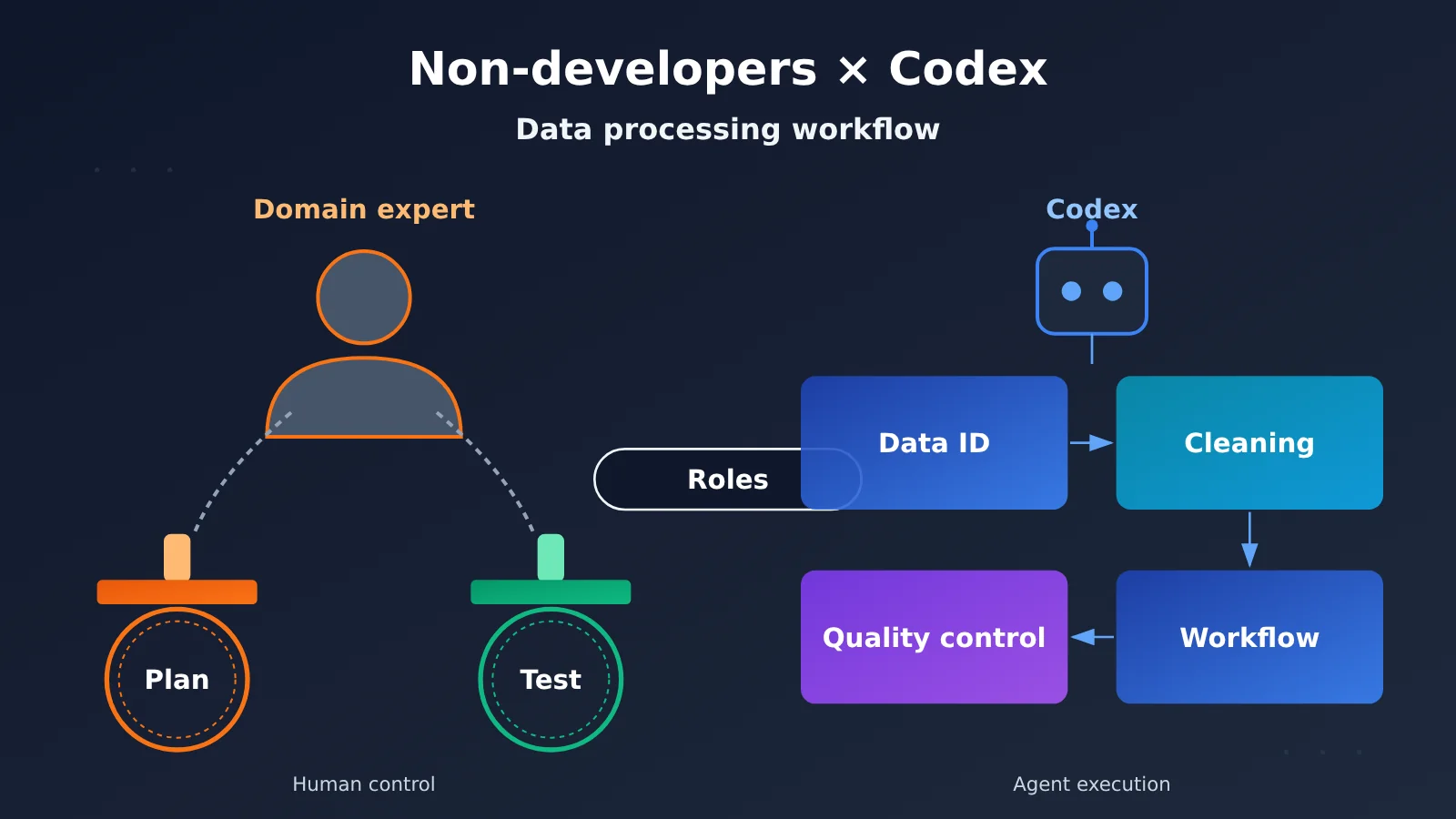
The most important point in the case is simple: Codex supported data discovery, cleaning, standardization, quality checks, and the development of a repeatable workflow, while Julia retained control over the methodology and validation. That draws a clear line. You can delegate the work of cleaning data and turning it into a runnable workflow to an agent. But decisions about which standards to use for judging risk, and whether the results are correct, must remain with people.
That distinction matters because the environmental risk assessment ultimately supports climate risk assessments, reporting compliance, and investment decisions. If the methodology is based on an agent’s default assumptions, the analyst can’t explain to investors or auditors how the conclusions were reached. Julia’s own words reinforce the point: “We now own the methodology and can continue developing it ourselves.” Here, “owning” means understanding and controlling the assessment logic—not just having a table of results.
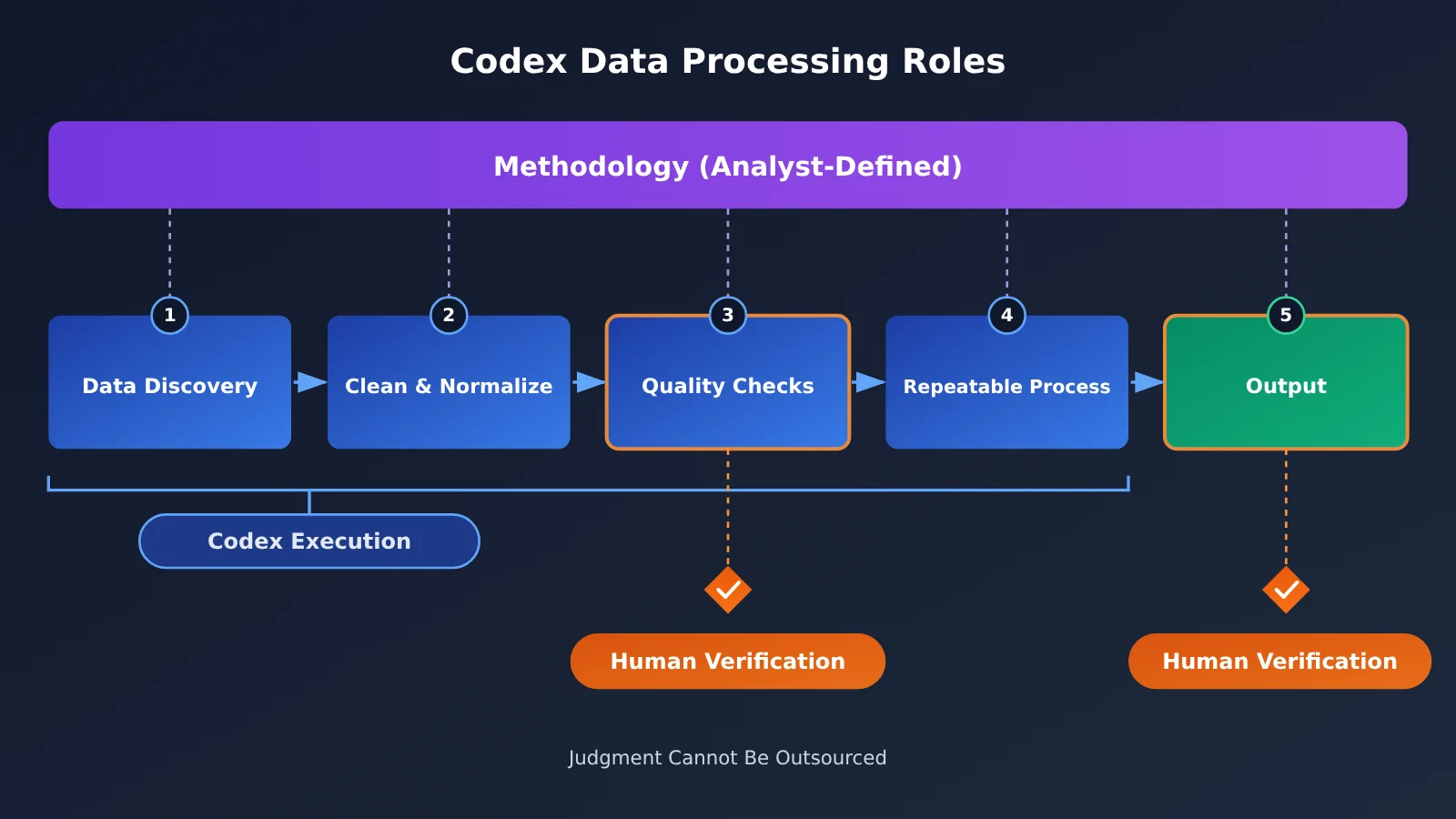
How Non-Developers Can Divide Responsibilities in a Codex Data Workflow
The case suggests a broader way to divide the work. The “Details disclosed in the case” column indicates whether the original article provided specifics. The suggested practices are based on common data project experience and don’t necessarily reflect how Heimstaden works.
| Stage | Coding agent handles | Domain expert retains | Details disclosed in the case |
|---|---|---|---|
| Data discovery | Searches for and lists candidate data sources; explains what fields mean | Determines whether sources are authoritative and fit for the assessment | Specific data sources not disclosed |
| Cleaning and standardization | Standardizes formats, units, encoding, coordinates, and address matching | Decides how to handle missing and conflicting values | Rules not disclosed |
| Quality checks | Writes automated checks and produces a list of anomalies | Defines what counts as an anomaly and reviews samples | Methods and error rates not disclosed |
| Workflow construction | Packages the steps into a repeatable workflow | Confirms that the workflow aligns with the methodology | Only described as “repeatable” |
| Methodology and conclusions | Performs calculations as instructed | Sets the assessment framework, weights, and thresholds, and takes responsibility for the results | Explicitly retained by the analyst |
From this table, we can draw five principles:
- Execution can be delegated; judgment can’t. An agent can turn a vague request to “organize the data” into concrete steps, but only someone with domain expertise can say whether a threshold is reasonable.
- Write down the methodology before handing it to the agent. The assessment framework should be a document you can explain on your own, not a collection of scattered instructions in a conversation.
- Validation needs an independent perspective. An agent checking a workflow it wrote will catch only some problems. Don’t skip human spot checks or comparisons against external benchmarks.
- The workflow must be repeatable. A one-off manual result can’t be iterated on; a workflow you can rerun is an asset.
- A person is always accountable for the conclusions. Heimstaden’s broader AI strategy also emphasizes that employees are responsible for reviewing and approving decisions, and AI-generated content must be checked by a person before it’s sent out.
🎯 Technical tip: If a step in your data workflow requires a Large Language Model—for example, to classify unstructured text descriptions by risk level—you can use APIYI at apiyi.com to call multiple mainstream models through the same interface. Having different models assess the same batch of samples makes it easier to spot systematic bias in any one model. That’s a low-cost form of validation in itself.
A Quick Start Guide to Data Processing with Codex for Non-Developers
The case study doesn’t disclose which version of Codex Julia used or how she interacted with it. So the steps below aren’t a recreation of her workflow. Instead, they draw on the way responsibilities were divided in the case and offer analysts without a development background a starting point. As requested, there’s no code here—just a checklist of what to give the agent and what to check yourself at each step.
Step 1: Write a Methodology Document in Plain Language
Before you start, document your evaluation approach in a file such as methodology.md. At a minimum, include the evaluation goals, required metrics, how each metric should be calculated, thresholds for risk levels, and rules for handling missing data. This document is your record of ownership over the methodology. Whenever you ask the agent to change the workflow, use it as the source of truth.
Step 2: Let the Agent Discover Data, but Make the Final Call Yourself
Tell the agent what you’re evaluating and ask it to list potential data sources, the fields each source contains, how often they’re updated, and their known limitations. Review each source to decide whether it’s authoritative and whether its coverage matches the distribution of your assets. Ask the agent to put the original downloaded data in a separate raw directory and never modify it. All subsequent processing should use copies.
Step 3: Clean and Standardize the Data, Keeping a Record of Every Change
Tell the agent your standardization rules—for example, consistent address formats, coordinate systems, units, and date formats—then ask it to create a processing workflow. The key requirement is that every transformation produces a change log: how many rows were deleted, how many records were merged, and which records couldn’t be matched. That way, you can use the logs to judge whether the processing was reasonable without having to understand the code.
Step 4: Run Two Layers of Quality Checks
The agent handles the first layer. Ask it to write automated checks for duplicates, missing values, out-of-range values, failed asset matches, and other issues, then produce a list of exceptions. You handle the second layer: randomly sample some assets from the results and check them manually using a method you’re familiar with. Document the sampling rate and tolerance criteria in the methodology document beforehand, and record them separately in a table such as validation_log.
Step 5: Turn the Process into a Repeatable Workflow
Once you’re confident in the results, ask the agent to turn the entire process into a workflow that can be rerun with one click and write operating instructions. The instructions should be clear enough for a colleague who doesn’t know how to code to follow. Only then does the project become a reusable capability rather than a one-off analysis.
| Stage | What You Give the Agent | Outputs You Must Check | Common Risks |
|---|---|---|---|
| Methodology | Assessment goals and industry knowledge | The methodology document you wrote | Vague metric definitions lead to repeated rework |
| Data discovery | Goals and scope of coverage | Source list and limitations | Using unreliable or outdated data |
| Cleaning and standardization | Standardization rules | Change log for each step | Data is silently deleted, making the results look clean |
| Quality checks | Exception definitions and sampling rate | Exception list and manual sampling results | Trusting automated checks alone and missing systematic errors |
| Workflow implementation | Run and update requirements | Repeatable workflow and operating instructions | Only the agent “remembers” how to run the workflow |
🚀 Quick start: If step 3 or 4 requires a Large Language Model to interpret text fields—for example, to parse descriptive risk information in public reports from different countries—try comparing several models on a small sample through APIYI apiyi.com first. Choose the most consistent one before adding it to the production workflow, rather than betting the entire dataset on a single model from the start.
Comparing the Codex Data Processing Workflow with Other Approaches
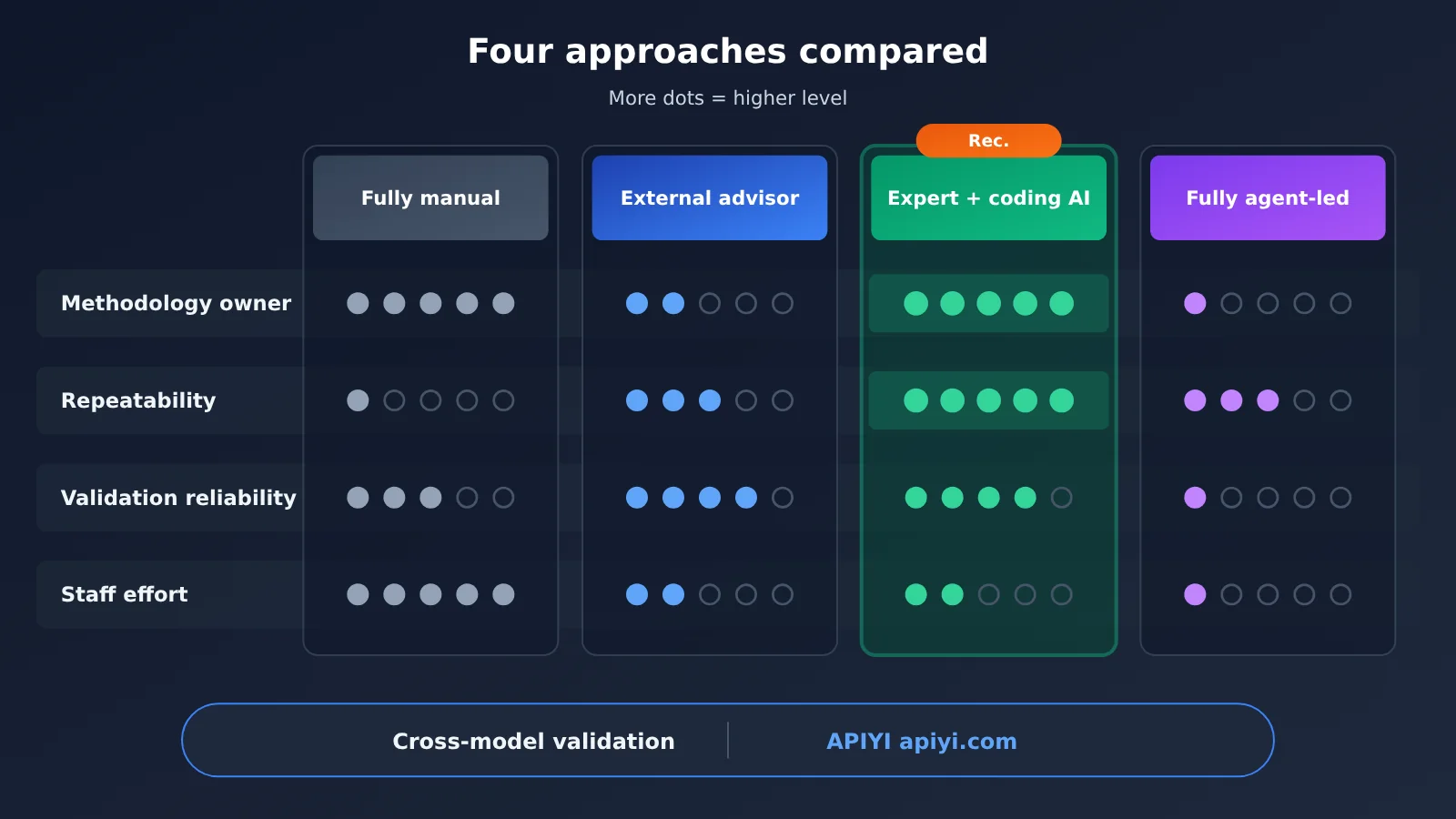
| Approach | Methodology ownership | Repeatability | Validation reliability | Main issue |
|---|---|---|---|---|
| Fully manual processing | With the expert | Low; often difficult to rerun | Depends on individual diligence | Labor-intensive; the case estimate was 5 people working for 1 year |
| External consultants | Often with the consultants | Medium; depends on consultant deliverables | Relatively high, but not transparent | Subsequent iterations require purchasing services again |
| Expert + coding agent | With the expert | High; the workflow can be rerun | High, provided human validation is thorough | Requires experts to clearly articulate their methodology |
| Fully delegated to an agent | Unclear; implicit in default assumptions | Medium | Low; conclusions are difficult to trace | Difficult to stand behind the conclusions externally |
Understanding the Comparison
Comparison with external consultants: External consultants offer advantages in professional experience and delivery speed. But the methodology often stays with them, so updating the assessment the following year means going through the discussion and payment process again. By contrast, the “expert + coding agent” approach keeps the methodology within the organization. Heimstaden also explicitly noted that the project avoided the need to hire external consultants.
Comparison with fully delegating to an agent: Handing the entire project to an agent looks like the easiest option and produces results quickly. But the agent will make its own assumptions about many details, such as how to fill in missing values or remove outliers. Those assumptions may not align with industry practice. For assessments that need to support reporting compliance and investment decisions, such conclusions may not hold up under scrutiny.
The staffing savings need to be viewed objectively. The original article says the “estimated delivery requirement” fell from 5 people working for 1 year to 2 people working for 2 months. In person-months, that’s roughly 60 versus 4. But this was the company’s own estimate, wasn’t independently verified, and didn’t explain how the work was divided between the two people.
💡 Recommendation: If your team already has a methodology but lacks the technical capacity to execute it, “expert + coding agent” is the approach most worth trying. For parts of the workflow that require model invocation, you can use APIYI apiyi.com’s unified interface to switch between and compare models, without rewriting the entire workflow when you change models later.
What We Know and Don’t Know About the Codex Data Processing Case
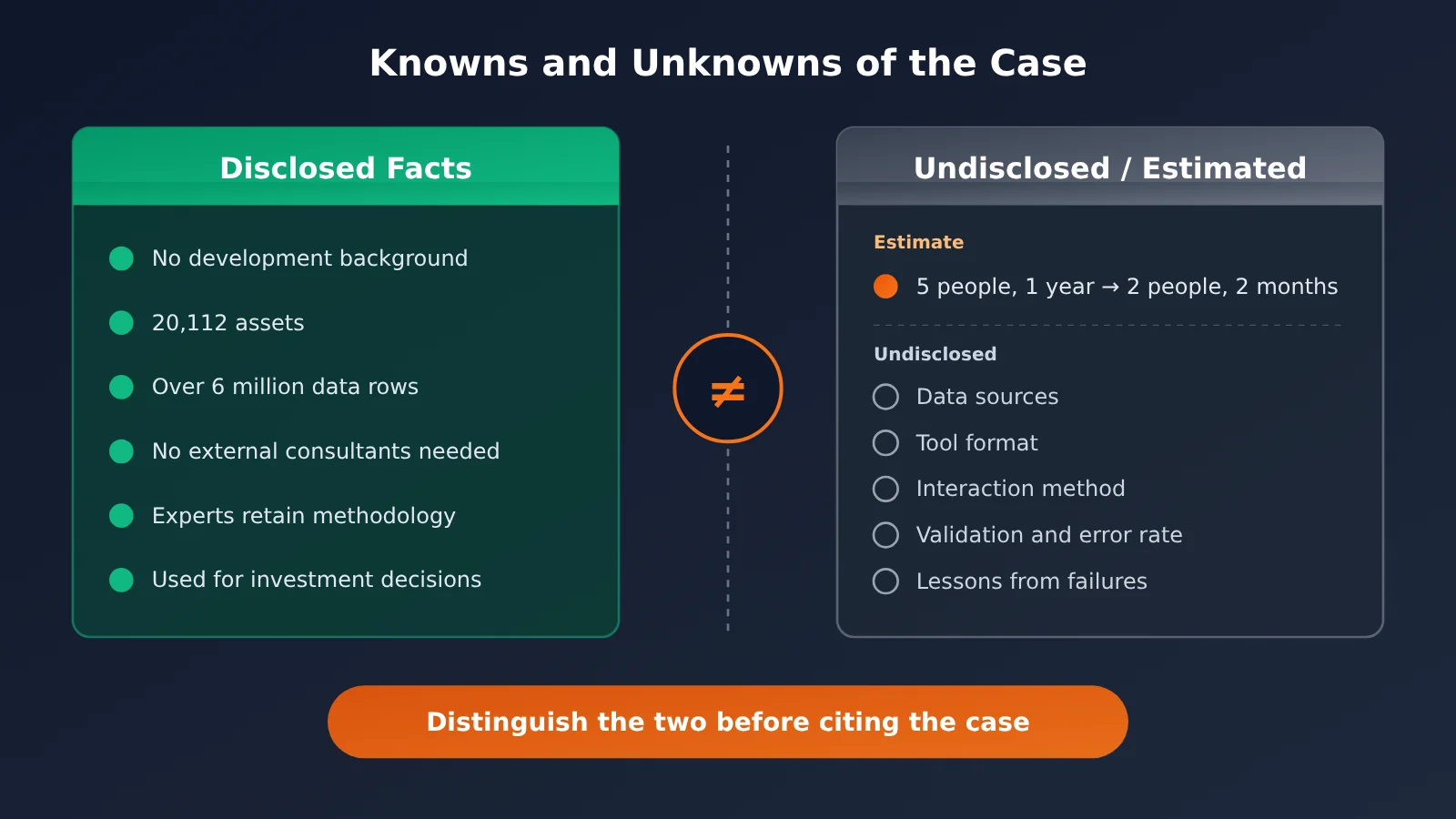
To avoid reading too much into the case, let’s separate what the original article explicitly states from what it doesn’t disclose.
| Category | Details |
|---|---|
| Disclosed | The analyst had no software development background; Codex supported data discovery, cleaning and standardization, quality control, and workflow development; the analyst retained responsibility for methodology and validation; 20,112 assets were assessed, producing more than 6 million rows of data; no external consultants were needed; the results supported climate risk assessment, reporting, and investment decisions |
| Estimated | The company estimated that delivery requirements fell from 5 people working for 1 year to 2 people working for 2 months |
| Not disclosed | Specific data sources; how Codex was used (desktop, CLI, or otherwise); interaction methods and workflows; specific validation methods and error rates; difficulties and failures encountered during use |
These gaps don’t diminish the value of the case’s approach to dividing responsibilities, but they do mean you can’t assume the same efficiency gains for your own project. In practice, you’ll likely spend more time refining your methodology and validating results manually than getting an agent to write a workflow. One takeaway from Heimstaden’s leadership is worth remembering: AI can’t fix a bad process, but it can significantly amplify a good one.
Frequently Asked Questions
Q1: What does it mean for non-developers to build data processing workflows with Codex?
It means a domain expert with no programming background describes their requirements to a coding agent in natural language. The agent handles technical tasks such as fetching, cleaning, and checking data, and building the workflow. The expert defines the methodology and verifies the results. Heimstaden’s environmental risk assessment project is a public example.
Q2: How is this different from asking ChatGPT questions about data?
A question-and-answer approach usually addresses a one-off problem, and the results can be hard to reproduce. A coding agent can produce a workflow that runs repeatedly. You can rerun it when the data changes and modify it when the methodology changes. That’s what the case study means by turning a complex analysis project into a repeatable capability.
Q3: When was this case study published?
OpenAI published the case study on November 3, 2026. It reflects recent enterprise use of coding agents. Specific figures and tools may change over time, but the division of labor—letting agents handle execution while experts retain judgment—has more lasting value.
Q4: What kinds of data projects are best suited to this division of labor?
– **Integrating public data from multiple sources**: Datasets on the environment, climate, or population spread across different organizations
– **Periodic reporting**: Compliance and disclosure reports repeated every quarter or year
– **Portfolio-wide batch assessments**: Scenarios where thousands of records need to be scored against consistent criteria
Q5: How can I get started quickly if my workflow needs to use Large Language Models?
You can register with APIYI at apiyi.com and use the same interface to call several mainstream models. Compare their classification or extraction results on a small batch of representative samples. Once you’ve confirmed that the results are stable and consistent with your criteria, integrate them into your production workflow. Comparing multiple models can also help support human validation.
Q6: How thorough should human validation be?
The case study doesn’t disclose the validation methods or error rates. A general approach is to set sampling rates and error tolerance thresholds in advance, review every anomaly flagged by automated checks, randomly sample results marked as normal, and compare them against known external benchmarks. Keep all validation records for future audits.
Q7: What are the limitations of this approach?
First, the efficiency figures are company estimates that haven’t been independently verified. Second, non-developers still need to be able to articulate their methodology clearly; otherwise, the agent will only amplify the confusion. Third, the case study doesn’t discuss difficulties or failures. In practice, a workflow may fail in ways that are hard to understand, and technical colleagues may still need to help troubleshoot.
Q8: Why is it so important to own the methodology?
When the team owns the methodology, it can modify and explain it directly the next time data is updated, regulatory requirements change, or investors ask follow-up questions—without going back to a consultant. That’s the long-term autonomy Julia was referring to when she said, “We now own the methodology and can continue to develop it ourselves.”
Key Takeaways: Codex Data Processing for Non-Developers
- Define the division of labor: Let agents handle data discovery, cleaning, quality checks, and workflows; leave methodology and validation to experts.
- Start with methodology: Document the evaluation framework first, then have the agent follow it.
- Validate independently: Automated checks, manual sampling, and comparisons against external benchmarks are all essential.
- Make it repeatable: A workflow you can rerun is an asset; a one-off result can’t be iterated on.
- Treat the numbers with caution: The reduction from five people working for one year to two people working for two months is an estimate, not a figure to apply directly.
- Use model comparisons to support validation: For steps that require a Large Language Model, APIYI’s unified interface can help cross-check results across multiple models.
Summary
For non-developers building data processing workflows with Codex, the most useful takeaway isn’t the efficiency figure—it’s the clear division of labor:
- Agents handle execution: Data discovery, cleaning and standardization, quality checks, and repeatable workflows can all be delegated to agents.
- Experts make the judgment calls: Defining the methodology and validating results are fundamental to credible, explainable conclusions.
- Build lasting capability: Keeping ownership of the methodology and making workflows repeatable turns a one-off project into an organizational capability that can keep improving.
If you’re working on a project where data is scattered and technical resources are hard to secure, try documenting the methodology first, then start with a small pilot. For steps involving Large Language Model invocation, you can use APIYI apiyi.com to compare multiple models through a unified interface, adding another layer of support to manual validation.
📚 References
- OpenAI Customer Story – Heimstaden: How Heimstaden uses ChatGPT and Codex to transform residential property management
- Link:
openai.com/index/heimstaden/ - Note: The sole source for the case study facts in this article, including the division of responsibilities and estimates for the environmental risk assessment project
Author: APIYI Technical Team
Technical inquiries: Contact us through the APIYI homepage. For more model integration resources, visit the docs.apiyi.com documentation center.