
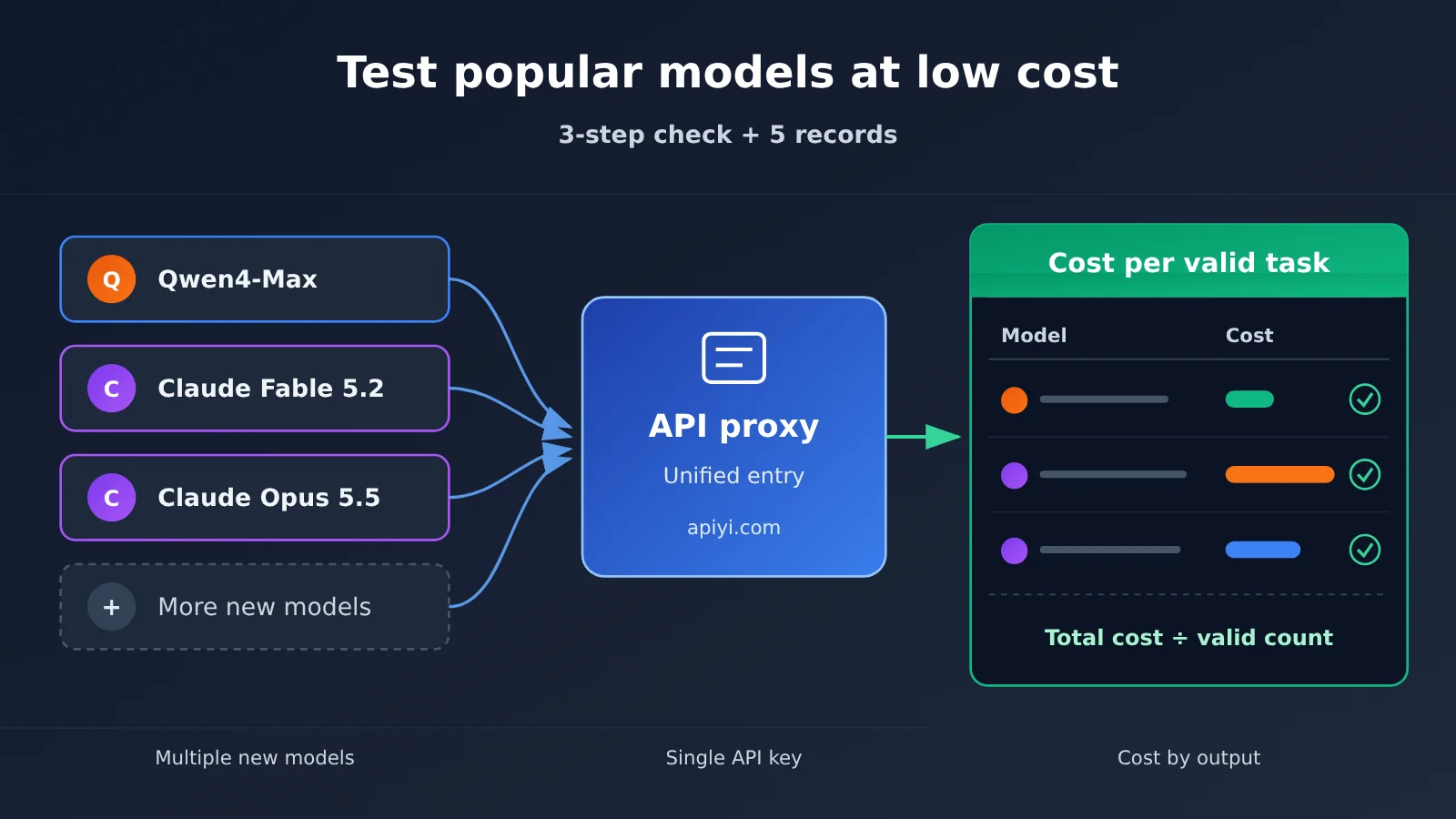
When a bunch of new models launch at once and you want to test the popular ones on a small budget, the easiest approach is to use a single unified API proxy service entry point for access. That saves you from registering with each provider and configuring a separate SDK for every one. A unified entry point only solves “how to connect,” though—it doesn’t answer “which one should I choose.” The right order is to first check the model catalog, key permissions, and endpoints, then compare qualified output and total spend using the same set of real tasks. This article uses APIYI (apiyi.com) as an example to walk through a low-budget trial workflow with clear acceptance criteria.
What will you learn from this article?
- The exact model IDs, available endpoints, and groups for Qwen4-Max and Claude Fable 5.2 in the current catalog.
- A reusable baseline integration snippet, plus a way to first check “which models this key can see.”
- How to control trial costs with small sample tasks, usage records, and billing—and how to make trade-offs based on “cost per qualified task.”
Index: The “Objective facts” section first lists catalog entries, access conditions, and trial policies as of 2026-11-17, and explains who the pricing and leaderboard scores in third-party materials belong to. The “Analysis and judgment” section covers three things: how to design same-prompt mini-samples, how to track costs, and the gap between being visible in the catalog, a successful call, and qualified output. It ends with a record sheet for readers to fill in themselves.
Key Concepts: What You Need to Know Before Testing Popular Models with an API Proxy Service
| Concept | Brief explanation |
|---|---|
| API proxy service | A gateway that routes model requests from multiple providers through a single service entry point |
| Model ID | The string used in a request to precisely specify a model, such as qwen4-max |
| Endpoint | The specific request path for a service capability, such as chat, responses, and messages |
| Token group | Configuration that defines which model channels a given key can access and which billing multiplier is used for settlement |
| usage | Usage record in the response, used to verify the tokens actually consumed by this request |
| Cache read | Reusing an already processed input prefix; its price may differ from that of new input |
| Cost per qualified task | Total cost of all attempts ÷ number of tasks that ultimately meet the acceptance criteria |
At a Glance: What Testing Models on an API Proxy Service Means for Different Groups
- Developers onboarding for the first time: one Base URL and one key let you switch models without reconfiguring accounts and SDKs across multiple platforms.
- Teams with existing products: you can test new models against your own acceptance criteria instead of relying on someone else’s leaderboard conclusions; however, parameters such as tool calling, vision, and reasoning still need separate adaptation.
- Budget-conscious individual users: first limit the number of tasks and input length, then calculate based on “usable output.” Don’t look only at the price per million tokens.
The Facts: The Current Popular Model Catalog and Access Conditions at API Proxy Services
What’s in the Catalog: Entries for qwen4-max and claude-fable-5-2
APIYI’s publicly available machine-readable model registry (docs.apiyi.com/model-registry.json) says its data source is the platform pricing API and that it was generated at 2026-11-17T07:54:33Z. The table contains 285 model records. Note that this is the number of catalog records, not the number of models actually available to a given account. The three entries relevant to this article are as follows:
| Exact model ID | Catalog endpoint | Group (machine ID) | Catalog list price: Input / Output / Cache read (USD per million tokens) |
|---|---|---|---|
claude-fable-5-2 |
chat / messages | ClaudeCode / ClaudeCodeReverse / ClaudeOfficial / default / svip | 8 / 40 / 0.2 |
claude-opus-5-5 |
chat / messages | ClaudeCode / ClaudeCodeReverse / ClaudeOfficial / default / svip | 4 / 20 / 0.2 |
qwen4-max |
chat / responses / messages | ClaudeCode / CodexResponses / default / svip | 1.5 / 4.5 / 0.075 |
All of the above are catalog list prices as of 2026-11-17, not the amount an account actually pays. Final billing is also affected by factors such as token group. Also, earlier blog posts and old announcements once said these two models “were not yet listed.” Those statements only reflect the situation at the time they were published and can’t be used to conclude whether the models can be invoked today.
The registry lists a reverse group (ClaudeCodeReverse) for Fable, but early announcements and the FAQ did not make that group available. So this article uses the default or ClaudeCode group as an example and does not guarantee that the reverse group is usable. If you need the official forwarding channel, keep an eye on the ClaudeOfficial group in the Fable entry.
How to connect: Base URL and visibility check
The quickstart docs (docs.apiyi.com/getting-started, retrieved on 2026-11-17) give the following base configuration:
- Base URL for the OpenAI-compatible SDK:
https://api.apiyi.com/v1 - Base URL for the Anthropic SDK:
https://api.apiyi.com - First call
GET /v1/modelsto check which models your current API key can see, then choose a compatible endpoint.
Both models support the chat endpoint, so the examples below use OpenAI-compatible Chat Completions. First confirm the model is visible, then send the shortest possible request and print the usage:
from openai import OpenAI

client = OpenAI(
    api_key="YOUR_API_KEY",
    base_url="https://api.apiyi.com/v1",  # APIYI OpenAI-compatible endpoint
)

visible = {m.id for m in client.models.list().data}
for model in ["qwen4-max", "claude-fable-5-2"]:
    if model not in visible:
        print(f"{model}: 本密钥不可见,检查令牌分组")
        continue
    r = client.chat.completions.create(
        model=model,
        messages=[{"role": "user", "content": "用一句话解释什么是API中转站。"}],
        max_tokens=100,
    )
    print(model, r.usage, r.choices[0].message.content)
Trial Credit: Check the Current Quick Start Page
The current Quick Start page states that a registered account comes with a $0.05 trial credit—enough to verify your first call without topping up. The older card claim of “3 million tokens free on sign-up” no longer applies; go by the rules shown on your account page. One more note: I didn’t make any paid model calls while writing this article. Every “cost” figure here is an estimate based on catalog list prices, not an actual bill.
What the Unified Interface Shares—and What It Doesn’t
According to the APIYI text generation capability docs, the unified chat interface is good for comparing the parts that are shared: text input and output. The caller is responsible for organizing the history of multi-turn conversations. Different models still differ in capabilities, reasoning settings, and optional parameters, so needs like tool calling, vision input, and reasoning intensity each require separate adaptation. Simply swapping the model field won’t get you out of that work.
How to Read Third-Party Sources: OrcaRouter’s Pricing and Benchmark Scores
Most of the recent English-language discussion about these two models comes from a blog post by another routing provider, OrcaRouter (published 2026-11-16). Here are the key points:
- Release dates: Qwen4-Max became generally available on 2026-11-16; Claude Fable 5.2 launched on 2026-11-09. The so-called “Claude Fable 5.5” doesn’t appear anywhere in Anthropic’s official model list.
- Benchmark scores and cost per task: The Artificial Analysis data cited in the post (accessed 2026-11-17) puts Qwen4-Max at a composite index of about 42.9, with a measured cost of $3.27 per index task. Fable 5.2, at its default medium tier, scores 56.4 at $3.80 per task. The post also notes that Qwen4-Max tends to generate a higher volume of output tokens during evaluations.
- Preview retirement: Preview IDs such as
qwen4-max-previewwill be discontinued on 2026-11-25 24:00 (UTC+8). After that, the official ID that remains isqwen4-max.
All of these figures belong to that provider and the corresponding third-party evaluation. They’re neither APIYI’s pricing nor a conclusion we measured ourselves. What makes them useful is the way of thinking they offer: a low unit price doesn’t mean a low cost per task.
Analysis: How to Test Popular Models at Low Cost with an API Proxy Service
Define the Task and Acceptance Criteria First, Then Run the Same-Question Sample
A unified entry point pushes integration cost close to zero, so the real cost shifts to “what to test.” We recommend picking 3–5 small tasks from real needs, and locking down the input version, pass criteria, and judgment basis for each one. For example, “the output must be parseable JSON containing 5 fields,” or “the summary must not omit any of the 3 numbers in the source text.” If you don’t write the criteria down beforehand, you’ll end up at the finish line with nothing but “which one feels better.”
Next, send the same input to each candidate model and keep the judgment rules consistent: empty responses, format errors, and truncation all count as failures. For parameters, start with a common minimal set — only model, messages, and max_tokens. Requirements like tool calling, vision, and reasoning effort get their own separate round of testing, so you don’t mistake “the parameters weren’t set right” for “the model is no good.”
🚀 Getting started tip: You can run the first sample round with the trial credits that come with signing up at APIYI apiyi.com. First confirm that two or three candidate models are visible and callable under your API key, then decide whether to top up and expand the test scope.
Counting Every Attempt: Cost per Qualified Task
Log the input, output, and cache reads from usage on every request (if the response returns that field) — retries and failed requests included. The core metric is cost per qualified task = total spend across all attempts ÷ number of qualified tasks. If you only count the one successful attempt, you’ll systematically underestimate models that are “cheap but need a few retries.”
Here’s a purely arithmetic estimate based on list prices (not actual billing — grouping coefficients will change the result). Assume each request uses 2,000 input tokens and 500 output tokens:
| Model | Input cost | Output cost | Per-request estimate | What $0.05 roughly covers |
|---|---|---|---|---|
qwen4-max (1.5 / 4.5) |
$0.003 | $0.00225 | about $0.0053 | about 9 calls |
claude-fable-5-2 (8 / 40) |
$0.016 | $0.02 | about $0.036 | about 1 call |
Two takeaways from this table. First, trial credits are enough to verify “does it work at all,” but a real quality comparison needs a bigger budget. Second, if a model actually produces longer output, or needs two retries before it passes, its per-token advantage gets wiped out — exactly the pattern the third-party sources mentioned earlier describe. So control your budget at two levels: cap it with your account balance and the per-call max_tokens, start with short text, and only move to long context once you’ve confirmed the pass rate.
Here’s a ready-to-reuse logging script that writes every attempt to a CSV, so you can compute cost per qualified task later:
View the sample logging script for the same tasks
import csv, time
from openai import OpenAI

client = OpenAI(api_key="YOUR_API_KEY", base_url="https://api.apiyi.com/v1")

MODELS = ["qwen4-max", "claude-fable-5-2"]
TASKS = [
    {"id": "t1", "prompt": "把下面的会议记录整理为 JSON:...", "check": lambda s: s.strip().startswith("{")},
    # Add 2–4 more real tasks, each with its own check function
]

with open("trial_log.csv", "w", newline="", encoding="utf-8") as f:
    w = csv.writer(f)
    w.writerow(["model", "task", "attempt", "prompt_tokens", "completion_tokens",
                "cached_tokens", "passed", "latency_s", "error"])
    for model in MODELS:
        for t in TASKS:
            for attempt in range(1, 3):  # retry at most once; log failures too
                start = time.time()
                try:
                    r = client.chat.completions.create(
                        model=model,
                        messages=[{"role": "user", "content": t["prompt"]}],
                        max_tokens=800,
                    )
                    text = r.choices[0].message.content or ""
                    u = r.usage
                    details = getattr(u, "prompt_tokens_details", None)
                    cached = getattr(details, "cached_tokens", 0) if details else 0
                    ok = bool(text) and t["check"](text)
                    w.writerow([model, t["id"], attempt, u.prompt_tokens,
                                u.completion_tokens, cached, ok,
                                round(time.time() - start, 2), ""])
                    if ok:
                        break
                except Exception as e:
                    w.writerow([model, t["id"], attempt, 0, 0, 0, False,
                                round(time.time() - start, 2), str(e)[:120]])
What a Unified Entry Point Saves You—and What It Can’t
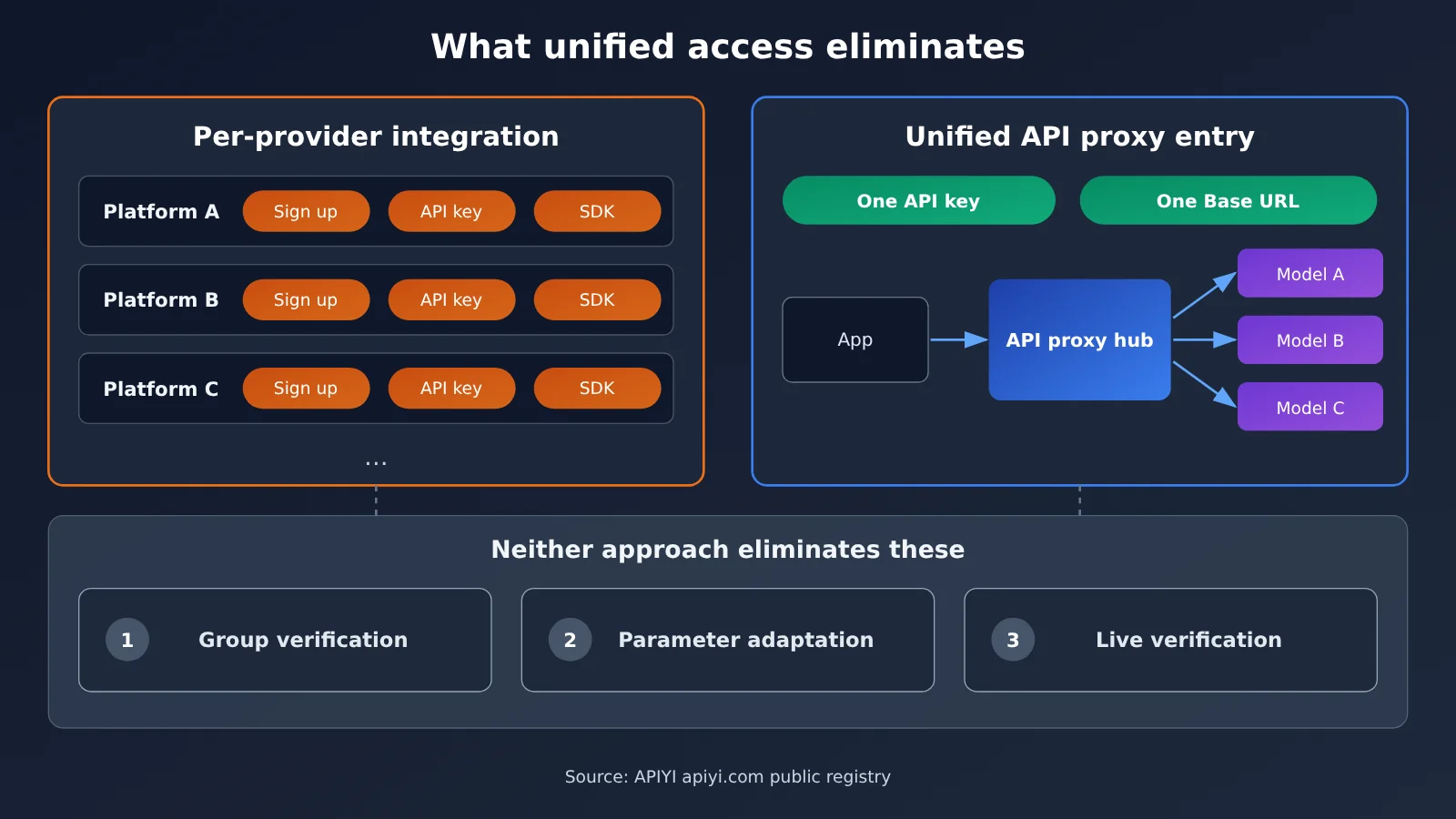
A unified entry point saves you the duplicate accounts, API keys, and SDK configuration. What it can’t save you is three things:
- Groups and visibility: just because it’s in the catalog doesn’t mean your key can see it.
- Parameter adaptation: non-public parameters have to be handled model by model.
- Result validation: being able to see a model doesn’t mean the call succeeds or the output is any good.
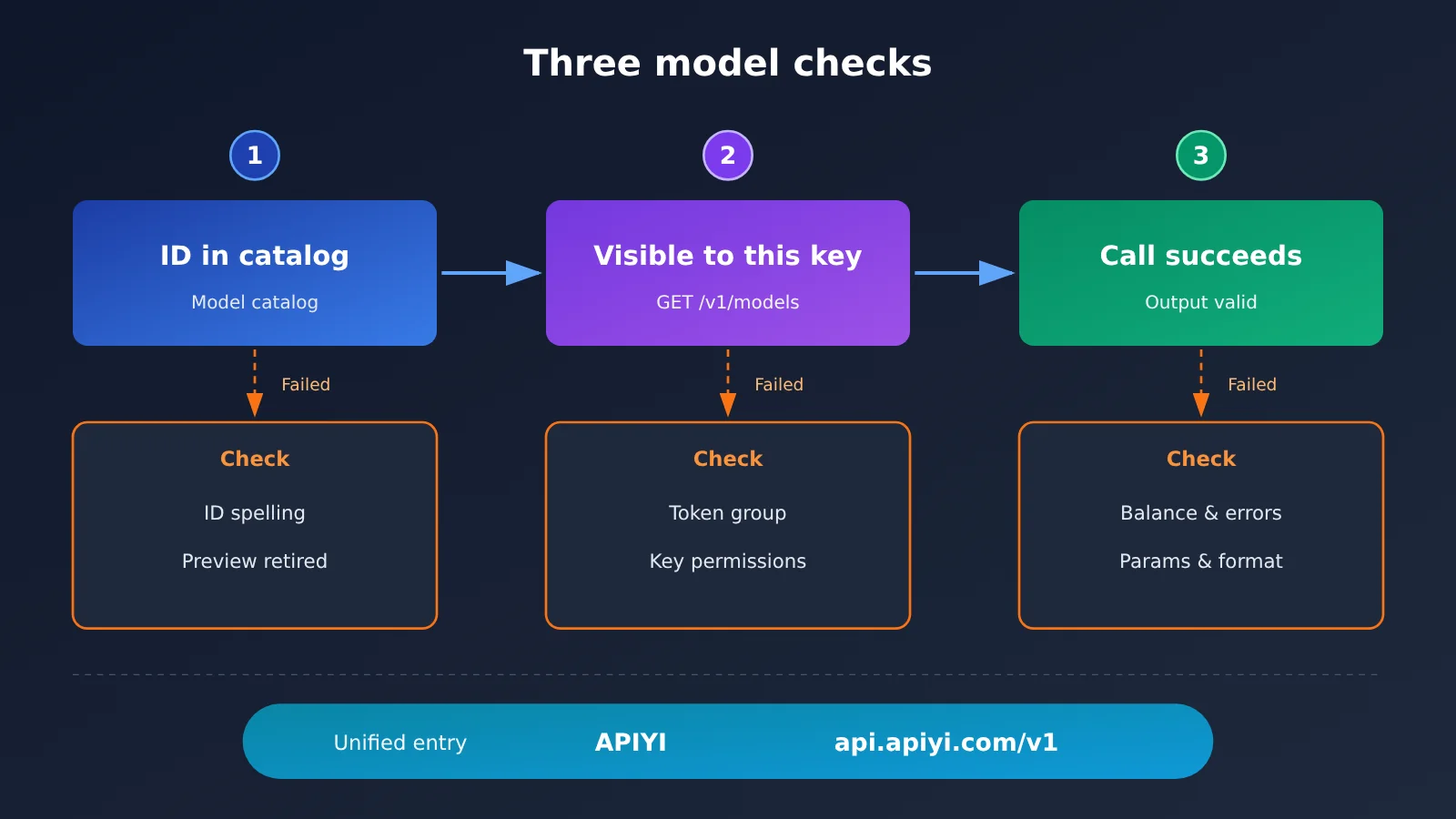
Catalog visibility, key visibility, successful invocation, and acceptable output are four gates you pass in sequence, and each one needs its own verification. You can tick these off one by one while testing:
| Check | How to verify | Common cause of failure |
|---|---|---|
| The model ID exists in the catalog | Look it up in the public registry and confirm the ID is spelled exactly right | You used a preview ID or an alias |
| Visible to this key | Call GET /v1/models |
The token group doesn’t include that channel |
| Endpoint compatibility | Compare against the endpoint column in the catalog | You used chat to call a capability that only supports responses |
| The call succeeds | Fire off the shortest possible request | Insufficient balance, or the parameters aren’t supported |
| The output is acceptable | Check it against a preset pass/fail rule | Wrong format, truncation, empty response |
💡 Recommendation: In the APIYI apiyi.com console, create a dedicated token just for testing and tick only the groups the test needs. That way your billing and usage stay separate from production traffic, and it’s easier to work out the cost per acceptable task after the fact.
The Conclusion Table Is Yours to Fill In
We’re not going to rank qwen4-max against claude-fable-5-2 by quality here. We haven’t run experiments on your tasks, and third-party leaderboards don’t represent your business either. The more reliable approach is to run a small pilot, fill in the table below yourself, and then decide:
| Model | Attempts | Passes | Total spend (use your invoice as source of truth) | Cost per passing task | Parameters needing extra adaptation |
|---|---|---|---|---|---|
| qwen4-max | |||||
| claude-fable-5-2 | |||||
| Your current model |
Two suggestions, both judgment calls rather than verified conclusions. First, put your current model in the same table. A new model is worth switching to only when it clearly wins on “cost per passing task” or “pass rate.” Second, in the early days after a new model launches, IDs, prices, and parameter limits can all change—the preview ID mentioned earlier being retired on November 25 is one example. Write model IDs into a config file instead of hardcoding them, and keep a fallback path.
If you need to widen the candidate pool, you can keep adding new models through APIYI apiyi.com’s unified entry point and rerun them with the same tasks and pass/fail rules. Leaderboards and catalogs can only tell you which models are worth a try. Which model truly fits your business is a question only the table you run yourself can answer. As Lu You wrote in “Reading Books to Ziyu on a Winter Night”: “What you get from paper is always shallow; to truly know a thing, you must put it into practice.”