
How to choose between APIYI official relay and reverse channels: the direct answer
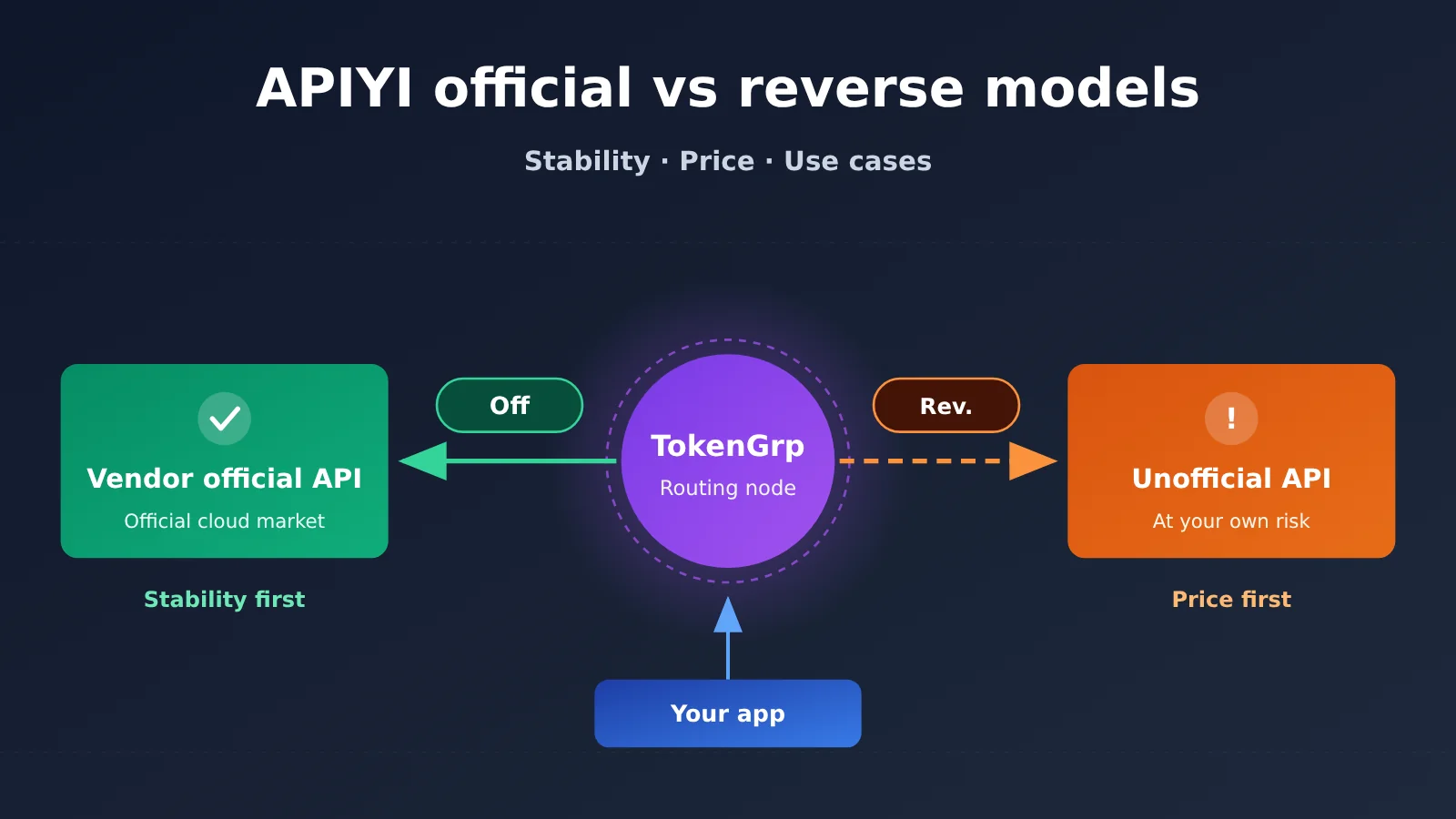
For production environments and complex Agent tasks, prefer official relay. Reverse channels are better suited to non-critical, cost-sensitive tasks. Official relay uses the vendor API or official cloud marketplace resources directly, while reverse channels obtain invocation capability through unofficial interfaces. Their risk sources are different.
Don’t choose based only on the “official relay” or “reverse channel” label, and don’t choose based only on the group name. What you ultimately need to compare is: for the same specific model, the same group, and the same set of real tasks—after accounting for retries—how much each valid output actually costs and how long it takes.
What you’ll learn from this article
- Tell “group” and “model” apart: why the same group may contain both official-relay and reverse-engineered models.
- Understand the difference dimensions between official relay and reverse channels listed in APIYI’s public documentation, and what the public SLA actually covers.
- Use the two real incidents on November 12 and 13, 2026 to understand the failure modes each type of channel can have.
- Get an acceptance log template so you can compare candidate channels with real tasks instead of making decisions based on list price.
Index for Choosing Between Official Proxy and Reverse-Engineered Channels
The “Objective Facts” section covers, in order: how channels and groups are classified, the publicly available dimensions of feature differences, the timeline of two real operational incidents, and the conditions under which the public compensation mechanism applies. The “Analysis and Judgment” section discusses how to make trade-offs for three use cases — production Agents, ordinary chat, and enterprise procurement — explains why a low list price doesn’t mean low cost, and closes with an acceptance-recording method plus a ready-to-run recording script.
To Know: Concepts Related to Official Proxy and Reverse-Engineered Channels
| Concept | Brief Explanation |
|---|---|
| Official Proxy | A channel that forwards requests to the vendor’s official API or official cloud marketplace |
| Reverse-Engineered | A channel that obtains model invocation capability through a non-official interface |
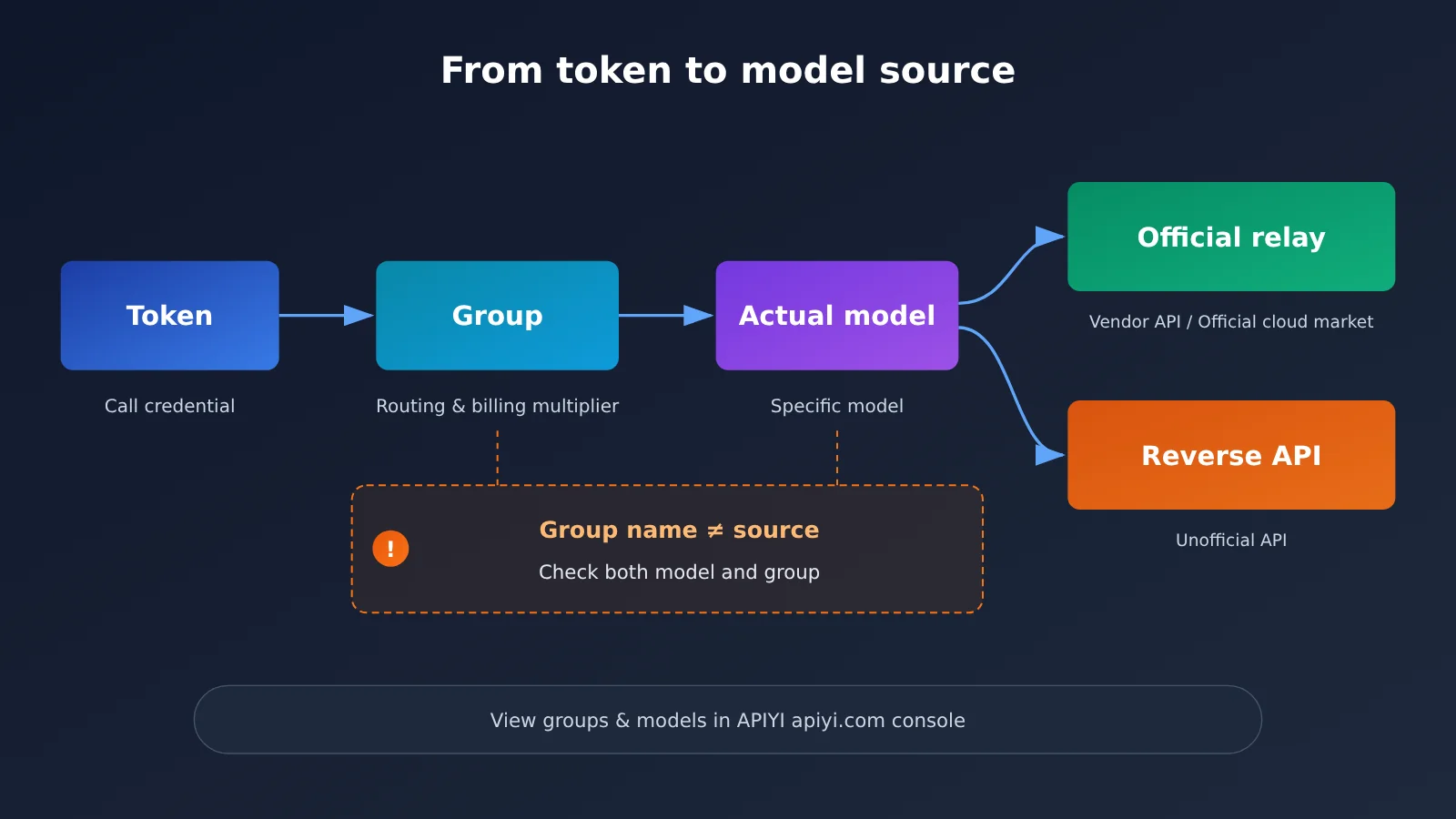
| Group | The routing and billing channel used by the token; which models you can actually call also depends on the model filled in the request |
| Tool Calling | The model requests external tools to perform actions using structured parameters; it’s a foundational capability for Agent tasks |
| Prefix Caching | Reusing identical leading content across requests to reduce repeated computation and billing |
| SLA | The scope of guarantees, responsibilities, and compensation conditions agreed upon in a contract or service description |
| P95 Latency | The response time that 95% of samples fall below; used to monitor slow requests |
Quick Look: How Official-Route vs. Reverse-Engineered Access Affects You
- Developers running production workloads: Before you compare prices, first check whether tool calling, structured output, caching, and failover actually meet your task requirements.
- Enterprise procurement teams and technical leads: The public pages don’t make a single availability commitment that covers every model, so you’ll need contract terms that apply to your specific project.
- Non-critical personal or internal tasks: Reverse-engineered access can be a way to cut costs, but compare it on effective output cost — including retries.
The Facts: What APIYI Publicly Says About Official-Route vs. Reverse-Engineered Access
The facts in this section come from public pages in the APIYI documentation center, verified on 2026-11-17 (Beijing time). The feature comparison below is the platform’s own description as a provider, not a third-party head-to-head review. Archived records show that the “Group Introduction Page and Official-Route vs. Reverse-Engineered FAQ” was published on 2026-11-14 at 23:38.
The Difference Between Official Relay, Reverse, Groups, and Models
According to the public FAQ definitions, official relay uses vendor APIs or official cloud marketplace resources, while reverse uses unofficial interfaces. There’s one easy-to-miss point: channel attributes belong to the specific model, not the group. The documentation explicitly states that Default and SVIP groups also include image models from both official and reverse channels, so you can’t tell where an image comes from just by looking at the group name.
A group is the invocation channel for a token and affects three things: which models can be called, how requests are routed, and the billing multiplier. The documentation’s recommended order for choosing a group is: first confirm which groups support the target model, then match the use case, compare prices, and finally configure a backup channel. One account can split multiple tokens by use case; final pricing is based on what the console displays.
| Group positioning (public description) | Main use | What to check when choosing |
|---|---|---|
| Default | General invocation | The group may contain both official-relay and reverse models; confirm each specific model |
| ClaudeCode | Anthropic-format coding calls | Adapted for coding tools; the format differs from OpenAI-compatible APIs |
| Enterprise group / image-only group | Has independent resource positioning | The archive includes enterprise groups with multipliers; pricing is subject to the console |
| Groups with “Reverse” in the name | Reverse resource groups that have appeared in the archive | The discount was part of the announcement at the time and may be adjusted later; confirm in the APIYI apiyi.com console |
The public FAQ’s description of reverse coverage for the Fable series doesn’t match the current registry. This article makes no promise that this series can actually be called in reverse groups; rely on the models actually available in the console.
Functional Differences Between Official Relay and Reverse Channels
The public comparison lists the following acceptance dimensions and stresses that conclusions must be tied to specific models and groups. The platform’s position: for production environments and complex agents, prioritize official relay; reserve reverse channels for non-critical, cost-sensitive tasks. Real-world experience also has to be verified separately by channel, time window, and task.
| Dimension | What to check during acceptance |
|---|---|
| Parameter passthrough | Whether parameters like temperature and max_tokens take effect as-is |
| Streaming response | Whether chunked output is stable and first-token latency is acceptable |
| Tool call structure | Whether the tool_calls field is complete and multi-turn calls error out |
| JSON constraints | Whether structured output passes schema validation |
| Context limit and reasoning control | Whether long inputs get truncated and reasoning tiers take effect |
| Multimodal | Whether image and video inputs are recognized correctly |
| usage / error codes | Whether token counts can be used for reconciliation and error codes distinguish retryable from non-retryable |
| Cache prefix | Whether repeated prefixes hit the cache and are billed at the cache price |
| Capacity and resource continuity | Whether 429s or queuing occur frequently during peak hours |
Timeline of Two Real Incidents (November 2026)
The two incidents below are real operational records, not controlled experiments. They only show the state of a given channel at a given point in time and can’t be used to estimate long-term availability.
| Time (UTC+8) | Channel / Model | Incident | Platform’s official statement |
|---|---|---|---|
| 2026-11-12 17:15 | GPT Image 2.6 official relay | Error rate rose, stuttering occurred | Caused by an OpenAI upstream failure; some of the other channels listed at the same time were still usable |
| 2026-11-12 17:48 | GPT Image 2.6 official relay | Recovered | Incident lasted about 33 minutes |
| 2026-11-13 13:16 | Three GPT Image -vip official-reverse lines | Saturated, frequent 429s and queuing | Account pool replenishment was blocked; recommended using official relay or 2.6-all as fallback |
Looking at these two incidents together, the conclusion is clear: official relay is equally affected by upstream fluctuations, while the bottleneck for reverse channels lies more in account pool capacity. Similar records exist in the archive — for instance, on 2026-10-15 a DeepSeek official relay timeout was traced to a vendor-side failure, and the same day, when -vip load ran too high, the platform recommended falling back to official relay first.
Public Compensation Mechanism and Applicable Conditions
The public SLA page states: for issues attributable to the platform, the platform will review the logs and issue replacement credits; designated high-volume image customers with monthly spend above $10,000 can request a billing review and compensation when they hit clearly abnormal charges. Enterprise contracts can specify coverage scope, availability, response times, and compensation caps.
The page does not provide a unified contract table of monthly availability, P95, or MTTR covering every official-relay and reverse-engineered model. The 300 seconds mentioned on the page is only one example of abnormal billing—it’s not a compensation promise for time-limited image generation.
Analysis and Judgment: How to Choose Between APIYI Official Relay and Reverse-Engineered Models
This section is the author’s judgment based on the facts above and does not represent a commitment from the platform.
Choosing Between Official Routing and Reverse-Engineered Routes in Three Scenarios
Production Agents: Multi-turn agent tasks depend on tool-call structure, JSON constraints, and cache prefixes. If any one of these is unstable, the entire task chain has to rerun. Public documentation lists these dimensions as the basis for prioritizing official routing, so for production agents, use official routing as the primary channel. At the same time, configure a backup group; remember, though, that a backup group only solves the problem of “having a channel available”—the backup model’s format and output still need separate acceptance testing.
General Chat and Non-Critical Tasks: For single-turn conversations, internal drafts, batch rewriting, and similar tasks, retrying after a failure is cheap, so reverse-engineered groups are a good fit for reducing costs. The -vip saturation incident on November 13 is a reminder that reverse-engineered routes may see concentrated 429s during certain periods, so it’s best to give them a fallback of official routing or another model.
Enterprise Procurement: The compensation mechanism described on the public page only covers issues “attributable to the platform” and designated high-volume image customers; it can’t be treated as a general SLA. For projects that require explicit availability and compensation terms, contract terms should be negotiated for the specific models involved in the project.
Why a Low Sticker Price Doesn’t Equal Low Cost
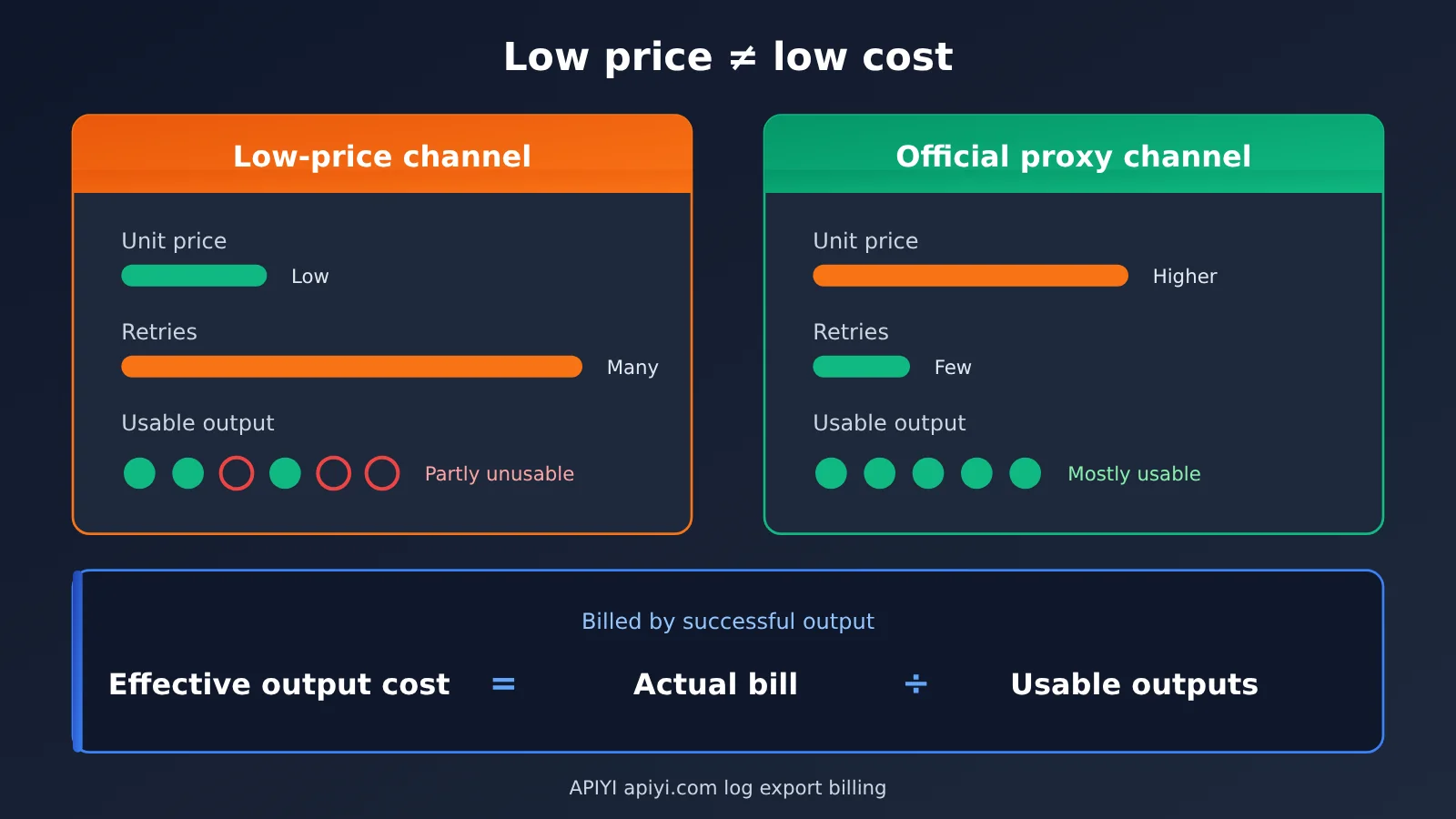
Sticker prices are calculated per request, but what businesses really care about is how much it costs to successfully complete each task. If a channel has a low unit price but requires multiple retries—or has incomplete tool-call fields that force the entire Agent run to start over—its effective cost per output can actually be higher. The same goes for image tasks: queuing and 429s stretch out total time, and in scenarios with delivery deadlines, that time is a cost too.
Conversely, for offline batch tasks that can tolerate failures and aren’t time-sensitive, the discount from reverse-engineered groups is a real saving. So the sensible approach isn’t to say broadly that “official relays are expensive and reverse-engineered channels are cheap,” but to calculate costs separately by task type.
Validating Candidate Channels with Real Tasks
Below is the acceptance log table suggested in this article. It’s not measured data, and no availability rate is filled in. Chat, tool calling, structured output, and image tasks should be tracked separately. If the sample size is too small or doesn’t cover outage windows, record only the events and method—don’t write conclusions like “stability is X% higher.”
| Record field | How to fill it in |
|---|---|
| Fixed task set | The same set of prompts and inputs, e.g. 50 tool-calling cases |
| Date and time window | Cover peak and off-peak periods, note UTC+8 |
| Model / group | Specify the exact model and token group, e.g. a test token split out in the APIYI apiyi.com console |
| Total attempts / usable outputs | Retries count in the denominator; usable = passes format validation or manual acceptance |
| TTFT / total latency / P95 | For streaming tasks, record time to first token; for image tasks, record total duration |
| Actual spend | Use billing or log-based charges; divide by usable outputs to get cost per successful output |
You can automate the record-keeping with a short script. Groups are bound to tokens, so you can create one token per candidate group and cycle through the same task set:
import time, openai

# Create one token per candidate group in the APIYI console
CANDIDATES = {"official": "KEY_OFFICIAL_GROUP", "reverse": "KEY_REVERSE_GROUP"}
MODEL = "your-model-name"  # Enter the model actually available to that group in the console

def run(group, key, prompt, max_retry=3):
    client = openai.OpenAI(api_key=key, base_url="https://api.apiyi.com/v1")
    for attempt in range(1, max_retry + 1):
        t0 = time.time()
        try:
            r = client.chat.completions.create(model=MODEL,
                messages=[{"role": "user", "content": prompt}])
            return {"group": group, "attempts": attempt,
                    "latency": round(time.time() - t0, 2),
                    "usage": r.usage.model_dump() if r.usage else None,
                    "ok": bool(r.choices[0].message.content)}
        except Exception as e:
            last = str(e)
    return {"group": group, "attempts": max_retry, "ok": False, "error": last}

for g, k in CANDIDATES.items():
    print(run(g, k, "用 JSON 返回北京今天的三条出行建议"))
View the version with tool-call validation
import json, time, openai

client = openai.OpenAI(api_key="YOUR_API_KEY",
                       base_url="https://api.apiyi.com/v1")  # APIYI unified interface

tools = [{"type": "function", "function": {
    "name": "get_weather",
    "parameters": {"type": "object",
                   "properties": {"city": {"type": "string"}},
                   "required": ["city"]}}}]

def check_tool_call(model):
    t0 = time.time()
    r = client.chat.completions.create(
        model=model, tools=tools,
        messages=[{"role": "user", "content": "查一下上海天气"}])
    calls = r.choices[0].message.tool_calls or []
    valid = False
    if calls:
        try:
            valid = "city" in json.loads(calls[0].function.arguments)
        except json.JSONDecodeError:
            valid = False
    return {"model": model, "tool_call_valid": valid,
            "latency": round(time.time() - t0, 2)}

print(check_tool_call("your-model-name"))
🚀 Validation tip: First create a test token for the official group and the reverse group in APIYI apiyi.com, run the same batch of tasks, and then check the actual charges in the console logs—that’s more reliable than judging by list prices. New users can complete this step with the free trial quota first.
After the run, combine the charges from the logs with the attempt counts recorded by the script to get cost per successful output for each group. If an upstream outage happens later, the live updates in APIYI apiyi.com’s docs center will publish the status of the corresponding channels. You can use that to decide whether anomalous samples should be excluded or annotated separately.
The following is a prediction and has not yet been verified: As vendors continue to adjust risk controls and resources, capacity on reverse-engineered channels is likely to keep fluctuating in phases, and official-proxy channels will also continue to be affected by upstream incidents. So it’s not a good idea to treat an acceptance test record as a one-and-done artifact and then file it away. After each model upgrade or group adjustment, I recommend rerunning the tests.
💡 Selection tip: The same account can hold both official-proxy tokens and reverse-engineered tokens at the same time, routing tasks according to how business-critical they are. For specific model coverage and current rate multipliers, refer to the APIYI apiyi.com console.
A selection guide can tell you which dimensions are worth looking at, but which channel actually fits your business can only be answered by your own tasks, bills, and latency records. As Lu You wrote in “Reading Books on a Winter Night to Show My Son Ziyu”: “What you learn from books is shallow; to truly understand something, you must practice it yourself.”
Author: APIYI Technical Team
Technical support: For questions about group and model configuration, feel free to contact us via the APIYI apiyi.com homepage. For more materials, check the docs.apiyi.com documentation center.