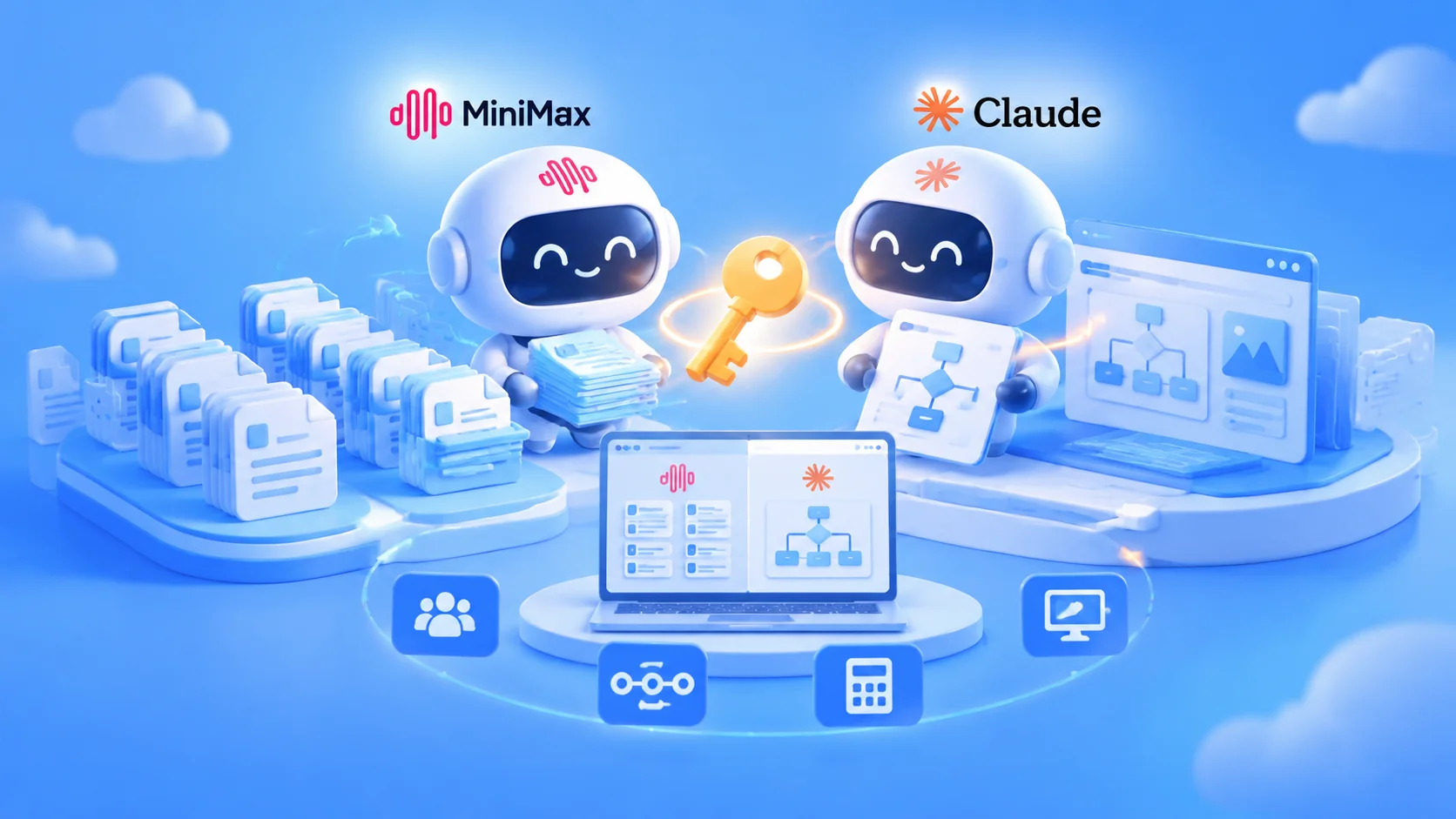
Summary: Compare the combinations available in China across three layers—models, coding agents, and API channels—then choose a replication plan that fits you based on real coding tasks, cost, and compatibility.
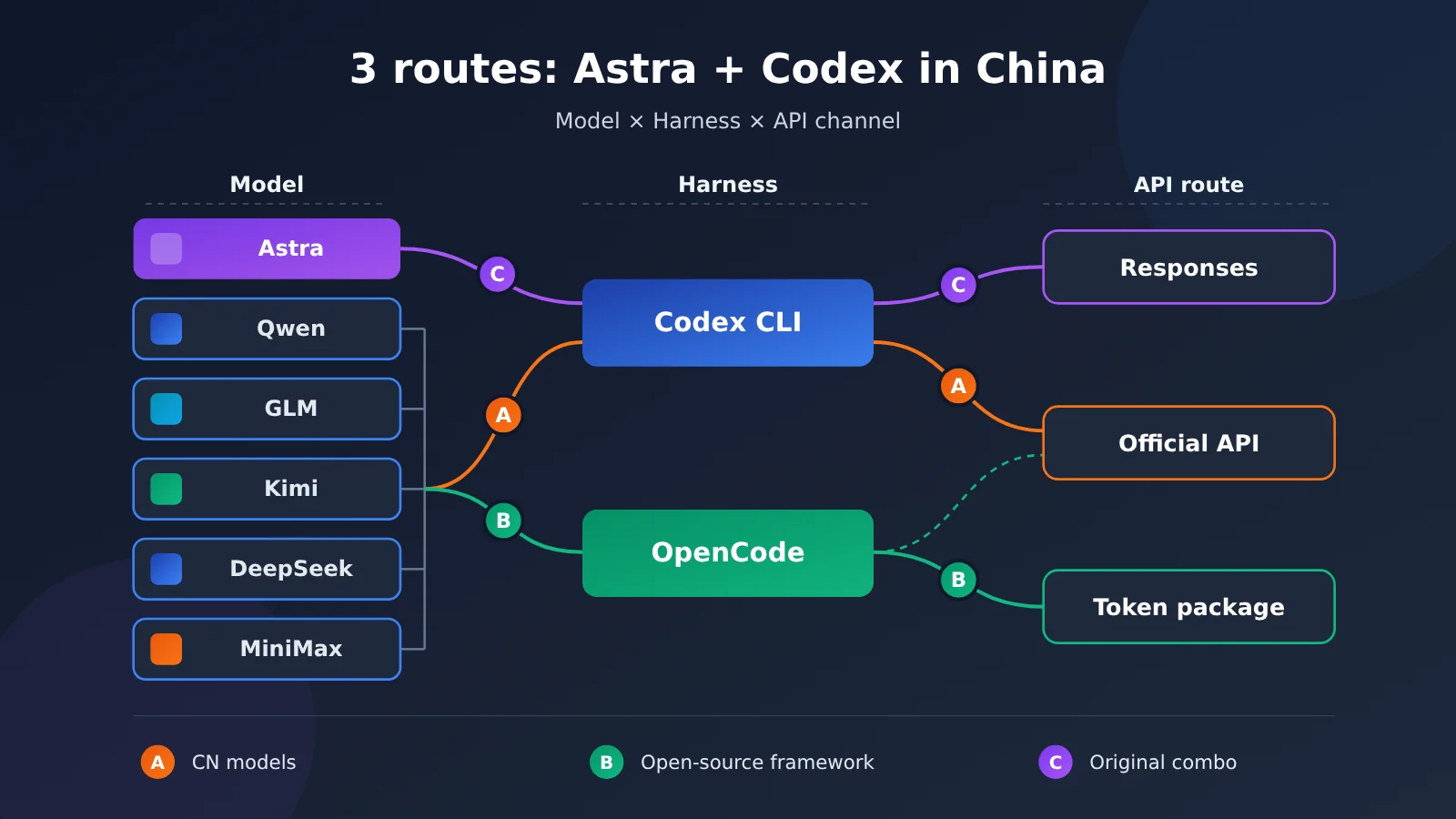
To replicate Astra + Codex in China as closely as possible, there are three routes worth testing. Route A: keep the original Codex CLI and connect domestic flagship models through the Responses-compatible interfaces from Alibaba Cloud Bailian or Tencent Cloud TokenHub—this route preserves Codex’s execution experience. Route B: switch to an open Harness such as OpenCode and connect multiple domestic models—this route gives you the most freedom in model choice. Route C: provided it’s legal and compliant and the service is actually available, keep the GPT-6 Astra model and connect the original Codex through an API channel that fully supports the Responses protocol—this route has the highest fidelity to the original combination.
If you require domestic models, Route A is the starting point. Qwen4-Max-Preview is only available until 24:00 on November 25, 2026, so it’s suitable for evaluation but not as your only long-term dependency. If you only need to use it within China’s network environment and don’t require domestic models, Route C comes closest to the original in model intelligence. The final trade-off among the three routes should be decided by the success rate, time, cost, and tool compatibility of the same set of real coding tasks—not by leaderboards or per-token pricing.
The rest of this article first breaks Astra + Codex into five capability components to explain what “replication” actually replicates; then presents two official access configurations and plan comparisons for Route A, four Harnesses for Route B, and domestic models worth testing first; next, a summary table captures the trade-offs among the three routes; finally, it provides a reproducible testing method across five task types, using “cost per successful task” as the core selection metric.
To Know: Terminology Primer
| Term | Explanation |
|---|---|
| GPT-6 Astra | OpenAI’s flagship reasoning model, built for complex reasoning, software engineering, and long-horizon agent tasks. Its model ID is gpt-6-astra. |
| Codex | OpenAI’s coding agent. It can read projects, modify code, run commands, and verify results. |
| Harness | The execution framework that connects model decisions to real tools. It handles the tool loop, context, permissions, and failure recovery. |
| Responses API | The API protocol OpenAI provides for model output, reasoning, and tool calls. Newer versions of Codex rely on it to run. |
| Chat Completions | OpenAI’s older chat API protocol. Older versions of Codex use it. |
| Provider | A vendor that supplies model services to agent tools; in config files, it appears as a set of access parameters. |
| Base URL | The base access URL for the model service API. It’s the main setting you change when switching channels. |
| Token Plan | A billing scheme where cloud providers offer monthly plans with model invocation quotas. |
| Credits / Points | The unit used to deduct invocation quota within a plan. Units from different providers can’t be directly exchanged. |
| Context window | The maximum amount of content a model can handle in a single request, measured in tokens. |
| Reasoning level | A parameter that controls how deeply the model thinks. Astra offers five levels, from low to max. |
| Cache hit | When repeated input is reused by the server and billed at a lower rate. |
| MCP | An open protocol that connects model applications to external tools and data sources. |
| Function Calling | A mechanism where the model outputs a structured call request, the application executes the function, and the result is sent back. |
| Peak/off-peak billing | Time-based pricing where peak hours consume more quota. |
Main Content
1. What Makes Astra + Codex So Strong?
1.1 What Astra Provides
GPT-6 Astra is OpenAI’s flagship reasoning model. Its official positioning covers complex reasoning, software engineering, multi-step code changes, browser and computer operation, research analysis, and professional document production. What it gives Codex is “judgment”: the ability to understand an unfamiliar codebase, design a change plan, read errors, and adjust strategy.
The official model specs (information checked on 2026-11-13) are as follows:
- Context window: 1,050,000 tokens; maximum output: 128,000 tokens.
- Reasoning levels: low, medium, high, xhigh, max.
- Standard pricing (USD / million tokens): input $10, output $50, cached input $1, 30-minute cache write $12.50; higher long-context rates apply when input exceeds 272K tokens.
- Responses API tools: Web Search, File Search, Hosted Shell, Apply Patch, Computer Use, MCP, and more.
The last item needs to be understood separately: these tools are capabilities provided by the OpenAI platform. Whether a given client or third-party gateway can use them depends on which tools it actually integrates.
1.2 What Tasks Codex Handles
In the Codex Harness article OpenAI published in August 2026, it summarized Codex’s core as the agent loop, codebase understanding and file operations, command execution, tool calls and result return, multi-turn context management, user approval, sandbox security boundaries, and execution observability and failure recovery.
The division of labor is clear: the model handles judgment and generation, while the Harness is responsible for turning the model’s decisions into actions on the real filesystem and terminal. A very strong chat model can only complete the full programming task of “read the project → modify code → run tests → fix failures → verify again” when paired with this execution system.
1.3 Are We Reproducing the Model or the Entire Agent?
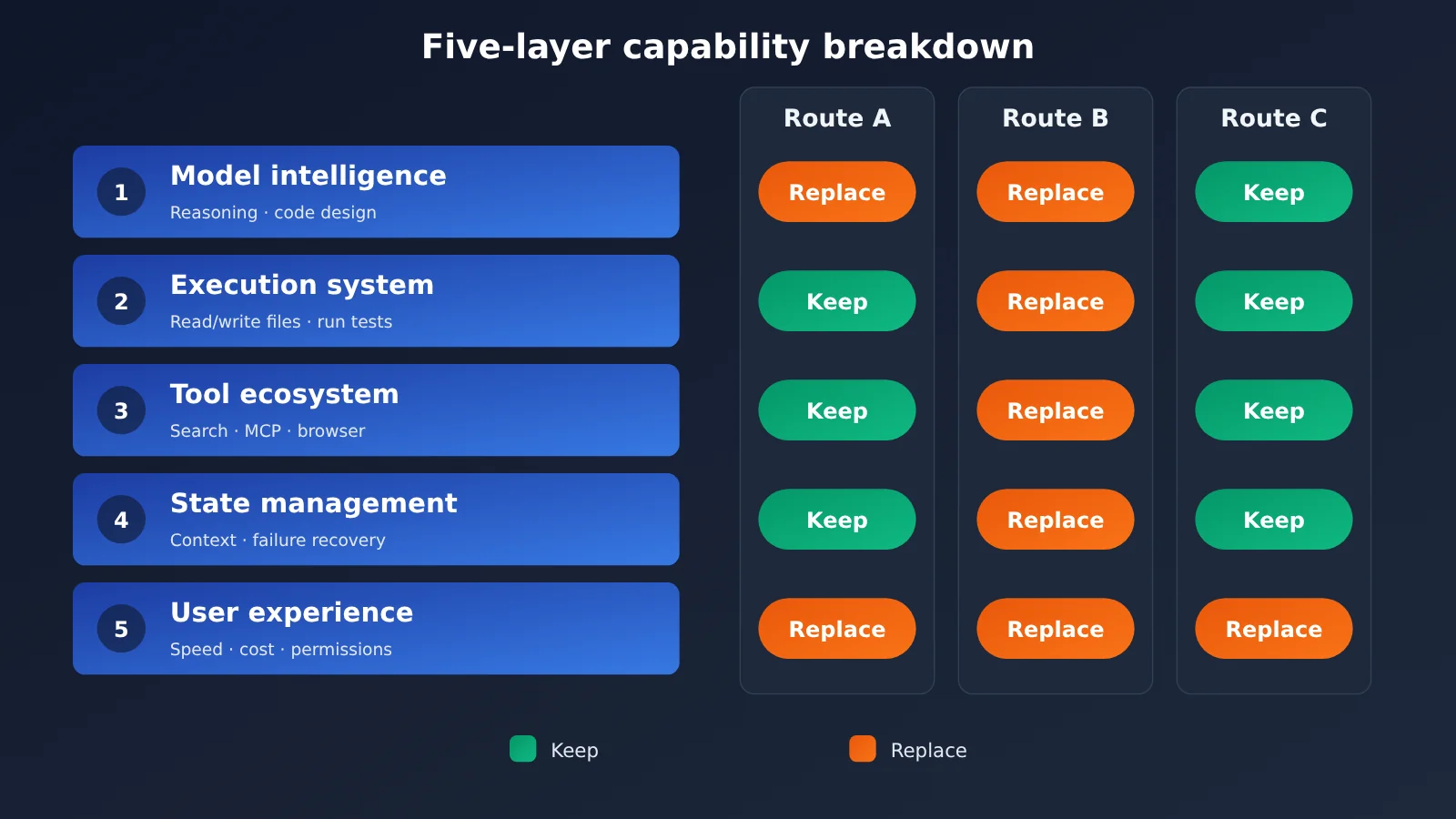
Breaking down the original experience gives us five components:
- Model intelligence: complex task understanding, code design, reasoning, and debugging.
- Execution system: reading the project, editing files, executing commands, and running tests.
- Tool ecosystem: web search, web page reading, MCP, file processing, and browser operation.
- State management: long-task context, tool call loops, and failure recovery.
- User experience: response speed, stability, cost, permission controls, and ease of use.
Swapping the model mainly changes item 1, but what users ultimately experience is the sum of all five. This is also where the three routes diverge: Route A replaces item 1 and keeps items 2 and 4; Route B replaces items 1, 2, and 4 at the same time; Route C keeps items 1, 2, and 4 as much as possible, with differences concentrated in item 5 and the protocol details introduced by the API channel.
2 Keep Codex and Connect Domestic Models (Route A)
2.1 Alibaba Cloud Bailian Token Plan + Codex
Alibaba Cloud has published official Codex integration docs. Token Plan provides a Responses-compatible API that connects directly to the new version of Codex. Write the following into ~/.codex/config.toml (on Windows, this is usually C:\Users\<用户名>\.codex\config.toml):
model_provider = "Token_Plan"
model = "auto"

[model_providers.Token_Plan]
name = "Token_Plan"
base_url = "https://token-plan.cn-beijing.maas.aliyuncs.com/compatible-mode/v1"
env_key = "OPENAI_API_KEY"
wire_api = "responses"
The environment variable that env_key points to must contain the API key dedicated to the Token Plan package. There are a few technical details that are easy to trip over during setup:
- Protocol version: Codex has required the Responses API since 0.94.0. The older Alibaba Cloud Coding Plan uses Chat Completions, and the official guidance is to pair it with Codex 0.93.0 or earlier. Environments you plan to maintain long-term should go with Token Plan.
- Key isolation: Token Plan, Coding Plan, and pay-as-you-go use three different sets of API keys.
- Region: Token Plan currently only supports North China 2 (Beijing).
- Model metadata: New models need the correct model ID and metadata configured before they get full support in Codex’s model picker.
The most noteworthy offering from Bailian right now is Qwen4-Max-Preview (model ID qwen4-max-preview), launched on November 11, 2026. The official docs confirm it’s a new-generation flagship multimodal model supporting code development, complex agent tasks, and image and video understanding. It supports deep thinking (on by default), tool calling, web search, and structured output, and is compatible with three protocols: OpenAI Chat Completions, Responses, and Anthropic Messages. The context window is 1M tokens, with a maximum output budget of 393,216 tokens — thinking and the final answer share that budget.
Its availability terms are equally clear: it’s currently only offered in Token Plan, with no pay-as-you-go option. The preview runs from 10:00 Beijing time on November 11, 2026 to 24:00 on November 25, after which it goes offline. As of the date of this article, there’s less than two weeks left to test it, so it’s worth getting your evaluation done quickly — and you should have a replacement model ready for production.
2.2 Tencent Cloud TokenHub + Codex
Tencent Cloud offers a dedicated official integration tutorial for Codex CLI. The same config file looks like this:
model_provider = "Tencent_Cloud_Token_Plan"
model = "$model_id"

[model_providers.Tencent_Cloud_Token_Plan]
name = "Tencent_Cloud_Token_Plan"
base_url = "https://tokenhub.tencentmaas.com/plan/v3"
env_key = "Token_Plan_API_KEY"
wire_api = "responses"
$model_id needs to be replaced with the exact model ID currently supported by your plan. TokenHub’s model library includes GLM-5.3, Kimi K3, the DeepSeek V4 series, MiniMax M3, Tencent’s Hunyuan Hy series, plus some lightweight and auto-routing models. The same plan also supports tools like Claude Code, Cline, and OpenClaw.
TokenHub’s advantage is “one Codex config, many domestic models”: change a single line of model and the same Harness can run GLM, Kimi, DeepSeek, and MiniMax in sequence — great for side-by-side comparisons. Model inventory, versions, and quota policies change dynamically, so before each test you should go by the model IDs listed in the console.
2.3 What’s the Difference Between the Two Plans
Both are called Token Plan, but they use different units of measurement: Bailian uses Credits, while TokenHub uses points, and the two can’t be converted directly. The table below reflects data as of 2026-11-13, with prices in RMB per month:
| Comparison dimension | Alibaba Cloud Bailian Token Plan (Personal) | Tencent Cloud TokenHub General Token Plan (Personal) |
|---|---|---|
| Tiers and monthly fee | Lite ¥39, Essential ¥79, Standard ¥139, Pro ¥312 | Lite ¥39, Standard ¥99, Pro ¥299, Max ¥599 |
| Monthly quota | 20,000 / 45,000 / 80,000 / 200,000 Credits | 780 / 1,980 / 5,980 / 11,980 points |
| Recommended concurrent Agents | 1–2 / 2–3 / 3–4 / 6–8 | No comparable metric given in the docs |
| Discounts and benefits | Lite and Essential new-user first purchase at ¥19.5 and ¥39.5 (through 2026-11-30); Standard and Pro include AgentStudio Harness benefits | Limited-time discount deduction rates on some models; reference purchase rate of ¥1 = 20 points |
| Codex integration protocol | Responses (wire_api = "responses") |
Responses (wire_api = "responses") |
| Representative models | Qwen series, including Qwen4-Max-Preview, which is exclusive to the Token Plan | GLM-5.3, Kimi K3, DeepSeek V4, MiniMax M3, Hunyuan Hy |
| Metering method | Credits deducted per model | Points deducted starting 2026-08-31, with different rates per model |
| Usage limits | North China 2 (Beijing) only; interactive coding plans shouldn’t be used directly for arbitrary commercial backend automation | Model library and promotional offers may change |
When comparing these two plans, ranking them by monthly fee doesn’t tell you much. What matters is “how much quota does the model I actually want to use deduct per completed task in this plan.” Bailian’s value is concentrated in the Qwen ecosystem and the currently exclusive Qwen4-Max-Preview; TokenHub’s value is concentrated in several domestic models sharing a single quota pool.
TokenHub publishes the point deduction rate for each model. Below are some limited-time discounted rates looked up on 2026-11-13, converted to RMB per million tokens at ¥1 = 20 points:
| Model | Standard input | Output | Cache-hit input | Notes |
|---|---|---|---|---|
| GLM-5.3 | ¥4.40 | ¥15.40 | ¥1.10 | Reverts to list price after the promotion ends |
| GLM-5.3-Flash | ¥0.56 | ¥1.96 | ¥0.161 | For speed- and cost-sensitive scenarios |
| Kimi K3 | ¥15.00 | ¥75.00 | ¥1.50 | Reverts to list price after the promotion ends |
| Kimi K2.7 Code | ¥5.20 | ¥21.60 | ¥1.04 | Code-focused model |
| DeepSeek V4.1 Flash (off-peak) | ¥0.40 | ¥1.60 | ¥0.008 | Peak/off-peak billing |
| DeepSeek V4.1 Flash (peak) | ¥0.80 | ¥3.20 | ¥0.016 | Weekdays 09:00–12:00 and 14:00–18:00 |
| MiniMax M3 | ¥2.10 | ¥8.40 | ¥0.42 | Price applies to input ≤ 512K tokens |
There are two things to keep in mind when reading this table. First, the monthly subscription is billed at the plan’s monthly fee; the amounts in the table represent the reference value of the points, which you use to compare consumption rates across models. Second, DeepSeek’s peak/off-peak billing has been in effect since 2026-10-30, with peak consumption running roughly twice the off-peak rate. Running asynchronous tasks like batch code checks and test analysis overnight can save you a noticeable chunk of quota.
Let’s run the numbers with GLM-5.3: a large coding task that consumes 100,000 tokens of regular input, 300,000 tokens of cache hits, and 30,000 tokens of output works out to a reference credit value of 0.1 × ¥4.40 + 0.3 × ¥1.10 + 0.03 × ¥15.40 ≈ ¥1.232. Cache hits make up the bulk of the input — that’s exactly what Agent tasks typically look like, and it shows just how much cache pricing affects total cost in coding scenarios.
3 Switching to a Different Harness: Can We Get Closer to Astra + Codex? (Route B)
3.1 OpenCode: The Big Draw Is Multi-Model Freedom
OpenCode is an open-source AI coding agent that supports a wide range of LLM providers: use /connect to add a provider and /models to switch models. It supports custom base URLs and local models, and runs in the terminal, on the desktop, and in some development environments, with file retrieval, editing, command execution, and agent workflows. Alibaba Cloud already publishes official setup instructions — just choose Alibaba Token Plan (China) to use the Model Studio plan.
OpenCode’s official security notes are worth taking seriously: the local agent by default has no system-level security isolation, and permission approvals can’t replace a container or a VM. When running untrusted code or high-privilege automation tasks, run it inside Docker or a virtual machine.
3.2 Qwen Code, Kimi Code, and DeepSeek Harness
Each of these three native harnesses serves its own model ecosystem:
- Qwen Code: Alibaba Cloud ships it in three forms — CLI, desktop, and IDE. Log in to Model Studio, pick a region, and enter your API key to get started; it offers codebase retrieval, file editing, and command execution. Teams that mainly use Qwen models and want to cut down on protocol wrangling should look at this one first.
- Kimi Code CLI: a terminal coding tool maintained by Moonshot AI. It can read and edit code, call a shell, fetch web content, resume sessions, run in plan and approval modes, integrate with editors, and be pointed at third-party compatible models. On Windows, install it with the official PowerShell script — it depends on Git Bash from Git for Windows. The legacy Kimi CLI reached end of maintenance in September 2026, so new users should go straight to Kimi Code CLI.
- DeepSeek Harness: an open-source agent framework that offers both a Web UI and a CLI, supports custom providers and tool configuration, and can connect to various Model Studio billing plans. Start it with
npx @deepseek-ai/dsh web; the default address ishttp://127.0.0.1:3080. When choosing it, focus on how reliably tools execute, how permissions are controlled, and how well it adapts to your target model’s protocol.
3.3 Why the Harness Affects Model Performance
Put the same model in different harnesses and the results can differ a lot, because the harness decides what the model “sees,” what it can do, and what happens after it makes a mistake:
- Code reading strategy: how many files get pulled in at once and in what order they’re searched determines whether the model’s understanding of the project is complete.
- Tool loop design: how tool results get passed back and whether failures trigger automatic retries determines whether long tasks actually finish.
- Context compression: which history gets kept and which details get dropped in long sessions directly affects whether the model “forgets the goal.”
- Patches and tests: whether changes are whole-file overwrites or diff patches, and whether tests run by default after edits, determines both accuracy and regression risk.
So the scores you get on Route B are the combined result of “the model plus that harness.” When comparing them with Route A, keep in mind that the execution strategies on the two sides are different to begin with.
4 Which Domestic Models Are Worth Testing?
4.1 Qwen4-Max-Preview
Judging from its published specs, its 1M context window, its 393,216-token shared budget for thinking and output, tool calling, and structured output make it a good fit for testing complex coding, long-context analysis, and multi-turn agent workflows. It’s compatible with both Responses and Anthropic Messages, so it can plug into Codex as well as Claude Code-style tools.
The time window is the primary constraint on choosing it: the preview ends and gets taken offline at 24:00 on 2026-11-25. The recommended approach is to use it to run the full test suite during this period, then treat the results as a baseline for later official Qwen models, while also configuring a long-term available backup model in production.
4.2 GLM-5.3, Kimi K3, DeepSeek V4, MiniMax M3
All four of these series are included in a single TokenHub bundle, so allocating them by task type is the easiest approach:
- Complex logic and multi-file edits: Use GLM-5.3, Kimi K3, and DeepSeek V4-Pro as the high-capability comparison group. Kimi K3 has the highest output unit price in the table, so it’s best suited for the hardest tasks to probe the upper limit.
- Code-focused tasks: Kimi K2.7 Code is dedicated to comparison in code editing scenarios, and you can also pair it with Kimi Code CLI to test the native experience.
- High-frequency, low-cost tasks: GLM-5.3-Flash and DeepSeek V4-Flash are for cost- and speed-sensitive scenarios like code review and batch refactoring.
- Long-context stability and tool-call accuracy: Include MiniMax M3 as a candidate, but note that pricing rises above the 512K input threshold.
4.3 How to Judge Who Is Closest to Astra
Context length, parameter count, marketing positioning, and token unit price can’t give a reliable ranking of models, and promotional benchmark scores from different sources aren’t comparable. The only reliable way to judge “who is closest to Astra + Codex” is to record task success rate, execution time, token cost, tool compatibility, and number of manual interventions uniformly across the same Harness on the same batch of tasks—see Section 6 for the specific method.
5. Three reproduction paths — how do you choose?
5.1 Want the original Codex experience: pick Path A
Keep the Codex Harness and connect it to a domestic service that officially supports the Responses protocol. If Qwen is your daily driver, go with Bailian; if you want to switch between several domestic models, go with TokenHub. The upside is a low learning and migration cost — file operations and the agent execution stack are all original. The trade-off is that model intelligence differs from Astra, the degree of interface compatibility affects the tool-calling experience, and context and reasoning parameters have to be tuned separately for each model.
5.2 Want domestic models and multi-model freedom: pick Path B
OpenCode paired with a domestic multi-model API, plus Qwen Code, Kimi Code, or DeepSeek Harness when needed. It suits developers who work with multiple models long-term and don’t want to be locked into a single vendor, and it’s the easiest way to compare how different models handle the same task side by side. The cost is an execution strategy that differs from Codex, and the extra configuration and maintenance that multi-provider access brings.
5.3 Want to preserve Astra capabilities as much as possible: pick Path C
Path C is the combination of “original Codex CLI + GPT-6 Astra + a usable API access service.” As long as the channel genuinely offers the original GPT-6 Astra and fully supports the Responses API, streaming events, tool calls, and context management that Codex requires, you get to keep both core components: the model and the Harness. This path solves network availability — it’s a separate matter from replacing domestic models.
Take APIYI as an example: the setup is identical to Path A, you just swap in a different Provider config:
model_provider = "APIYI"
model = "gpt-6-astra"            # Use the model ID actually listed in the APIYI console
model_reasoning_effort = "high"  # Adjust between low and max based on task difficulty

[model_providers.APIYI]
name = "APIYI"
base_url = "https://api.apiyi.com/v1"
env_key = "APIYI_API_KEY"
wire_api = "responses"
Before wiring it in, it’s worth running a quick script to confirm the channel really supports the Responses protocol and tool calls, rather than only returning plain text:
import os
from openai import OpenAI

client = OpenAI(
    api_key=os.environ["APIYI_API_KEY"],
    base_url="https://api.apiyi.com/v1",
)

resp = client.responses.create(
    model="gpt-6-astra",  # Replace with a model ID available in the console
    reasoning={"effort": "medium"},
    input="Read src/app.py and tell me the entry function name",
    tools=[{
        "type": "function",
        "name": "read_file",
        "description": "Read the contents of a file in the project",
        "parameters": {
            "type": "object",
            "properties": {"path": {"type": "string"}},
            "required": ["path"],
        },
    }],
)

# Under normal conditions this should return function_call output items with structured arguments
for item in resp.output:
    print(item.type, getattr(item, "arguments", None))
print("usage:", resp.usage)  # Check that input, output, cache, and reasoning tokens are all itemized
This probe covers the three things Codex depends on most: the Responses protocol, Function Calling responses, and itemized usage stats. Once the script passes, connect Codex and run a complete task that includes “edit code + run tests” to confirm streaming events and the multi-turn tool loop work properly.
Even with the same model, the Path C experience is still affected by actual model routing, reasoning effort levels, API latency and output throughput, cache hit rates, gateway protocol compatibility, and channel pricing. The Codex desktop app, cloud tasks, and ChatGPT account-exclusive features rely on OpenAI’s own authorization system — using an API key gives you the Codex CLI plus model API combination, so plan on excluding those features.
🚀 Quick-start tip: If you want to compare Route A and Route C side by side, you can sign up at APIYI apiyi.com and claim free trial credits, then run domestic models and GPT-series models in the same Codex environment. For the exact models APIYI lists and the protocols it supports, refer to the console and the docs.apiyi.com documentation.
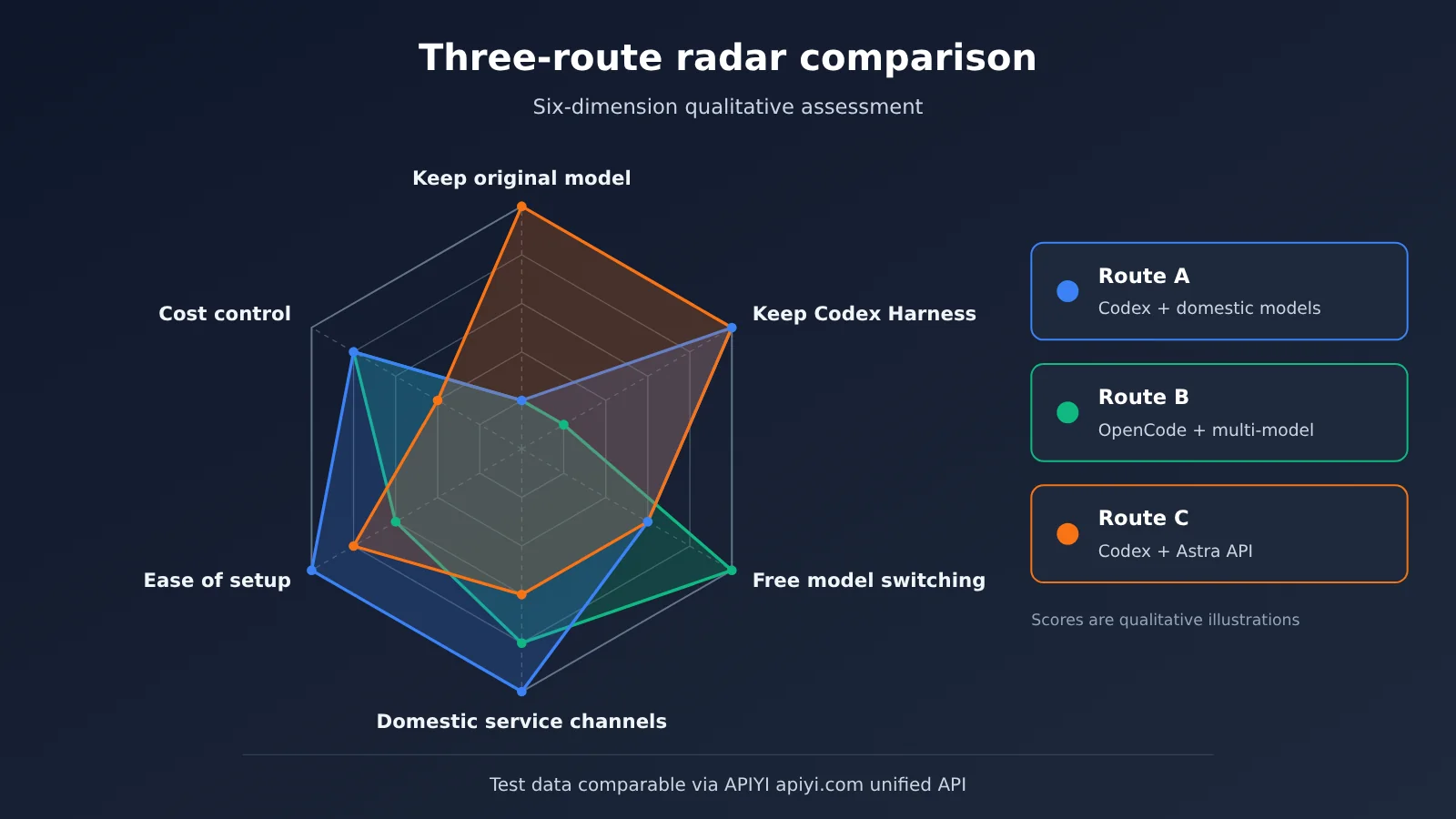
Here’s a summary of the trade-offs across the three routes:
| Comparison dimension | Route A: Codex + domestic models | Route B: OpenCode, etc. + multiple domestic models | Route C: Codex + Astra API |
|---|---|---|---|
| Retain the original model | No; switched to Qwen / GLM / Kimi, etc. | No | Yes (provided the channel can be verified) |
| Retain the Codex Harness | Yes | No; switched to an open Harness | Yes |
| Model switching | Change the model ID within the same platform | Freely switch between multiple Providers | Switch between models supported by the channel |
| Domestic service channels | Alibaba Cloud Bailian, Tencent Cloud TokenHub | Bailian, TokenHub, and other compatible services | Third-party channels that support Responses, such as APIYI apiyi.com |
| Configuration complexity | Low; official ready-made configuration is available | Medium; multiple Provider setups need to be maintained | Low, provided the protocol is verified first |
| Cost model | Monthly package (Credits / points) | Package or pay-as-you-go, depending on the Provider | Pay-as-you-go; Astra’s unit price is higher than most domestic models |
| Best for | Original Codex experience + domestic models | Long-term multi-model workflows | Maximum preservation of original capabilities |
5.4 Network and security boundaries for use in China
Having model APIs on domestically accessible addresses only solves the model invocation part of the chain. While working, the Agent also accesses software sources such as GitHub, npm, and PyPI, external official documentation, third-party MCP services, and web search. The reachability of these links needs to be checked separately. Web search is also a separate capability: cloud providers’ built-in search, the Harness’s built-in networking tools, and self-built Search API / MCP each have their own access, billing, and invocation limits.
On security, a coding Agent can modify files, run Shell, and read environment variables. We recommend the following:
- Store API keys in environment variables or a credential management tool; never write them into source code or Git repositories.
- Make complex changes on a separate Git branch, and keep version control and recoverable backups for the project.
- Restrict the Agent from accessing sensitive files outside the working directory, and put untrusted code in a container or virtual machine.
- Keep human approval for high-risk operations such as deletion, deployment, and payment.
6 Real-world task testing is more valuable than model leaderboards
6.1 Set up five types of test tasks
Use a real project that includes frontend, backend, tests, and dependency configuration. Design five types of tasks to separately test model capabilities and Harness capabilities:
- Project understanding: Ask it to explain the architecture and the relationships between key modules. Observe how it locates files, understands cross-file dependencies, and whether it can provide verifiable path references.
- Cross-file development: Add a new feature that requires changes in multiple places. Observe the accuracy of the changes, feature completeness, and whether it introduces regressions.
- Bug fixing: Provide a project with a reproducible failing test. Observe whether it finds the root cause, changes the right place, proactively runs tests, and doesn’t break other test cases.
- Long-horizon Agent workflow: Complete the continuous chain of “requirements understanding → code changes → running tests → finding failures → fixing → re-verification”. Observe whether it stays focused on the goal and whether it adjusts its strategy based on errors.
- Online documentation lookup: Read the latest SDK docs and then migrate a piece of old API code. Observe whether it can actually fetch the content online, whether it applies the new API in the code, and whether it can distinguish between “tool unavailable” and “search results empty”.
6.2 Track success rate, time, and cost
Run the same set of tasks for every “model + Harness” combination, repeat at least three times and take the average, and record the following metrics consistently:
| Metric | How it’s calculated or observed |
|---|---|
| Task success rate | Successful tasks / total tasks |
| First-pass success rate | Share of tasks that succeed on the first attempt without manual correction |
| Total task duration | From task dispatch to final successful verification |
| Number of model invocations | Cumulative API requests per task |
| Number of tool calls | Number of read, edit, Shell, search, and similar calls |
| Token usage | Itemized input, output, cache-hit, and reasoning usage |
| Actual task cost | Real cost of completing one successful task |
| Number of manual interventions | Number of manual adjustments and fixes by the user |
To make the experiment reproducible, fix the following variables: the same code repository snapshot, the same Harness version, the same reasoning tier or thinking setting, and the same time window (especially important for models with peak/off-peak pricing like DeepSeek). Reset the repository to the snapshot before each task starts, so changes from the previous round don’t affect the next one.
6.3 Use cost per successful task as the core purchasing metric
The recommended calculation is: cost per successful task = total cost of all attempts ÷ number of successful tasks. The cost of failed attempts must be included, because they also consume quota.
A model with a low unit price isn’t necessarily cheap. If a model needs more rounds of reasoning, repeated edits and retries, or frequent manual intervention, its total consumption to complete a task may exceed a model with a higher unit price that gets it right in one go. Conversely, on simple, high-frequency tasks, the low unit price and high speed of Flash-class models often deliver real savings. Only by calculating cost per successful task can the two types of models be compared on the same yardstick.
💰 Cost evaluation tip: Usage-based billing channels are the most convenient for this kind of experiment, because the Token line items and cost of each request can be checked one by one. With APIYI apiyi.com, you can use one API key to call multiple models and track the cost per successful task for different models in the same dashboard.
7 APIYI Scenario: Making the Model a Swappable Component
The analysis above all points to the same conclusion: a stable AI coding environment should lock down the Harness and treat the model as a replaceable component. Codex or OpenCode handles execution and state management, the API channel supplies the models, and you switch models flexibly based on task difficulty and budget.
APIYI apiyi.com serves as the unified access layer in this architecture: a single API key lets you call mainstream models like OpenAI, Claude, and Gemini, with an OpenAI-compatible interface and pay-as-you-go billing. For coding users, before choosing any API channel (APIYI included), it’s worth checking the following items one by one:
- Whether it supports the Responses API and streaming events required by your current Codex version.
- The actual model IDs listed in the console, and whether the target model is available.
- Whether tool calls and Function Calling can complete the full round-trip.
- Whether latency and sustained output throughput meet the needs of long-running tasks.
- Whether cache usage is correctly recognized and billed as a separate line item.
Treat the service console and technical docs as the source of truth, and the probe script from Section 5.3 can be used directly to verify these. In practice, a common setup is to use Route A’s monthly plan for daily high-frequency tasks, and the pay-as-you-go channel for hard problems and comparison testing that need stronger models. Both Providers go in the same config.toml, and you switch between them with --profile or by editing model_provider.
8 FAQs
Q1: Which route offers the highest fidelity when reproducing Astra + Codex in China?
Route C offers the highest fidelity: the original Codex CLI paired with a genuinely usable GPT-6 Astra API, preserving both core components—the model and the harness. The prerequisite is that the channel can be verified to provide the original model and fully support the Responses protocol and tool calls. If you need domestic models, Route A is the best choice for replicating the Codex execution experience.
Q2: Is Qwen4-Max-Preview suitable for long-term use in Codex?
It’s suitable for the current evaluation. The model is only available in Bailian Token Plan and will be taken offline after the preview period ends at 24:00 on November 25, 2026. I recommend finishing your test tasks during the preview period and preparing a long-term fallback model for production.
Q3: Why can’t the new Codex connect to Alibaba Cloud’s old Coding Plan?
Starting with 0.94.0, Codex requires the Responses API, whereas the old Coding Plan uses the Chat Completions protocol, and the official guidance is to use it with Codex 0.93.0 or earlier. Switch to Token Plan and set `wire_api = “responses”` to connect to the new Codex. Note that Token Plan uses a separate API key.
Q4: Can Bailian Credits and TokenHub points be compared directly?
No, they can’t be compared directly. They’re billing units for their respective platforms, and the rate at which credits are deducted also varies by model. A more reliable approach is to run the same task on both platforms and compare “the amount of plan quota consumed to complete one successful task as a percentage of the monthly fee.”
Q5: How can I quickly verify whether a third-party channel can run Codex?
First use the Python script in Section 5.3 to send a Responses request with a function tool, confirm that it returns a `function_call` output item and that the usage breakdown is reported correctly, then connect Codex and run a complete task that includes tests. After you register at APIYI apiyi.com, you can claim free trial credits to complete this verification step; check the console for the exact models available.
Q6: Is it normal for the same model to perform differently in OpenCode and Codex?
Yes. The harness determines the code-reading strategy, tool loop, context compression, and testing habits, all of which affect how the model actually performs. When comparing, hold the harness constant while testing the model, or hold the model constant while testing the harness, so you don’t change two variables at once.
Q7: If I use Codex via an API key, can I get the Codex features from a ChatGPT subscription?
The API key approach provides a combination of Codex CLI and model API. Codex cloud tasks, the desktop app, and ChatGPT account-exclusive features depend on OpenAI account authorization, which third-party API channels can’t provide.
Q8: How do I control total costs when switching between multiple models?
Tier your tasks: use high-capability models for hard problems, hand batch checks and simple refactors to Flash-class models, and for models that support peak/off-peak billing, move asynchronous tasks to nighttime. Always evaluate with “cost per successful task”; pay-as-you-go channels such as APIYI apiyi.com make it easy to verify each model’s actual usage transaction by transaction.
9 Summary: Key Takeaways
- Three routes, three priorities: Route A preserves the Codex experience, Route B preserves model freedom, and Route C preserves the original model.
- Astra + Codex is a five-layer combination: The model, execution system, tool ecosystem, state management, and user experience all shape the final result together.
- Route A has ready-made configurations: Both Bailian and TokenHub provide official Codex configurations. The key is
wire_api = "responses". - Qwen4-Max-Preview has a deadline: It’s available only under the Token Plan and will end preview and go offline at 24:00 on 2026-11-25.
- Package units can’t be compared apples-to-apples: Credits, points, tokens, and RMB-denominated units belong to different metering systems, so you can only compare them by testing against real tasks.
- Let tasks do the talking: Use five types of real tasks and eight metrics, and base procurement decisions on the cost per successful task.
- Make models replaceable components: Fix the harness, unify access channels, and switch models by task. That’s how the environment stays stable and controllable.
The most practical way to start is to configure two Providers in the same Codex environment: one domestic cloud package for daily tasks, and one pay-as-you-go channel for comparison tests and harder tasks. Run a round using the method in Section 6, then decide on your long-term combination. We recommend using APIYI apiyi.com to quickly set up a control group and validate domestic models and the GPT series on the same tasks through a unified interface.
📚 References
- GPT-6 Astra Official Model Documentation: Model specs, reasoning tiers, and pricing
- Link:
developers.openai.com/api/docs/models/gpt-6-astra -
Notes: Context window, max output, tool support, and long-context rates
-
OpenAI Codex Harness: Design of the Codex execution framework
- Link:
developers.openai.com/blog/codex-as-a-platform -
Notes: Official documentation on the agent loop, tool callbacks, context management, and sandboxing
-
Alibaba Cloud Model Studio Codex Integration: How to configure Token Plan
- Link:
help.aliyun.com/zh/model-studio/codex -
Notes: config.toml fields, the Responses protocol, and version requirements
-
Alibaba Cloud Token Plan Personal Edition: Plan pricing and Credits
- Link:
help.aliyun.com/zh/model-studio/token-plan-personal-overview -
Notes: Tiers, quotas, and first-purchase discounts after the 2026-11-09 adjustment
-
Qwen4-Max-Preview Official Documentation: Model specs and preview period
- Link:
help.aliyun.com/zh/model-studio/qwen4-max-preview -
Notes: 1M context, protocol compatibility, and the retirement date
-
Tencent Cloud TokenHub Codex CLI Configuration: Official integration guide
- Link:
cloud.tencent.cn/document/product/1823/130071 -
Notes: Provider configuration and how to swap in your model ID
-
Tencent Cloud TokenHub Plans and Credit Rates: Billing rules
- Link:
cloud.tencent.cn/document/product/1823/130060 - Link:
cloud.tencent.com/document/product/1823/133811 -
Notes: Plan tiers, model credit rates, and peak/off-peak billing
-
OpenCode Official Repository: Open-source coding agent
- Link:
github.com/anomalyco/opencode -
Notes: Provider configuration and security notes
-
Qwen Code, Kimi Code CLI, DeepSeek Harness: Native harnesses
- Link:
help.aliyun.com/zh/model-studio/qwen-code - Link:
github.com/MoonshotAI/kimi-code - Link:
help.aliyun.com/zh/model-studio/deepseek-harness - Notes: Installation, integration, and capability scope
Author: APIYI Technical Team
Technical Support: Feel free to reach out through the contact details on the APIYI homepage. For more integration resources, visit the docs.apiyi.com documentation center.