Author's Note: This article provides a detailed breakdown of the 7 key differences between Claude Opus 4.7 and 4.6, including a 3x boost in visual performance, a significant leap in coding capabilities, the new xhigh reasoning tier, and the Task Budgets feature. We also analyze how the new Tokenizer affects your actual costs, even though the pricing remains unchanged.
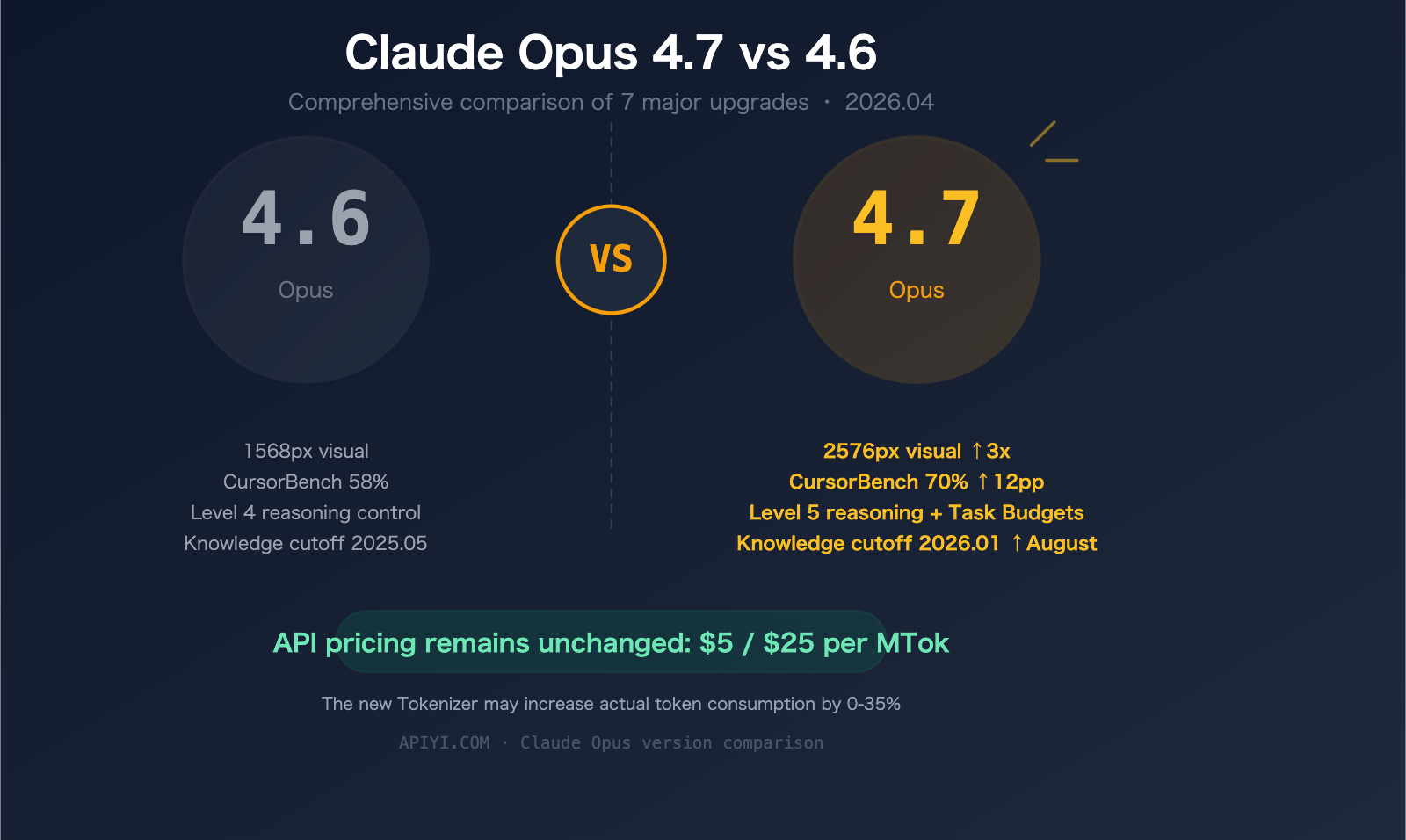
Claude Opus 4.7 was officially released on April 16, 2026. As the successor to Opus 4.6, it brings several major upgrades, including a 3x increase in visual resolution, a 12 percentage point jump in CursorBench coding benchmarks, and an all-new xhigh reasoning tier. The good news is that the API pricing remains identical to Opus 4.6—$5 per million tokens for input and $25 per million tokens for output.
However, this doesn't mean your actual usage costs will remain exactly the same. The new Tokenizer might cause the same content to consume up to 35% more tokens.
Core Value: In just 5 minutes, this article will help you understand exactly where 4.7 outperforms 4.6, whether you should upgrade, and what you need to watch out for during the transition.
Claude Opus 4.7 vs 4.6 Key Parameter Comparison
| Comparison Dimension | Claude Opus 4.7 | Claude Opus 4.6 | Change |
|---|---|---|---|
| Model ID | claude-opus-4-7 |
claude-opus-4-6 |
Updated |
| API Pricing (Input) | $5 / million tokens | $5 / million tokens | Unchanged |
| API Pricing (Output) | $25 / million tokens | $25 / million tokens | Unchanged |
| Context Window | 1M tokens (~555k characters) | 1M tokens (~750k characters) | Unchanged (but consumes more tokens with new Tokenizer) |
| Max Output | 128K tokens | 128K tokens | Unchanged |
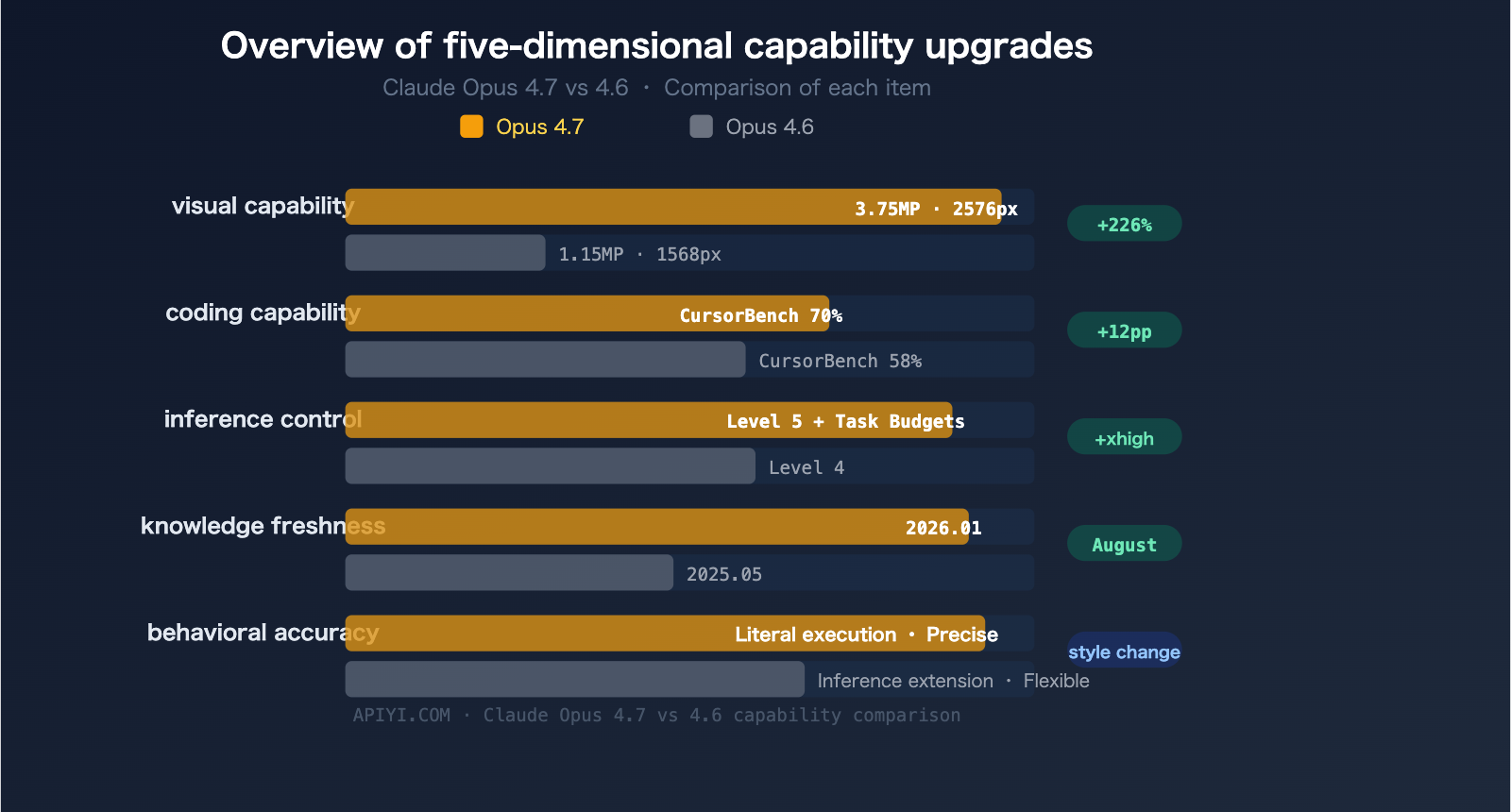
| Max Image Resolution | 2576px / 3.75MP | 1568px / 1.15MP | +226% |
| Max Tokens per Image | ~4784 tokens | ~1600 tokens | ~3x |
| Reasoning Effort Tier | 5 tiers (added xhigh) | 4 tiers | +1 tier |
| Thinking Mode | Adaptive Thinking only | Extended + Adaptive | Simplified |
| Sampling Parameters | Not supported | Supported (temperature/top_p/top_k) | Removed |
| Knowledge Cutoff | January 2026 | May 2025 | +8 months |
| Training Data Cutoff | January 2026 | August 2025 | +5 months |
| CursorBench | 70% | 58% | +12pp |
| Tokenizer | All-new tokenizer | Legacy tokenizer | Same content +0~35% tokens |
🎯 Key Takeaway: While the price tag is the same, the new Tokenizer may increase your actual usage costs by 0-35%. However, given the significant performance gains, the cost-effectiveness is actually higher. Use APIYI (apiyi.com) to invoke Claude Opus 4.7 and enjoy a unified interface with flexible billing.
Upgrade 1: Visual Capabilities—From "Seeing" to "Seeing Clearly"
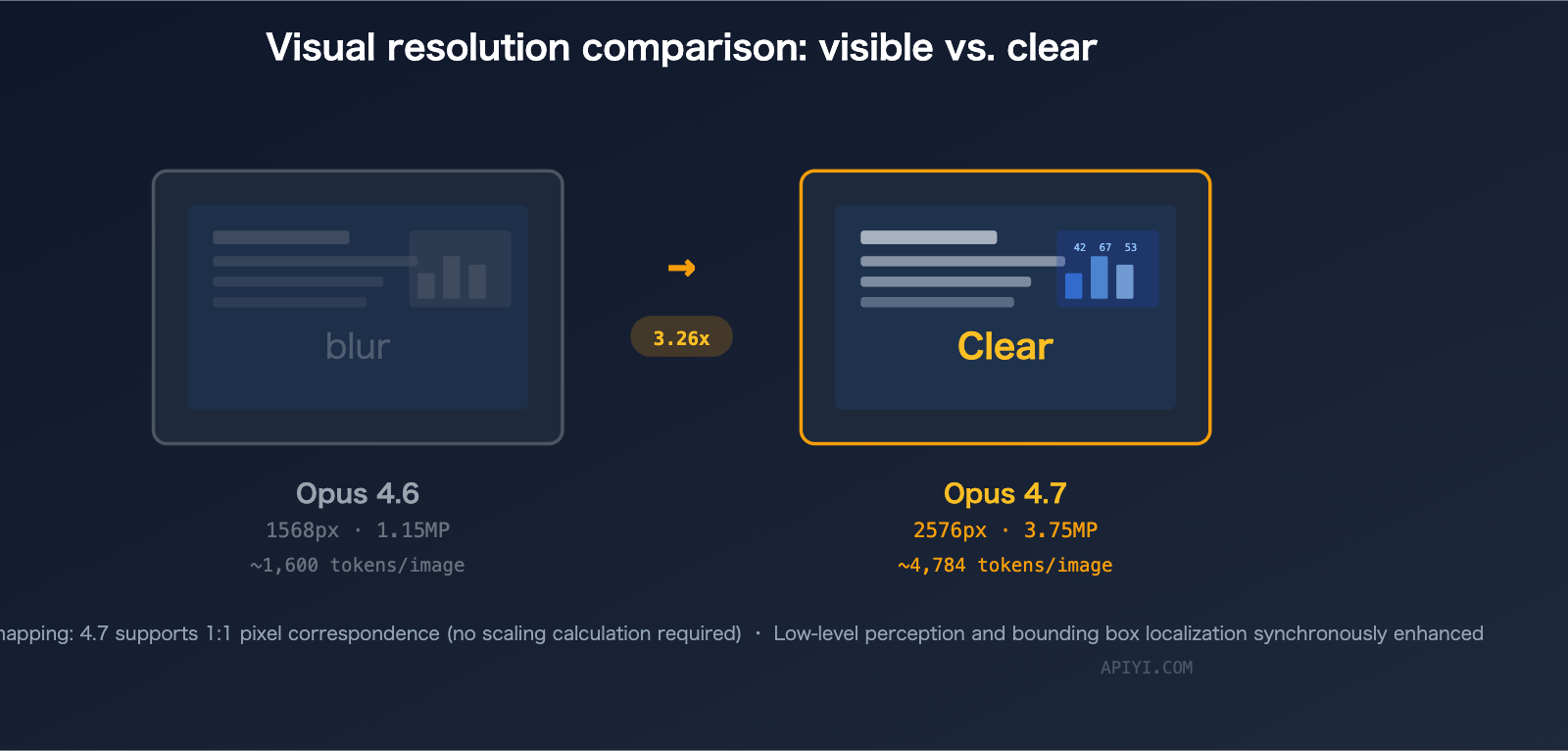
This is the most intuitive improvement in Opus 4.7 compared to 4.6. Opus 4.7 is the first Claude model to support high-resolution images.
| Visual Metric | Opus 4.7 | Opus 4.6 | Improvement |
|---|---|---|---|
| Max Long Edge Pixels | 2576px | 1568px | 1.64x |
| Max Total Pixels | ~3.75 Million | ~1.15 Million | 3.26x |
| Coordinate Mapping | 1:1 pixel correspondence | Requires scaling calculation | Greatly simplified |
| Max Tokens per Image | ~4784 | ~1600 | ~3x |
| Low-level Perception | Enhanced (pointing/measuring/counting) | Basic | Improved |
| Bounding Box Localization | Enhanced | Basic | Improved |
What does this mean?
When Opus 4.6 looks at a screenshot, it's like wearing blurry glasses—it can recognize the general content, but details are lost.
Opus 4.7, on the other hand, is like switching to high-definition lenses—it can precisely read small text in a UI, identify specific values in charts, and accurately locate specific elements within an image.
Differences in real-world scenarios:
- Computer Use Agents: 4.7 can accurately read small-font buttons and menu items on the screen, whereas 4.6 might misread them.
- Document Understanding: 4.7 can precisely extract table data from scanned documents, while 4.6 requires larger font sizes to identify them accurately.
- Chart Analysis: 4.7 can perform pixel-level data transcription, while 4.6 is prone to errors with dense charts.
⚠️ Cost Reminder: High-resolution images consume about 3 times the tokens compared to before. If your application processes a large volume of images, your image processing costs will increase significantly after the upgrade. For scenarios that don't require high precision, we recommend downsampling images before sending them.
Upgrade 2: Coding Capabilities—From "Capable" to "Autonomous"
Coding is one of the areas where Opus 4.7 has seen the most significant improvement. Anthropic officially used the term "step-change improvement in agentic coding" to describe this leap.
Benchmark Comparison
| Coding Benchmark | Opus 4.7 | Opus 4.6 | Change |
|---|---|---|---|
| CursorBench | 70% | 58% | +12 percentage points |
| Rakuten-SWE-Bench | 3x baseline | 1x baseline | Solves 3x production tasks |
| Finance Agent | SOTA | — | Current state-of-the-art |
| GDPval-AA | SOTA | — | Best for economic knowledge work |
Coding Behavior Differences
| Coding Behavior | Opus 4.7 | Opus 4.6 |
|---|---|---|
| Self-Verification | Proactively verifies its own output before reporting | Requires prompt guidance |
| Error Fixing | Automatically discovers and fixes during coding | Requires explicit error pointing |
| Planning Quality | Identifies logic vulnerabilities during the planning phase | Discovers issues only during execution |
| Long-cycle Tasks | Reliably handles asynchronous workflows and CI/CD | Context often lost in complex processes |
| Tool Invocation | Defaults to fewer calls, more reasoning | Tends to call tools frequently |
🎯 Practical Advice: For development teams that need to handle complex codebases, Opus 4.7 solved 3 times the number of real-world production tasks on the Rakuten-SWE-Bench compared to 4.6—this is the most compelling reason for the upgrade. You can quickly switch model IDs via APIYI (apiyi.com) to perform comparative tests.
Upgrade 3: Inference Control—New xhigh Level
Opus 4.7 introduces the xhigh inference effort level, sitting right between high and max.
| Level | Opus 4.7 | Opus 4.6 | Recommended Use Case |
|---|---|---|---|
low |
✅ | ✅ | Simple classification, format conversion |
medium |
✅ | ✅ | Daily Q&A, summarization |
high |
✅ | ✅ | Most intelligent tasks (minimum recommended) |
xhigh |
✅ New | ❌ | Coding and agentic workflows (recommended) |
max |
✅ | ✅ | Extremely difficult reasoning problems |
Anthropic has emphasized a key point: the effort parameter is more critical in Opus 4.7 than in any previous Opus model.
Key changes:
- 4.7 strictly adheres to the scope at
lowandmediumlevels, avoiding "over-processing." - 4.6 might perform extra reasoning even at lower levels.
- If a complex task isn't performing well at the
lowlevel, you should increase the effort level rather than adjusting the prompt.
Upgrade 4: Task Budgets—A New Cost Control Tool
Task Budgets is a brand-new feature (in Beta) introduced in Opus 4.7; it is completely unavailable in 4.6.
Core Concepts
| Feature | Task Budget | max_tokens |
|---|---|---|
| Nature | Advisory budget (model-aware) | Hard limit (model-unaware) |
| Scope | Entire agentic loop | Single request |
| Model Behavior | Prioritizes work and wraps up gracefully | Hard truncation upon limit |
| Minimum Value | 20K tokens | 1 token |
| Opus 4.6 | ❌ Not supported | ✅ Supported |
| Opus 4.7 | ✅ New (Beta) | ✅ Supported |
# Opus 4.7 Task Budgets usage
response = client.beta.messages.create(
    model="claude-opus-4-7",
    max_tokens=128000,
    output_config={
        "effort": "xhigh",
        "task_budget": {"type": "tokens", "total": 128000},
    },
    messages=[{"role": "user", "content": "Review the codebase and propose a refactoring plan"}],
    betas=["task-budgets-2026-03-13"],
)
🎯 Usage Tip: For quality-first scenarios, do not set a Task Budget. Use it only for batch tasks where you need to control token expenditure. This parameter is also supported when using the APIYI (apiyi.com) API proxy service.
Upgrade 5: Knowledge Refresh—8 Extra Months of Knowledge
| Knowledge Dimension | Opus 4.7 | Opus 4.6 | Difference |
|---|---|---|---|
| Reliable Knowledge Cutoff | January 2026 | May 2025 | +8 months |
| Training Data Cutoff | January 2026 | August 2025 | +5 months |
This means Opus 4.7 is aware of all major technical events that occurred from the second half of 2025 through the beginning of 2026, including the latest programming framework versions, API changes, and industry developments. For tasks requiring the most up-to-date knowledge, 4.7 significantly outperforms 4.6.
Upgrade 6: Behavioral Patterns—More Precise, But Requires Adaptation
The behavioral style of Opus 4.7 differs noticeably from 4.6. This isn't a bug; it's a feature:
| Behavioral Dimension | Opus 4.7 | Opus 4.6 |
|---|---|---|
| Instruction Execution | More literal, doesn't overgeneralize | Infers and expands on instructions |
| Response Length | Adapts to task complexity | Tends toward a fixed length |
| Tone/Style | More direct and opinionated | Warmer and more polite |
| Emoji Usage | Less frequent | More frequent |
| Progress Updates | Provides high-quality status updates automatically | Requires scaffolding code to force |
| Sub-agents | Generates fewer by default | Generates more by default |
| Tool Calling | Relies more on reasoning, uses fewer tools | Tends to call tools frequently |
Adaptation Tips
If you used to write prompts for 4.6 like this:
Analyze this code and check all related files.
4.6 might have automatically expanded the scope to check related test files, configuration files, etc. However, 4.7 will strictly analyze only the specific code you pointed to. If you need it to check more, you have to be explicit.
This is an improvement in precision, not a regression in capability.
Price Analysis: Same List Price, Different Actual Costs
Pricing Comparison
| Billing Item | Opus 4.7 | Opus 4.6 | Change |
|---|---|---|---|
| Input Price | $5 / MTok | $5 / MTok | Unchanged |
| Output Price | $25 / MTok | $25 / MTok | Unchanged |
| Long Context Premium | None | None | Unchanged |
| Batch Discount | Available | Available | Unchanged |
| Prompt Caching | Supported | Supported | Unchanged |
But the Tokenizer Has Changed
Opus 4.7 uses a brand-new tokenizer, which means:
- The same text content may consume 1.0x to 1.35x more tokens on Opus 4.7.
- The maximum increase is about 35%, depending on the content type.
- The 1M context window of Opus 4.7 is roughly equivalent to 555,000 words, whereas 4.6 was roughly equivalent to 750,000 words.
Estimated Impact on Actual Costs
| Use Case | 4.6 Monthly Usage | 4.7 Estimated Usage | Cost Change |
|---|---|---|---|
| Plain Text Chat | 100M tokens | 110-135M tokens | +10~35% |
| Code Generation | 100M tokens | 105-120M tokens | +5~20% |
| Image Analysis (HD) | 100M tokens | ~300M tokens (3x for images) | Significant Increase |
| Image Analysis (Downsampled) | 100M tokens | 110-135M tokens | +10~35% |
🎯 Cost Optimization Tips:
- Use the
/v1/messages/count_tokensendpoint to re-evaluate your token consumption.- For scenarios that don't require high resolution, downsample images before sending.
- Use Task Budgets to control token spending on long-running tasks.
- Through the APIYI (apiyi.com) platform, you can flexibly manage model invocation and choose the most cost-effective model for different tasks.
Migration Pitfalls: 5 Breaking Changes
Upgrading from 4.6 to 4.7 is not a seamless switch. The following changes will cause your old code to throw errors:
Breaking Change 1: Extended Thinking Removed
# ❌ 4.6 Syntax (Returns 400 error in 4.7)
thinking = {"type": "enabled", "budget_tokens": 32000}

# ✅ 4.7 Correct Syntax
thinking = {"type": "adaptive"}
output_config = {"effort": "xhigh"}
Breaking Change 2: Sampling Parameters Removed
# ❌ 4.6 Syntax (Returns 400 error in 4.7)
response = client.messages.create(
    model="claude-opus-4-7",
    temperature=0.7,  # Error!
    top_p=0.9,        # Error!
)

# ✅ 4.7 Correct Syntax: Simply remove these parameters
response = client.messages.create(
    model="claude-opus-4-7",
    max_tokens=64000,
    messages=[...],
)
Breaking Change 3: Thinking Content Hidden by Default
4.6 returned thinking summaries by default, but 4.7 does not. If your UI displays the thinking process:
# ✅ 4.7 Restore thinking display
thinking = {"type": "adaptive", "display": "summarized"}
Breaking Change 4: Tokenizer Update
You need to update max_tokens to reserve more space and re-test your token counting.
Breaking Change 5: Prefill Removed
Prefilling assistant messages returns a 400 error on 4.7. Switch to structured output or system prompts instead.
Quick Migration Command
If you are using Claude Code, you can migrate with one click:
/claude-api migrate this project to claude-opus-4-7
FAQ
Q1: Is Opus 4.7 more expensive than 4.6?
The pricing is exactly the same: $5 per million tokens for input and $25 per million tokens for output. However, since the new tokenizer can cause the same content to consume up to 35% more tokens, your actual costs might increase. I'd recommend re-evaluating your costs using the token counting API. You can manage your budget flexibly by using the API proxy service at APIYI (apiyi.com).
Q2: Do I need to change my code when upgrading from 4.6 to 4.7?
Most likely, yes. If you use Extended Thinking Budgets, sampling parameters (temperature/top_p/top_k), assistant message pre-filling, or rely on default thought content outputs, you'll encounter 400 errors with 4.7. It's a good idea to go through the migration checklist item by item.
Q3: Are there any situations where I shouldn’t upgrade?
If your application heavily relies on fine-tuned sampling parameters (like controlling creativity via temperature), or if you process a large volume of images and are cost-sensitive, you should carefully evaluate the upgrade first. Additionally, because 4.7 follows instructions more literally, you may need to tweak your well-optimized prompts, which could mean some extra work.
Summary
Here are the key differences between Claude Opus 4.7 and 4.6:
- 3x Vision Leap: Resolution has increased from 1568px to 2576px, a 3.26x increase in total pixels.
- Coding Breakthrough: +12pp in CursorBench, and it solves 3x more production tasks in Rakuten-SWE-Bench.
- New 'xhigh' Tier: Offers finer control over reasoning, with 'effort' being more important than in any previous Opus model.
- Task Budgets: A brand new token budget management mechanism (Beta).
- 8 Months of Newer Knowledge: Knowledge cutoff moved from May 2025 to January 2026.
- More Precise Behavior: More literal, direct, and less redundant.
- Same Price Tag: Still $5/$25 per MTok, though the new tokenizer may increase actual consumption by 0-35%.
Should you upgrade? For the vast majority of use cases, the answer is yes. The performance gains far outweigh the cost increase from the new tokenizer, especially for coding and vision-related tasks. The only reason to be cautious is if you have a high-volume image processing workload where costs are extremely sensitive.
You can quickly switch your model ID from claude-opus-4-6 to claude-opus-4-7 via APIYI (apiyi.com) to test both versions in your actual production environment before making a final decision.
📚 References
-
Anthropic Official – What's New in Opus 4.7: Complete upgrade documentation
- Link:
platform.claude.com/docs/en/about-claude/models/whats-new-claude-4-6 - Description: The most authoritative primary technical documentation, covering all new features and changes.
- Link:
-
Claude API Documentation – Migration Guide: A comprehensive guide for migrating from 4.6 to 4.7
- Link:
platform.claude.com/docs/en/about-claude/models/migration-guide - Description: Includes breaking changes, behavioral shifts, and a migration checklist.
- Link:
-
Claude Model Overview: Specifications and pricing comparison for all Claude models
- Link:
platform.claude.com/docs/en/about-claude/models/overview - Description: Official model specification table, including detailed parameters and pricing information.
- Link:
-
Anthropic Official Announcement – Claude Opus 4.7: Launch blog post
- Link:
anthropic.com/news/claude-opus-4-7 - Description: Official launch announcement, including benchmark data and product positioning.
- Link:
Author: APIYI Technical Team
Technical Discussion: Feel free to join the discussion in the comments section. For more resources, visit the APIYI documentation center at docs.apiyi.com.