Author's Note: A comprehensive breakdown of the core upgrades in the official Claude Opus 4.7 release, including a 3x increase in visual resolution, the new xhigh reasoning level, the Task Budgets mechanism, a leap in coding capabilities, as well as an API migration guide and integration methods.
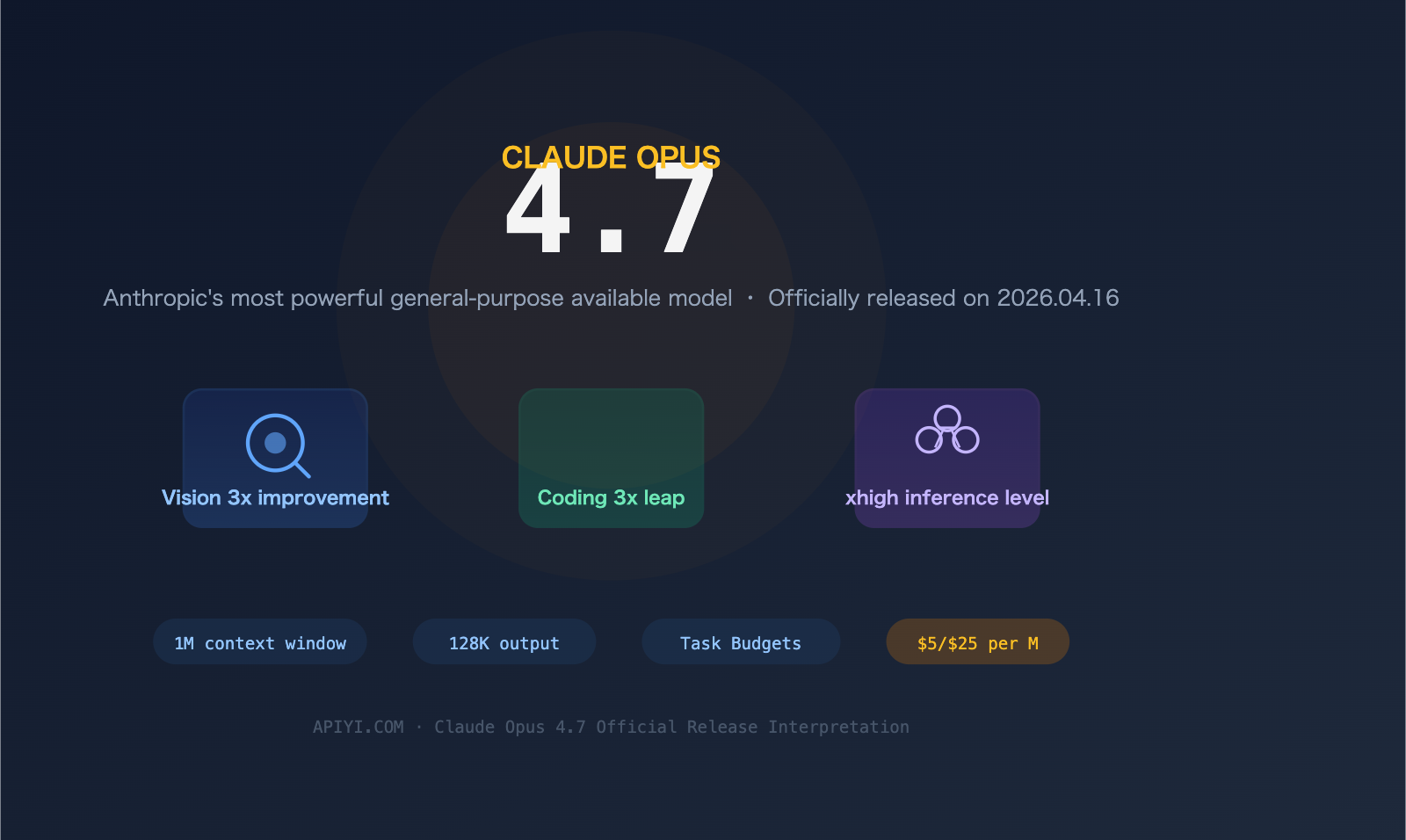
On April 16, 2026, Anthropic officially released Claude Opus 4.7—the most powerful Generally Available (GA) model to date. This upgrade brings several major breakthroughs: a visual resolution increase of over 3x, a brand-new xhigh reasoning level, a Task Budgets mechanism, and significant performance improvements in coding and knowledge-based tasks.
It's worth noting that this is a major version upgrade that includes breaking changes—the Extended Thinking Budgets have been removed, sampling parameters have been canceled, and the tokenizer has been completely updated.
Core Value: Master all the upgrades, API changes, and best practices for Claude Opus 4.7 in just 3 minutes.
Claude Opus 4.7 Quick Parameter Overview
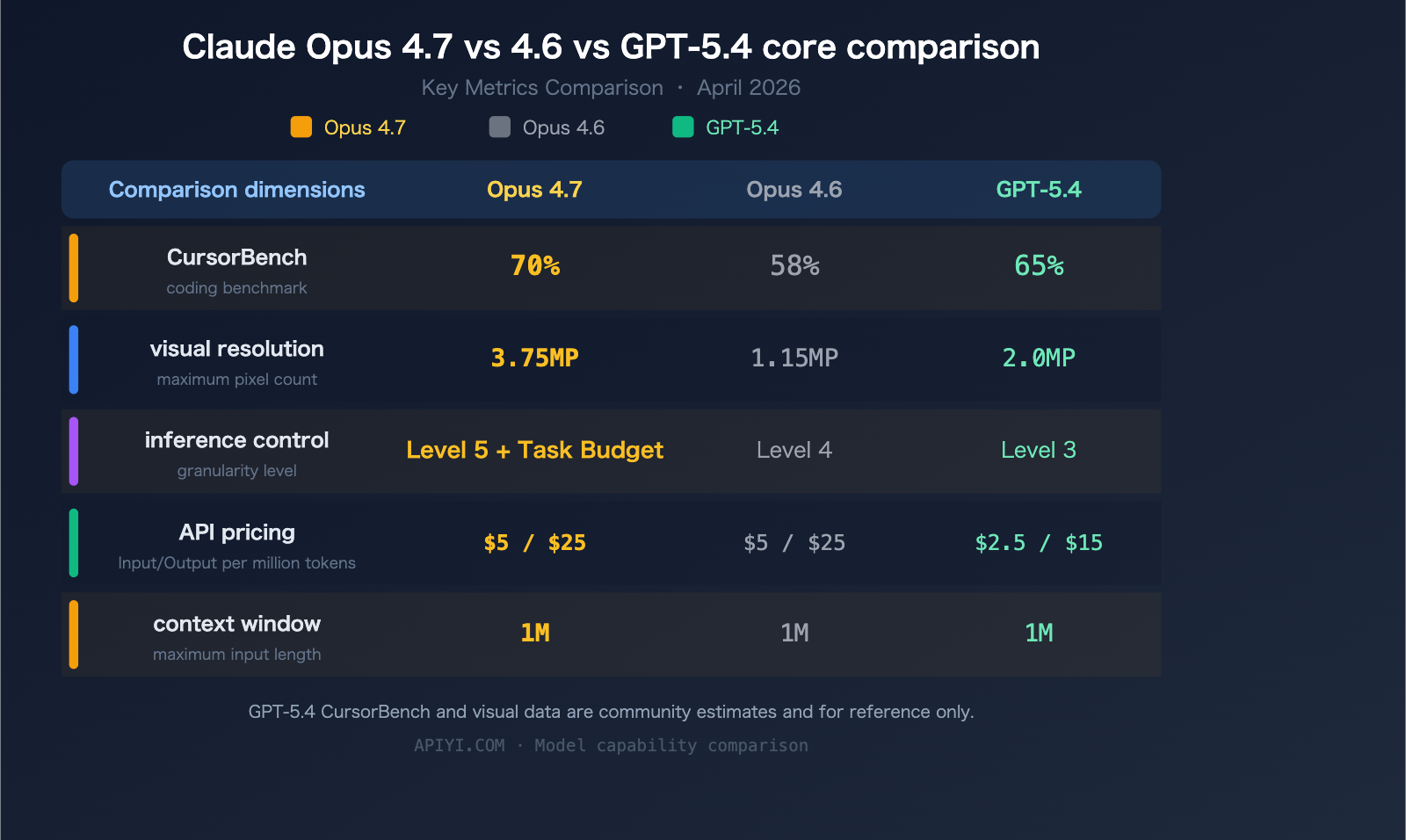
| Parameter | Claude Opus 4.7 | Claude Opus 4.6 (Comparison) |
|---|---|---|
| Model ID | claude-opus-4-7 |
claude-opus-4-6 |
| Context Window | 1M tokens | 1M tokens |
| Max Output | 128K tokens | 128K tokens |
| Image Resolution | 2576px / 3.75MP | 1568px / 1.15MP |
| Reasoning Mode | Adaptive Thinking (Only mode) | Extended Thinking + Adaptive |
| Effort Level | low / medium / high / xhigh / max | low / medium / high / max |
| Input Price | $5 / million tokens | $5 / million tokens |
| Output Price | $25 / million tokens | $25 / million tokens |
| CursorBench | 70% | 58% |
🎯 Integration Tip: APIYI (apiyi.com) is integrating Claude Opus 4.7 immediately. Developers can invoke it via the unified OpenAI-compatible interface using the model ID
claude-opus-4-7, with no need to modify your existing code framework.
Claude Opus 4.7: Three Core Upgrades
Upgrade 1: 3x Vision Capability Boost
Claude Opus 4.7 is the first Claude model to support high-resolution image processing. This is one of the most eye-catching breakthroughs in this update.
| Vision Parameter | Opus 4.7 | Previous Claude Models | Improvement |
|---|---|---|---|
| Max Long Side | 2576 px | 1568 px | 1.64x |
| Max Pixels | ~3.75 MP | ~1.15 MP | 3.26x |
| Coordinate Mapping | 1:1 pixel correspondence | Required scaling calculations | Greatly simplified |
Specific improvements include:
- High-Resolution Support: Up to 2576px on the long side (~3.75 megapixels), more than 3 times that of previous models.
- 1:1 Coordinate Mapping: The coordinates output by the model map directly to actual pixels, eliminating the need for scaling factor calculations.
- Enhanced Low-Level Perception: Improved accuracy in fundamental visual tasks like pointing, measuring, and counting.
- Improved Image Localization: Enhanced bounding box localization and detection capabilities for natural images.
This is particularly important for scenarios such as:
- Computer Use agents reading screen captures.
- Extracting information from charts and data visualizations.
- Pixel-perfect design reference.
- Understanding and editing documents and slides.
⚠️ Note: High-resolution images consume more tokens. If high-precision image analysis isn't required, we recommend downsampling images before sending them to control costs.
Upgrade 2: All-New xhigh Reasoning Level
Claude Opus 4.7 introduces the new xhigh reasoning effort level, positioned between high and max. This gives developers finer control over the balance between reasoning depth and latency/cost.
The complete effort level system:
| Effort Level | Reasoning Depth | Typical Use Case | Token Consumption |
|---|---|---|---|
low |
Lowest | Simple classification, formatting | Lowest |
medium |
Medium | Everyday Q&A, summarization | Lower |
high |
High | Most intelligence-intensive tasks | Medium |
xhigh |
Higher (New) | Coding, Agentic workflows | Higher |
max |
Highest | Mathematical reasoning, complex problems | Highest |
Anthropic's official recommendations:
- Coding and Agentic scenarios: Prioritize
xhigh. - Most intelligence-sensitive tasks: Use at least
high. - Higher effort levels result in more frequent tool calls and deeper reasoning chains.
Upgrade 3: Task Budgets Mechanism (Beta)
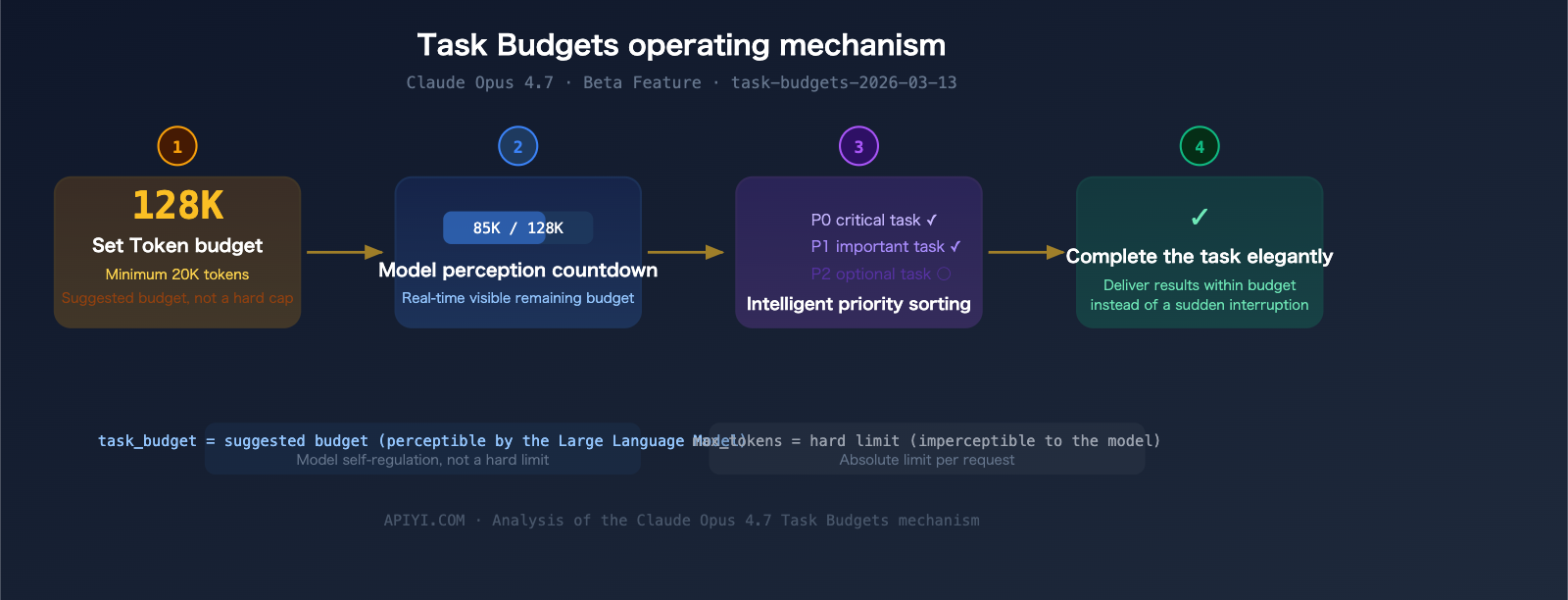
Task Budgets is a brand-new feature in Claude Opus 4.7, allowing developers to set a consultative token budget for Claude. This guides the model to allocate resources reasonably during long-running agentic tasks.
How it works:
- Developers set a total token budget (minimum 20K tokens).
- The model sees a real-time countdown during execution.
- The model uses this to prioritize the most important work.
- It gracefully completes the task as the budget runs out.
import anthropic

client = anthropic.Anthropic()

response = client.beta.messages.create(
    model="claude-opus-4-7",
    max_tokens=128000,
    output_config={
        "effort": "high",
        "task_budget": {"type": "tokens", "total": 128000},
    },
    messages=[
        {"role": "user", "content": "Review the codebase and propose a refactor plan."}
    ],
    betas=["task-budgets-2026-03-13"],
)
🎯 Usage Tip: Task Budgets isn't a hard limit, but rather a suggestion that the model is aware of. For open-ended agent tasks where quality is more important than speed, we recommend not setting a Task Budget; use it only when you need to control token spending. This parameter is also supported when calling via APIYI (apiyi.com).
Claude Opus 4.7 Coding Capabilities Leap
Claude Opus 4.7 has made impressive strides in coding, particularly in long-cycle autonomous coding scenarios.
Key Benchmark Results
| Benchmark | Opus 4.7 | Opus 4.6 | Improvement |
|---|---|---|---|
| CursorBench | 70% | 58% | +12 percentage points |
| Rakuten-SWE-Bench | 3x | Baseline | Solves 3x more production tasks |
| Finance Agent | SOTA | — | State-of-the-art |
| GDPval-AA | SOTA | — | State-of-the-art for economic knowledge work |
Coding Behavior Upgrades
- Self-Verification: Actively designs methods to verify its output before finalizing it.
- On-the-fly Correction: Automatically detects and fixes logical errors during the coding process.
- Bug Capture at Planning Stage: Identifies logical vulnerabilities during the planning phase.
- Long-cycle Autonomy: More reliable when handling asynchronous workflows, CI/CD, and multi-step tasks.
- Fewer Tool Calls: Defaults to using more reasoning rather than tool calls, improving overall efficiency.
🎯 Developer Tip: Opus 4.7 solved 3x more production-level tasks on the Rakuten-SWE-Bench compared to Opus 4.6. For development teams needing to handle complex codebases, you can quickly access and evaluate Opus 4.7 via the APIYI platform at apiyi.com.
Claude Opus 4.7 API Migration Guide (Breaking Changes)
This upgrade includes several breaking changes that you must be aware of before migrating:
Change 1: Extended Thinking Budgets Removed
# ❌ Old Opus 4.6 syntax (returns a 400 error in 4.7)
thinking = {"type": "enabled", "budget_tokens": 32000}

# ✅ New Opus 4.7 syntax
thinking = {"type": "adaptive"}
output_config = {"effort": "high"}
Adaptive Thinking is the only supported reasoning mode in Opus 4.7, and it is disabled by default. You must explicitly set thinking: {"type": "adaptive"} to enable it.
Change 2: Sampling Parameters Removed
Setting temperature, top_p, or top_k to any non-default value will return a 400 error.
The safest way to migrate is to remove these parameters from your requests entirely and use prompting to guide the model's behavior instead.
Change 3: Thinking Content Hidden by Default
Thinking blocks still appear in the response stream, but the thinking field is empty by default. If you need to view the reasoning process:
thinking = {
    "type": "adaptive",
    "display": "summarized",  # Displays a summarized version of the reasoning process
}
Change 4: Tokenizer Update
The new tokenizer may cause the same input to consume 1.0x to 1.35x more tokens (an increase of up to approximately 35%). We recommend:
- Updating your
max_tokensparameter to reserve more space. - Adjusting your compression trigger thresholds.
- Using the
/v1/messages/count_tokensendpoint to re-evaluate token consumption.
Other Key Upgrades in Claude Opus 4.7
Enhanced Knowledge Work Capabilities
- .docx Redline Annotations and .pptx Editing: Improved ability to generate and self-check revision marks, as well as handle slide layouts.
- Chart and Data Analysis: Enhanced capability for programmatic tool-use analysis of charts using image processing libraries (like PIL), including pixel-level data transcription.
Enhanced Memory Capabilities
Opus 4.7 features significant improvements in file-system-based memory read/write operations. If your agent maintains cross-turn notebooks, note files, or structured memory storage, you'll see better memory utilization after the upgrade.
Behavioral Changes (Non-breaking but noteworthy)
| Behavioral Change | Description | Recommendation |
|---|---|---|
| More literal instruction following | Does not automatically generalize instructions | Ensure instructions are clear and complete |
| Adaptive response length | Adjusts based on task complexity rather than fixed length | You may need to adjust your prompt |
| Fewer tool calls | Defaults to more reasoning, increasing effort to improve tool usage | Adjust effort levels as needed |
| More direct tone | Reduces pleasantries and emojis | User experience may feel different |
| Cybersecurity protection | Automatically detects and blocks high-risk security requests | Legitimate security work may require verification |
Available Platforms
Claude Opus 4.7 is now live on the following platforms:
- Claude.ai and the Claude product line
- Anthropic API (Model ID:
claude-opus-4-7) - Amazon Bedrock
- Google Cloud Vertex AI
- Microsoft Foundry
🎯 Unified Access: Through the APIYI (apiyi.com) platform, developers can use a unified OpenAI-compatible interface to call Claude Opus 4.7 and other mainstream models (GPT-5.4, Gemini, etc.) without needing to integrate with multiple cloud platforms separately.
Frequently Asked Questions
Q1: Is the pricing for Claude Opus 4.7 the same as Opus 4.6?
Yes. The pricing for Claude Opus 4.7 is identical to Opus 4.6: $5 per million tokens for input and $25 per million tokens for output. However, keep in mind that because the new tokenizer may consume up to 35% more tokens for the same content, your actual usage costs might increase. We recommend using the /v1/messages/count_tokens endpoint to re-evaluate your usage.
Q2: Do I need to change my code to migrate from Opus 4.6 to 4.7?
Possibly. If you have used Extended Thinking Budgets (budget_tokens), sampling parameters (temperature/top_p/top_k), or rely on default outputs for thinking content, you must update your code. We recommend checking the official Anthropic migration guide item by item. Developers calling the model via APIYI (apiyi.com) should also be mindful of these changes.
Q3: Are Task Budgets hard token limits?
No. A Task Budget is an advisory budget; the model is aware of it but isn't strictly limited by it. It differs from max_tokens—the latter is a hard limit per request that the model is not aware of. The minimum budget is 20K tokens. For open-ended tasks where quality is the priority, we recommend not setting a Task Budget.
Summary
Here are the key takeaways from the official release of Claude Opus 4.7:
- 3x Vision Boost: Resolution has been bumped up to 2576px / 3.75MP with support for 1:1 coordinate mapping, significantly improving how the model handles screenshots and document comprehension.
- Coding Leap: CursorBench scores jumped from 58% to 70%, and it now solves 3x more production tasks on Rakuten-SWE-Bench.
- New
xhighReasoning Tier: Provides more granular control over reasoning depth, sitting right betweenhighandmax. - Task Budgets Mechanism: Introduces token budget management for long-running agentic tasks.
- Breaking Changes: Extended Thinking Budgets have been removed, sampling parameters are gone, and the tokenizer has been updated (resulting in up to 35% more tokens).
- Pricing Remains Unchanged: Input is $5/M tokens and output is $25/M tokens, though your actual consumption might increase due to the tokenizer changes.
APIYI (apiyi.com) is working to integrate Claude Opus 4.7 as we speak. Developers can seamlessly switch to the latest model via our unified API interface. We also support model invocation for GPT-5.4, Gemini, and others, making it easy to quickly evaluate and compare how different models perform in your specific business scenarios.
📚 References
-
Anthropic Official Announcement – Claude Opus 4.7: The official release blog post with full upgrade details.
- Link:
anthropic.com/news/claude-opus-4-7 - Note: The most authoritative source for first-hand information.
- Link:
-
Claude API Documentation – What's New in Opus 4.7: Detailed API changes and migration guide.
- Link:
platform.claude.com/docs/en/about-claude/models/whats-new-claude-4-6 - Note: Includes all breaking changes and code examples.
- Link:
-
Anthropic Claude Opus Product Page: Full model specifications and benchmark data.
- Link:
anthropic.com/claude/opus - Note: Official product page featuring performance comparisons.
- Link:
-
StreetInsider Report: Coverage on Claude Opus 4.7's enhanced coding and vision capabilities.
- Link:
streetinsider.com/Corporate+News/Anthropic+launches+Claude+Opus+4.7+with+enhanced+coding+and+vision+capabilities/26322789.html - Note: Third-party analysis of the release.
- Link:
Author: APIYI Technical Team
Technical Discussion: Feel free to join the discussion in the comments. For more resources, visit the APIYI documentation center at docs.apiyi.com.