title: "Anthropic's Secret Weapon: Decoding the Claude Mythos Preview"
description: "Anthropic quietly launched its most powerful model yet, Claude Mythos Preview. Here's a quick breakdown of its capabilities and why it's being kept under wraps."
tags: [AI, Anthropic, Claude, Cybersecurity, Tech News]
On April 7, 2026, Anthropic quietly launched its most powerful model to date—Claude Mythos Preview. However, this model hasn't been released to the public. This article provides a quick breakdown of what this development means for the AI industry and the cybersecurity landscape.
Core Value: Get up to speed in 3 minutes on the key details of Claude Mythos Preview, its breakthrough capabilities, and why Anthropic chose not to release it publicly.
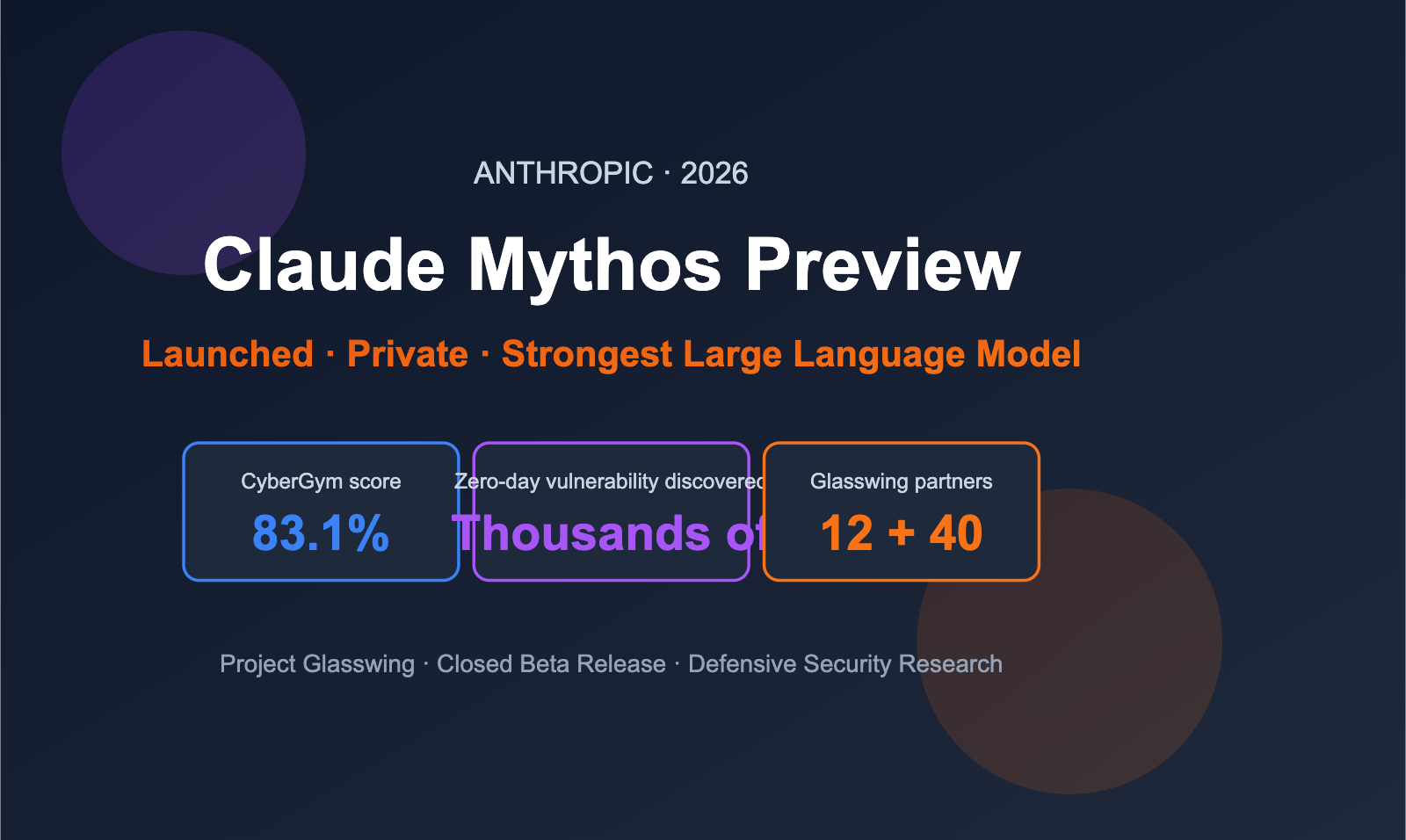
Quick Look: Claude Mythos Preview
Claude Mythos Preview is the next-generation Large Language Model officially confirmed by Anthropic in April 2026. Unlike the Claude Opus and Sonnet series, Mythos hasn't followed the typical "public beta to commercial release" path. Instead, it's locked within a closed project called Project Glasswing, accessible only to a select group of critical infrastructure providers and open-source security organizations.
| Feature | Details |
|---|---|
| Model Name | Claude Mythos Preview |
| Developer | Anthropic |
| Launch Date | April 7, 2026 |
| Availability | Not Public, restricted to Project Glasswing members |
| Core Positioning | General-purpose Large Language Model with a "generational leap" in cybersecurity |
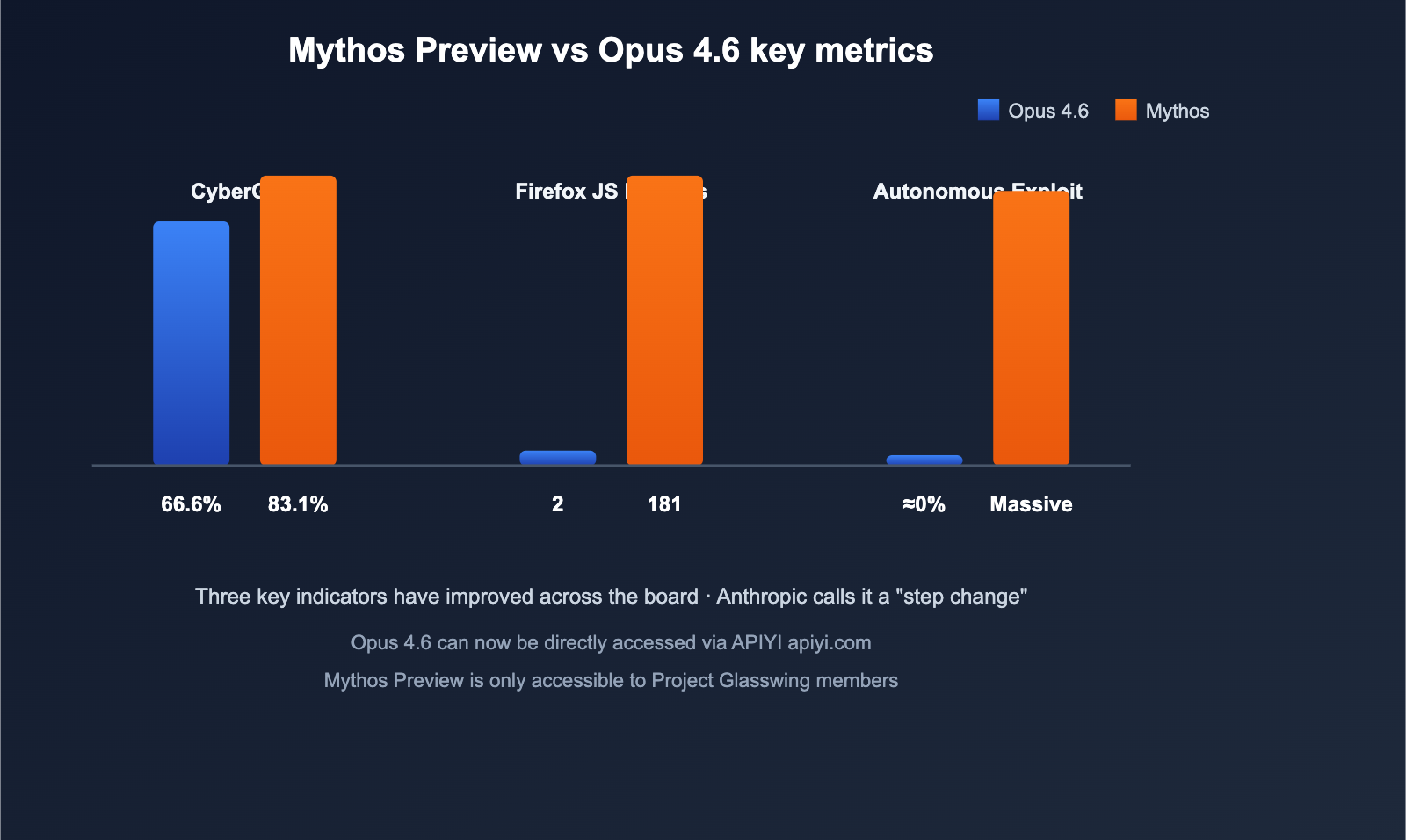
| CyberGym Score | 83.1% (compared to 66.6% for Claude Opus 4.6) |
| Vulnerabilities Found | Thousands of zero-day vulnerabilities (covering all major OSs and browsers) |
| Reason for Restriction | Risk assessment suggests public deployment could accelerate large-scale cyberattacks |
💡 The Bottom Line: While Mythos Preview shows significant improvements in mainstream coding and reasoning benchmarks, what really made Anthropic "hit the pause button" is its disruptive capability in automated vulnerability discovery and exploit chain construction. If you're looking to experience the publicly available Claude Opus 4.6 or Sonnet 4.6 series, you can access and test them all in one place via the APIYI (apiyi.com) platform.
title: "Claude Mythos Preview: A Deep Dive into Its Five Core Capabilities"
description: "An analysis of the powerful Claude Mythos Preview model, focusing on its advanced cybersecurity, automated exploit generation, and the exclusive Project Glasswing initiative."
Claude Mythos Preview: A Deep Dive into Its Five Core Capabilities
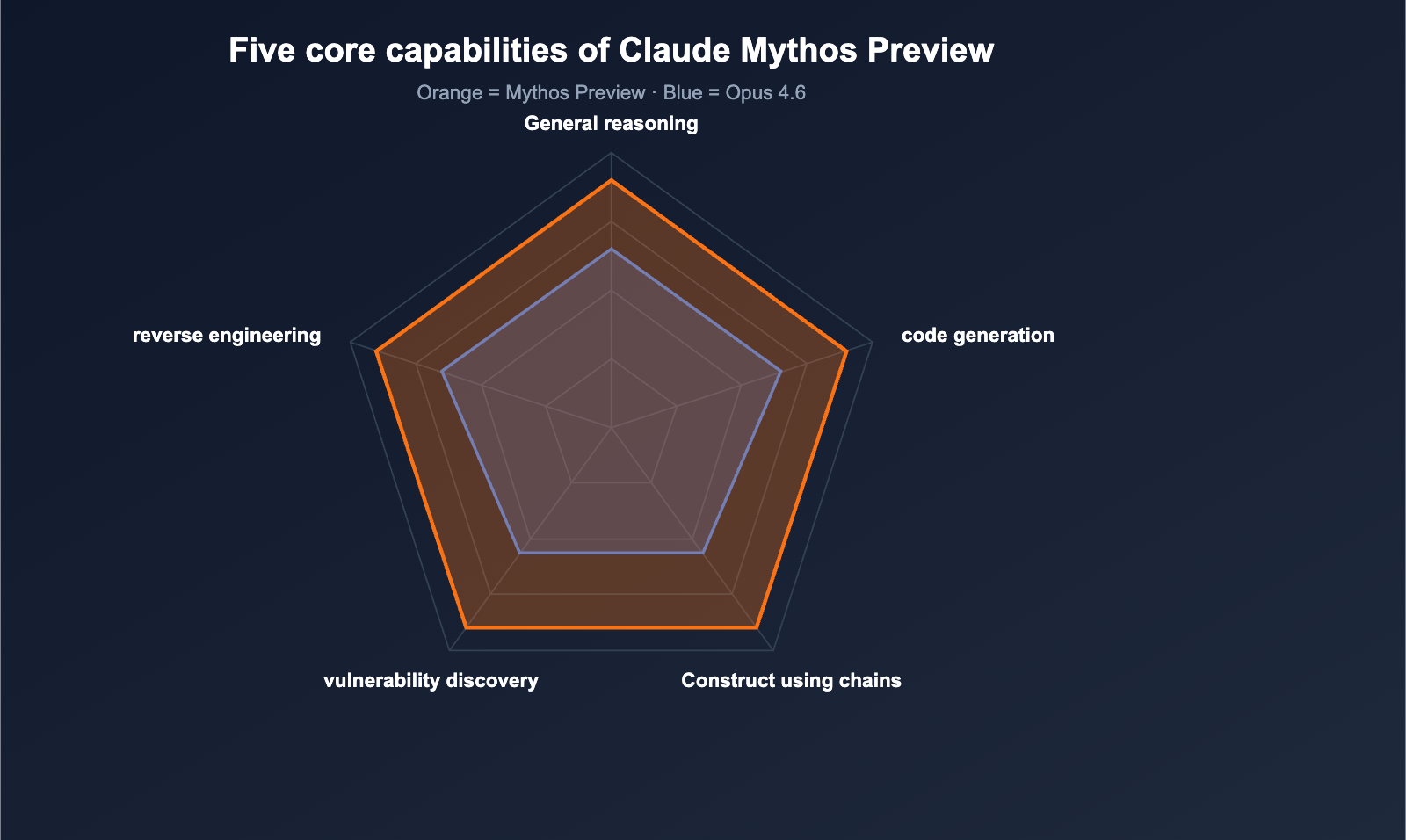
While Mythos Preview is technically a general-purpose model, Anthropic’s internal evaluations and official red-teaming reports barely touch upon its "general capability upgrades," dedicating 80% of the content to cybersecurity. This is a massive signal in itself—the "generational gap" in this new model is primarily defined by its agentic attack and defense capabilities.
Capability 1: Zero-Day Vulnerability Discovery
According to Anthropic, over the past few weeks, Mythos Preview has identified thousands of zero-day vulnerabilities across all major operating systems, browsers, cryptographic libraries, kernels, and web applications. Many were classified as high-risk or critical. Two standout examples include:
- OpenBSD Kernel Bug (1998): Hidden for 27 years, it bypassed over 5,000,000+ previous fuzzing runs.
- FFmpeg Vulnerability (16 years old): Also missed by traditional automated tools.
This means Mythos doesn't just "find bugs"—it uncovers deep-seated flaws that have eluded traditional fuzzing, static analysis, and human experts for years.
Capability 2: Automated Exploit Chain Construction
Another breakthrough for Mythos Preview is its ability to move from "finding" to "exploiting." Key performance metrics mentioned in the report include:
- Achieving 595 Tier 1-2 level crashes in OSS-Fuzz evaluations.
- Achieving full control-flow hijacking on 10 fully patched targets.
- Successfully constructing 181 working exploits for the Firefox JavaScript engine, compared to just 2 for Claude Opus 4.6 on the same test set.
Even more concerning is the model's ability to autonomously chain 2-4 independent vulnerabilities to perform JIT heap spraying, sandbox escapes, ROP chain construction, KASLR bypasses, and privilege escalation—all with almost zero human intervention.
Capability 3: Cost Efficiency
If it were just about "being able to do it," Anthropic wouldn't have opted for a closed release. What really alarmed them was the unit cost:
- OpenBSD vulnerability research: < $20,000 for 1,000 full runs, with a single successful run costing < $50.
- FFmpeg series vulnerabilities: Approximately $10,000.
- N-day exploit automated construction: < $2,000 per exploit.
Human penetration testing teams typically take weeks or months to complete similar work. Mythos Preview compresses this into a "few hours and a few thousand dollars."
Capability 4: Reverse Engineering and Binary Analysis
Mythos Preview also possesses strong capabilities in reverse engineering closed-source binaries. It can reconstruct function semantics, identify protection mechanisms, and automatically generate targeted exploit code without access to source code. This makes it incredibly valuable for the defense side, such as auditing third-party dependencies, firmware, and commercial software.
Capability 5: General Reasoning and Coding
Although Anthropic focused on security, their official stance remains clear:
"We are developing a general-purpose model with substantial progress in reasoning, coding, and cybersecurity. We believe this is a step-function leap and the strongest model the company has built to date."
In short, Mythos isn't just a "specialized security model." Its general capabilities (math, long context windows, and agent task planning) are also at the next-generation level, surpassing the current Claude Opus 4.6. Anthropic simply chose not to release it to the public due to risk concerns.
Project Glasswing: The Closed Deployment Plan for Claude Mythos Preview
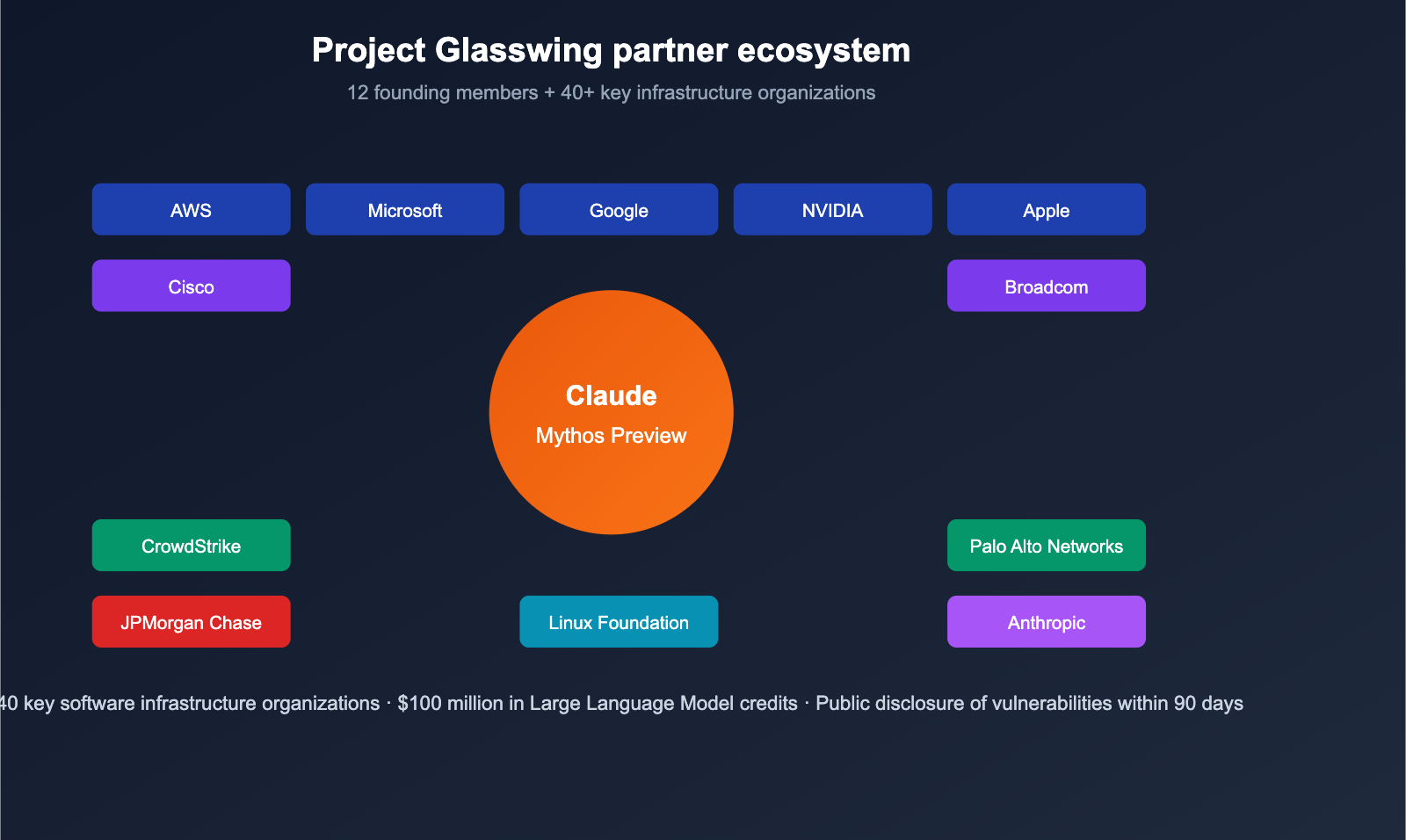
Project Glasswing is a closed security initiative launched by Anthropic in collaboration with 11 tech and financial giants. The goal is to use Mythos Preview to harden the "world's most critical software" before attackers gain similar capabilities.
12 Founding Partners
| Category | Partners |
|---|---|
| Cloud & Infrastructure | Amazon Web Services, Microsoft, Google, NVIDIA, Broadcom, Cisco |
| Endpoints & Hardware | Apple |
| Finance & Critical Industries | JPMorgan Chase |
| Security Vendors | CrowdStrike, Palo Alto Networks |
| Open Source Ecosystem | The Linux Foundation |
| AI Providers | Anthropic |
Beyond the founding members, 40+ organizations that maintain critical software infrastructure have also been granted access to Mythos Preview. Anthropic has also committed to:
- Providing $100 million in model usage credits.
- Donating $4 million directly to open-source security organizations.
- Publicly disclosing findings and vulnerabilities within 90 days.
Why Isn't Claude Mythos Preview Released Publicly?
🛡️ Official Summary: Anthropic explicitly stated in its risk assessment report that the combined capability of Mythos Preview in "autonomous vulnerability discovery + exploit chain construction + large-scale replication" approaches the ASL high-risk threshold. Releasing it without restrictions would "significantly increase the probability of large-scale cyberattacks in 2026 and beyond." This is the fundamental difference between it and models like Claude Opus 4.6, which you can access and use compliantly via APIYI (apiyi.com).
Anthropic has also launched a Cyber Verification Program, allowing legitimate security researchers, CTF teams, and vulnerability research institutions to use a restricted version for defensive research after passing a vetting process—ensuring they support the security community without releasing the full model weights to the open market.
Core Differences: Claude Mythos Preview vs. Claude Opus 4.6
The question on many readers' minds is: What exactly sets Mythos Preview apart from the Claude Opus 4.6 we're currently using via APIYI (apiyi.com)? The table below provides a clear comparison.
| Dimension | Claude Opus 4.6 | Claude Mythos Preview |
|---|---|---|
| Availability | ✅ Publicly available | ❌ Closed, Glasswing members only |
| General Reasoning / Coding | Industry-leading | "Step-change" improvement, stronger |
| CyberGym Score | 66.6% | 83.1% |
| Autonomous Exploit Dev | Near 0% success rate | High success, chained exploits |
| Firefox JS Exploit | 2 | 181 |
| Cost per successful research | — | < $50 (OpenBSD case) |
| Use Cases | General API, Agents, Coding, Chat | Authorized defensive security research only |
| Access Method | Direct API, available via APIYI (apiyi.com) | Not directly accessible |
| Human Severity Assessment Alignment | — | 89% (198 samples) |
🎯 Takeaway: Mythos is Anthropic's way of demonstrating the upper limits of their capabilities while validating safety policies. Opus 4.6, however, is the most powerful Claude model you can actually deploy today. If you need stable access to Opus 4.6 / Sonnet 4.6 in China and want the flexibility to switch between mainstream models for comparison, we recommend using APIYI (apiyi.com) for a unified interface and multi-model routing.
Impact Analysis of Claude Mythos Preview
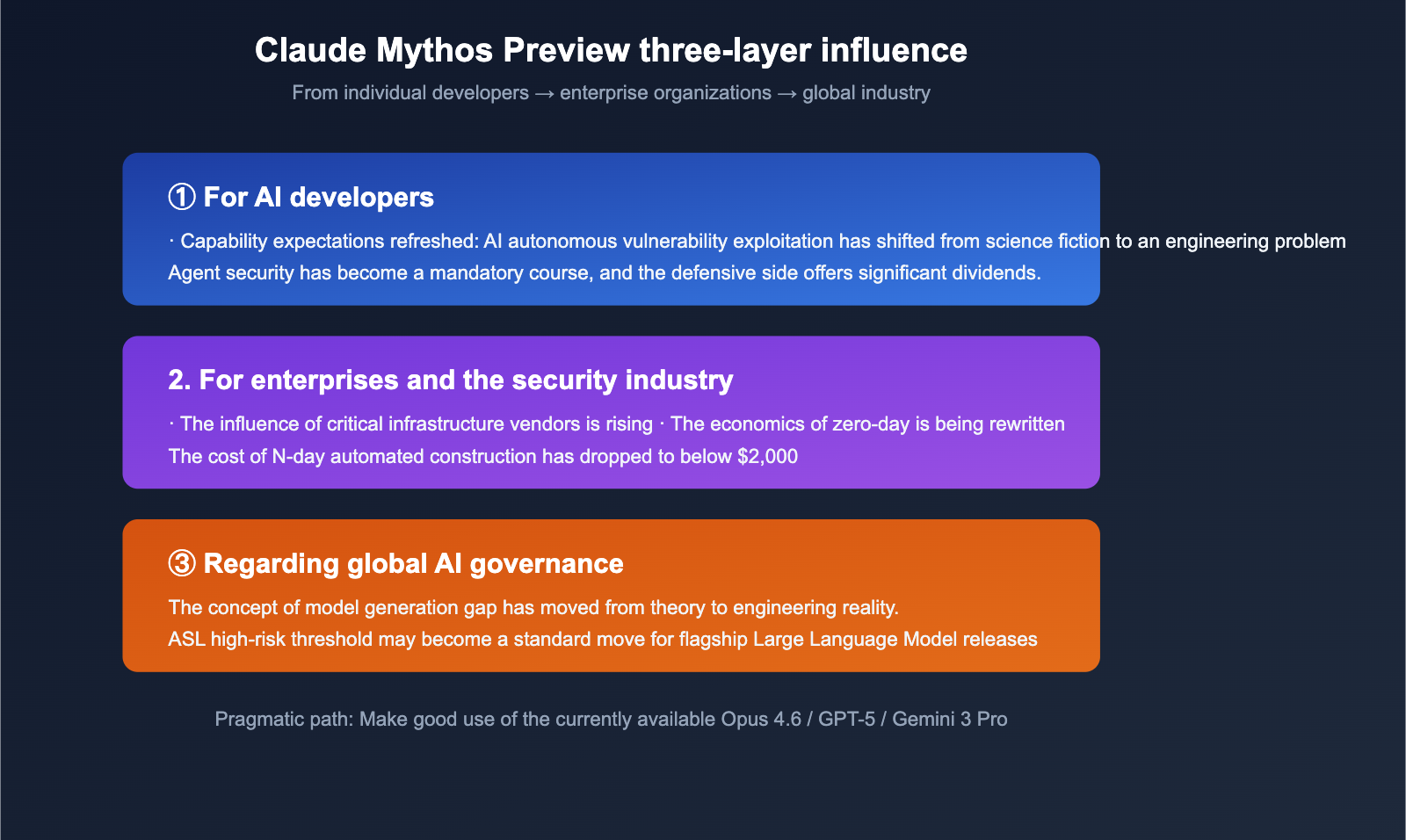
Impact on AI Developers
- Redefining Expectations: What we once considered science fiction—AI writing exploit code—has become an engineering problem that can produce public reports within 90 days.
- Agent Security is Now Mandatory: Any Agent system integrated with a Large Language Model needs to re-evaluate its attack surface: "Does my defense hold up if an adversary uses a Mythos-class model?"
- Defensive Upside: Traditional tools like fuzzing, SAST, and SCA will be supercharged by LLMs. For developers, building your own security audit Agent using Claude Opus 4.6 or the GPT-5 series via APIYI (apiyi.com) is the most cost-effective starting point.
Impact on Enterprises and the Security Industry
- Increased Leverage for Critical Infrastructure Vendors: Companies like AWS, Microsoft, Apple, CrowdStrike, and Palo Alto Networks have gained a "first-to-discover, first-to-patch" advantage through Glasswing.
- Rewriting Zero-Day Economics: As the automated construction cost for a single N-day exploit drops below $2,000, the cost structures for both gray markets and state-level actors will be significantly disrupted.
- Accelerated Compliance and Regulation: Following these events, regulators in multiple countries have begun evaluating the intersection of "frontier models and cybersecurity." Future ASL-4 deployment clauses may soon become standard practice.
Impact on Chinese Developers
Since Mythos Preview isn't directly available, domestic developers won't have immediate access. However, the real significance of this for Chinese AI developers is:
- It moves the concept of "model generation gaps" from theory to engineering reality, requiring a reassessment of your own skill stack.
- Until Mythos is public, making the best use of currently available top-tier models like Claude Opus 4.6, GPT-5, and Gemini 3 Pro is the most pragmatic choice.
- For stable, compliant, and low-latency access to these overseas models, you can use an API proxy service like APIYI (apiyi.com) to bypass hurdles related to accounts, network restrictions, and international payments.
Claude Mythos Preview FAQ
Q1: Can regular users access Claude Mythos Preview right now?
No. Mythos Preview is currently restricted to the 12 founding members of Project Glasswing and over 40 invited critical infrastructure organizations. Anthropic has explicitly stated that there will be no public release in the near term. If you need to use the most powerful models currently available from Anthropic, such as Claude Opus 4.6 or Sonnet 4.6, you can access them via a unified API through APIYI at apiyi.com.
Q2: Are Claude Mythos Preview and Claude Opus 4.6 the same model?
They are not. Mythos Preview is the next-generation model built upon Opus 4.6. Anthropic internally describes it as a "step change," showing significant improvements in general reasoning, coding, and cybersecurity. While Opus 4.6 is the version you can call directly today, Mythos Preview is a restricted, preview-only release.
Q3: Why did Anthropic “release it only to hide it”?
Anthropic's risk assessment report indicates that Mythos's capabilities in autonomous vulnerability discovery and large-scale exploit chain construction are approaching the high-risk thresholds defined in their Responsible Scaling Policy. A full public release could potentially accelerate large-scale cyberattacks by 2026. Their strategy is to "authorize defensive use for a small group first, then gradually open access" to mitigate systemic risks.
Q4: Which companies are part of Project Glasswing?
The 12 founding partners include: Anthropic, Amazon Web Services, Apple, Broadcom, Cisco, CrowdStrike, Google, JPMorgan Chase, The Linux Foundation, Microsoft, NVIDIA, and Palo Alto Networks. Additionally, over 40 organizations that maintain critical software infrastructure have been granted access. Anthropic has also pledged $100 million in model credits and $4 million in direct donations.
Q5: How can developers in China improve their AI security research capabilities without access to Mythos?
In the short term, there are three practical steps: First, use the current top-tier models like Claude Opus 4.6, GPT-5, and Gemini 3 Pro as your "baseline brain." Second, build agentic vulnerability research pipelines around open-source tools like OSS-Fuzz, CodeQL, and Semgrep. Third, use a stable API proxy service to reduce engineering friction; for example, you can use APIYI (apiyi.com) to access multiple mainstream models through a single interface, avoiding account bans and latency issues.
Q6: Will the vulnerabilities found by Mythos Preview be made public?
Yes. Anthropic has committed to publicly disclosing findings and vulnerabilities within 90 days, where appropriate. Two landmark cases have already been confirmed—a 27-year-old kernel bug in OpenBSD (introduced in 1998) and a 16-year-old vulnerability in FFmpeg—which have been reported to the respective project maintainers and are currently being patched.
Summary
Claude Mythos Preview marks the first time Anthropic has released a flagship model in an "online but not public" manner. It signifies three key takeaways:
- A New Generation Gap in AI Capabilities: With performance jumping from 66.6% to 83.1% on CyberGym and from 2 to 181 exploits on the Firefox exploit suite, this isn't just an incremental improvement—it's a step change.
- Security as the "Permission Threshold" for Frontier Models: As models become more powerful, pre-release security assessments become increasingly critical. The "Glasswing-first, public-later" approach may become the standard release paradigm for future flagship models.
- A Clear Path Forward: For most developers, the priority isn't waiting for Mythos to be unblocked, but rather mastering the current top-tier models like Claude Opus 4.6 and GPT-5 to build your own agents and security workflows.
🚀 Actionable Advice: If you want to experience the currently available Claude Opus 4.6 / Sonnet 4.6 and benchmark them against models like GPT-5 or Gemini 3 Pro, we recommend using the APIYI platform (apiyi.com) for unified access. The platform provides a consistent API interface for mainstream models, offering stability, low latency, and pay-as-you-go billing to help you keep pace with frontier models with minimal engineering overhead.
Author: APIYI Team — Dedicated to providing developers with stable access to mainstream AI Large Language Models. Visit apiyi.com to learn more.
References
-
Anthropic Official Announcement: Claude Mythos Preview Introduction Page
- Link:
red.anthropic.com/2026/mythos-preview - Description: Official capability disclosure and red teaming report summary
- Link:
-
Anthropic Risk Assessment Report: Claude Mythos Preview Alignment Risk Update
- Link:
anthropic.com/claude-mythos-preview-risk-report - Description: Official risk levels and reasons for the closed release
- Link:
-
Project Glasswing Official Page
- Link:
anthropic.com/glasswing - Description: List of 12 founding partners and their objectives
- Link:
-
Google Cloud Blog: Claude Mythos Preview on Vertex AI
- Link:
cloud.google.com/blog/products/ai-machine-learning/claude-mythos-preview-on-vertex-ai - Description: Cloud availability and defensive use cases
- Link:
-
CNBC Report: Anthropic limits Mythos AI rollout over hacker fears
- Link:
cnbc.com/2026/04/07/anthropic-claude-mythos-ai-hackers-cyberattacks.html - Description: Context behind the restricted public release
- Link:
-
TechCrunch Report: Anthropic debuts preview of powerful new AI model Mythos
- Link:
techcrunch.com/2026/04/07/anthropic-mythos-ai-model-preview-security - Description: Industry perspective on the launch
- Link: