In May, ByteDance teased the release of Seedance 2.1 through international media outlets like Pandaily. It’s expected to deliver a 20% overall quality improvement over version 2.0, marking the most significant update to this product line since the official launch of Seedance 2.0 in February 2026. Meanwhile, the 2.0 series has already branched into "Standard" and "Fast" tiers on international platforms like fal, Replicate, and PiAPI. The "Fast" budget version has pushed the cost per second as low as $0.10, bringing ByteDance's video generation models into a completely new price bracket.
This article synthesizes official announcements from ByteDance Seed, Volcengine pricing documentation, and the latest API lists from TechNode, fal, and Replicate. We’ll break down the core intelligence on Seedance 2.1, the pricing structure of the Seedance 2.0 budget versions, and provide integration and selection advice for the APIYI (apiyi.com) platform. All data is sourced from public English channels to help developers connect directly with official documentation and third-party platforms.
1. Seedance 2.1 Key Release Intelligence: 4 Major Upgrades
The report published by Pandaily in May remains the most authoritative source on 2.1, with the "20% quality improvement" being the headline. Combining this with the "continued exploration" goals mentioned in the ByteDance Seed team's 2.0 launch blog, we can infer that 2.1 will focus on optimizations in the following four dimensions.
1.1 Upgraded Physical Realism and Motion Stability
Seedance 2.0 already made significant strides in physical accuracy and motion stability for complex scenes. The "20% quality improvement" in 2.1 is interpreted by several English-language media outlets as a continuation of this trajectory. For developers working on high-dynamic scenes—such as characters running, vehicles moving, or fluid effects—this upgrade means a further reduction in frame skipping, distortion, and texture misalignment, ultimately cutting down on post-production rework.
1.2 Enhanced Prompt Adherence and Multi-shot Consistency
Version 2.0 already supports 15-second multi-shot output. Rumor has it that 2.1 will further refine shot transitions, character consistency, and scene continuity. This is crucial for scenarios like short video scripts, advertising storyboards, and product storytelling where "generating multiple shots at once" is required, significantly lowering post-editing costs.
1.3 Improved Audio-Visual Synchronization and Native Audio Quality
One of the core selling points of Seedance 2.0 is its unified multimodal audio-video joint generation architecture, which supports stereo sound and phoneme-level lip-syncing in over 8 languages. 2.1 is expected to fine-tune audio clarity, background sound realism, and dialogue pacing, further narrowing the gap with Veo 3 in terms of native audio capabilities.
1.4 Expanded Input Modalities and Reference Material Capacity
Version 2.0 already supports up to 9 reference images, 3 reference videos, and 3 reference audio clips per generation. Whether 2.1 will further expand this capacity or offer more granular input control is a key point for developers to watch. On the APIYI (apiyi.com) platform, if you have already integrated Seedance 2.0, you can standardize your multimodal input workflows now so that you can upgrade smoothly once 2.1 is released.
II. Deep Dive into Seedance 2.0 Budget Version: Fast Mode Pricing and Capabilities
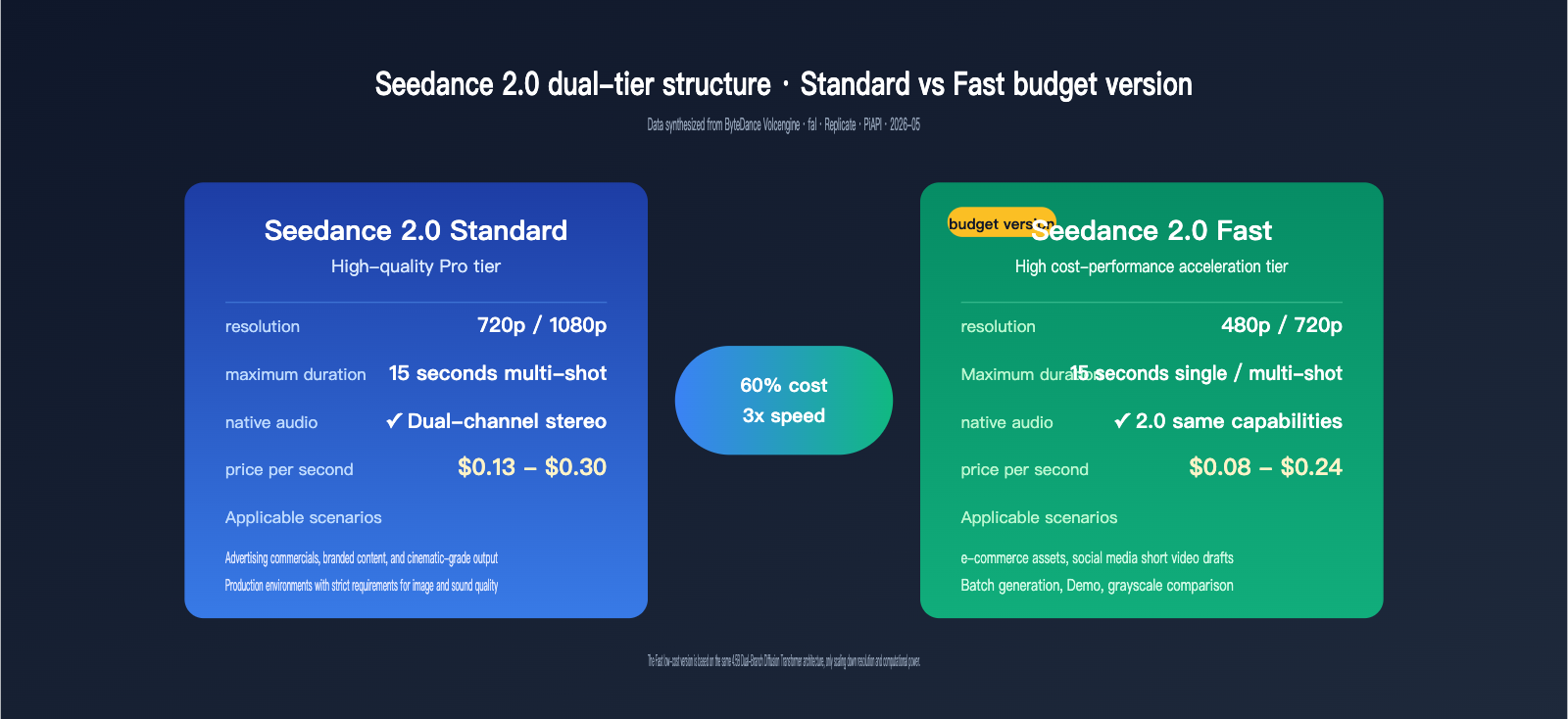
The "budget-friendly Seedance 2.0" that many developers are interested in usually appears in English channels under the names Fast or Pro Fast. ByteDance inherited this product line from the 1.0 era (where Seedance 1.0 Pro Fast offered 3x rendering speed and roughly 60% cost reduction). With the launch of 2.0, the Fast and Standard tiers have formed a stable dual-structure offering.
2.1 Capability Boundaries of Fast Mode
The core strategy of Fast mode is "trading a bit of image quality for speed and lower costs." The typical approach is to cap the generation resolution at 720p, with some platforms starting at 480p and supporting Fast Upscaling to 720p. For short video drafts, e-commerce assets, and fast-paced social media content, Fast is perfectly adequate. However, for high-bitrate final cuts intended for cinema or advertising, we still recommend using the Standard mode or waiting for 2.1.
2.2 Cost Comparison per Video
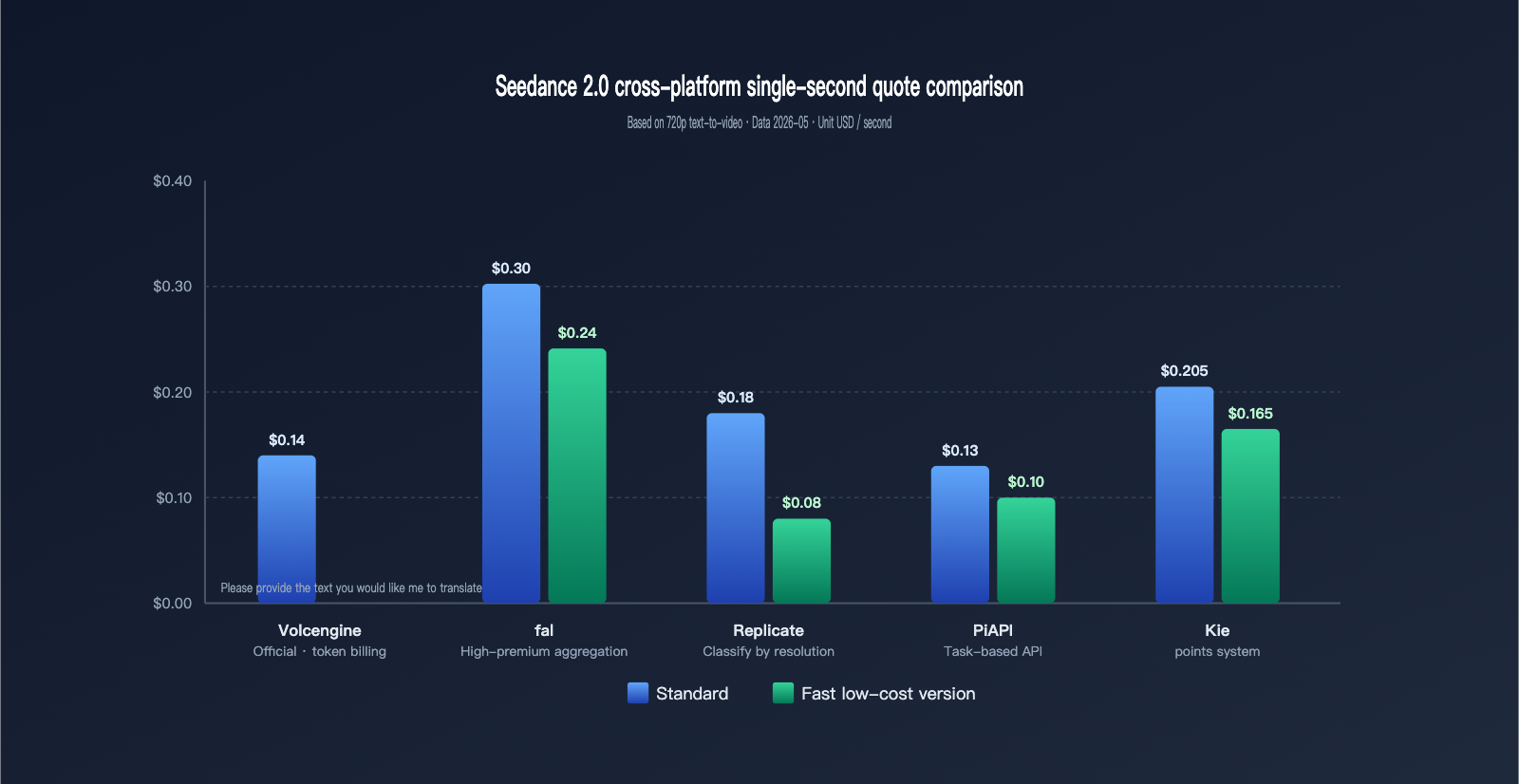
The table below summarizes the per-second pricing for Seedance 2.0 Standard/Fast across major platforms as of May 2026. Data is based on official platform pages or English-language compilations like LaoZhang AI.
| Platform | Standard Price | Fast Price | Notes |
|---|---|---|---|
| ByteDance / Volcengine (Official) | ~$0.14/sec | Not yet public | Based on 46 CNY/M tokens |
| fal | $0.3034/sec | $0.2419/sec | 720p text-to-video |
| Replicate | $0.18/sec (720p) | From $0.08/sec (480p) | Tiered by resolution |
| PiAPI | $0.13/sec | $0.10/sec | Task-based API |
| Kie | $0.205/sec (720p) | $0.165/sec (720p) | Credit-based |
💡 Pricing Insight: Fast mode typically offers a 20%-50% discount on most overseas platforms. If you're a SaaS team with monthly billing, shifting 80% of your traffic to Fast and keeping 20% for Standard can usually reduce your video generation costs by over 35% without a noticeable drop in perceived quality. You can perform small-scale A/B testing on APIYI (apiyi.com) to verify this.
2.3 The Specifics of Volcengine Official Pricing
It's easy for developers to overlook that ByteDance uses token-based billing rather than per-second billing for Seedance 2.0 on Volcengine. The two official price tiers are: 46 CNY per million tokens ($6.40) for text/image input + video output, and 28 CNY per million tokens ($3.90) for video input + video output. Generating a 15-second video consumes roughly 308,880 tokens, which converts to approximately $0.14/sec—the origin of the "1 Yuan/sec era" reported by TechNode.
III. Comprehensive Cross-Platform Pricing Comparison: Seedance 2.1 / 2.0
To truly evaluate the production costs of Seedance 2.0, you can't just look at official quotes; you have to factor in upstream and downstream expenses. We've categorized the major platforms into three types for comparison.
3.1 Official Direct vs. Third-Party Aggregation
Official Direct (Volcengine / BytePlus) offers the most transparent pricing and highest quotas, but can be less friendly to overseas teams regarding settlement currencies, latency, and compliance audits. Third-Party Aggregators (fal, Replicate, PiAPI, etc.) act as API gateways, typically adding a 0-30% service premium, but they save significant development time through OpenAI compatibility, unified authentication, and easy model switching.
3.2 "Actual Usable Cost" per Generation
| Video Duration | Volcengine Estimate | fal Standard | Replicate 720p | PiAPI Fast |
|---|---|---|---|---|
| 5 sec | $0.70 | $1.52 | $0.90 | $0.50 |
| 10 sec | $1.40 | $3.03 | $1.80 | $1.00 |
| 15 sec | $2.10 | $4.55 | $2.70 | $1.50 |
📊 Selection Advice: If you're just building internal demos or social media shorts, PiAPI Fast's $0.10/sec is among the lowest in the international market. If you need Replicate-style webhook/task callback capabilities, Replicate 480p is also a solid budget option. For teams requiring both cost-efficiency and stability, you can use APIYI (apiyi.com) to connect to both Volcengine and fal's Seedance 2.0 interfaces, benefiting from unified billing and authentication, which eliminates the headache of multi-platform reconciliation.
3.3 Hidden Differences in Billing Units
The difference between per-second and per-token billing is significant for longer videos. For example, with a 15-second video, if you use multiple reference images (e.g., 9 images + 3 video clips), the token count will be significantly higher than a pure text-to-video scenario, potentially making the actual cost 20%-40% higher than per-second billing. When estimating budgets for Seedance 2.0 and 2.1, be sure to include "input material complexity" as a key variable.
IV. Competitive Positioning: Seedance 2.1 vs. Sora 2 / Kling 2.5 / Veo 3
While Seedance 2.1 hasn't officially opened its API yet, we can perform a relatively objective comparative analysis based on the 2.0 capability baseline and the official claim of a "20% quality improvement." The table below compares capabilities based on public reports from English-language media as of May 2026.
| Model | Max Duration | Native Audio | Multi-shot | 1080p Support | Ref. Price/Sec |
|---|---|---|---|---|---|
| Seedance 2.1 (Upcoming) | 15s (est.) | ✅ Enhanced | ✅ Enhanced | ✅ | TBD |
| Seedance 2.0 | 15s | ✅ 8+ lang lip-sync | ✅ | ✅ | $0.14 (Official) |
| Sora 2 | 60s | ✅ | ✅ | ✅ | $0.30+ |
| Kling 2.5 | 10s | ⚠ Partial | ⚠ | ✅ | $0.20+ |
| Google Veo 3 | 8s | ✅ Native Audio | ⚠ | ✅ | $0.50+ |
4.1 Relative Advantages of Seedance 2.1
The Seedance series is in a league of its own when it comes to the "15-second multi-shot + native audio + mid-range price" combination. Sora 2 offers longer durations but at a significantly higher unit price; Veo 3 has strong audio quality but is limited to 8 seconds; and while Kling 2.5 is popular among creators in the Asia-Pacific region, its audio capabilities are weaker. If Seedance 2.1 truly delivers that 20% quality boost, it will have almost no direct competitors on the price-to-performance curve.
4.2 Potential Drawbacks of Seedance 2.1
To be fair, the Seedance series currently lacks the 60-second long-form capability of Sora 2 and misses the integration advantages that Veo 3 enjoys within the Western creator ecosystem. For long-form storytelling or complex narrative projects, Seedance 2.1 will still require manual editing or multiple stitching, which is something you should evaluate during your selection process.
V. 5 Practical Tips for Integrating Seedance 2.1 / 2.0
5.1 Pre-integrate with the Seedance 2.0 Standard API on APIYI
Even though 2.1 isn't out yet, ByteDance typically maintains backward compatibility for API fields during version iterations. By getting your 2.0 invocation workflow running on the APIYI (apiyi.com) platform now, you'll likely only need to update the model field to switch over once 2.1 launches.
5.2 Invocation Example: Seedance 2.0 Text-to-Image Video
import openai

client = openai.OpenAI(
    api_key="your-apiyi-key",
    base_url="https://api.apiyi.com/v1"
)

# Generate video using Seedance 2.0
response = client.videos.generations.create(
    model="seedance-2.0",
    prompt=(
        "A cinematic dusk shot of a glass-facade residential building, "
        "warm interior glow contrasts with cool sky, slow dolly-in, "
        "ambient evening city sounds."),
    size="1280x720",
    duration=10,
    fps=24,
)
print(response.video.url)
5.3 Invocation Example: Seedance 2.0 Fast (Budget Version)
# Generate video using the cost-effective Fast model
response = client.videos.generations.create(
    model="seedance-2.0-fast",
    prompt="A product showcase video of a wireless earbud, white seamless background, slow 360 rotation.",
    size="1280x720",
    duration=5,
    fps=24,
)
Simply switch the model to seedance-2.0-fast to enjoy a cost reduction of approximately 60%, which is perfect for e-commerce assets, social media video drafts, and batch generation tasks.
5.4 Use "Fast" for Drafts and "Standard / 2.1" for Final Cuts
The best practice is "layered rendering": run 3-5 drafts using the Fast model to confirm your prompt and shot logic, then re-render the final cut using the Standard or 2.1 model. This approach can reduce your production video costs by over 50% while maintaining high quality for the final output.
5.5 Keep an Eye on ByteDance and Volcengine Release Cycles
Looking at the Seedance team's iteration cadence—1.0 (2025-06) → 2.0 (2026-02) → 2.1 (expected mid-2026)—they release a major version roughly every 6-8 months. Follow the ByteDance Seed blog and the Volcengine announcement page to get the latest on the 2.1 release schedule and quota policies as soon as they drop.
🚀 Quick Start Tip: If you're evaluating Seedance 2.0 for production, you can open an account on the APIYI (apiyi.com) platform to run comparison scripts between the Standard and Fast models. Once 2.1 is officially released, the platform will add the corresponding model name immediately, making your migration cost near zero.
VI. FAQ
Q1: When will the Seedance 2.1 API be officially released?
As of May 2026, neither ByteDance nor Volcengine has announced a specific timeline. Reports from Pandaily have only indicated that it is "coming soon." Based on the historical iteration pace of Seedance (with an interval of about 8 months between 1.0 and 2.0), it's highly likely that the public release window for 2.1 will be in the second half of 2026.
Q2: Are the "budget version of Seedance 2.0" and Seedance 1.0 Pro Fast the same thing?
No, they aren't. 1.0 Pro Fast is an accelerated version of the 1.0 series, still based on the 1.0 foundation model. 2.0 Fast is based on the 2.0's 4.5B parameter Dual-Branch Diffusion Transformer architecture. It shares the same baseline capabilities as 2.0 in terms of audio, multi-shot consistency, and prompt adherence, but with reduced resolution caps and optimized rendering compute.
Q3: Which platform is the most cost-effective if I only need to generate 5-second short videos?
In terms of pure cost per 5-second video, PiAPI Fast at $0.50/clip and Replicate 480p at $0.40/clip are the cheapest. However, if you need to balance API stability with Chinese language support, we recommend using APIYI (apiyi.com) to connect to both Volcengine and Replicate, as the platform will automatically route requests based on availability.
Q4: Will Seedance 2.1 increase in price?
Historically, ByteDance didn't significantly raise prices when upgrading from Seedance 1.0 to 2.0; instead, they expanded the price range by introducing the Fast mode. It's highly likely that 2.1 will continue this strategy, meaning Standard pricing will see only minor adjustments or remain flat, while the Fast version will maintain its low-cost status.
Conclusion
Seedance 2.1 is a key step for ByteDance to further solidify its cost-performance advantage in the video generation market. With a 20% quality improvement combined with the 15-second multi-shot and native audio capabilities already present in 2.0, it remains well-positioned as a "high cost-performance" alternative amidst competition from Sora 2, Kling 2.5, and Veo 3. Meanwhile, the budget-friendly Seedance 2.0 Fast has brought the cost per second down to the $0.10 level, making it ideal for high-volume content drafting and e-commerce asset production.
For developers planning to use ByteDance video models long-term, we recommend integrating both Seedance 2.0 Standard and Fast. You can get your model invocation and billing workflows running on the APIYI (apiyi.com) platform now; once 2.1 is officially released, you'll only need to switch the model field for a seamless upgrade with virtually zero migration costs.
This article was compiled by the APIYI Team, focusing on the latest trends and production practices in AI video generation models. To view the latest list of available models and pricing for Seedance 2.1 and Seedance 2.0, please visit the official APIYI website at apiyi.com.