Author’s note: This article sorts through GPT-6.2 Sol and Claude Fable 5.2’s third-party composite scores, official list prices, cache reads, and head-to-head benchmark data separately, and explains which numbers can be compared directly — and which can’t be summed up with a single “which one is stronger.”
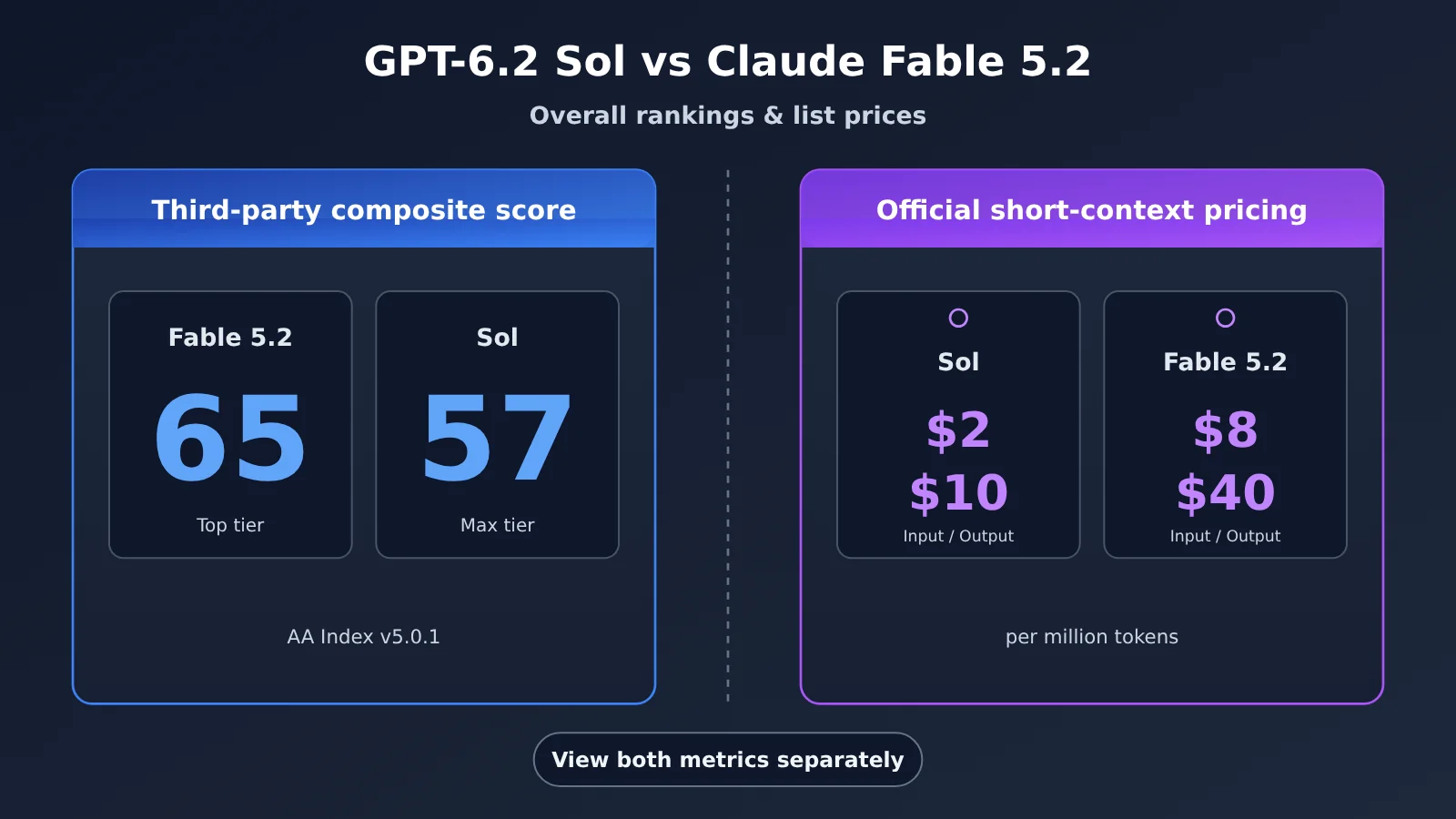
When you put GPT-6.2 Sol and Claude Fable 5.2 side by side, the easiest mistake to make is letting a single “which one is stronger” verdict paper over all the numbers. On November 17, 2026, OpenAI released GPT-6.2 Astra and GPT-6.2 Sol, and the third-party firm Artificial Analysis updated its composite leaderboard that same day: Claude Fable 5.2 scored 65 at its highest reasoning tier, while GPT-6.2 Sol’s Max tier scored 57. On the flip side, going by both companies’ official short-context list pricing, Sol’s input and output unit prices are each one-quarter of Fable’s.
The score gap is large, and the price gap is large too. Both facts hold — but they can’t cancel each other out, and they can’t be rolled into a single conclusion. This is not an article that picks a side for you. Official self-reported numbers, third-party leaderboards, and vendor list prices are three separate frames of reference. This article takes them apart layer by layer, and separately flags which individual benchmarks have no direct official Sol-versus-Fable comparison at all.
Key takeaway: By the end of this article, you’ll have three sets of verifiable numbers — composite scores, list prices, and cache reads — know which individual benchmarks can’t be used for a Sol-versus-Fable comparison, and be able to decide, based on your own task, which side’s data to check first.
GPT-6.2 Sol and Claude Fable 5.2: Key Takeaways
The table below leads with the headline numbers, and every row notes its measurement basis. The sections that follow unpack them row by row.
| Key Point | Number | Basis and How to Read It |
|---|---|---|
| Overall score | Fable 5.2 at 65, Sol (Max) at 57 | Third-party Artificial Analysis Intelligence Index v5.0.1, each at its highest reasoning tier |
| Short-context input/output list price | Sol $2 / $10, Fable $8 / $40 (per 1 million tokens) | Official list prices from both vendors; Sol is a quarter of Fable’s, but only for these two items |
| Cache read list price | Sol $0.10, Fable $0.20 | Official list prices; Sol is half of Fable’s here, not a quarter |
| Direct head-to-head in official materials | AA-3D human blind-test Elo: Sol 1259, Fable 1271 | Officially relayed figures; the remaining official single-benchmark numbers are mostly Astra vs. Fable, or Sol vs. its own older models |
| APIYI availability | claude-fable-5-2 is live; gpt-6.2-sol is not yet listed |
The platform’s model list is the source of truth |
About the GPT-6.2 Sol pricing in the table: these are OpenAI’s official list prices. The model isn’t on the platform yet, but we’ll list it as soon as we can; the platform’s model list is authoritative for both models and pricing.
Why This GPT-6.2 Sol vs. Claude Fable 5.2 Comparison Needs Layers
A composite index squeezes dozens of tasks into a single score. That’s useful for answering “roughly which tier is each model at overall,” but it can’t answer “which one fits my task better.” List price tells you what you pay per million tokens—not what it actually costs to get a task done, because on both sides the reasoning tier, the number of thinking tokens, and the cache hit rate all change the final bill.
Individual benchmarks form a third layer. In OpenAI’s announcement, the Fable numbers they call out are mostly measured against GPT-6.2 Astra, not Sol. Crediting Astra’s results to Sol is the most common misreading in this kind of comparison, and this article will deliberately keep the two apart.
GPT-6.2 Sol vs Claude Fable 5.2: Core Differences
Third-Party Composite Scores for GPT-6.2 Sol and Claude Fable 5.2
Artificial Analysis is an independent benchmarking outfit, so the numbers below aren’t self-reported by OpenAI or Anthropic. They score each model separately by reasoning tier on Intelligence Index v5.0.1, so when you compare, be clear about which tier you’re using.
| Model | Reasoning tier | Intelligence Index v5.0.1 | Per-task cost on the composite index (from each model’s page) |
|---|---|---|---|
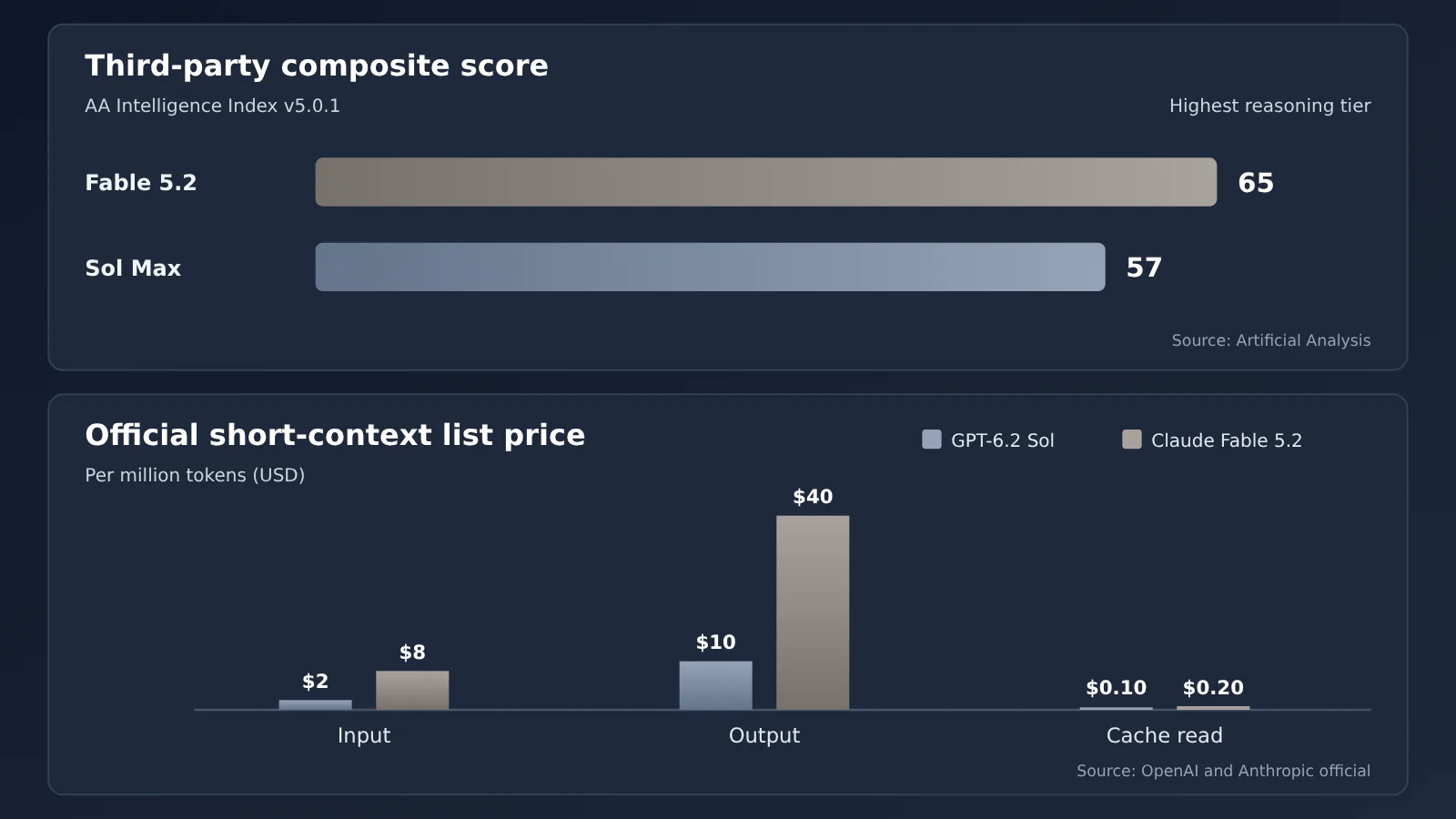
| Claude Fable 5.2 | Highest reasoning tier | 65 (first on the leaderboard) | $26.54 |
| GPT-6.2 Astra | Max / Xhigh | 62 | $4.00 (Max) |
| Gemini 4 Carbon | Highest tier | 60 | — |
| Claude Opus 5.5 | Highest tier | 59 | — |
| GPT-6.2 Sol | Max | 57 | $1.01 |
| GPT-6.2 Sol | Xhigh / High / Medium / Low | 56 / 55 / 53 / 41 | — |
According to Artificial Analysis, Sol is 2 points up from GPT-6.1 Sol at 57, matching GPT-6 Astra, while its per-task cost runs about 15% of Astra’s. The “per-task cost” in the table is what the third party actually spent running this index suite—it reflects the combined effect of reasoning tier, thinking length, and list pricing, not the API sticker price.
One thing to keep in mind: OpenAI officially says Astra’s cost on Agents’ Last Exam is about 5% of Fable’s, but that’s a different task suite. You can’t cross-convert the $26.54 figure against that official “5%”, and you can’t apply it to Sol either.
GPT-6.2 Sol vs Claude Fable 5.2: Official Pricing and Caching
Let’s start with GPT-6.2 Sol. The OpenAI model page lists its standard-tier short-context pricing as: $2 for input, $0.10 for cache reads, $2.50 for cache writes (30-minute retention), $5 for 12-hour cache writes, and $10 for output. This model isn’t live yet—we’ll get it listed as soon as we can; treat the platform’s model list as the source of truth for model names and pricing. The release notes indicate that Sol keeps the same API token pricing as GPT-6.1 Sol.
For Claude Fable 5.2, Anthropic’s documentation lists: $8 for input, $40 for output, $10 for 5-minute cache writes, $16 for 1-hour cache writes, and $0.20 for cache reads. In APIYI’s (apiyi.com) master model table, claude-fable-5-2 and claude-fable-5-2-thinking are listed with input, output, and cache read pricing of $8 / $40 / $0.2, matching the official figures; the detail pages for both models currently return 404, so go by the master table for pricing.
| Pricing Item (per 1M tokens) | GPT-6.2 Sol (OpenAI official) | Claude Fable 5.2 (Anthropic official) | How They Compare |
|---|---|---|---|
| Input (short context) | $2 | $8 | One quarter |
| Output (short context) | $10 | $40 | One quarter |
| Cache reads | $0.10 | $0.20 | Half |
| Cache writes | $2.50 for 30 min; $5 for 12 hrs | $10 for 5 min; $16 for 1 hr | Different retention periods, so not directly comparable |
| Batch | 50% of standard price | 50% off input and output | Rules are close |
| Accelerated tier | Fast is 2x standard; Ultrafast is 3x through 2027-02-28, then 6x from 2027-03-01 | Fast mode input $16, output $80, up to ~2.5x speed | Different mechanisms |
The GPT-6.2 Sol figures in the table are OpenAI’s official prices. The model isn’t live yet—we’ll get it listed as soon as we can; treat the platform’s model list as the source of truth for model names and pricing.
The “Sol is a quarter of Fable” claim only holds for short-context input and output. The OpenAI model page includes another rule: when a single request’s input exceeds 272K tokens, the input and cache unit prices double, output is billed at 1.5x the short-context rate, and the whole request is calculated as one unit. At that point, Sol’s output price is no longer $10, so estimating with the one-quarter ratio will lead you astray; for Fable’s long-context pricing, follow Anthropic’s documentation.
GPT-6.2 Sol vs. Claude Fable 5.2: Specs and Interfaces
Both models offer context windows in the million-token range, with a max output of 128K. The real differences come down to input modalities, reasoning controls, and endpoints—all of which will shape how you integrate them.
| Item | GPT-6.2 Sol | Claude Fable 5.2 |
|---|---|---|
| Context / Max Output | 1,050,000 (max input 922,000) / 128,000 | 1M / 128K |
| Input / Output | Text, images / Text | See Anthropic docs |
| Knowledge Cutoff | 2026-06-01 | 2026-06 |
| Reasoning Settings | The API doesn’t allow setting reasoning effort to none | Default effort is high; thinking is always on and can’t be turned off |
| Official Endpoints | Chat Completions, Responses, Batch | Anthropic API |
| APIYI | Not yet listed | claude-fable-5-2, claude-fable-5-2-thinking, with chat and messages endpoints |
When calling the listed Fable models through APIYI, use https://api.apiyi.com/v1 as the base URL for OpenAI-compatible access and set the model to claude-fable-5-2. If your project already speaks the Anthropic Messages protocol, you can also use the platform’s messages endpoint. As for group routing, the master list includes ClaudeCode, Claude_Reverse, Claude_Enterprise, Default, and SVIP.
GPT-6.2 Sol vs Claude Fable 5.2, Task by Task
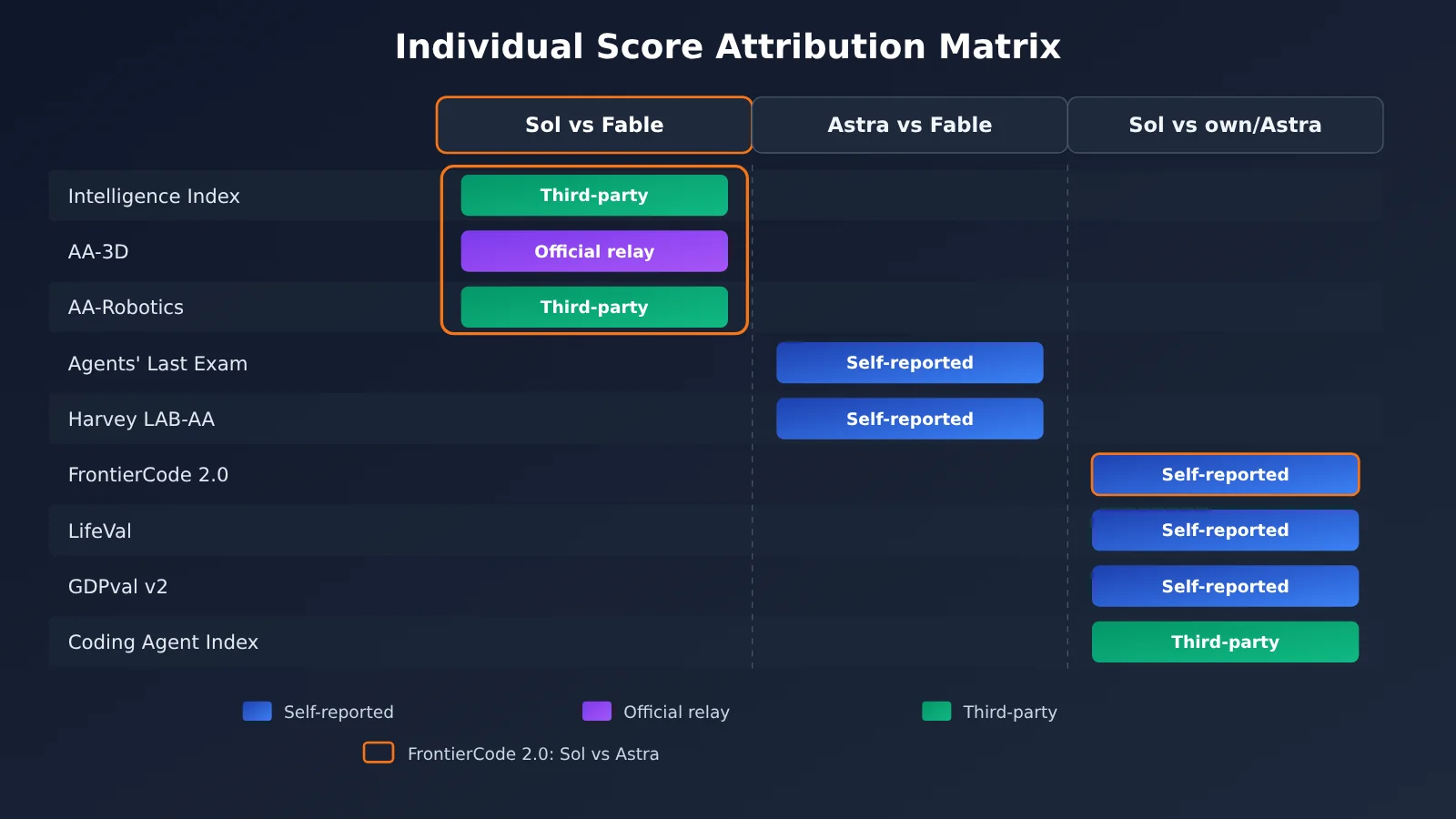
This is the most important section of this article. OpenAI’s release post includes quite a few individual scores, but direct “Sol vs Fable” comparisons are rare among them. The table below lists each one by source and by the pair of models being compared.
| Individual Task | Source | Models Compared and Result | Direct Sol vs Fable Comparison? |
|---|---|---|---|
| Intelligence Index v5.0.1 | Third-party AA, highest reasoning tier | Fable 65, Sol (Max) 57 | Yes (third-party composite score) |
| AA-3D Human Blind-Test Elo | Relayed in official materials | Sol 1259, Fable 1271 | Yes (the only such item in official materials) |
| AA-Robotics v0.1 | Third-party AA, research preview | Sol 78, Fable 75 | Yes (third-party preview; reasoning tier per the AA page) |
| Agents’ Last Exam | Official self-report | Astra 5.5 points above Fable, at roughly 5% of the cost | No, it’s Astra vs Fable |
| Harvey LAB-AA v1.1 | Official self-report | Astra’s pass rate more than twice Fable’s, at roughly one-sixth the cost | No, it’s Astra vs Fable |
| FrontierCode 2.0 | Official self-report | Sol within 0.5 points of Astra, at roughly one-fifth the cost; both at Max | No, it’s Sol vs Astra |
| LifeVal | Official self-report | Sol above GPT-6 Astra, at roughly one-seventh the cost | No |
| GDPval v2 | Official self-report | Sol 5.3 points above GPT-6.1 Sol | No |
| Coding Agent Index | Third-party AA, max tier | Sol 3 points below GPT-6.1 Sol | No |
GPT-6.2 Sol’s FrontierCode 2.0 Score Can’t Be Borrowed for a Fable Comparison
FrontierCode 2.0 was designed by Cognition and measures whether changes to real codebases can actually get merged by maintainers. The officially self-reported result is that Sol lands within 0.5 points of Astra at roughly one-fifth of Astra’s cost, with both at the Max tier. Fable isn’t involved here at all, so you can’t rewrite this as “Sol is within 0.5 points of Fable on FrontierCode.”
By the same logic, it’s Astra that leads Fable on Agents’ Last Exam and Harvey LAB-AA. The release post doesn’t say how Sol stacks up against Fable on these two benchmarks, so no inferences should be drawn.
GPT-6.2 Sol and Claude Fable 5.2 on Science and Coding Benchmarks
Terminal-Bench-Science 0.1 also calls for caution. The official self-report says Astra is 9 percentage points above GPT-6 Astra; in the footnotes, Fable 5.2 has two numbers — one from Artificial Analysis’s test using mini-swe-agent, and another from Anthropic reporting 74.6% under Claude Code at Max reasoning effort. These two Fable numbers come from different tests, can’t be treated as a single comparison, and neither is a Sol score anyway.
On the third-party side, Artificial Analysis notes that Sol scores 3 points below GPT-6.1 Sol on the Coding Agent Index (Codex harness, max), mainly due to a 14-point drop on SWE-Atlas-QnA-AA, meaning it’s more likely to miss key facts. Its measured AA-Omniscience hallucination rate (Max) for Sol is 55%. None of these numbers have corresponding Fable values — they only tell you about Sol’s own weaknesses.
GPT-6.2 Sol and Claude Fable 5.2: Scenario Recommendations
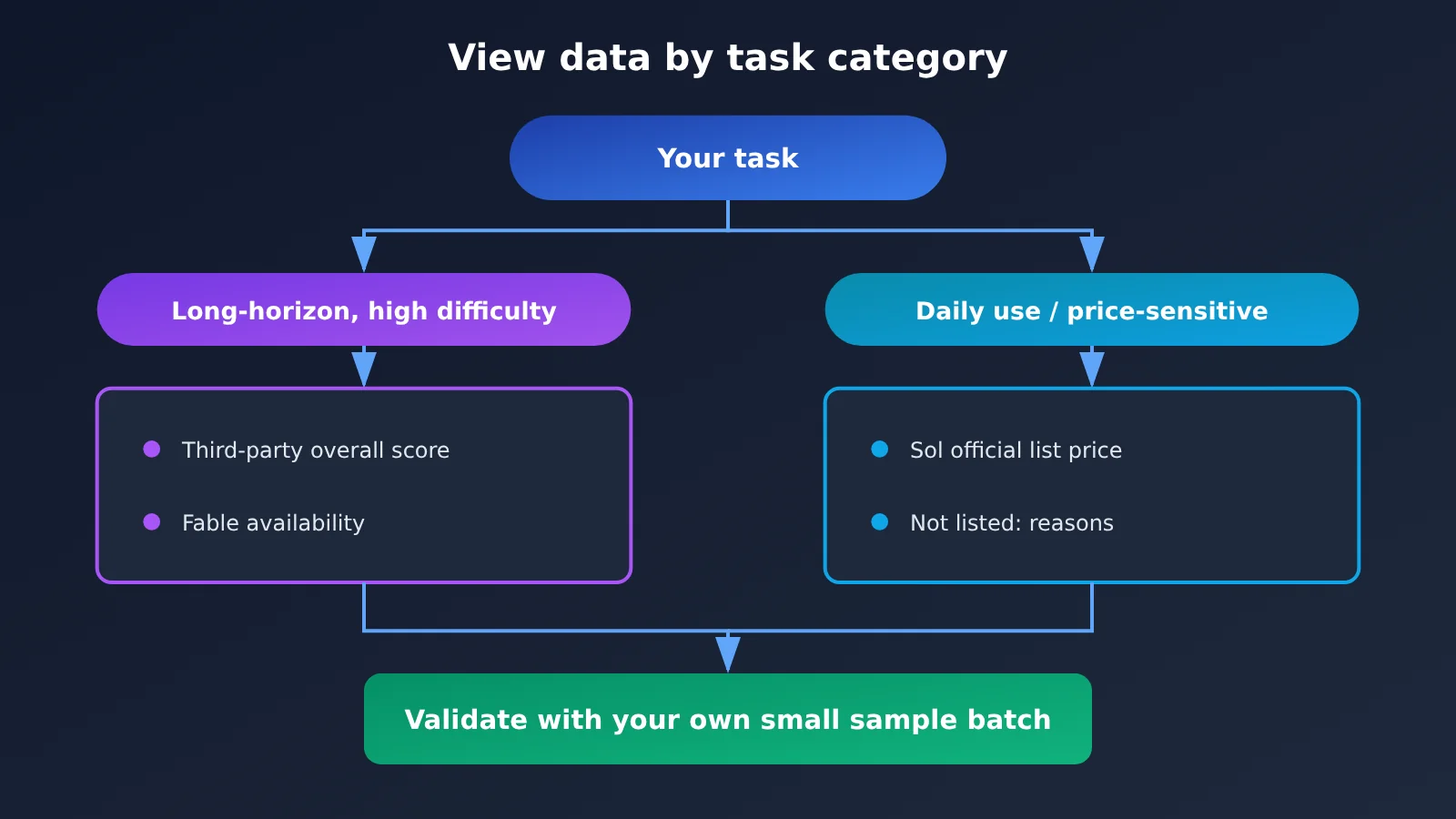
This section isn’t going to make the choice for you—it just tells you which set of numbers to check first depending on the task.
Tasks Where You Check Claude Fable 5.2 Data First
- Long-horizon, high-difficulty, multi-step complex tasks: start with the third-party composite score. Fable scores 65 at the highest reasoning tier of Intelligence Index v5.0.1, topping the leaderboard—this is currently the only composite data directly comparable with Sol.
- Projects that need to integrate right away:
claude-fable-5-2is already listed on APIYI, so you can start testing with your own samples immediately. - Projects where thinking overhead matters: Fable’s thinking is on by default and can’t be turned off, with effort defaulting to high—make sure to factor thinking tokens into your budget.
Tasks Where You Check GPT-6.2 Sol Data First
- Everyday tasks and price-sensitive batch jobs: start with the official short-context pricing and Batch rules, then look at officially self-reported everyday task results like LifeVal and GDPval v2.
- Requests mostly within 272K: the one-quarter price gap on Sol’s input and output mainly shows up in this range.
- Teams already working in ChatGPT Work or Codex: officially, it’s available starting today on Plus, Pro, Enterprise, and Edu, and Pro 200 gets Ultrafast for the first time, rolling out starting with Sol.
GPT-6.2 Sol and Claude Fable 5.2 Quick Start
This section lays out the order of operations task by task. There’s no code anywhere in this guide—model names and URLs are written right into the sentences.
Long-running, high-difficulty tasks: check Fable’s overall score and availability first. Create an API key in the APIYI console, point your OpenAI-compatible SDK’s base URL to https://api.apiyi.com/v1, and set the model to claude-fable-5-2; if you’d rather have the model name explicitly flag thinking mode, you can also use claude-fable-5-2-thinking. The master price list quotes $8 for input, $40 for output, and $0.2 for cached reads—in line with Anthropic’s official pricing. We’d suggest logging completion rates and token usage across 20 to 50 of your own real tasks first, then judging whether that 65-point score actually shows up in your scenario.
Everyday tasks where list price matters: then look at Sol’s official pricing and its not-yet-listed status. GPT-6.2 Sol’s official OpenAI pricing is $2 for input, $0.10 for cached reads, and $10 for output. It isn’t listed yet, but we’ll add this model as soon as possible; the platform’s model list is the source of truth for model names and prices. Until it goes live, check the model list on apiyi.com regularly, and don’t substitute gpt-6.1-sol or gpt-6-sol for your testing—they’re not 6.2, and gpt-6-sol has a different cached-read price.
Once Sol is listed, keep three things in mind: reasoning effort can’t be set to none; inputs exceeding 272K get billed at a premium across the entire request; and while the official endpoint supports both Chat Completions and Responses, the platform’s supported endpoints follow the model list.
🚀 Quick Start: One API key works across multiple providers’ models on the platform. We recommend using the free test credits on APIYI at apiyi.com to get Fable up and running first, with your evaluation scripts and samples ready, then simply swap in the model name once Sol is listed for a same-sample comparison.
GPT-6.2 Sol and Claude Fable 5.2 Decision Guide
Here’s a checklist to help you put those numbers back into the context of your own tasks.
- Confirm the metric first: Are you citing a third-party composite score, an officially self-reported single benchmark, or an official list price? Don’t add them together, and don’t convert between them.
- Check the reasoning tier: Sol’s score of 57 is the Max tier—High tier comes in at 55, and Low tier at just 41. Whichever tier you’ll actually be running, that’s the number to look at.
- Do the math by request length: Within 272K, you can estimate input and output at the one-quarter rate; beyond 272K, you’ll need to recalculate under OpenAI’s whole-request billing rules.
- Price caching separately: Cached reads are $0.10 versus $0.20—a twofold difference. Cache write retention periods also differ, so estimate each one based on your own caching strategy.
- Verify the head-to-head data exists: If the benchmark you care about only has Astra-vs-Fable or Sol-vs-Astra numbers, you can’t treat them as a conclusion about Sol versus Fable.
- Factor in safety policies: Officially, both 6.2 models hit the “Critical” cybersecurity level in the Preparedness Framework. With stricter safeguards in place, some legitimate vulnerability research requests will be refused.
💡 Recommendation: Which model to pick depends on task length, reasoning tier, and cache hit rate. You can run the same batch of samples through both models on the APIYI platform and let the bills and completion rates do the talking—no need to rely on a single leaderboard.
FAQ
Q1: What are GPT-6.2 Sol and Claude Fable 5.2?
GPT-6.2 Sol is the model OpenAI released on 2026-11-17 alongside GPT-6.2 Astra, with the model ID `gpt-6.2-sol`. It accepts text and image input, outputs text, and has a context window of 1,050,000. Claude Fable 5.2 is the model Anthropic released on 2026-11-09, with a 1M context window, 128K max output, and thinking enabled by default that can’t be turned off.
Q2: The composite leaderboard shows 65 vs 57 — does that mean Claude Fable 5.2 leads GPT-6.2 Sol across the board?
No. The 65 vs 57 figure comes from the third-party Artificial Analysis Intelligence Index v5.0.1, where Fable ran at its highest reasoning tier and Sol ran at the Max tier. It reflects the overall level on that index — it doesn’t mean every individual benchmark shows the same gap. In the officially relayed AA-3D human blind-evaluation Elo, Sol scored 1259 and Fable 1271, a noticeably smaller gap; on the third-party AA-Robotics v0.1 research preview, Sol scored 78 and Fable 75.
Q3: Is GPT-6.2 Sol really one-quarter the price of Claude Fable 5.2?
That only holds for input and output at short context. At official list prices, Sol is $2 input / $10 output, while Fable is $8 input / $40 output. The model isn’t listed yet — we’ll add it as soon as we can, and the model ID and pricing will follow the platform’s model list. Cache reads are $0.10 vs $0.20, exactly half. Beyond 272K input tokens, Sol applies a surcharge to the entire request, with output priced at 1.5× the short-context rate — so at that point you can’t estimate it as a quarter anymore.
Q4: How far apart are GPT-6.2 Sol and Claude Fable 5.2 on FrontierCode 2.0?
The official materials don’t include that head-to-head. The “less than 0.5 points apart” comparison in FrontierCode 2.0 is between GPT-6.2 Sol and GPT-6.2 Astra — both at the Max tier, with Sol costing about one-fifth as much. Fable wasn’t part of that comparison.
Q5: How do I call GPT-6.2 Sol and Claude Fable 5.2 via the API?
Here are the steps:
1. Sign up at APIYI (apiyi.com) to get an API key and free trial credits.
2. Point the base URL of your OpenAI-compatible SDK to the platform’s address and set model to `claude-fable-5-2` to call Fable.
3. `gpt-6.2-sol` isn’t listed yet. Once it goes live, the model ID and pricing will follow the platform’s model list — then test with the same batch of samples.
Q6: What are the known limitations of GPT-6.2 Sol and Claude Fable 5.2?
For Sol: third-party AA measured a 55% hallucination rate at the Max tier, and its Coding Agent Index is 3 points below GPT-6.1 Sol’s, mainly because it’s more likely to miss key facts; reasoning effort can’t be set to none; and its cybersecurity safeguards are stricter, so some legitimate vulnerability research gets refused. For Fable: thinking can’t be turned off, the default effort level is high, and thinking tokens count toward your cost; Fast mode is priced at $16 input / $80 output.
Q7: The official word is that Astra’s cost is only 5% of Fable’s — can that be cross-checked against the third-party $26.54 figure?
No. The “about 5%” figure is the officially self-reported Agents’ Last Exam cost, and it compares Astra with Fable; the $26.54 is Artificial Analysis’s per-task cost for Fable when running its composite index. The two come from different tasks and different sources — you can’t divide them, and you can’t use them to extrapolate Sol’s cost. If all you want is a rough sense of the order of magnitude, tracking actual bills with your own samples on the APIYI platform will give you a more reliable read.
GPT-6.2 Sol and Claude Fable 5.2 Key Takeaways
- Composite score: On the third-party AA index, Fable’s top reasoning tier scores 65 and Sol’s Max tier 57 — a direct head-to-head on the same leaderboard.
- Listed pricing: For short-context input and output, Sol costs a quarter of what Fable does ($2 vs $8, $10 vs $40).
- Cached reads: $0.10 vs $0.20 — only half the price, so the one-quarter ratio doesn’t apply here.
- Long context: Once Sol’s input exceeds 272K, the entire request is billed at a premium, so the original ratio no longer holds.
- Few direct comparisons: Official materials include only one Sol vs Fable benchmark — AA-3D, at 1259 vs 1271.
- Don’t repurpose scores: FrontierCode 2.0 is Sol vs Astra, while ALE and Harvey are Astra vs Fable.
- Availability: Fable is available for direct invocation on APIYI (apiyi.com); Sol isn’t listed yet — go by the model list.
Summary
When comparing GPT-6.2 Sol and Claude Fable 5.2, the key is to keep three layers of numbers separate:
- Third-party composite scores: Fable 65, Sol (Max) 57 — use these to judge which tier each model sits in overall.
- Official list prices: short-context input and output differ by about a quarter, cached reads differ by about half, and long-context pricing is calculated separately under each provider’s own rules.
- Individual tasks: most official task-level results aren’t a direct Sol-vs-Fable comparison, so confirm exactly who’s being compared before citing them.
Score gaps and price gaps can’t be collapsed into a single “which one’s worth it” verdict. The more reliable approach is to use your own samples, fix the reasoning tier, and track completion rates and billing separately. Fable is available to test right now on APIYI at apiyi.com; GPT-6.2 Sol isn’t listed yet — we’ll add this model as soon as we can, and model availability and pricing are subject to the platform’s model list.
📚 References
-
OpenAI launch post: GPT-6.2 Astra and Sol release notes with officially reported task-level results
- Link:
openai.com/index/introducing-gpt-6-2-astra-sol - Notes: officially self-reported task-level scores, availability scope, and pricing summary
- Link:
-
OpenAI model page – GPT-6.2 Sol: specifications, list prices, and the 272K pricing rules
- Link:
platform.openai.com/docs/models/gpt-6.2-sol - Notes: treat this as the source of truth for cache-write pricing, long-context surcharges, and accelerated-tier multipliers
- Link:
-
OpenAI system card: GPT-6.2 Astra and Sol safety evaluations
- Link:
deploymentsafety.openai.com/gpt-6-2-astra-sol - Notes: preparedness framework tiering and alignment evaluations
- Link:
-
Artificial Analysis article and model page: third-party Intelligence Index v5.0.1
- Link:
artificialanalysis.ai/models/claude-fable-5-2 - Notes: tiered composite scores, per-task costs, and the Coding Agent Index
- Link:
-
Anthropic docs – Claude Fable 5.2: official pricing and specifications
- Link:
platform.claude.com/docs/en/models/fable-5-2/overview - Notes: cache writes, cache reads, Fast mode, and effort settings
- Link:
-
APIYI master model list: platform model availability and pricing
- Link:
docs.apiyi.com/models.md - Notes: data timestamp 2026-11-17 15:54 (UTC+8); model availability and pricing are subject to the platform’s model list
- Link:
Author: APIYI Technical Team
Technical discussion: Feel free to reach out through the APIYI homepage — for more model and API documentation, check out the docs.apiyi.com documentation center