“Is gpt-4o-mini about to be phased out?” This is a question that keeps coming up in tech communities. The immediate trigger is a series of model retirement announcements from Azure OpenAI Service, combined with gpt-4o-mini’s continued decline in various benchmark rankings. As a result, many teams have started reevaluating their model choices.
Based on OpenAI’s official documentation, Microsoft Learn retirement announcements, and authoritative benchmark data from Artificial Analysis, this article first clears up the confusion surrounding rumors that gpt-4o-mini is being discontinued. It then compares five similarly priced alternatives—GPT-5 mini, GPT-5 nano, Gemini 2.5 Flash-Lite, DeepSeek V4 Flash, and Claude Haiku 4.5—across pricing and performance, helping you decide whether migration is necessary and which model could deliver the greatest benefits.
Key takeaway: By the end of this article, you’ll know whether gpt-4o-mini is actually being “partially discontinued” or simply being overinterpreted—and which alternative can deliver the most noticeable improvement without significantly increasing your budget.
This misunderstanding has spread largely because Azure retirement announcements, the removal of models from the ChatGPT web interface, and broad community claims that “OpenAI is phasing out its older models” have all been discussed together. What’s missing is a clear breakdown by platform and deployment type. The sections below separate these timelines so you won’t rush into a migration over a rumor that hasn’t actually taken effect—and so you won’t overlook a genuinely urgent Azure retirement date.
gpt-4o-mini Today: A Score of Just 7—Are the Retirement Rumors True?
Let’s start with the conclusion: The rumors surrounding gpt-4o-mini’s retirement are based on significant information mixing. Azure and the official OpenAI API follow two completely different timelines, so it’s inaccurate to simply say that “gpt-4o-mini is being discontinued.”
Current Pricing and Performance of gpt-4o-mini
| Metric | Value | Description |
|---|---|---|
| Input pricing | $0.15 / 1M tokens | Official OpenAI API pricing |
| Cached input pricing | $0.075 / 1M tokens | Half price when the cache is hit |
| Output pricing | $0.60 / 1M tokens | Official OpenAI API pricing |
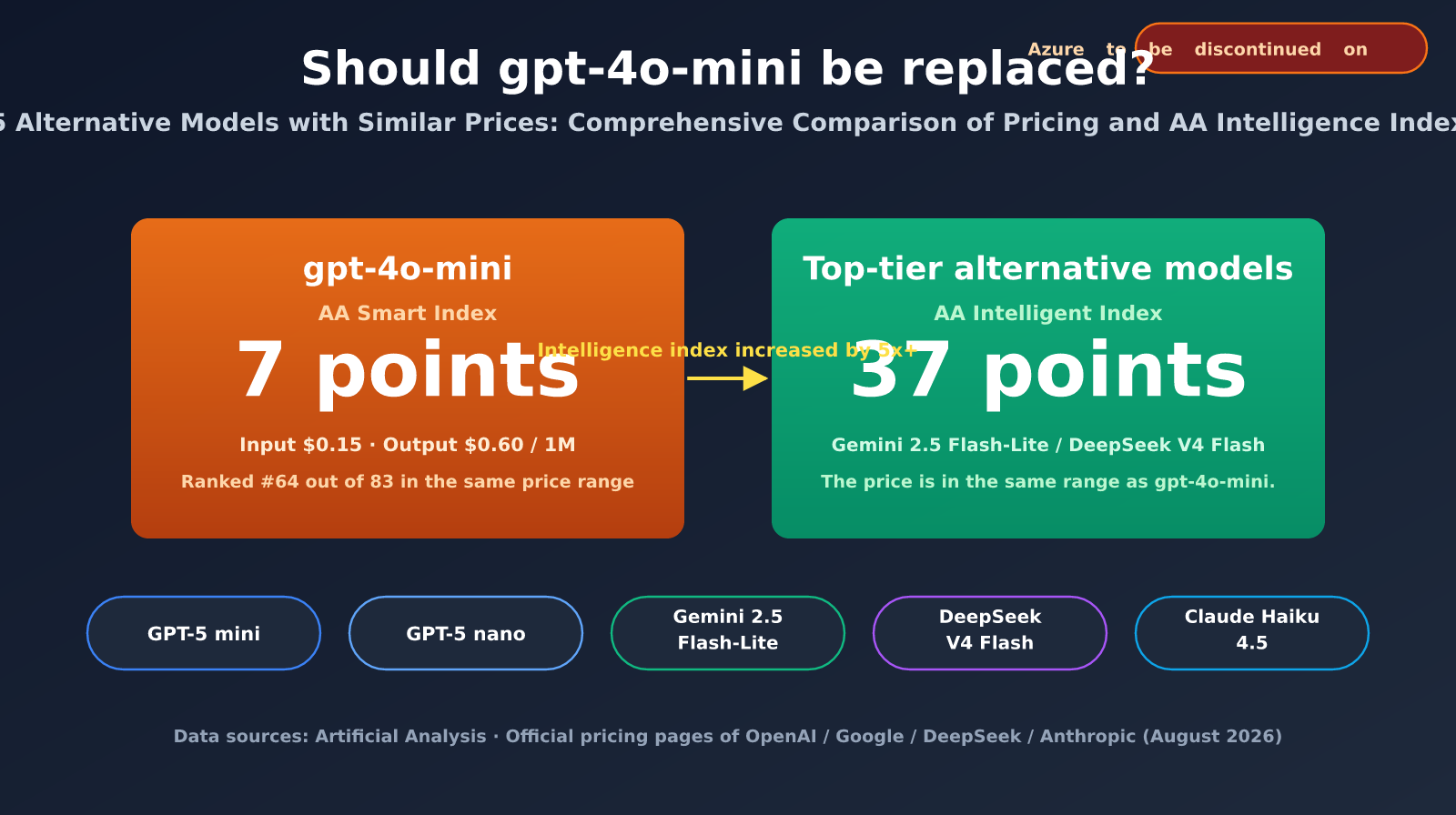
| AA Intelligence Index | 7 points | Artificial Analysis evaluation; ranked #64/83 in its price range |
| Output speed | 100.9 tokens/s | Below the category average of 102.1 tokens/s |
The main reason gpt-4o-mini has come under frequent scrutiny in 2026 isn’t that its price has changed. It’s that its Artificial Analysis Intelligence Index score is only 7, ranking it 64th out of 83 models in the same price range—well below the median for that segment. In other words, gpt-4o-mini is still inexpensive, but “cheap” no longer automatically means “good value.” With the same budget, you can now get considerably smarter models.
It’s worth adding some context about the AA Intelligence Index. Artificial Analysis calculates it by weighting multiple public benchmarks covering capabilities such as reasoning, coding, and mathematics. Its strengths are broad model coverage and frequent updates, making it useful for comparing models from different providers on a common scale. Its limitation is that it reflects average general-purpose capabilities and can’t fully replace testing on your own business data. It’s best used as a first-pass filter for shortlisting candidates—not as the sole basis for your final model selection.
gpt-4o-mini Retirement Timeline: Azure and the OpenAI API Are Completely Different
| Platform / Deployment type | Status | Retirement date |
|---|---|---|
| Official OpenAI API (gpt-4o-mini itself) | No retirement date set | None currently |
| OpenAI fine-tuned version, ft-gpt-4o-mini | Retirement plan announced | Training cutoff no earlier than 2027-04-01; deployment cutoff 2027-10-01 |
| Azure OpenAI Standard deployment | Retired | 2026-03-31 |
| Azure Provisioned / Global Standard / Data Zone Standard | Scheduled for retirement | 2026-10-01 |
One point needs special clarification: On February 13, 2026, OpenAI did remove GPT-4o, GPT-4.1, GPT-4.1 mini, and o4-mini from the ChatGPT product interface. However, this was a change to the model selector on the ChatGPT web interface. The official announcement explicitly stated that the API was unaffected, and gpt-4o-mini itself wasn’t included in that retirement list.
The timeline that truly deserves attention is on the Azure side. Azure OpenAI’s gpt-4o-mini Standard deployment was retired on March 31, 2026. Provisioned, Global Standard, and Data Zone Standard deployments will also be discontinued on October 1, 2026—less than two months from now. Once that happens, invocations will return a 410 Gone error. If your business runs on Azure, this timeline matters far more than the question of whether “OpenAI is discontinuing the model.”
Another easily overlooked detail is that even when the model has the same “gpt-4o-mini” name, its retirement date may differ depending on the Azure deployment type—Standard, Provisioned, Global Standard, or Data Zone Standard. Teams using multiple deployment types can easily misjudge the overall retirement schedule after checking only one announcement. Before investigating further, confirm the exact deployment type you’re using in the Azure portal, then verify its retirement date against the table above. This will help prevent a mismatch between “I heard it’s being discontinued” and “how long can we actually keep using it?”
gpt-4o-mini vs. 5 Alternatives: A Complete Price and Benchmark Comparison
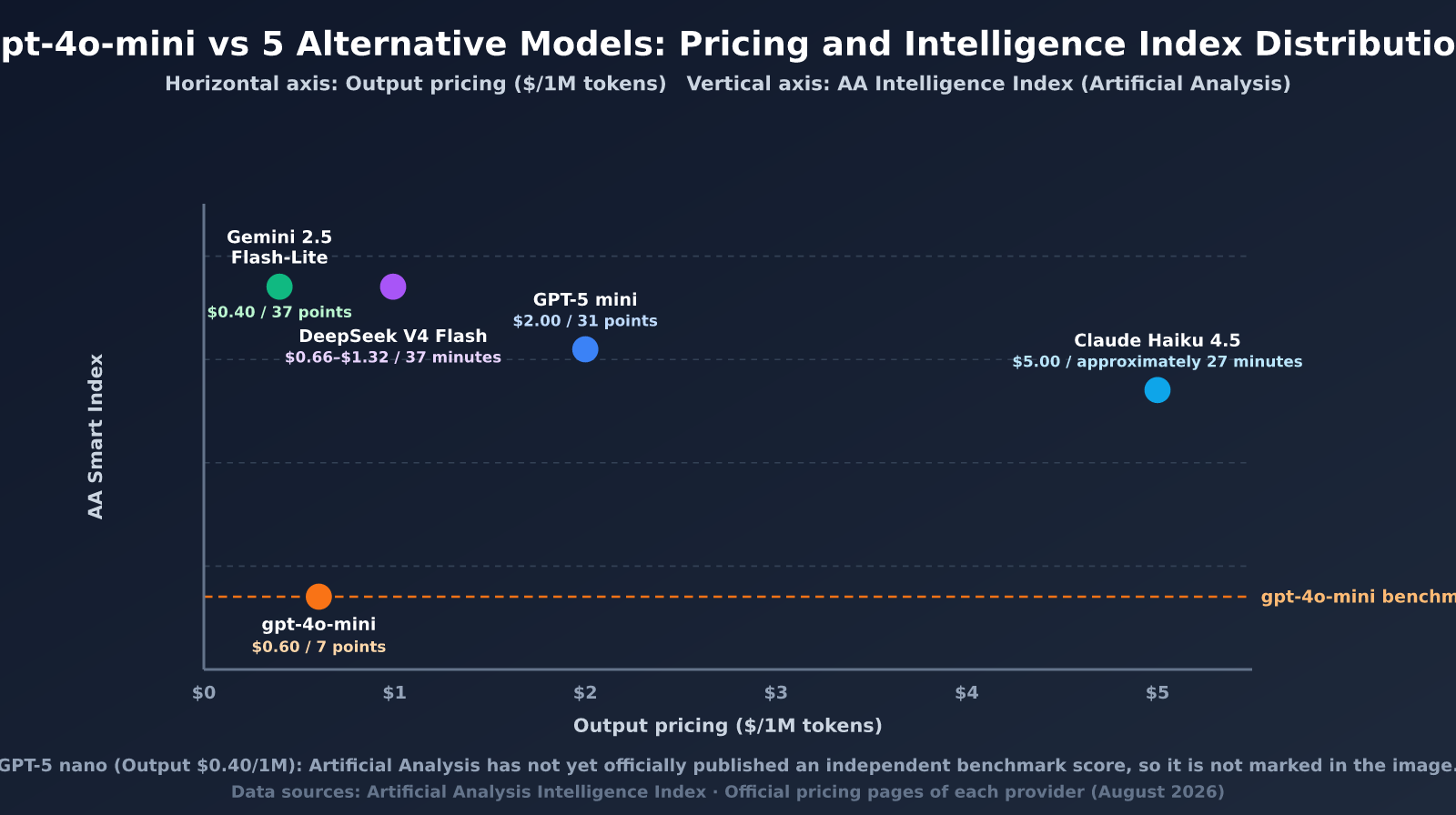
If you’re evaluating migration options, the comparison table below brings together five alternatives priced close to gpt-4o-mini, each backed by official or authoritative third-party data. It should make it easier to narrow down your choices based on budget and performance requirements.
| Model | Input / Output ($/1M) | AA Intelligence Index | Key advantage |
|---|---|---|---|
| gpt-4o-mini (baseline) | $0.15 / $0.60 | 7 points (#64/83) | Mature ecosystem and broad compatibility |
| GPT-5 nano | $0.05 / $0.40 | No separate official benchmark published | The lowest-cost option in the series |
| GPT-5 mini | $0.25 / $2.00 | 31 points (medium reasoning level) | The most direct official alternative within the OpenAI ecosystem |
| Gemini 2.5 Flash-Lite | $0.10 / $0.40 | 37 points | Pricing close to gpt-4o-mini, with a significant boost in intelligence |
| DeepSeek V4 Flash | $0.22–$0.44 / $0.66–$1.32 (off-peak/peak pricing) | 37 points (high reasoning intensity) | Time-based pricing; cached requests can cost as little as $0.007/1M |
| Claude Haiku 4.5 | $1.00 / $5.00 | Approximately 24–30 points, depending on the reasoning level | Stronger long-context and tool-calling capabilities |
🎯 Technical recommendation: When making a final choice, we recommend testing each of the models above through the APIYI apiyi.com platform. It provides a unified API for gpt-4o-mini, the GPT-5 series, Gemini, DeepSeek, Claude, and other major models, making it easy to switch between models and compare results within the same codebase.
Beyond these five models, Alibaba Cloud’s Qwen3.5 Flash is another option in a similar price range. Third-party pricing comparison channels list it at around $0.10 / $0.40, but because the price hasn’t been confirmed directly on the official DashScope pricing page, you should verify the price in the official console before migrating. This will help avoid discrepancies caused by regional pricing or exchange-rate differences. Similarly, no separate benchmark score for GPT-5 nano has currently been published by OpenAI or Artificial Analysis. We’ve therefore marked it honestly as “not published” rather than inventing a number.
Overall, Gemini 2.5 Flash-Lite is the option most worth testing first. Its price is only slightly higher than gpt-4o-mini, while its AA Intelligence Index jumps from 7 to 37 points, making it the most noticeable value upgrade in this price range. If compatibility with the OpenAI ecosystem matters more to you, GPT-5 mini is priced at more than twice the cost of gpt-4o-mini, but the performance improvement is also significant. For extremely budget-sensitive workloads, GPT-5 nano and DeepSeek V4 Flash’s off-peak pricing are worth considering.
DeepSeek V4 Flash’s pricing model deserves a closer look. It uses separate peak and off-peak rates: Input/Output costs just $0.22/$0.66 during off-peak hours, rising to $0.44/$1.32 during peak hours. With cache hits, the cost can drop further to $0.007–$0.014 per million tokens. For offline workloads that can be scheduled during off-peak hours—such as overnight batch summarization or log analysis—this pricing model can be more cost-effective than models with fixed rates. However, if your application handles real-time requests during daytime peak hours, you’ll need to recalculate costs using the peak rate. Claude Haiku 4.5 takes a different approach: its unit price is significantly higher than gpt-4o-mini, but it offers stronger long-context stability and tool-calling capabilities. It’s better suited to workloads involving long documents and multi-step tool orchestration than to straightforward short-form Q&A replacement.
Scenario Recommendations: Which Model to Choose for Different Needs
| Use Case | Recommended Model | Why |
|---|---|---|
| High-concurrency customer service / FAQ bots | Gemini 2.5 Flash-Lite | Matches gpt-4o-mini on price, while delivering more than a 5× improvement in intelligence scores |
| Complex reasoning / multi-step Agent tasks | GPT-5 mini | Offers the best compatibility with the OpenAI ecosystem, with significantly stronger reasoning than gpt-4o-mini |
| Ultra-low-cost batch processing (content tagging, summarization) | GPT-5 nano / DeepSeek V4 Flash during off-peak hours | Per-token pricing can be as low as roughly one-third that of gpt-4o-mini |
| Long-document / long-context analysis | Claude Haiku 4.5 | More stable with long contexts and more capable at tool calling |
| Extremely budget-sensitive prototyping | DeepSeek V4 Flash with cache hits | Cache-hit pricing can be reduced to extremely low levels |
💡 Selection tip: The right model mainly depends on your specific use case and quality requirements. We recommend running practical tests through the APIYI apiyi.com platform, comparing how different models perform on your real business data within the same budget, rather than making a decision based only on publicly reported benchmark scores.
Keep in mind that the table above provides the “default recommendation.” In practice, you’ll also need to consider context length, concurrency, and latency requirements. For example, even in the same customer service scenario, if conversations have long histories and frequently need to reference earlier context, Gemini 2.5 Flash-Lite’s cost-effectiveness advantage may be partially offset by the additional prompt usage. In that case, it’s worth including Claude Haiku 4.5 in a side-by-side test. Similarly, if response latency is critical for complex Agent tasks, you should measure GPT-5 mini’s end-to-end latency with your specific toolchain instead of relying solely on its officially published intelligence score.
Quick Migration: Switch from gpt-4o-mini to an Alternative Model in Two Steps
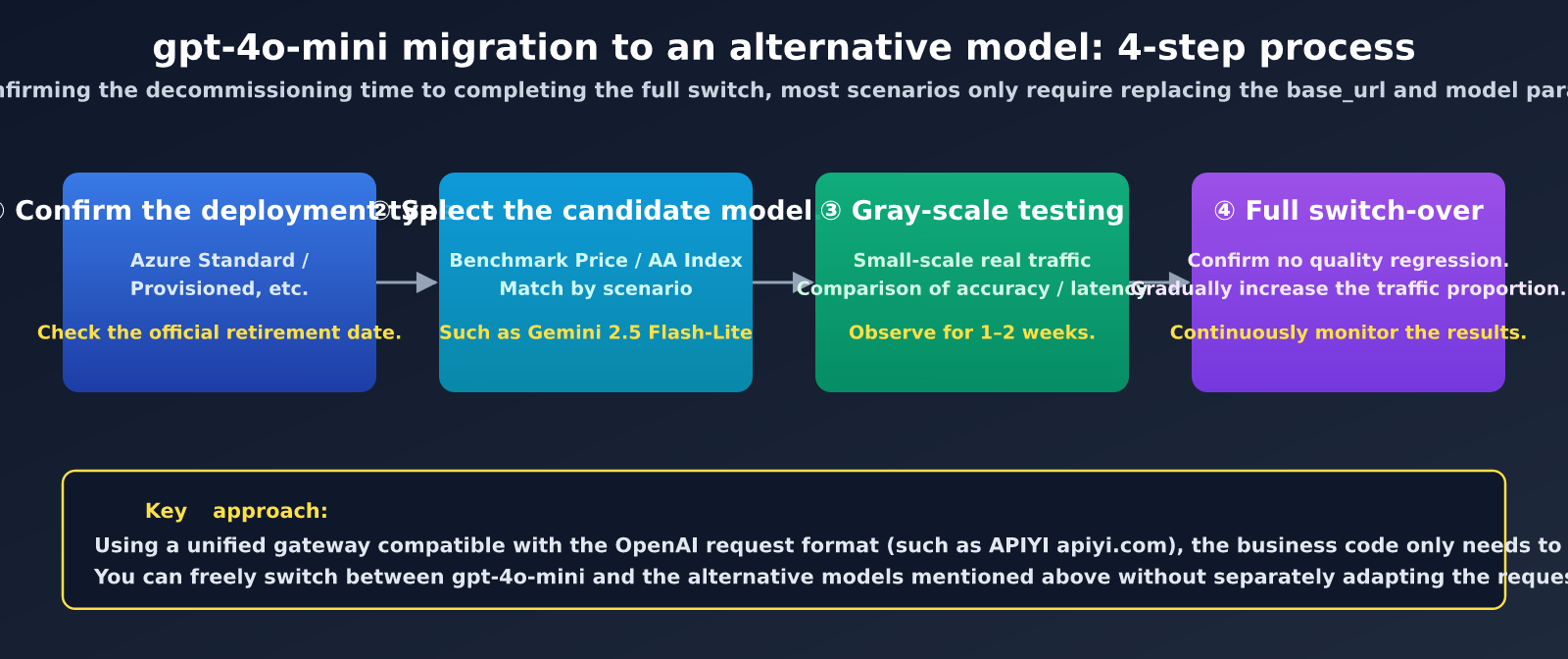
Most migration work only requires changing two parameters: base_url and model. If you’re already using the OpenAI SDK or a client that supports a compatible format, you won’t need to rewrite any business logic.
The real challenges usually aren’t at the code level. Native APIs from different providers often differ in message formats, tool-calling fields, and rate-limit policies. Switching directly to Gemini or Claude’s native SDKs often means rewriting both the request body and response-parsing logic. A unified gateway that supports the OpenAI-compatible request format can hide these differences, allowing your business code to maintain a single invocation method. That’s why the example below makes model a configurable parameter instead of implementing a separate client for each provider.
Minimal Example
import openai

client = openai.OpenAI(
    api_key="YOUR_API_KEY",
    base_url="https://api.apiyi.com/v1"  # APIYI unified endpoint; switch between multiple models with a single integration
)

response = client.chat.completions.create(
    model="gemini-2.5-flash-lite",  # Switch from gpt-4o-mini to an alternative model
    messages=[{"role": "user", "content": "Hello!"}]
)
print(response.choices[0].message.content)
View the complete migration code (including model switching and error retries)
import openai
import os

MODEL_MAP = {
    "baseline": "gpt-4o-mini",
    "openai-upgrade": "gpt-5-mini",
    "budget": "gpt-5-nano",
    "gemini": "gemini-2.5-flash-lite",
    "deepseek": "deepseek-v4-flash",
    "claude": "claude-haiku-4-5",
}

client = openai.OpenAI(
    api_key=os.environ["APIYI_API_KEY"],
    base_url="https://api.apiyi.com/v1"  # APIYI unified endpoint, compatible with the OpenAI SDK invocation format
)

def call_model(prompt: str, profile: str = "gemini", max_retries: int = 2):
    model = MODEL_MAP[profile]
    for attempt in range(max_retries + 1):
        try:
            response = client.chat.completions.create(
                model=model,
                messages=[{"role": "user", "content": prompt}],
                timeout=30,
            )
            return response.choices[0].message.content
        except Exception:
            if attempt == max_retries:
                raise
    return None

if __name__ == "__main__":
    print(call_model("Summarize the sunset timeline for gpt-4o-mini", profile="gemini"))
🚀 Get started quickly: We recommend using the APIYI apiyi.com platform to run comparison tests before migration. The platform provides unified billing across multiple models, so you don’t need to apply for separate keys or accounts for each new model. You can test all the candidate models listed above within minutes.
Frequently Asked Questions
Q1: I’m currently using gpt-4o-mini on Azure OpenAI. How much longer can I use it?
It depends on the deployment type. Standard deployments were retired on March 31, 2026, so they should no longer be available for model invocation. Provisioned, Global Standard, and Data Zone Standard deployments are scheduled for retirement on October 1, 2026—less than two months from now. We recommend completing migration testing as soon as possible through a platform that supports switching between multiple models, such as APIYI apiyi.com, to avoid business disruptions after the retirement date.
Q2: I’m using the official OpenAI API. Do I also need to migrate immediately?
Not necessarily. According to OpenAI’s official Deprecations page, gpt-4o-mini itself is not currently listed for retirement. Only its fine-tuned version, ft-gpt-4o-mini, has a later retirement timeline. If cost is your top priority, you can continue monitoring the situation. However, given that gpt-4o-mini has an AA Intelligence Index score of only 7, running a performance comparison against similarly priced models through the APIYI apiyi.com platform could deliver a noticeable quality improvement without increasing your budget.
Q3: After migrating to a new model, how can I confirm that performance hasn’t declined?
Don’t rely solely on subjective impressions. Start by assembling a representative set of real business samples—not just a few ad hoc test cases. Run the same inputs through gpt-4o-mini and the candidate models, then compare the results across three dimensions: accuracy, format compliance, and average response time. During the gradual rollout, let the new model handle only a small portion of real traffic and monitor its production performance for one to two weeks. Once you’ve confirmed that there are no significant quality or latency regressions, gradually increase its traffic share to 100%.
Summary and Decision Recommendations
| Check | Details |
|---|---|
| Confirm the deployment type | Azure Standard, Provisioned, Global Standard, and Data Zone Standard deployments have different retirement dates |
| Verify official pricing | Pricing may vary by region and peak/off-peak periods; always refer to the official pricing page |
| Compare AA Intelligence Index scores | Prioritize public third-party rankings such as Artificial Analysis, rather than relying solely on vendor claims |
| Use a gradual rollout | Validate performance on non-critical workflows first, then gradually increase the traffic share |
| Standardize API access | Use an API proxy platform compatible with the OpenAI SDK format to reduce the cost and effort of switching between models |
Overall, gpt-4o-mini has not been fully discontinued from the official OpenAI API, but Azure’s retirement timeline is already very tight, and its lower benchmark performance is an objective concern. For most use cases, Gemini 2.5 Flash-Lite and GPT-5 mini are the two leading options with similar pricing and clear performance improvements. For scenarios that are extremely budget-sensitive, you can also consider the peak/off-peak pricing of GPT-5 nano and DeepSeek V4 Flash.
One important reminder: don’t switch models hastily just because one option is “cheaper” or because you’ve heard that a model may be discontinued. Price and benchmark scores are only the first steps in narrowing down your candidate pool. What ultimately determines whether—and where—you should migrate is the model’s performance on your own business data. Extending the evaluation period to one or two weeks and covering enough real-world scenarios is more reliable than chasing changes in leaderboard scores. We recommend conducting a side-by-side test with real business data through the APIYI apiyi.com platform before deciding which model to migrate to.
If you encounter specific issues during the migration, feel free to contact us through the APIYI apiyi.com technical support channel. We’ll continue tracking official pricing changes for gpt-4o-mini and its alternatives and update the data in this article accordingly.