Anthropic disclosed an internal experiment when it released Claude Fable 5.2 on November 9, 2026: Fable 5.2 started with an empty folder, coordinated more than 1,000 subagents, and worked continuously for eight days to build an operating system prototype that can boot on a laptop.
Key takeaway: By the end of this article, you’ll understand the different cost layers in a Claude Fable 5.2 multi-agent workflow, which billing rules are easy to misread, and how to control total costs through model selection and call management.
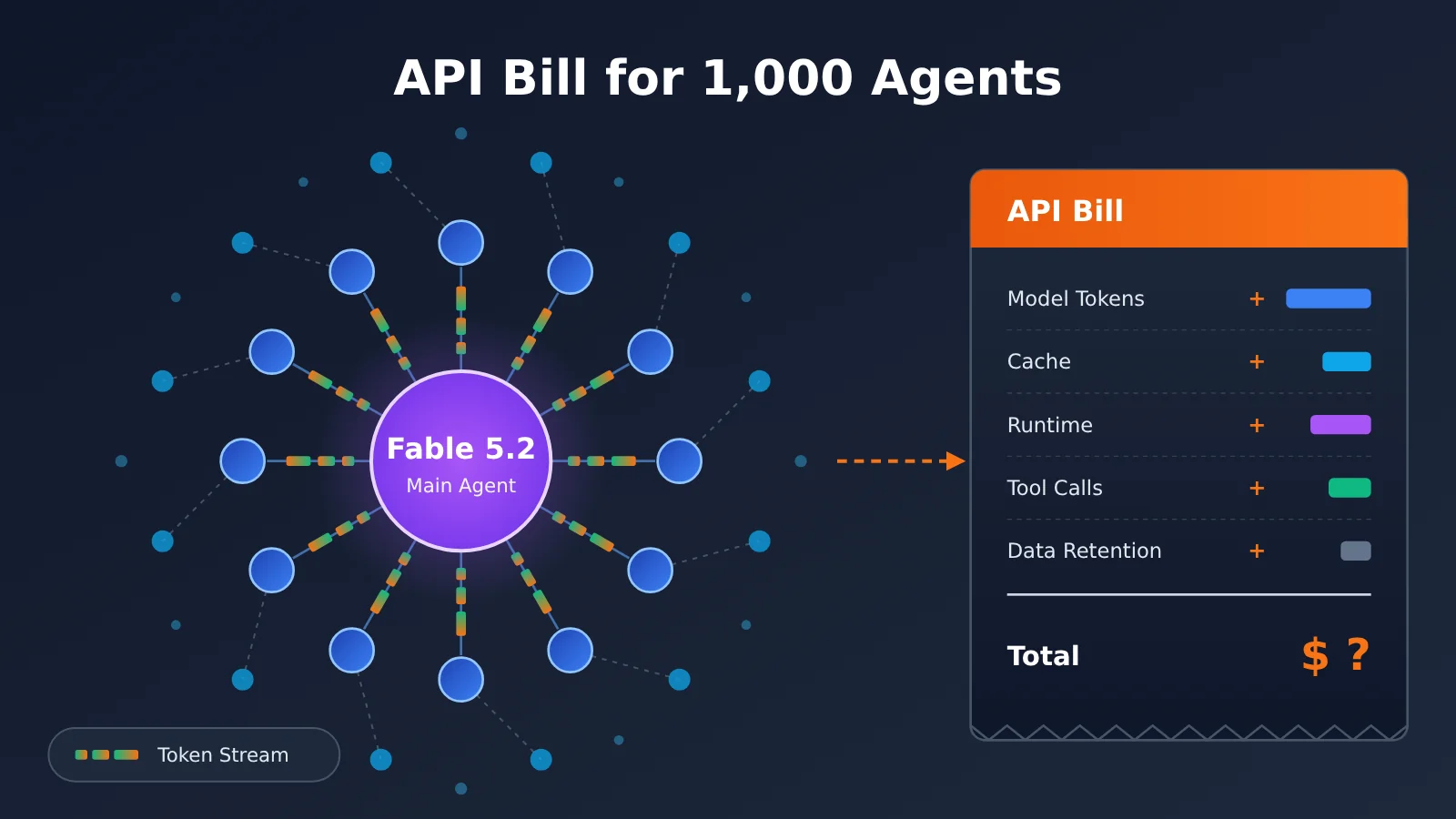
Claude Fable 5.2’s Operating System Experiment: Why the Bill for 1,000 Agents Is Unknown
Let’s start with the key information Anthropic has disclosed. This experiment demonstrates more than the model’s ability to write code: it shows its capacity to organize large-scale software engineering, coordinate many subagents, maintain progress over an extended period, and continually validate code.
| Item | Details |
|---|---|
| Release date | November 9, 2026 |
| Released by | Anthropic |
| Starting point | An empty folder; the task was to design and build an operating system prototype |
| Agent scale | More than 1,000 subagents |
| Runtime | Eight days of continuous coding, testing, reviewing, and revising |
| Final result | An operating system prototype that can boot on a real laptop, with a kernel, disk/keyboard/network drivers, file storage, a window system, a login screen, an installer, and built-in Claude features |
| Information not disclosed | Total Token usage, total experiment cost, Agent roles and structure, communication protocols, lines of code, and more |
It’s important to note that Anthropic described the result as a working operating system prototype. That doesn’t mean it’s a mature commercial operating system. Anthropic also hasn’t disclosed the actual bill for the experiment, so any figure for “how much this operating system cost” is only a guess.
How Many Layers of API Calls Does an Agent Team Generate?
Even without knowing the actual bill, we can understand the cost pressures of a multi-agent setup by looking at its structure. A main Agent needs to understand the goal, break it into tasks, assign them to subagents, then collect and summarize their results and validate them. Each subagent also needs to read the project context, tool instructions, and relevant code before reasoning through and completing its own task.
That means a single “completed task” can involve multiple layers of model calls: planning, execution, reporting, validation, and retries after failures. As the number of Agents grows and runtimes stretch over several days, Token costs, concurrent calls, and long-running sessions all become factors in the bill.
Claude Fable 5.2 API Pricing: The Starting Point for Multi-Agent Costs
To discuss multi-agent costs, start with the per-token prices. The prices below are Anthropic’s publicly listed rates, in US dollars per million tokens (MTok).
| Model | Input price | Output price | Best for |
|---|---|---|---|
| Claude Fable 5.2 | $8 | $40 | Complex, open-ended, long-running tasks |
| Claude Opus 5.5 | $4 | $20 | Anthropic’s recommended starting point for most coding and knowledge work |
| Claude Sonnet 5.5 | $2 | $10 | Moderately difficult subtasks and information processing |
| Claude Haiku 5.5 | $0.10 | $0.50 | Simple, high-frequency subtasks (up to 100K input tokens) |
For Haiku 5.5, when input exceeds 100K tokens, the price increases to $0.50/MTok for input and $2.50/MTok for output. Fable 5.1 was previously priced at $10 for input and $50 for output, so Fable 5.2’s standard per-token rates are 20% lower.
💡 Choosing a model: These models aren’t interchangeable in terms of capability. The right choice depends on the task’s difficulty and quality requirements. You can use APIYI (apiyi.com) to compare the actual outputs and token usage of multiple Claude models through the same OpenAI-compatible interface, then decide how to assign models to different types of subtasks. (Available models depend on the platform’s model list.)
Claude Fable 5.2 Specifications and Fast Mode
Fable 5.2’s API model ID is claude-fable-5-2. It has a 1M-token context window, a maximum output of 128K tokens, and a knowledge cutoff of June 2026. Adaptive Thinking is always enabled, with High as the default Effort setting. You can also choose Low, Medium, High, Xhigh, or Max. Effort isn’t a response-style setting: it directly affects reasoning depth, execution time, and token usage.
| Billing item | Price (USD/MTok) | Details |
|---|---|---|
| Standard input / output | $8 / $40 | Standard mode |
| Fast Mode input / output | $16 / $80 | Double the price; output speeds up to 2.5× faster than standard mode |
| Batch API input / output | $4 / $20 | 50% discount on asynchronous batch requests; can’t be used with Fast Mode |
| 5-minute cache write | $10 | Saves an input prefix for reuse |
| 1-hour cache write | $16 | Longer cache lifetime |
| Cache read | $0.20 | Just 2.5% of the standard input price |
This table highlights an important point: the most capable model shouldn’t necessarily handle every subtask. If you use Fable 5.2 for tasks like formatting or simple classification, it costs 4× as much as Sonnet 5.5 and 80× as much as Haiku 5.5, with little benefit from its additional reasoning capability.
How Costs Add Up in Multi-Agent Systems: A Breakdown of the Claude Fable 5.2 Workflow
In a multi-agent system, the main agent handles planning and summarizing, while sub-agents take care of specific tasks. It may look like the work is being “divided up,” but the tokens don’t disappear. In fact, they can multiply at several points in the process.
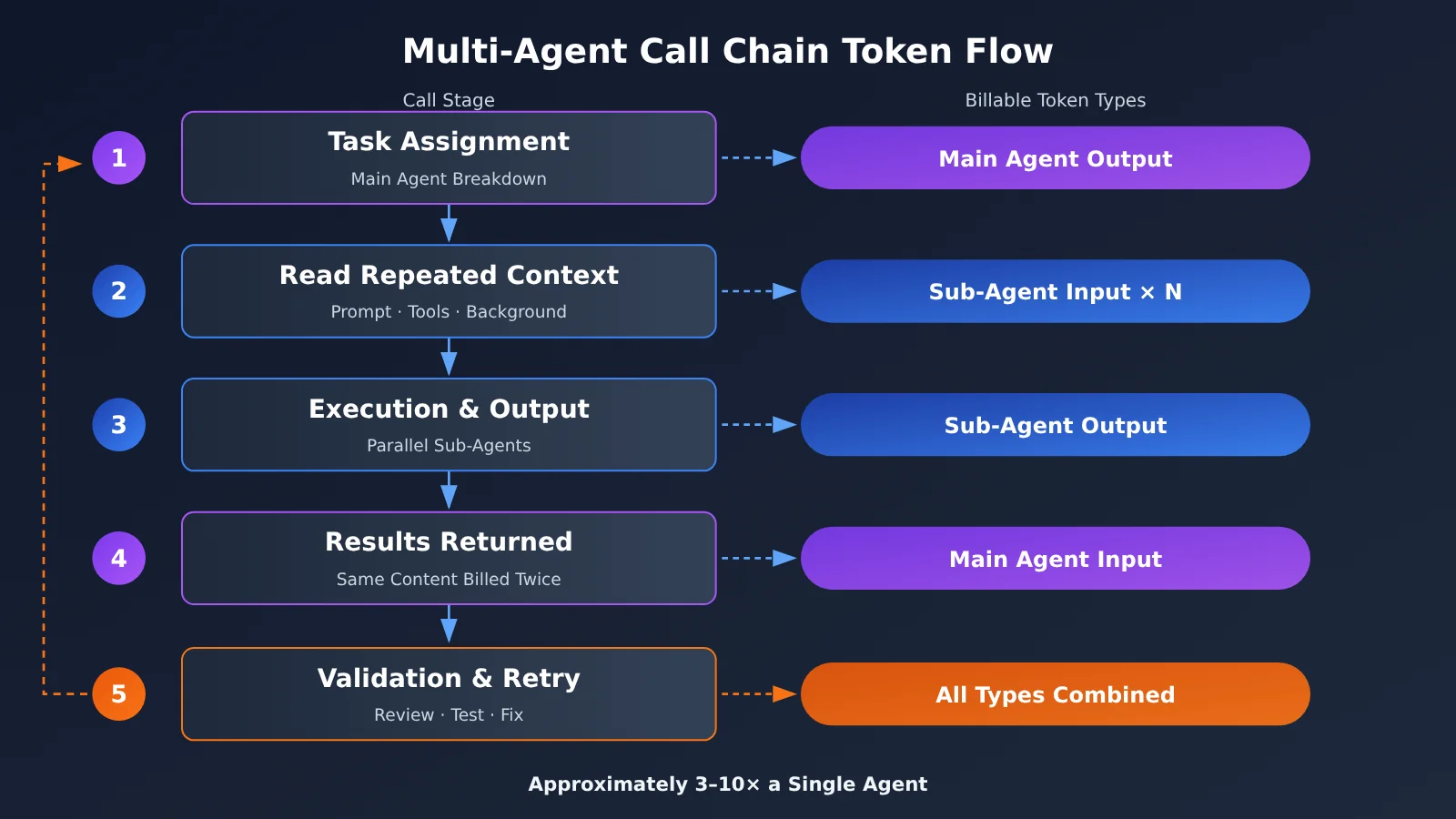
- Task assignment: The task description generated by the main agent uses output tokens, billed at the main agent model’s rates.
- Repeated context: Each sub-agent has to read the system prompt, tool descriptions, and project background again, so the same content is billed multiple times.
- Returning results: A sub-agent’s output becomes input for the main agent, so the same content is billed twice.
- Multiple rounds of validation: Reviewing, testing, finding issues, and assigning fixes all require new calls.
- Failed-call retries: If a call fails or the result isn’t acceptable, the task has to be run again, adding directly to token consumption.
Anthropic’s 2026 multi-agent engineering guide notes that, for the same task, multi-agent systems typically use 3–10 times as many tokens as a single agent. This is a typical range for comparisons on the same task, not a fixed multiplier. As a purely illustrative example, suppose a single-agent task costs $1.60 in tokens. At the same model and input-to-output ratio, 3 times the usage would cost $4.80, while 10 times the usage would cost $16.
This also explains why running agents in parallel doesn’t necessarily reduce total costs. Parallelism shortens wall-clock time, but it doesn’t reduce the tokens used by each agent—and coordination adds overhead on top. What you really need to control isn’t the number of agents, but how many tokens each agent actually uses.
Claude Fable 5.2 Multi-Agent Cost Estimate: What Would a Workflow Cost?
Below is a hypothetical workflow: one Fable 5.2 main agent handles planning and synthesis, while 10 Sonnet 5.5 sub-agents handle independent research tasks. All token usage figures are hypothetical. They aren’t actual bills from Anthropic’s system experiments, nor are they a model comparison based on tasks of equivalent quality.
Main agent (Fable 5.2): Assume 100,000 input tokens and 10,000 output tokens.
- Input: 100,000 × $8 / 1,000,000 = $0.80
- Output: 10,000 × $40 / 1,000,000 = $0.40
- Subtotal: $1.20
10 sub-agents (Sonnet 5.5): Assume each uses 100,000 input tokens and 20,000 output tokens, for a combined total of 1,000,000 input tokens and 200,000 output tokens.
- Input: 1,000,000 × $2 / 1,000,000 = $2.00
- Output: 200,000 × $10 / 1,000,000 = $2.00
- Subtotal: $4.00
| Component | Input cost | Output cost | Total |
|---|---|---|---|
| Fable 5.2 main agent | $0.80 | $0.40 | $1.20 |
| 10 Sonnet 5.5 sub-agents | $2.00 | $2.00 | $4.00 |
| Total token costs | $2.80 | $2.40 | $5.20 |
| Session Runtime (assuming one Session runs for exactly 8 hours) | — | — | $0.64 |
| Example total (excluding tool costs) | — | — | $5.84 |
How Managed Agents Session Runtime Is Billed
If you use Claude Managed Agents, your bill will include an additional Session Runtime charge of $0.08 per Session hour. Only time spent in the running state is billed; idle time, time waiting for user confirmation, and terminated Sessions aren’t charged. Tokens used by sub-agents are still billed separately at their respective model rates.
The $0.64 in the table assumes that one Session runs for exactly 8 hours: 8 × $0.08 = $0.64. Runtime is billed based on how long a Session runs, not by multiplying the number of Agents by an hourly rate for each Agent. If multiple Sessions accrue runtime, calculate the charge for each Session based on its actual time in the running state, then add them together. So $0.64 shouldn’t be treated as a fixed cost for running a multi-Agent system.
How Caching, Batch, and Tool Calls Affect the Total Cost
A few other charges can make the actual bill for this workflow differ from $5.84:
- Prompt Caching: If sub-agents share a System Prompt and project context that hit the cache, reads cost just $0.20/MTok. But the initial write costs more than regular input, so caching may not be worthwhile if it’s used too few times.
- Batch API: Asynchronous batch requests can get a 50% discount on tokens. But Managed Agents are stateful, interactive Sessions and can’t use the Messages API Batch discount, so you can’t apply the 50% discount to Session costs.
- Tool calls: Web Search in Managed Agents costs $10 per 1,000 searches. Search-heavy Agents need to be calculated separately.
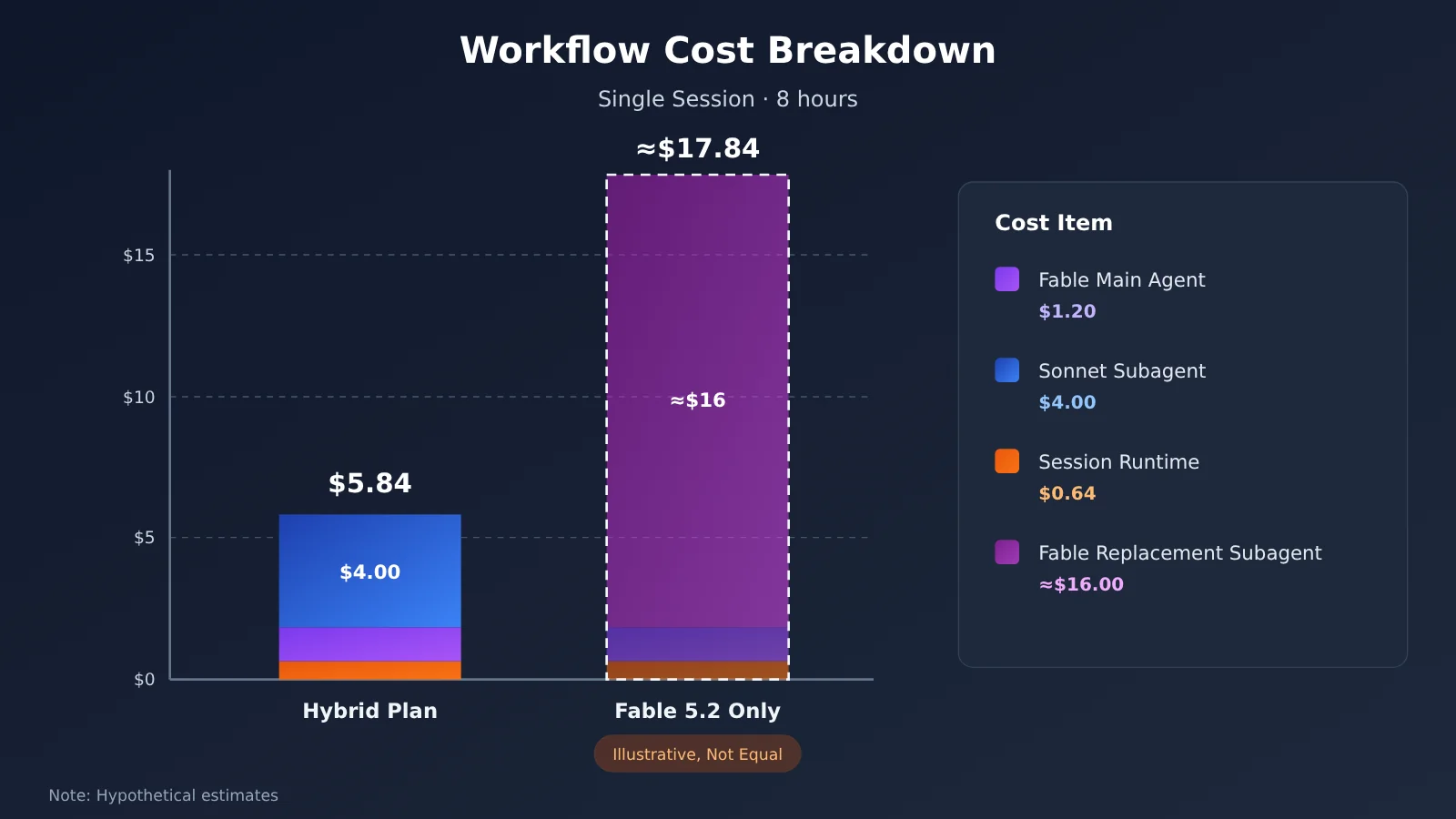
📊 Image note: The figures above are hypothetical estimates based on publicly listed prices. To estimate costs for your own workflow, you can first run a few real requests through APIYI apiyi.com, read the actual token counts from the returned
usagefield, and then calculate the cost using the pricing table.
How to Reduce Costs in Claude Fable 5.2 Multi-Agent Systems
The minimal example below shows how to read usage from a response and estimate the cost of a single call using the price table. Replace the model name with an ID that’s actually available on your platform.
import openai

client = openai.OpenAI(
    api_key="YOUR_API_KEY",
    base_url="https://api.apiyi.com/v1"  # APIYI OpenAI-compatible endpoint
)

resp = client.chat.completions.create(
    model="claude-sonnet-model-id",  # Replace with an actual ID from the platform's model list
    messages=[{"role": "user", "content": "总结这段需求文档的要点"}]
)
u = resp.usage
cost = u.prompt_tokens * 2 / 1e6 + u.completion_tokens * 10 / 1e6  # Sonnet 5.5 list price
print(resp.choices[0].message.content, f"估算费用: ${cost:.4f}")
View the complete implementation: tier calls by model and track the budget
import openai

# Unit: USD per million tokens, based on Anthropic's public list prices
PRICES = {
    "planner": {"model": "claude-fable-model-id", "in": 8, "out": 40},
    "worker":  {"model": "claude-sonnet-model-id", "in": 2, "out": 10},
    "simple":  {"model": "claude-haiku-model-id", "in": 0.10, "out": 0.50},
}

client = openai.OpenAI(
    api_key="YOUR_API_KEY",
    base_url="https://api.apiyi.com/v1"
)

class BudgetTracker:
    def __init__(self, limit_usd: float):
        self.limit = limit_usd
        self.spent = 0.0

    def add(self, tier: str, usage) -> float:
        p = PRICES[tier]
        cost = usage.prompt_tokens * p["in"] / 1e6 + usage.completion_tokens * p["out"] / 1e6
        self.spent += cost
        if self.spent > self.limit:
            raise RuntimeError(f"预算超限:已花费 ${self.spent:.2f}")
        return cost

def run(tier: str, prompt: str, tracker: BudgetTracker) -> str:
    resp = client.chat.completions.create(
        model=PRICES[tier]["model"],
        messages=[{"role": "user", "content": prompt}],
    )
    cost = tracker.add(tier, resp.usage)
    print(f"[{tier}] 本次 ${cost:.4f},累计 ${tracker.spent:.4f}")
    return resp.choices[0].message.content

tracker = BudgetTracker(limit_usd=10.0)
plan = run("planner", "把资料整理任务拆成 3 个独立子任务,每行一个", tracker)
results = [run("worker", f"执行子任务:{t}", tracker) for t in plan.splitlines() if t.strip()]
summary = run("planner", "汇总以下结果:\n" + "\n".join(results), tracker)
print(summary)
🚀 Quick-start tip: We recommend claiming the free trial credits for new users through APIYI at apiyi.com first. Run the budget-tracking script above to test the minimal “plan—execute—summarize” workflow, then scale up your agents once you’ve seen the actual token distribution.
Based on the pricing rules above, cost control comes down to five methods:
| Method | What to do | When it applies |
|---|---|---|
| Choose a model based on task difficulty | Use Fable 5.2 or Opus 5.5 for planning and complex reasoning | The official recommendation is to start most tasks with Opus 5.5 |
| Downgrade simple subtasks | Use Sonnet 5.5 or Haiku 5.5 for classification, formatting, and extraction | First verify that the lower-cost model meets your quality requirements |
| Enable Prompt Caching | Cache shared system prompts, tool descriptions, and long documents | Savings depend on the number of cache hits and how consistent the context is |
| Enable Fast Mode only when needed | Use it only for latency-sensitive interactive requests | It doubles the price, so it’s not cost-effective for offline tasks |
| Track usage and set budgets | Track usage by model, agent, and task, and set limits | The sooner you add this, the sooner you can spot unusual usage |
Batch API also has its limits: it’s a good fit for tasks that can be handled asynchronously, such as classifying large batches of documents, generating content offline, and analyzing non-real-time data. It’s not the right choice for every long-running Agent Session.
The Role of API Gateways in the Claude Fable 5.2 Multi-Agent Era
On November 9, 2026, Vercel announced that Claude Fable 5.2 was available through AI Gateway, with the model ID anthropic/claude-fable-5.2. It’s a real-world example of how a multi-model gateway works. The gateway supports AI SDK, OpenAI Chat Completions, OpenAI Responses, and Anthropic Messages, so developers can call the model through a unified entry point.
At the routing layer, the same model can be served by providers such as Anthropic, AWS Bedrock, and Google Vertex AI, with options to prioritize price, time to first token, or throughput. Vercel’s Fallback example prioritizes Fable 5.2, then switches to Opus 5.5 and Sonnet 5.5 if a safety classifier rejects the request. The gateway also offers usage reports, cost tracking, API key budgets, retries, and failover.
Why do multi-Agent systems need this kind of infrastructure more than simple chat applications? If a chat request fails, the user can just try again. But in an Agent workflow that runs for days, a single failed call can stall the entire task chain, while retries drive up token usage. In multi-Agent systems, model selection, call management, failover, and cost tracking go from nice-to-haves to necessities.
🎯 Technical recommendation: For developers in China, APIYI apiyi.com offers a multi-model access layer built on a similar approach: use one API key to call leading models such as OpenAI, Claude, and Gemini. Its OpenAI-compatible interface reduces differences between providers, and pay-as-you-go pricing makes it easier to track costs for each Agent and task.
Claude Fable 5.2 Data Retention: Compliance Considerations for Enterprise Multi-Agent Applications
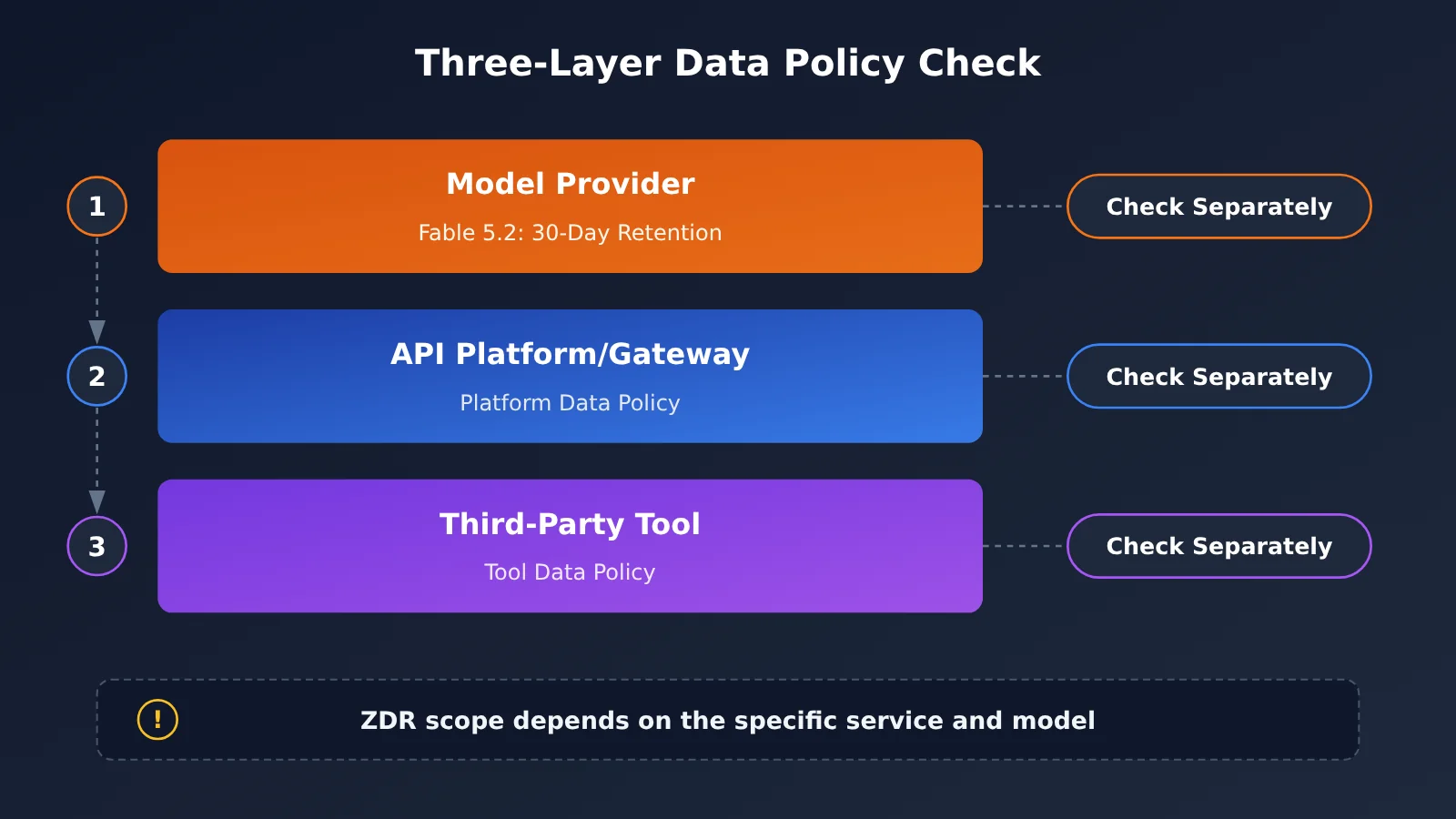
Beyond cost, enterprise developers also need to consider data compliance. According to Anthropic’s official data retention documentation, Fable 5.2 is a Covered Model subject to 30-day data retention; it doesn’t support zero data retention (ZDR) by default.
The rules are as follows: By default, organizations can’t use the model under a ZDR arrangement unless they receive explicit authorization from Anthropic. Prompts and model outputs are retained for 30 days under the applicable policies, and retained data isn’t used to train models without explicit permission. Eligible ZDR organizations can use the model by enabling 30-day data retention in a specific Workspace. Vercel’s integration announcement also explicitly calls out this requirement.
One point that’s easy to confuse: a model provider’s data policy and a third-party API gateway’s data policy are two different things. Even if an API platform offers ZDR, that doesn’t mean every model it provides meets ZDR requirements. When handling sensitive business data, enterprises should review the data processing policies of the model provider, the API platform, and any third-party tools separately—not just compare model prices.
Frequently Asked Questions
Q1: How much did the Claude Fable 5.2 experiment with 1,000 agents cost?
Anthropic hasn’t disclosed the cost. The company hasn’t published the experiment’s total token usage, compute costs, or overall price. Any specific figures you see online aren’t official.
Q2: Do multi-agent systems always cost 3–10 times as much as single-agent systems?
Not necessarily. That’s Anthropic’s typical cost range for the same task, not a fixed multiplier. The actual difference depends on how much context is repeated, how often tasks are handed off, which models are used, and how often the cache is hit.
Q3: Is Session Runtime billed per agent?
No. Managed Agents are billed for the time each Session is in the running state, at $0.08 per Session hour. Idle time, time spent waiting for confirmation, and time after termination aren’t billed. For multiple Sessions, calculate the cost for each one based on its actual runtime, then add them together.
Q4: Can I use the Batch API’s 50% discount with Managed Agents?
No. The Batch discount applies to asynchronous batch requests made through the Messages API. Managed Agents use stateful, interactive Sessions and aren’t eligible for the discount. Fast Mode also can’t be used with the Batch API.
Q5: How can I quickly test the actual cost of dividing work across multiple models?
Here’s a simple three-step approach:
1. Sign up at APIYI apiyi.com to get an API key and free testing credits.
2. Set `base_url` in the code in this article to `https://api.apiyi.com/v1`, then replace the model ID with one available on the platform.
3. Run the budget-tracking script on a small task and record the actual token distribution across model tiers.
Q6: What limitations should I be aware of with Claude Fable 5.2?
First, it’s relatively expensive at $40/MTok for output, so it’s not suitable for handling every subtask. Second, Fast Mode doubles the price. Third, it requires 30-day data retention and can’t be used under a ZDR arrangement by default. Be sure to check compliance requirements before processing sensitive data.
Claude Fable 5.2 Multi-Agent Cost Key Takeaways
- The bill hasn’t been disclosed: Anthropic hasn’t revealed the actual cost of its 1,000-agent operating system experiment.
- Prices are 20% lower: Fable 5.2’s standard pricing is $8 per million input tokens and $40 per million output tokens.
- Costs can multiply: For the same task, multi-agent setups typically use 3–10 times as many tokens as single-agent setups.
- Runtime is billed per session: $0.08 per session hour, based only on running time—not the number of agents.
- Discounts have limits: The 50% Batch discount doesn’t apply to Managed Agents, and cache savings depend on hit rate.
- Don’t overlook compliance: Fable 5.2 requires 30-day data retention; ZDR requires additional authorization.
- Test before scaling up: Use APIYI at apiyi.com to validate the actual token distribution across models with different roles through a unified interface.
Summary
Claude Fable 5.2’s 1,000-agent experiment shifts developers’ focus from “How much does one call cost?” to “How much does the entire workflow cost?” Here are the key points:
- Costs add up across multiple layers: The main agent, subagents, repeated context, verification, retries, session runtime, and tool calls all contribute to the bill.
- How you divide work between models matters most: Let the most capable model handle planning and critical reasoning, and assign execution-focused subtasks to cheaper models.
- Read the billing rules carefully: Runtime is billed by session duration, Batch doesn’t cover Managed Agents, and caching only pays off when there are enough hits.
- Compliance matters as much as price: Consider the 30-day data retention requirement and ZDR restrictions during the selection process.
The more complex a multi-agent application gets, the more it depends on stable model access, clear usage tracking, and reliable failover. We recommend using APIYI at apiyi.com to quickly test different model-role configurations through a unified interface. Plan your budget based on real token usage, then scale up the number of agents gradually.
📚 References
- Anthropic announcement: Claude Fable 5.2 and Mythos 5.2
- Link:
anthropic.com/claude-fable-and-mythos-5-2 -
Description: Official details of the 1,000-agent operating system experiment
-
Claude Platform model specs and pricing: Fable 5.2 Overview
- Link:
platform.claude.com/docs/en/models/fable-5-2/overview -
Description: Pricing, context window, Effort, and other specs
-
Claude Managed Agents pricing: Session Runtime billing rules
- Link:
platform.claude.com/docs/en/about-claude/pricing -
Description: Runtime, Web Search, and full API pricing
-
Prompt Caching documentation: Cache writes and reads
- Link:
platform.claude.com/docs/en/build-with-claude/prompt-caching -
Description: Details on automatic caching and explicit cache breakpoints
-
API data retention policy: Covered Model and ZDR
- Link:
platform.claude.com/docs/en/manage-claude/api-and-data-retention -
Description: Official guidance on the 30-day data retention requirement
-
Vercel AI Gateway integration announcement: Fable 5.2 availability
- Link:
vercel.com/changelog/claude-fable-5-2-now-available-on-ai-gateway - Description: Examples of multi-provider routing, fallback, and cost management
Author: APIYI Technical Team
Technical discussions: Get in touch via the homepage of the APIYI website. For more integration resources, visit the documentation center at docs.apiyi.com.