Author’s note: Using the controversy over GPT-6 Astra rewriting Qwen3.5-0.8B weights as a case study, this article breaks down model capability claims in six steps, covering baselines, tool permissions, evaluation settings, and reproducibility evidence.
A claim that “a frontier model read and rewrote another model’s weights, boosting its math score from 7.9% to 48.1%” is enough to take the AI community by storm. But within a day, a developer published a rebuttal, and Chinese media followed up with headlines like “MIT’s Masterpiece Gets Torn Apart.” Using the dispute over Astra modifying Qwen’s weights as a case study, we’ll build a reusable method for examining model capability claims.
This isn’t about taking sides. We won’t decide who’s right or wrong. Instead, we’ll compare the original experiment logs, the author’s claims, and the criticisms, turning a hot topic into a checklist you can use again and again.
What you’ll learn: By the end, you’ll have six questions to ask about any claim of a “model capability breakthrough,” helping you avoid pitfalls when choosing models, reporting results, and making technical judgments.
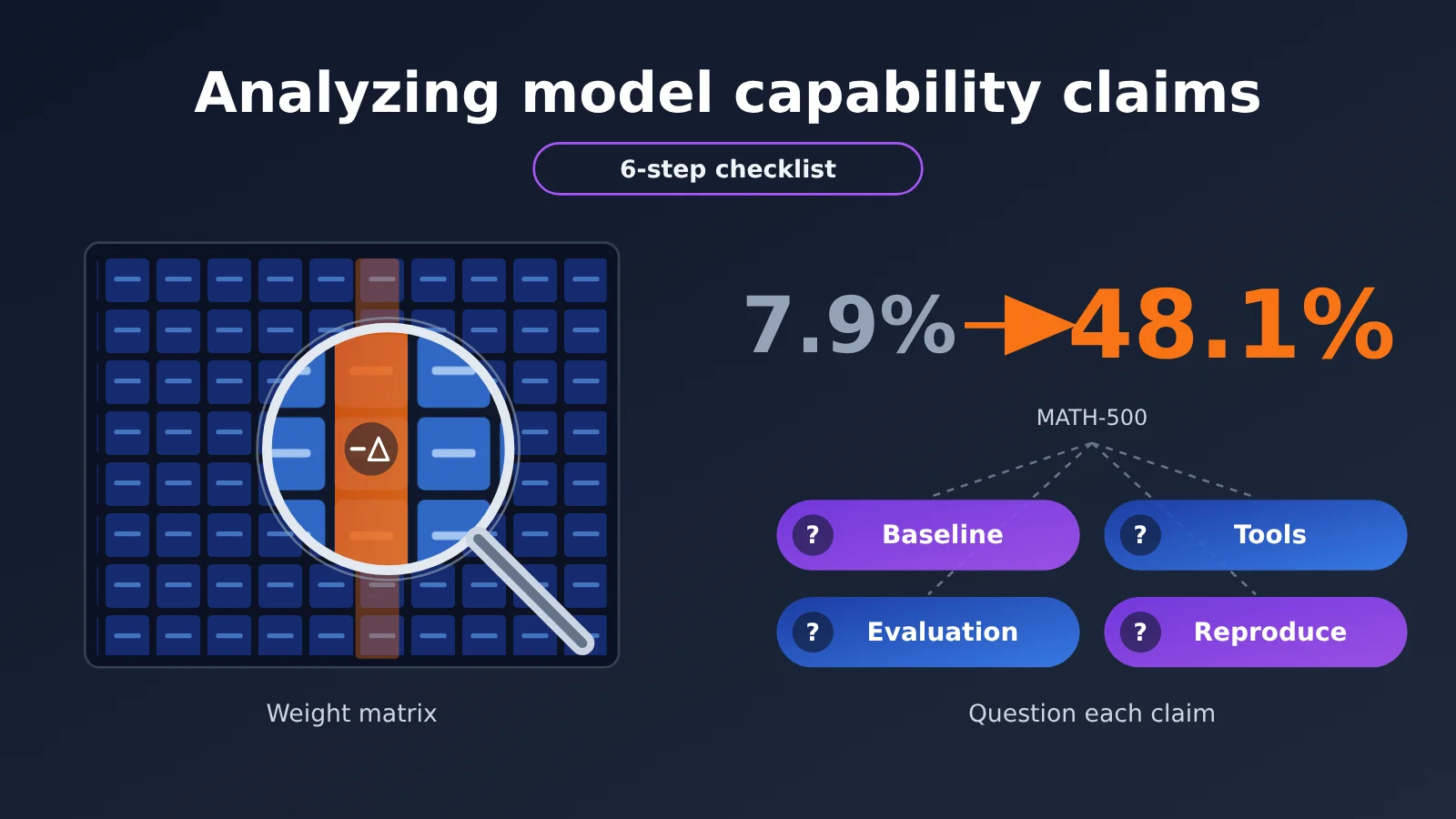
Key Points in the Astra-Qwen Weight Modification Debate
Here’s a quick look at the key facts and points of contention. The analysis that follows builds on them.
| Key point | Details | What it tells us about evaluating the claims |
|---|---|---|
| Research source | MIT CSAIL’s Rikiya Takehi, Jayden Teoh, Alex Zhang, and Omar Khattab published the blog post Sparks of Weight-Space Programming on November 2, 2026, along with experiment logs and modified models | Public logs are a first test of credibility |
| Headline result | GPT-6 Astra modified 131,072 of Qwen3.5-0.8B’s roughly 800 million weights (about 0.016%), raising its MATH-500 score from 7.9% to 48.1% | The more striking the percentage gain, the more important it is to ask why the baseline was so low |
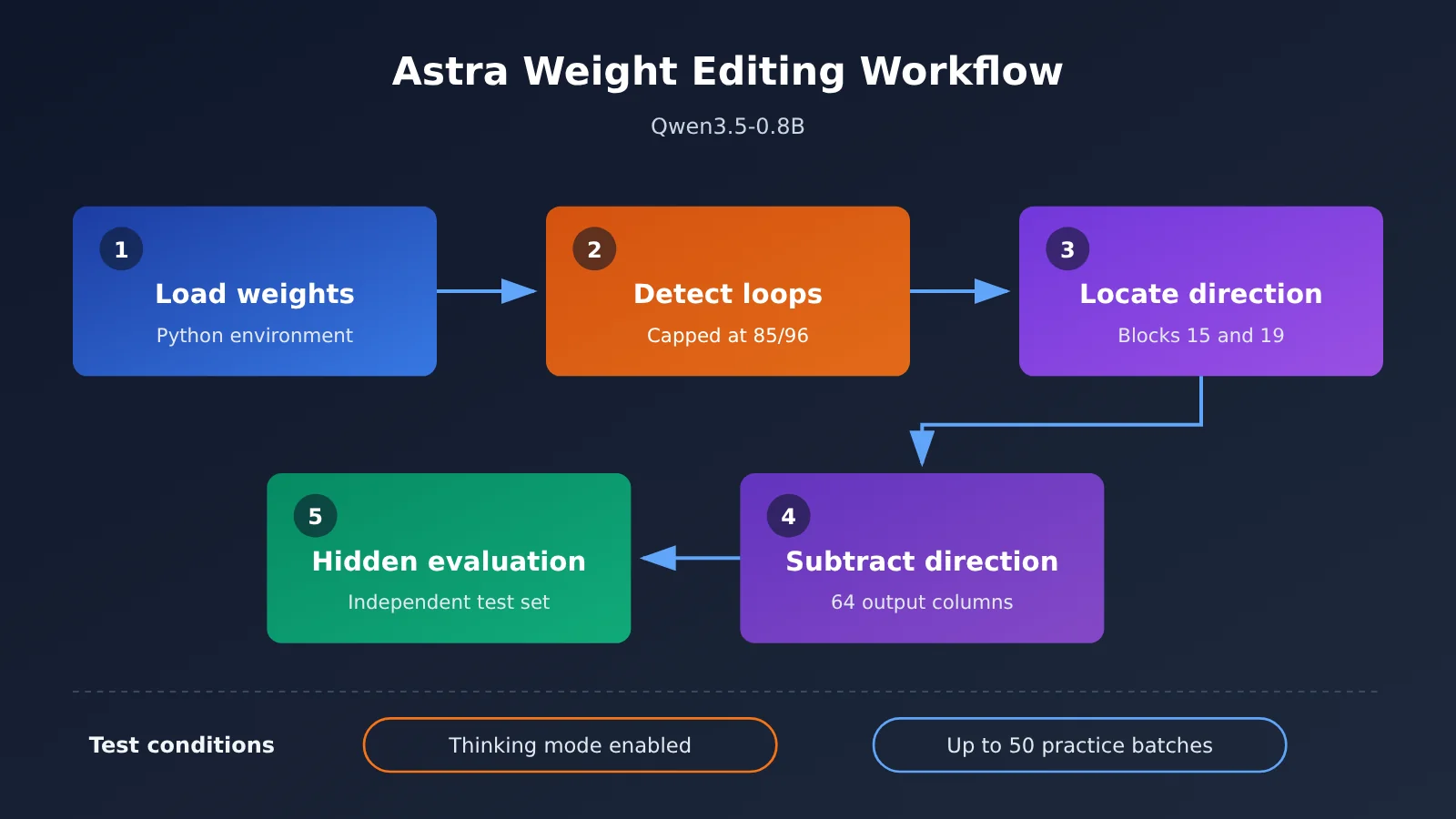
| Tools available | Astra worked in a Python environment with the weights loaded and could run up to 50 batches of practice evaluations | “Understanding weights” and “writing code to analyze weights” are two different things |
| Main criticisms | Matthew Honnibal argues that the publicity combines experiments with different levels of tool access into one sweeping conclusion; Sean Goedecke argues that the Qwen fix is essentially an existing steering technique | To judge whether a method is new, compare it with existing techniques |
| Counterexample | Applied to Gemma 3 270M, the same process raised MATH-500 from 6.8% to at most 7.7%; the authors themselves didn’t consider the improvement meaningful | Success on one model doesn’t mean the capability generalizes |
How Astra Actually Modified Qwen’s Weights
The experiment was far more complicated than “reading weights to improve scores.” When thinking mode was enabled, Qwen3.5-0.8B had a serious looping problem: of the first 96 practice answers Astra examined, 85 kept generating until they hit the 32,768-token limit without providing an answer. This weakness had already been documented in Qwen’s official model card. Notably, the model defaults to non-thinking mode; the experiment deliberately enabled thinking mode.
Astra then traced the looping behavior to a particular direction written by the feed-forward layers in blocks 15 and 19, and subtracted that direction from 64 output columns in each block. According to the experiment’s README, the plan was to modify 131,072 weights; after rounding to the precision used for evaluation, 130,188 actually changed. The successful run executed Python code 80 times and took 20.3 hours, including a 4.7-hour service interruption.
A Quick-Start Guide to Evaluating Model Capability Claims: A 6-Step Checklist
We put together this checklist based on the controversy over Astra’s edits to Qwen’s weights. Each step addresses a specific question and applies to research papers, product launches, benchmark posters, and vendor marketing copy.
Step 1: Check the Baseline and Failure Modes First
Whenever you see a claim that performance “improved by X percentage points,” start by asking: Why was it so low in the first place? Qwen3.5-0.8B’s baseline was just 7.9%, and 93.0% of its MATH-500 answers hit the token limit. In other words, the model often didn’t finish its answer—it wasn’t necessarily unable to solve the problem.
Compare the last column in the table below with the model versions in the first column, and the pattern becomes clear: the sharp rise in scores happened almost in step with the drop in the rate of answers hitting the token limit.
| Qwen3.5-0.8B version | MATH-500 | GSM8K | IFEval | MATH-500 token limit hit rate |
|---|---|---|---|---|
| Base model | 7.9% | 13.8% | 21.0% | 93.0% |
| Edited version, 10 practice batches | 12.3% | 25.7% | 49.0% | 87.2% |
| Edited version, 25 practice batches | 14.1% | 25.1% | 39.9% | 86.4% |
| Edited version, 50 practice batches | 48.1% | 67.1% | 62.3% | 33.1% |
Source: Takehi et al., MIT CSAIL, November 2, 2026, with thinking mode enabled. The original report notes that each edited version was run independently with different edits. The headline figure of 131,072 weight edits corresponds to the 50-batch row.
Step 2: Look at What Tools the Model Had
This is the heart of Honnibal’s criticism. The research reported eight experiments and one follow-up experiment with Gemma, but the conditions available to the model varied widely. In some cases, it received only raw weights as plain text, with no tools. In others, it had a full Python environment and multiple rounds of practice and evaluation. Grouping these results under the single conclusion that it can “read and write weights” makes it easy to overestimate its ability to “understand” weights on their own.
| Experiment | Network size | What Astra had access to | Result |
|---|---|---|---|
| Identify which game a network was playing | 17,253 weights | Raw weights as plain text | 4/4 correct |
| Identify shapes drawn by a diffusion model | 23,824 | Raw weights as plain text | 3/3 correct |
| Identify the training text of a small language model | 7.2 million | Intermediate layers + Python | 3/3 correct |
| Fix a stuck driving policy | 171,664 | Raw weights, scenario description, 1 failure record | Success rate rose from 0% to 100% |
| Build a 9×9 Go network from scratch | 1.48 million | Python, up to 50 practice attempts | Beat a PPO network of the same size |
| Identify a sycophantic model | 270 million | Python first, then attention patterns | Failed initially, then 3/3 |
| Fix Qwen’s math performance | 800 million | Python, up to 50 practice batches | MATH-500 rose from 7.9% to 48.1% |
| Improve Gemma’s math performance | 270 million | Python, up to 50 practice batches | No definitive improvement (at most 0.9 percentage points) |
The table is based on R&D World’s summary of the original research, with access categories adapted from Honnibal’s breakdown. One thing is clear: the experiments involving reading weights as plain text all used small networks with tens of thousands of parameters. When it came to working with an 800-million-parameter language model, Astra had a Python workspace like one a human machine learning engineer might use.
Step 3: Compare the approach with existing techniques to assess novelty
Goedecke points out that finding an activation direction and then subtracting it from the weights is essentially an application of steering, an established technique for guiding model activations. That doesn’t diminish the value of the result, but it does change what the conclusion means: what’s noteworthy is that “the model can independently complete a standard interpretability engineering workflow,” not that “the model has a superhuman ability to read weights.”
Step 4: Check whether the evaluation setup was carefully selected
Details to verify include whether the default inference mode was changed, what token limit was set, how many questions could be generated per exercise (in this experiment, each invocation could generate up to 512 questions or inspect the internal activations of up to 1,024 text passages), and whether the evaluation questions were isolated from the editing process. The original article notes that the evaluation questions and results weren’t visible to the model during editing, which is a point in its favor. But enabling thinking mode happened to amplify Qwen’s tendency to loop, and that must also be reflected in your conclusion.
Step 5: Look for Counterexamples and Limits
Gemma 3 270M provides one of the most valuable data points in the study. It rarely gets stuck in loops: only 8.5% of its answers hit the limit, compared with 93% for Qwen. The same process didn’t produce a clear improvement on Gemma. The authors’ interpretation is that weight editing can remove obstacles that mask a model’s abilities, but it can’t create abilities the model doesn’t already have. If a promotional claim shows only successes and leaves out failures, take it with a grain of salt.
Step 6: Check for Independent Replication
The modified model’s model card documents an independent rerun by Hugging Face’s akhaliq using ML Intern. It covered all 500 MATH-500 problems, with 2,000 generations in total, and achieved a score of 51.0%, with 31.6% hitting the limit. The independent results broadly matched the original findings, supporting the conclusion that the score really did improve. The debate is about how to interpret that score, not whether it was fabricated.
🎯 Practical tip: After reading a promotional claim, try comparing several models on the same set of questions yourself. APIYI apiyi.com provides API access to models including Claude Opus 5.5, Kimi K3.1 Pro, and the Qwen3.8 series. It supports both OpenAI and Anthropic API formats, making it easy to switch models in the same script for cross-validation. See docs.apiyi.com for integration instructions.
Checking Astra’s Claims and Criticisms Against the Checklist
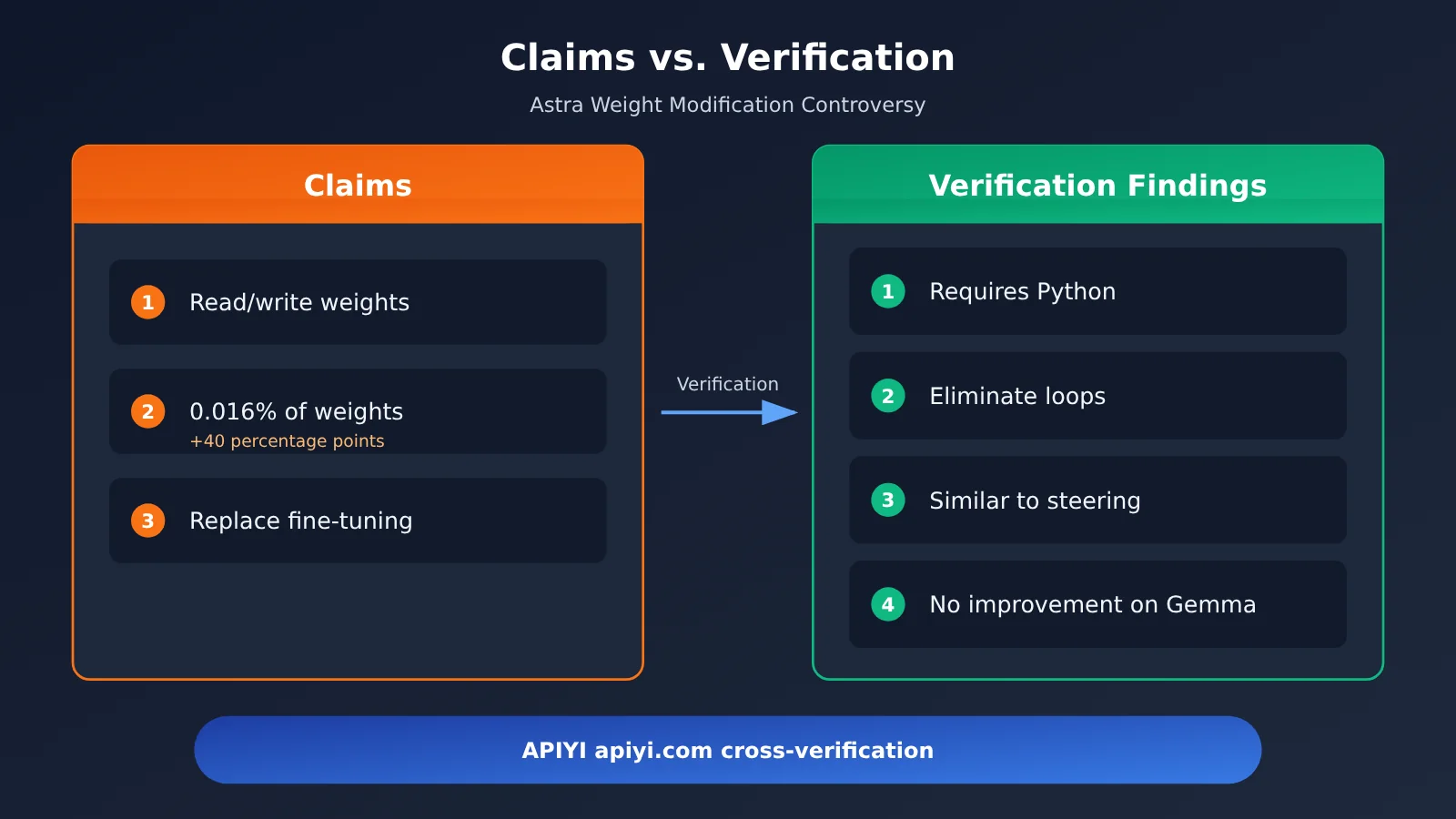
Applying the six-step checklist to this debate gives us a “claim vs. finding” comparison table. It’s a format you can reuse in future technical evaluation reports.
| Claim | What to Check | Finding |
|---|---|---|
| Astra can understand neural network weights | Tool access | Plain text works for small networks; the 800-million-parameter model relies on Python analysis |
| Changing 0.016% of weights improves performance by 40 percentage points | Baseline and failure modes | The improvement mainly comes from reducing loops, with the cap-hit rate falling from 93.0% to 33.1% |
| Pioneers programming in weight space | Method novelty | The core operation is close to existing steering techniques |
| Can replace some fine-tuning | Generalization | No clear improvement on Gemma; it can remove obstacles but can’t add capabilities |
| The results are genuine and reliable | Independent replication | A third-party rerun achieved 51.0%, supporting the reported numbers |
Competitor Comparison: How to Evaluate Similar Claims
GPT-6 Astra has drawn attention for its benchmark scores several times. In September, the ARC Prize Foundation reported a score of 62.7% on ARC-AGI-3 under a shared evaluation framework. OpenAI also said Astra reached its Critical-level cybersecurity capability threshold. The same checklist applies to these numbers: first ask whether the evaluation framework was shared or custom-built, then check tool access and the number of runs.
Claude Opus 5.5 and Kimi K3.1 Pro were compared alongside Astra in an October 23 R&D World comparison. Models from different vendors may lead on tasks that play to their strengths, but marketing claims often use the settings most favorable to each vendor. Running the same questions with the same parameters yourself is more convincing than any promotional graphic.
💡 Choosing a model: If you want to compare these models on your own business tasks, you can start with a small-scale test through the unified interface at APIYI apiyi.com. Note that GPT-6 Astra isn’t available on APIYI yet; we’ll add it as soon as possible. Claude Opus 5.5 and Kimi K3.1 Pro are already available for direct invocation.
APIYI Availability and Pricing for the Models Discussed
All prices in the table below are based on the actual data on the APIYI pricing page at docs.apiyi.com/models. Refer to that page for billing units; this article doesn’t use any third-party quotes.
| Model | APIYI Model Name | Input Price | Output Price | Cache Price | Availability |
|---|---|---|---|---|---|
| Claude Opus 5.5 | claude-opus-5-5 | $4 | $20 | $0.2 | Available on APIYI |
| Claude Sonnet 5.5 | claude-sonnet-5-5 | $2 | $10 | $0.1 | Available on APIYI |
| Kimi K3.1 Pro | kimi-k3.1-pro | $2 | $10 | $0.2 | Available on APIYI |
| DeepSeek V4.1 Flash | deepseek-v4.1-flash | $0.3 | $1.2 | $0.006 | Available on APIYI |
| Qwen3.8 series | qwen3.8 series | See pricing page | See pricing page | See pricing page | Available on APIYI |
| GPT-6 Astra | None | None | None | None | Not yet available on APIYI; coming as soon as possible |
| Qwen3.5-0.8B | None | None | None | None | Not yet available on APIYI; coming as soon as possible |
| Gemma 3 270M | None | None | None | None | Not yet available on APIYI; coming as soon as possible |
Qwen3.5-0.8B and Gemma 3 270M are small open-weight models, and the modified Qwen checkpoint from the research is also publicly available on Hugging Face. To reproduce the weight editing itself, you’ll need to load the weights locally. For comparing capabilities across models, a cloud API is a better fit.
Frequently Asked Questions (FAQ)
Q1: What is the Astra Qwen weight-editing study about?
The MIT CSAIL team tested whether GPT-6 Astra could understand and rewrite the weights of other neural networks. In the headline experiment, Astra modified approximately 0.016% of Qwen3.5-0.8B’s weights, raising its MATH-500 score from 7.9% to 48.1%. The logs and models have been made public.
Q2: What do the critics and authors disagree on?
The disagreement isn’t about whether the data is real, but how to interpret it. The authors emphasize the model’s ability to read and write weights. Honnibal argues that experiments with different levels of tool access were combined into one sweeping conclusion, while Goedecke argues that the Qwen fix uses an established steering technique and that the core work was Python analysis a human engineer could also write.
Q3: When was the study published, and have there been further developments?
The study was published as a blog post on November 2, 2026. Public criticism appeared within a day, along with a lengthy discussion on Hacker News. The authors say they’re building a benchmark and evaluation framework to measure this capability, so future results are worth watching.
Q4: When is the six-step verification checklist useful?
– **Technology selection**: Scrutinize vendor benchmark scores and marketing claims before purchasing or integrating a model
– **Research reading**: Quickly assess how meaningful a paper’s headline numbers are
– **Internal reporting**: Explain a “breakthrough” to your team with appropriately qualified conclusions
– **Content writing**: Avoid letting a single number skew your model evaluations
Q5: How can I use an API to verify model capability claims myself?
The simplest approach is to prepare a set of questions relevant to your business, keep the reasoning mode and output length consistent, and run the set through multiple models. With APIYI apiyi.com, you can call models such as Claude Opus 5.5, Kimi K3.1 Pro, and the Qwen3.8 series through a unified interface compatible with OpenAI and Anthropic formats. See docs.apiyi.com for integration instructions and docs.apiyi.com/models for pricing.
Q6: What are the known limitations of the study?
First, the Large Language Model experiments relied on Python tools and multiple rounds of practice; they weren’t simply a matter of “reading” weights. Second, the improvement came primarily from reducing looping and depended on enabling thinking mode. Third, there was no definitive improvement on Gemma, suggesting the approach can’t add capabilities out of thin air. Fourth, applications such as self-improvement remain proposals from the authors and haven’t been demonstrated.
Q7: Are the agent collaboration risks mentioned in the study related to Astra?
The Hugging Face incident disclosed by OpenAI on August 26 was primarily driven by IM1, an internal research model. OpenAI explicitly excluded Astra from the incident. The combination of “multi-agent collaboration + weight editing” is currently speculation and hasn’t been demonstrated by this study.
Key Takeaways for Evaluating Model Capability Claims
- Start with the baseline: Qwen’s baseline was low largely because 93% of its answers hit the output limit. Most of the improvement came from fixing looping behavior.
- Ask about the tools: Reading weights as plain text only works for small networks. The Large Language Model experiments relied on a Python environment.
- Compare with existing techniques: The Qwen fix resembles steering. Its value lies in autonomously completing the engineering workflow.
- Examine the evaluation setup: Thinking mode, token limits, and practice batches can all affect the final score.
- Look for counterexamples: Gemma showed no definite improvement, suggesting that editing can remove obstacles but can’t add capabilities.
- Credit independent replication: A third-party rerun achieved 51.0%, lending credibility to the number, though its interpretation still calls for caution.
- Test it yourself: Use APIYI apiyi.com’s unified interface to cross-compare models on your own questions.
Conclusion
The biggest lesson from the debate over Astra modifying Qwen’s weights isn’t that one model is strong or weak. It’s that a real, reproducible result can still be packaged with claims that go beyond the evidence. Keep these points in mind when evaluating model capability claims:
- Pair numbers with failure modes: Without the baseline and the rate of answers hitting the output limit, 48.1% alone doesn’t tell us much.
- Pair conclusions with conditions: Tool access, reasoning mode, and the number of practice attempts define the limits of a conclusion.
- Pair successes with counterexamples and replication: The Gemma counterexample and the third-party rerun together help define what the results really mean.
The next time you see a headline claiming that a model has made a breakthrough, work through these six questions, then run your own test. You can use APIYI apiyi.com to compare multiple models through the same interface. See docs.apiyi.com for documentation and docs.apiyi.com/models for pricing.
📚 References
- 36Kr article: MIT’s “Masterpiece” Under Fire: Did Astra Really Rewrite Qwen’s Weights?
- Link:
36kr.com/p/4056481264866438 -
Description: Chinese-language coverage of the controversy
-
Original research blog: Sparks of Weight-Space Programming
- Link:
rikiyat.github.io/blog/weight-space-programming -
Description: The MIT CSAIL team’s original account of the experiment
-
Experiment logs repository: lm_understand-logs
- Link:
github.com/RikiyaT/lm_understand-logs -
Description: Includes the Qwen experiment README and complete logs for each experiment
-
Matthew Honnibal’s critique
- Link:
honnibal.dev/blog/astra-read-write-misleading -
Description: Examines the claims from the perspective of tool access
-
Sean Goedecke’s critique
- Link:
seangoedecke.com/llms-are-not-superhuman-at-reading-and-writing-neural-network-weights -
Description: Compares the Qwen fix with steering techniques
-
Modified Qwen model card
- Link:
huggingface.co/RikiyaT/Qwen3.5-0.8B-weight-space-programming - Description: Includes results from an independent third-party reproduction
Author: APIYI Technical Team
Technical discussions: Contact us through the APIYI homepage at apiyi.com. For more integration resources, visit the documentation center at docs.apiyi.com.