Author's Note: A detailed breakdown of Anthropic's announcement that Claude Pro/Max subscriptions will no longer cover third-party tools like OpenClaw, effective April 4, 2026. This article analyzes the policy background, the $200 compensation credit, the impact on developers, and available alternatives.
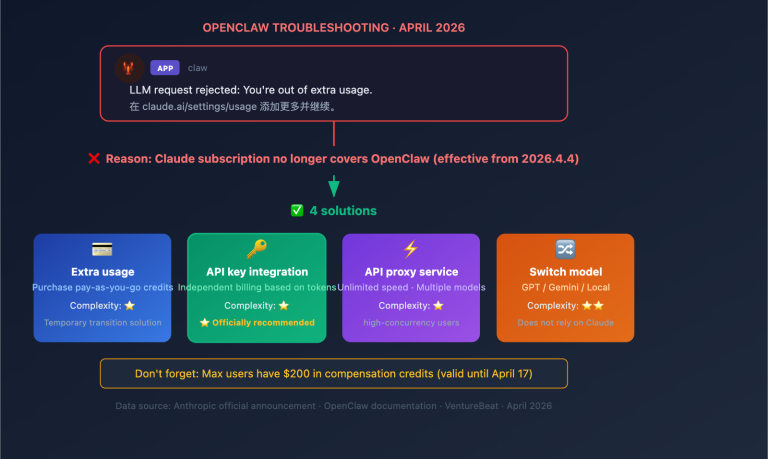
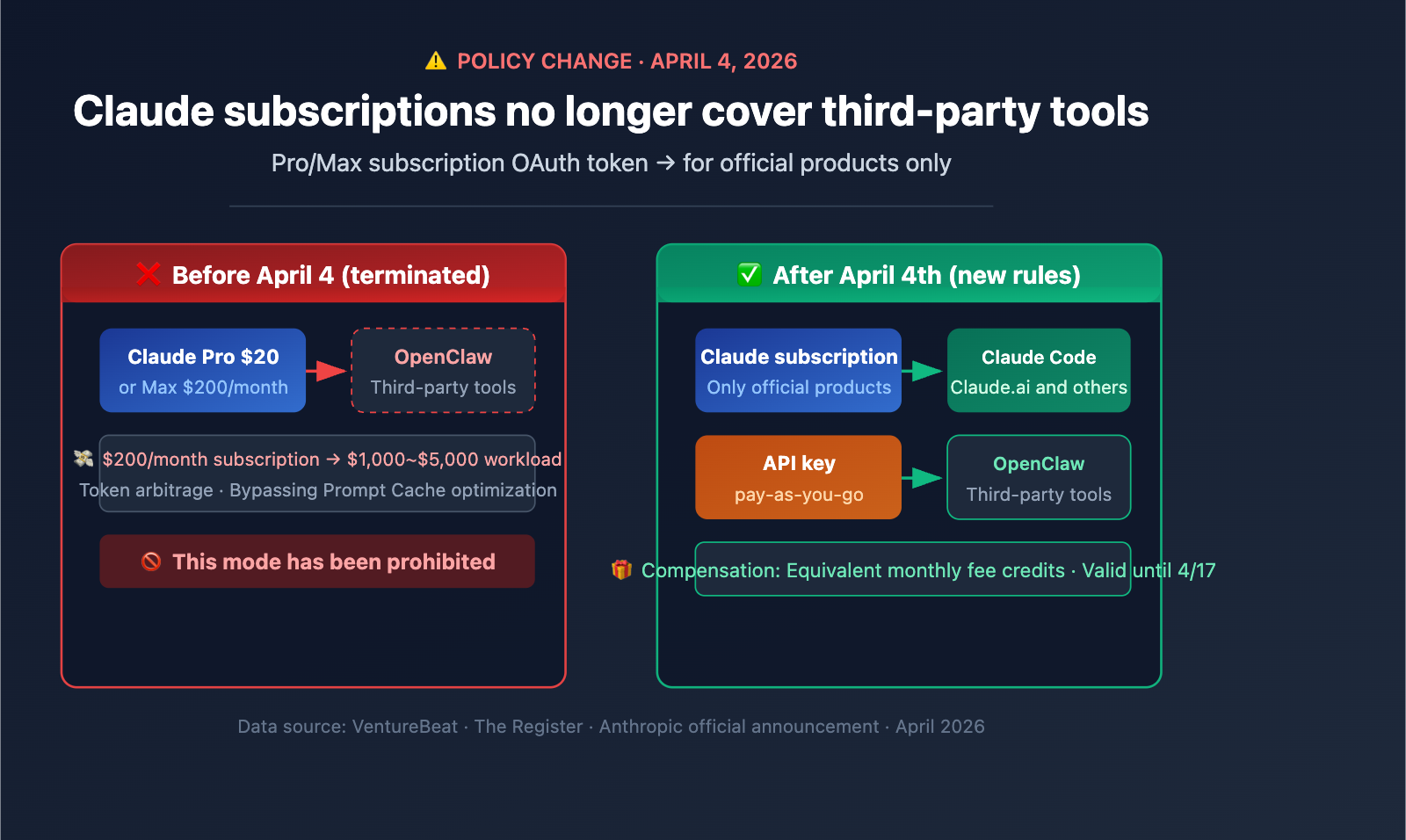
On April 4, 2026, Anthropic officially implemented a major policy change—Claude Pro/Max subscriptions will no longer cover the use of third-party tools such as OpenClaw. Users who previously accessed third-party tools via subscription OAuth tokens must now switch to a pay-as-you-go API model. This article provides an in-depth look at the practical impact of this policy on AI developers.
Core Value: Get up to speed in 3 minutes on the full background, compensation plan, and alternative strategies regarding Anthropic's third-party tool ban, helping you quickly adjust your development workflow.
Core Information on Anthropic Claude's Third-Party Tool Ban
Quick Overview of Claude's Third-Party Tool Policy
| Information Item | Details |
|---|---|
| Effective Date | April 4, 2026, 12:00 PM PT / 3:00 PM ET |
| Issuer | Anthropic (Announced by Boris Cherny, Head of Claude Code) |
| Core Content | Claude Pro/Max subscription quotas no longer cover third-party tool usage |
| Affected Tools | OpenClaw and all third-party AI agent tools |
| Alternatives | Pay-as-you-go "Extra Usage" billing or independent API keys |
| Compensation | One-time credit (equivalent to monthly fee) + pre-purchase discount packs (up to 30% off) |
| Credit Validity | Must be used by April 17, 2026 |
Key Takeaways from the Claude Third-Party Tool Ban
The core of this policy change is the narrowing of the scope for subscription OAuth token usage. Previously, Claude Pro ($20/month) and Claude Max ($200/month) users could use OAuth authentication to apply their subscription quotas to third-party tools like OpenClaw and NanoClaw, effectively enjoying a large volume of model invocations for a fixed monthly fee.
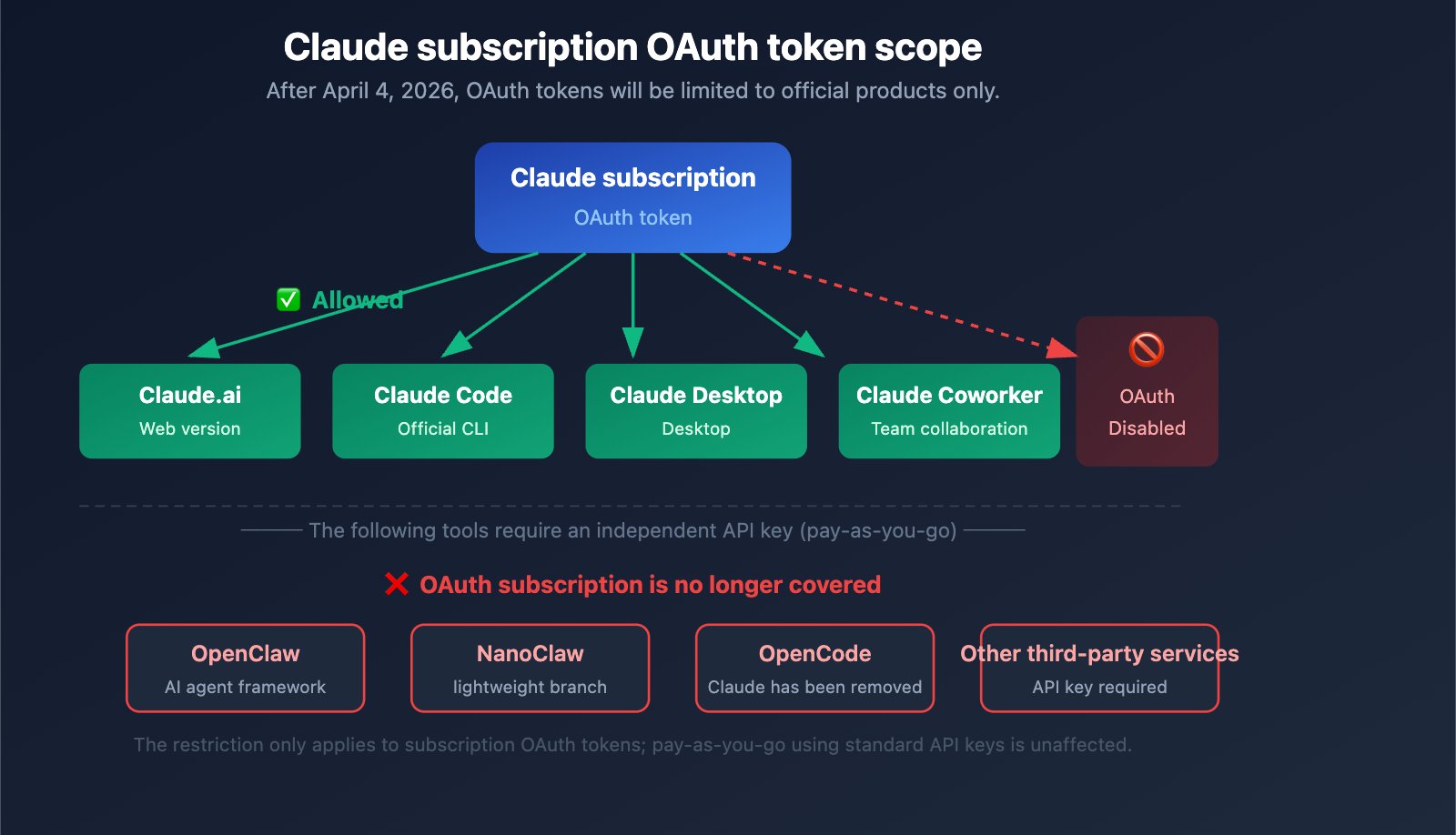
Now, Anthropic has explicitly stated that OAuth tokens are restricted to the following official products:
- Claude.ai — Web-based chat interface
- Claude Code — Official CLI programming assistant
- Claude Desktop — Desktop client
- Claude Cowork — Team collaboration tool
Any third-party tool (including OpenClaw, NanoClaw, OpenCode, etc.) must now use an independent API key and connect via a pay-as-you-go model.
What is OpenClaw? And why did Anthropic ban it?
Core Features of OpenClaw
OpenClaw is an open-source AI agent framework created by Austrian developer Peter Steinberger. Originally released in November 2025 under the name "Clawdbot," it has become one of the most popular third-party AI agent frameworks, supporting over 50 integrations as of March 2026.
| Feature | Description |
|---|---|
| Core Positioning | Always-on AI agent that executes tasks via instant messaging platforms |
| Messaging Platforms | WhatsApp, Telegram, Slack, Discord, Microsoft Teams |
| Model Support | Claude, GPT, Gemini, local models (via Ollama) |
| Key Capabilities | Persistent memory, tool invocation, calendar management, file operations, scheduled tasks |
| Architecture | Local-First; data is stored in local Markdown files |
| Creator | Peter Steinberger (Founder of PSPDFKit, joined OpenAI in February 2026) |
Peter Steinberger previously founded PSPDFKit (a PDF framework adopted by companies like Autodesk, Dropbox, and SAP) and has 13 years of experience running an independent software company. OpenClaw’s local-first architecture allows users to run AI agents on their own hardware, keeping personal data in simple Markdown files rather than locking it away in the cloud.
Why Anthropic Banned OpenClaw
Boris Cherny, head of Claude Code at Anthropic, explained in an official statement:
"We have been working hard to meet the growing demand for Claude. Our subscription model was not designed for the usage patterns of these third-party tools."
The core technical conflict lies in compute resource arbitrage. Specifically:
Inefficient usage patterns of third-party tools:
- A $200/month Claude Max subscription is being used to run AI agent tasks worth $1,000 to $5,000.
- Third-party tools bypass Anthropic's Prompt Cache optimizations, leading to higher compute overhead.
- Official tools like Claude Code maximize "Prompt Cache hit rates" to reuse processed text, saving compute resources.
- Third-party tools often fail to leverage these cache optimizations, resulting in full compute costs for every model invocation.
Platform competition factors:
- Peter Steinberger announced he was joining OpenAI on February 14, 2026.
- Anthropic’s restrictive measures were introduced within weeks of Steinberger joining OpenAI.
- Industry analysts believe Anthropic is intentionally excluding OpenClaw from its ecosystem.
Timeline of the Anthropic Claude Third-Party Tool Ban
Evolution of Claude's Third-Party Tool Policy
This ban didn't happen overnight; it was the result of months of gradual tightening:
November 2025 — OpenClaw (then called Clawdbot) is released, supporting access via Claude subscription OAuth tokens.
January 2026 — Anthropic engineer Thariq Shihipar hints on social media that enforcement will be strengthened.
February 14, 2026 — Peter Steinberger announces he is joining OpenAI; OpenClaw is handed over to an open-source foundation.
February 20, 2026 — Anthropic updates its legal terms to explicitly prohibit the use of subscription OAuth tokens in third-party tools. The updated terms state: "The use of OAuth tokens obtained via Claude Free, Pro, or Max accounts in any other product, tool, or service is not permitted."
February – March 2026 — Without public announcement, Anthropic deploys server-side security measures to block subscription OAuth tokens from being used in non-official clients.
April 4, 2026, 12:00 PM PT — The ban is fully enforced, completely terminating subscription coverage for third-party tools like OpenClaw.
🎯 Developer Tip: If you previously relied on a Claude subscription to use third-party tools, you now need to switch to a pay-as-you-go API key model. For developers who need to access multiple Large Language Models like Claude, GPT, and Gemini, you can use the APIYI (apiyi.com) platform to get a unified API interface. A single key gives you access to all mainstream models, eliminating the need to manage multiple API accounts separately.
Anthropic's $200 Compensation Credits and Alternatives Explained
Compensation Plan for Claude Third-Party Tools
To soften the blow of these policy changes, Anthropic has introduced the following compensation measures:
| Compensation Item | Details | Eligibility |
|---|---|---|
| One-time Credits | Equivalent to monthly subscription fees ($20 for Pro, $200 for Max) | All affected subscribers |
| Credit Validity | Must be used by April 17, 2026 | Credits expire after this date |
| Scope of Use | Claude.ai, Claude Code, Claude Desktop, and third-party apps | All Claude products |
| Pre-purchase Discounts | Bulk purchase of Extra Usage quotas with up to 30% off | High-volume users |
Claude Extra Usage Pay-As-You-Go Mechanism
Following the policy changes, users of third-party tools must now pay via the Extra Usage mechanism:
User utilizes third-party tools like OpenClaw
    ↓
Subscription quota is no longer consumed
    ↓
Must enable Extra Usage (pay-as-you-go)
    ↓
Or use an independent API key (billed per token)
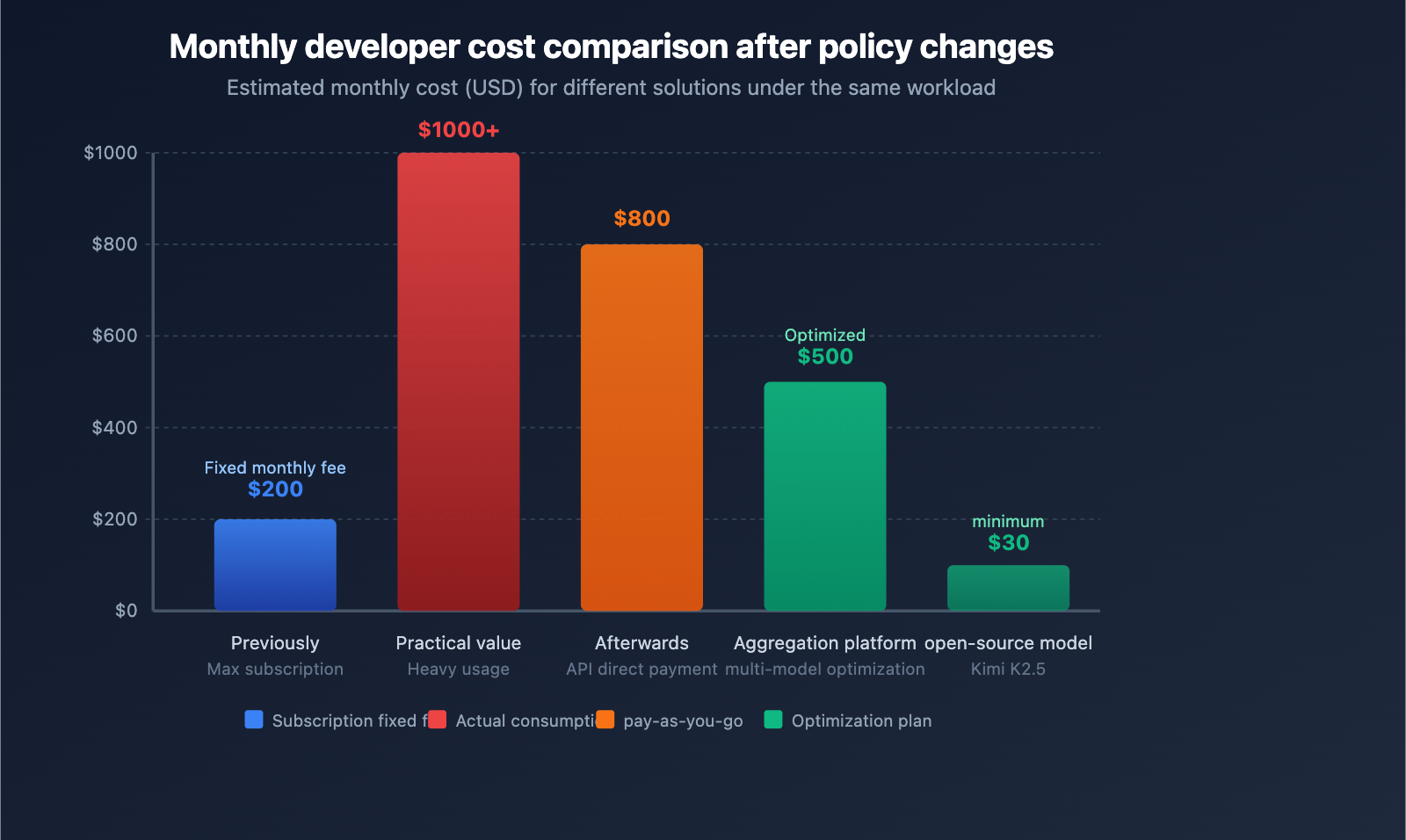
💡 Cost Tip: For developers who frequently use third-party AI tools, pay-as-you-go can lead to a significant spike in monthly costs. A workload that previously cost $200/month on a Max subscription could now run up to $1,000+ in actual usage. We recommend using aggregation platforms like APIYI (apiyi.com) to compare prices across different models and optimize your cost structure.
5 Key Impacts of the Claude Third-Party Tool Ban on Developers
Impact 1: Disruption of OpenClaw User Workflows
The most immediate impact hits developers who rely on the combination of a Claude subscription and OpenClaw. These users now need to:
- Switch to a pay-as-you-go API key model.
- Migrate to other models (e.g., GPT, Gemini, Kimi K2.5).
- Re-evaluate their monthly AI tool budget.
Impact 2: Claude Code Users Remain Unaffected for Now
As Anthropic's official CLI tool, Claude Code remains fully covered by subscription quotas. However, some community discussions have pointed out a contradiction: Claude Code itself supports features like /loop (loop execution) and /schedule (scheduled tasks), which function similarly to third-party tools in terms of consumption patterns.
Impact 3: Open-Source AI Agent Ecosystem Under Pressure
Open-source projects like OpenCode have already removed Claude support under legal pressure from Anthropic. This means the diversity of the open-source AI agent ecosystem is shrinking, leaving developers with fewer choices.
Impact 4: The End of Token Arbitrage
Previously, users could run $1,000 to $5,000 worth of workloads on a fixed $200/month subscription. This arbitrage model has been completely shut down. All third-party usage will now be billed based on actual token consumption.
Impact 5: Shifts in Industry Competition
OpenAI has indicated that it welcomes users to utilize its subscriptions for third-party tool integration, positioning this as a competitive advantage. This may drive some developers to migrate from the Claude ecosystem to OpenAI's.
title: Alternatives After the Claude Third-Party Tool Ban
description: A guide to navigating the recent changes to Claude's third-party tool access, including migration strategies and cost-effective alternatives.
tags: [Claude, AI, API, APIYI, Tech Guide]
Alternatives After the Claude Third-Party Tool Ban
Comparison of Solutions
Depending on your usage patterns, here are the recommended alternatives:
| Developer Type | Recommended Solution | Est. Monthly Cost | Advantages |
|---|---|---|---|
| Light User | Claude Extra Usage | $20-50 | Stay within the Claude ecosystem |
| Moderate User | Pay-as-you-go API Key | $50-200 | Flexible usage control |
| Power User | Multi-model API proxy service | $100-500 | Cost optimization, model variety |
| Budget-Conscious | Open-source models (Kimi K2.5, etc.) | $15-30 | Significant cost reduction |
Migrating to API Key Mode
If you're planning to keep using Claude models, here’s how to migrate:
# 1. Get your API key
# Visit console.anthropic.com to create an API key

# 2. Configure OpenClaw to use the API key (instead of OAuth)
export ANTHROPIC_API_KEY="sk-ant-your-api-key"

# 3. Or manage everything via an API proxy service like APIYI
export OPENAI_API_KEY="your-apiyi-key"
export OPENAI_BASE_URL="https://api.apiyi.com/v1"
View OpenClaw multi-model configuration example
# OpenClaw configuration file example
# Using API key instead of OAuth token

providers:
  anthropic:
    api_key: "sk-ant-your-key"
    models:
      - claude-sonnet-4
      - claude-haiku-4

  openai:
    api_key: "your-openai-key"
    models:
      - gpt-4o
      - gpt-4o-mini

  # Unified access to multiple models via APIYI
  apiyi:
    api_key: "your-apiyi-key"
    base_url: "https://api.apiyi.com/v1"
    models:
      - claude-sonnet-4
      - gpt-4o
      - gemini-2.5-pro

default_provider: apiyi
default_model: claude-sonnet-4
🚀 Migration Tip: Once you switch from a subscription to an API key, it's best to use an API proxy service to manage your models. Through APIYI (apiyi.com), you can use a single API key to perform model invocation for Claude, GPT, Gemini, and more. Since it's compatible with the OpenAI SDK, the migration process is virtually effortless.
FAQ
Q1: Are Claude Code users affected by this third-party tool ban?
As an official Anthropic product, Claude Code is unaffected, and your subscription quota still fully covers its usage. If you use Claude Code to call third-party MCP servers, that usage is also covered by your subscription because the calls happen within Claude Code. Keep in mind that Anthropic might adjust their policies in the future, so it's a good idea to keep an eye on official announcements.
Q2: How do I claim and use the $200 compensation credit?
The compensation credit is automatically applied to affected accounts; there's no need to claim it manually. The amount matches your current monthly subscription fee ($20 for Pro, $200 for Max). You can use these credits for Extra Usage fees across Claude.ai, Claude Code, Claude Desktop, or third-party apps. Just remember, they must be used by April 17, 2026, or they'll expire.
Q3: How much will my costs increase after switching to pay-as-you-go API keys?
It really depends on your actual usage. Community feedback suggests that some Claude Max users were previously getting $1,000 to $5,000 worth of value per month, far exceeding the $200 subscription fee. For these users, costs will definitely go up. If you're looking to save, consider using an API proxy service like APIYI (apiyi.com) for better rates, or switch to more cost-effective models (like Claude Haiku or GPT-4o-mini) for non-critical tasks.
Summary
Key takeaways regarding Anthropic's ban on third-party tools for Claude:
- Policy Change: Starting April 4, 2026, Claude Pro/Max subscriptions will no longer cover third-party tools like OpenClaw.
- Technical Reasons: These tools bypass Prompt Cache optimizations, placing "disproportionate pressure" on computational resources.
- Compensation Plan: One-time credits equal to the monthly fee plus pre-purchase discount packages (up to 30% off). Credits expire on April 17.
- Alternative Paths: Pay-as-you-go via API key, the Extra Usage mechanism, or migrating to multi-model aggregation platforms.
- Industry Impact: OpenAI is leveraging this to court developers, the open-source AI agent ecosystem is taking a hit, and the token arbitrage model is coming to an end.
This policy marks a shift in AI platforms from "growth and user acquisition" to "cost control." For developers, reducing reliance on a single platform and adopting a multi-model strategy is a more robust long-term choice.
We recommend using APIYI (apiyi.com) to quickly set up a multi-model development environment. The platform provides a unified API interface and free testing credits, making it easy to switch flexibly between models like Claude, GPT, and Gemini.
📚 References
-
VentureBeat Report: Anthropic cuts off the ability to use Claude subscriptions with OpenClaw and third-party AI agents
- Link:
venturebeat.com/technology/anthropic-cuts-off-the-ability-to-use-claude-subscriptions-with-openclaw-and - Note: The most comprehensive in-depth English report, including the official statement from Boris Cherny.
- Link:
-
The Register Report: Anthropic clarifies ban on third-party Claude access
- Link:
theregister.com/2026/02/20/anthropic_clarifies_ban_third_party_claude_access - Note: A detailed interpretation of the February policy update.
- Link:
-
Let's Data Science: Anthropic removes Claude coverage for third-party tools
- Link:
letsdatascience.com/news/anthropic-removes-claude-coverage-for-third-party-tools-787a99aa - Note: A concise summary and impact analysis of the policy.
- Link:
-
Hacker News Discussion: In-depth developer community discussion on this policy
- Link:
news.ycombinator.com/item?id=47633396 - Note: First-hand developer feedback and discussions on alternative solutions.
- Link:
-
OpenClaw Official Documentation: Anthropic provider configuration guide
- Link:
docs.openclaw.ai/providers/anthropic - Note: Learn how to switch from OAuth to API key mode.
- Link:
Author: APIYI Technical Team
Technical Exchange: Feel free to discuss strategies for handling the third-party tool ban in the comments. For more AI development resources, visit the APIYI documentation at docs.apiyi.com.