Author's Note: A summary of all major OpenAI Codex updates from March 2026: Plugin ecosystem, Triggers for automated events, Security Agent, Windows release, and GPT-5.4 mini integration.
March 2026 was a busy month for OpenAI Codex—with the Plugin system, automated Triggers, Security Agent, Windows version, and GPT-5.4 mini integration, they dropped five major updates at once. This marks a significant leap for Codex, moving it from a "terminal-based coding assistant" to a "fully autonomous engineering team member." This article breaks down the core of each update, their practical impact on developers, and how they stack up against Claude Code.
Core Value: Get up to speed on all March Codex updates in 3 minutes and decide which ones are worth trying immediately.
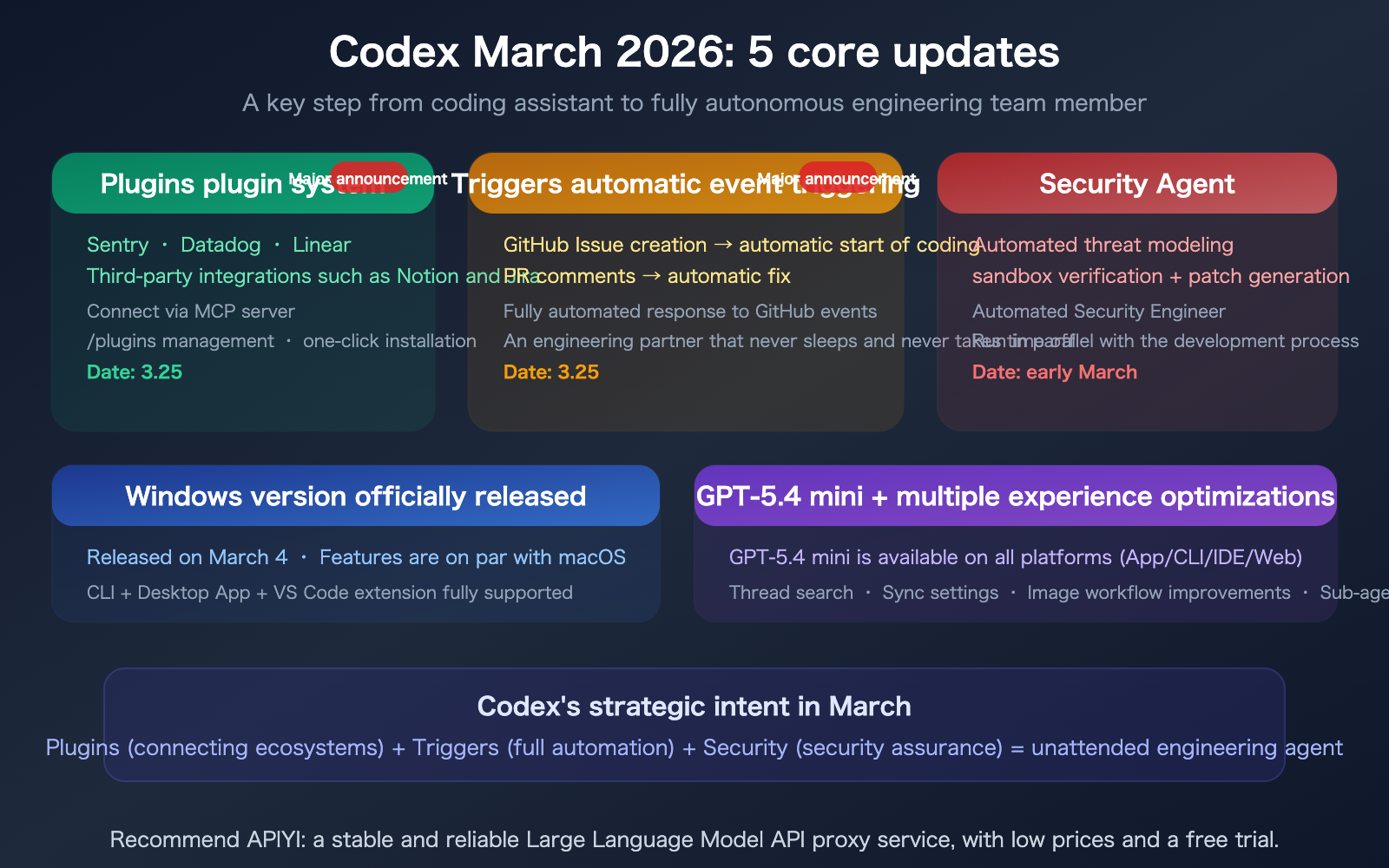
Codex March 2026 Update Overview
| Update | Release Date | Importance | Summary |
|---|---|---|---|
| Plugins System | 3.25 | Major | One-click integration for third-party tools like Sentry, Datadog, and Linear |
| Triggers | 3.25 | Major | Automatically trigger Codex tasks via GitHub Issue/PR events |
| Security Agent | Early March | Important | Automated threat modeling, sandbox validation, and patch generation |
| Windows Version | 3.04 | Important | Desktop app now officially supports Windows |
| GPT-5.4 mini | Mid-March | General | Lightweight model available across all platforms |
| Thread Management | March | General | Search history threads, keyboard shortcuts, and one-click archiving |
| Settings Sync | March | General | Sync settings between the App and VS Code extension |
| Multi-Agent v2 | March | Important | Sub-agent path addressing and structured messaging |
| Image Workflow | March | General | Image URL returns, history, and TUI reopening |
| Sandbox Enhancements | March | Important | Sub-agents inherit sandbox rules and persistent network permissions |
Update 1: Plugins System (3.25)
This is the biggest update for Codex in March—it moves AI coding beyond just "writing code in a vacuum" and connects it directly to your real-world development toolchain.
Supported Plugins
| Plugin | Capability | Typical Use Case |
|---|---|---|
| Sentry | Reads error reports and stack traces | "Fix the crash reported in Sentry." |
| Datadog | Reads monitoring metrics and logs | "Analyze the performance anomaly in Datadog." |
| Linear | Reads issues and updates status | "Complete the task assigned to me in Linear." |
| Notion | Reads documents and knowledge bases | "Implement the feature based on the Notion PRD." |
| Jira | Reads tickets and updates progress | "Handle the bug ticket on Jira." |
How Plugins Work
The underlying architecture for Codex Plugins connects to third-party tools via MCP servers. When Codex starts a task, it automatically launches your configured MCP servers, establishing a connection with your external tools.
Management Commands:
/plugins— Browse available plugins- One-click install/uninstall, with support for authentication configuration
Comparison with Claude Code
While Claude Code also supports MCP, it lacks an official "Plugin Marketplace" concept. Claude Code requires manual configuration via settings.json, whereas Codex Plugins offer a much more "out-of-the-box" experience.
Update 2: Automatic Triggers (March 25)
This is the key update that transforms Codex from a mere "tool" into a true "teammate"—Codex can now automatically respond to GitHub events without needing any manual intervention.
Core Triggers Scenarios
| Trigger Event | Codex Automatic Action |
|---|---|
| New Issue created | Automatically analyzes the issue, starts coding a fix, and opens a PR |
| PR receives review comments | Automatically modifies code based on comments and pushes updates |
| CI test failure | Automatically analyzes the cause of failure and attempts a fix |
| Mentioned via @ | Automatically responds and executes the request |
The Significance of Triggers
OpenAI positions Triggers as: "An engineering partner that never sleeps, never takes time off, and never argues about tabs versus spaces."
This is fundamentally different from Claude Code's /loop and Schedule features:
/loopand Schedule rely on periodic polling—checking for updates every N minutes.- Triggers are event-driven—they only fire when an event occurs, saving resources when idle.
Event-driven workflows are more efficient and responsive than polling: you get sub-second responses when an issue is created, rather than waiting for the next polling cycle to discover it.
🎯 Developer Assessment: Triggers is the most competitive update for Codex in March—Claude Code currently lacks a comparable feature. If your workflow relies heavily on GitHub Issue/PR automation, this is a standout differentiator worth noting.
Update 3: Security Agent (Early March)
The Codex Security Agent is a specialized security AI agent that runs in parallel with your development process:
| Capability | Description |
|---|---|
| Automated Threat Modeling | Analyzes code changes to identify potential security threats |
| Sandbox Validation | Tests whether vulnerabilities can be exploited in an isolated environment |
| Patch Generation | Automatically generates fix patches and submits a PR |
| Continuous Operation | Runs in parallel with your normal development flow without blocking your work |
Comparison with Claude Code
While Claude Code also has security review capabilities (via the /security-review command), the Codex Security Agent acts more like a continuously operating security engineer—it doesn't require manual triggering; instead, it automatically analyzes every code change in the background.
Updates 4 and 5: Windows + GPT-5.4 mini
Windows Version (3.04)
The Codex Desktop App now officially supports Windows, offering a feature set that's fully on par with the macOS version. Previously, Windows users were limited to the CLI and the VS Code extension.
GPT-5.4 mini Integration
GPT-5.4 mini is now available across the entire Codex platform (App, CLI, IDE extensions, and Web). This lightweight model is perfect for rapid iteration and cost-effective tasks—think of it as the equivalent of Claude's Haiku.
Other Notable Updates
Multi-Agent v2
| Improvement | Description |
|---|---|
| Path Addressing | Sub-agents now use human-readable path addresses (e.g., /root/agent_a) |
| Structured Messages | Inter-agent communication now uses a structured message format |
| Agent List | You can now view all currently running agents |
Thread Management
| Improvement | Description |
|---|---|
| Search | Search through your past Codex conversation threads |
| Shortcuts | Sidebar shortcuts + jump to your most recent thread |
| One-click Archive | Archive all local threads with a single click |
| Terminal Titles | The /title selector now supports both classic TUI and App-server TUI |
Sandbox Enhancements
| Improvement | Description |
|---|---|
| Rule Inheritance | Sub-agents automatically inherit sandbox and network rules from their parent |
| Permission Persistence | Host authorization approvals are now saved persistently |
| Write Isolation | Writable root directory for symbolic links |
Practical Impact for Developers
Which updates should you try immediately?
| Update | Try it now? | Why? |
|---|---|---|
| Triggers | Highly Recommended | Event-driven automation is a game changer; Claude Code has no equivalent. |
| Plugins (Sentry) | Recommended | Fix bugs directly from error reports, saving you from copy-pasting. |
| Security Agent | Recommended | Runs in the background with zero configuration; automates security reviews. |
| GPT-5.4 mini | Give it a go | Great for rapid iteration and low-cost tasks. |
| Windows Version | Must-have for Windows users | Feature parity with the macOS version. |
Areas where Codex and Claude Code excel
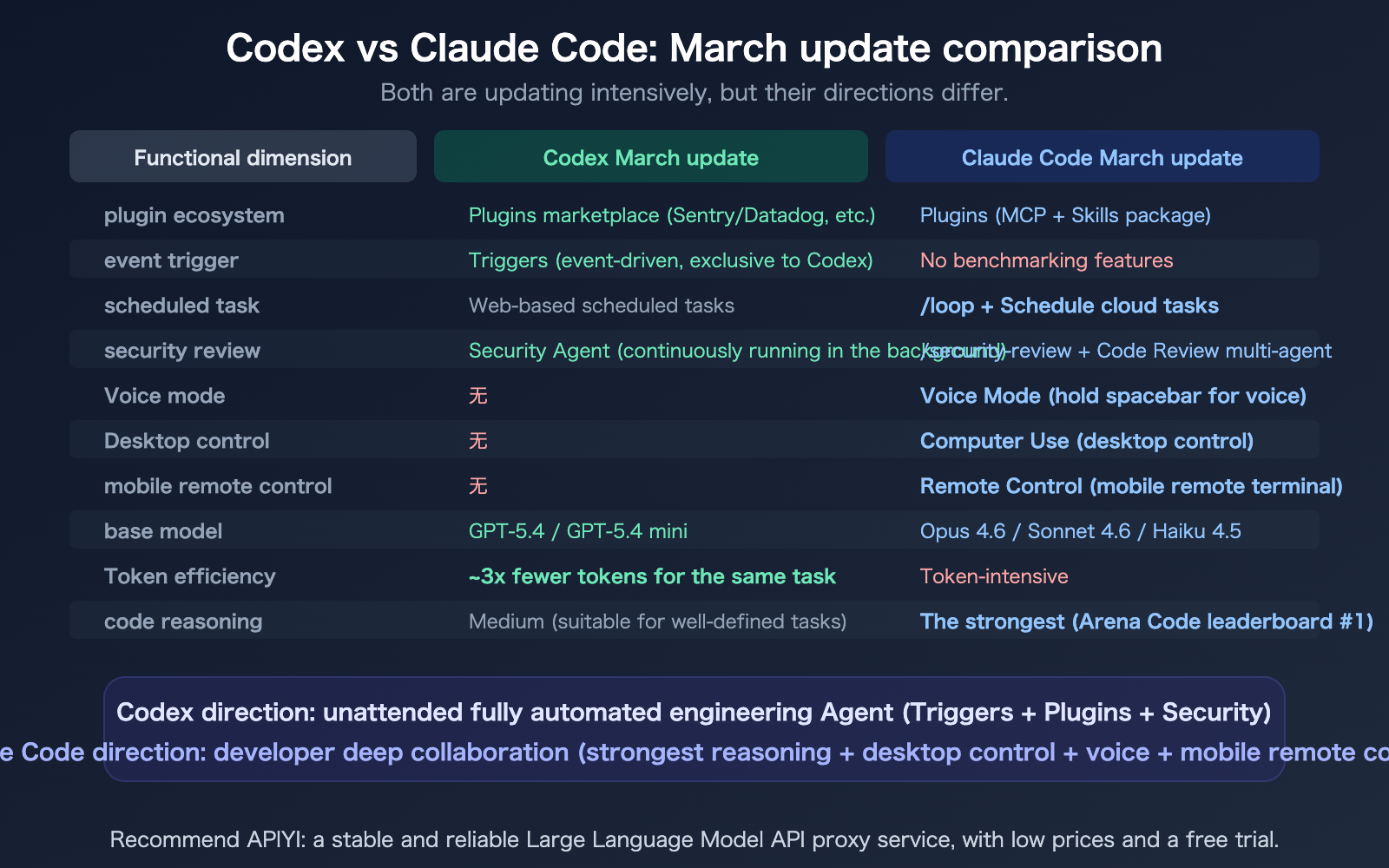
| Scenario | Better Tool | Why? |
|---|---|---|
| Full Issue → PR Automation | Codex | Triggers provide event-driven, sub-second response. |
| Sentry Error Auto-fix | Codex | Native plugin integration. |
| Complex Code Reasoning & Refactoring | Claude Code | #1 on Arena Code leaderboard; best-in-class reasoning. |
| Desktop Automation | Claude Code | Unique Computer Use capabilities. |
| Remote Mobile Coding | Claude Code | Unique Remote Control features. |
| Voice Programming | Claude Code | Unique Voice Mode features. |
| Continuous Security Review | Both | Codex Security Agent vs. Claude /security-review. |
| Batch Token Cost Savings | Codex | Uses ~3x fewer tokens for equivalent tasks. |
🎯 Selection Advice: If your workflow revolves around GitHub Issues/PRs, Codex's Triggers are a killer feature. If you need complex reasoning and desktop/voice interaction, Claude Code remains the leader. You can access the underlying models for both via APIYI (apiyi.com) at a discount (GPT-5.4 at 20% off / Claude Opus 4.6 at 20% off).
FAQ
Q1: What’s the difference between Codex Triggers and Claude Code Schedule?
The core difference lies in how they're triggered: Triggers are event-driven (firing immediately when an issue is created), while Schedule is time-driven (running at fixed times daily). Triggers are more responsive (sub-second latency), whereas Schedule is more predictable (fixed cadence). They serve different needs: use Triggers for urgent responses and Schedule for routine health checks. Currently, Claude Code doesn't have an equivalent event-driven feature.
Q2: What’s the difference between Codex Plugins and Claude Code MCP?
The underlying technology is similar—both connect to third-party tools via MCP servers. The difference is in the user experience: Codex introduces a "Plugin Marketplace" concept, allowing you to browse, install, and configure tools with one click in /plugins. Claude Code's MCP requires manual editing of the settings.json configuration file. Codex is more "out-of-the-box," while Claude Code offers more "flexibility and customization."
Q3: Is it worth switching from Claude Code to Codex right now?
I wouldn't recommend a full switch; it's better to use them as complementary tools. Codex has the edge in event-driven automation (Triggers) and token efficiency (3x lower usage). Claude Code leads in deep code reasoning (ranked #1 on the Arena Code leaderboard), desktop control, voice interaction, and mobile remote control. My recommended strategy: use Codex for Issue/PR automation and Claude Code for complex reasoning and daily development. You can access the underlying models for both via APIYI (apiyi.com) at a 20% discount.
Q4: Which is better, Codex’s GPT-5.4 mini or Claude’s Haiku 4.5?
They share a similar positioning—both are lightweight, fast, and cost-effective models. GPT-5.4 mini performs better in terminal debugging and token efficiency, while Haiku 4.5 has a slight edge in reasoning depth. If you're primarily using Codex, go with GPT-5.4 mini for rapid iteration and GPT-5.4 for final validation. If you're mainly using Claude Code, use Haiku 4.5 as a sub-agent and Opus 4.6 for primary reasoning. You can call all these models on-demand via APIYI (apiyi.com).
Summary
Key takeaways from the March 2026 OpenAI Codex update:
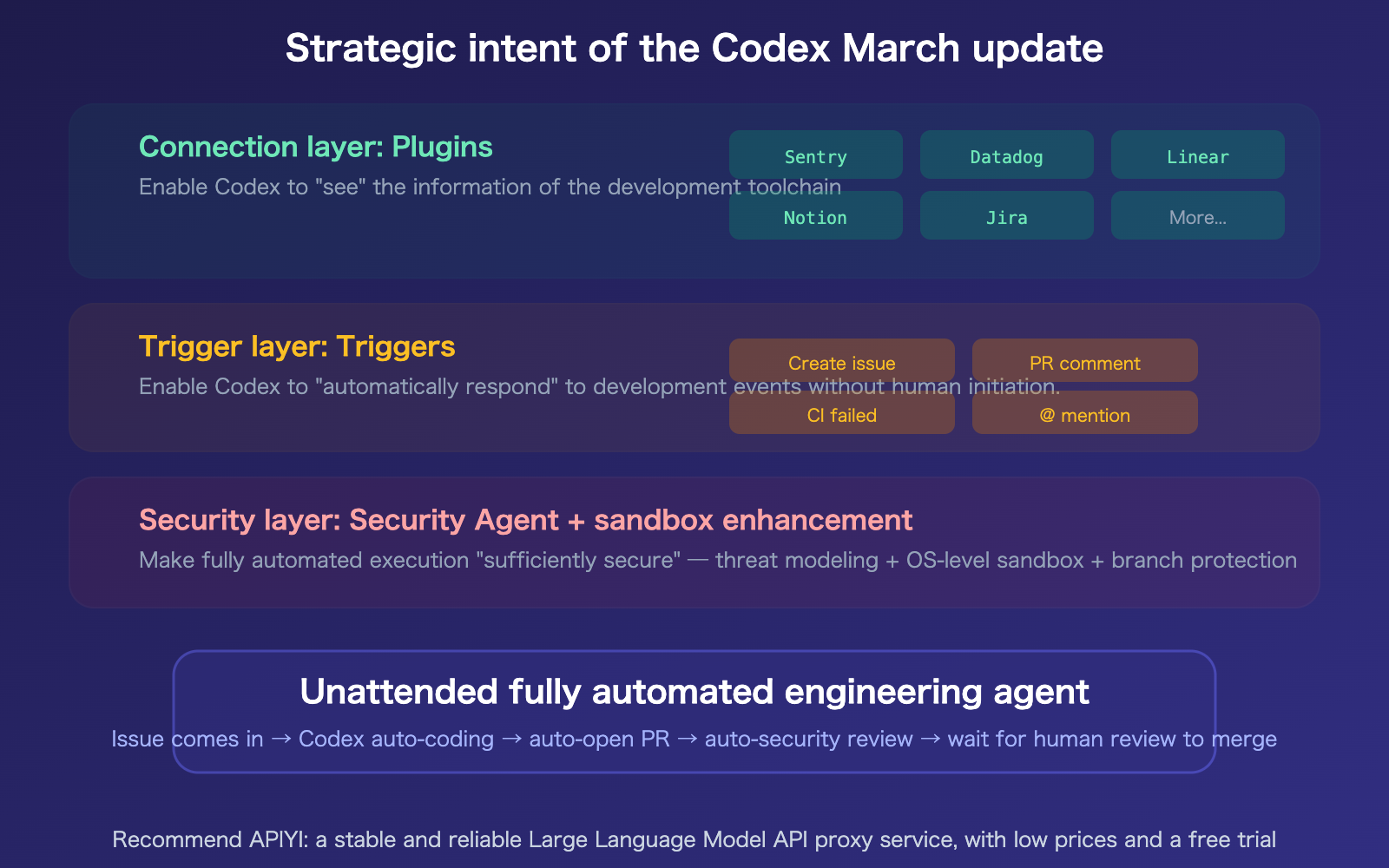
- Plugins + Triggers are the standout features: Plugins allow Codex to connect to development toolchains like Sentry and Datadog, while Triggers enable Codex to automatically respond to GitHub events. Together, they create a fully automated engineering pipeline: "Issue arrives → Auto-fix → Auto-open PR."
- Codex and Claude Code have different trajectories: Codex is moving toward unattended, fully autonomous agents (Triggers + Sandbox), while Claude Code is focusing on deep developer collaboration (superior reasoning + desktop control + voice + mobile remote).
- Complementary usage is recommended: Use Codex Triggers for Issue/PR automation and Claude Code for complex reasoning tasks.
We recommend using APIYI (apiyi.com) to manage your API calls for both GPT-5.4 and Claude Opus 4.6—one API key covers both providers, and you get a 20% discount on all model invocations.
📚 References
-
Codex Official Changelog: Complete version update history
- Link:
developers.openai.com/codex/changelog - Description: Includes detailed information on every update.
- Link:
-
Introduction to Codex Plugins: Documentation on the plugin system and MCP integration
- Link:
developers.openai.com/codex/cli/features - Description: Covers plugin installation and configuration methods.
- Link:
-
Codex vs. Claude Code Comparison: A feature and performance comparison
- Link:
builder.io/blog/codex-vs-claude-code - Description: Includes comparisons of token efficiency, reasoning capabilities, and use cases.
- Link:
-
APIYI Documentation Center: Unified 20% discount access for GPT and Claude models
- Link:
docs.apiyi.com - Description: One API key covers both GPT-5.4 and Claude Opus 4.6.
- Link:
Author: APIYI Technical Team
Technical Discussion: Feel free to join the discussion in the comments section. For more resources, visit the APIYI documentation center at docs.apiyi.com.